
Offshore vs. Local Engineering Team: When to Go Offshore

In this article
- Why “offshore vs. local engineering team” is the wrong framing
- The real predictor is remote-work culture
- Offshore vs. onshore dedicated team: who owns the outcome
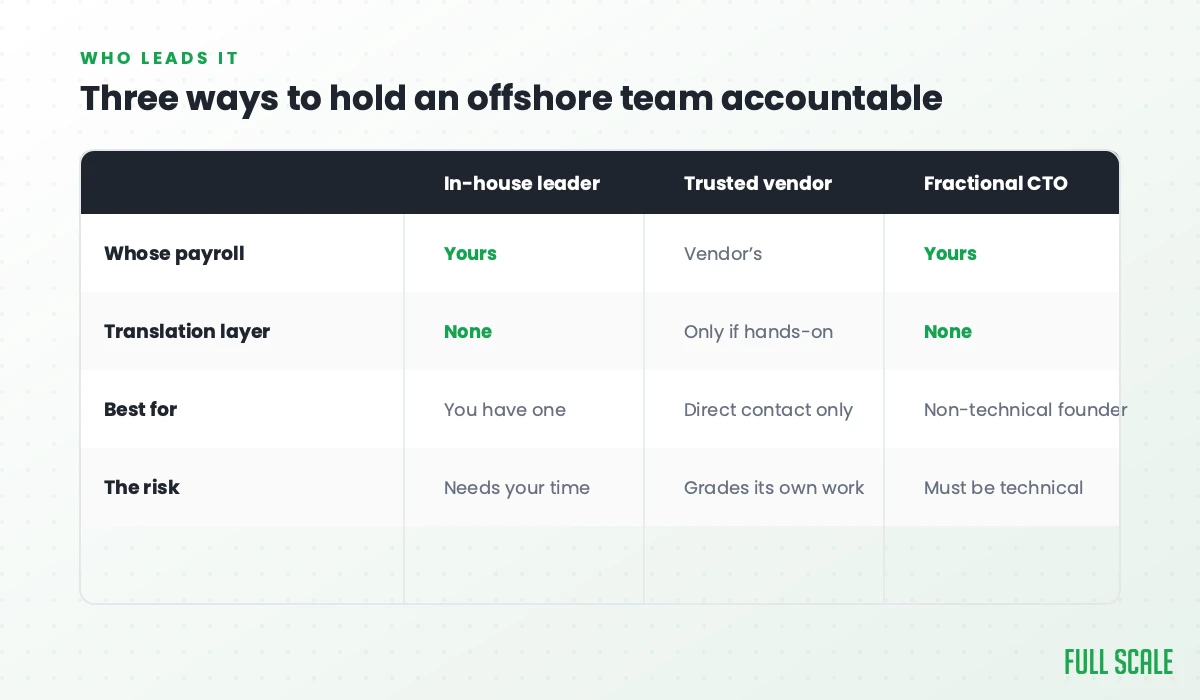
- In-house leader, trusted vendor, or fractional CTO: how an offshore dedicated team gets led
- The cheapshoring mistake: hiring cheap instead of hiring smart
- How to build a software engineering team offshore without losing control
- FAQ
Quick Answer: The offshore vs. local engineering team decision comes down to who leads the team, not where the developers sit. If someone on your payroll can direct developers and judge their work, you can go offshore and usually save 50 to 70 percent. If nobody can, hiring local won’t fix that. Full Scale developers work inside the client’s own standups and tools, with someone on the client’s side accountable for the outcome.
Here’s the answer nobody selling offshore development wants to give you: the location doesn’t matter nearly as much as you think. I’ve built engineering teams both ways, local at VinSolutions and offshore at Full Scale, and the thing that decides whether either one works has nothing to do with the map.
Why “offshore vs. local engineering team” is the wrong framing
You can always go offshore. There’s no shortage of talented developers in the Philippines, India, Eastern Europe, or Latin America, and the cost math is real. What “when should I go offshore” is really asking is something else: do you have someone who can lead and manage a team of developers?
That threshold doesn’t move based on where the developers sit. If you can’t manage a team of local hires, you can’t manage an offshore engineering team either, and hiring closer to home won’t fix that. Offshore just makes the gap visible faster, because there’s no hallway conversation or shared lunch room quietly covering for a lack of direction. Everything has to be explicit. That’s the point of the whole exercise, and it means the leadership question comes first, the location question second.
One honest exception: this whole framework assumes location itself isn’t already off the table. Regulated data (HIPAA handling rules, export-controlled defense work) or a contract that requires US-person developers takes the location question out of your hands before leadership even enters the picture. Rule that out first. Security and compliance requirements, SOC 2 certification for offshore development companies, IP protection, data residency, also still need their own review no matter who’s leading the team, offshore or local; solving accountability doesn’t solve those separately.
The real predictor is remote-work culture
If I had to pick the single biggest factor in all of this, it’s whether your company already knows how to hire and work with remote people. Not “offshore people.” Remote people, period. A company that’s genuinely good at hiring remote employees, onboarding them, writing things down instead of relying on hallway conversations, and trusting someone it can’t see at a desk, will do fine with an offshore engineering team. A company that’s never actually built that muscle will struggle with a distributed team whether that team sits in Cebu or three states over. This is really the same leadership question from a different angle: a company with real remote-work culture already has someone who knows how to lead people they can’t see, which is exactly the capability the whole offshore decision hinges on.
Most companies that think they’re good at remote work have never actually tested it. Their “remote” hires are usually in a nearby time zone and show up to the same regional meetups, so the culture gap never gets exposed. Offshore removes that padding.
Those habits are written decisions, async-first communication, and trusting someone you can’t see at a desk. Your company either already has them or it doesn’t. Offshore is where you find out which. That’s also why communication and culture fit come ahead of cost when I’m helping someone pick a country to hire in. The country falls out of that filter. It was never the input.
Offshore vs. onshore dedicated team: who owns the outcome
The offshore vs. onshore dedicated team question matters less than a different one: who on your side actually owns this? Every successful engagement I’ve seen, staff augmentation, an offshore dedicated team, a fully outsourced project, has one thing in common: someone on the client’s side is accountable for the outcome. It doesn’t have to be a full-time hire. It has to be someone whose paycheck comes from you.
Picture hiring someone to renovate your house. A contractor runs the crew day to day, but you picked that specific contractor because you trust their judgment, not because they answered the phone first, and the decisions still run through you. Hand the whole relationship to someone with no stake in your outcome and you’ve built a middleman into the process instead of a partner. The farther away the team sits, the worse that gets.
If readiness itself is the open question, I’ve covered that separately in the signs you’re actually ready to offshore.
In-house leader, trusted vendor, or fractional CTO: how an offshore dedicated team gets led
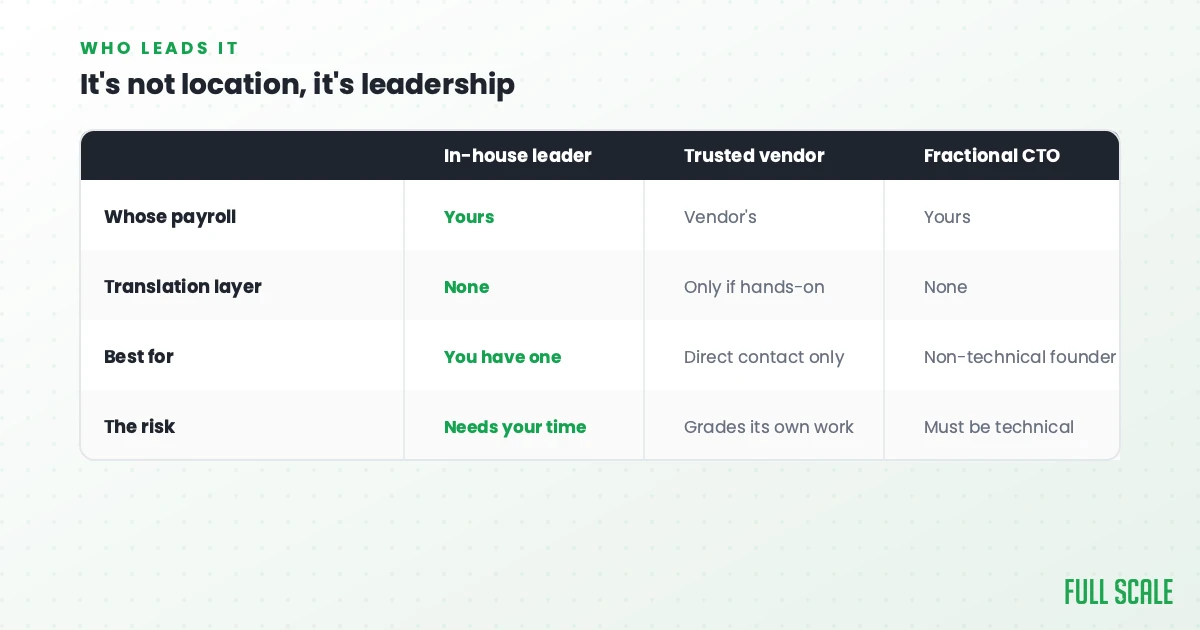
Accountability for an offshore or onshore team lands in one of three places in practice.
An in-house technical leader. A CTO, or a strong senior engineer who can oversee a couple more people. This is the cleanest option if you already have it, because there’s no translation layer between you and the work.
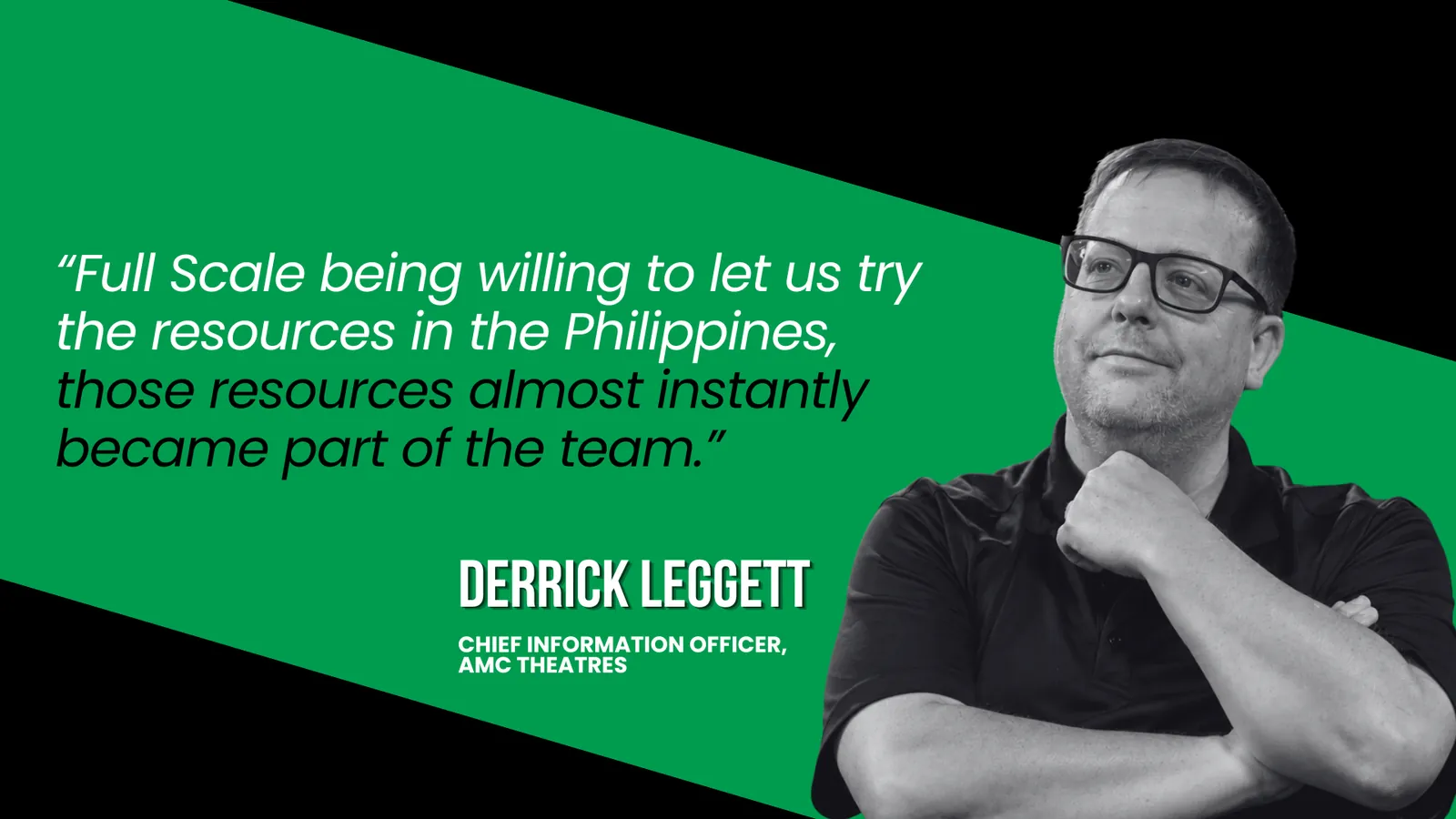
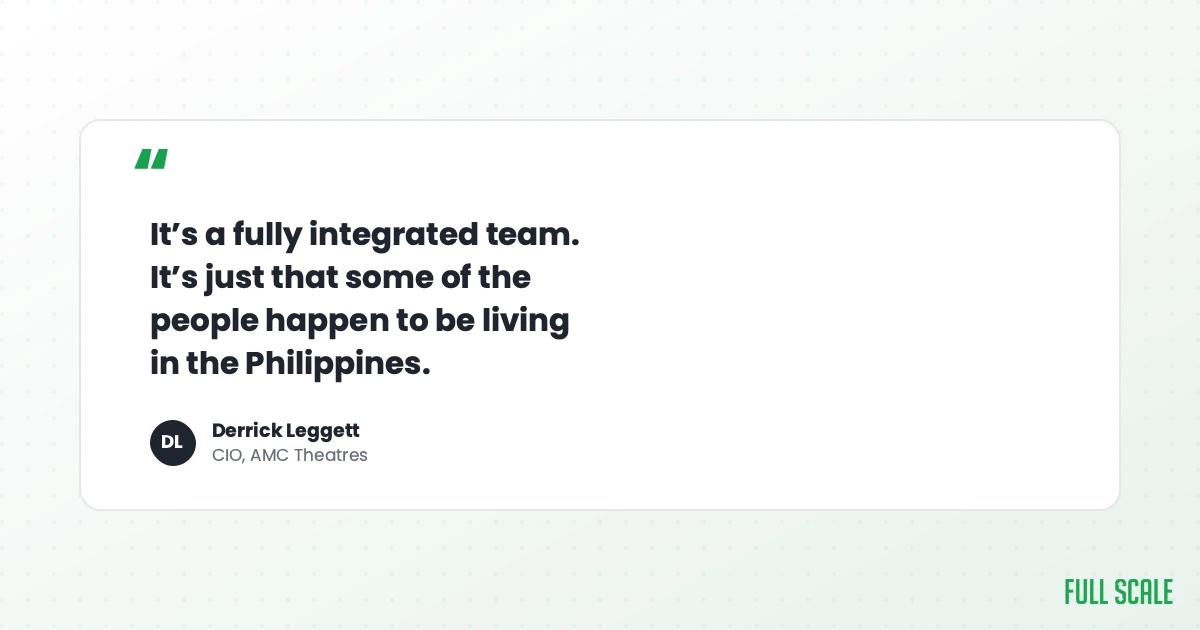
A vendor, but only if you keep direct, daily contact with the actual developers. This is not the same as trusting a vendor to run the whole relationship for you. If you’re routed through a single point of contact who fronts a team you never talk to, that’s the middleman problem from the last section wearing a sales pitch. If your developers show up in your own Slack and your own standups, the vendor relationship is working the way it’s supposed to. A good customer success team exists to keep that channel open. AMC Theatres runs it this way: their developers in the Philippines sit in AMC’s own standups and tools, not behind an account manager. Their CIO, Derrick Leggett, put it plainly: “It’s a fully integrated team. It’s just that some of the people happen to be living in the Philippines.”
A fractional CTO on your side of the table. Most buyers don’t realize this option exists, and it’s the one I’d point a non-technical founder toward first. You hire and pay someone whose only job is representing your interests and holding the offshore vendor accountable.
Most vendor struggles come down to accountability, and a fractional CTO closes that gap directly.
One caveat, because I’ve seen this go wrong: the fractional leader has to actually be technical enough to evaluate the work. Otherwise you’ve just hired a more expensive version of the middleman problem, with a nicer title and a bigger invoice.
None of this requires you to be technical yourself. It requires you to have technical judgment sitting somewhere on your payroll, full-time or fractional. If you’re a non-technical founder, you can outsource the building. You can’t outsource the fact that somebody working for you has to be able to tell good work from bad. That split, buying the work without buying away your ownership of the product, is most of what I wrote Product Driven about.
The cheapshoring mistake: hiring cheap instead of hiring smart
The advantage of going offshore is access to talent, not a discount on it. Most companies go looking for the cheapest developer they can find, and that is the part that actually costs them money. Smart, experienced developers live everywhere in the world.
Hire the expensive developer who happens to live in a cheap place. Don’t hire the cheapest developer you can find.
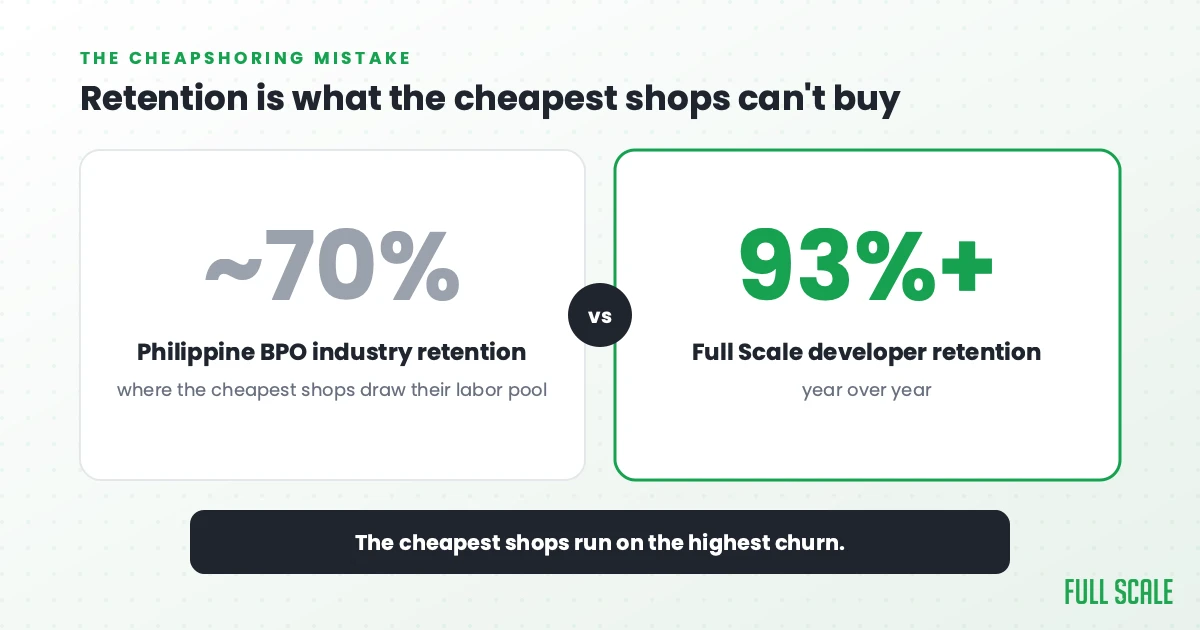
I call the opposite mistake cheapshoring: picking the lowest hourly rate on the page and calling it a strategy. It looks smart in a spreadsheet. Spreadsheets are very supportive of bad decisions; they never ask a follow-up question. An $8-an-hour developer next to a $35-an-hour one looks like a steal, right up until the $8 developer ships code you have to throw away, or vanishes mid-sprint because a slightly better offer showed up. Turnover is the tell here. The Philippine BPO industry, where the cheapest shops draw their labor pool from, keeps retention closer to 70%. Full Scale’s developer retention runs over 93% year over year, and that gap is exactly what cheapshoring can’t buy, because the cheapest shops run on the highest churn.
The cost math is still real. A developer earning $20 to $30 an hour in the Philippines is doing well by local standards, and the U.S. median software developer salary sits around $133,000 a year before benefits and overhead. Cost of living explains most of that gap, and skill explains almost none of it. Cost is a legitimate reason to look offshore. Cheapest is a terrible way to decide who to hire once you’re there. If you want the fuller math on why the savings are real without the developers being worse, I’ve written that up separately as offshore ROI.
How to build a software engineering team offshore without losing control
If you’re actually deciding to build a software engineering team offshore, work the questions in this order:
- Who’s holding this accountable on my side? Answer that before you post a single job listing, whether it’s you, an in-house hire, or a fractional CTO.
- Can this person or vendor actually communicate with my team? Figure out communication fit before you narrow down countries. Cost of living comes after that, and the country ends up falling out of those two filters instead of leading them.
- Am I hiring for talent or for a discount? If the honest answer is “discount,” go back and reread the cheapshoring section above.
Get that order right and the offshore-vs-local question mostly answers itself. You’re not choosing a location. You’re deciding who’s in charge, and whether that person can actually do the job. If the answer is “nobody yet,” that’s not a reason to skip offshore. It’s a reason to fix that first, whether that means hiring in-house, bringing in a fractional CTO, or working with a staff augmentation partner willing to be held to account instead of just promising to be.
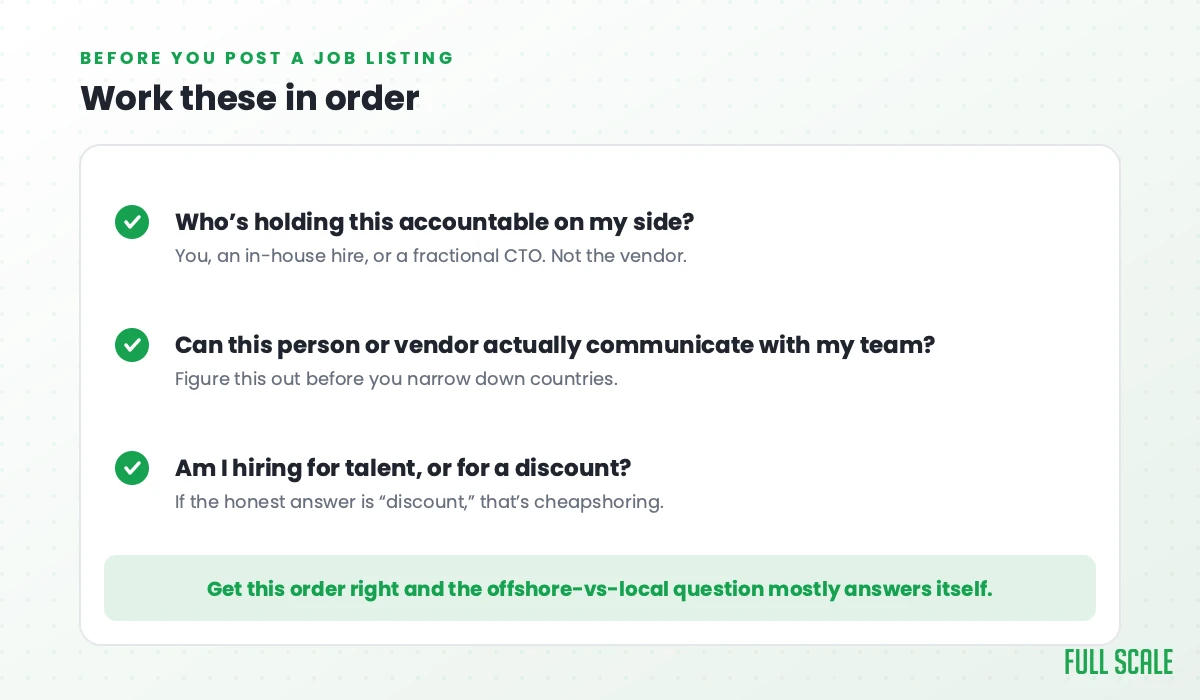
Figure out who’s leading your team before you figure out where they sit, and talk to Full Scale when you’re ready to build the offshore half of that answer.
FAQ
Is it cheaper to build an engineering team offshore than locally?
Usually, yes, often by 50 to 70 percent, but the savings come from cost of living, not from developers being worse at their jobs. Treat “cheaper” as a byproduct of where the arbitrage happens, not the reason to hire any specific person.
Do I need to be technical to manage an offshore team?
No, but you need technical judgment somewhere on your side, full-time or fractional. A non-technical founder can buy the building. They can’t buy their way out of needing someone who can evaluate whether the work is any good.
What’s the best offshore staffing partner for scaling engineering teams?
The best partner puts a real accountability structure in front of you instead of a single point of contact hiding a pile of developers you never meet. Ask who you’ll talk to day to day, and ask what happens when someone underperforms. A vague answer means keep looking.
What is the difference between an offshore dedicated team and an in-house team?
Structurally, not much once someone owns the accountability piece. A dedicated offshore team should show up in your standups and your Slack the same way an in-house hire would, which is how Full Scale runs its dedicated teams. If it doesn’t, the vendor relationship is built wrong; that’s not evidence offshore itself doesn’t work.
Should a startup go offshore before it has any in-house engineering leadership?
Only with a fractional CTO or an equivalent trusted advisor on the founder’s side. If a full fractional engagement isn’t in the budget yet, even a short paid consult to vet your first vendor relationship beats going in with no one advising you at all. Going straight to a vendor with no one to hold them accountable is the single most common way an offshore engagement fails, regardless of which country the developers are in.