
AI Staff Augmentation Means Three Different Things: Which One Do You Need?

In this article
- AI staff augmentation is one no and two different yeses
- Yes: Your developers already build with AI tools
- Also yes: Developers who build AI into your product
- No: We don’t do traditional machine learning
- The real skill is the question we ask back
- What good AI staff augmentation services look like
- Frequently asked questions
- Ask the question before you sign
Someone calls Full Scale wanting developers, and at some point they ask the question. “Do you do AI?”
I’ve stopped answering that one straight. Not because the answer is complicated, but because the question is broken. It sounds like one question. It’s really three, and they don’t share an answer.
These days, asking a staff augmentation company if it does AI is a little like walking into a restaurant and asking if they serve food. Of course they do. What’s on the menu is the part worth asking about.
Quick Answer: AI staff augmentation usually means one of two things: developers who use AI coding tools like Cursor or Claude Code to build faster, or developers who build AI features into your product. For the non-AI-specific version of this question, which company to hire at all, see IT staff augmentation companies in the Philippines. It rarely means traditional machine learning or data science. A vendor saying yes to “do you do AI” tells you almost nothing. What tells you something is which of those two they mean, and whether they’re honest about the one thing they don’t do. Either way, it’s still IT staff augmentation underneath, just applied to a newer kind of work.
AI staff augmentation is one no and two different yeses
Ask ten people what AI staff augmentation means and you’ll get ten answers, because the term covers at least three unrelated things: developers who use AI tools to code faster, developers who build AI into your product, and developers who do traditional machine learning and data science.
Fielding this question for real clients, I’ve learned the honest answer is almost always yes. Not because every offshore staffing company turned into an AI shop overnight, but because when someone asks “do you do AI” in 2026, they’re almost never talking about machine learning. They mean generative AI, and it comes in two flavors.
There’s a fourth thing people sometimes mean, and it’s worth clearing out of the way first: AI agents doing the work instead of developers. That’s a real question, just a different one. I’ve written about why AI coding tools don’t replace offshore developers already. This post is about the other three, the readings where you’re still hiring people.
The question that matters
If the answer is basically always yes, what’s left to sort out?
It comes down to which yes. A developer who’s fast with an AI coding assistant is not the same hire as one who can build a working retrieval pipeline into your product. A recruiter might call both of them “does AI.” Staff the wrong one and you find out at the first sprint review, when the feature that was supposed to ship doesn’t.
Yes: Your developers already build with AI tools
The first flavor is the one people usually mean: developers who use tools like Cursor, GitHub Copilot, or Claude Code to write code faster and catch their own mistakes before a human opens a pull request.
At Full Scale, we don’t run this as a formal skills test. We ask about it. A real conversation about how a candidate uses these tools day to day tells us more than watching someone finish a scripted coding challenge. Do they understand the generated code well enough to catch it when it’s wrong, or are they just accepting whatever comes back?
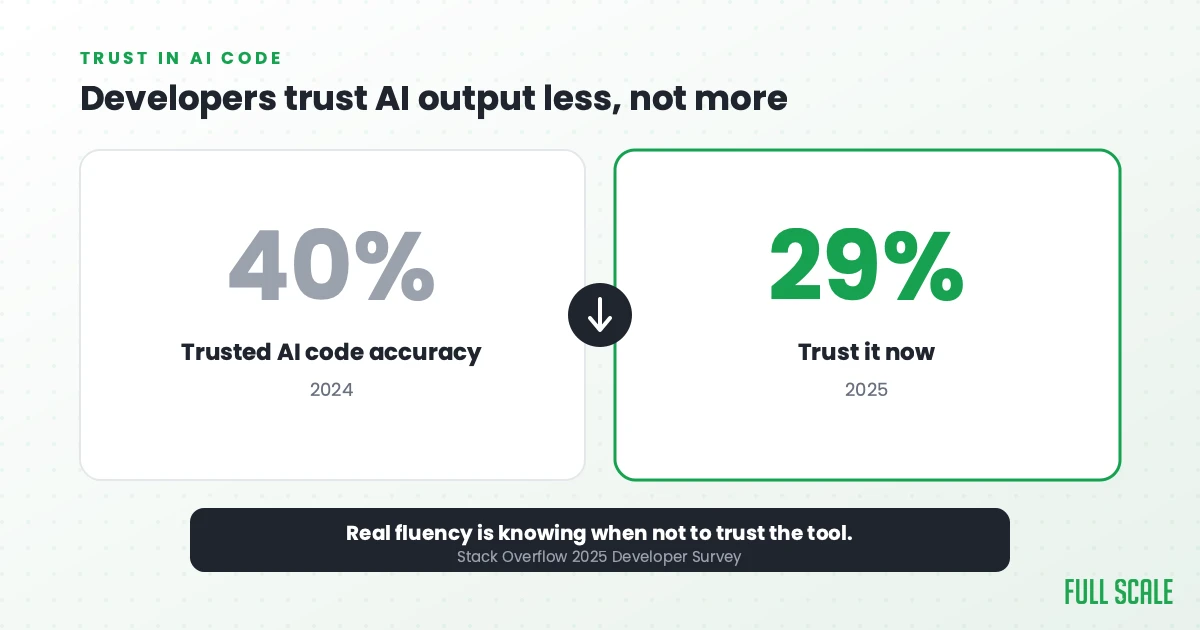
That distinction matters more than which tool is on the resume. Plenty of developers are skeptical of their own output for good reason. Stack Overflow’s 2025 developer survey found only 29% of developers trust the accuracy of AI-generated code, down from 40% the year before. Real fluency is knowing when not to trust the tool.
Here’s the truth about ‘vibe coding.’ It only works if you’ve been coding long enough to know when the AI is wrong.
Why this stopped being a differentiator
For a while, “our developers use AI tools” was a real selling point. It’s table stakes now. About 85% of developers already use AI tools day to day, per JetBrains’ 2025 survey, so a vendor that can’t say this is behind on hiring, not behind on AI.
The harder part is staying current, and you can’t do that with a course. The skill gets built on real work, a thousand code reviews, not a slide deck. The catch is that the reps are uneven: a developer on a conservative enterprise client gets almost no AI exposure, while one on an aggressive early-stage client learns at the frontier every day. That’s why we run an internal program, the Spartan Training Academy, to manufacture the reps when a client’s environment won’t. The point isn’t learning a list of tools. It’s widening what a developer owns, from the problem all the way to whether the customer got what they needed.
Also yes: Developers who build AI into your product
The second flavor changes what you’re buying: developers who build generative AI features into your product. That means retrieval-augmented generation (RAG), agent workflows, and prompting pipelines, the plumbing that turns a language model into a feature a customer can use.
Screening for this is a different job than screening for tool fluency. You can’t sort it out in an interview, because talking about RAG and having shipped it are not the same thing. What you look for is a track record: features that actually went to production, and references who watched them do it. That’s how any senior specialist gets vetted, and it’s how we staff this.
The strongest proof of this came from a client. Lytho, a marketing technology company, has a CTO, Brandon Grady, who told us something that surprised him.
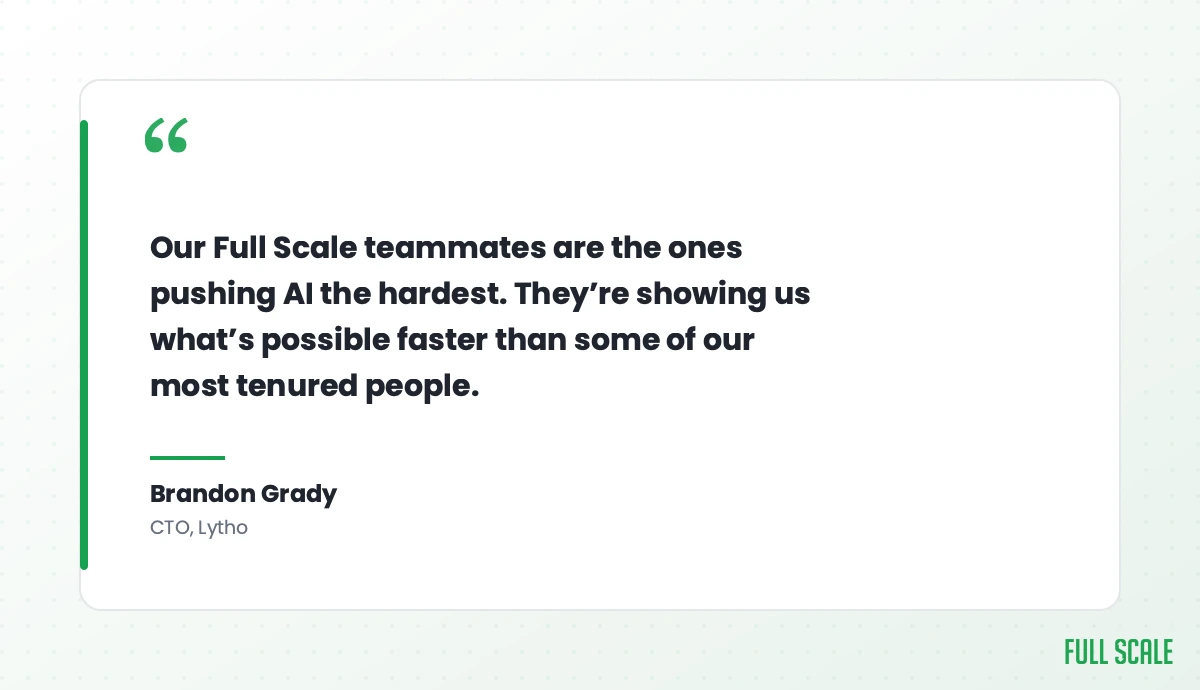
Our Full Scale teammates are the ones pushing AI the hardest. They’re showing us what’s possible faster than some of our most tenured people.
Lytho had been building AI features into its own platform, the compliance and brand-governance tooling now central to its product. Brandon expected his in-house veterans to lead that push. The offshore team got there first.
The stereotype this breaks
The stereotype of an offshore team is one that executes tickets and never brings an idea of its own. Lytho ran the other way. This is a CTO who ran engineering at companies like Twilio, telling us his tenured staff took cues from the augmented team. He put it down to the same thing that makes the Philippines a strong place to staff in the first place: engineers who are curious, communicate well, and go looking for the next thing before anyone asks.
There’s a cost argument hiding in that, too. Once a senior developer’s job is largely directing and reviewing AI-generated code, paying a loaded US salary for that work gets harder to justify when a senior offshore developer does the same for a fraction. AI makes the case for offshore stronger.
If this is the flavor you need, it’s worth looking at what hiring AI developers or a dedicated AI development engagement covers, because it’s a different hire than the one above.
No: We don’t do traditional machine learning
This is the one honest no. Full Scale doesn’t do traditional machine learning: model training, classical data science, the work that needs someone who spends the day tuning algorithms instead of shipping product features.
My answer to a client who genuinely needs that: we can help you find somebody, but it’s not our expertise. That’s a real boundary. We’re not hedging, and we’re not saying no politely while hoping you don’t notice. If you need it, look for a dedicated data-science firm or an ML specialist contractor, the kind of shop whose whole business is models rather than product features.
Handing that work to our developers would be like asking your accountant to also handle your plumbing. He might get there eventually. You do not want to be in the house when he does.
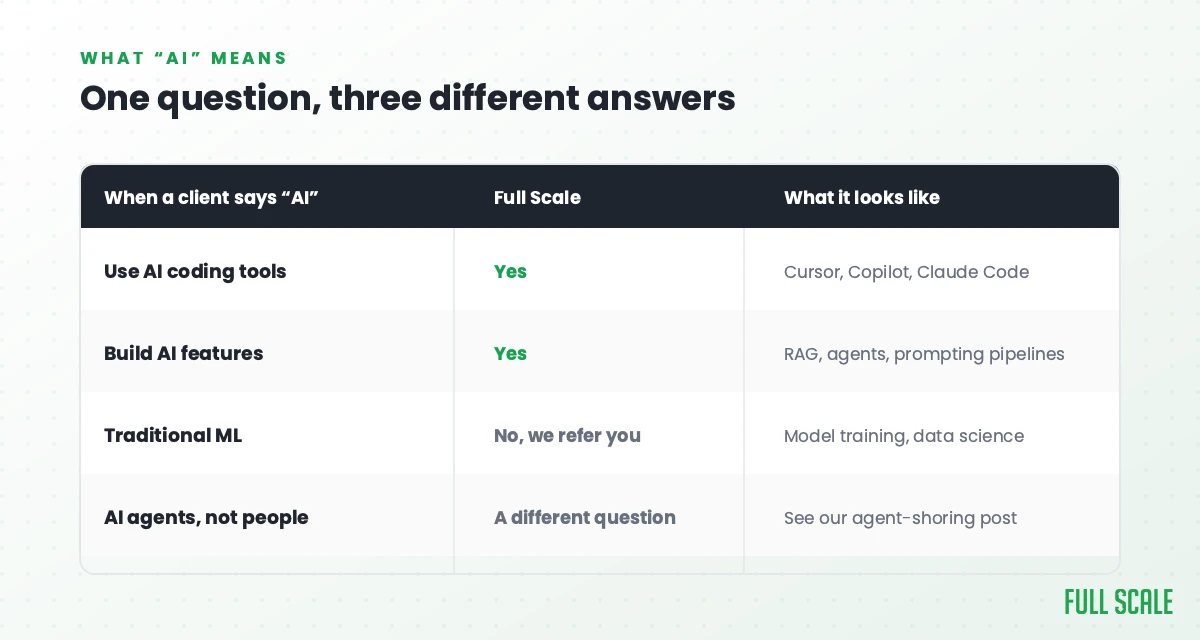
| What you mean by “AI” | Full Scale | What it looks like |
|---|---|---|
| Developers who use AI coding tools | Yes | Cursor, Copilot, Claude Code to build faster |
| Developers who build AI features | Yes | RAG, agents, prompting pipelines in your product |
| Traditional machine learning | No, we’ll refer you | Model training, data science, algorithm tuning |
| AI agents instead of people | A different question | See agent-shoring |
The real skill is the question we ask back
Each of these answers, yes, yes, no, is easy once you know which one applies. The actual skill is asking the question that sorts them out before anyone gets staffed.
Get it wrong and the cost is real. A client who needed a developer fluent in retrieval pipelines, and got a solid generalist instead, doesn’t find out until that first sprint review.
Pure coders will be replaced by AI. Problem solvers will run technology organizations.
That holds inside a staffing decision too. Tool fluency matters less than understanding the problem before you decide who solves it. It’s the same argument I make throughout Product Driven: the hard part was always understanding the problem well enough to build the right thing. AI made the typing faster and left that part exactly where it was.
What good AI staff augmentation services look like
If you’re weighing vendors who all claim to “do AI,” ask these before you sign:
- Which of the two flavors are you offering, tool fluency or feature development, and can you show an example of each?
- How do you screen for it? If the answer is “we ask them,” that’s not wrong by itself, but it should sound like a real conversation rather than a checkbox.
- What’s explicitly out of scope? A vendor with no stated boundary is the bigger red flag than one that names its own clearly.
- Can I talk to a client whose developers built a real AI feature into their product, not just used AI tools internally?
If you want the broader version of this, how to choose a staff augmentation company covers vetting a vendor past the AI question.
Frequently asked questions
What does AI staff augmentation mean?
The phrase usually points to one of two things: bringing on developers who use AI coding tools to work faster, or developers who build AI features directly into your product. Traditional machine learning and data science sit outside that for most vendors.
Does the staff augmentation industry do machine learning?
Most staff augmentation firms don’t. The field skews heavily toward product engineering, so classical machine learning and data science are usually left to specialist ML shops and data-science contractors rather than general staff augmentation vendors.
Is AI staff augmentation different from regular staff augmentation?
Not as a staffing model. What staff augmentation is doesn’t change: engineers who work directly for you on a long-term basis. What changes is what you’re screening for, general engineering ability versus AI-tool fluency or generative AI feature-building experience.
Does AI capability cost more than a regular developer?
An AI-fluent generalist isn’t a separate premium tier, since tool use is baseline now. A developer with real generative AI feature-building experience is staffed like any senior specialist, so the rate tracks seniority and skill rather than an “AI” surcharge.
Do you offer offshore AI and machine learning staff augmentation?
Only half of that. Full Scale staffs offshore developers for AI-assisted engineering and AI feature development, but not for traditional machine learning or data science. We’ll point you to the right specialist for that instead. This kind of AI-era vetting question is one of several staff augmentation trends reshaping how these engagements get built in 2026.
Ask the question before you sign
The vendor worth hiring is the one who asks you a question back before saying yes.
If you’re not sure which kind of AI help you need, that’s the first conversation worth having. Schedule a call and we’ll help you figure it out.