
Staff Augmentation vs. Managed Services: How to Pick the Right Model

In this article
- You’re Comparing the Wrong Two Things
- Definitions That Cut Through the Confusion
- Side-by-Side Comparison
- When Managed Services Is Actually the Right Call
- When Staff Augmentation Wins
- The Mistake CTOs Make When They Confuse the Two
- How to Decide What Model Fits the Work
- Frequently Asked Questions
- Name the Work and the Choice Picks Itself
I pay someone else to manage our server hosting. At Stackify, we hired a firm to run our Elasticsearch. Staffing a team to do either of those things was never on the table. That same logic applies to picking a rate: understand staff augmentation vs managed services pricing before you sign either one. The engagement’s payment and rate terms are worth reading closely whichever model you choose.
Those are managed services. They worked. I’d do them again. But every time a CTO asks me whether they should “go staff augmentation or managed services” for their product engineering team, I have to back them up and explain that they’re comparing two things that don’t actually compete in that decision. Gigster is one of the better-known managed shops, and weighing Gigster against a marketplace shows what you trade away either way.
Managed services is a real category. So is staff augmentation. Most posts on this topic confuse them because they treat both as ways to staff the team building your product. The honest advantages and disadvantages of staff augmentation are worth knowing before you pick either one. Only one of them is. The team extension and staff augmentation labels show up in the same conversations and trip up the same buyers, even though those two are the same model and managed services is a genuinely different one. The same question applies when you buy cloud transformation services: are you paying for a finished project, or for engineers who can run it afterward? Consulting muddies the picture in a different way, since it answers a question neither of these models does: what to build, not who staffs it. See whether you need a consultant or a staff augmentation team for that split. Managed services and consulting are only two of the labels people lump under “staffing.” So is SDaaS, which usually just means staff augmentation with a subscription wrapper. I sort out the other staffing models too.
You’re Comparing the Wrong Two Things
The comparison most articles set up looks tidy on a slide. Staff aug puts developers inside your team. Managed services hands them to a provider behind an SLA. Picking between a managed offshore team vs staff augmentation is really the same payroll question in different clothes.
That framing breaks the moment you ask what work you’re actually buying.
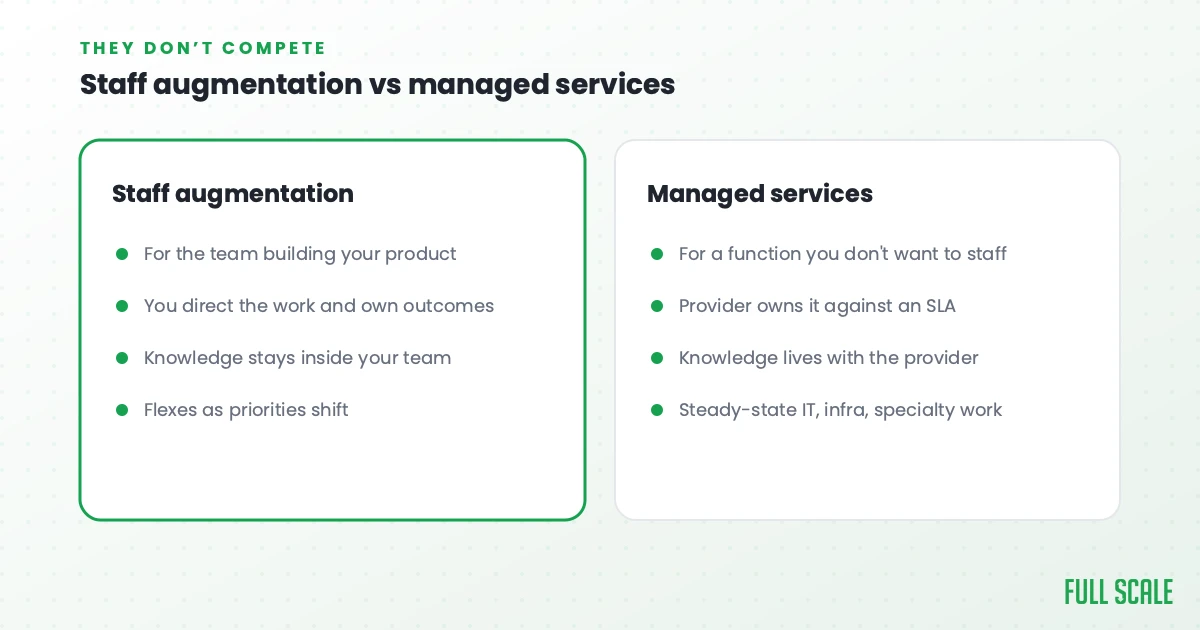
Managed services is for things you don’t want to staff
I’ve used managed services to cover our server hosting, Elasticsearch, and a handful of other functions I didn’t have internal resources for or didn’t want to mess with. That’s the whole category. The work covers server hosting, cloud infrastructure, helpdesk, network operations, security monitoring, and niche specialty support like Elasticsearch or SAP administration.
The function is well-defined. The work looks the same month to month. You’d rather pay someone to own it than build a team around it.
Staff augmentation is for the team building your product
Staff aug developers join your team. They report to your tech lead. They commit to your repo and they sit in your standups. The work doesn’t stop because the codebase keeps growing, and the team has to stay attached to the product or the product slows down. That includes infrastructure roles. When you need to hire DevOps engineers who embed in your team rather than sit behind a managed service wall, staff augmentation is the right model.
Product engineering managed services isn’t really a thing
If your “managed service” is actually building and running your product, you didn’t outsource a function. You handed the company’s reason for existing to a third party.
“You don’t hand off the product. You shape it while making room for others to help it grow.” (from Product Driven)
That’s the line that separates the two categories. Hand off the function around the product. Build the team that builds the product itself.
Definitions That Cut Through the Confusion
Most articles open with definitions written like dictionary entries. Here’s what each one looks like when you’re actually buying it.
Staff augmentation
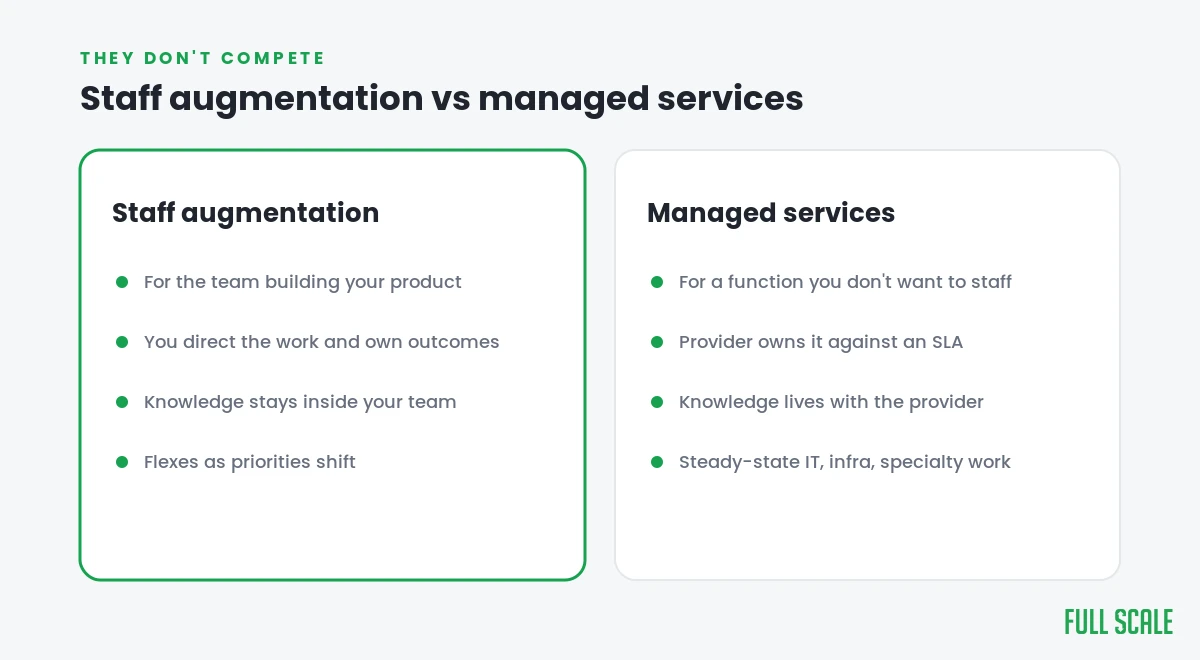
You bring in external developers who join your team. You direct the work, you own the outcome, and the institutional knowledge stays with you. The provider handles hiring, payroll, retention, and replacement; the developers do the work for you, on your repo, against your priorities.
Best used when you have engineering leadership in-house and need to scale faster than local hiring can deliver.
Managed services
A provider takes ownership of an entire function. You define what “good” looks like, usually in an SLA. They figure out how to deliver against it. You manage the contract, not the people.
Every legitimate managed services arrangement in software I’ve seen lives in IT-and-infrastructure territory: cloud ops, hosting, network management, helpdesk, security monitoring, or specialty support like Elasticsearch or SAP administration. The category exists because that work is steady-state and well-defined enough to write a contract around.
Side-by-Side Comparison
Most posts on this topic include a comparison table. Most of those tables are decorative. Here’s a real one.
| Dimension | Staff Augmentation | Managed Services |
|---|---|---|
| What you’re contracting for | People who join your team | A function or outcome delivered against an SLA |
| Who manages day-to-day | Your tech lead | The provider’s manager |
| Who’s accountable for results | You | The provider, bound by the SLA |
| Pricing model | Monthly rate per developer | Fixed retainer or outcome-based fee |
| Best fit | Long-term product engineering | Steady-state IT or specialty functions |
| Worst fit | Steady-state ops you don’t want to manage | Anything that is your product |
| Flexibility when priorities shift | High; swap roles, scale up or down | Low; bound by the SLA scope |
| Where institutional knowledge lives | Inside your team | Inside the provider |
| Time to first contribution | 1 to 2 weeks | Longer (contract negotiation plus onboarding) |
| IP and codebase ownership | You own from day one | You own the contract output, not necessarily the playbook |
If you trust one row in that table, trust the “Best fit” row. Everything else follows from it.
When Managed Services Is Actually the Right Call
I’m not anti-managed-services. I run my hosting that way, and I’ve paid firms to handle technical functions I had no business staffing. Plenty of work fits managed services cleanly.
Server hosting and cloud infrastructure
I’d never go back to running our own infrastructure. The function is steady-state, the work is specialized, and the provider does a better job at it than I could in-house. AWS-managed, Azure-managed, or a third party running your cloud ops is the right call for any company that isn’t itself a hosting provider.
Specialty and niche functions
This is the Elasticsearch story for me. Stackify ran on Elasticsearch heavily. Anyone who’s used it at scale knows what that means: it eventually breaks, the upgrades aren’t backward-compatible, and somebody has to be the expert when the cluster falls over at 2am.
We didn’t staff that person. We hired a firm that did Elasticsearch full-time, every day, for a long list of clients. They were better at it than any single hire we’d have made. The same pattern fits SAP administration, Salesforce admin, specialty compliance tooling, anything where the expertise is real but the workload doesn’t justify a full-time hire. The flip side: when the Salesforce roadmap is big enough to fill a developer’s time, companies hire offshore Salesforce developers instead, because a managed-service shop won’t accumulate the org-specific context that a long-term hire will.
Helpdesk, network ops, security monitoring
Steady-state operational functions where the work looks similar week to week. The SLA describes “good” cleanly. The provider can scale the function without you being the bottleneck on hiring.
The pattern: anything that isn’t your product
The common thread: managed services fits when you can write a contract describing what “delivered” looks like and the work doesn’t fundamentally change month to month. The same logic runs the other way when the work does keep changing: I wrote a separate piece on choosing between staff augmentation and a SOW for exactly that case.
When that’s true, you’re better off not staffing it. When it isn’t, no contract is going to save you.
When Staff Augmentation Wins
The work most CTOs are actually asking about (building features, shipping product, maintaining a codebase that’s growing every week) doesn’t fit managed services. Staff augmentation does.
Your product is something you keep building
The code you write this month, you’ll be extending next month, and the developer who built the feature needs to be there when it breaks. Continuity is the variable that matters most on a product team.
“We aren’t in this for some 3-month project.”
A managed services contract written against an SLA can’t carry that continuity. The developers belong to the provider, not to you, and they’re paid to hit the SLA, not to make your product better.
Priorities shift quarter to quarter
Roadmaps change. The work needed in Q1 looks nothing like Q3. Staff aug lets you swap a React developer for a Python developer mid-engagement, or scale up before a launch and scale back after. That flexibility is built into how a staff augmentation engagement actually runs, not something you negotiate separately each time.
A managed services contract is bound by the scope you negotiated. When priorities shift, you either renegotiate or live with the wrong shape of team.
You want the team to own outcomes, not just hours
The Ownership pillar from Product Driven rests on a single observation: engineers who think like owners outperform those who wait for tickets. Staff augmentation puts the developers inside your org, where ownership is possible. Managed services keeps them outside the org, where they’re following the contract.
Two KC companies that chose to build teams
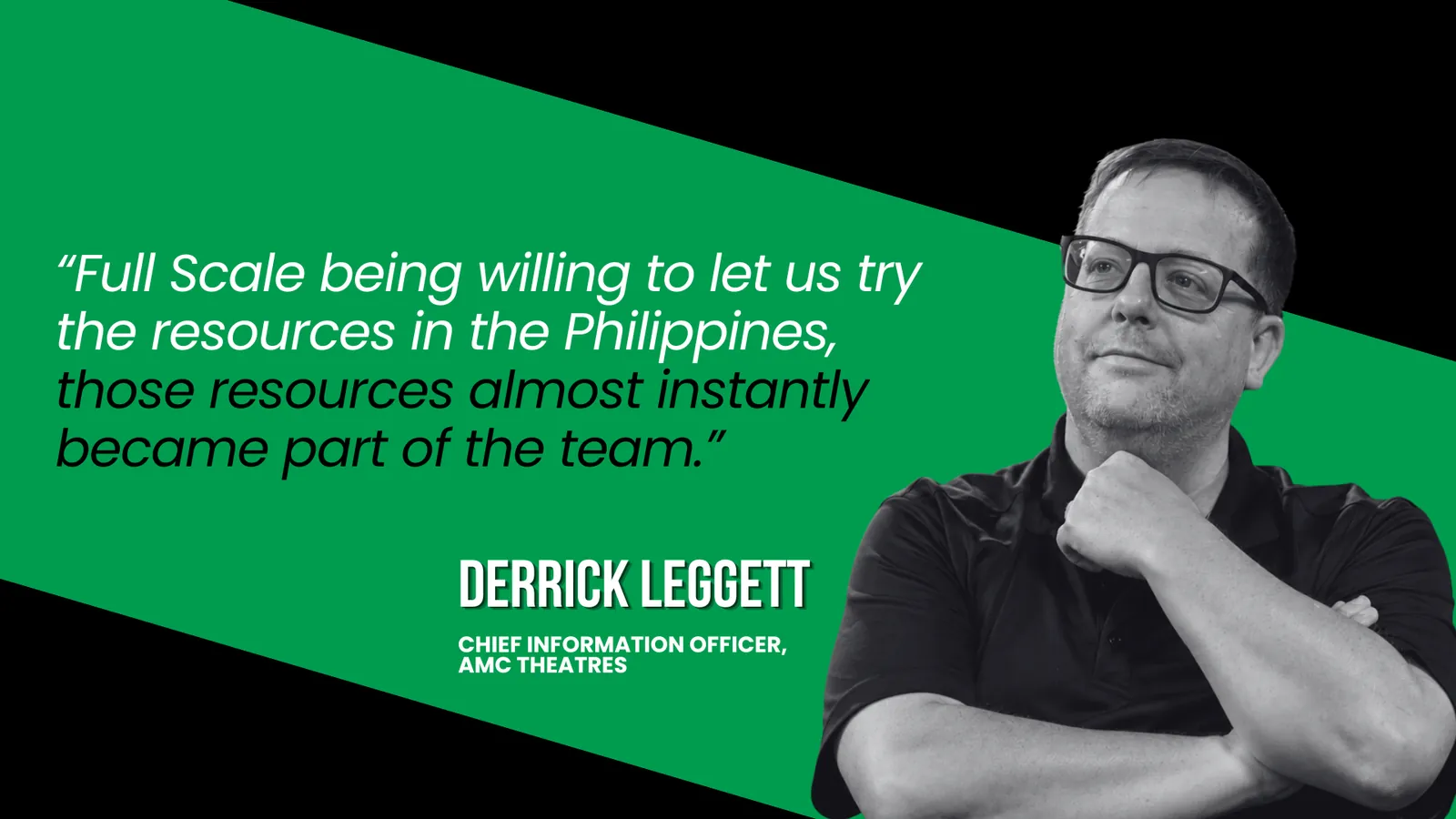
AMC Theatres (Derrick Leggett, CIO). AMC built a global engineering organization where the developers in the Philippines are AMC engineers, not contractors. Same Slack threads, same code review process, same product conversations. The decision wasn’t between “managed services or staff aug.” It was about how much AMC wanted the team to actually be AMC. They chose all the way.
LendingStandard (Andy Kallenbach, CEO). LendingStandard processes roughly 30% of affordable multifamily property loans nationwide. They’re a Kansas City commercial real estate platform. They tried hiring locally first, including vocational programs and college recruiting. They came to Full Scale because local hiring couldn’t keep up with their growth.
“Waking up each morning to collaborate with the Full Scale team has become the highlight of my day. Their work ethic, pride in craftsmanship, and the sheer quality of their output have not only met but exceeded our expectations. The most significant impact has been the seamless integration of their team with ours, making every challenge surmountable and every success sweeter.”
Andy Kallenbach, CEO, LendingStandard case study
Both companies could have shopped a managed services contract for their product engineering. They built teams instead. The people on those teams have been with the product for years.
The Mistake CTOs Make When They Confuse the Two
Most offshore failures happen the same way: somebody hands a stack of requirements to a firm and expects a successful product to come back. That’s a misapplied contract dressed up as either staff aug or managed services, and it’s neither.
Three things break when somebody tries to “managed-service” their product engineering:
- Institutional knowledge walks out. The provider’s developers learn your codebase. When the contract ends, or even when the provider rotates somebody off internally, that knowledge leaves with them. Six months later you can’t ship a fix because the only person who understood your auth service is at a different client now.
- You can’t pivot. SLAs are written against a defined scope. When the product needs to change direction, the contract gets in the way. You’re paying for what you agreed to a year ago, not what you need today.
- Nobody owns the outcome the way you do. A managed services provider owns SLA performance. You own product success. Those are different goals, and when they conflict the provider optimizes for the contract.
“You always need technical leadership in-house.”
That’s the line I’ve repeated more than any other when CTOs ask about offshore arrangements. It applies twice as hard when managed services is on the table for product work. A managed services arrangement that runs your product has stopped being a managed service and started running your company.
How to Decide What Model Fits the Work
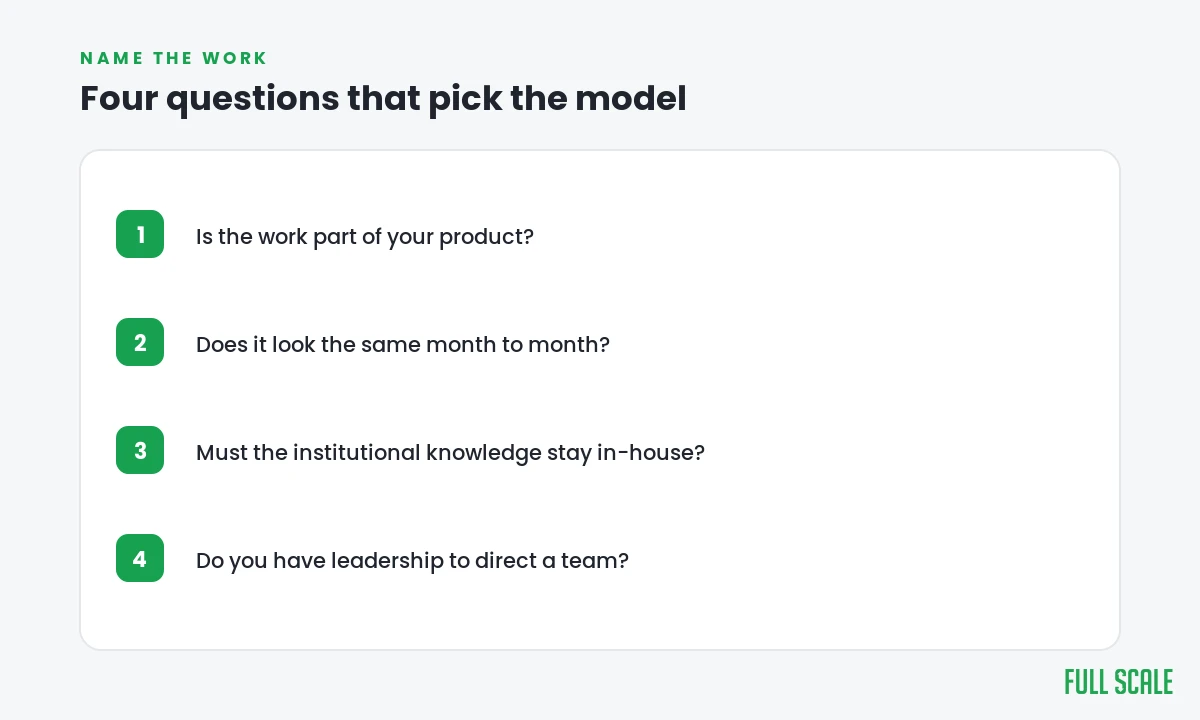
You can pick the right model in four questions.
- Is the work part of your product? Yes → staff augmentation. No → managed services is on the table.
- Does the work look the same month to month, year to year? Yes → managed services fits. No → you need a team that can change shape, which means staff augmentation.
- Do you need the institutional knowledge to stay inside your company? Yes → staff augmentation. No → managed services is fine.
- Do you have engineering leadership in-house to direct a team? No → managed services is your only real option for technical work. Yes → staff augmentation wins for any work that touches the product.
Where most companies should land
Use both. Staff augmentation for the team building your product. Managed services for the infrastructure, hosting, and specialty work that supports it. The mistake isn’t choosing one model. It’s using the wrong one for the work.
Frequently Asked Questions
What is the difference between staff augmentation and managed services?
Staff augmentation adds developers to your team who you manage directly. Managed services hands off an entire function, usually IT, infrastructure, or specialty work, to a provider who delivers against an SLA. Staff augmentation extends a team, while managed services replaces one.
Are managed services the same as outsourcing?
Related, not identical. Outsourcing usually means handing off a one-shot, scoped project. Managed services means continuous coverage of an ongoing function. Both transfer ownership of the work to a third party. Managed services just makes it a long-term arrangement.
When should you use managed services instead of staff augmentation?
When the work isn’t your product. Server hosting, cloud infrastructure, helpdesk, network operations, and specialty work like Elasticsearch or SAP administration all fit. Any function that’s well-defined, steady-state, and not core to what your company sells is a candidate for managed services.
When should you use staff augmentation instead of managed services?
When the work is your product. Anytime the codebase keeps growing, the priorities keep shifting, and the institutional knowledge needs to stay with your team. Staff augmentation wins for product engineering.
Can you combine staff augmentation and managed services?
Yes, and most companies should. Use staff augmentation for the team building your product. Use managed services for the infrastructure, hosting, and specialty support functions that surround it. What trips companies up is applying the wrong model to the work, not the choice to use both.
What’s the biggest risk with managed services for product engineering?
The provider optimizes for SLA performance while you’re optimizing for product success. Those goals look the same on a good day and pull in different directions on a bad one. For non-product functions like hosting or helpdesk, that risk is small because the work doesn’t change much over time. For product work, it’s the whole problem.
Name the Work and the Choice Picks Itself
Managed services covers a function you don’t want to staff, while staff augmentation builds the team that builds your product. Name which one the work actually is, and the choice picks itself.
If you’re building a long-term team and need senior developers in two weeks, that’s what Full Scale’s staff augmentation does. Talk to us about how we’d staff your team.