
AI Coding Tools vs. Hiring Offshore Developers: Is Agent-Shoring Real?

In this article
- What is agent-shoring?
- Agent-shoring assumes offshore developers can’t use the tools
- Agent-shoring is just cheapshoring in a new outfit
- What good developers actually do, and agents can’t
- The scaling ceiling nobody in the pitch mentions
- The real future is offshore developers plus agents
- Frequently asked questions
Quick Answer: No, AI agents will not replace offshore software developers. The agent-shoring pitch assumes offshore developers cannot use the same AI tools US developers use, and that assumption is wrong. AI arms good developers, offshore or local, with more leverage; it does not replace the judgment, communication, and ownership that make an engineer worth hiring in the first place. The developers most at risk are the ones who were only ever executing tickets, not the ones running the product.
I run a software company that staffs offshore engineers, so when a headline tells me my entire business is about to be replaced by a chatbot, I read the whole thing. This one had a new word attached: agent-shoring. The idea is that AI coding agents are the new offshore team. They’re cheaper than people, they don’t sleep, and so the smart move is to stop hiring developers overseas and let the agents do the work.
I finished the article and laughed, because I’ve heard this exact pitch before. It just used to have a different name.
The people making it are not dumb, and the trend underneath it is real. AI has made writing code cheaper, and a lot of the routine work that used to fill an offshore team’s day can now be done faster with a good agent. All of that is true. But the conclusion, that agents replace offshore developers, only works if you believe something quietly insulting about the developers. So let me say the quiet part out loud. That is only one reading of the question, and it helps to be clear about what clients mean by AI staff augmentation before assuming the worst.
What is agent-shoring?
Agent-shoring is the idea that companies should meet their engineering needs with AI agents instead of hiring an offshore team. The pitch, made in a recent LeadDev article, is that this is the natural next step after offshoring: same work, lower bill, no humans in another time zone. One founder quoted in the piece, Lexi Reese of the AI company Lanai, called it “the new offshore,” and said it’s “cheaper than traditional offshore work.” The article asks whether some work needs to be staffed by a person at all.
To be fair to the piece, it asks that as a real question, and the data it leans on is more careful than the headline. Its own labor economist, Deel‘s Lauren Thomas, found that demand for generalist offshore developer roles is slipping, while offshore hiring for AI-focused work is growing, and offshore overall is still expanding. Read that honestly and it isn’t “offshore is dead.” It’s “the routine tier is shrinking and the AI-fluent tier is growing,” which, spoiler, is most of my argument.
The line that gets quoted instead came from a developer and entrepreneur named Patrick Husting. “It completely gets rid of offshore,” he said. “If you have a person that’s good with code from end-to-end, you can orchestrate an entire team using the AI tools that are available today.”
Agent-shoring assumes offshore developers can’t use the tools
Read Husting’s line again. If you have a person who’s good with code, they can orchestrate an entire team of AI agents and skip the offshore developers entirely.
The person in that sentence, the one good with code from end to end who can orchestrate a team of agents, describes a lot of the offshore engineers I work with. They can pick up Claude Code and Cursor as fast as anyone in San Francisco, because the tools don’t check your passport. So here’s my real question for the people selling this: why do you think so little of the offshore developers? The whole pitch only works if the answer is that they can’t. Drop that assumption and agent-shoring stops being a replacement story. It goes back to being an ordinary hiring question: who are the good engineers, and what do they cost?
Agent-shoring is just cheapshoring in a new outfit
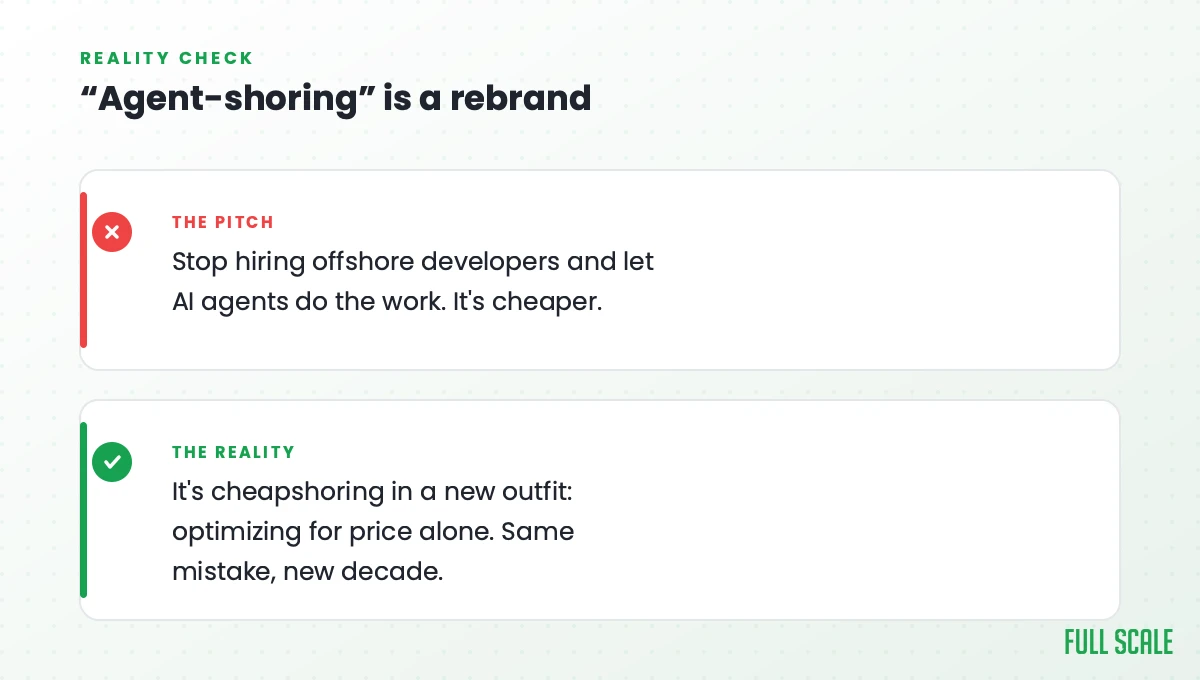
I’ve watched this movie. A few years ago the plan was to fire your expensive local developers and hire the cheapest bodies you could find overseas. It failed constantly, and I gave the mistake a name. I call it cheapshoring: offshoring where the only thing you optimize for is price. You sort the options by hourly rate, pick the bottom of the list, and call it a strategy. Then you join the long line of founders who tried offshore once, got burned, and swore it off forever.
Agent-shoring is the same instinct wearing new clothes. Last time the cheapest thing was an $8-an-hour freelancer juggling six clients. This time it’s an agent that runs for the price of an API call. The logic is identical, and so is the flaw. You’re treating engineering as a pile of code to be typed as cheaply as possible, when the expensive part was never the typing.
Here’s the part I’ll happily concede, because it helps my case. The bottom tier of offshore, the cheap-hands body shop that took a pile of requirements and handed back routine implementation, really is under threat from agents. Good riddance. That tier was cheapshoring the whole time, and an agent does that job faster and without the invoice surprises. Customer support already ran this experiment on itself. Customer service AI agents take a real chunk of tier-one volume now, and nobody is out there mourning the phone tree. What companies still pay humans for is the cases the bot cannot close, plus the judgment about what the bot should be handling in the first place. What’s dying is the worst version of offshore development, the one I’ve been telling people to stop buying for years.
And the “price of an API call” is a sticker price, not the loaded cost. Somebody still has to read what the agent wrote, catch what it got wrong, and fix it. When that somebody is missing, you get the GitClear finding below: a lot of code, fast, quietly rotting. The real arbitrage is a senior engineer who bills 50 to 70 percent less than a US hire and knows how to make the agent useful. That was always the game, and agents don’t change it.
What good developers actually do, and agents can’t
Here’s what the agent-shoring pitch misunderstands about developers. It assumes their job is to take a set of requirements, not really think about them, and turn them into code. If that were the job, then yes, an agent would eat it, because that’s exactly the part AI is good at.
The job is bigger. It’s knowing what to build, catching the requirement that doesn’t make sense before you build the wrong thing, understanding the business well enough to make a call the ticket didn’t cover, and owning the outcome after it ships. That’s product thinking, domain knowledge, and judgment, and none of it is code you can generate. An agent supplies none of it on its own.
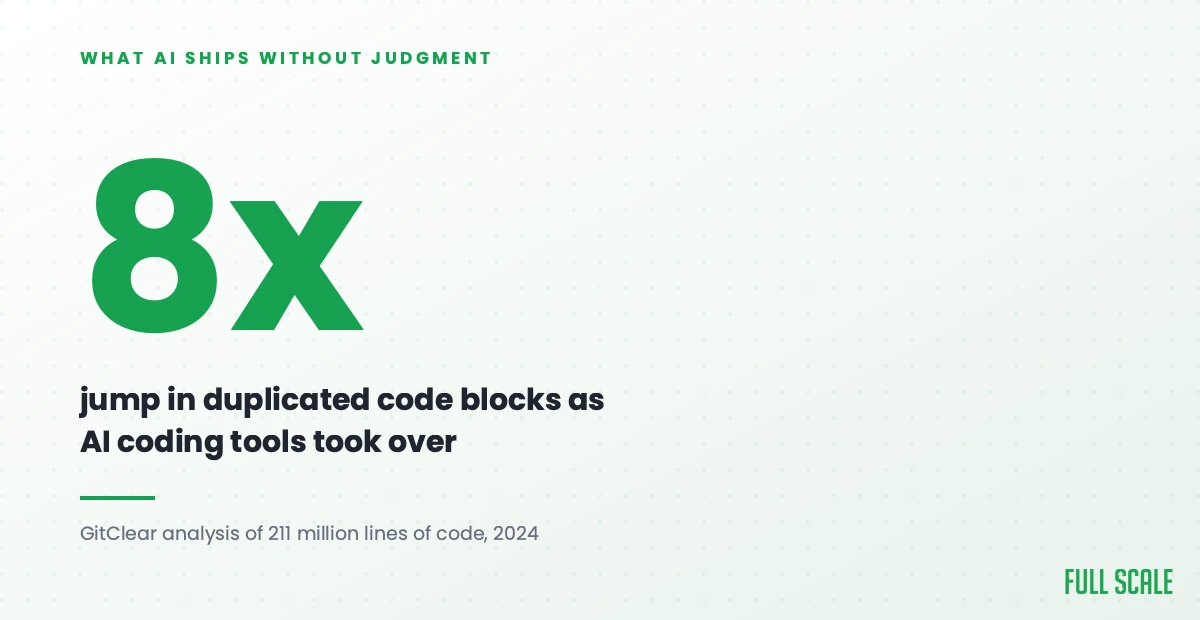
An agent will confidently hand you a plausible, wrong answer and never blink. GitClear looked at 211 million lines of code and found duplicated blocks jumped roughly eightfold as AI tools took over, while actual refactoring fell off a cliff. That’s what “orchestrate an entire team with AI” ships when nobody with judgment is steering. I tell clients, half joking, that we’re all essentially paying developers to babysit AI now, to review what it generates, catch what it gets wrong, and steer it toward something useful. The joke lands because it’s mostly true, and babysitting is a human job.
I’ll put it more bluntly, because it’s the thing I actually believe. AI without product thinking is just a slop machine, and the developers I want on my team know how to avoid that trap. They think first, use AI for the parts where judgment doesn’t add value, and own the outcome of what they ship. That’s who we hire and train at Full Scale. The DORA 2025 report found the same pattern in the data: AI amplifies what’s already there, so strong teams get faster and better while weak teams just ship their problems quicker. Agents multiply the engineers you already have, in both directions.
The scaling ceiling nobody in the pitch mentions
Take the agent-shoring pitch at its best: one person, good with code end to end, orchestrating a team of agents. Sure. That works, for a while.
Then it hits the same ceiling every solo operator eventually hits. There are only so many hours in your day, only so many agents you can supervise at once before you’re the bottleneck, only so much context you can hold in one head. It doesn’t matter how good you are or how much you automate. To scale past yourself, you need more people. More developers who have product thinking and domain knowledge and can take ownership, and who also know how to use AI.
Which is the exact thing agent-shoring just declared dead. The pitch talks you out of hiring a team, then quietly requires one the moment you try to grow.
I know the obvious objection, because it’s the honest one: if each engineer plus agents now does the work of several, don’t you need fewer of them? For a fixed amount of work, yes. But the work has never been fixed. Cheaper software means people want more of it, scope gets more ambitious, and the backlog grows to fill whatever capacity you add. What actually gets scarce isn’t typing capacity, it’s judgment: people who can point the agents at the right problem and know when the output is wrong. So demand shifts toward better developers, not toward zero of them. Even at Google, where Sundar Pichai says about 75% of new code is now AI-generated, the response was to move those engineers up a level, to supervising the agents instead of typing every line. That cuts both ways, I’ll admit it: Google is getting far more output per engineer than it used to. It’s just getting it from engineers, not instead of them. That’s also why babysitting AI-generated code is a more accurate description of the job than typing it.
The real future is offshore developers plus agents
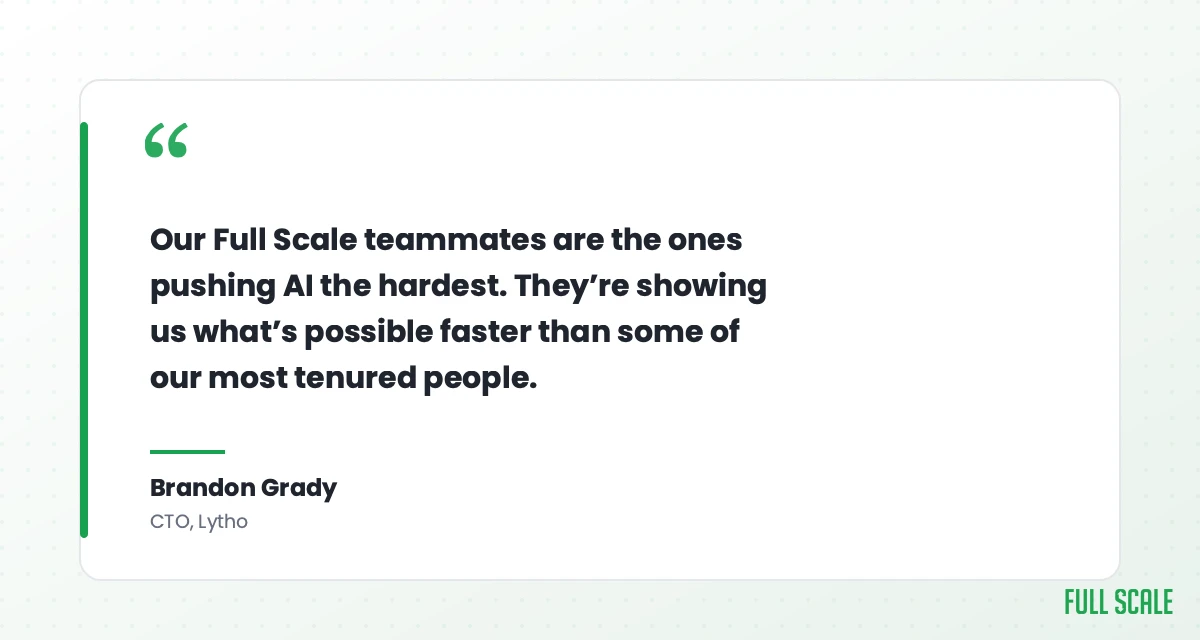
I don’t have to guess at how this plays out, because I’m watching it. At Lytho, a creative operations software company, CTO Brandon Grady expected his most tenured, most technical people to lead the charge on AI. That isn’t what happened. The engineers pushing hardest were his Full Scale team in the Philippines.
Our Full Scale teammates are the ones pushing AI the hardest. They’re showing us what’s possible faster than some of our most tenured people,” Grady told us. “It’s not us pushing a culture onto Full Scale. We’re building this new tech culture together, and in some cases they’re leading us.
That’s one client, so take it as one data point. But it isn’t the only one. At Slydyn, an automotive startup, President Kim Cowan built her product from scratch with a Full Scale team while the ground kept shifting under AI, and the offshore engineers were the ones absorbing the change, not the ones slowing it down. In both cases the offshore developers were the ones out front, showing a US company how to use the tools, not the routine work waiting to be automated away.
That isn’t an accident. We train all 350-plus of our engineers on AI through an internal program, because I don’t want to get a year down the road and have clients hand back half our developers because they never learned this stuff and fell behind. We refuse to be in that position. The offshore developer who lives in Claude Code every day is the point of the AI shift, not its casualty.
So no, agents are not the new offshore. The winning team is a small number of good developers, wherever they sit, each one wielding AI to do the work of several. That’s not onshore versus offshore versus agents, the three-way cage match the framing wants to sell you. It’s good engineers plus agents, and offshore is simply where a lot of the good, affordable engineers are. This is the whole idea behind staff augmentation done right, and it’s the same product-thinking-first argument I make in my book, Product Driven.
Cut your offshore team to save money on agents, and in a year you’ll be the founder who tried offshore, got confused about what actually broke, and swore it off forever. Again.
Frequently asked questions
Will AI replace software developers?
No. AI is taking over a slice of what developers used to spend their time on, the routine code generation, and moving the value to the parts it can’t do: product thinking, domain judgment, and ownership of the outcome. The developers who thrive are the ones who use AI to do more. And because cheaper software makes people want more software, the demand for those developers keeps climbing rather than shrinking. Fewer hands per feature, more features, more roles for people who can steer the agents. That’s a role change, not a pink slip.
Is offshore software development dead?
Not even close. What’s dying is the old version where an offshore team was a pile of cheap hands doing routine implementation, because that’s the exact work AI now does well, and that was never worth buying in the first place. Offshore development is changing in the AI era, and the offshore teams that win are the ones full of senior engineers who direct AI and own results, not the ones you hired purely on rate.
Onshore, offshore, or AI agents: which should I choose?
It’s not a three-way choice, and framing it that way is how you make a bad one. Agents are a tool your developers use, not a workforce that replaces them. The real question is where you find genuinely senior engineers who can wield those tools at a cost you can sustain, and how you keep them once you’ve got them. For a lot of companies, the answer includes an offshore team, now armed with AI.
Ready to build a team of senior engineers who already live in these tools? Talk to Full Scale about staffing developers in the Philippines who think first and use AI to do the rest.