What Is a MarTech Developer, and Do You Need One?


In this article
A marketing leader I know walked into her CEO’s office and asked to hire another marketer. Signups were down, the dashboard looked grim, and more marketing horsepower felt like the obvious answer.
The actual culprit was a form field. Someone had renamed it, the integration that carried leads into the CRM never got the memo, and half the new signups were landing in a status nobody was tracking. No marketer alive was going to fix that, because it wasn’t a marketing miss.
The problem was software.
The person who fixes that kind of problem is a MarTech developer. If the title is new to you, you’re in good company. It’s younger than the mess it cleans up. This post is about what the role really is, and the more useful question underneath it: how to tell whether you need one, or whether you’re one form field away from hiring the wrong thing.
What a MarTech developer actually is
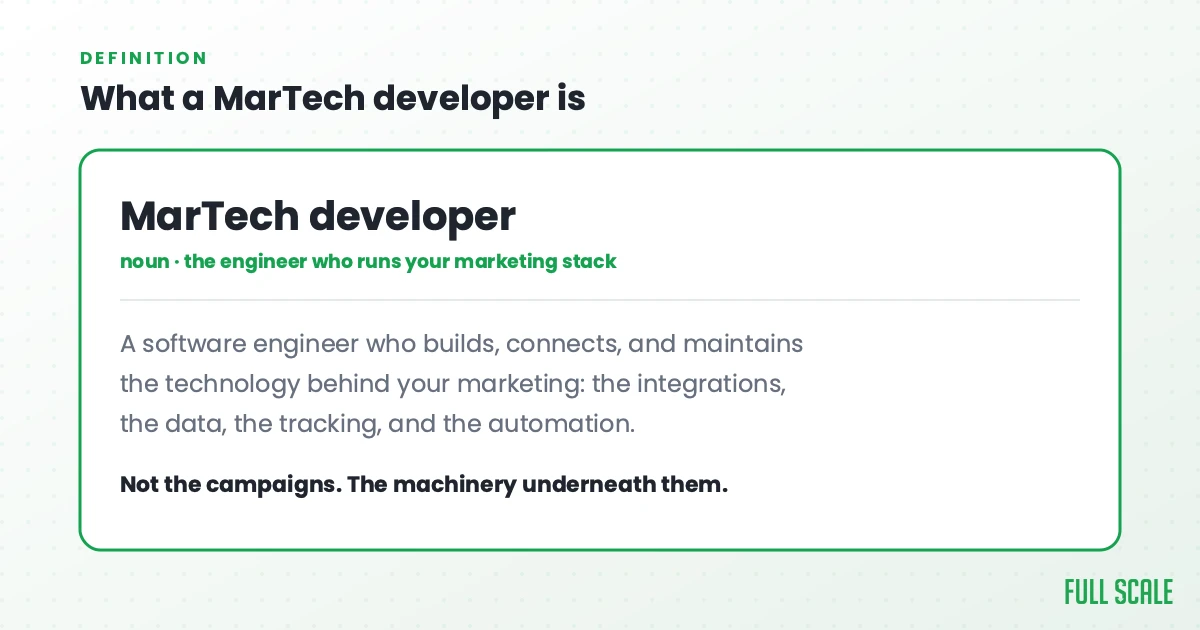
A MarTech developer is the engineer who owns the code side of your marketing. Their domain isn’t the words, the campaigns, or the brand; it’s the machinery underneath all of it: the connections between your tools, the data moving between your CRM and everything it touches, the tracking, the automation, and the pile of AI agents your team keeps wanting to bolt on.
The offer and the headline get the applause. They’re also the small part. Most of what decides whether a campaign works is the stuff nobody sees: did the lead land in the CRM, did the event fire, did the automation trigger on the right trigger, does the number on the dashboard mean what everyone in the room assumes it means. In my experience that unglamorous layer is where the time and the revenue leaks go, and it is engineering, so it wants an engineer.
Here’s where their hours tend to go:
- Connecting tools that were each built to think they’re the center of the universe, so your data stops falling through the cracks between them.
- Standing up tracking and attribution you can actually trust when you’re deciding where the budget goes.
- Pushing automation past the point where the drag-and-drop builder gives up, which in my experience is right about when you reach the thing you actually needed.
- Building small internal tools and AI agents that quietly retire SaaS subscriptions you’d otherwise rent for the rest of your life.
One warning about titles, because the market is genuinely sloppy here. A MarTech developer and a MarTech engineer are the same job wearing two name tags. A marketing technologist or a marketing operations person is usually next door but not the same. They live inside the tools and run the campaigns, but they don’t ship code.
Then there’s “marketing engineer,” which can mean either of those depending on who wrote the job post. Read the responsibilities, not the label. If the work includes fixing a broken API call at 9pm, you want the one who writes code.
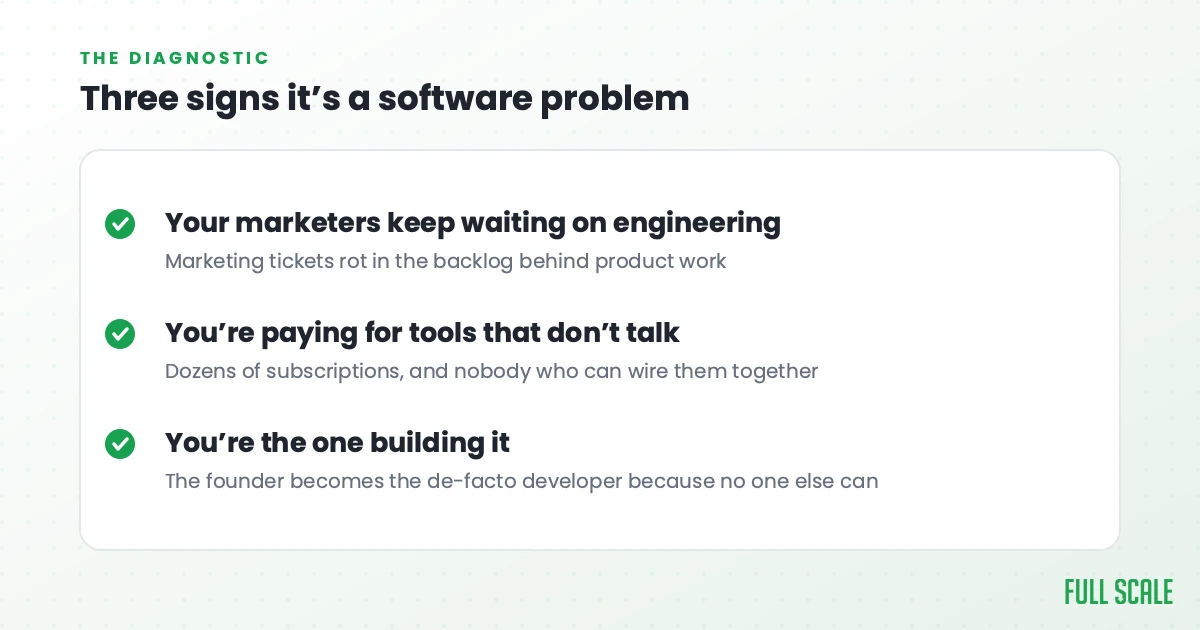
Do you need one? Three signs it’s a software problem
Most companies never actually decide to hire for this. They hit a wall, assume it’s a marketing wall, throw a marketer at it, and stay stuck. Here are the three signs the wall is made of software.
Your marketers keep waiting on engineering
Marketing needs a tracking pixel, an integration, a quick report. They file a ticket. The ticket drops into the engineering backlog and sits there behind the product roadmap, where it will sit approximately forever, because product work ships the thing customers pay for and a marketing pixel does not.
So the campaign goes out half-instrumented, or late, or not at all. This is the most common version, and it’s structural. Marketing’s software needs are real, and they lose every fight for engineering time against work that will always outrank them. Someone dedicated to the marketing stack ends that standoff.
You’re paying for tools that don’t talk to each other
Go look at what marketing is expensing. Scott Brinker’s landscape now counts more than 15,000 martech tools, and plenty of companies are paying for dozens at once, some of them well past a hundred. Each one solved a real problem on the day it was bought. Each one assumes it sits at the center of everything.
None of the value lives in a single tool. It lives in getting them to share data, which is precisely the part no vendor will build for you, since it means playing nice with their competitor. So you end up with sprawl: subscriptions lashed together with a couple of Zapier zaps and some good intentions, and nobody on the marketing team who can make the whole thing behave like one system. Working out what to build versus buy here, and then building the connective tissue, is a developer’s job.
You’re the one building it
This is the sign I know best, because it’s my own story. I’m Matt Watson), and I’ve started four companies. At VinSolutions, the automotive CRM I co-founded and later sold, I kept ending up as the person who wired the marketing technology together, mostly because I could write code and the work would not do itself. That experience is most of the case for how to build a custom CRM instead of buying one when off-the-shelf doesn’t fit.
It never really stopped. At Full Scale I’ve built our marketing software instead of buying it. One internal tool finds warm leads on LinkedIn. Another watches which of our pages rank in Google and which ones actually earn their keep. I built an AI system that drafts a big chunk of our marketing content, too. None of that arrived as a SaaS subscription. I built it because I could, and because the off-the-shelf versions either didn’t exist or didn’t fit.
I’m not telling you this to show off my weekend hobbies. I’m telling you because I am the most expensive possible way to solve this problem.
When the CEO is moonlighting as the MarTech developer, the role is real and unstaffed, and the company is paying for it in the highest salary in the building doing plumbing. If that’s you, the answer isn’t to get better at plumbing.
One honest caveat before you go hiring. If you read all three signs and none of them sting, you probably don’t need a dedicated MarTech developer yet. A lean stack held together with a few automations is completely fine right up until it isn’t, and hiring ahead of that pain just buys you an underused engineer. Wait for the wall.
The trait that decides the hire isn’t on the résumé
You’re not looking for a marketer who dabbles in code, and you’re not looking for a backend engineer who has never opened a CRM. The person you want lives in the overlap, and that overlap is narrower than the job market pretends.
The competence is table stakes: comfort in JavaScript and TypeScript plus a backend language, real scars from REST APIs and webhooks, enough SQL to chase down why a report is lying to you, and hands-on time with a customer data platform and a marketing automation tool. If they can wire an AI API into production and also tell you when not to, better still.
But the thing that actually decides whether the hire works isn’t on that list. It’s whether they’ll talk to your marketers. The book I wrote is basically one long argument that software is about communication before it’s about code, and this role is the proof. A MarTech developer who treats marketing as a ticket queue and never asks what they’re really trying to do turns into an expensive button-pusher, and button-pushers don’t move the number you hired them to move.
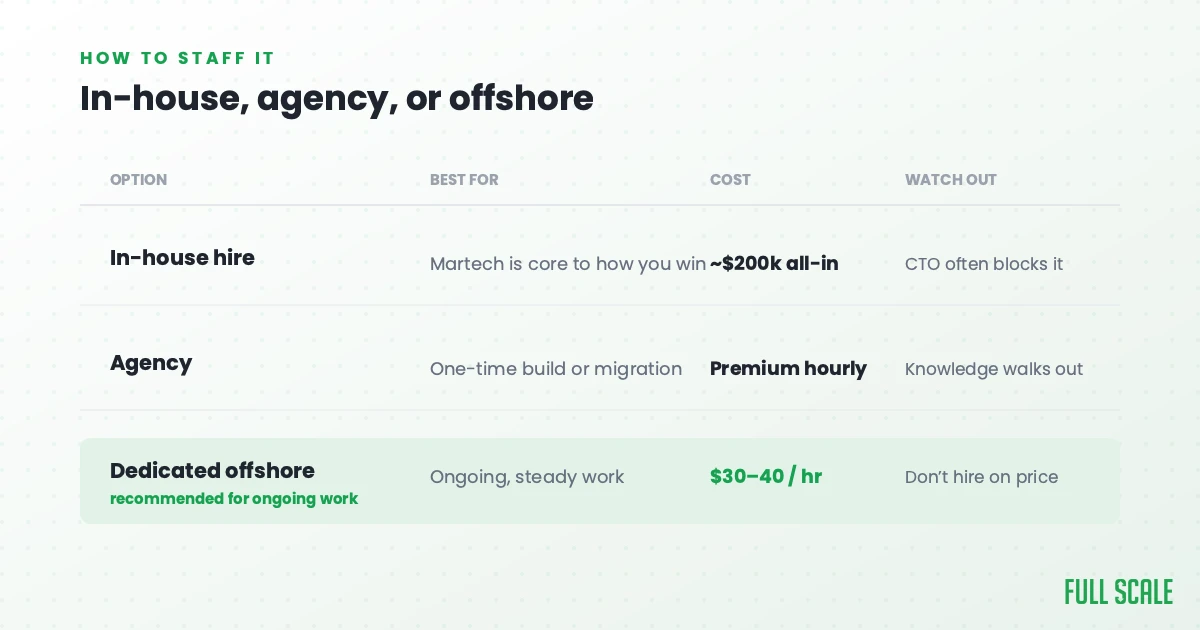
How to staff the role: in-house, agency, or offshore
Once you accept the role is real, the question becomes how to fill it. There’s no single right answer. The honest one turns on whether the work is a steady drumbeat or a one-time push.
| Your situation | Best fit | Why |
|---|---|---|
| Ongoing work, martech matters but isn’t your product | Dedicated offshore developer | Continuous, embedded, far cheaper than a US hire |
| Martech is a core differentiator | In-house full-time hire | Worth the premium to have them in every standup |
| A one-time build or migration | Agency or fractional | Senior help for a fixed scope, then they leave |
The in-house route is the move when your marketing stack is genuinely part of how you win, and you want the person sitting in every standup. It costs, though. A MarTech engineer in the US averages around $114,000 a year, and a strong senior developer runs higher than that on base alone. Load in benefits, taxes, and overhead at the usual 1.25 to 1.4 times base, and the all-in number lands near $200,000. For a lot of companies that’s the exact hire a CTO quietly declines, because the same engineer sails through approval for the product team and stalls the moment marketing asks.
An agency is the right tool for work with a finish line: a site launch, a platform move, a one-off attribution cleanup. You rent senior talent fast and skip the management overhead. It’s a poor fit for the steady drumbeat, though, because the people cycle off and take everything they learned about your stack with them, and you keep paying launch prices for what is really upkeep.
For the steady version, which is most of the time, I’d reach for a dedicated developer offshore. Most of this work is API-driven and breaks into chunks you can hand off, which is why it holds up across a time-zone gap. The conditions are simple: keep a few hours of daily overlap, and bring the developer onto the team instead of lobbing tickets over a wall. The failure mode here has a name I use for it, cheapshoring: shopping on price alone and getting precisely what you paid for. Skill first, geography second. A strong engineer who lives somewhere cheaper is a bargain; the cheapest engineer anywhere is a bill you pay later. That developer bills somewhere around $30 to $40 an hour, against the ~$200,000 all-in of the US version.
That’s the model we run at Full Scale. The developer becomes a fixture on your marketing team, carrying the same targets everyone else does. Because they aren’t rotating off in ninety days, they get to know your stack well enough to move fast in it. How we assemble that team is spelled out on our marketing software development page, and it’s one slice of what we do under staff augmentation.
If you want the backstory on how marketing quietly became an engineering job in the first place, I covered that shift separately. This post is the role. That one is the reason it exists.
Frequently asked questions
Do I need a MarTech developer or a marketing operations person?
If the work is configuring tools, running campaigns, and keeping platforms tidy, a marketing operations person or marketing technologist covers it. If the work includes fixing broken integrations, building custom tracking, or writing internal tools, you need a MarTech developer who actually ships code. Larger teams eventually want both.
What’s the difference between a MarTech developer and a marketing technologist?
A MarTech developer writes code. A marketing technologist usually configures and operates the tools without coding. Both are valuable, but only the developer can repair a broken API integration or build something new from scratch when no vendor sells it.
How much does a MarTech developer cost?
In the US, an in-house MarTech engineer averages around $114,000 a year, and the fully loaded cost climbs toward $200,000 once you add benefits and overhead. A dedicated offshore developer of similar skill typically bills in the $30 to $40 an hour range, which is why ongoing martech work so often gets staffed offshore.
Should I hire a MarTech developer in-house or offshore?
Match it to the workload. In-house makes sense when the marketing stack is core to how you compete and you need the person in daily standups. Offshore fits the ongoing, steady work better on cost, as long as you keep real overlap hours and hire for quality rather than the cheapest rate.
The bottom line
The role is real, and now it has a name. The reason most companies miss it is that a broken marketing stack looks exactly like a marketing problem, right up until you notice the person patching it keeps turning out to be an engineer.
Most leaders can’t and shouldn’t run their own marketing stack the way I have. That’s the whole point. You need this capability held by someone whose actual job it is, not borrowed from the product roadmap and not improvised at the top of the org chart.
Behind every marketing team that ships, there’s a developer keeping the machine running.
If you want help staffing one, book a discovery call.