The Staff Augmentation Process: What Actually Happens After You Say Yes

In this article
- The staff augmentation process forks in the first week
- Interview the people joining your team, because most vendors won’t let you
- Sign fast, and save the real scrutiny for the rate
- Onboard them like a new hire, because that’s what they are
- You run the team day to day, and we stay out of the way
- The engagement keeps running after onboarding ends
- Frequently asked questions
- Get the process, skip the flowchart
Every vendor in this space has the same flowchart on their website. Nine boxes, some arrows, “Identify Needs” in box one and “Offboard” in box nine. I’ve looked at a dozen of them writing this, and I’m fairly sure they all trace back to the same PowerPoint template from around 2019 that nobody’s had the heart to update since.
I’m not going to give you box ten. Full Scale has made more than 700 of these placements across 200-plus companies on my watch, and the flowchart is beside the point. This isn’t a niche way to staff a team, either. US staffing companies placed 12.7 million temporary and contract workers in 2023 alone. The steps aren’t the hard part. Almost every vendor does “identify needs” and “sign contract” and “onboard” in some order. What decides whether the engagement works sits inside two of those boxes, and most vendors would rather you didn’t look too closely at either one.
The staff augmentation process forks in the first week
Once you’ve picked a partner, the engagement splits onto one of two paths, and which path you’re on gets decided before you’ve had a single standup.
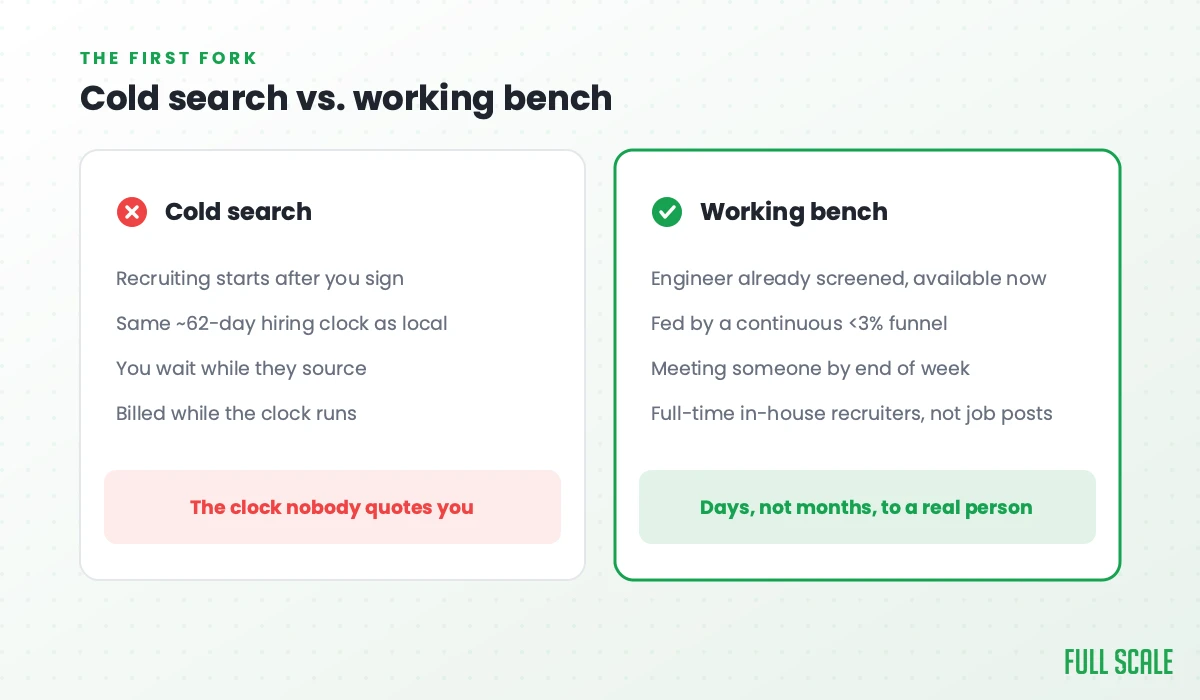
- Path one: the partner already has your kind of engineer, working today, on a bench. You describe the role, they check who’s available, and if there’s a fit, you’re meeting a real person by the end of the week.
- Path two: the partner starts recruiting after you sign. They post the role, or their recruiters start reaching out, and now you’re waiting on the same hiring timeline you were trying to avoid by not doing this yourself.
US tech roles take roughly 62 days to fill on average when you’re sourcing from scratch, and a cold offshore search runs on a similar clock. A vendor without a bench doesn’t erase that math. They do the waiting for you and bill you while you wait.
Why Full Scale usually has someone already
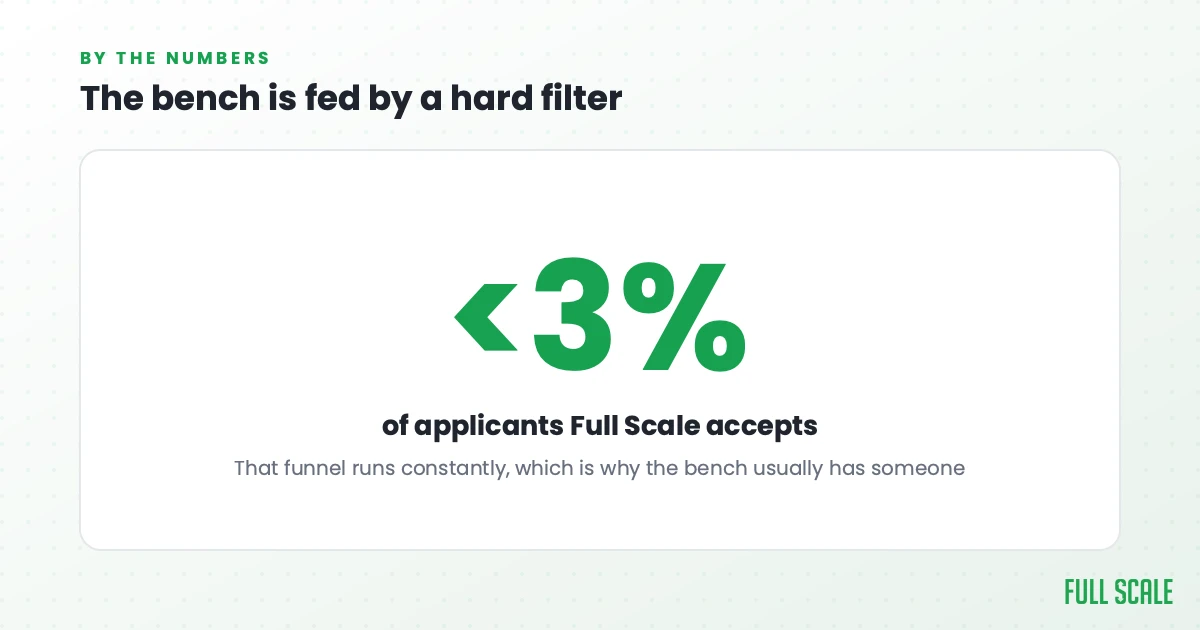
The bench isn’t decoration. We run full-time in-house recruiters. Their entire job is finding good engineers who aren’t looking, the ones already employed, not browsing job boards. We accept fewer than 3% of the people who apply. That funnel runs constantly, not just when a client signs, which is why a bench match is the common outcome rather than a lucky one.
It’s not always a clean either-or. Sometimes it’s a bench engineer for one role and a fresh search for a specialty the bench doesn’t cover that week. When there’s a genuine gap, the same recruiters who built the bench go find someone, and that’s a different search than a vendor posting a job cold. It starts from a warm list of people we already know are good, not a stack of inbound applications. Compare that to a traditional recruiting agency’s placement fee, typically 15 to 25% of a first-year salary, buying you the same slower search.
Neither path is a scam. A lot of the “recruit after you sign” vendors are honest about it, if you ask. The problem is almost nobody asks, because the sales conversation is built to make both paths sound identical. Ask any vendor directly whether they’re staffing you from a working bench or starting a search once you sign. It’s a two-minute question, and the answer changes your timeline by weeks.
Interview the people joining your team, because most vendors won’t let you
Say the bench has your person. This is the fork that decides whether the whole thing works.
Some vendors screen candidates, pick the best fit, and hand you their start date. You meet them on day one, on your team, with no say in the decision. Other vendors, and this is the Full Scale model, let you interview every offshore engineer and approve them before they join. You still get someone who already cleared a real screening process. You just also get a veto.
I’ve watched both versions play out across a thousand-plus placements, and the difference isn’t subtle. Skipping the interview is buying the mystery box on a marketplace app, except this mystery box costs six figures a year and shows up in your Slack every morning.
Sometimes it’s great. When it isn’t, you’re stuck managing someone you never chose, for a contract term you did.
Ask a vendor why they don’t offer this, and the honest answers cluster into three. It slows down their placement numbers. They’d rather you not see how thin the screening actually was. Or the bench is smaller than the sales deck implies, and an interview would surface that. None of those is a reason you should accept.
If your candidate doesn’t pass your interview, that’s not a failed placement, it’s the process working. A good partner takes the feedback, goes back to the bench or the search, and brings you someone else, at no cost to the week you’ve already spent. Full Scale’s own screening cuts the applicant pool down hard before you ever see a resume, and the interview is the last check on top of it, run by you, not us.
If you want the mechanics of running a good technical interview instead of a whiteboard ritual nobody’s used since 2015, how to interview a software engineer covers what to ask and why most of the traditional questions stopped working. This is the one step in the process worth slowing down for.
Sign fast, and save the real scrutiny for the rate
Once you’ve approved someone, the contract itself should be the boring part.
At Full Scale, the terms are simple by design: a two-week money-back guarantee if it’s not working out, and after that, 30 days’ notice to cancel with no long-term lock-in. That’s the whole exit ramp. Read the longer version too, payment terms, intellectual property (IP) ownership, how rate increases work, before you sign anything, not after. I wrote up the contract terms that matter after watching one client try to force a staffing deal into a contract built for buying popcorn machines.
Don’t repeat that.
The mistake at this stage is chasing the lowest number on the page and assuming the rest holds constant. It rarely does. I call hiring the cheapest developer you can find cheapshoring, and the vendors who skip the bench and skip the interview step are very often the same ones competing hardest on rate. Vetting costs money. Cutting it is how you get to a lower number.
Onboard them like a new hire, because that’s what they are
The engineer starts. This is where a lot of the theoretical savings from the last two steps either gets banked or quietly evaporates.
The date a vendor quotes you is the wrong clock to watch. “As little as seven days” measures when someone shows up with a laptop and a login, not when they’re actually moving your roadmap. Full onboarding, real access to the codebase, the docs, the standups, someone walking them through the architecture, usually runs about two more weeks on top of that start date. Skip it and you pay the ramp-up cost twice: once now, badly, and once later when you redo the onboarding you should have done the first time.
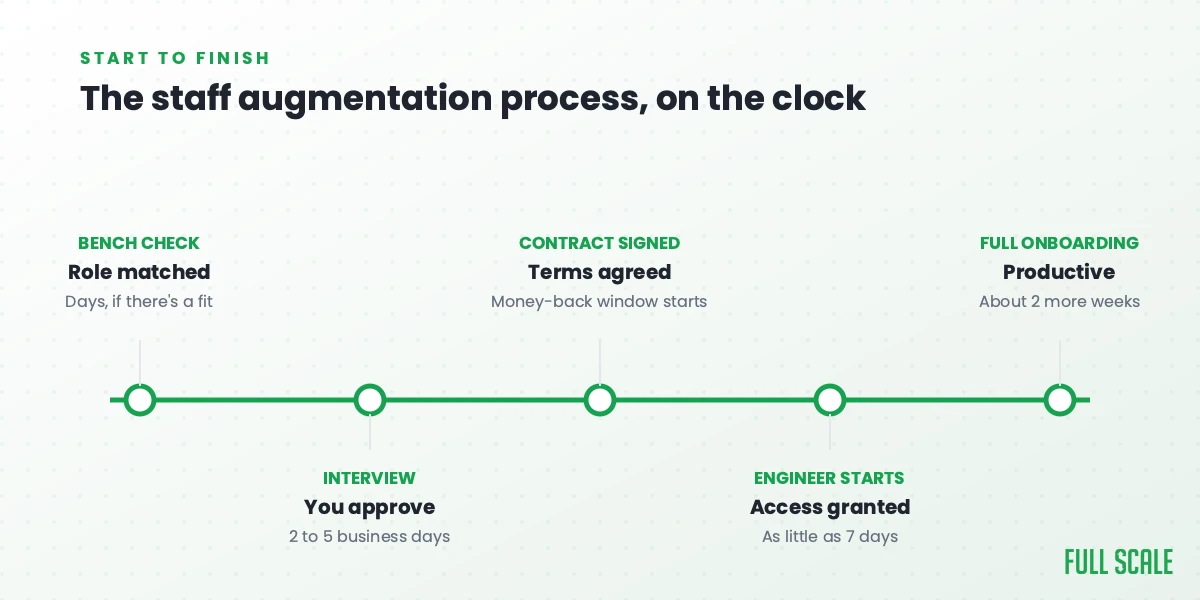
Here’s roughly how the timeline breaks down, start to finish:
| Step | What’s happening | Typical timeframe |
|---|---|---|
| Bench check | Partner matches your role against who’s available now | Days, if the bench has a fit |
| Interview and approval | You interview the candidate and approve or reject | 2 to 5 business days |
| Contract signed | Terms agreed, money-back window starts | Days, once terms are settled |
| Engineer starts | First day, access provisioned | As little as 7 days from approval |
| Full onboarding | Codebase, docs, standups, architecture walkthrough | ~2 more weeks |
| Ongoing management | Daily standups, monthly checkpoints | Continuous for the life of the engagement |
Treat the first ninety days like an investment, not a formality, and the rest of the engagement gets a lot easier.
You run the team day to day, and we stay out of the way
This is the part of the process people get backwards, and it’s the one that defines staff augmentation as a model.
Once the engineer or the team is onboarded, they work inside your standups, your Slack, your sprint planning, reporting to your leads, not to us. There’s no vendor project manager translating your requirements into tickets and reporting status back up a chain you never see. That middleman layer is what made a generation of engineering leaders hate project outsourcing. There’s no middleman in between on a real staff augmentation engagement, and the developer cares about your product the same way an in-house engineer does. Removing that layer is what makes the model work.
What the Customer Success Manager does
Full Scale still has a Customer Success Manager on every account, and that role deserves a precise description. The CSM doesn’t sit between you and your developers as a layer. Think of it as a monthly checkpoint: a place to raise something before it becomes a real problem, and an escalation path if something needs fixing. The direction, the priorities, the management itself, all of that is yours.
If you want a model where someone else runs the team and hands you results on a schedule, that’s managed services. It’s a real, legitimate category, and it’s the right call when nobody on your side has the bandwidth to run daily standups for a second group, or when you’d rather have one vendor accountable for an outcome than a team you have to direct yourself. Where it breaks down is a product roadmap that changes every quarter: you can’t write a fixed SLA around a plan that’s supposed to keep changing. Read the comparison before you assume that’s what you’re buying.
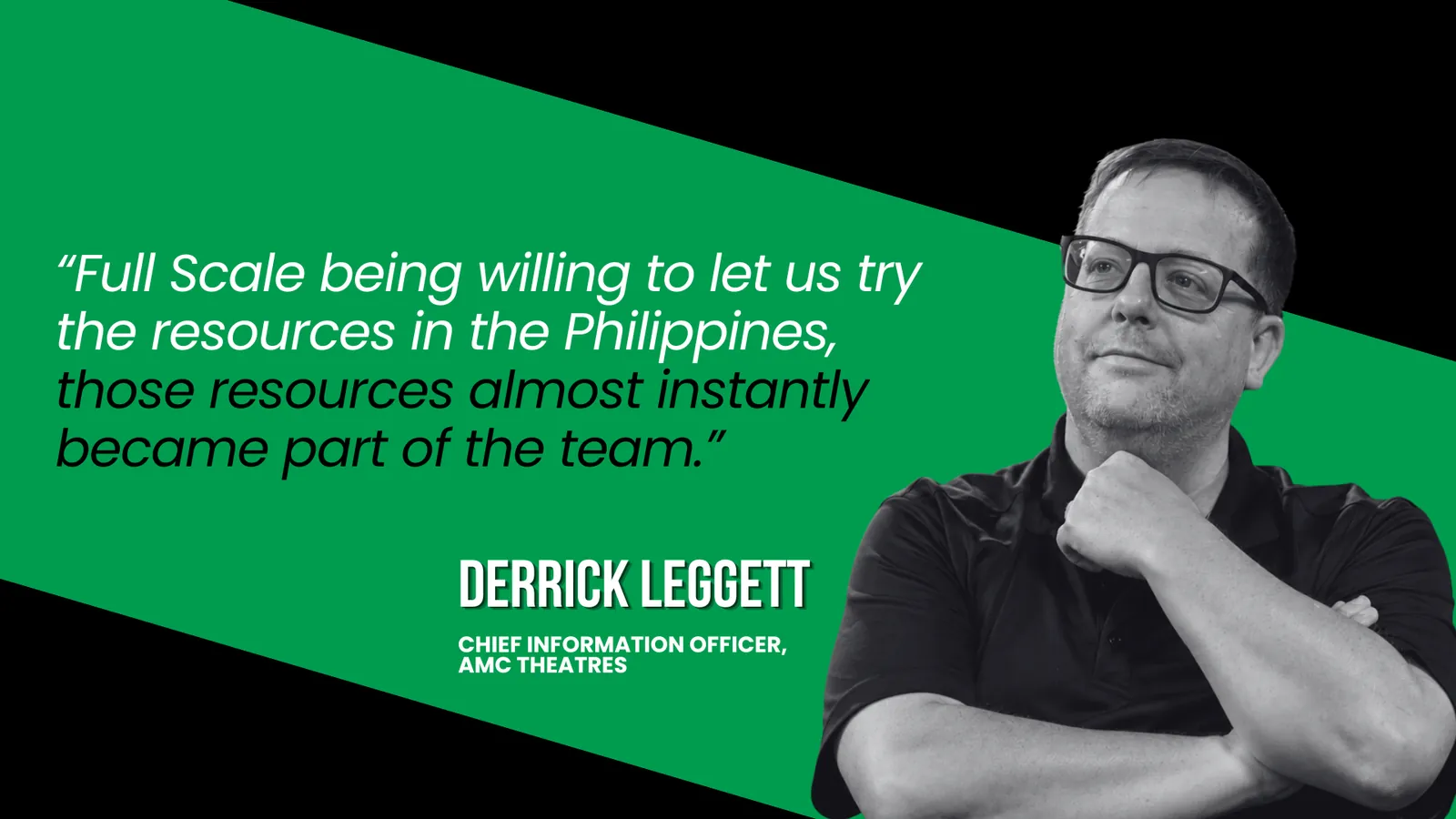
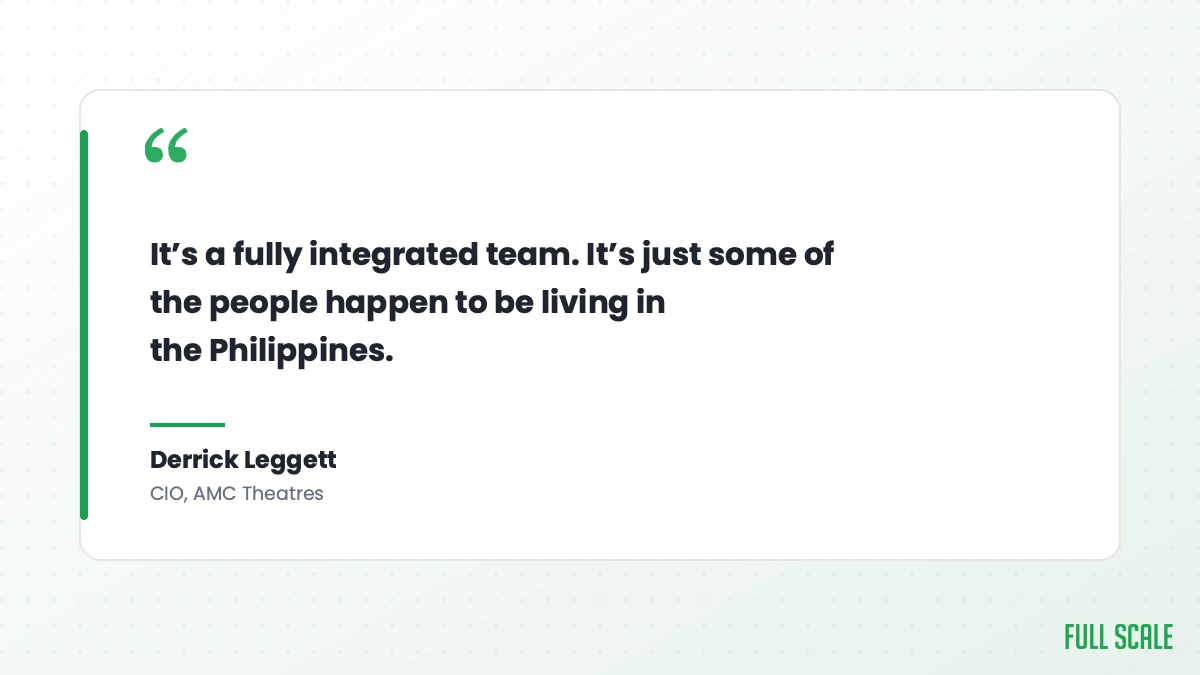
AMC Theatres is the clearest example I have of the direct model working at real scale. Derrick Leggett, their CIO, put it better than I could:
It’s a fully integrated team. It’s just some of the people happen to be living in the Philippines.
Derrick Leggett, CIO, AMC Theatres
The developers are yours to run. We just make sure they’re good, and that they stick around.
I wrote an entire book about treating engineers like part of the product team instead of rented hands, called Product Driven, mostly because I got tired of watching companies undo the value of a good hire by managing them like a line item. Buy it or don’t. The short version is free: hire talent to work directly for you on a long-term basis, not just for a project, because that’s the formula.
The engagement keeps running after onboarding ends
Approval isn’t a lifetime warranty. Even a good interview process doesn’t guarantee a perfect fit six months in, and a real process has an answer for that beyond hoping it never happens. What that answer actually costs you in time and money, and what’s fair to ask a vendor for when a swap is needed, is a contract question more than a process question, so I answered it in detail in the contract terms piece linked below rather than repeat it here.
Short of a swap, the rhythm that keeps a healthy engagement healthy is boring: daily standups, a monthly checkpoint, and someone on your side actually watching whether the work is landing. Software development is about communication more than anything else, and that doesn’t stop being true once the team is up and running. Go quiet for a few months, and you’ll eventually be furious about something that was fixable in week one.
The flexibility built into the contract terms keeps running too. Thirty days’ notice means you can scale the team up when the roadmap demands it and down when it doesn’t, without renegotiating anything every time your headcount needs change.
Retention is the single number that tells you whether all of this is actually happening the way it’s supposed to. Full Scale’s runs above 93%, and it lines up with an independent Great Place to Work certification two years running, a separate survey of the same employees asking a simpler question: do you like working here. A vendor with a revolving door is running a different process than this one, and it looks exactly like the flowchart on their website: same steps, no substance behind them.
Frequently asked questions
What is the staff augmentation process?
It’s the sequence from picking a vendor to running a team day to day: checking whether the vendor has your kind of engineer on a bench or needs to recruit, interviewing and approving the candidate, signing straightforward terms, onboarding them like a new hire, then managing them directly while the vendor handles recruiting and retention in the background.
How long does the staff augmentation process take before someone is productive?
The start date isn’t the useful number. An engineer can join as little as seven days after approval if they’re coming off the bench, longer if the vendor had to recruit. What that date doesn’t include is full onboarding, real codebase access and an architecture walkthrough, which typically adds about two more weeks before they’re genuinely moving your roadmap.
Do I get to interview staff augmentation candidates before they join my team?
You should, and if a vendor won’t let you, that’s worth treating as a warning sign rather than a formality. At Full Scale, every candidate is interviewed and approved by the client before joining. Vendors who just assign you whoever’s next available are asking you to skip the one step that actually protects you.
Who manages the team once the engagement starts, the client or the vendor?
The client does. Staff augmentation puts the engineer inside your standups, your Slack, and your reporting structure, working for your leads directly. The vendor’s role at that point is recruiting, screening, retention, and a periodic checkpoint, not day-to-day direction. If the vendor is managing the work itself, that’s a managed services arrangement, not staff augmentation.
What happens if the engineer I approved isn’t working out six months in?
You swap them, not restart the whole process. The specific terms, notice period, cost, and what a handoff actually looks like, are covered in the contract terms piece rather than repeated here.
How do I end a staff augmentation engagement?
With notice, not drama. At Full Scale, that’s a two-week money-back window if it’s not working out early, and 30 days’ notice after that with no long-term contract. Scaling the team down should be as simple as scaling it up.
Get the process, skip the flowchart
The nine-box version isn’t wrong, it’s marketing copy dressed up as a diagram. The real process comes down to two questions worth asking before you sign anything: is this person coming from a working bench or a cold search, and do you get to interview them or just meet them. I’ll be honest that those happen to be the two questions Full Scale is built to answer well, that’s not an accident, but they’re also the right two to ask of any vendor, not just us. Everything else, the contract, the onboarding, the day-to-day management, works fine once those two are answered honestly.
If you want a team built that way, let’s talk.