90% of Software Development Talent Lives Outside the US. Here’s How to Hire It.

In this article
- The talent isn’t scarce, you’re just looking in the most crowded room
- AI raised the bar on developers, it didn’t make them optional
- I’ve hired developers on four continents, and the lesson stuck
- Why a developer in Manila costs a fraction of one in San Francisco
- Where the software development talent actually is, and why the Philippines wins for US teams
- How to hire it without getting burned
- The time zone objection is mostly a scheduling choice
- At AMC, the Philippine developers are simply part of the team
- Frequently asked questions
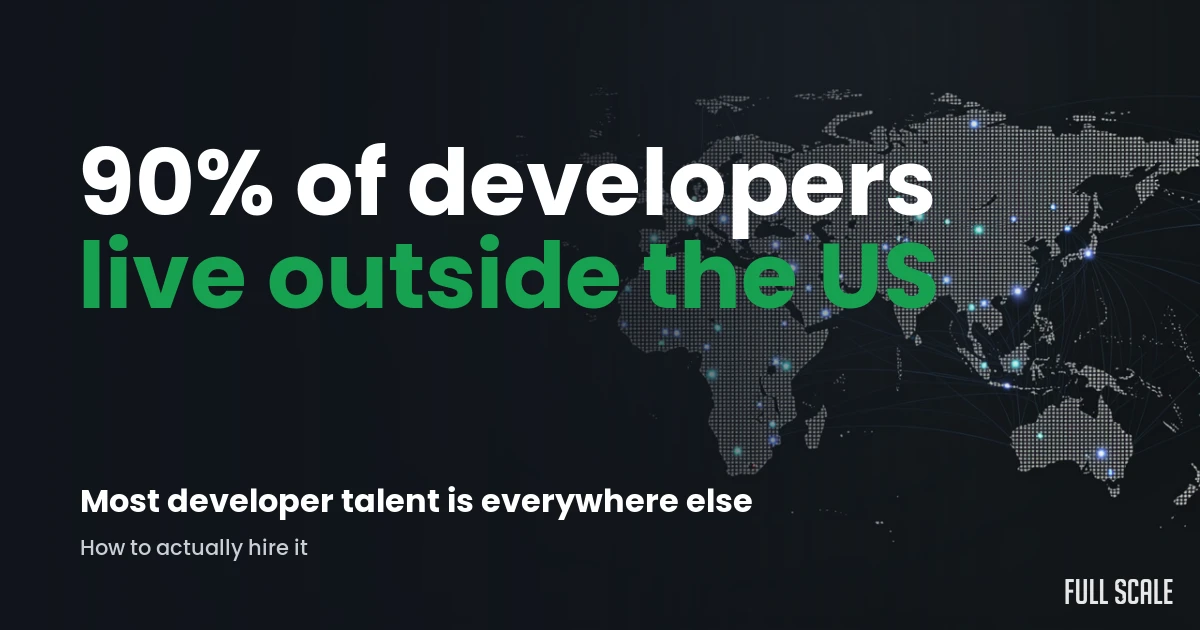
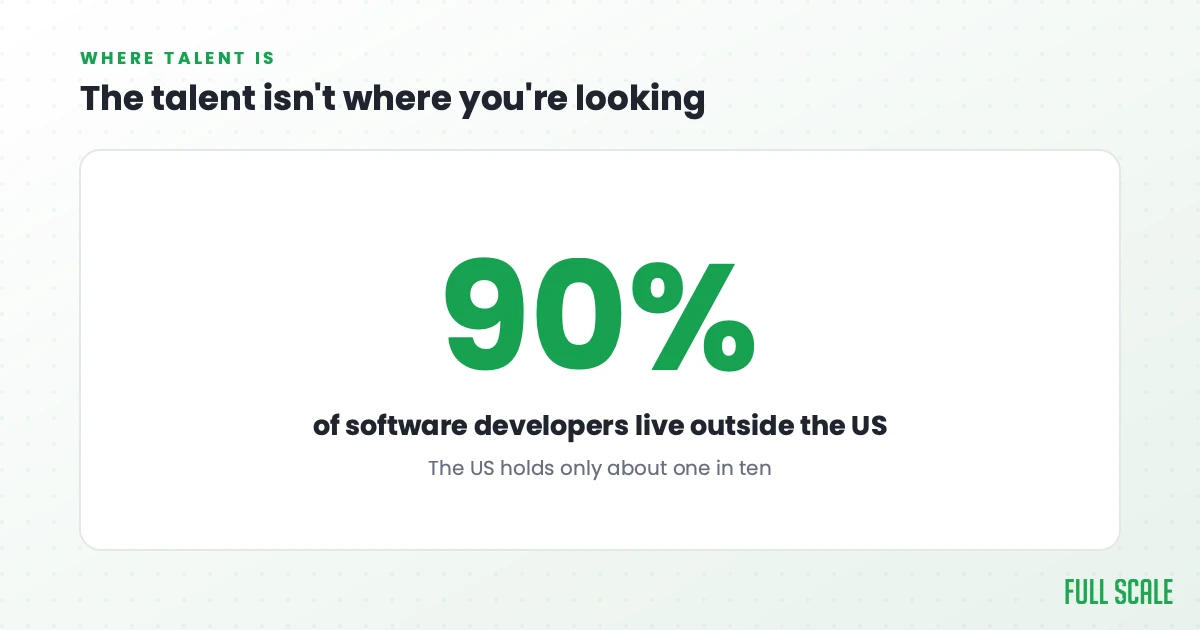
The United States is the single largest developer hub on the planet. It also holds only about one in ten of the world’s software developers.
Both of those things are true at the same time, and the gap between them is the whole story. GitHub’s most recent Octoverse report counts more than 180 million developers on the platform, with the US as the top country and India already the largest base of open-source contributors and on track to lead the total developer population by the end of the decade. SlashData puts the global developer population around 47 million. Run the US headcount against either number and you land in the same place. The gap is sharpest when you’re hiring .NET talent in India rather than the Philippines.
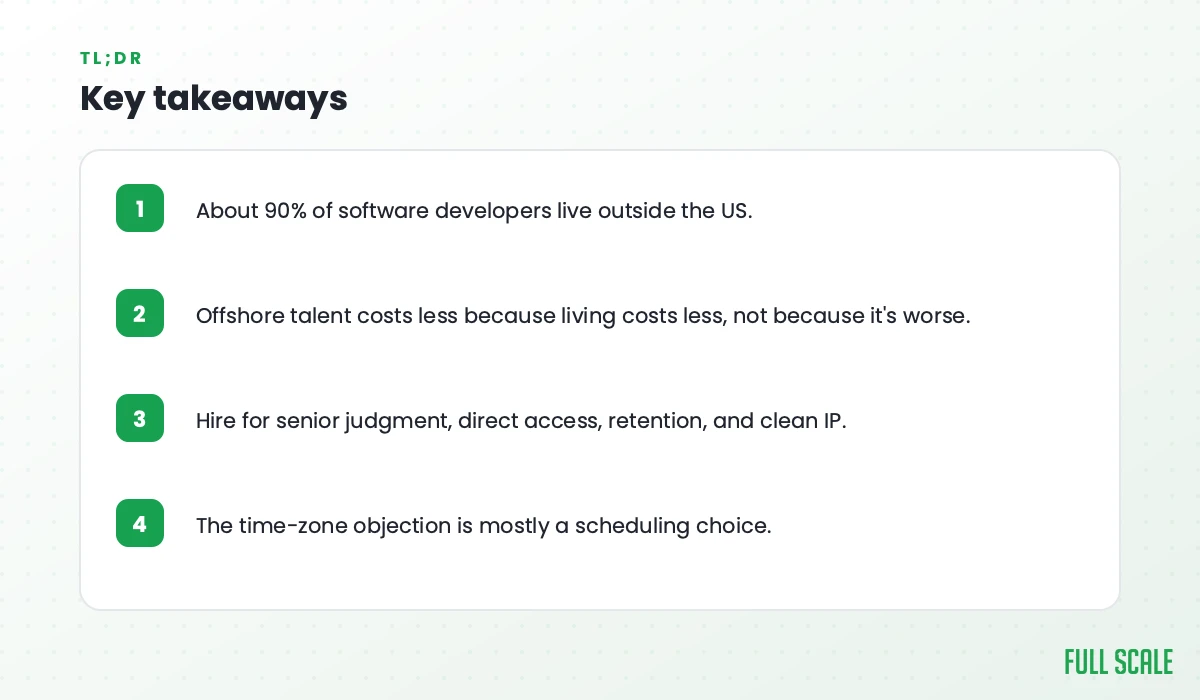
Roughly nine in ten of the world’s software development talent sits somewhere other than the US.
I’ve spent two decades building software companies, and for most of that time I watched founders treat the local hiring market like it was the only one. They’d post a role, wait three months, fight over the same shortlist of expensive engineers everyone else in town was chasing, and call the result a talent shortage. It isn’t a shortage. The software development talent is out there, just not where most people are looking for it. It is also why we judge the best IT companies in the Philippines on communication and quality, not price. That holds even for the scarcest specialties: the engineers behind VR development are some of the hardest hires in software, and they do not all live in your city. If India is where you’re looking, start with what to check before you hire developers in India.
The talent isn’t scarce, you’re just looking in the most crowded room
When people say they can’t find developers, what they usually mean is they can’t find developers in their zip code at a price they like. That’s a real frustration. It’s also self-inflicted.
There’s a whole narrative about a developer shortage that gets repeated every year, and the version that’s true is narrower than the headlines. Senior engineers in a few US metros are genuinely hard to hire and expensive to keep. The rest of the world is full of people who write excellent software. Supply was never the real constraint. Most companies just chose to hire within driving distance of the office.
Remote work knocked that constraint over and most of us already know it. The companies that adjusted fast hired from the other 90% of the map. The ones still trying to recruit software engineers from the local shortlist are the ones complaining. That access to talent is now the biggest driver of why companies outsource software development in the first place. It is the talent shortage behind IT outsourcing that no visa fee or tariff can fix.
AI raised the bar on developers, it didn’t make them optional
By now someone is thinking the obvious 2026 objection. If AI writes the code, why hire more developers at all, let alone overseas?
It’s a fair question, and the answer is that AI changes the kind of developer you need without making developers optional. The hard part of building software was never typing the code. It’s understanding the problem you’re trying to solve, and AI is good at the first thing and useless at the second. So-called vibe coding only works if you’ve written enough software to know when the AI is wrong. Pure coders will be replaced by it. The people who can frame a problem, weigh a tradeoff, and own the result will be the ones running engineering teams.
That shift actually strengthens the case for hiring globally. The thing that’s now scarce isn’t hands on a keyboard, it’s judgment, and judgment is spread across the whole world. The developer population is growing fastest outside the US, and India recently passed the US as the largest contributor base on GitHub on the back of exactly this change.
I’ve hired developers on four continents, and the lesson stuck
This isn’t a thought experiment for me. At my last company, Stackify, I hired developers in Russia, Uruguay, Colombia, and the Philippines, with different levels of success in all of them. Python has the largest developer pool of any language, which is why offshore Python development is often the fastest path to scaling a Python team past the local talent ceiling. That experience extends to framework-specific hiring: for offshore Rails teams, the Philippines delivers engineers who stayed with the framework through its maturation and know it at a depth that shows in production code. That depth is exactly what you get when you hire dedicated Django developers instead of generalists who picked it up last quarter.
The first one was an accident. Back in 2012, I hired through a friend’s dev shop and only later realized the team was in St. Petersburg. I was paying Kansas City rates for developers I assumed would be local. The English was strong, the work was excellent, and we kept them for years. That was the moment the geography stopped mattering to me.
Later I hired a firm in Uruguay for a side project and got something I’d never seen from an outsourcing relationship: a proxy product owner who could carry the vision when I didn’t have time to. Eventually I hired some of those developers directly. Then came the Philippines in 2018, when Stackify needed to support ten new programming languages and I could not afford ten more senior engineers in Kansas City, where the Kansas City software companies were all bidding for the same people. That team grew past twenty people, covered on-call while I slept thanks to the time difference, and worked so well that it turned into a separate company. That company is Full Scale.
There are smart people all over the world. That part has never been in question.
What separates a good global hire from a bad one comes down to whether you can actually communicate with the people writing your code, not which country they sit in. I’ll come back to that, because it’s where most of this goes wrong.
Why a developer in Manila costs a fraction of one in San Francisco
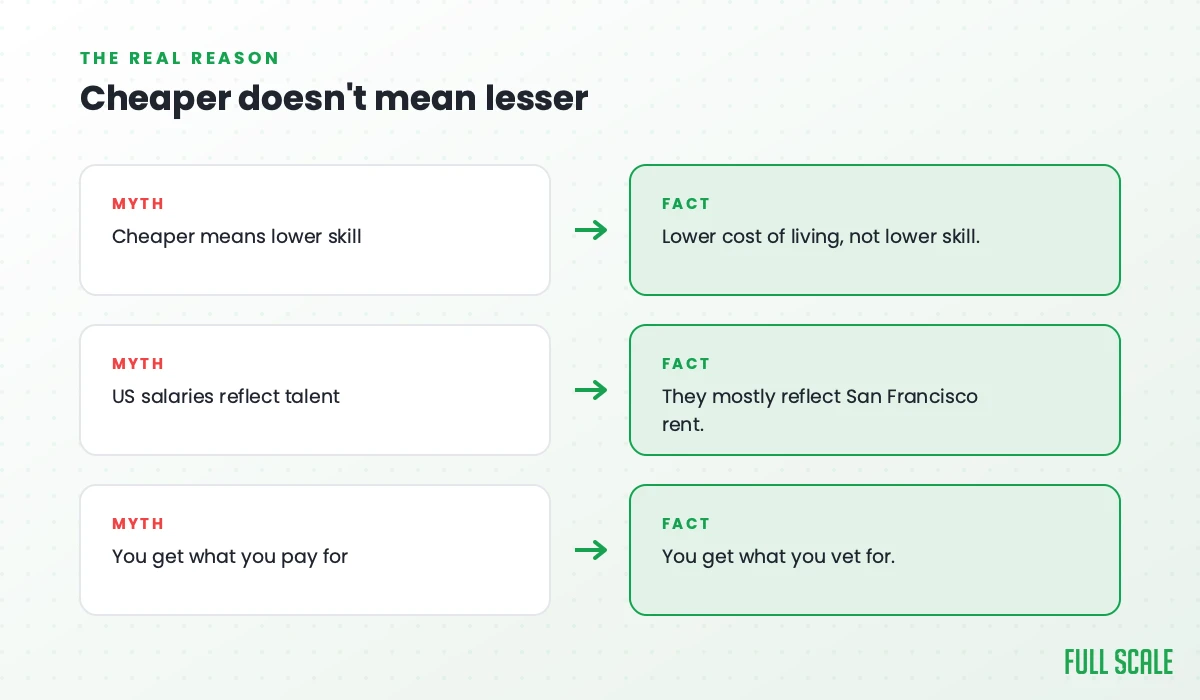
Here’s the part founders get backwards. They assume cheaper means worse, so a low rate must mean low skill. The rate is about where the developer lives, not how good they are. I’ve written the fuller, personal case for why hire Filipino developers specifically, beyond just the rate.
A senior developer in Manila costs a fraction of an equivalent engineer in San Francisco for the same reason a house in Manila costs a fraction of a house in San Francisco. The gap comes from the cost of living, and it has nothing to do with the quality of the work. The US Bureau of Labor Statistics puts the median US software developer salary around $133,000, and senior engineers in the major markets run well past that. Hiring globally can cut that 50 to 70 percent, and the work doesn’t get 50 to 70 percent worse. You’re arbitraging rent, not talent. I have run both sides of this, and the code my Philippine teams shipped held up against anything I built in Kansas City, at a fraction of the price.
But cost is also where companies sabotage themselves, so let me be blunt about the trap.
If the only reason you’re hiring offshore is to spend as little as possible, you’ll buy the cheapest thing on the market, which is a freelancer who vanishes mid-sprint or a project shop that bills for ten people while three do the work. I call this cheapshoring, and it’s how most people end up with one bad offshore experience that they swear off forever. Cost is a perfectly good reason to look abroad. It just can’t be the only one.
Where the software development talent actually is, and why the Philippines wins for US teams
Once you accept that offshore talent is on the table, the next question is where to point. A few regions do most of the work.
Latin America gives you near-total time zone overlap with the US, which matters for teams that want real-time collaboration all day. Eastern Europe has deep senior talent in places like Poland and Romania. South and Southeast Asia hold the largest pools by raw headcount, with India and the Philippines leading.
I’ve hired across most of these, and for US companies I keep coming back to the Philippines.
The reason is communication, and it’s not a small thing. The Philippines is the third-largest English-speaking country in the world. Filipino engineers speak English fluently, grow up steeped in American culture, and bring a working style that fits remote collaboration unusually well.
Software development is about communication more than anything else, and that’s exactly where most offshore engagements quietly fall apart. A developer who will speak up when the spec is wrong is worth more than one who’s a dollar an hour cheaper and stays silent.
That’s also why our team there stays put. Full Scale is Great Place to Work Certified in the Philippines, where 95 percent of employees call it a great place to work, compared to 65 percent at a typical company in the country. We hold developer retention around 93 percent, in a market where call-center attrition runs the highest of any industry. People who like where they work write better software, and they stay long enough to learn your product.
How to hire it without getting burned
This is the question that actually keeps engineering leaders up at night. They’re past wondering whether the talent exists. What they want to know is how to get that software development talent onto the team without inheriting someone else’s mess. There are four common ways to do it, and they are not equal.
You can recruit and hire individuals abroad yourself, which gives you full control and a full-time human resources, payroll, and compliance problem in a country whose labor laws you don’t know. You can use a freelance platform, which is fine for a one-off task and a disaster for long-term product work. You can hire a traditional outsourcing shop on a fixed-scope contract. Or you can use staff augmentation to add dedicated developers who work directly on your team, long-term, the same as your in-house engineers.
Staff augmentation isn’t the right answer for everyone. If you have no technical leadership in-house, nobody to set direction or judge the work, then adding developers to a team that can’t steer them just moves the problem around. A company in that spot needs a partner who owns the outcome, which is an outsourcing relationship, not an augmented team. You always need someone technical on your own side of the table.
The real decision underneath all of this is simpler than the menu makes it look.
You’re either buying a project or building a team, and software worth keeping is always a team.
A fixed-scope outsourcing contract makes sense for well-scoped work you won’t touch again, like a marketing site or a one-time integration. I’ve used outsourcing exactly that way and would again. But your core product is different. You’ll develop it for years, and that argues for people who stay, accumulate context, and care about the outcome. This is most of what my book Product Driven is about: great software comes from engineers connected to the product, instead of tickets thrown over a wall.
The middleman is how offshore actually fails
The classic way offshore goes wrong is the middleman. A lot of outsourcing firms put a technical project manager between you and the developers, and every engineer hides behind that one person. Sometimes it’s a language gap, sometimes it’s a rule about who’s allowed to talk to the client. Either way you end up with a team you can’t actually talk to and a translator standing in front of every decision. The developers who survive in that model are the ones who never have to defend their own work, which is not the trait you want to select for.
The fix is to hire people who sit on your team, join your standups, and answer to you directly. If you’re new to managing a distributed group, the mechanics of running an offshore team are learnable, and they matter more than which country you picked. Get the setup right and you end up with offshore developers your team will love instead of a vendor your engineers merely tolerate.
What to screen for when you can’t meet in person
You can teach a framework. You can’t teach whether someone will tell you the truth. The screen that matters most on a remote hire is communication: will this developer push back when the spec is wrong, explain a tradeoff in plain language, and say “I don’t understand this yet” instead of quietly guessing? I care about that far more than a clever answer on a coding test. It maps to what I call the three C’s in Product Driven, communication, curiosity, and courage, and it’s the part a take-home exercise never shows you.
A real partner also carries the parts of global hiring you don’t want to own: payroll, benefits, equipment, local labor law, and a contract that assigns the intellectual property to you. That is the line between hiring a person in another country and taking on a compliance project.

The time zone objection is mostly a scheduling choice
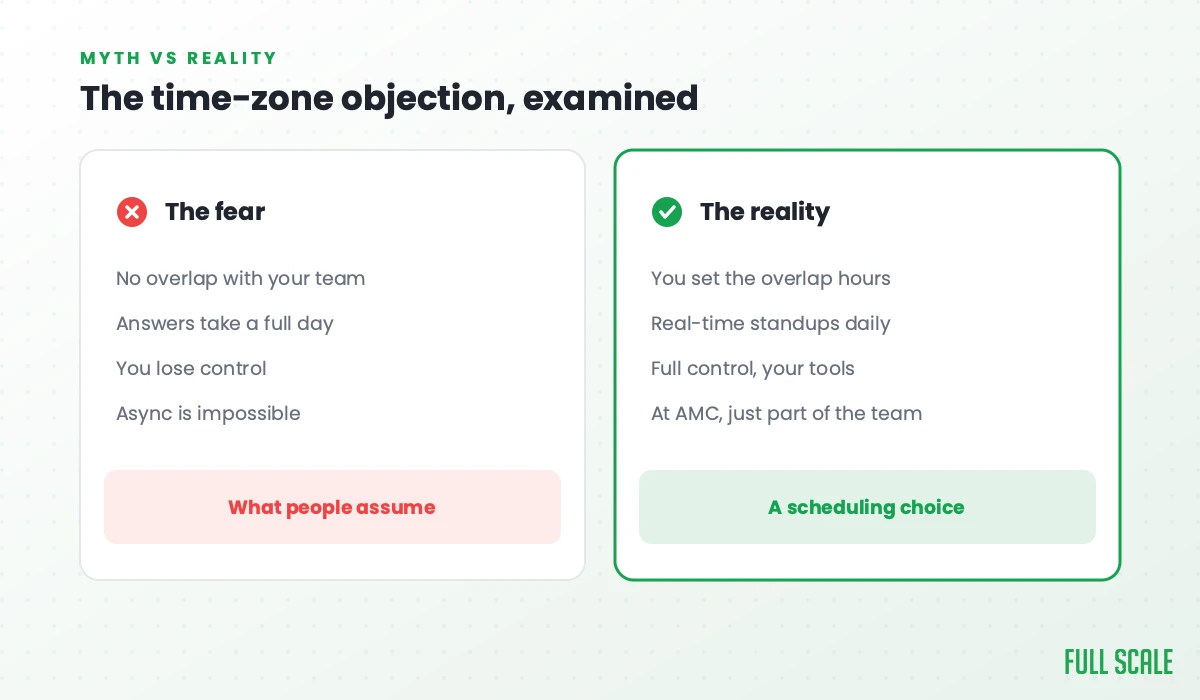
The most common reason people give for not hiring in Asia is the clock. It’s the easiest objection to take apart, because the time zone isn’t fixed by geography. It’s set by the shift you ask people to work.
At Full Scale we run three patterns, depending on what the role needs:
- Half-day overlap, the most common by far. Engineers work late afternoon into the evening their time, which gives three to four hours of live overlap with the US workday. Most teams find this is plenty.
- Full US hours, where engineers work an overnight shift to cover the entire US business day. We use this for roles that need real-time collaboration with US customers.
- Async-first, where the only fixed overlap is a daily standup and the rest of the day is independent work.
The country is incidental. What matters is the hours your team actually works, and that’s a decision you get to make.
At AMC, the Philippine developers are simply part of the team
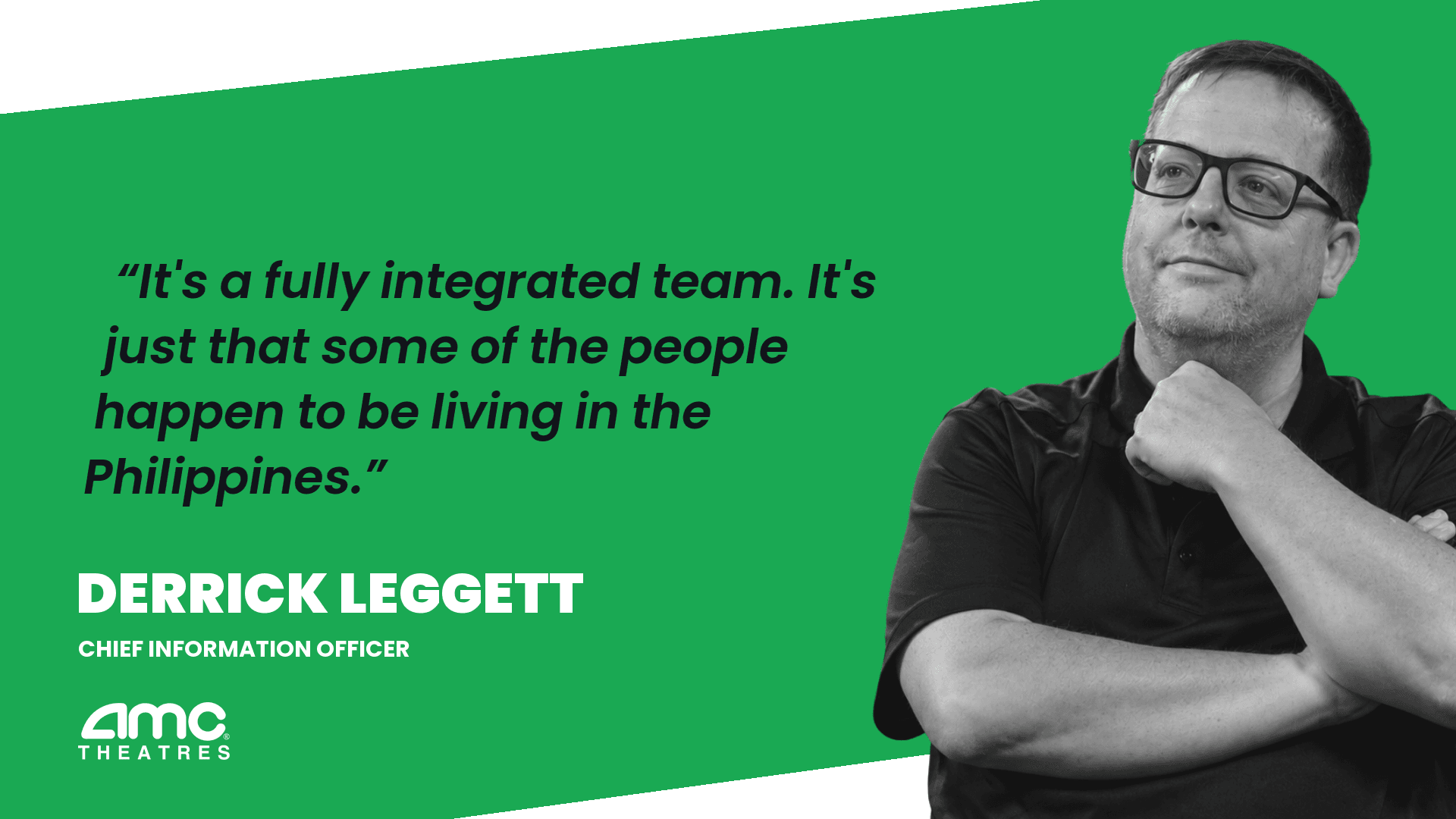
The clearest example I can point to is AMC Theatres. We placed developers in the Philippines who are treated as full AMC engineers, in the standups, on the same tools, owning real parts of the product. They’re not contractors at arm’s length. It’s the same model we’ve now built for more than 200 companies.
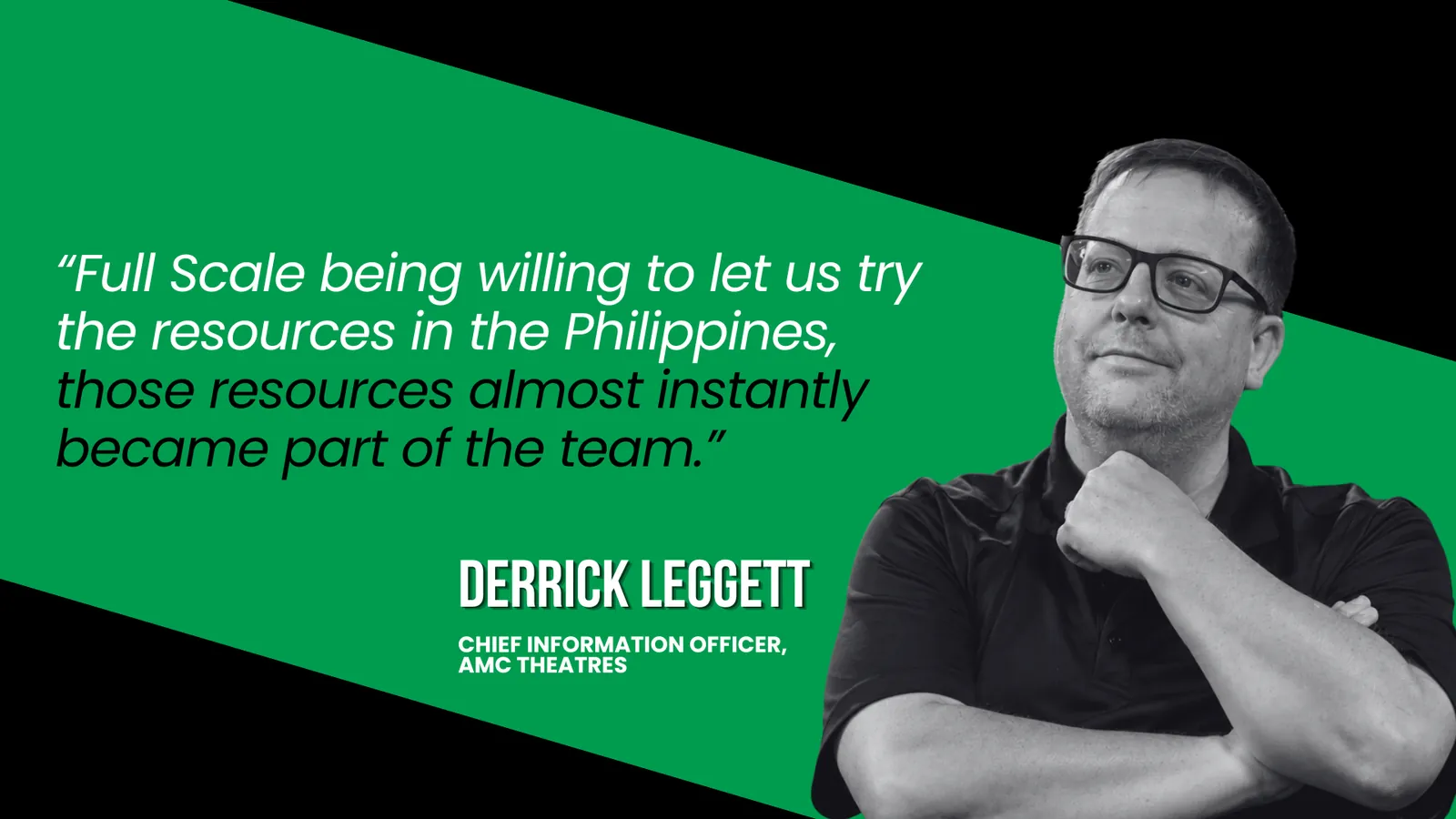
Their CIO, Derrick Leggett, put it better than I could: “It’s a fully integrated team. It’s just some of the people happen to be living in the Philippines.” He’s also clear-eyed about what the old model costs, where you pay 30 or 40 percent overhead for account managers and architects whose actual job nobody can quite explain. With an integrated team there’s no middleman, and the developers care about the product the way your in-house engineers do.
The cheap version of offshore gets you lower labor costs and a constant headache. The integrated version gets you a team that treats your product like its own, which is the only version worth doing.
Frequently asked questions
Where can you find software developers outside the US?
The largest pools sit in South and Southeast Asia (India and the Philippines), Latin America (Brazil, Argentina, Mexico, with near-total US time zone overlap), and Eastern Europe (Poland, Romania, Ukraine). For US teams, the deciding factor is rarely the raw size of the pool. It’s English fluency and how directly you can work with the people writing your code, which is why I keep coming back to the Philippines.
Is the tech talent shortage real?
In a few US metros, yes. Senior engineers there are genuinely hard to hire and expensive to keep. Globally, no. There are more than 47 million developers worldwide and the number grows every year. The shortage is local, and global software development talent is the answer to it.
Does hiring global software development talent mean lower quality?
No. The rate difference reflects cost of living rather than skill. A senior engineer in Manila earns less than one in San Francisco for the same reason housing costs less there. Quality problems in offshore work almost always trace back to communication and a vendor middleman rather than the developers themselves.
How do you hire offshore software development talent without getting burned?
Hire people who work directly on your team for the long term, rather than a project shop that walls the engineers off behind an account manager. Keep your own technical leadership in the loop, insist on direct communication with the developers, and don’t pick the cheapest option for its own sake. That last mistake is what I call cheapshoring, and it’s the most common way these engagements fail.
Software development talent is everywhere. It always has been. The companies that go out and get it are the ones that stop calling it a shortage and start treating the whole world as their hiring market. Stack-specific talent is part of the same global story: offshore .NET developers in the Philippines are building enterprise-grade production systems at a fraction of US salary cost, with direct team integration.