
Beware: 10 Upwork Scams That Can Ruin Your Software Development Project

In this article
- Who this is for, and why it got worse
- Top Upwork scams that target the people doing the hiring
- Red flags to watch for before you hire
- The pattern nobody names: the cheapshoring trap
- How to protect your project
- A better model than a marketplace gamble
- Don’t let a cheap hire cost you your project
- Frequently asked questions
Most articles about Upwork scams are written for freelancers worried about getting stiffed by a client. This one is for the other side of the table. I’ve talked to hundreds of founders about how they hire developers, and plenty of them have great experiences on Upwork. The platform is full of talented, honest freelancers, and for the right kind of work it does exactly what it promises. When the software really matters, though, vetted marketplaces like Toptal and Turing are a safer place to start. If you would rather pay for vetting up front, premium platforms are an option too, and I mapped out where Toptal and Gigster fit. I also dug into how legit Toptal actually is, since the brand comes up so often.
Full Scale itself started on Upwork. My co-founder needed PHP developers and found a few talented Filipino developers there, back when it was one of the few platforms for hiring Filipino developers anyone knew about. That was his first time hiring in the Philippines. It worked well enough to plant the seed for the company I run today. So I’m not here to tell you Upwork is worthless. I’m here to tell you what to watch for when the software actually matters.
But I also hear the other stories. A founder interviews someone sharp, hires them, and within a few weeks realizes the person writing the code isn’t the person they hired. A developer goes quiet right before a deadline. Work that looked fine in a demo falls apart the moment a real user touches it.
To be clear, most freelancers aren’t scammers, and these problems aren’t unique to Upwork. You’ll find the same risks on any marketplace where strangers bid for work, and on plenty of hires made off a marketplace entirely. Upwork just happens to be the biggest, so it’s where most founders run into them. If you’re a founder, a startup leader, or a CTO paying to get software built, you face a set of risks almost no one writes about. If you’re weighing the platform against the obvious alternative, I compared Toptal vs Upwork head to head.
Here’s the part that matters. When a hire does go wrong, it’s rarely random. It usually traces back to one decision: hiring the cheapest available person on an anonymous marketplace and hoping it works out. I call that the cheapshoring trap, and it’s the thread running through the problems below.
Who this is for, and why it got worse
Upwork is one of the biggest freelance marketplaces in the world, with more than $4 billion in work flowing through it a year (Upwork results). For a logo, a landing page, or a quick script, that scale is a feature. You can find someone in an afternoon.
For your core product, that same scale is the problem. Anyone can make a profile. The platform matches you on price and availability, not on whether the person can actually build and own real software.
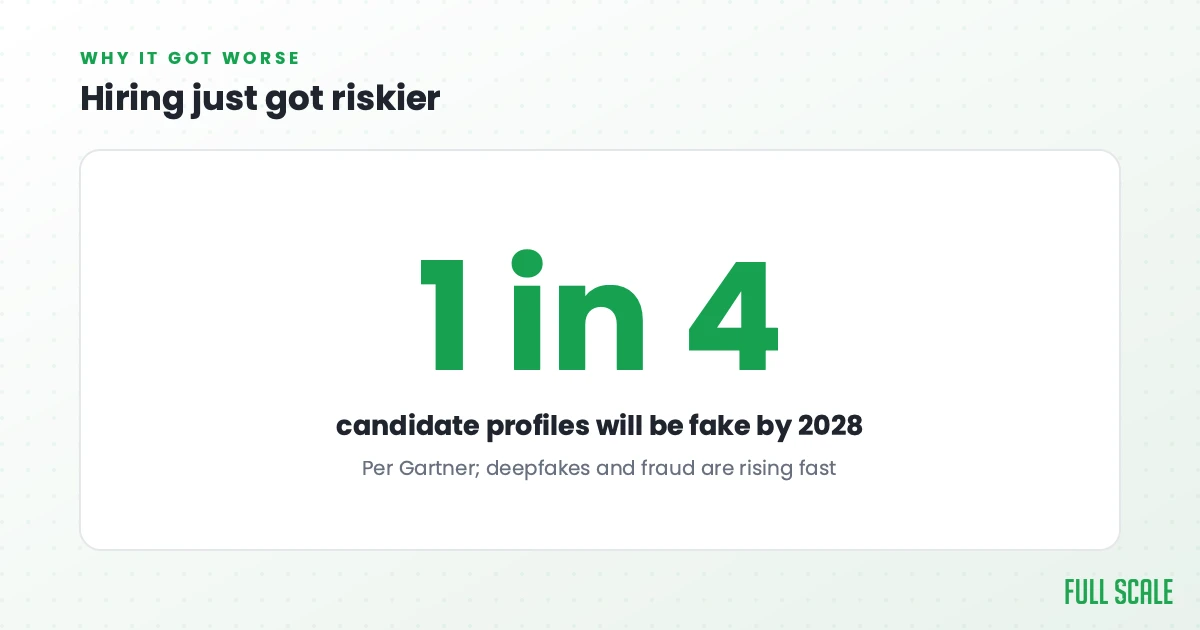
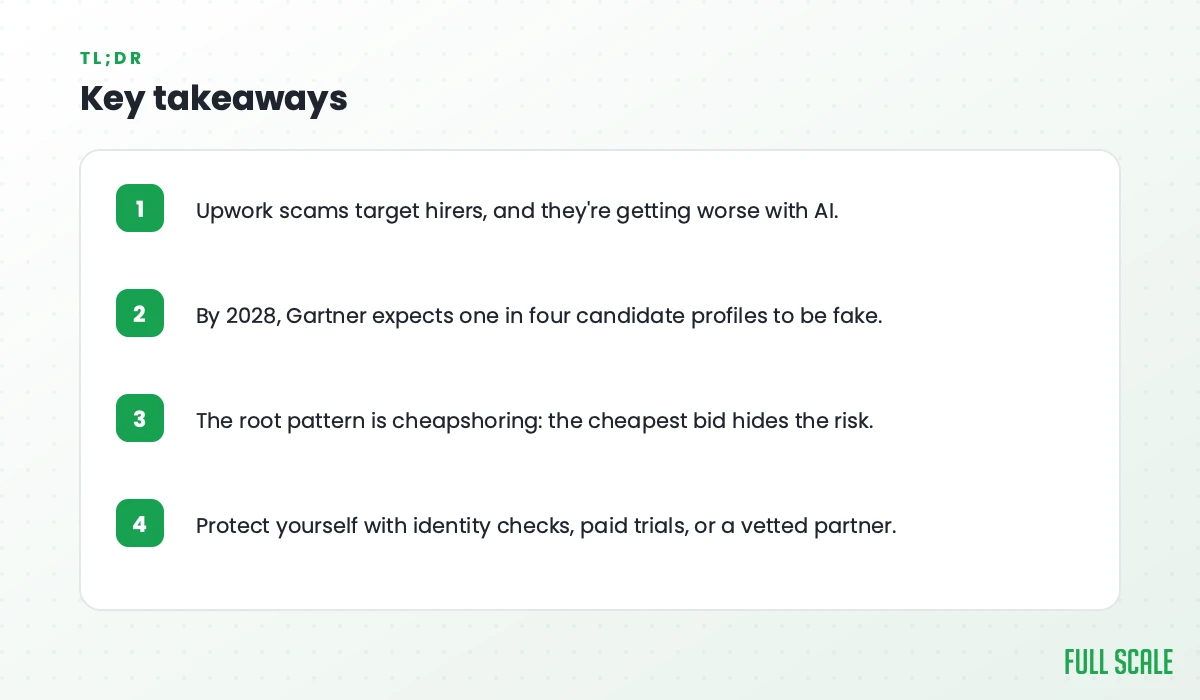
And the risk has climbed sharply in the last year. The Federal Trade Commission reported that losses to job and employment-agency scams jumped from $90 million in 2020 to $501 million in 2024, with the number of reports tripling (FTC, 2025). AI made it cheaper to fake a résumé, a portfolio, and even a face on a video call. Gartner predicts that by 2028, one in four candidate profiles worldwide will be fake (Gartner, via HR Dive).
So the advice from a few years ago no longer holds. Let’s go through what actually happens.
Top Upwork scams that target the people doing the hiring
Each one is something done to you, the buyer. These are the Upwork scams to look out for, and I’ve added the tell so you can catch each one before you sign.
1. Bait-and-switch
You interview an impressive senior developer with a strong portfolio. You hire them. Then a cheaper, less experienced person quietly does the work while the original profile collects your money.
This is the most common one I hear about, and it’s baked into how a marketplace works. The incentive is to win the contract with the best face available, then deliver it with the lowest-cost labor.
The tell: ask the person to share their screen and walk through a piece of their past code live. The one who built it can explain every decision. The stand-in cannot.
2. Fake and hijacked profiles
Upwork scammers build profiles with fabricated work histories, borrowed reviews, and portfolios lifted from real developers on GitHub or Behance. At a glance they look legitimate.
You’re not just risking bad work here. You may be handing your code and your credentials to someone whose identity you can’t verify at all. If compromised credentials end up circulating online, using a dark web monitoring service helps alert you to security breaches quickly.
The tell: reverse-image-search the profile photo, and check whether the portfolio work actually appears under their name anywhere else. Stolen work usually traces back to its real owner.
3. The deepfake interview
This is the new one that breaks the old playbook. Every guide tells you to “just do a video interview.” That advice is now a liability.
AI face and voice tools, and plain old hired stand-ins, mean the person on your call may not be the person who shows up to work. Roughly 17% of hiring managers say they’ve already run into candidates using deepfake technology in video interviews (Resume Genius, 2025). A Gartner survey found 6% of candidates admitted to interview fraud, including having someone pose for them (Gartner, 2025).
The tell: ask them to turn their head fully to the side, hold a hand up next to their face, or pick up a specific object in the room. Real-time deepfakes still stumble on movement that crosses in front of the face.
4. AI-generated proposals and portfolios
A polished cover letter and a senior-looking portfolio used to signal effort. Now a language model writes both in seconds.
You can get dozens of proposals that read beautifully and mean nothing, attached to portfolio pieces that were generated rather than built. It’s hard to screen at the volume a marketplace produces.
The tell: ignore the writing and ask a specific, messy question about a real tradeoff in your project. Generic polish collapses fast when you push on the details.
5. Identity fraud and location spoofing
The “US-based senior engineer” you hired may be an operator somewhere else entirely, using a stolen or synthetic identity and a proxy to fake their location.
This is not a fringe worry. In November 2025 the Department of Justice announced guilty pleas in a scheme where North Korean IT workers used stolen American identities to get hired by more than 136 US companies, generating over $2.2 million for the regime (DOJ, 2025). It only grew from there. By 2026 the US Treasury was sanctioning the networks behind it, and investigators estimated the broader operation pulled in close to $800 million in a single year (U.S. Treasury, 2026). These operatives go after remote and freelance roles, including on platforms like Upwork, using stolen identities and AI to get past screening (FBI IC3, 2025). For you, that’s sanctions exposure, a security breach, and code written by someone you can never hold accountable.
The tell: verify identity through a real document check, not a screen-shared ID, and be suspicious when someone resists any verification that ties a face to a legal name.
6. “AI did the work” code dumps
A developer hands you a large amount of code fast and bills it as bespoke senior work. In reality it’s lightly edited AI output that nobody fully understands, including them.
It demos fine. Then it fails a security review, breaks under load, or turns out to be impossible to maintain because no human ever reasoned through it. As I argue in Product Driven, writing code is becoming commoditized, and shipping a pile of it is not the same as building a product.
The tell: require a short walkthrough of the architecture and ask why they made specific choices. Owning the reasoning is the thing AI slop can’t fake.
7. Low-quality work and the endless-revision trap
Some developers deliver work they know is mediocre, betting you’ll accept it rather than start over. You end up in a loop of revisions that drains your time and budget.
This is the quiet scam, and it often costs more than the dramatic ones. The person who ghosts you at least frees you to move on. The person who keeps delivering “almost there” work holds your timeline hostage for months.
The tell: scope a small, paid test project with a clear definition of done before you commit to anything larger.
8. Plagiarism, unlicensed code, and IP violations
A developer passes off plagiarized code as their own or builds your product on unlicensed libraries and assets. You can end up not legally owning the software you paid for, or facing a license dispute down the road.
The tell: put intellectual-property assignment in writing before work starts, and run delivered code through a license scanner. Don’t assume payment equals ownership.
9. Payment hostage and the off-platform push
Two moves that usually travel together. A developer demands more money than you agreed on and withholds the finished build until you pay. Or they push you to move payment and communication off Upwork, to Telegram, WhatsApp, or crypto.
That second one sounds harmless. It isn’t. Going off-platform strips away Upwork’s escrow, its dispute process, and the paper trail you’d need if things go wrong. You’re giving up your only recourse as the buyer.
The tell: keep every payment and major conversation on the platform, and treat any pressure to leave it as a reason to walk.
10. Ghosting and the security exit
The developer disappears mid-build. Sometimes they leave with nothing but your deposit gone. Sometimes it’s worse, because along the way you gave them access to your repository, your servers, or your credentials.
Now you have an orphaned codebase only they understood and a security cleanup on top of a missed deadline.
The tell: grant access in the smallest pieces necessary, revoke it the moment an engagement ends, and never hand over production credentials to someone you haven’t verified.
Red flags to watch for before you hire
Most bad hires send signals early. Walk away if you see these:
- A profile with little work history, thin feedback, or no real portfolio
- Proposals that are generic, vague, or clearly written by AI
- Evasiveness about experience, identity, or how they’ll actually do the work
- Rates far below the market for the skills you need
- Pressure to start immediately without discussing project details
- Any push to move payment or communication off the platform
The pattern nobody names: the cheapshoring trap
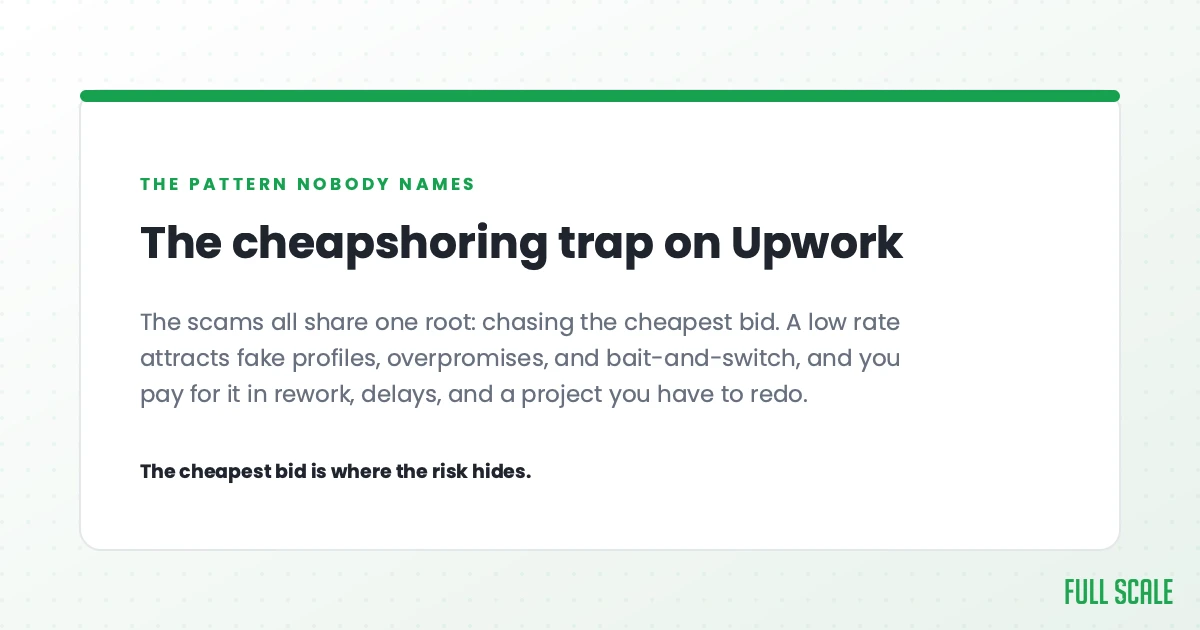
Step back and look at the list. Every one of these scams comes from the same root. You’re hiring the lowest bidder on a marketplace that matches you on price and speed, not on whether the person can build and own real software.
A platform optimized for cheap, fast, anonymous matching cannot screen for any of this. It isn’t designed to. You chase the cheapest hourly rate and end up paying far more in rework, delays, and headaches, which is exactly how the cheapest developer ends up costing the most.
The math is worse than it looks. A bad hire is commonly estimated to cost around 30% of that person’s first-year earnings, and that’s before you count a slipped launch or burned runway (DistantJob). For an early-stage company, a few months lost to a developer who couldn’t deliver can be the whole ballgame. Some cash-strapped founders respond by trading ownership instead, and software development for equity carries the same vetting burden with higher stakes.
The cheapest developer is rarely the cheapest outcome. This is the same trap that catches teams who outsource without a real vetting process, and our guide to software outsourcing walks through how to avoid it.
How to protect your project
You can hire on Upwork carefully. If you do, treat it like the high-risk channel it is:
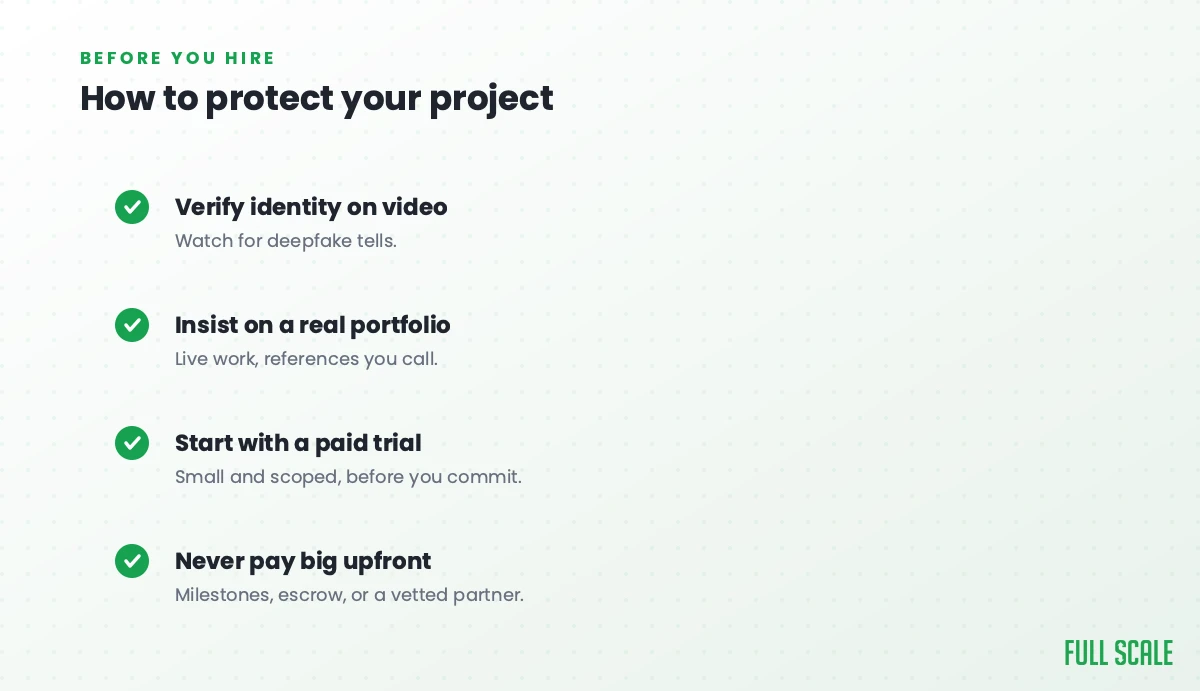
- Vet beyond the profile. Verify identity against a legal document, and confirm past work traces back to the person in front of you.
- Don’t rely on a video call alone. Deepfakes have broken that control. Combine it with document verification and a live technical exercise.
- Scope a small, paid test with a clear definition of done before any larger commitment.
- Keep payments and communication on the platform so you keep your recourse.
- Get IP assignment in writing, and scan delivered code for licensing problems.
- Control access tightly. Give the least access needed, and revoke it the day the work ends.
This is real work, and it never fully goes away. On a marketplace, the burden of vetting always lands on you.
A better model than a marketplace gamble
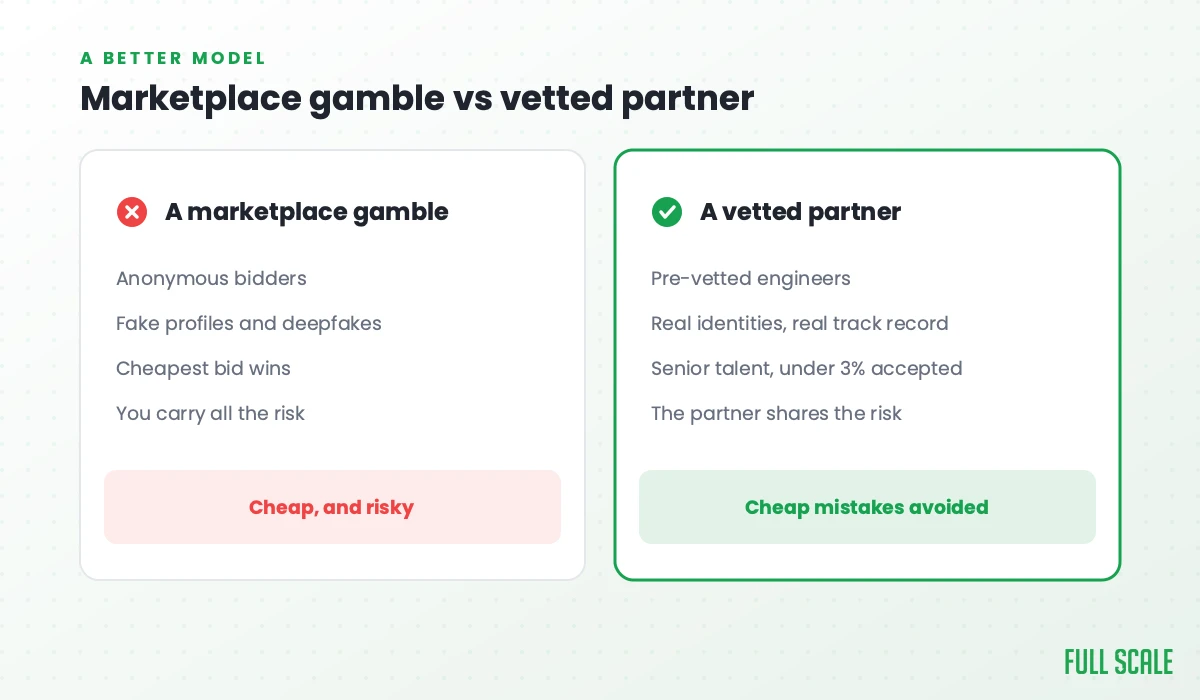
The deeper fix is to stop betting your product on an anonymous lowest bidder. The alternative is a vetted, dedicated team where someone else has already absorbed the vetting risk and owns accountability for the result.
That’s the model we built at Full Scale. Traditional offshore hiring fails when developers disappear after onboarding, so we did it differently. Our developers are vetted before you ever meet them, you interview a short list and keep full control of your tools and process, and our developer retention runs over 93%, so the team you start with is the team you keep. It’s the difference between a dedicated team and transactional gig labor, and it’s why we work with vetted developers in the Philippines rather than rolling the dice on a marketplace. I go deeper on matching the model to the job in Upwork alternatives for hiring developers.
You might be thinking this is just cheapshoring with a nicer logo. The real difference comes down to accountability, not geography or the rate. On a marketplace you trust an anonymous stranger and hope. With a vetted team, a company has put its name on the line that these specific engineers are who they say they are and will still be here next quarter.
The point isn’t that Upwork is useless. A freelance marketplace and building a real product are two different jobs. Pick the right tool for the one you’re actually doing.
Don’t let a cheap hire cost you your project
Upwork can work for small, low-stakes tasks. For the software your business depends on, the risks are real and they’ve gotten sharper in the AI era. The good news is that avoiding them is a choice you make before you ever hire, not a fire you fight afterward.
If you’d rather not gamble your roadmap on it, talk to us. Book a discovery call and we’ll show you developers, already vetted, who can start in about two weeks.
Dedicated teams. Faster delivery.
Frequently asked questions
Are there scams on Upwork?
Yes. Like any open marketplace, Upwork attracts bad actors alongside its many legitimate freelancers, and the company publishes its own resources to help users spot and report fraud (Upwork). The risk is real on both sides, but the scams that hit the people hiring developers, like bait-and-switch and identity fraud, get far less coverage than the ones aimed at freelancers.
Is Upwork legit or a scam?
Upwork is a legitimate, publicly traded company, not a scam. The problem isn’t the platform itself, it’s that anyone can create a profile and the marketplace matches you on price and availability rather than vetting whether someone can build real software. That structure is what lets individual scammers operate.
How do you avoid scams on Upwork?
Verify identity against a real document, don’t rely on a video call alone now that deepfakes exist, scope a small paid test with a clear definition of done, keep payments and communication on the platform, get IP assignment in writing, and control access to your code and credentials tightly.
Is Upwork safe for hiring software developers?
It can be safe for small, low-stakes work. For core product engineering, the burden of vetting falls entirely on you, and the cost of getting it wrong, in rework, delays, and security risk, is high. Many founders find a vetted, dedicated team is a better fit for software that matters.
What are the risks of hiring freelance developers?
The main risks are getting a different person than you interviewed, low-quality or AI-generated code, not legally owning the work, security exposure from shared access, and a developer who disappears mid-project. A managed team or staff augmentation model shifts much of that risk off your plate.