
Developer Hiring Trends in 2026: The Five Forces Reshaping How You Build a Team

In this article
- Trend 1: AI reshaped the demand, it did not cut the headcount
- Trend 2: The market came back, but it is a barbell
- Trend 3: A senior US hire broke the budget
- Trend 4: The H-1B route became a coin flip
- Trend 5: Teams stopped importing talent and started building where it lives
- Where a global team fits, and where it does not
- When Full Scale is not the right fit
- Frequently asked questions about developer hiring in 2026
- The trends all point the same direction
What are the biggest developer hiring trends in 2026?
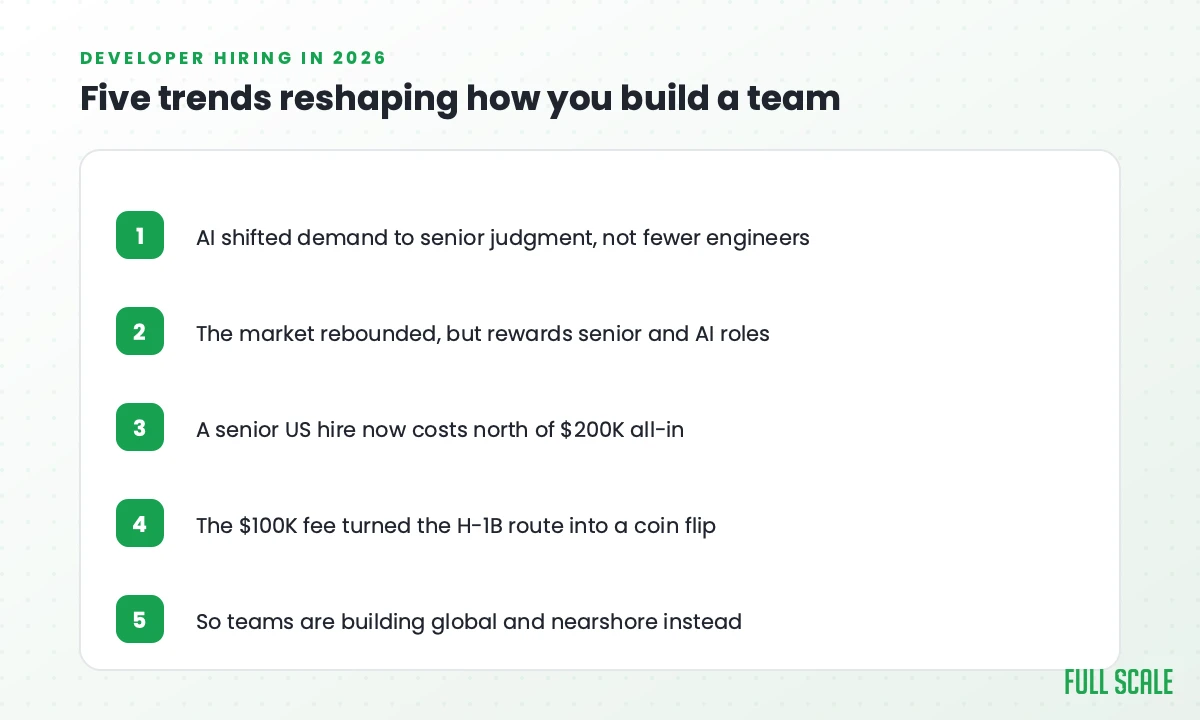
Five forces are reshaping how engineering teams get built in 2026: AI shifted demand toward senior judgment instead of cutting headcount, the market rebounded into a barbell that rewards senior and AI roles while squeezing juniors, a senior US hire now costs north of $200,000 all-in, the H-1B route turned into a legal coin flip after a $100,000 fee, and more teams are responding by building global and nearshore teams where the talent already lives.
Most CTOs I talk to right now say a version of the same thing.
“We have six open roles. We’ve been interviewing for months. We still don’t have the people.”
One more job board will not fix it. The way you hire engineers has shifted under everyone’s feet this year, and the headlines do not capture half of it. Some of the change is the market. Some of it is AI. And a big piece of it landed in a courtroom in Boston a few weeks ago. The full market picture sits in our 2026 State of IT Staffing report. Part of that shift is definitional, and it helps to pin down the three things AI staff augmentation can mean before you write the job description.
I have been building software companies for more than 20 years. I co-founded VinSolutions and bootstrapped it to $35M in annual revenue before a nine-figure exit, founded and sold Stackify, and started Full Scale in 2018 because I had personally hired developers in Russia, Latin America, and the Philippines and knew the offshore model was usually run badly. Since then we have made more than 700 engineer placements and served over 200 tech companies.
Here are the five trends actually moving developer hiring in 2026, and what each one means for how you build your team.
Trend 1: AI reshaped the demand, it did not cut the headcount
The story a lot of executives told themselves in 2024 was that AI would let them ship with fewer engineers. It went the other way. AI is everywhere now. As of JetBrains’ 2025 survey, about 85% of developers regularly use AI tools, and Google’s CEO says roughly 75% of the company’s new code is AI-generated. The typing got faster. The judgment did not.
So the demand moved. When a junior can generate a working draft in seconds, the scarce skill becomes knowing whether the draft is right. Veracode’s 2025 report found that 45% of AI-generated code carried a known security flaw, and bigger models were no safer. DORA’s 2025 research put it best: AI amplifies what is already there. A strong team gets faster with it, while a weak one just ships its problems quicker.
You can see where that demand landed in the postings. Robert Half found that AI, machine learning, and data science roles hit 49,200 postings in 2025, up 163% from the year before. Security and data engineering are close behind. The hiring did not shrink. It concentrated on people who can direct AI rather than be replaced by it. The same shift is why we stopped giving coding tests and moved the practical check into a live conversation.
Trend 2: The market came back, but it is a barbell
If your read on 2026 is that hiring loosened up, you are half right, and the half you are missing is the expensive one. Tech leaders are hiring again, and aggressively: Robert Half reports that 78% plan to grow permanent headcount in the second half of 2026, up from 61% earlier in the year. So yes, there are more openings and more resumes in the pile than there were eighteen months ago.
The trap is that the demand and the supply are not landing in the same place. The growth is concentrated at the senior and specialist end, the AI and security and staff-level roles, while entry-level hiring stays soft because AI now does a lot of what a junior used to do. You end up with a barbell: heavy demand for experienced engineers, a thick stack of junior applicants, and a thin, fought-over middle of senior talent. More applicants does not mean more of the people you actually need.
The volume came back. The senior supply did not. That is why a rebounding market and a months-long senior search can be true at the same time, and why “just post the job again” stopped working.
Trend 3: A senior US hire broke the budget
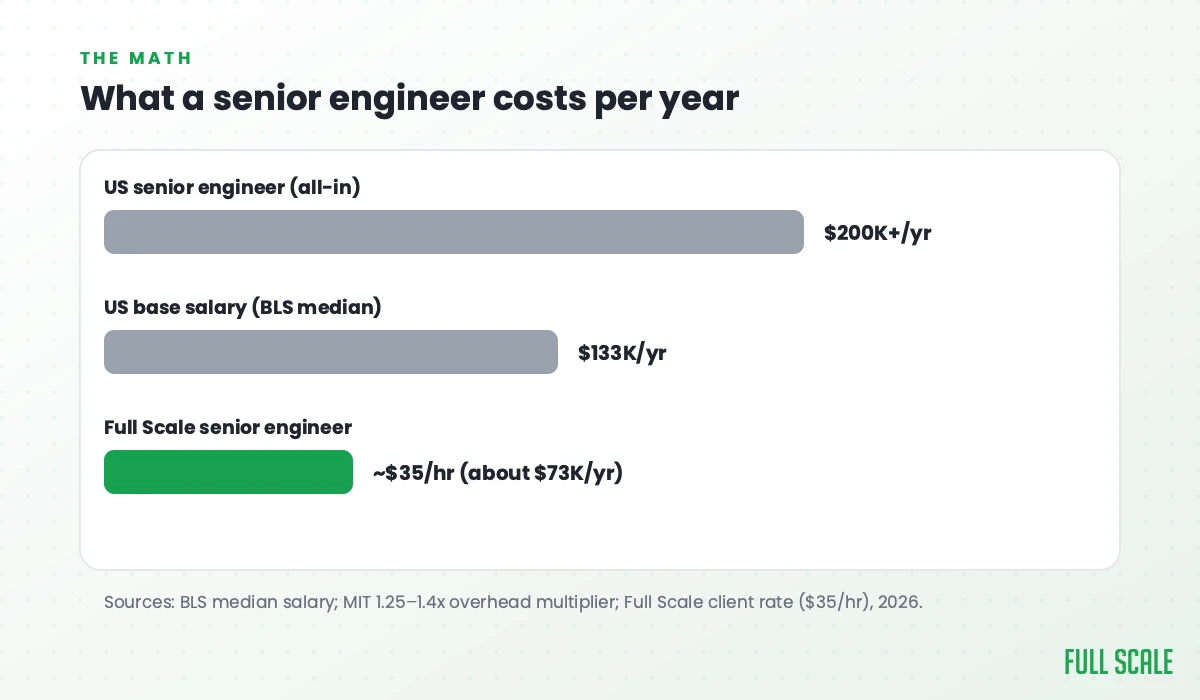
The U.S. Bureau of Labor Statistics puts the median software developer at about $133,000 a year, with senior engineers landing between $150,000 and $185,000 in base pay. Base pay is not the real number. Add benefits, payroll taxes, equipment, recruiting, and overhead, and the fully loaded cost runs 1.25 to 1.4 times base. A senior hire lands north of $200,000 all-in. The AI specialists from Trend 1 cost more: Robert Half puts AI and ML engineers at $134,000 to $193,250 in starting salary alone, and climbing.
That is before you find them. A recruiter or staffing agency typically takes 20 to 25% of first-year salary for a permanent placement, up to 30% for a senior or hard-to-fill role. I have paid those fees. They buy you the introduction and nothing after it.
When five senior engineers cost you over a million dollars a year in salary alone, hiring stops being a line item the engineering manager owns. It becomes a financial strategy question that belongs in a board conversation.
Trend 4: The H-1B route became a coin flip
For decades, the answer to “we can’t find senior engineers here” was to bring them in on an H-1B. In 2026 that lever got expensive and unpredictable in a way nobody has fully priced in yet.
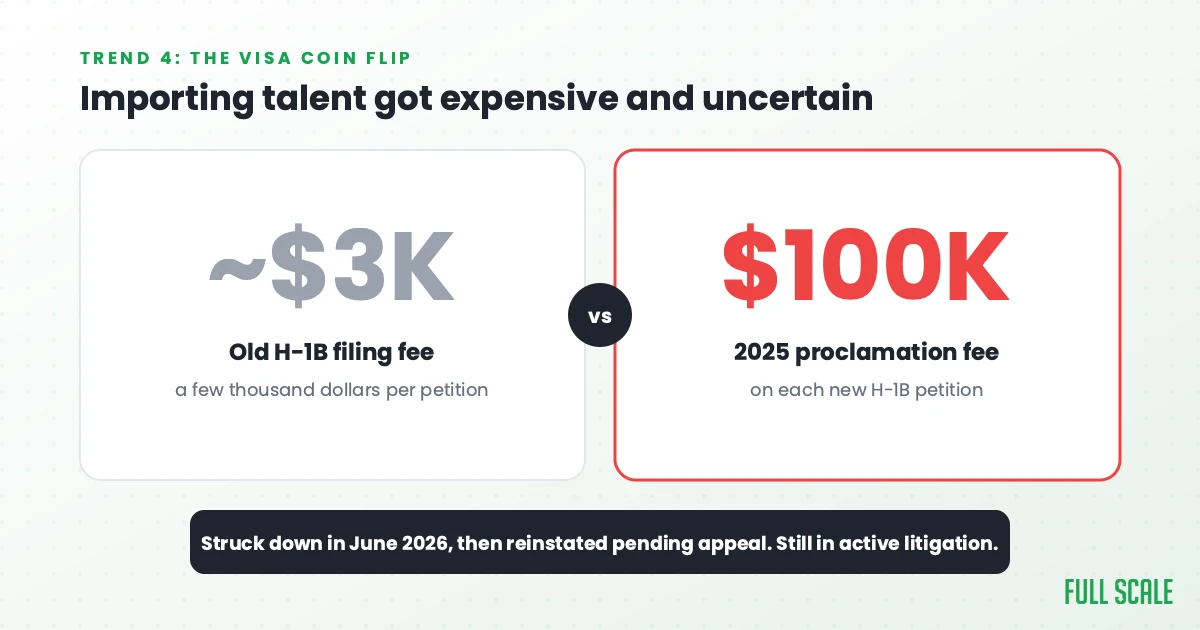
A presidential proclamation in September 2025 added a $100,000 fee on new H-1B petitions. For context, most H-1B filings used to run a few thousand dollars. Then it went to court. On June 8, 2026, a federal judge in Boston struck the fee down, ruling that the executive branch had imposed a tax without authority from Congress. Days later a court let the government keep collecting it while the case is appealed, and parallel lawsuits are running in Washington and San Francisco. As I write this in mid-2026, the fee is technically in effect, under appeal, and scheduled to expire in September unless something changes again.
I am not here to argue the politics. The practical point for a hiring plan is simpler. You cannot build a 2026 roadmap around a hiring channel whose cost swings by a factor of twenty depending on which court rules last. Even if the fee disappears, the lottery odds and the multi-month timeline were already a poor fit for a team that needs senior help this quarter. Importing talent into the US got slower, pricier, and far less certain. That uncertainty is pushing CTOs toward the option in Trend 5.
Trend 5: Teams stopped importing talent and started building where it lives
Put the first four trends together and they point one direction. The senior people are scarce and expensive at home, and the visa route to bring them here is a gamble. So instead of fighting to import talent, more teams are building where the talent already lives. The same Robert Half data shows it: 66% of tech leaders plan to bring in more contract and flexible talent in 2026, not just full-time hires.
Global hiring covers a spectrum. Nearshore teams in Latin America buy you near-total time-zone overlap. Offshore teams in places like the Philippines buy you a deeper senior bench at a different cost structure. Both beat waiting six months for a local hire who may take a counteroffer anyway. The version that works is not a separate “offshore team” on the other side of a wall. It is staff augmentation: the engineers join your Slack, attend your standups, use your tools, and report to your team leads, the same as any remote US developer. That model itself is changing fast this year, from AI-era vetting to more transparent contracts, which I break down in our staff augmentation trends in 2026 piece.
Most offshore horror stories come from the other model, where you hire an agency, they assign a project manager, the PM assigns developers you never speak to, and requirements get lost in translation. That is not offshore development. That is bad procurement. If you pick a partner on price alone, which I call cheapshoring, you get exactly what you pay for.
I want to be specific, because vague claims are easy. Two companies that named us publicly show what the integrated version looks like.
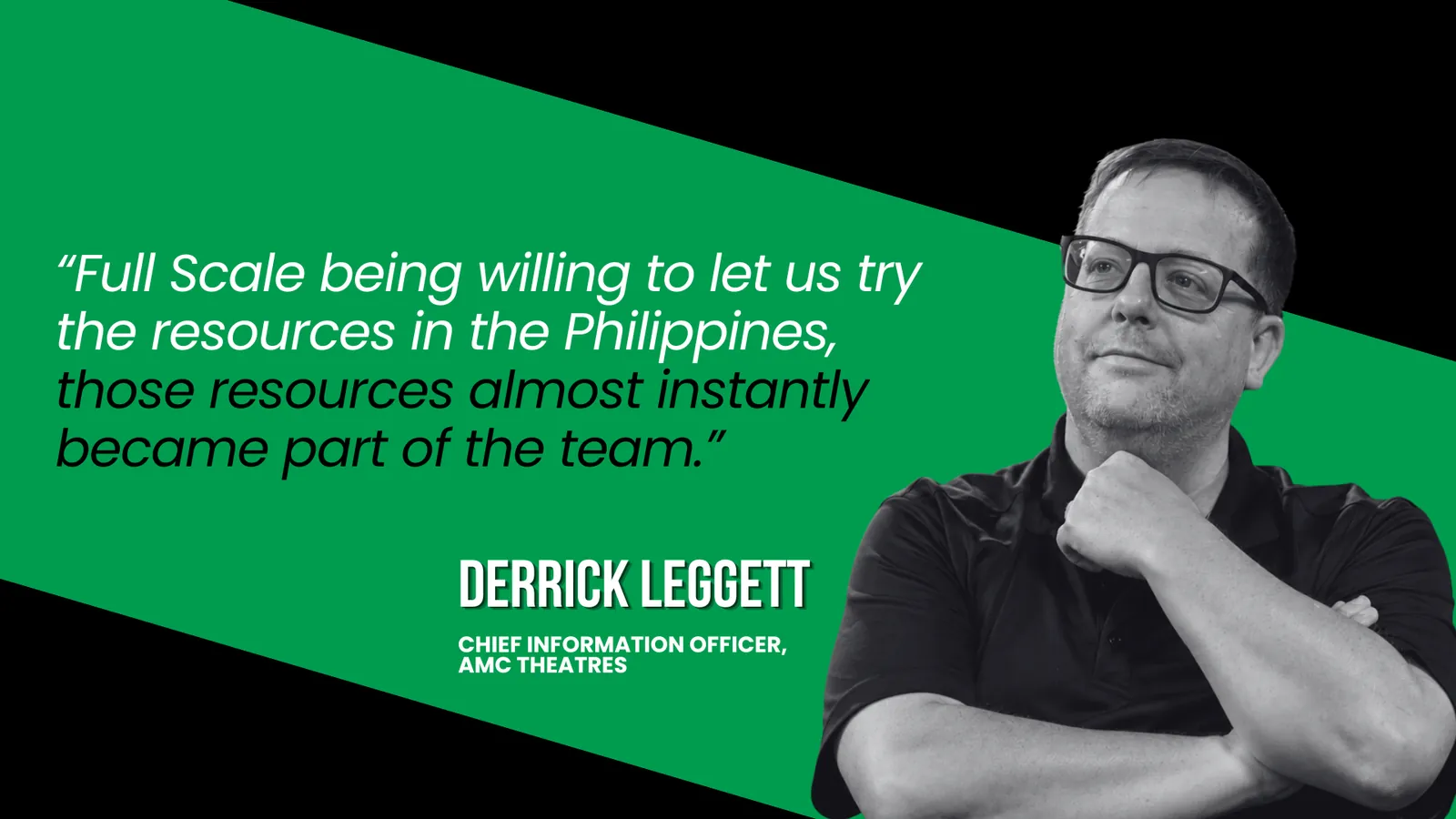
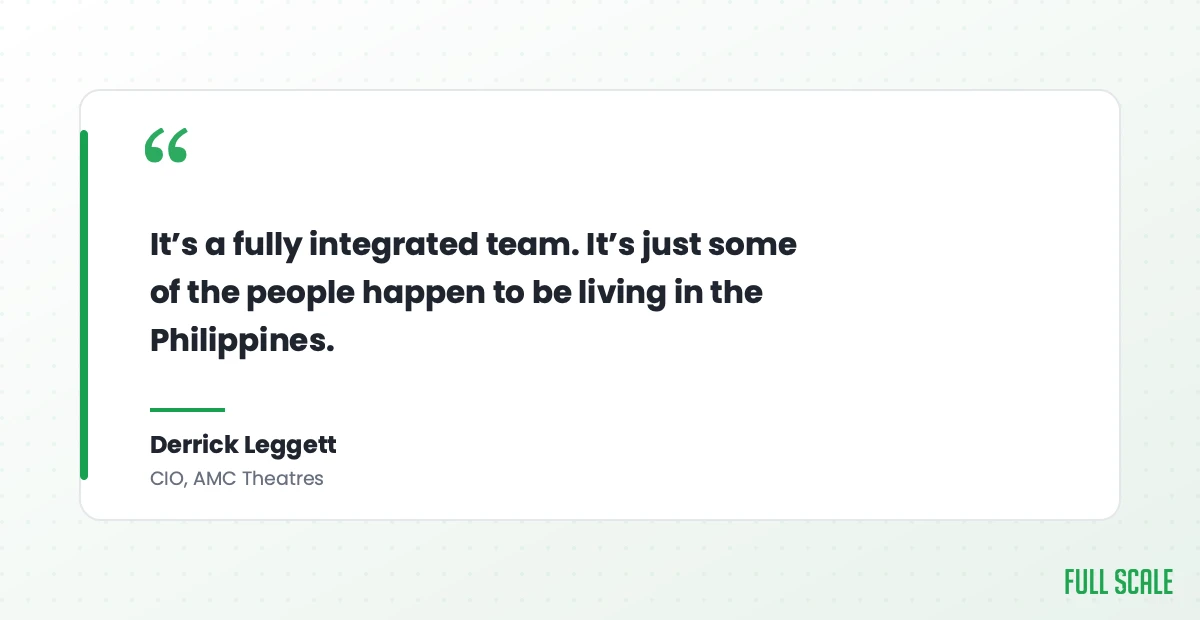
AMC Theatres. Their CIO, Derrick Leggett, runs a global engineering organization where Full Scale engineers in the Philippines are treated as full AMC engineers, on the same standups and roadmap as everyone else. His line says it better than I can: “It’s a fully integrated team. It’s just some of the people happen to be living in the Philippines.” Read how that came together in the AMC case study.
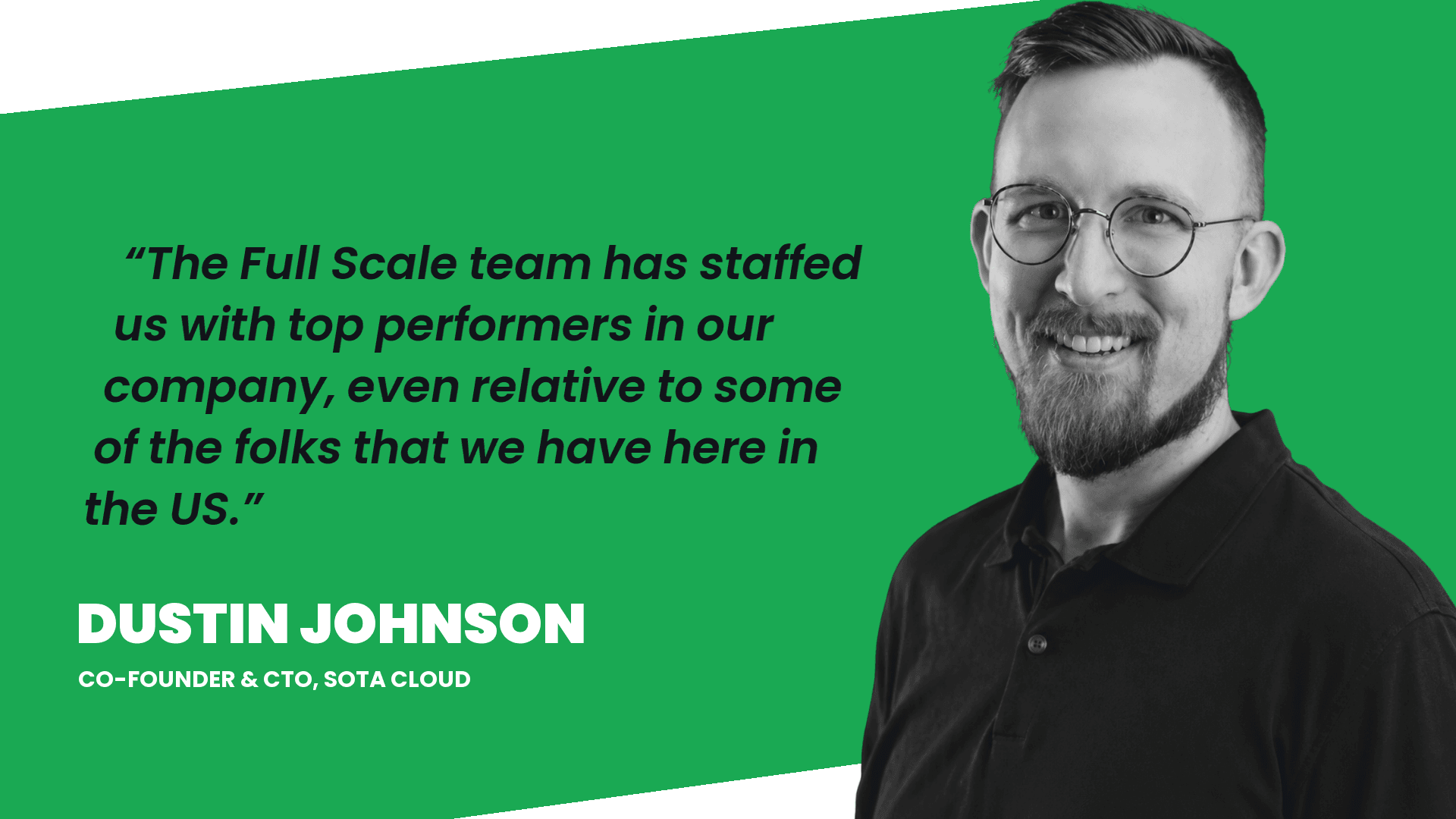
SOTA Cloud. Their co-founder and CTO, Dustin Johnson, scaled a small team without a big HR function. His take on the talent: “The Full Scale team has staffed us with top performers in our company, even relative to some of the folks that we have here in the US.” The full story is in the SOTA Cloud case study.
Here is what we see across our placements:
- 93% developer retention, against a Philippine call-center industry that keeps closer to 70%. Most offshore contractor arrangements churn faster than either. The difference comes down to how you structure the relationship from day one.
- Vetted senior engineers in front of you in days, and on the team in about two weeks. That holds for the common stacks: React, Node, Python, Java, .NET, and AWS.
- Fewer than 3% of applicants make it through our vetting. The engineers who pass are already in the pool, which is why placement takes weeks rather than months.
- The most common failure mode is not technical. It is isolation. The developers treated as vendors churn; the ones treated as teammates stay.
The cost math is the part that ends up in front of the board. A senior engineer on a US contract through us runs around $35 an hour, all-in, which works out to roughly $73,000 a year against the $200,000-plus of a senior US hire. On a five-person team that is a six-figure annual difference, and you can see the full breakdown in our guide to staff augmentation cost. We pay our engineers at the top of their local market, so the lower cost reflects cost of living rather than lower pay. If you want the actual pay picture, we lay it out in our post on software engineer salaries in the Philippines.
Seeing these trends play out on your own team?
Most CTOs who reach out have already spent months on a local search that went nowhere. If that sounds familiar, it is worth a short conversation. We will tell you honestly whether a global team fits your situation. See which developers are available in your stack this week.
Where a global team fits, and where it does not
I am not going to pretend this works for every role. It does not. A global team works well when:
- Your team already runs on async-friendly tools: Slack, Jira, Confluence, GitHub.
- You have defined coding standards and a documented architecture.
- Your leads can run distributed standups without it eating their day.
- You need senior talent in a specific stack that is hard to find locally.
- You are scaling a stable product that already has some process in place.
It is honest to name the exception too. For your top one or two architect or staff-level roles, the people who set technical direction and mentor everyone else, there is still a real argument for hiring local or at least in your own time zone. Those seats are worth a premium for the hours in the room. The move most teams make is to fund and surround those anchor roles with a global team, not to replace them. A global team is also harder when you have no documented process and run on tribal knowledge, when strict data-residency rules rule out anyone outside the building, or when you need someone physically on-site for hardware work.
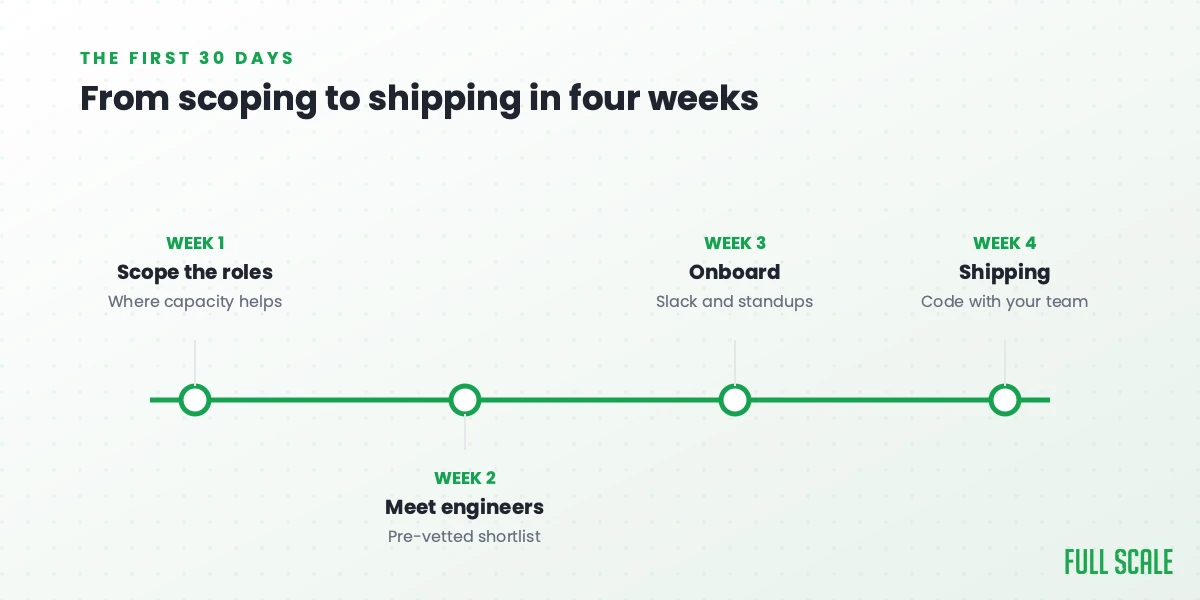
If you are a fit, the first 30 days look like this:
- Week 1: Pick the two or three roles where added capacity has the most immediate impact. Prioritize by cost, timeline, and stack fit.
- Week 2: We match pre-vetted engineers to your roles and you interview the shortlist. The vetting is already done, so this moves fast.
- Week 3: The engineer signs on and starts onboarding into your Slack, your standups, and your board.
- Week 4: They are shipping code alongside your existing team.
One scheduling note decides whether this is smooth or painful: agree on the overlap up front. Our standard is three to four hours of shared working hours a day, and our engineers shift their schedule to hit your workday rather than the other way around. Teams that set async norms in week one rarely complain about time zones. Teams that skip that step consistently do. More on the mechanics in staff augmentation vs. outsourcing and our offshore software development overview.
When Full Scale is not the right fit
This section exists because honesty builds more trust than a pitch.
We are not the right partner if you need a single developer for a 30-day project. Our model is built for teams and for tenures measured in years. We are also not a fit if you are shopping purely on price and want the cheapest hour you can find. We do not compete at the bottom of the market, and the model only works when you treat the engineers as part of your team.
If you need a one-time vendor for a short engagement, freelance platforms exist for that. If you need embedded, full-time engineers who become a real part of your team for the long haul, that is what we do. I wrote a whole book on building engineering teams that own outcomes, Product Driven, if you want the longer version of how I think about it.
Ready to talk specifics? Book a short call. We will look at your current hiring situation, tell you honestly whether a global team is a fit, and show you which engineers are available in your stack this week. No commitment required. Book your discovery call.
Frequently asked questions about developer hiring in 2026
What are the biggest developer hiring trends in 2026?
Five trends dominate. AI shifted demand toward senior engineers who can review and direct AI output rather than reducing headcount, and AI, ML, and data roles grew 163% year over year. The market rebounded, with 78% of tech leaders planning to grow headcount, but the growth concentrated in senior and specialist roles while junior hiring stayed soft. The fully loaded cost of a senior US engineer passed $200,000. The H-1B route became unpredictable after a $100,000 fee landed in court. And more teams responded by building global and nearshore teams where senior talent already lives.
How is AI changing developer hiring in 2026?
AI raised the value of senior judgment instead of replacing engineers. With about 85% of developers now using AI tools and a large share of new code AI-generated, the scarce skill is knowing whether the generated code is correct, since 45% of AI-generated code has carried a known security flaw. Demand shifted hard toward AI, ML, data, and security specialists, which grew 163% year over year, while routine junior tasks that AI now handles saw softer hiring. That is the honest answer to whether AI will replace software developers: no, but it keeps raising the price of judgment. That’s also behind the new kind of context switching AI creates for the engineers still doing the work.
What is happening with the H-1B visa fee in 2026?
A September 2025 presidential proclamation added a $100,000 fee on new H-1B petitions, up from the few thousand dollars most filings used to cost. A federal judge in Boston struck the fee down in June 2026, ruling it an unauthorized tax, but a court then allowed the government to keep collecting it during appeal, with parallel lawsuits in Washington and San Francisco. As of mid-2026 the fee is in active litigation and scheduled to expire in September, so its status can change quickly. The practical takeaway is that importing senior talent on an H-1B is now expensive and unpredictable, which is pushing more teams toward global hiring instead.
How long does it take to hire a developer in 2026?
Through a traditional local search, filling a senior role routinely takes months once you add posting, sourcing, screening, interviewing, and offer negotiation, and that is before counteroffers pull a candidate back out. Through staff augmentation with a pre-vetted pool, the timeline is much shorter: we put vetted engineers in front of you in days and onto the team in about two weeks.
What does an offshore developer cost compared to a US hire?
A senior US engineer lands north of $200,000 a year all-in, once you add benefits, taxes, equipment, recruiting, and overhead to a base of roughly $150,000 to $185,000. Through Full Scale, a senior engineer on a US contract runs around $35 an hour all-in, which is roughly $73,000 a year. On a five-person team that difference adds up to six figures a year, with the full breakdown in our guide to staff augmentation cost. We pay our engineers at the top of their local market, so the lower cost reflects cost of living rather than lower pay.
What is the difference between staff augmentation and project outsourcing?
Staff augmentation embeds engineers directly into your team, under your direction, on your tools. Project outsourcing hands a defined deliverable to a vendor who manages their own team and gives you a project manager instead of direct access to the developers. Augmentation keeps you in control and integrated. Outsourcing trades control for hands-off delivery. Most offshore communication problems trace back to the outsourcing model rather than to offshore work itself. Full breakdown: staff augmentation vs. outsourcing.
Is offshore development safe for intellectual property?
IP protection comes down to contract structure rather than geography. Full Scale uses US-based contracts with full IP assignment and confidentiality provisions, regardless of where the engineer sits. Everything created by a Full Scale engineer belongs to the client. Engineers go through background checks and sign confidentiality agreements as part of onboarding, and we provide compliance documentation up front for regulated industries.
How do you handle time zone differences?
Our standard is three to four hours of daily overlap with your working hours, and our engineers shift their schedules to meet your workday, including full US-hours coverage when a role needs it. Real-time work like standups and planning happens in the overlap window, and the rest runs on async handoffs through Slack, your board, and documented code reviews. Nearshore teams in Latin America offer near-total overlap if your work demands more real-time hours.
The trends all point the same direction
The 2026 hiring market is not one story. It is AI concentrating demand on senior judgment, a rebound that rewards experience, a senior price tag that broke the budget, and a visa route that turned into a gamble. Read together, they explain why the local-only playbook stopped working and why so many teams are building globally instead. Mobile teams feel this acutely; see the mobile-specific hiring trends for what it means when you are staffing for Flutter, React Native, or native.
None of this means you stop hiring at home. It means you stop assuming home is the only place to hire. The teams shipping on schedule this year are the ones that treated global talent as a real part of the plan, not a last resort. With more than 700 placements and 93% retention behind us, the part I am sure of is that it works when you do it right: engineers embedded in your team, US contracts, no middlemen.
Is your team set up to hire through these trends in 2026? We work with CTOs at growing tech companies who need senior engineers fast. If that is you, let’s spend a few minutes on it. We will tell you exactly what is available in your stack and what a realistic start looks like. Book a discovery call, no commitment required.