
Why Outsourcing Software Development to India Fails: The Evidence (2026)

In this article
- It’s not the talent, so what is it?
- Filter 1: India graduates 1.5 million engineers a year, and that is the problem
- Filter 2: The best engineers already work for someone else
- Filter 3: The market churns underneath you
- Filter 4: The engagement model hides problems by design
- Filter 5: The communication style keeps problems hidden longer
- When outsourcing to India works
- The fix: Hire people, not projects
- It was never the people
- Frequently asked questions
- Key sources
Quick Answer: Outsourcing software development to India fails more often than it should, and the people are not the reason. The evidence points to five structural problems: a thin layer of job-ready talent inside a huge graduate pool, the best engineers absorbed by captive centers, brutal market churn, a hand-off vendor model that hides problems, and a communication style that delays bad news. Fix the model and India works.
Early in my career, I never outsourced anything.
It wasn’t a strategy. Everyone I knew who had tried outsourcing software development had done it in India, and they all seemed to come back with a horror story. I said this on a podcast back in 2019, years before I had any stake in this debate: “Nine times out of 10, it had to do with India. Everybody knows somebody who tried to do some kind of software project in India and had a bad experience.” The stories were always the same: the communication was painful, the code had to be rewritten anyway, and “it was easier to just do the work myself.”
So I stayed away from offshore entirely, until I hired offshore developers by accident.
At Stackify in 2012, I hired two Java developers through a friend’s agency and only learned on the first phone call that they were in St. Petersburg, Russia. They were excellent. I went on to hire developers in Uruguay, Colombia, and the Philippines, where the team grew past 20 and helped carry Stackify to its exit. Outsourcing absolutely works. I’ve since helped 200+ companies build offshore teams at Full Scale.
But the India outsourcing pattern never went away. Across hundreds of conversations with founders and engineering leaders since then, when someone tells me they outsourced to India, about 80% of the time it’s an experience they wouldn’t repeat. When they did it anywhere else, Eastern Europe, Latin America, Southeast Asia, about 80% of the time it worked. That’s my unscientific tally, not a study, and you should know my bias: I run a company that builds teams in the Philippines, and the founders who find me are disproportionately the ones who already got burned somewhere else. For the specific Eastern-Europe-vs-Philippines version of that decision, I’ve written up the full comparison.
That’s exactly why I’m not going to ask you to take my word for it. I went and did the research, and almost all of the evidence below comes from India’s own institutions, executives, and data.
The problem was never the people. It’s everything standing between you and them.
It’s not the talent, so what is it?
Let’s get the most important fact on the table first. The best Indian engineers are as good as any engineers in the world. Sundar Pichai runs Google, Satya Nadella runs Microsoft, and Arvind Krishna runs IBM. Some of the most capable engineers I’ve worked alongside have been Indian. That talent base is the whole case for offshore talent: the skills are global even when the hiring models aren’t.
So why does the average outsourcing engagement there go so wrong, so often?
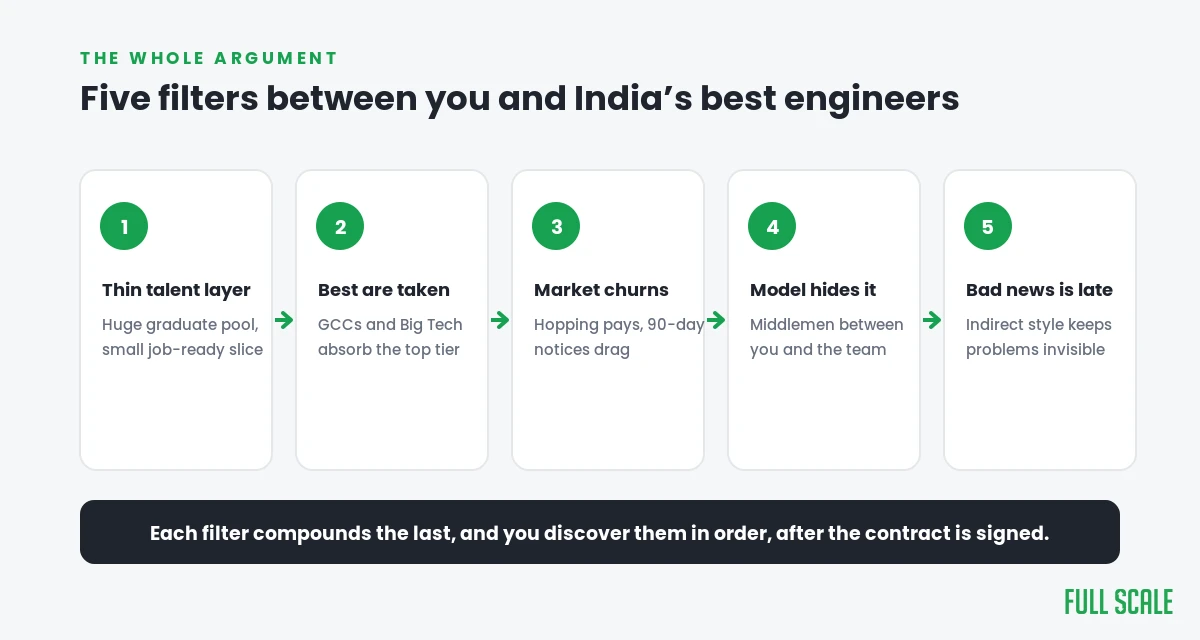
The research kept pointing at the same five problems. Each one filters out talent or hides information, each one compounds the one before it, and a buyer discovers them in order, after the contract is signed. Here’s the whole argument in one table.
| The filter | What it does to your engagement |
|---|---|
| 1. A thin talent layer | The graduate pool is enormous, but India’s own data says only a small slice is job-ready |
| 2. The best are taken | Captive centers and Big Tech absorb the top tier before a vendor can offer them to you |
| 3. The market churns | Job-hopping, 90-day notice periods, and offer reneging hit small foreign clients hardest |
| 4. The model hides problems | The hand-off vendor structure puts middlemen between you and your engineers |
| 5. The style delays bad news | Formal, indirect communication keeps problems invisible until they’re expensive |
Hire anywhere offshore and you’ll face one or two of these. Outsource to India through a typical vendor and you can hit all five at once.
Filter 1: India graduates 1.5 million engineers a year, and that is the problem
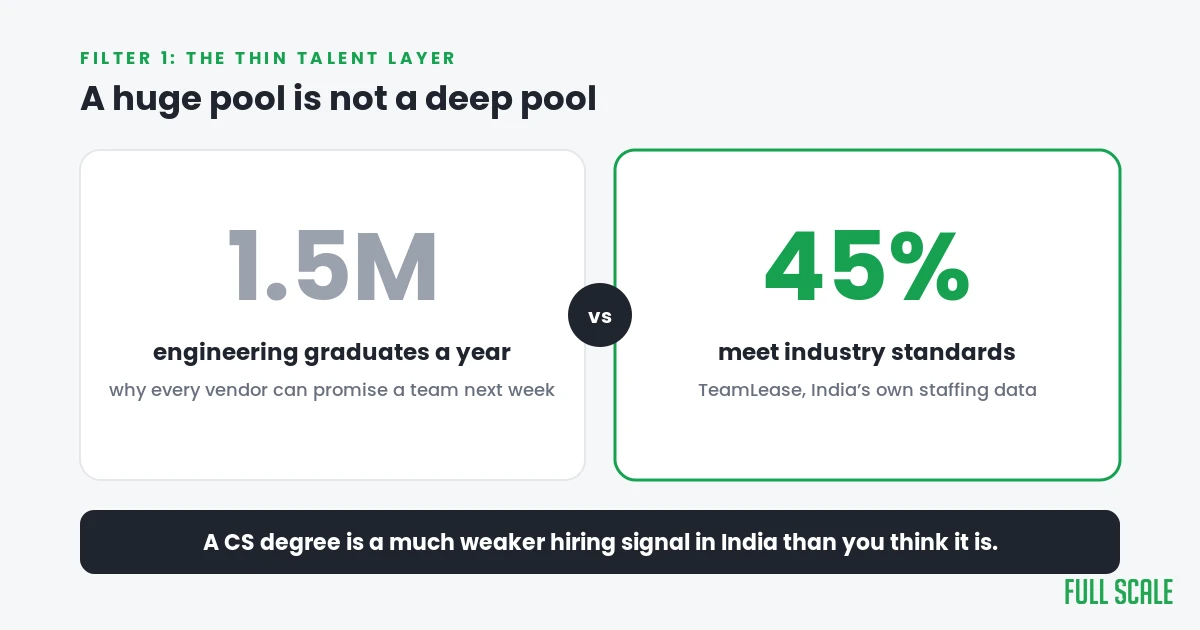
India produces roughly 1.5 million engineering graduates every year. That number is why every outsourcing vendor can promise you a team next week. It’s also why so many of those teams disappoint, because the share of those graduates who can actually do the job is small, and the people saying so are Indian.
In the same report, staffing firm TeamLease found only about 10% of those 1.5 million graduates were expected to secure employment, and that while over 60% are broadly “employable,” only 45% meet industry standards. India’s tech industry body NASSCOM projects the demand-supply gap for digital talent will widen from 25% to nearly 30% by 2028. C.P. Gurnani, who ran Tech Mahindra, one of India’s largest IT services companies, told the Times of India in a widely reported interview that the top 10 IT companies hire about 6% of India’s engineering graduates. That’s the biggest employers in Indian IT skimming the hireable top of the pool, and everyone else recruits from what’s left.
The most brutal number comes from a 2017 study by Aspiring Minds, an Indian skills-assessment company, which ran 36,000 engineering students from 500+ colleges through a hands-on programming test. Only 4.77% could write correct logic for a basic program, and more than 60% couldn’t write code that compiles. I’ll be fair here: that study is almost a decade old, and former Infosys CFO Mohandas Pai publicly called it “total rubbish”. The India Skills Report 2026 puts overall graduate employability at 56%, but that measures general work-readiness, aptitude and English, not whether someone can build software. No comparable hands-on coding study since has shown a dramatically better picture.
Here’s why this matters to you as a buyer.
A computer science degree is a much weaker hiring signal in India than you think it is, and your vendor is fishing in that pool.
The degree factory behind those numbers
The broken funnel is not an accident of scale. It was built. When IT services hiring exploded in the 2000s, engineering education in India became a business. Capacity grew from about 1,350 colleges and 440,000 seats in 2004 to more than 3,200 colleges and over 3 million seats at the 2014-15 peak, most of it private and run for profit. As far back as 2011, V. Raghunathan, a former professor at the Indian Institute of Management (IIM) Ahmedabad, called most of these institutions “real-estate rackets in the guise of educational institutions,” a large majority of them controlled by politicians and builders.
The product was the credential, the degree every middle-class family wanted regardless of whether the student had any interest in building software. Quality collapsed under the volume. The regulator eventually had to order every technical college to submit teachers’ identity documents to root out “ghost faculty” listed on several colleges’ rolls at once. By 2017-18, an expert committee convened by the All India Council for Technical Education (AICTE), the sector’s own regulator, found half of India’s engineering seats sitting empty, and AICTE froze approvals of new engineering colleges for three years.
The cycle is now repeating: the post-2023 recovery in enrollment is driven almost entirely by computer science and AI seats, with colleges cutting mechanical and civil programs to chase the demand.
So when a vendor’s résumé pile is full of CS degrees, remember what those degrees were designed to sell.
The vetting problem: 1,000 applications per posting, and some of them are fake
The volume makes screening genuinely hard, even for people who do it full time. Karat, a US firm that runs technical interviews at scale, found that job postings in India routinely draw 1,000+ applications, and that hiring an engineer there takes about 42 more recruiter screens and 25 more technical interviews than the same hire in the US or Europe.
And screening has to catch more than weak skills. In late 2022, Accenture India said in a statement to The Hindu, reported by Business Today, that it had “discovered an effort to use documentation and experience letters from fraudulent companies to obtain offers of employment” and had exited the people involved. This wasn’t new. The Caravan, one of India’s most respected long-form magazines, documented how the graduate glut built an entire background-verification industry, citing an Economic Times finding back in 2012 that one in five IT résumés showed discrepancies. Paid proxy interviewing, where a stronger engineer sits the video interview for the candidate, is well known enough in the market that vetting firms treat it as a standard risk.
None of this means Indian engineers are dishonest. It means an oversupplied, credential-driven market produces fraud at the margins, and a foreign buyer doing Zoom interviews is the easiest person in that market to fool. The work of separating the strong minority from the volume is real, expensive, and exactly the work most outsourcing vendors do badly.
An Indian assessment company, HackerEarth, diagnosed the deeper gap in its own market years ago: too many graduates are coders by profession, not passion, pushed into IT because it’s the respectable white-collar job. That diagnosis matches the trait I screen for above everything, and the one I built Product Driven around: curiosity. You can’t fix its absence with a bigger résumé pile. Curiosity drives clarity. You want a team that keeps asking why, not just what or how.
Filter 2: The best engineers already work for someone else
Here’s the part almost nobody tells you. The world’s biggest companies already figured out that Indian engineering talent is excellent, and they hired it directly.
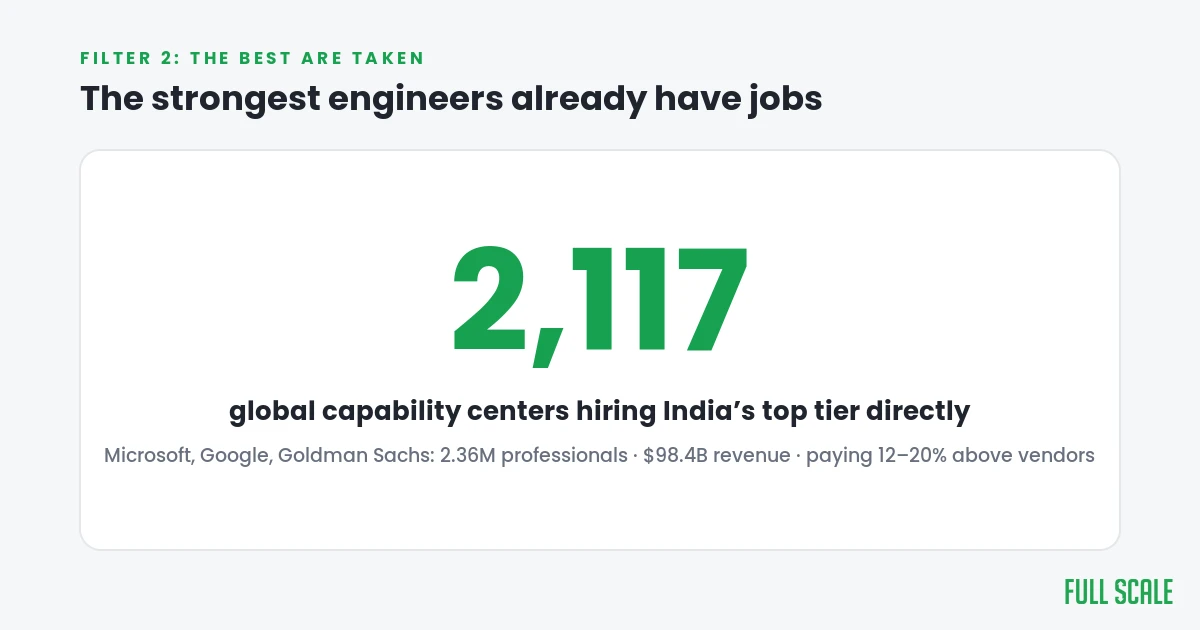
India now hosts 2,117 global capability centers (GCCs), the in-house India offices of companies like Microsoft, Google, Goldman Sachs, and Walmart. Per Zinnov and NASSCOM’s 2026 landscape report, those centers generate $98.4 billion in revenue, employ 2.36 million professionals, and 506 of the Forbes Global 2000 run one. This is not grunt work being shipped overseas: only 13% of those centers are pure cost-arbitrage outposts, while 39% own products and intellectual property outright and another 5% run transformation work for the parent company.
GCCs pay 12 to 20% more than Indian IT services firms for the same skills, and engineering graduates know it. The strongest engineers in India work at Google India, a GCC, a hot funded startup, or remotely for a global company at pay far above the local services market.
The exact engineers you’re imagining when a vendor says “world-class Indian talent” are mostly employed by companies that will never rent them out.
I’ve lived this dynamic from the other side. One of the reasons I love building companies in Kansas City is that I’m not competing with Big Tech for people. I’ve always told people that if I were in Silicon Valley, I’d be hiring whoever couldn’t get a job at Google, Microsoft, or Apple. In Kansas City, I get to be the cool place to work.
In India’s talent market, those 2,117 capability centers are the Google you’re competing against, and the typical outsourcing vendor is the Silicon Valley also-ran, hiring from whoever Big Tech and the GCCs didn’t take. There are still strong engineers in that pool, but finding them is the hard part, and you’re trusting a vendor whose margin depends on filling the seat fast.
Filter 3: The market churns underneath you
The lazy version of this section says Indian developers job-hop and leave it there. The honest version is more interesting, because the headline attrition numbers are actually fine now. After peaking around 23% during the post-pandemic frenzy, attrition at credit rating agency ICRA’s sample of five large Indian IT firms settled back to 12 to 14% by FY2026. That’s still above the 8.2% Mercer measured for US tech in 2023, but it’s no longer the outlier it was. India’s churn problem isn’t that people quit more. It’s the mechanics of how the market moves.
Job-hopping pays, notice periods drag, and offers fall through
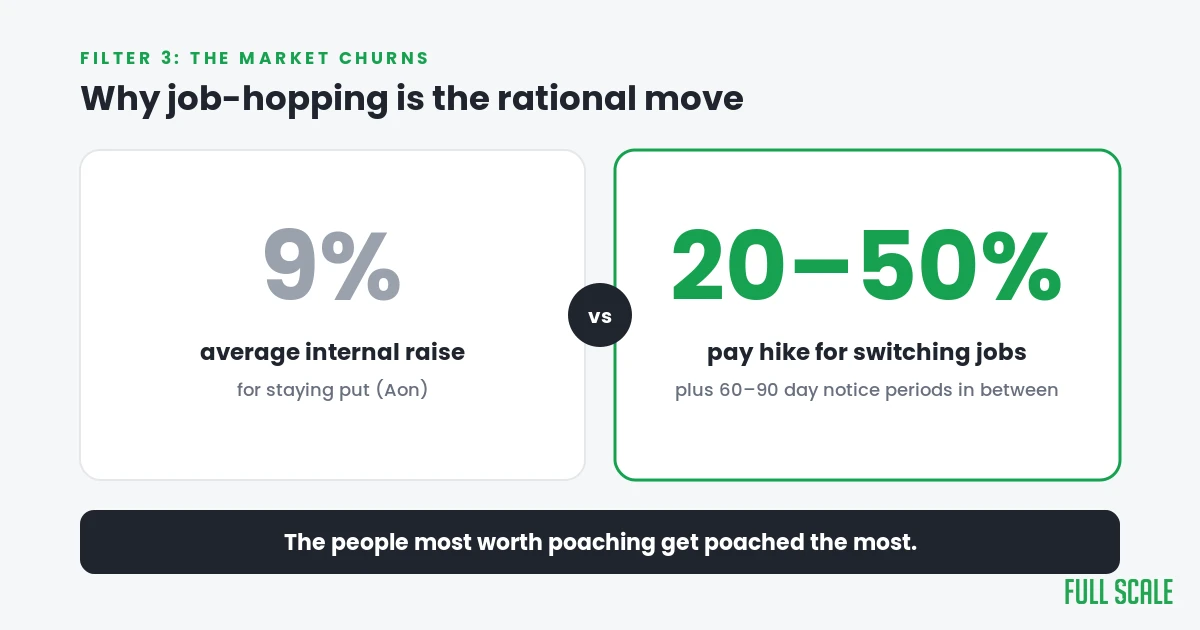
Internal raises in India average about 9% a year per Aon. Switching jobs gets you what recruiting executive Gaurav Chattur, in a 2021 Business Today column, put at a 20 to 50% hike. When changing employers pays several times better than staying put, frequent hopping is the rational move, and the people most worth poaching get poached the most.
Indian IT also runs on 60-to-90-day notice periods, against the two weeks Americans expect. That long runway creates a failure mode US buyers have never seen: the candidate you “hired” keeps interviewing for three months after accepting, fields counter-offers, and takes a better one before day one. Chattur’s same column estimated only one of every two or three accepted offers turns into a person who actually shows up, and put the industry-wide cost at $5 to 6 billion a year.
I dealt with this firsthand at Stackify, where we had developers in India through an outside engagement. I worked with some very talented people there. But here’s what that 90-day window does to you as a buyer. You make an offer, you wait out the notice period, and halfway through you find out the person rejected your offer for a counter and is never showing up.
Do that a couple of times and you never want to hire there again. The individual developers were never the problem; you lose trust in the process itself, and that’s the key. It was frustrating enough that we eventually stopped trying to grow there at all.
The talent was there; the process kept us away.
And none of that is a character flaw, it’s what a red-hot talent market and a 90-day runway will naturally produce. In 2022 it boiled over publicly when Wipro’s chairman Rishad Premji announced the company had caught 300 employees secretly working second jobs for competitors and fired them, calling moonlighting “cheating – plain and simple.” Whatever you think of moonlighting (Tech Mahindra’s CEO publicly welcomed it), the episode tells you how hot that market runs under the surface.
The pyramid that fed the vendors is breaking
Indian IT services were built as a pyramid: hire huge fresher classes cheap, train them, bill them out. That base is collapsing. Freshers made up 70 to 80% of IT services hiring in 2021 and only about 25% by 2025. FY24 fresher intake was the lowest in two decades. Veteran investor Saurabh Mukherjea told CNBC that “the number of people required to work in IT services in the world of AI will be orders of magnitude lower than where we are currently.”
If you’re buying from a traditional Indian outsourcing vendor in 2026, you’re buying from an industry whose own training pipeline is shrinking while AI eats its junior tier.
Filter 4: The engagement model hides problems by design
This filter explains the other four, and it’s the failure I’ve watched founders walk me through, over and over, for 15 years.
Outsourcing fails when it’s treated as a blind hand-off of execution instead of a direct integration of talent.
The classic India engagement is a project hand-off. You write requirements, the vendor quotes a price, and the work disappears behind an account manager, who talks to a delivery manager, who talks to a team lead, who assigns it to developers you will never meet. Every signal you need to steer the project, the developer who’s struggling, the spec that’s wrong, the engineer who just gave notice, gets filtered through people whose job is to keep the engagement calm and the invoices flowing. Project managers in the middle can undermine the whole thing even when everyone means well.
The research on this is unambiguous. A 2020 peer-reviewed study in PLOS ONE ranked the root causes of software outsourcing failure and found communication issues were the number one category, with five of the eleven top-ranked issues communication-linked. Research cited in the same study found 40% of offshored projects failed to achieve the expected benefits.
The mechanism is old and well measured. A landmark IEEE study found distributed software work takes about two and a half times as long as the same work done by a colocated team, and the delay grows with the number of people in the loop. Every middleman your vendor adds is another multiplier.
India didn’t invent the hand-off model. But India ran it at greater scale, for longer, than anywhere on earth, through the “body shop” era of billing warm seats by the hour.
A lot of India’s bad reputation is really that model’s reputation.
And it’s remarkably persistent. CIO magazine was publishing “Eight Reasons Why Outsourcing to India Could Hurt Your Business” back in 2007, and its list (turnover, infrastructure, hand-off friction, rising costs) could run today with a fresh date on it. Two decades is long enough to rule out bad luck. Problems that survive that long are structural.
India’s own industry says the model is ending
Don’t take my word for that either. Sridhar Vembu, founder of Zoho, one of India’s most successful product companies, wrote in 2025:
“The broader software industry has been quite inefficient, both in products and services… Sadly, we adapted to a lot of those inefficiencies in India. Our jobs came to depend on them.”
When a follower replied that India had spent a generation of talent serving as a back office for global giants, Vembu answered: “I am sorry to have to agree with this.” And NASSCOM’s own Strategic Review 2026 describes the industry moving away from full-time-equivalent (FTE) delivery toward outcome-based, risk-sharing contracts. Translated from industry-speak: the per-head billing model is ending, and the industry that perfected it says so itself.
This is exactly why, when we started Full Scale in 2018, we were 100% against the project model. From day one we went all in on staff augmentation instead, and it’s been a big part of why Full Scale works. It’s the key for any engineering leader hiring offshore talent: you have to integrate directly with the individual engineers. For the stack-specific version of this argument, here’s what to know before you hire .NET developers in India.
By the way, the cheapest version of this model has a name. When companies pick a vendor purely on the lowest hourly rate, I call it cheapshoring, and it finds the worst of every filter in this article at once.
Filter 5: The communication style keeps problems hidden longer
The last filter is the one people whisper about.
Indian business culture is what researchers call high-context. Erin Meyer’s The Culture Map documents that negative feedback in India is delivered softly and indirectly, wrapped in positives. Cross-cultural consultant Karine Schomer, who specializes in India offshore teams, puts it plainly: people from cultures that avoid conflict and loss of face “often find it hard to say ‘no’ or raise problematic issues effectively with their American counterparts.” The “yes” you heard in the status meeting meant “I heard you,” not “I agree” and definitely not “it will be done Friday.” English proficiency adds friction at the margins too: the 2025 EF English Proficiency Index puts India 74th globally, in the low-proficiency band, versus 28th and high-proficiency for the Philippines.
Now the fairness check, because this is where most articles about India get dishonest. This is not about deference to hierarchy. On Hofstede’s power distance index, the Philippines scores 94, higher than India’s 77. A Filipino developer doesn’t naturally challenge the boss any more than an Indian developer does; I’ve managed both and neither country hands you engineers who love telling a client he’s wrong.
The difference is the style on top of the deference. Filipino communication reads warm and American-familiar, so a US team picks up on the hesitation behind a soft answer quickly. Indian professional communication reads formal and indirect to American ears, so the unspoken “no” stays unspoken longer.
Match that style with a vendor model that already filters out bad news, and you get the signature India failure: everything is good until the week it’s all bad.
When outsourcing to India works
If everything above were the whole story, India’s software industry would be shrinking. It is not, and an honest version of this article has to explain why.
The biggest companies in the world keep betting on Indian engineers, and winning, by employing them directly. Those 506 Forbes Global 2000 companies with capability centers aren’t running charity operations: Microsoft has over 20,000 employees in India and just committed $17.5 billion more, and Goldman Sachs’s India offices are its second-largest presence in the world.
The broader market has been learning the same lesson. Deloitte’s 2024 Global Outsourcing Survey found 78% of organizations now use in-house global centers, 70% have pulled previously outsourced work back from third parties, and cost has fallen from the top reason to outsource (70% in 2020) to just 34%. Duke University’s multi-year offshoring research found the same pattern in research going back to the late 2000s: directly managed offshore centers consistently outperformed third-party vendors. The honest counterweight, from rate-card studies of the same era: third-party delivery ran 5 to 15% cheaper per hour. The hand-off model wins on price and loses on outcomes, which is the cheapshoring trade in one sentence.
Notice what changed in every success case: the geography stayed, and the hand-off went away.
Vendor-model India can still be the right call in specific situations:
- You need 50-plus engineers on a stack fast. Few countries can field a team that big that quickly.
- You want the vendor, not your own team, to own enterprise compliance like SOC 2 at scale.
- You’re building a product for the Indian market.
- You need genuine 24/7 operations coverage. (Time zones themselves are a wash: India and the Philippines are both roughly half a day ahead of US time, so the overlap question is the same across Asia.)
If you’re choosing between countries for a small integrated team instead, I’ve written an honest comparison of India and the Philippines based on having hired in both models.
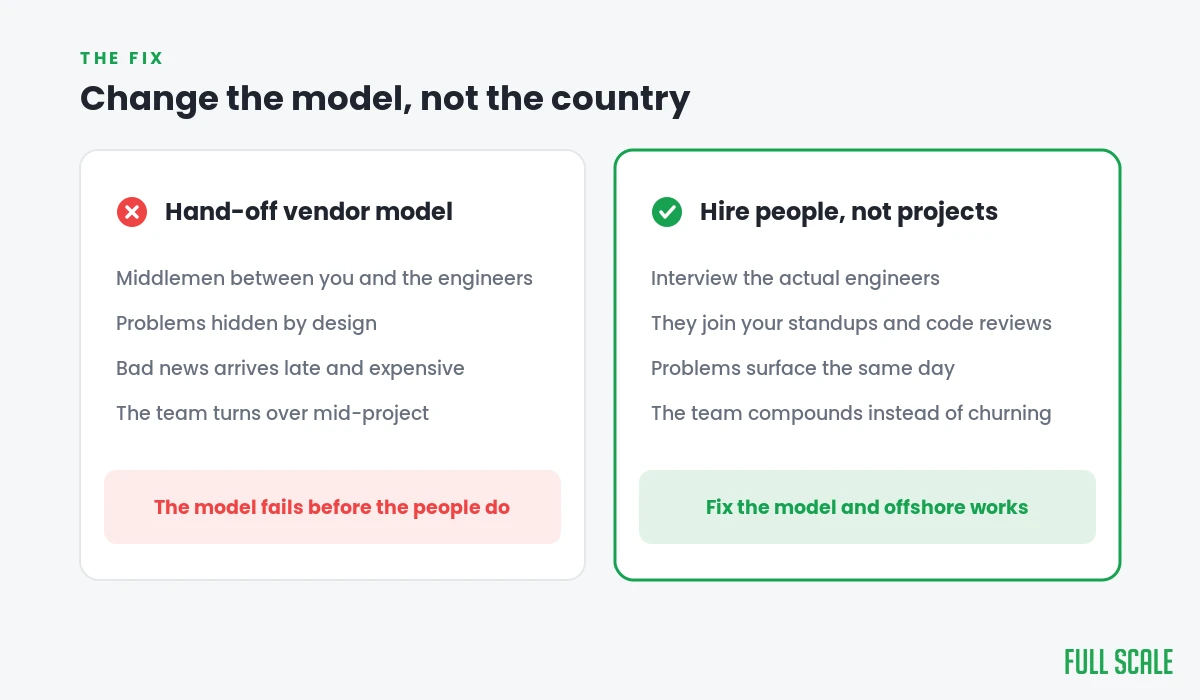
The fix: Hire people, not projects
Everything in this article points at one piece of advice, and it applies in any country.
Where you hire matters less than how you hire.
The model that works is staff augmentation: named engineers who work directly for you, in your standups, your Slack, your code reviews, led by your leads, even though someone else handles their payroll and benefits. Run it that way and look at what happens to the five filters. You interview the actual engineer, so the thin-talent-layer and fake-résumé problems get caught before day one instead of in sprint three. There’s no account manager between you and the work, so the IEEE math about hops and delay runs in your favor. And when a quiet “yes” hides a problem, you find out in days, because you’re in the room. AI pushes the same direction: it’s automating exactly the rote ticket work the hand-off model bills for, while making an integrated team that understands your product more valuable than ever.
Direct visibility also fixes the thing project outsourcing can never fix: what happens when someone isn’t working out. In a hand-off engagement, a weak developer hides behind the vendor’s reporting until the deadline exposes everyone. In an integrated team, you know within a few weeks, and you swap one engineer instead of firing a vendor and starting the project over.
One honest caveat: staff augmentation removes the model filters, but it can’t repeal the market. Run it in India and the hand-off problems disappear, but the capability centers are still outbidding you for the top tier, and the 90-day notice machinery keeps churning under you no matter how integrated your team is. The model is most of the answer; the market you hire in is the rest, and that’s the real reason destination still matters. It’s also exactly why I compared India and the Philippines head to head.
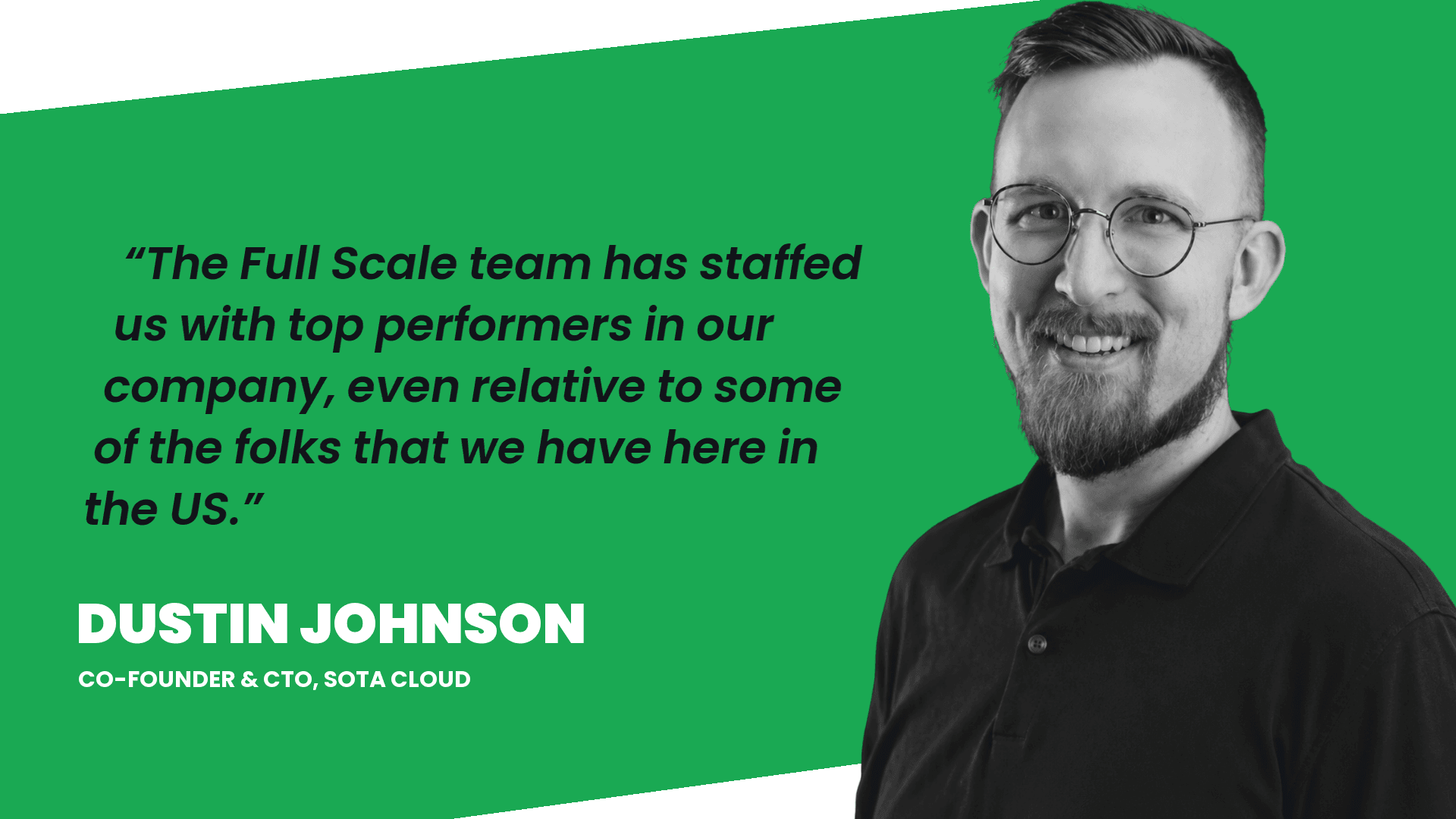
Clients see it too. Dustin Johnson, co-founder and CTO of our client SOTA Cloud, put it this way: “The Full Scale team has staffed us with top performers in our company, even relative to some of the folks that we have here in the US.” That’s what the model produces when the middlemen are gone.
Full disclosure, again: Full Scale is an outsourcing software development company, and we build these teams by outsourcing software developers in the Philippines, so judge my advice accordingly. But notice that the strongest evidence for it comes from India: the 2.36 million engineers doing excellent work in directly managed capability centers are the proof that Indian talent thrives the moment the middlemen disappear. The difference between staff augmentation and project outsourcing was never the map.
It was never the people
One last set of numbers, because the conclusion writes itself.
In fiscal year 2024, 71% of all approved US H-1B petitions went to workers born in India. India is the number one birth country of founders of US billion-dollar startups, with 96 of them. Indian-American households earn a median income of about $151,000, nearly double the US median.
GitHub projects India will pass the United States as the largest developer population on earth by 2030. The American tech industry has effectively run a 30-year experiment on whether Indian engineers can build the world’s best software, and the answer runs three of its biggest companies.
So when your outsourcing engagement in India fails, the explanation was never national talent. It was a thin hireable layer your vendor fished below, a top tier someone richer already employed, market mechanics that churned your team, a model built to hide all of that from you, and a communication style that kept it hidden a little longer. There’s great software talent everywhere. The companies that win with it, in India, the Philippines, or anywhere else, are the ones that hire people instead of buying projects.
If you’re weighing an offshore build and want a second opinion from someone who has done this 200+ times, get in touch.
Frequently asked questions
Why are companies outsourcing to India?
The two draws are scale and cost. India produces about 1.5 million engineering graduates a year, has the deepest IT services infrastructure in the world, and can mobilize large teams faster than any other country. For enterprises that need 50-plus engineers or vendor-owned compliance, that scale is the draw.
Why does outsourcing software development to India fail so often?
The evidence points to structural causes rather than skill: only a thin slice of India’s huge graduate pool is job-ready, the best engineers are absorbed by captive centers and Big Tech, and the traditional hand-off vendor model hides problems behind account managers. Peer-reviewed research ranks communication breakdown as the top cause of outsourcing failure, and that model maximizes it.
Is outsourcing to India a good idea in 2026?
It can be, if you change the model. Companies that employ Indian engineers directly, like the hundreds of Forbes Global 2000 firms running capability centers there, get strong results. Buying a hand-off project from a body-shop vendor is where the failure stories come from, in India or anywhere else.
What is the best way to outsource software development to India?
Use staff augmentation instead of project hand-off: interview the actual engineers, integrate them into your own standups and code reviews, and manage them like your own team. Direct integration removes the middlemen that research shows cause most outsourcing failures.
Key sources
The claims in this article lean on these primary studies and institutional reports. Inline links throughout point to the specific coverage behind each number.
- Iqbal et al., “Requirements engineering issues causing software development outsourcing failure,” PLOS ONE (peer-reviewed, 2020)
- Herbsleb & Mockus, “An Empirical Study of Speed and Communication in Globally Distributed Software Development,” IEEE Transactions on Software Engineering (2003; IEEE published a retrospective on it in 2025)
- Zinnov-NASSCOM India GCC Landscape Report 2026
- NASSCOM, Technology Sector in India: Strategic Review 2026
- Aspiring Minds, National Programming Skills Report: Engineers 2017
- ICRA, Indian IT services attrition commentary (December 2024)
- Karat, India engineering hiring research (2025-2026 editions)
- Deloitte Global Outsourcing Survey 2024
- USCIS, Characteristics of H-1B Specialty Occupation Workers, FY2024 report to Congress
- National Foundation for American Policy, Immigrants and US Billion-Dollar Companies (June 2026)
- GitHub Octoverse 2025
- EF English Proficiency Index 2025