
Offshore Dedicated Development Team Success: 12 Lessons from a CTO Turned CEO

In this article
I have hired offshore dedicated development teams as a CTO, and I have sold them as a CEO. The lessons I would write today are not the ones in the rest of the search results.
At Stackify, my second company, we brought on a dedicated Philippines team in 2018. By the time we exited in 2021, that team was central to the engineering org. After Stackify, we accidentally turned the same model into a company. Full Scale now runs offshore dedicated teams for more than 200 clients. Almost everything written about this online comes from people who have done neither side of it. Other companies have run the same arc at much bigger scale, and I walk through those offshoring success stories, and a few disasters, separately.
If you are still working out whether a dedicated team is the right model for your situation, start with the full dedicated development team guide and come back here when you have decided. The 12 lessons below are for the buyer who has already chosen the model and wants to not screw it up. And if you’re weighing the version with more infrastructure around it, here’s what an offshore development center is.
I have organized them by phase: picking the partner, setting up the team, running it well, and keeping it healthy. These lessons apply across every stack: teams building Vue.js frontends, for example, hire Vue.js developers offshore and get the same phase-by-phase results when they apply these principles.
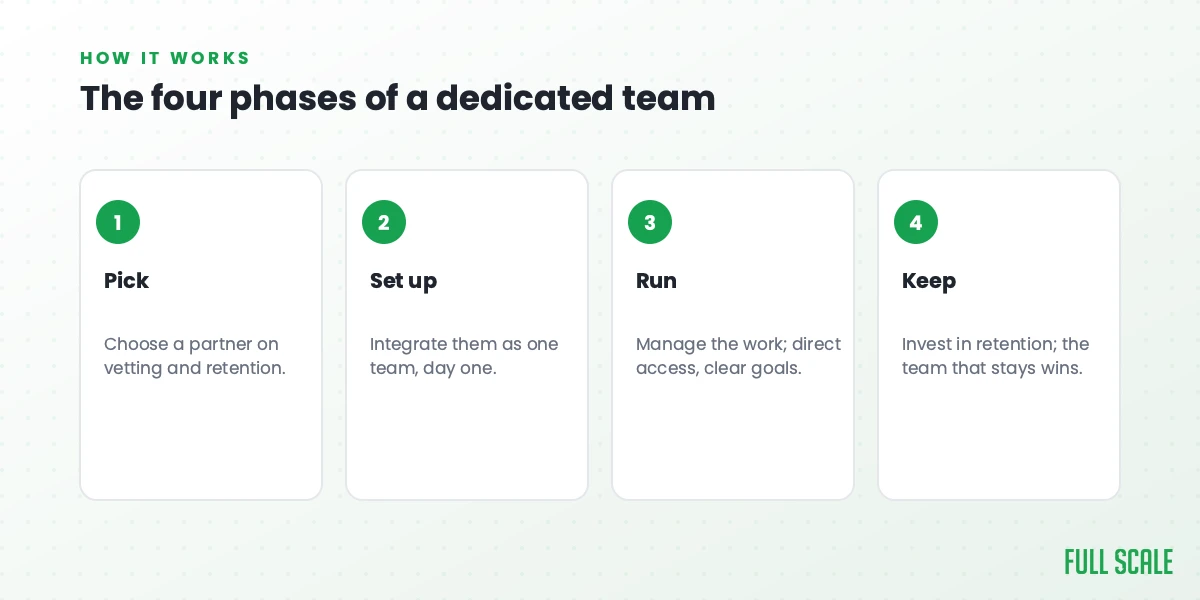
Picking the partner
Most failed offshore dedicated team engagements were already broken before the first sprint. The vendor selection and contract structure decided it.
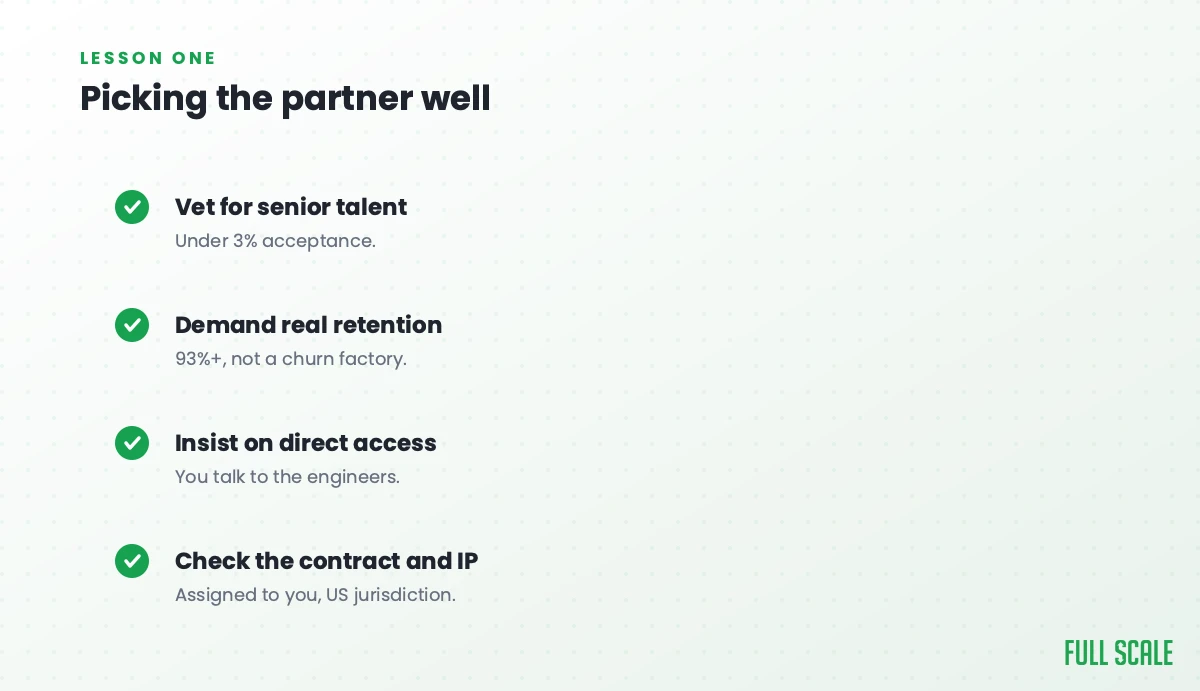
1. Interview every engineer yourself. Walk if the vendor resists.
The single biggest move a buyer can make at this stage is to interview the actual engineers, not just trust the vendor’s vetting. Two technical rounds plus a culture-fit conversation, exactly the way you would interview a local hire. The vendor’s resume hand-off is the start of the process, not the end.
The vendors who push back on this are signaling something. They might be protecting an engineer they know is on the edge. They might be optimizing for placement speed over fit. Either way, the resistance itself is the answer. If they will not let you interview the people who will be writing your code, walk.
2. A bench is a feature, not a red flag
The conventional take is that a vendor with a bench has previous teams cycling off, and is therefore hiding something. The actual operator truth is the opposite. A bench means the vendor can absorb scope changes without scrambling, can swap a poor fit within a week, and can scale you up in days rather than the four to six weeks it would take to hire from cold.
When you talk to a vendor, ask how many engineers they have available right now in your stack. A real answer (“we have four senior React engineers between contracts as of this week”) tells you the model is healthy. A vague answer tells you the opposite.
3. The vendor’s account manager is your secret weapon
Most posts treat the account manager as a sales contact you tolerate. That framing is wrong. A good account manager has the hard conversations with the engineers that you cannot have directly, keeps the talent happy across a cultural and time-zone gap, and surfaces problems before they reach you.
At Full Scale we call this role Customer Success Manager, not Account Manager. The industry-default name implies a sales-renewal function, and the work we actually run is operationally focused on making the engagement succeed for both sides. Whatever the title is, treat that person as part of your management team. Meet with them weekly. Use the channel to raise things you do not yet want to escalate inside the team.
4. Background checks, IP assignment, and confidentiality are the whole reason the staff augmentation model exists.
Buyers learn this lesson the hard way during acquisition diligence. If you hired offshore engineers directly as contractors on a freelancer site, you would be running IP assignment paperwork, NDA chains, and background checks across a foreign jurisdiction by hand, and you would discover during diligence that you got most of it wrong.
The reason a Full Scale as an IT staff augmentation company exists is so this part is already solved on day one. A US-based MSA with the vendor includes IP assignment, NDA terms, and background verification, with SOC 2 or ISO 27001 offshore development coverage if you need it. Before you sign anything, read the IP assignment clause and ask how the partner handles confidentiality across the team.
Setting up the team
The first 60 days of the engagement decide whether the operation becomes one team or two.
5. Do not run them as a separate team. Pair each offshore engineer with a US engineer for the first 60 days.
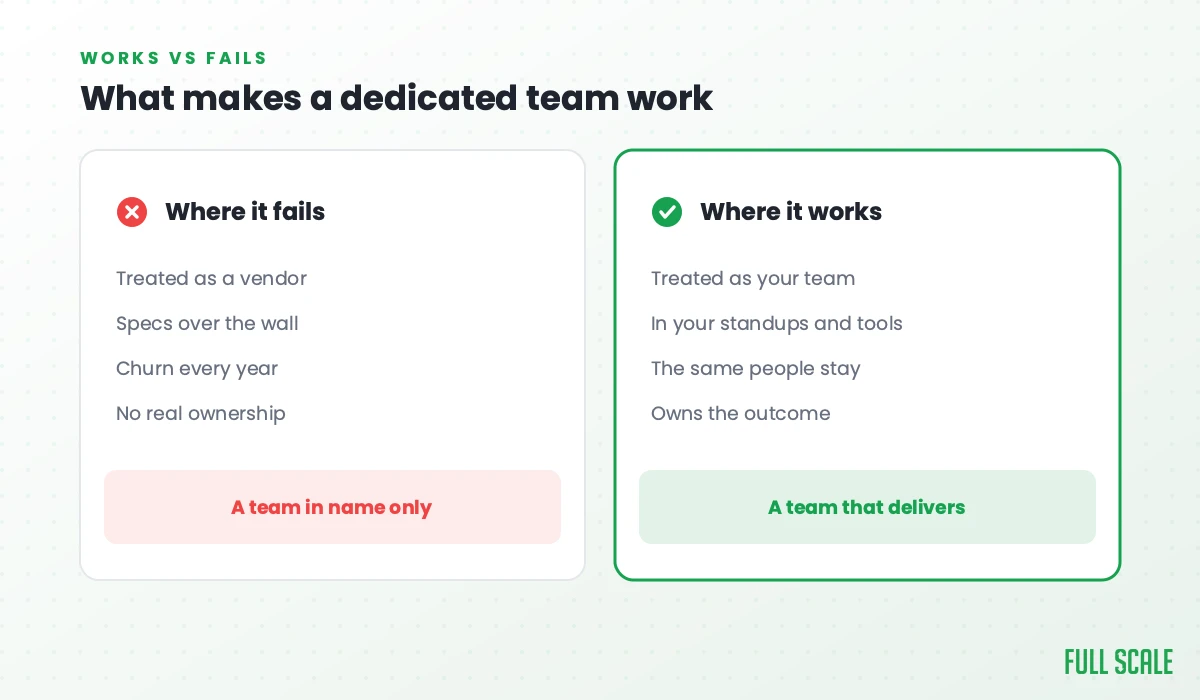
The most common reason this model fails is the org-chart decision to run the offshore team as a parallel unit. The fix is structural. Every offshore engineer gets a specific US engineer as their pair for the first 60 days, and the buyer measures the pair, not the engineer alone.
Write the pairing into the onboarding plan before day one. Tell each US engineer that pairing time is part of their job, not a favor to the new offshore hire. The first shared ticket, the first PR review, and the first definition of done all happen as a pair, with one shared outcome. If your team works well remotely, it will work well globally, too.
6. The offshore team adapts to your time zone, not the other way around
US engineers should not be taking 9pm calls to accommodate an offshore team. The Philippines team works an evening shift to overlap with the US business day from day one, with four or more hours of overlap to your working window. If the vendor balks at that arrangement, the model does not work.
Negotiate the time-zone setup in the sales conversation, not after the first sprint. When the schedule is set up right, the 14-hour difference becomes on-call coverage rather than a coordination problem. Vendors who push back on this are signaling how they treat their own engineers.
Running it well
The lessons in this phase are where most engagements quietly underperform. The work ships, but it is not great.
7. Owners over tickets
If the offshore engineer cannot name the business outcome they own, you have not hired an engineer. You have hired a typist. Engineering output that ships real value comes from people who understand why the work matters, not from people who close tickets.
Engineers who think like owners outperform those who wait for tickets. I wrote a whole book on the principle, and it is especially true offshore, where the distance makes it easy to fall back into a deliverables mindset. At the end of every sprint, ask each offshore engineer what their work meant for the customer that sprint. If the answer is a Jira ID, the team has a problem that is not the engineer’s fault.
8. Do not give them only the easy work, especially now
Standard advice for years has been to give offshore engineers the simpler tasks so they do not get stuck. That advice was always borderline. In an AI-augmented codebase, it is actively dangerous. Cursor and Claude Code handle the easy work already. If your offshore engineers are doing only what AI can do, they will leave for a vendor that gives them harder problems, and you will have built nothing transferable along the way.
Pure coders will be replaced by AI. Problem solvers will run technology organizations. That shift makes the difference between a “typist” offshore engineer and an “owner” offshore engineer matter more, not less. Audit your offshore team’s ticket queue once a quarter. If more than half is bug fixes and small features, the team is on the wrong work, and they know it before you do.
9. Code review is the contract
The bar your US engineers hold offshore PRs to is the bar the offshore team will perform at. If reviews are looser for offshore engineers than for local hires, the org has built a permanent quality gap into the codebase. Reviews are the line between “dedicated team” and “outsourced team,” and it is the buyer’s call which side of that line their codebase sits on. The setup that gets you to the dedicated-team side of that line is what I cover in how an outsourced development team works when accountability is built in from day one.
Audit one offshore PR and one local PR side by side every two weeks. Compare review comment count, approval cycle time, and the kind of feedback in each. The first time they look different, the gap is already forming. Hold offshore and local PRs to the same standard from the start, and the gap never gets a chance to open.
10. “Yes” is the scariest answer. Use video. Watch the face.
Most engineers will say yes to avoid a hard conversation, especially in cultures that prize harmony. Even when the engineer is not deflecting, “yes” on an audio-only call is ambiguous. It might mean “I agree,” it might mean “I heard you,” or it might mean “I am being polite and I am also lost.”
A different tone of voice will not solve it. Video will. You need to be able to tell someone something and see on their face whether they understood. A “yes” with confusion behind it is a red flag the size of a sprint. Software development is about communication. Engineers who cannot communicate clearly with each other ship the wrong thing, no matter how strong the code is.
Default to video for any conversation more complex than a status update. After explaining anything non-trivial, ask the engineer to play it back in their own words, not because you doubt them, but because the play-back forces real comprehension and gives you the cue you need.
Keeping it healthy
The first year is the easy year. The lessons in this phase are about the second, third, and fifth.
11. Track attrition explicitly. “Rotated” twice in a year is not actually dedicated.
A team that loses engineers and quietly backfills them is not a dedicated team. It is a contracting pool with a sticker on it. Track offshore attrition the same way you track local-team attrition: name, role, tenure, reason for leaving, replacement onboarding date.
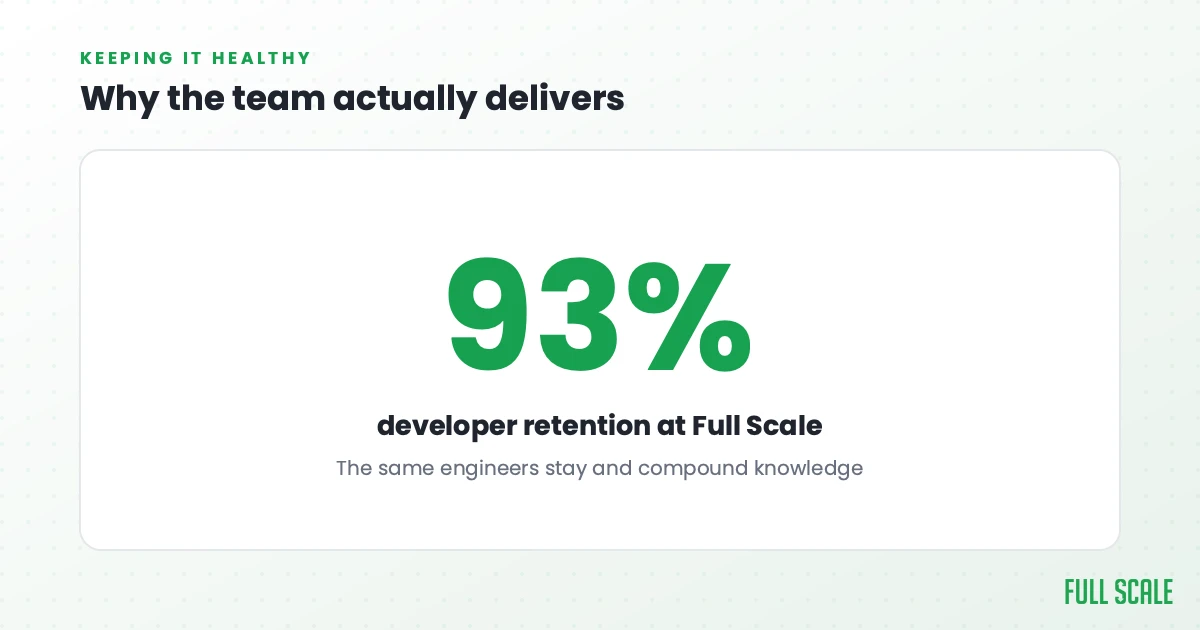
Full Scale runs over 93% developer retention, with engineers who average more than seven years of experience. Those are the numbers I expect from a vendor running the dedicated model honestly. In the quarterly review with whatever vendor you choose, ask the question directly: how many of the engineers who were assigned to us a year ago are still on our team today? That answer is the truth about whether the engagement is dedicated.
12. Visit them in person at least once a year. This one is underrated to the point of being free.
Almost no client does this. The ones who do see a velocity gain that does not show up on any spreadsheet. People who have karaoke’d together work differently than people who have only shared a Slack channel.
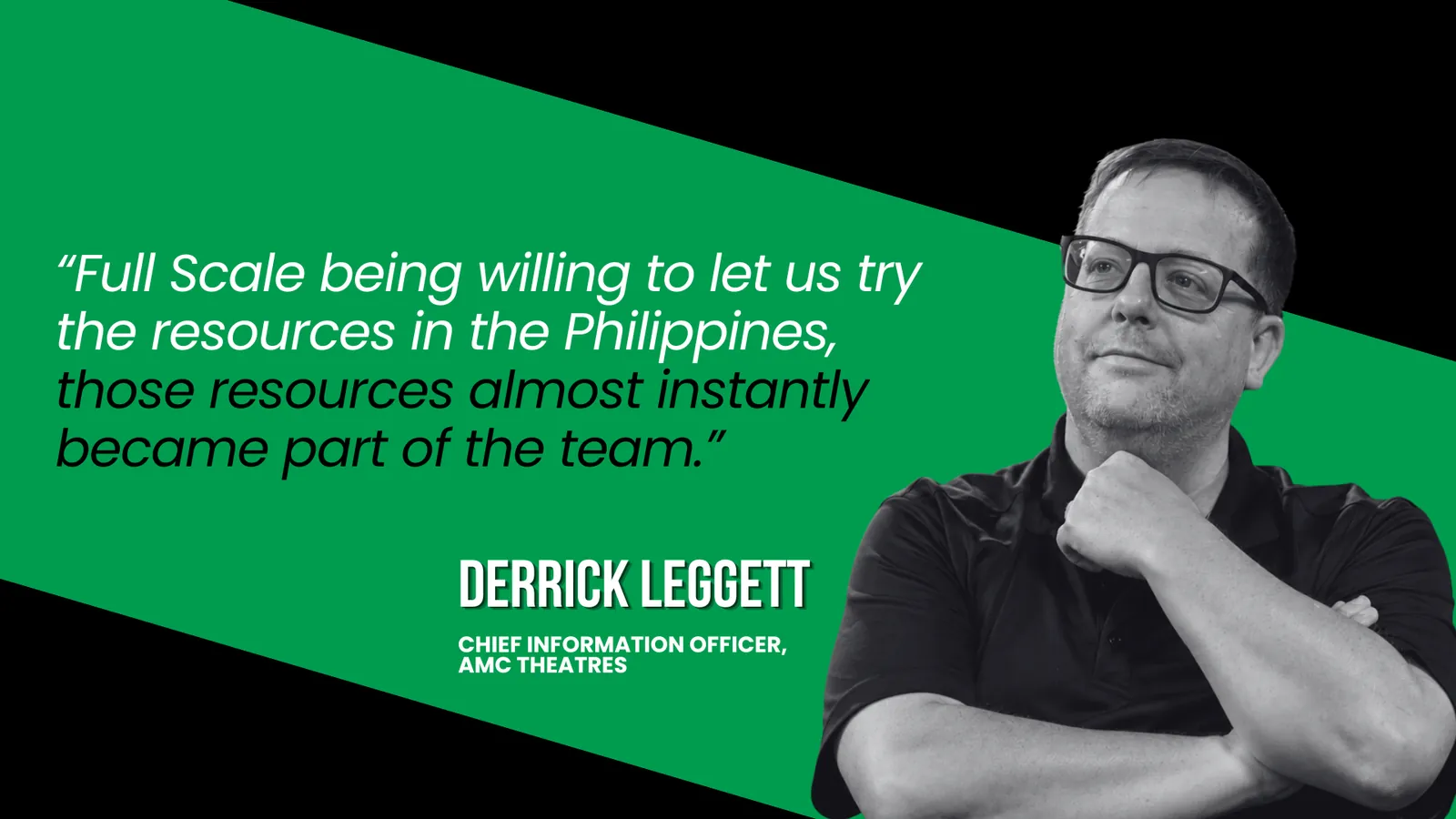
AMC Theatres’ engineering org runs on a mix of Kansas City staff and Full Scale’s dedicated .NET developers. Early in the relationship, they sent a delegation from their Kansas City team to our Cebu City office. The trip was not a working session in a conference room. They did karaoke with the engineers, went to the beach together, and explored the city as a group. The velocity in the following months changed in a way that was visible without analytics, because the offshore team was suddenly people, not Slack handles.
Plan one trip per year in the engagement budget. Even one US engineering lead going for three days does most of the work. The annual visit should be a line item, not a perk.
Frequently asked questions
What makes an offshore dedicated development team succeed?
The single biggest factor is whether the buyer integrates the team into one shared engineering org or runs them as a parallel unit. Teams that pair with US engineers, share code review standards, and operate on the same definition of done outperform teams that are managed as a separate offshore group. The model rewards integration.
How do you manage an offshore dedicated team across time zones?
The offshore team adapts to your business day, not the reverse. A Philippines team runs an evening shift to get four or more hours of overlap with US working hours, which turns the 14-hour difference into on-call coverage rather than a coordination problem. Your US engineers should not be shifting their schedule to accommodate the offshore team.
How often should you replace engineers on an offshore dedicated team?
Almost never, on a well-run engagement. A dedicated team that loses engineers and quietly backfills them is not actually dedicated. Track attrition with the same rigor you would for local hires. If engineers are “rotated” more than once in twelve months, the vendor is not running the model honestly.
Do offshore dedicated developers still have a role in the AI era?
Yes, and the role gets harder, not easier. AI handles routine coding work, which means the offshore engineers you keep need to be the ones who can supervise AI-generated code, debate architecture, and own product outcomes. The shift makes the difference between a “typist” offshore engineer and an “owner” offshore engineer matter more, not less.
Should I visit my offshore team in person?
Yes, at least once a year. The clients who do this see a velocity gain that is real but rarely measured. Three days on the ground in Manila or Cebu changes the relationship more than a year of Zoom standups ever will. Treat the trip as a line item in the annual engagement budget.
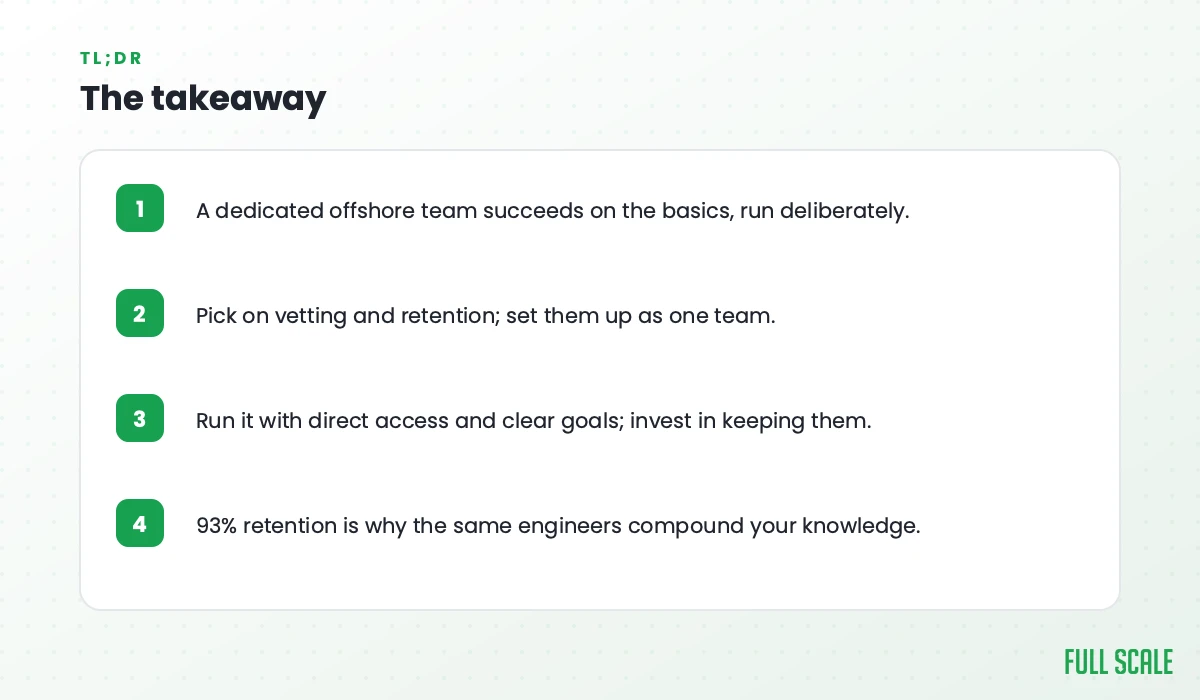
The takeaway
An offshore dedicated development team works when the buyer treats it as one engineering team that happens to span two countries, and fails when the buyer treats it as a separate offshore unit grafted onto the local org. At Full Scale, our clients are not hiring us for a short-term engagement. They are trusting us with their long-term teams. That’s the standard to hold any partner to before you hire experienced offshore developers for something that matters this much.
Schedule a call if you want to talk through what a dedicated offshore team would look like for your engineering org.