
How to Build a Custom CRM: A Step-by-Step Guide (and When It’s Worth It)

In this article
I’ve built a custom CRM before, and sold it, for real money, to an entire industry that needed one and didn’t have one, which is why I can answer the question every generic build guide skips: should you build one at all.
The difference between a CRM that pays for itself and one that quietly sinks a team was never the code. It was whether there was a real reason to build in the first place.
Custom CRM vs. off-the-shelf: when building actually makes sense
There are two honest reasons to build a custom CRM instead of buying one, and a third path that only works for a while. Most articles on this topic only know about the first reason.
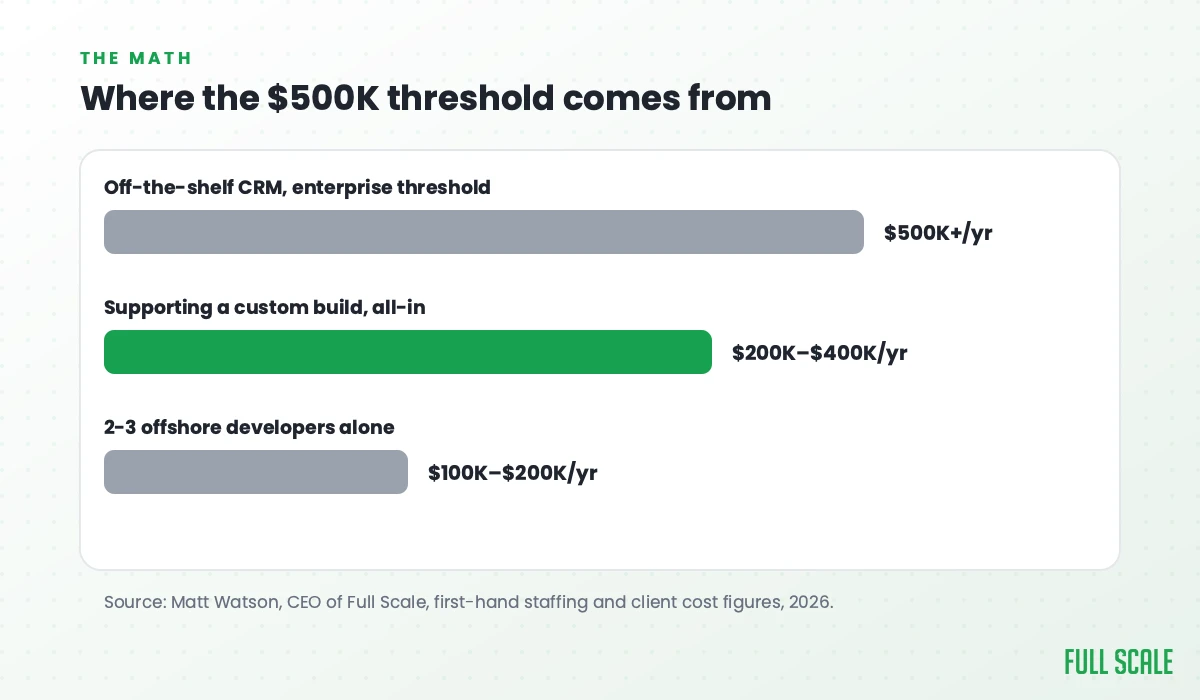
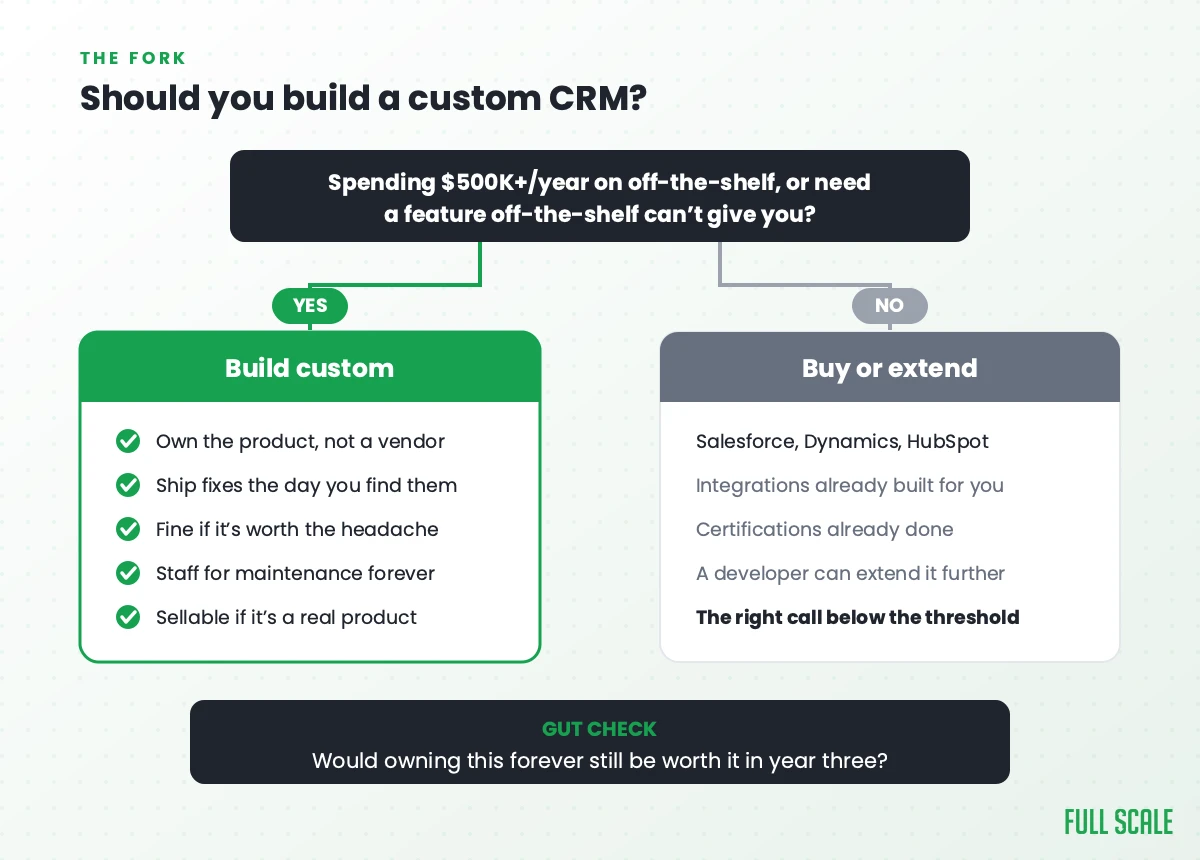
Reason one: you’ve outgrown off-the-shelf, financially. If you’re spending real enterprise money on Salesforce or Dynamics, somewhere north of $500,000 a year once you count licenses, add-on modules, and the consultants you hired to make it fit, building your own starts to pencil out.
That number comes from what it actually costs to support a build long-term: 2-3 offshore developers, roughly $100,000 to $200,000 a year, plus the in-house leadership to manage them. At most mid-to-large enterprises, doing it well runs $200,000 to $400,000 a year, all in. Below that math, the headache of owning a build isn’t worth it, unless it hands you a competitive advantage you can’t get off the shelf.
Reason two: you understand an industry nobody’s built for yet. This is the one nobody talks about. When an entire industry is running on generic software that nobody built specifically for it, that gap is a product to build and sell, not just a cost problem to fix for yourself.
There’s a third path worth naming honestly: no-code and low-code platforms like Knack or Bubble, which let you assemble something CRM-shaped without hiring anyone. That’s a fine choice if you genuinely just need a couple of database tables to track contracts. It stops being fine the moment you need real integrations, certifications you can’t fake, or a product you can sell to someone else, because you’re renting someone else’s ceiling instead of building your own.
You can see the pattern everywhere once you look for it. Nonprofits ended up with their own category of donor-focused CRM tools, because a generic sales CRM has no idea what a pledge or a recurring donor even is. Real estate got its own, legal got its own, and auto dealers got VinSolutions.
Christian Hammer, CEO of Vala AI, put his finger on why off-the-shelf software creates that gap in the first place, when he joined me on Startup Hustle to talk about technical debt:
“The problem with off-the-shelf software is it’s generalized. It has to be. It’s not built for your specific use case within your business. And so inherently, any off-the-shelf software has a form of tech debt.”
That’s true for a single company. It’s even more true for an entire industry generic software was never built for, and it compounds the same way any unmanaged technical debt does.
I built a product, not an internal tool
The second reason is my story, and I’ve never seen a competitor’s how-to-build-a-CRM guide mention it, because none of them are written by someone who’s shipped one.
I was 22, a college dropout, trying to build software for an industry I barely understood: car dealerships. There was no CRM built for how a dealership sells a car, so I built one. Notice that’s not reason one. I wasn’t spending anything on Salesforce as a 22-year-old with no company yet. The industry gap existed whether or not the spending math ever would have.
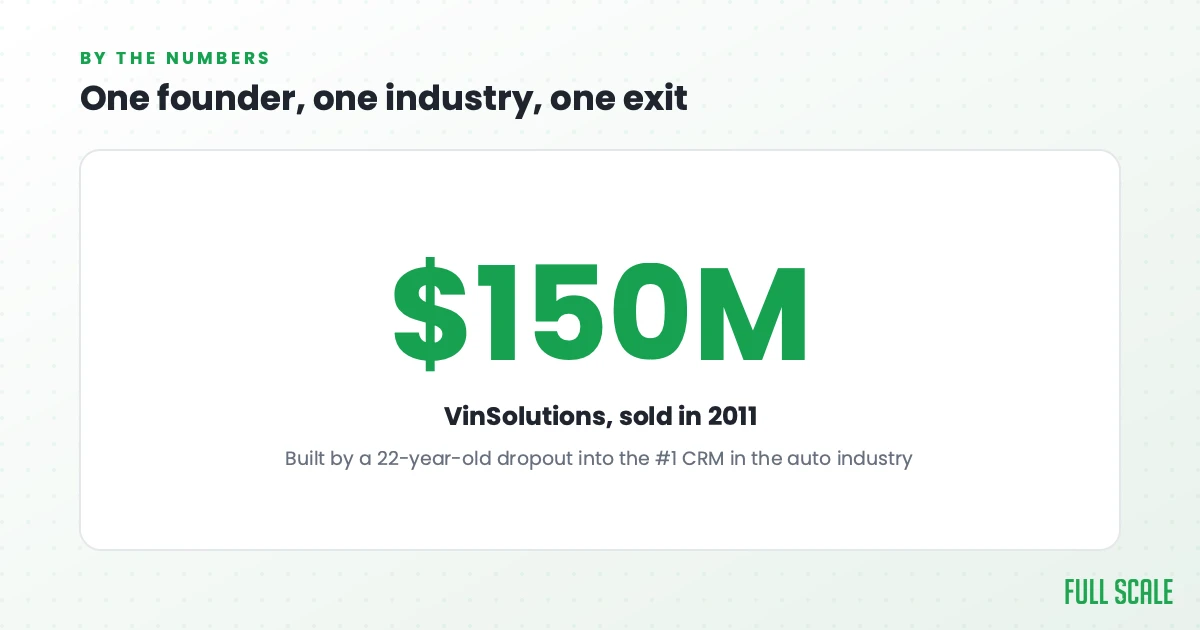
It became VinSolutions, the number one CRM platform in the auto industry, and I sold it in 2011 for around $150 million (the Wikipedia rundown has more on the story).
Owning the product instead of running someone else’s platform meant I could talk to a dealership in the morning and ship the fix that afternoon. There was no ticket queue and no product manager turning a request into a backlog item three sprints out.
That speed is one real advantage of building instead of buying, and it disappears the moment you forget who you’re building for.
That’s the Ownership pillar I write about in Product Driven: the person closest to the customer makes the better call, not the one three layers removed from them.
None of that mattered without selling it, door to door, to dealership owners who’d never bought software from a 22-year-old before. Understanding the industry got the product right. Getting anyone to actually buy it was the harder job, and it still is.
Our users made the “who you’re building for” part impossible to forget once we had them. My cofounder used to joke that we were building software for a fifth grader with a hangover.
It sounds harsh until you realize the point wasn’t that car salespeople were dumb. It was that they weren’t us. They didn’t think like engineers, and if the software required them to, they’d go back to writing deals on paper.
Design for who’s going to use it, not for who you wish was using it.
The hidden cost nobody warns you about
That’s the lesson everyone expects to hear. The one most guides skip is what you inherit the moment you stop buying and start building: everything a mature off-the-shelf platform already comes with, that you now have to rebuild yourself.
Integrations, mostly. Your CRM has to talk to your ERP, your marketing tools, your billing system, and whatever industry-specific data feed your business depends on. Salesforce and Dynamics have spent two decades and thousands of partner integrations solving that problem. You’re solving it from zero.
And that integration layer isn’t a one-time build either. Every system the custom CRM talks to needs records to stay current in both directions, which is why most teams end up stitching together webhooks and cron jobs, or turn to purpose-built real-time CRM-to-ERP sync tools to keep everything in lockstep as both platforms evolve.
The integration that blows the timeline is never the one you scoped up front. It’s the one added eighteen months later when finance switches payment processors and nobody remembers the custom CRM needs updating too.
Then there’s certifications. If you’re anywhere near healthcare, finance, or payments, your feature list also has to include HIPAA compliance, PCI DSS, or whatever your industry’s version of “don’t get us sued” happens to be. That never shows up in a features list. It shows up later, in the timeline and the budget.
The gap has widened in 2026. Salesforce, Dynamics, and HubSpot are all shipping AI agents that handle data entry and workflow orchestration out of the box now, on top of the integrations and certifications they already had. That’s one more capability you’re on the hook to replicate yourself the moment you go custom.
Every dev-agency blog will throw out a number like $50,000 to $300,000 for a custom build, with a straight face, before they know your integrations or your compliance load. Skip the made-up range. The honest cost is the one from the first section: what you’re already spending, and what rebuilding the integrations and certifications your current platform gives you for free will really cost.
Does AI change the math in 2026?
Off-the-shelf just got more AI-native. The build side changed too, though not the way the hype suggests. I’ve written elsewhere about why AI makes the boilerplate faster without making the judgment calls any easier. The moment your CRM has a live sales team depending on it, you’re past the weekend-prototype stage, and you need the same engineering judgment a build always required, just applied faster.
What’s actually different for a CRM specifically is pairing that speed with offshore access to senior engineers. A team that builds faster with AI, starting at a fully loaded $35 an hour instead of a US-market senior salary, has moved the $500,000 threshold from the first section lower than it sat a decade ago.
AI didn’t replace your dev team. Good engineers, working faster, just got cheaper to access.
How to build a custom CRM from scratch
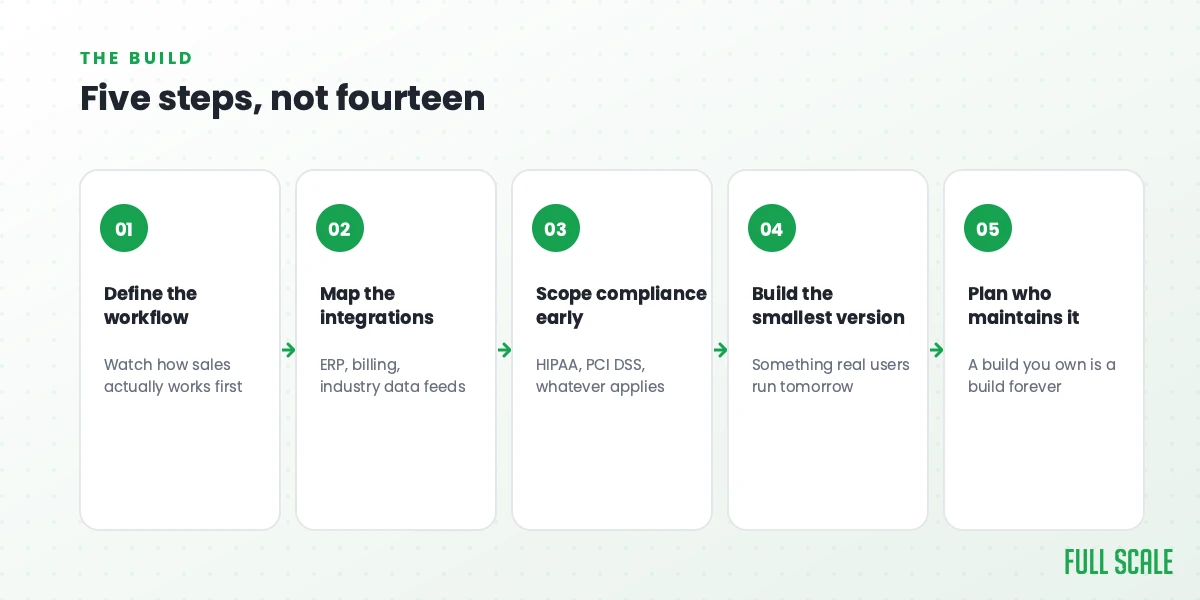
Every CRM, custom or not, needs the same bones: contact and account records, a pipeline with stages, activity logging, and reporting on top of it. That part isn’t the interesting decision. Here’s what is, without fourteen steps padded to make an agency’s process sound more sophisticated than it is:
- Define the workflow, not the features. Watch how the sales process really works before you design a single screen. A features list copied from a competitor’s marketing page gets the labels right and the workflow wrong.
- Map every integration you can’t live without. Your ERP, your billing, and your industry data feed all need a plan before you write code, because they change your architecture.
- Scope compliance early. If HIPAA, PCI DSS, or an industry certification applies, design for it from day one. Retrofitting compliance into a finished product is brutal.
- Build the smallest version someone can run their day on. Not a demo. A tool someone can use tomorrow morning.
- Get it in front of the people who’ll use it, not the people who approved the budget. The sales rep’s reaction matters more than the executive sponsor’s.
- Iterate on what they route around. Whatever your users are doing outside the CRM to get their job done is the feature you missed.
- Plan for who maintains it after launch. A CRM you built is a CRM you own forever. Staff for that reality now, not after the first outage.
You don’t need exotic architecture to pull this off, either. VinSolutions ran on one maxed-out Dell plus a couple of read replicas all the way to $35 million in ARR. I once had to physically drive to the data center just to add capacity, because I didn’t know enough yet to make that not my problem.
Most custom CRMs fail from scope creep and misread workflows, rarely from a database that couldn’t keep up.
None of this happens over a weekend, whatever a no-code demo video tries to tell you. A real MVP a sales team can run their day on takes months once integrations are actually in scope.
Who should actually build it
Most companies get this part backwards and hire the cheapest option they can find. I call that cheapshoring, and it’s worth understanding why it backfires before you staff this build.
If you’re still extending Salesforce or Dynamics, that’s not a failure. Below the threshold from the first section, it’s probably the right call. A Salesforce developer (or a Dynamics specialist, if that’s your platform) can push the platform past what clicks and configuration allow, without a full custom build. That’s the build vs. buy decision working the way it should.
If your answer is genuinely build, you want a dedicated team that understands your workflow well enough to ship the fix the same day you find the problem, the way I could at VinSolutions.
Either way, you want engineers embedded in your team, not walled off behind an account manager who’s never sat with your sales reps. That’s the whole argument behind staff augmentation over a fixed-bid agency: the team that builds it is the team that keeps improving it, because they’re still around after launch. It’s also how Full Scale staffs every build we run, custom CRM or otherwise.
Frequently asked questions
When should a startup build a custom CRM instead of buying one?
Almost never for cost reasons alone. A startup rarely spends enough on an off-the-shelf CRM for a custom build to pencil out financially. The real reason to build early is the second one: you understand an industry well enough to build the CRM for it, as a product, not just for your own internal use.
Why do custom CRM builds fail?
Usually not the code. They fail because the team skipped both reasons to build, guessed at the workflow instead of watching it happen, or budgeted for features and forgot the integrations and certifications a mature platform already includes for free.
How do I hire a developer to build a custom CRM?
Screen for engineers who’ve shipped CRM or workflow software before, not backend generalists who only know CRUD screens. Ask them to walk you through an integration they built and what broke a year later, since that’s the part most interviews skip. A build like this needs a small team covering backend, integrations, and someone who has sat with your sales reps, not just a single generalist. Full Scale’s CRM engineers cover all three.
Know which reason is yours
I built and sold a CRM to an entire industry that generic software wasn’t built for. Most companies reading this don’t need to go that far. They just need to know, honestly, whether their $500,000 off-the-shelf bill or their unbuilt industry is the real reason to pick up a keyboard.
If it is, let’s talk about your CRM team. I’ll help you build it the same way I’d want mine built: dedicated engineers, embedded in your team, who stick around long enough to own what they shipped.