
Upwork Alternatives for Hiring a Long-Term Development Team

In this article
Quick Answer: The best alternative to Upwork for hiring freelancers on ongoing software development is staff augmentation: a dedicated developer or team employed by a partner like Full Scale, integrated into your standups and codebase, instead of a contract that ends. Upwork still wins for a quick, well-scoped task where the stakes and price are both low. For a team you are building your product on, the freelancer marketplace model works against you the moment the work matters.
Full Scale started on Upwork.
My co-founder found a few good PHP developers in the Philippines on Upwork. That was his first time hiring in the Philippines, and it worked well enough to plant the seed for the company I run today.
So when I tell you where Upwork falls short, I am not trashing a platform I have never used. I built a business on it.
I have hired tons of marketplace freelancers myself over the years for a number of WordPress builds and some Elasticsearch tuning. I’m talking about the kind of job that comes with a spec, a deadline, and nothing riding on it past next week. For that kind of stuff, an open marketplace is the right call, and I’d send you right back to one.
The problems begin when people reach for the same tool to construct something that is important and enduring.
That search usually starts with which platform to use at all. The individual searching typically extends beyond simply one other freelancer. It encompasses long-term development teams, engineers that are hired for the next quarter, and a one-off gig marketplace is not going to provide that.
The more pertinent question here is not “should I use Upwork?” rather, it should be: “am I hiring for a task, or for a team?” Once you determine that, the answer is clear.
I will be honest: the alternative I will be advocating for is Full Scale, so consider the pitch as you will. I will also be honest about the part Upwork plays, and it is great.
What Upwork does best
An open marketplace is built for one thing, and it does it well: connecting you with someone for a discrete, well-scoped task.
For tasks like marketing copy, a checkout bug that needs to be fixed by the end of the week, a one-time data migration script, or a design comp that needs to be converted into working HTML, Upwork has the best freelancers available, and the risk is low enough that a bad hire will cost a few hundred bucks and take a weekend, definitely less than the cost of your product.
That’s the version of the platform I used, and I have no complaints about it.
The reason that particular job works is the same reason it fails on a larger scale. A marketplace is a place where strangers compete to win temporary contracts. If a contract is small and the finish line is clear, it is efficient.
However, if the work is your core product and spans several months, the same mechanics begin to work against you.
Why the Open Marketplace Fails for Long-Term Development Teams
When a marketplace hire fails, it is rarely considered a stroke of bad luck. It is simply the consequence of how the system is constructed.
The higher the stakes, the more the following three factors work against you.
The system incentivizes winning the contract, not quality work. In open marketplaces, freelancers compete based on price and your sales pitch. The goal is to win the contract with the most appealing presentation at the lowest price, and thereafter provide as little work as possible to protect profit margins.
This is most evident in outsourcing companies that are managing multiple contracts concurrently. They sell you on the idea of interviewing one of their lead senior developers to win the contract, but then they will quietly replace them with whoever is available as soon as the contract is signed. You continue to pay the same amount, but you no longer have any visibility on who is writing the code.
Most people who bid on software jobs are dealing with the same issue: you interview a person who seems competent and decisively hire them, but then a few weeks later, you notice that the person touching your codebase isn’t the person you hired. I call it cheapshoring, which is the tendency to hire the most inexpensive developer possible and believe you have formulated a strategy when, in reality, it ends up costing you the most.
The solution is to have a dedicated resource: one developer who works exclusively for you and doesn’t get rotated off to someone else’s contract the week after yours starts. This is how they gain real domain expertise on your codebase instead of just resolving tickets for whoever is paying this week. This is how you create an actual working relationship, rather than just managing a revolving door of anonymous strangers.
Now, it’s your job to screen and manage them. All you are given from the platform is a profile, a rating, and a vague suggestion of good luck.
Will they still be here next month? Is the code quality any good? Will anyone be there at 2 a.m. when production crashes? You can find out at the worst moment.
A marketplace does not stand behind the work. It takes its cut and moves on, and it’s up to you to deal with a potentially disastrous hire. Most founders and lean teams have no time for this on top of building their product.
The risk continues to grow, as it is now easier and cheaper to create fake profiles, commit resume fraud, and conduct deep fake interviews, which I covered in depth in the scams that target the person paying for the work.
An acquaintance of mine, Brad Parker, received a ransom note from a developer he contracted through Upwork. The developer “completed” the job, and then threatened to release the source code unless Brad paid him additional money. He also included an additional threat to start a competing business with it.
Brad was not reckless. He hired in the way the platform instructs you to.
The issue is that when the person on the other side decides to hold your code hostage, a marketplace gives you next to nothing as a safety net. The Upwork resolution center isn’t a legal practice.
It’s strictly business, and you needed a development team for the long haul. This is the one that shocks people.
A marketplace is designed for short, one-off tasks. Founders share the same story with me time and time again: a freelancer does excellent work for a month or two and then completely disappears right when a release is due.
It’s never an issue for a one-and-done project, but for something you have to keep operating, it’s a significant problem. The person who understood the code is gone, and all that knowledge left with them.
The knowledge-related risk is one the team can take, but a marketplace was never designed to provide you with one.
If these issues do not concern you, you may proceed to use Upwork. If they do, the alternative solution is to align the model with the task rather than the brand.
Task or team? Choose the model, not the platform
Each of these searches can really be classified into one of two hiring jobs, and the two do not share a model.
| What you’re hiring for | Best model | Rough cost | Structure |
|---|---|---|---|
| A one-off, well-scoped task | Open marketplace (Upwork) | Low hourly, you set the ceiling | Single contract, ends when the task does |
| A stable, long-term development team | A dedicated developer or team (Full Scale) | Fully-loaded, starting around $35/hr | Ongoing, no long-term contract, 30 days’ notice to cancel |
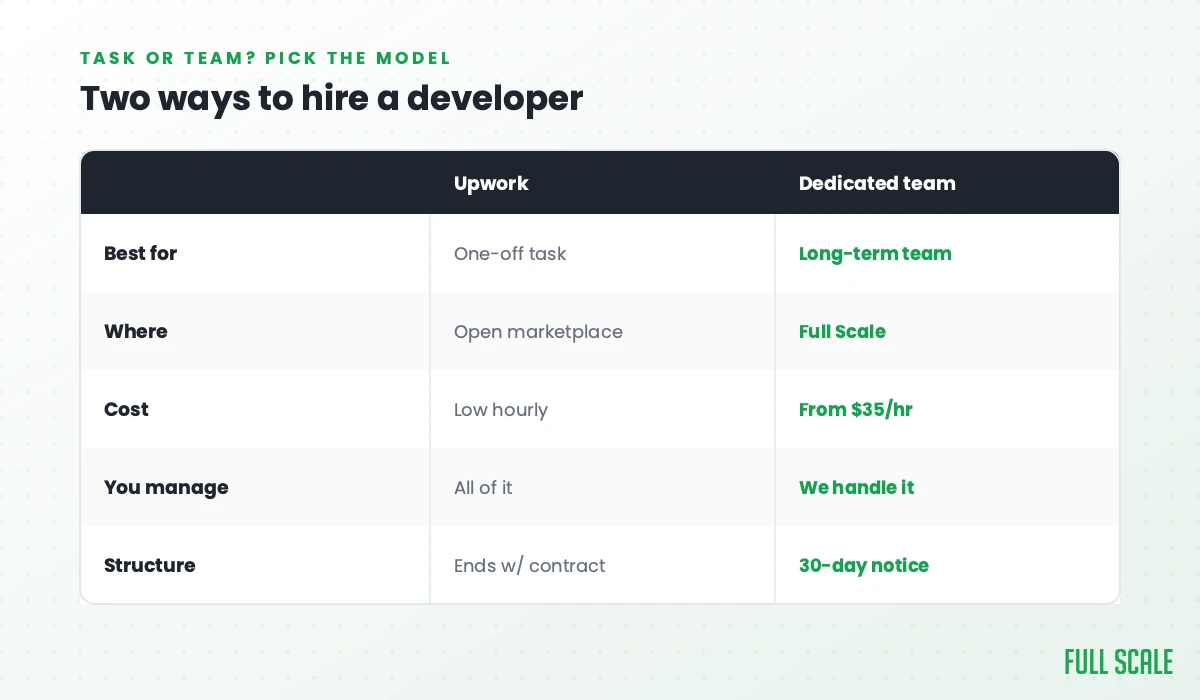
The task: stick with Upwork
You have a clear understanding of what you need, the task can be completed within a reasonable time frame, and once it is done you will not need to think about it again. In this case, Upwork is the most effective tool. You do all the vetting and management, but for a low-risk task, that is a reasonable trade off, and the most cost effective way to get the task completed.
Just a word of caution. The cheapshoring error typically begins right here, and it is only an issue if it remains in this bucket. Choosing the lowest bidder is acceptable for a weekend script. It is not a good way to hire for anything that is actually operational for the company. If the job has a definitive conclusion, then use the marketplace and move along. If it doesn’t, then you are in the wrong bucket.
The team: a dedicated developer or team
Many of these searches begin with “Upwork,” but the underlying requirement is a long-term development team. Founders expect engineers to understand the product, participate in the same standups as the rest of the team, and continue to release code a year down the line.
Having a single contractor for a single project has never been the true aim.
There’s a simpler problem as well, once you try to do this with a roster of freelancers instead of one team. They are dispersed over multiple time zones, each working on their own schedule, each one your responsibility to find, evaluate, and manage from the ground up. After a few more, you’re not building software anymore, you’re running a small recruiting agency on the side.
What you are outlining seems to be more of a hiring issue than a sourcing issue. The most fitting model for this is staff augmentation, where you can hire a dedicated developer, or even a whole dedicated team, who works only for you. The developer is an employee of the staffing company, and they work fully on your team, which resolves the two most common issues with a marketplace: who is held accountable for the work, and employee retention.
The key difference is that you get a partner to work with, not just a pile of profiles. You stop worrying about recruiting, interviewing, or vetting, and the day-to-day management that keeps retention above 93% is handled for you. You’re no longer a part-time recruiter managing a collection of individuals; you are back to running a team.
I walk through the mechanics in staff augmentation versus independent contractors.
Let’s start where the accountability is. Every engineer we send over is on Full Scale’s payroll, so your contact is with an actual US company, Full Scale, that you can reach and hold accountable under US law.
So, it’s not possible for anyone to simply kidnap your source code, because there is a real employer behind the person writing it. In eight years we have not had any IP or confidentiality problems, which is more than a star rating can promise.
The quieter decision-maker is the staying power, as they decide if the product is shipped or not. What matters here is retention being over 93%.
In simpler terms, the person who worked for 3 months learning the odd parts of your billing code, is the same person that will maintain it, not some random person who will be reading it after the last person has moved on. The work goes directly into your repo, your backlog, and your stand ups; no account manager is playing telephone for you.
When you include people as part of the team, they will behave like it.
The portion a marketplace cannot do at all is scaling. This is really what people mean when they go looking for Upwork alternatives for hiring multiple developers at once, not a better freelancer, a way to add several at a time without starting from zero on each one. If you need to go from 2 developers to 8 for a big push, and then back down once it ships, that means on Upwork it’s going to require going through the entire sourcing gauntlet again for each new hire, with no certainty that any of them will understand your codebase.
When you add a dedicated developer or two to an existing dedicated team, scaling becomes a discussion rather than a job posting. We’re fully prepared as we already have the bench, payroll, and processes. So, adding someone who will ramp up quickly to your existing team takes days instead of going through profile-sifting again.
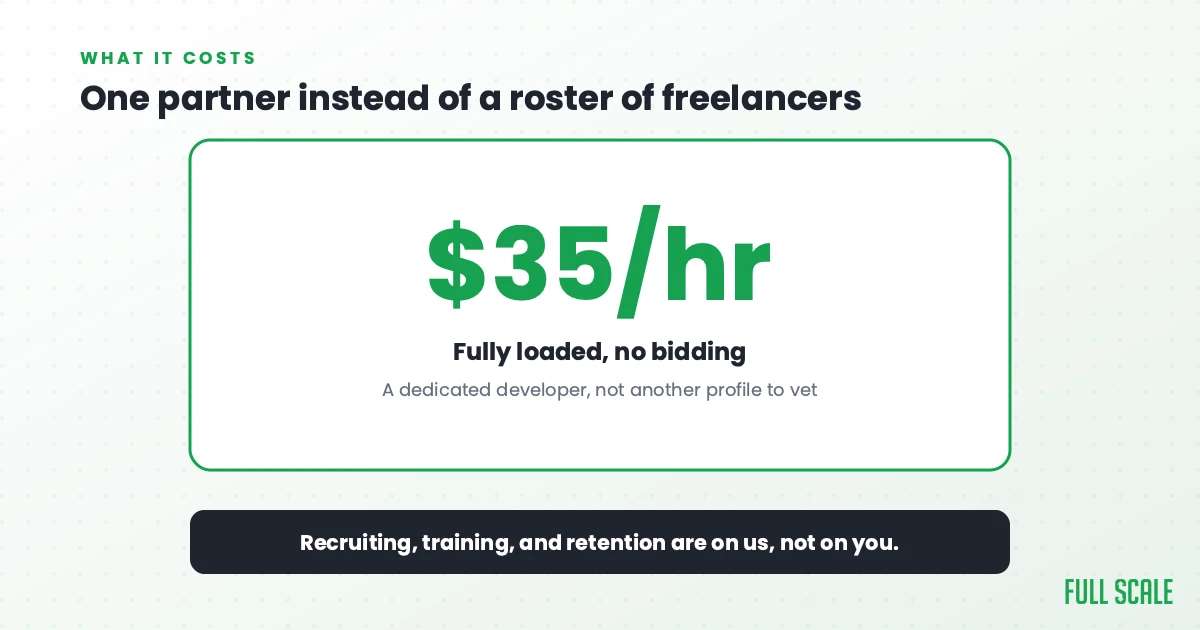
None of that qualifies as a discount. An augmented engineer starts at fully loaded rates around $35 an hour, all in, with no auction to win and no mark up that compounds every time you add a head and fewer than 3 in 100 applicants clear the vetting to get there.
The team is offshore, across the Philippines, which is usually the first thing a buyer worries about. In practice the engineers keep real overlapping hours with yours, so it reads less like outsourcing and more like a few teammates who happen to work from the other side of the planet.
Here is where automation doesn’t reach. Arm’s length coding where someone takes a spec, goes dark for two weeks and hands back a pull request is precisely what AI keeps getting better at.
What it can’t do is live inside your product long enough to know which tradeoff is the right one. That judgment is the whole argument of Product Driven, and it’s the reason a team that owns the outcome outlasts a cheaper stranger who only ships code.
I can cite two clients to prove my point. One of them is SOTA Cloud, an FDA-cleared dental imaging company. Their co-founder and CTO, Dustin Johnson, said the following:
“We really highly value retention and so Full Scale has been a great partner on the retention front to ensure that we have continuity with the folks that we really value on our team.”
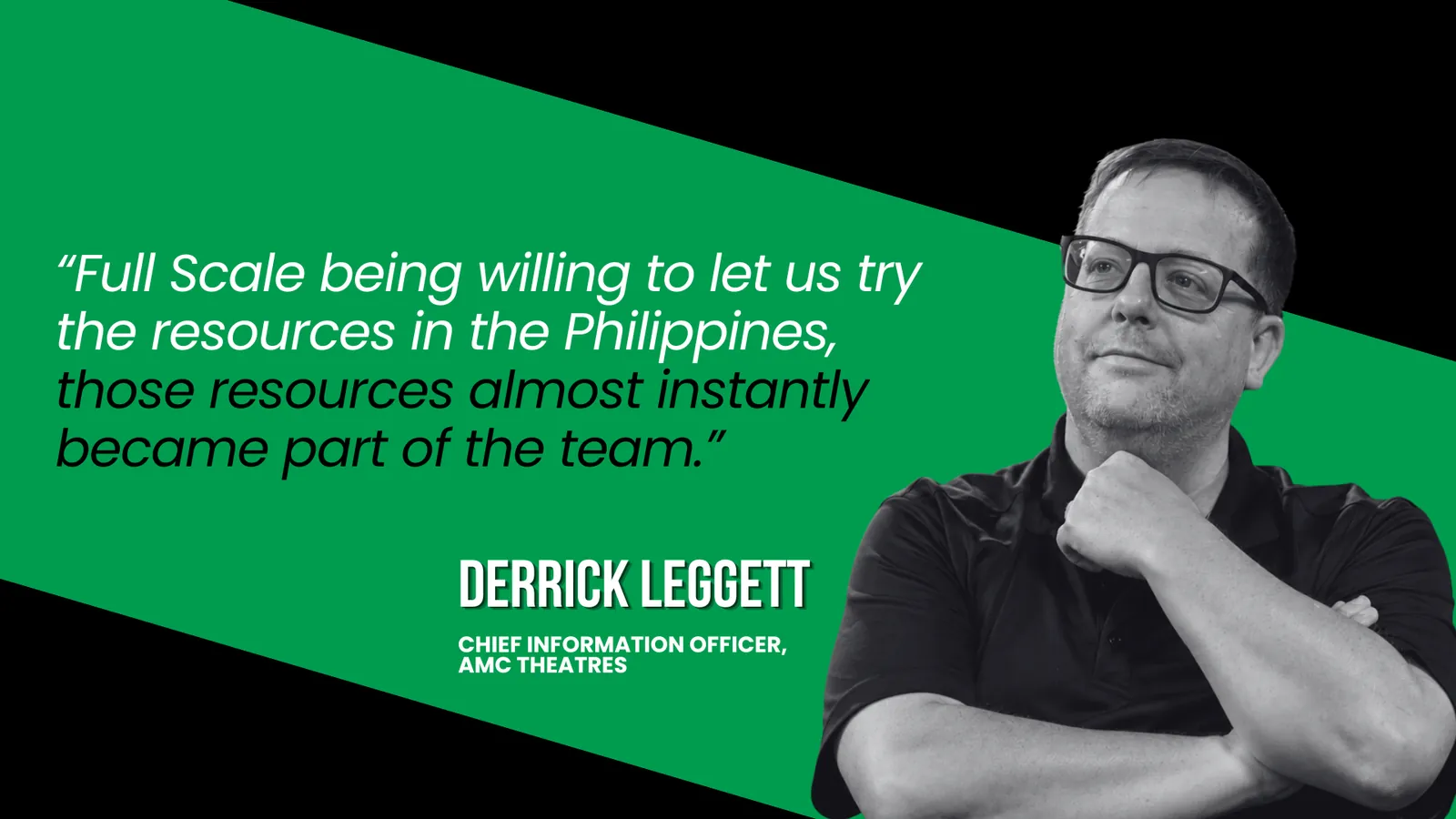
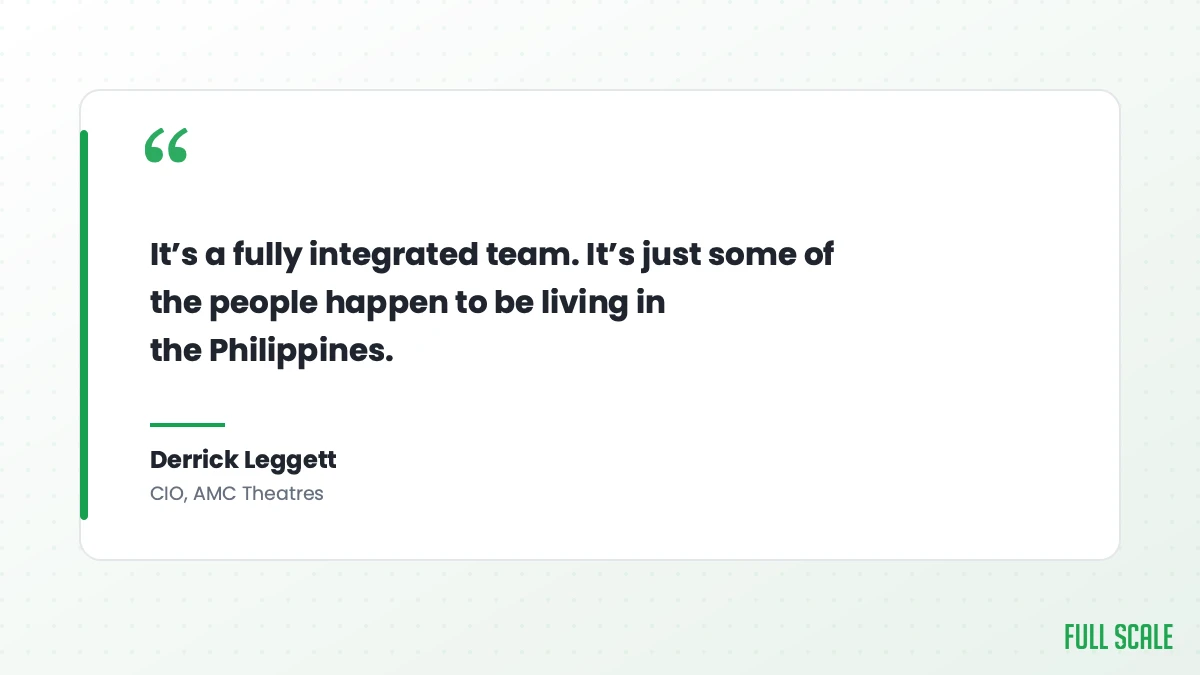
The other client is AMC Theatres, and they do this at a much larger level. Their CIO, Derrick Leggett, said the following:
“It’s a fully integrated team. It’s just some of the people happen to be living in the Philippines.”
Continuity is the word both of them reached for. It’s the one thing an open marketplace structurally cannot sell you, because it makes its money on developers rotating through, not staying put.
It’s also why clients tend to stay with us for years, not just for the length of one project.
A quick way to choose
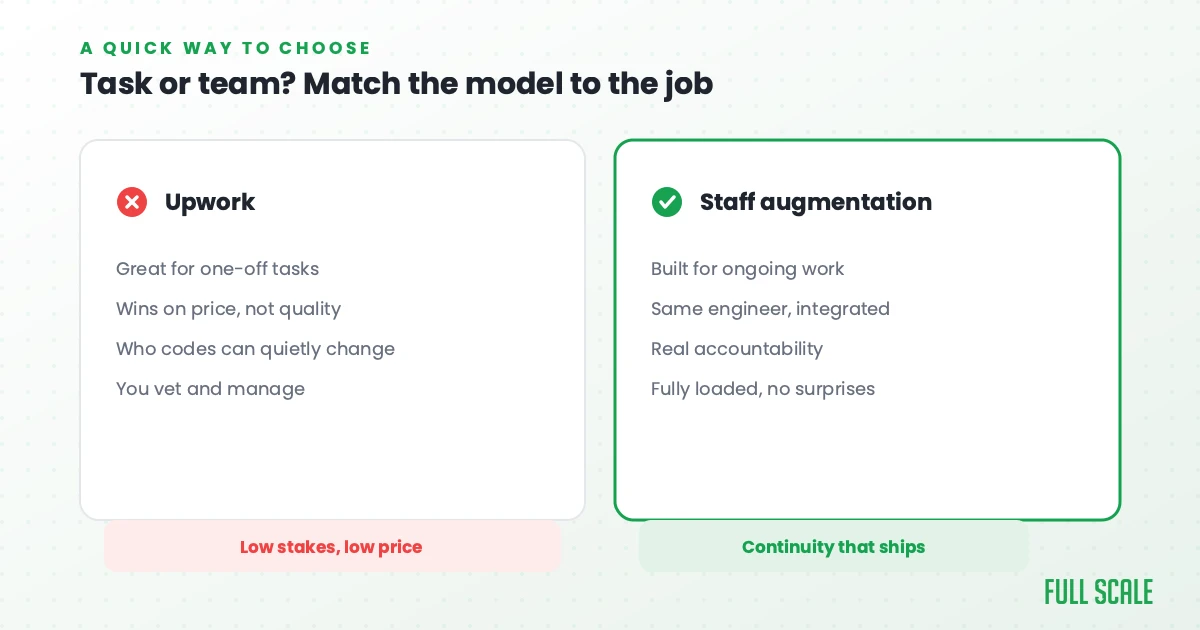
- A quick task with an obvious end? Stay on Upwork. The stakes and the price are both low, and the vetting and managing are yours.
- A long-term development team, with room to scale? A dedicated developer or team, through staff augmentation. A fully-loaded rate, real accountability, and the continuity that decides whether the software actually ships.
Upwork deserves to be on top. The problem starts when a person is forced to move it to second, which is about how most people end up here searching for Upwork alternatives for long-term teams in the first place.
Frequently asked questions
What can be said about Upwork for hiring a long-term development team?
Using a dedicated developer or a dedicated team, hired via staff augmentation. Upwork is centered around contracts that end, not ones that continue, so it was never going to provide you the same engineer working on your product a year from now. A staff augmentation company assigns that developer as an employee of theirs and integrates them into your team fully, which is designed for ongoing work. Determine if you are hiring for a job or for a team, and the platform stops being a difficult question.
Can developers be safely hired through Upwork?
If it’s tasks that are small and don’t carry risks, then yes. When it comes to engineering the core of the product, the risk falls entirely on you, and when it comes to getting things done wrong, it shows up in additional unnecessary work, delays, and risks in regards to security. Risk from fake profiles and interview fraud are exacerbated, not softened, as a result. Many founders have a stable team once the software becomes important, which is safe.
Is it possible for a dedicated development team to easily scale up or down?
Yes, and this is one of the largest practical differences from a marketplace. When adding a developer, it means pulling from the bench. This is not a rerun of the sourcing process, and the new person still reports to your existing team and repo. Scaling down is equally as simple. You do not have to manage a roster of individual freelance contracts.
What is a good Upwork alternative for hiring multiple developers?
Staff augmentation, for the same reason it works for one developer. Whether you need one hire or ten, each one comes from an existing bench and reports into your team the same way, so adding the fifth or sixth developer doesn’t mean running Upwork’s sourcing process all over again. That’s the practical difference once you’re hiring more than a single freelancer at a time.
What is the most cost-effective approach to hiring a developer?
When open marketplaces are evaluated solely based on hourly rates, they are the most cost-effective approach. That estimate falls apart the moment the work outlives the contract. Engaging the lowest bidder, or what I refer to as cheapshoring, tends to return as rework, security issues, and a re-hire. Those costs far exceed any savings you may have captured. For any continued work, a fully loaded engineer at around $35/hour is likely to cost less overall than a cheap freelancer you will have to manage, chase, and eventually replace.
When long-term development teams are required
Typically, by the time someone starts looking for an Upwork alternative, they have gone past the one thing that the platform does best: quick, self-contained tasks. Upwork handles those just fine. It was never designed to provide what a growing business needs the most: a long-term development team that stays on board and takes ownership of the results.
If that’s you, book a call and we’ll outline the team you truly need.