
Toptal vs Upwork: An Honest Comparison From Someone Who Sells Neither

In this article
Almost every “Toptal vs Upwork” article you’ll find is written by a company selling you a third platform at the end. Read the top results and you’ll notice the pattern. A fair-looking comparison, a few tables, and then a closing pitch for the author’s own marketplace. If the option you are weighing is a managed-delivery shop rather than another marketplace, I broke down Toptal vs Gigster the same honest way. If your question is more basic than the matchup, I answered is Toptal legit on its own.
I’m going to do something different. I run Full Scale, a staff augmentation company with developers in the Philippines, and we are neither a freelance marketplace nor a competitor to one. So I have no reason to talk you into either platform, and I’ll tell you plainly where each one is the right call.
I’ve also been on the buyer’s side of this. I’ve personally hired freelancers for WordPress builds and an Elasticsearch tuning project, and I’ve spent the years since 2018 building and running engineering teams for over 200 tech companies. I’ve hired developers as one-off gigs and as long-term team members, and the two could not be more different.
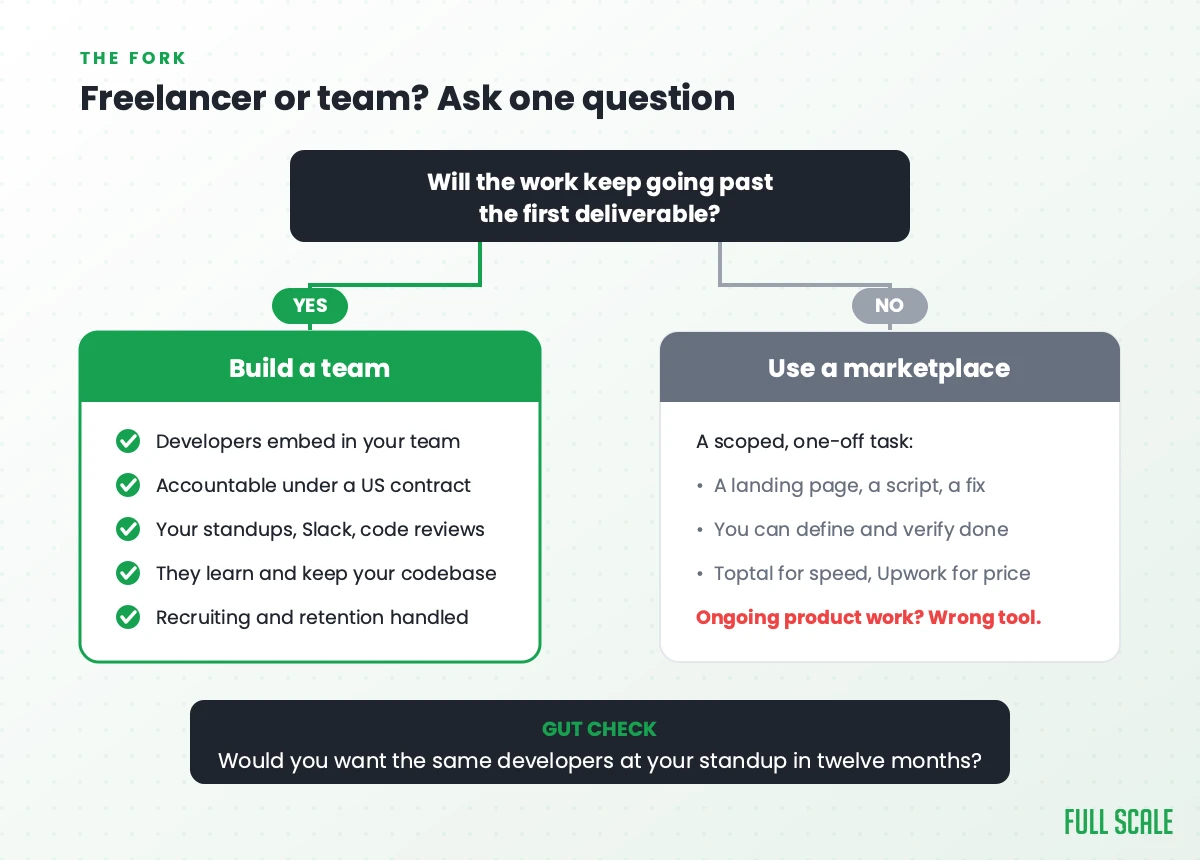
Most of these comparisons miss the part that actually decides it. The real question usually isn’t “Toptal or Upwork.” It’s “do I need a freelancer or a team?” Get that wrong and the platform you pick barely matters. If Upwork specifically is the one you’re weighing against a team, I broke down where it fits against every alternative. And if neither one fits, I laid out the other Toptal alternatives by use case.
The short answer
If you don’t read another word, here’s the honest version.
- Upwork is an open marketplace. Anyone can list, rates run from $10 to well over $150 an hour, and the vetting is your job. It’s best for a small, well-defined task where you can judge the work yourself.
- Toptal is a curated network. It screens applicants, matches you to one, and charges a premium for doing the filtering. It’s best for a senior specialist you need fast and can afford, where you don’t have time to vet a stranger yourself.
- Neither is built to give you a team that owns your product over the long haul. That’s a different model, and it’s the one most companies building real software actually need.
Both platforms do exactly what they were designed to do. The mistake is using a gig tool to build something that needs a team.
What Toptal actually is
Toptal is a vetted talent network. You tell them what you need, they run their screening, and they match you with one of their pre-approved freelancers, usually within a couple of days.
The pitch is quality control. Toptal markets itself as accepting only the “top 3%” of applicants, and the screening is real: a language check, a timed technical test, a live problem-solving interview, and a trial project. Whether the number is exactly 3% is impossible to verify, but the vetting is more than a profile and a star rating, which is the actual point. Turing runs a similar vetted model with AI doing the screening, which I cover in Toptal vs Turing.
That filtering costs money, and the structure is specific. To start, you put down a $500 deposit that’s credited to your first invoice or refunded if you walk away. You get a no-risk trial of up to two weeks. If you’re not satisfied, you aren’t billed and you can try a different candidate. Once you commit, you pay for the trial time in full. The developers themselves are senior and priced like it, commonly somewhere from sixty to two hundred dollars an hour and up, depending on the role.
What you’re really buying from Toptal is the filter. You’re paying them to throw away the bad candidates so you don’t have to interview a hundred people to find one good one. For a buyer with budget and no time, that’s a fair trade.
You’re buying one vetted person for a defined chunk of work, not a team that knows your product.
What Upwork actually is
Upwork is the opposite end of the spectrum. It’s an open marketplace where anyone can create a profile, and you sort through proposals yourself.
The range is enormous. You’ll find a student in their first year and a twenty-year veteran on the same search page, charging anywhere from $10 to $150 an hour and beyond. There’s no standardized vetting. Reviews, profile history, and your own interview are all you have to go on, and the responsibility for judging quality sits entirely with you.
The fees are easy to underestimate because the platform takes from both sides. Clients pay a marketplace fee of around 5%, more on some plans and payment methods, plus a small per-contract initiation fee. Freelancers pay their own service fee on top. None of that buys you any vetting. It buys you the platform, the payment rails, and the dispute process.
Upwork is genuinely useful for the right job. A scoped, well-defined task you can specify clearly and check yourself: a landing page, a WordPress build, a script, a data cleanup. I’ve used freelancers for exactly that kind of work and it was the right move every time.
It gets dangerous when people use it to staff a product they can’t evaluate themselves. That’s where the horror stories come from, and there are a lot of them. Profiles that don’t match the person who shows up, work that’s secretly outsourced again to someone cheaper, code held hostage at the worst moment, and the steady stream of founders who come to us tired of the whole circus. I won’t re-litigate all of that here. The short version: an open marketplace means the upside and the risk are both yours.
Toptal vs Upwork: the head-to-head
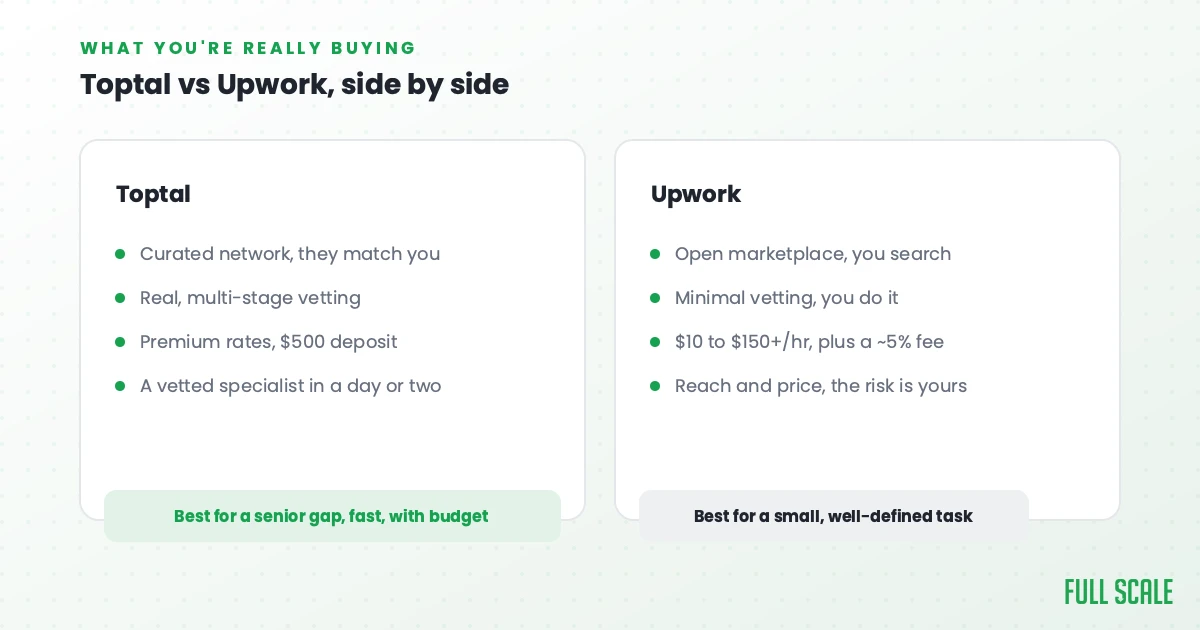
Here’s how the two stack up on the things that actually drive the decision.
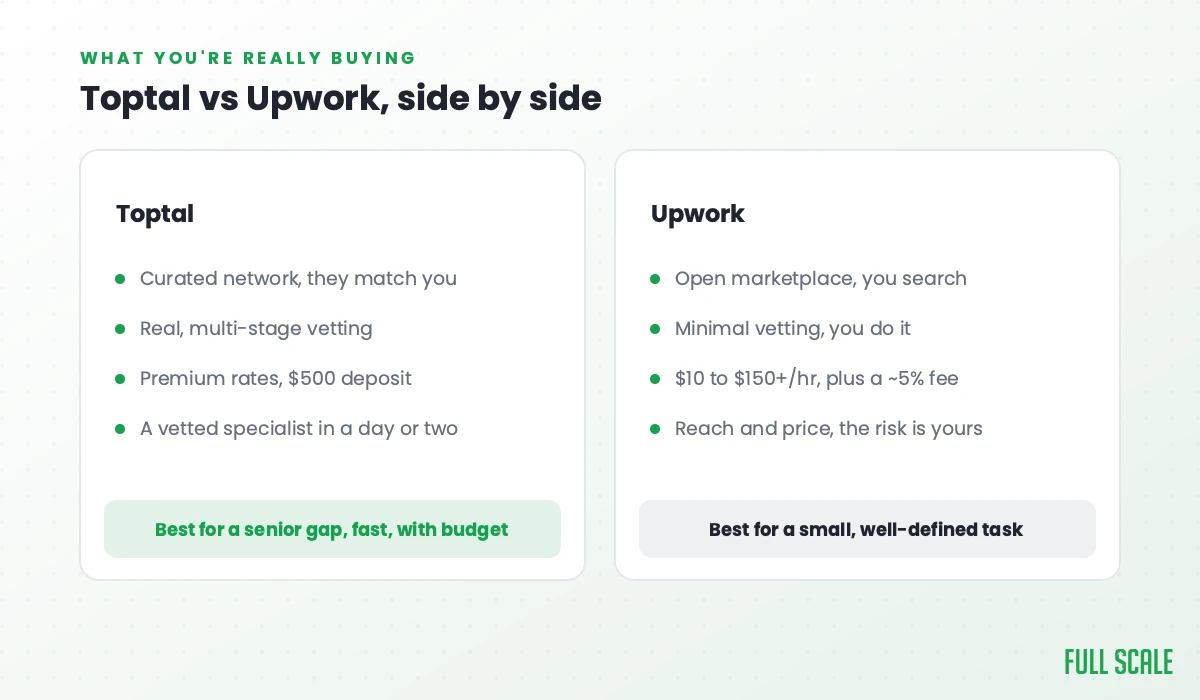
| What matters | Toptal | Upwork |
|---|---|---|
| Model | Curated network, they match you | Open marketplace, you search |
| Vetting | Real, multi-stage screening | Minimal, you do it yourself |
| Quality range | Consistently senior | Student to expert, wildly variable |
| Typical rate | ~$60–$200+/hr (premium) | ~$10–$150+/hr (your call) |
| Fees | $500 deposit, credited to first invoice | ~5% client fee + contract fee |
| Time to first candidate | A day or two | Hours to weeks of sorting proposals |
| Trial / guarantee | Up to 2 weeks, no-risk | None built in |
| Who carries the risk | Shared, they re-match you | All yours |
| Best fit | A senior specialist, fast, with budget | A small, well-defined task on a budget |
The pattern is clear once you lay it out. Toptal sells you speed and filtering at a premium. Upwork sells you reach and price, and hands you the risk. Both are real tradeoffs, and which one wins depends entirely on the job.
Neither column, though, describes a team that shows up to your standup every morning and cares whether the product succeeds. That row doesn’t exist on this table, because that’s not what either platform sells.
When Upwork is the right call
Reach for Upwork when the work is genuinely a project, not a role.
A scoped, well-defined task you can write down and check is the sweet spot. You need a specific WordPress site built, a one-off integration wired up, a design produced, a dataset cleaned. You can describe “done” precisely, you can verify it yourself, and you don’t need the person again next quarter.
In those cases, paying a premium for matching makes no sense, and the wide rate range works in your favor. Use Upwork when you’d be comfortable if the person vanished the day after they delivered. If that thought makes you nervous, it’s the wrong tool.
The trap is using cheap-and-fast for work that’s neither cheap nor fast to get wrong. Hiring the cheapest developer you can find to build the core of your product is a mistake I’ve named cheapshoring, and it almost never ends well. A low rate by itself is fine. There are smart people all over the world, and a strong developer in a low-cost country at $25 an hour is a genuine bargain. The real risk is paying rock-bottom for someone unvetted and unaccountable and hoping it works out. You get what you pay for, and on an open marketplace what you’re paying for is a gamble.
If you do use Upwork for real work, vet hard. Start with a small paid test task, watch for work that’s quietly re-outsourced to someone cheaper, confirm the person on the call is the person doing the work, and don’t hand over broad system access until trust is earned both ways.
When Toptal is the right call
Reach for Toptal when you need a senior specialist quickly, you can afford the premium, and you don’t have time to run a real hiring process yourself.
Say you need a strong React engineer or a data specialist for a few weeks, you have the budget, and your own pipeline is empty. Toptal’s filter genuinely saves you time. You skip the hundred-proposal slog, you get someone who can actually do the work, and the no-risk trial means a bad match costs you nothing but a couple of weeks.
Toptal makes the most sense as a fast, premium fix for a specific gap. A short engagement, a clear skill, money available, time short.
Where it gets expensive and awkward is when the “specific gap” is actually your whole engineering team, indefinitely. Stack up several premium freelancers, each matched separately, each a transaction, none of them employed by anyone you can hold accountable, and you’ve spent a fortune assembling a collection of contractors that still isn’t a team.
The thing neither one sells you: a team
Here’s where the freelancer-versus-team distinction stops being abstract.
Both Toptal and Upwork are optimized around a freelancer doing a defined piece of work. That’s the unit. When the work is done, the relationship is done. For a scoped project, perfect. For building a product over years, it’s the wrong shape entirely, and no amount of picking the “better” platform fixes that.
And the reason companies build real teams offshore stopped being about cost a while ago. In Deloitte’s 2024 outsourcing survey, cost as the top reason to outsource fell from 70% in 2020 to 34% in 2024, while talent access and speed rose to match it.
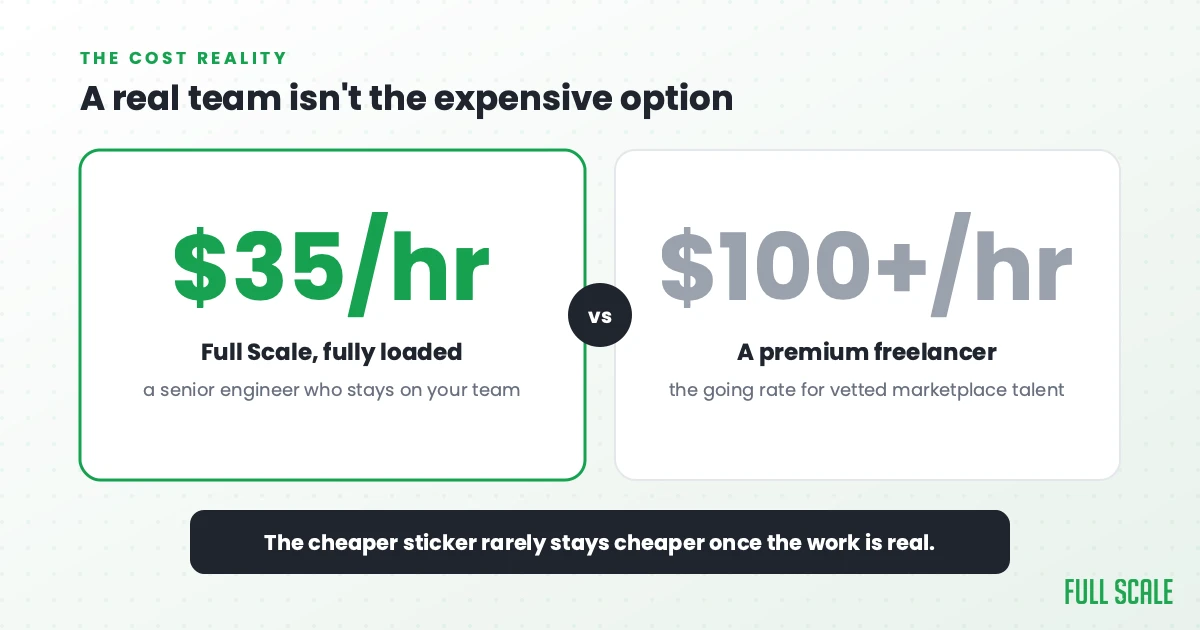
The cost math is worth seeing clearly, because it cuts against the idea that a real team is the expensive option. A premium Toptal freelancer can run well over a hundred dollars an hour. Upwork’s sticker looks cheaper until you add the hours you spend vetting and the cost of getting it wrong. Our fully-loaded rate is about $35 an hour for a senior engineer who stays on your team. A marketplace gig can be cheap. It usually isn’t even the cheaper choice once the work is real, and it still can’t give you talent that compounds.
What product work needs is a team that sticks around, learns your codebase, and owns outcomes. Staff augmentation is the model built for that. Instead of contracting a freelancer directly, you bring on developers who are employed by a firm and embedded into your team. They join your standups, work in your repo, follow your code review, and report to your tech lead. That person is a teammate, not a contractor you booked for a job, and no marketplace gives you that no matter which one you pick.
The obvious objection is that you can just keep a good Upwork or Toptal freelancer around for years, on a rolling contract, and call that your team. Some companies do exactly that, and it can work for a while. But that person is still a sole contractor with no employer behind them. There’s no company on the hook for their work, no one recruiting a replacement the week they quit, no bench when they get sick, and no real contract chain protecting your code. A long-term freelancer is better than a short one, and it still isn’t a team.
A few things change when you bring on a team instead, and they’re the things a marketplace structurally can’t give you.
Accountability has a real address
When you work with a US-based staff augmentation firm, you sign confidentiality and IP-assignment agreements with the company, enforceable under US law. If something goes wrong, you’re dealing with a reachable US business, not trying to track down a freelancer in a jurisdiction you don’t understand. The developers are the firm’s employees, which means the firm can actually hold them accountable. A freelancer can ghost you, but an employee answers to their employer.
Someone solves recruiting, managing, and retaining
The hardest part of building a team isn’t posting a job, it’s that the best developers aren’t looking, because they already have jobs nobody is letting them go. You have to recruit them away. We run in-house recruiters whose whole job is finding those people and pulling them away from their current employers, which beats anything you’ll fish out of a job board or a marketplace pool. Our developer retention runs over 93%, and that continuity is itself a quality and security advantage. People who stay know your systems. Constant churn means a rotating cast of strangers touching your code.
There’s no middleman in the way
The offshore model breaks when a vendor hides five developers behind one account manager and you never talk to the people writing your code. The fix is the opposite: you talk to the developers directly, every day, and they care about the product the way your in-house engineers do. That’s what makes it work.
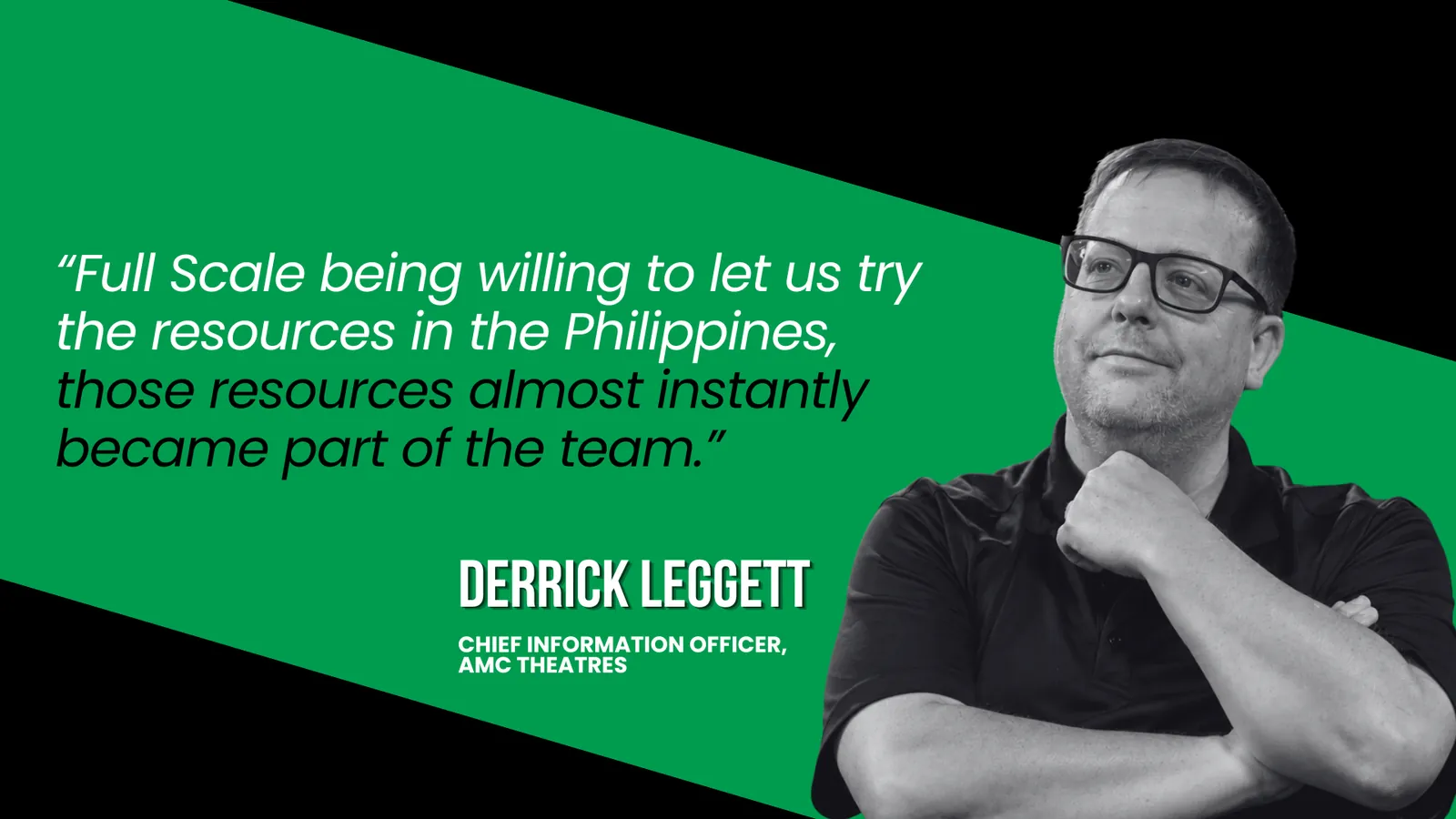
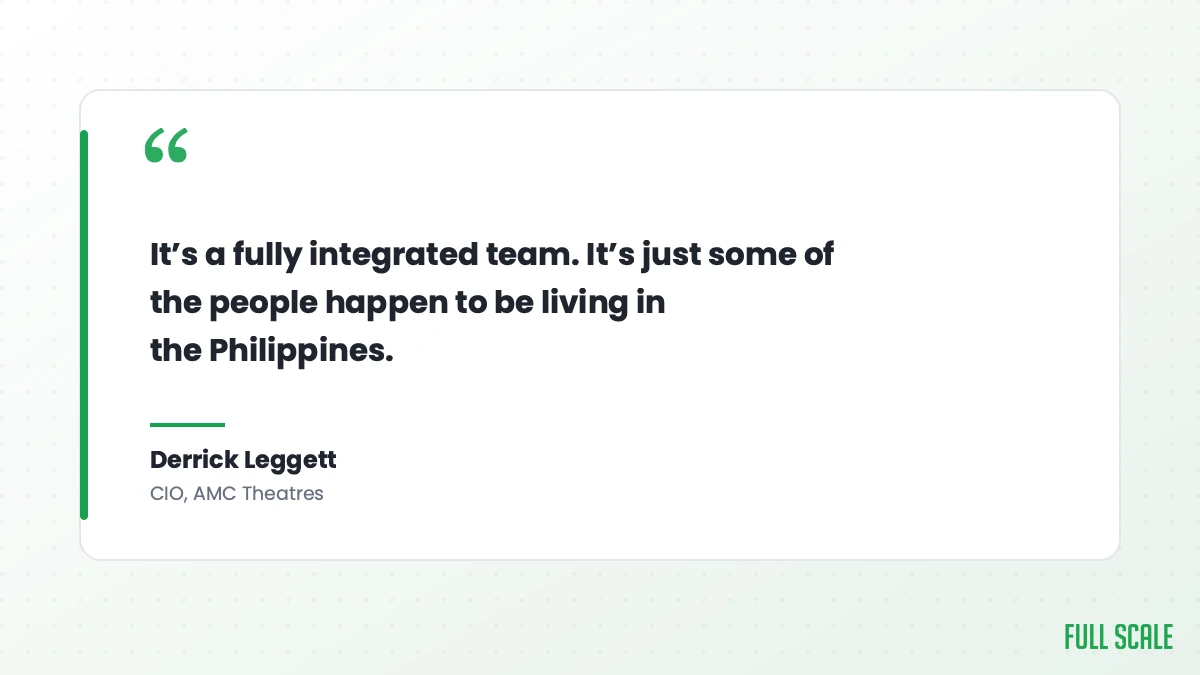
This isn’t theory. AMC Theatres runs the world’s largest movie-theatre ticketing platform, and their developers in the Philippines are treated as full AMC engineers. Their CIO, Derrick Leggett, puts it simply:
“It’s a fully integrated team. It’s just some of the people happen to be living in the Philippines.”
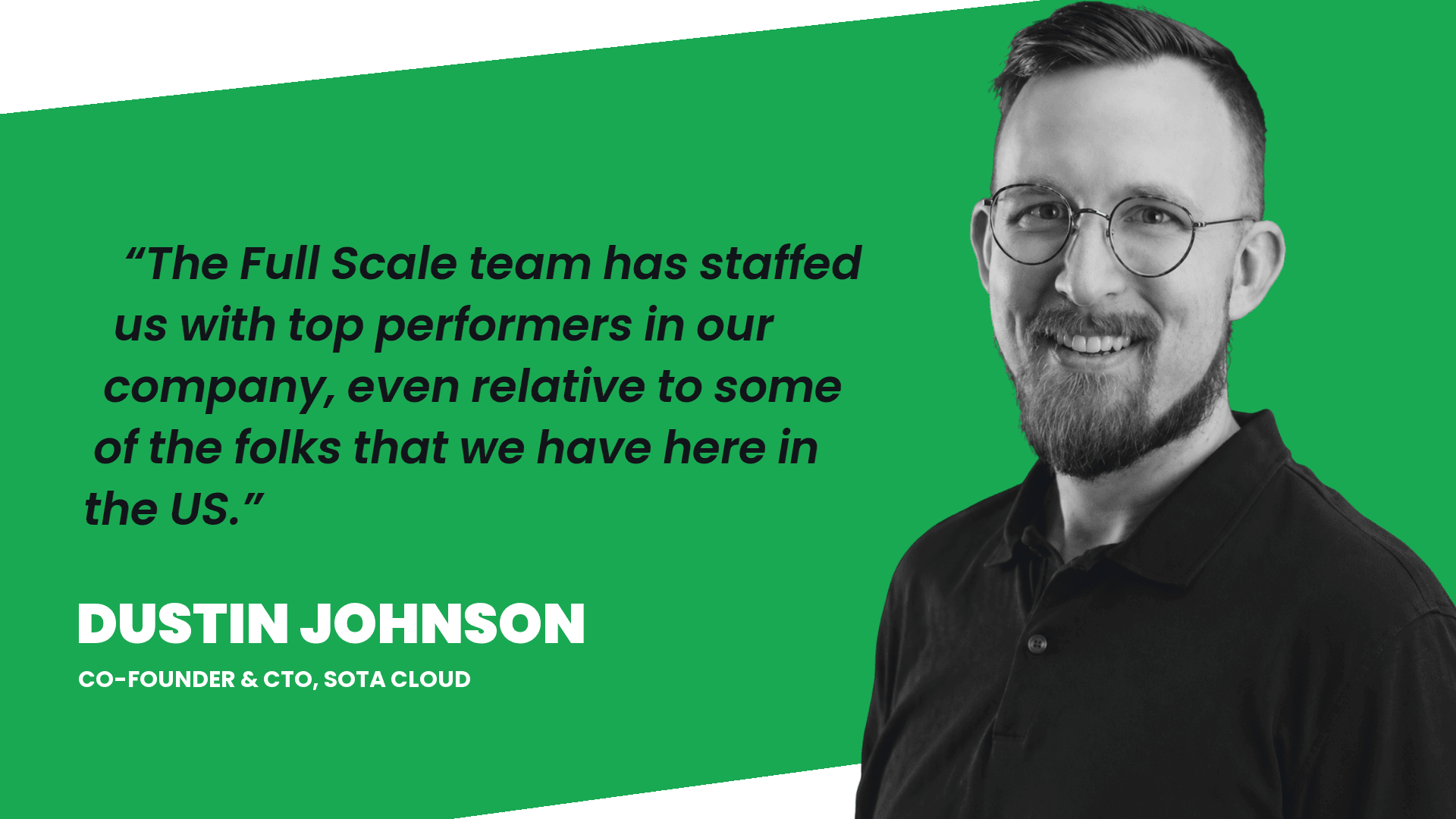
You don’t get that from a marketplace. Dustin Johnson, co-founder and CTO of SOTA Cloud, said the team we staffed turned out to be “top performers in our company, even relative to some of the folks that we have here in the US.” That’s a sentence you say about a team you’ve built with, not a gig you booked.
There’s also an honest safety net in this model that beats anything a marketplace offers, and it exists precisely because the developer is already our employee. You interview every engineer before committing, and every engagement starts with a two-week money-back guarantee: if it isn’t working out, you get your money back. No moonlighting, no notice period, no awkwardness. The agency structure is what makes that possible.
How to actually choose
Strip away the brand names and the decision comes down to one question.
Is this a scoped task, or is this a product?
If it’s a task you can define, verify, and walk away from, use a marketplace. Upwork if you want range and price and you’ll do the vetting. Toptal if you want speed and filtering and you have the budget. Both are fine tools for that job.
If it’s a product, something you’ll keep building, where the people need to understand the customer and own what they ship, then a freelancer is the wrong unit no matter which platform you find them on. You need a team. We aren’t in this for some three-month project, and the companies we work with aren’t either. They’re trusting us with their long-term teams.
And the answer often isn’t either-or. Plenty of companies keep a real team for the product and still reach for Upwork or Toptal when a genuinely one-off task comes up. The point isn’t to pick one tool forever, it’s to match the tool to the job in front of you.
This connects to a bigger shift, too. AI has made writing code faster and cheaper. Google’s CEO has said AI now generates about 75% of the company’s new code, which means the durable value was never the typing. It’s product thinking, the judgment to know what to build and why it matters. I wrote a whole book, Product Driven, about that distinction. A marketplace gig is built to ship a deliverable. A team you keep is built to figure out what’s worth shipping in the first place, and that judgment only gets more valuable as the code gets cheaper to produce.
Pick the tool that fits the job. Just be honest with yourself about which job you actually have.
Frequently asked questions
Is Toptal better than Upwork?
Neither is universally better. Toptal is better when you need a senior, pre-vetted specialist quickly and can pay a premium, because you’re buying their screening. Upwork is better for a small, well-defined task where you can judge the work yourself and want the widest range of prices. The better question is whether you need a freelancer at all, or a team that owns your product over time.
Is Toptal worth it?
For a fast, senior, short-term hire where your own pipeline is empty and budget isn’t the constraint, yes. You’re paying for the filter, and the no-risk two-week trial limits the downside. It’s not worth it as a way to assemble an entire engineering team, where stacking premium freelancers gets expensive and still doesn’t give you an accountable, durable team.
Is Upwork safe for hiring developers?
It’s safe for scoped, low-risk work you can verify yourself. It gets risky when you use it to staff a product you can’t evaluate, because the vetting is entirely on you and the platform is open to anyone. Profile misrepresentation, re-outsourced work, and identity fraud are real and documented. If you go this route, vet hard, start small, and never give broad system access early.
Is there a better option than Toptal or Upwork for building a software team?
For an ongoing product, yes: a staff augmentation model, where developers are employed by a firm and embedded into your team long-term. You get accountability under a real contract, recruiting and retention handled for you, and people who stick around and learn your codebase, rather than a series of one-off gigs. That’s the model Full Scale runs.
How fast can you hire on Toptal vs Upwork?
Toptal typically matches you with a vetted candidate in a day or two. Upwork can be faster to post but slower in practice, because you sort through proposals yourself, which can take days of screening before you find someone worth interviewing.
Pick the tool that fits the job
Toptal and Upwork are both good at what they were built for, and neither was built to give you a team. If you’re staffing a real product and you want developers who stick around, own outcomes, and answer to someone you can hold accountable, that’s the model we run. Talk to us about building your team.