
Top 10 Offshore Software Development Companies 2026

In this article
- The most expensive offshore mistake is not the vendor you pick
- How I ranked these firms
- What offshore actually costs, by region
- The 10 firms at a glance
- 1. Full Scale
- 2. BairesDev
- 3. EPAM Systems
- 4. GlobalLogic
- 5. Vention
- 6. FPT Software
- 7. ELEKS
- 8. ScienceSoft
- 9. Andela
- 10. Turing
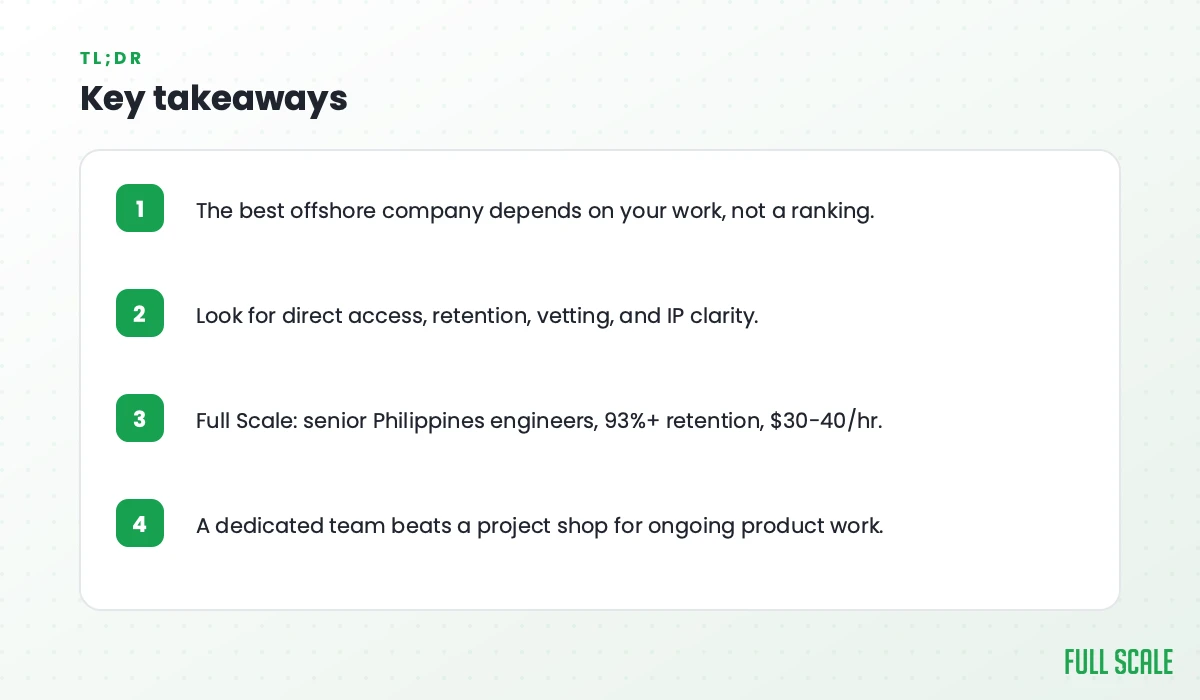
- How to pick
- A note on this list
- FAQ
You are not picking an offshore software development company because you ran out of US engineers to interview. You are picking one because you already know what hiring in the US looks like. A senior engineering seat routinely takes two to three months to fill, counting the search, a multi-round interview loop, and the candidate’s notice period. It stretches longer when the person you actually wanted is fielding competing offers, and the offer that finally lands usually comes in above what you budgeted. So your shortlist is down to two juniors and a contractor.
I have run engineering at three companies and personally hired developers in Russia, Latin America, and the Philippines. Full Scale is the fourth one. I built it because the model the rest of the industry was using was broken. Most offshore shops are project shops. They sell you a fixed scope, hand you a team you cannot communicate with directly, and put a middleman between you and every decision. Three months later you have software that almost works and a relationship that does not.
This post ranks ten offshore software development companies a CTO or technical founder might actually consider in 2026. The order reflects how the model works, not which logo is biggest. Some of these firms are enormous. Some are smaller. The criteria I use are the ones I would use if I were on the buying side.
If you want the operational details on how an offshore engagement actually works, read the offshoring manual first, then come back here.
The most expensive offshore mistake is not the vendor you pick
Most “top 10” lists treat this as a shopping problem. Pick the firm with the best logos and the right rate, sign the contract, and you are done. That framing is why so many offshore engagements fail, and it is worth being honest about before you read a single company writeup.
I have watched a lot of these go sideways. Almost none of them failed because the developers were bad. They failed because of two decisions the buyer made before anyone wrote a line of code: the engagement model and the question of who keeps the engineers.
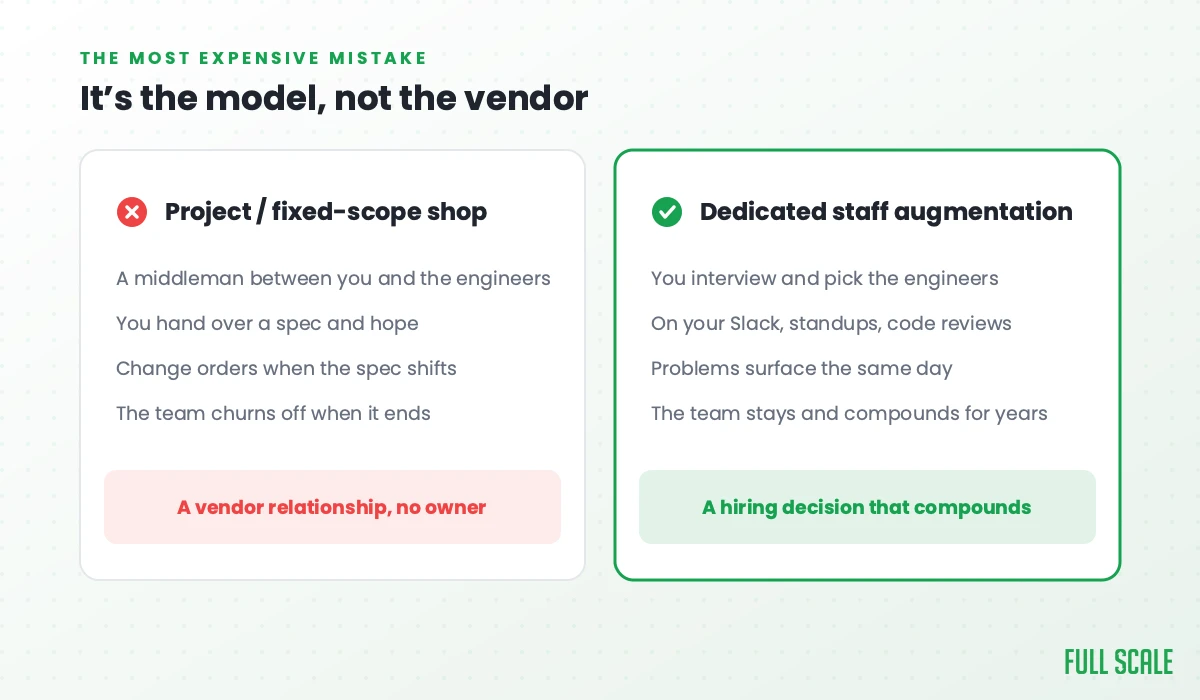
The engagement model is the first fork. There are really two shapes here, and they are not close. A project shop sells you a fixed scope of work. You hand over requirements, a middleman manages the team, and you get software back. You cannot talk to the engineers, you do not own the process, and when the spec turns out to be wrong, which it always does, the change order starts. The other shape is staff augmentation: dedicated engineers who join your team, sit on your Slack and your standups, and work directly for you with no one in the middle. One is a vendor relationship and the other is a hiring decision. For ongoing product work the hiring decision wins almost every time, and the buyers who pick the vendor relationship are usually the ones I hear from a year later. There is a real exception worth naming. If your work is a genuinely scoped, one-time build with a clear spec, and you have no one in-house to manage a team day to day, a scoped project or statement-of-work engagement can be the right call. The catch is that most software work is not that. Product work is ongoing, the spec changes the moment real users touch it, and that is exactly where the fixed-scope project shop falls apart. If you are choosing on price alone, you are doing what I call cheapshoring, and it costs more than it saves.
Retention is the second fork, and nobody talks about it. Here is the question that exposes a firm faster than any sales deck: what is your annual developer turnover? The whole point of an offshore team is institutional knowledge that compounds. An engineer who has been on your codebase for two years is worth three who rotate through in six-month stretches. But most offshore shops churn engineers constantly, because the developer working on your product is an interchangeable resource to them, not a person they are trying to keep.
The cost of that churn is real and it is documented. SHRM estimates that replacing an employee runs 50 to 200 percent of their annual salary, and for technical roles the number sits at the high end once you count recruiting, the three-to-six-month ramp before a new hire is productive, and the institutional knowledge that walks out the door. Now apply that to a team that turns over every nine months. You are paying the replacement tax over and over, and you never get the compounding that made offshore worth doing in the first place.
So before the list: the firm you pick matters less than the model you pick and the retention behind it. The rubric below starts with those two forks, then adds the practical filters that separate good firms from bad once the model is right.
How I ranked these firms
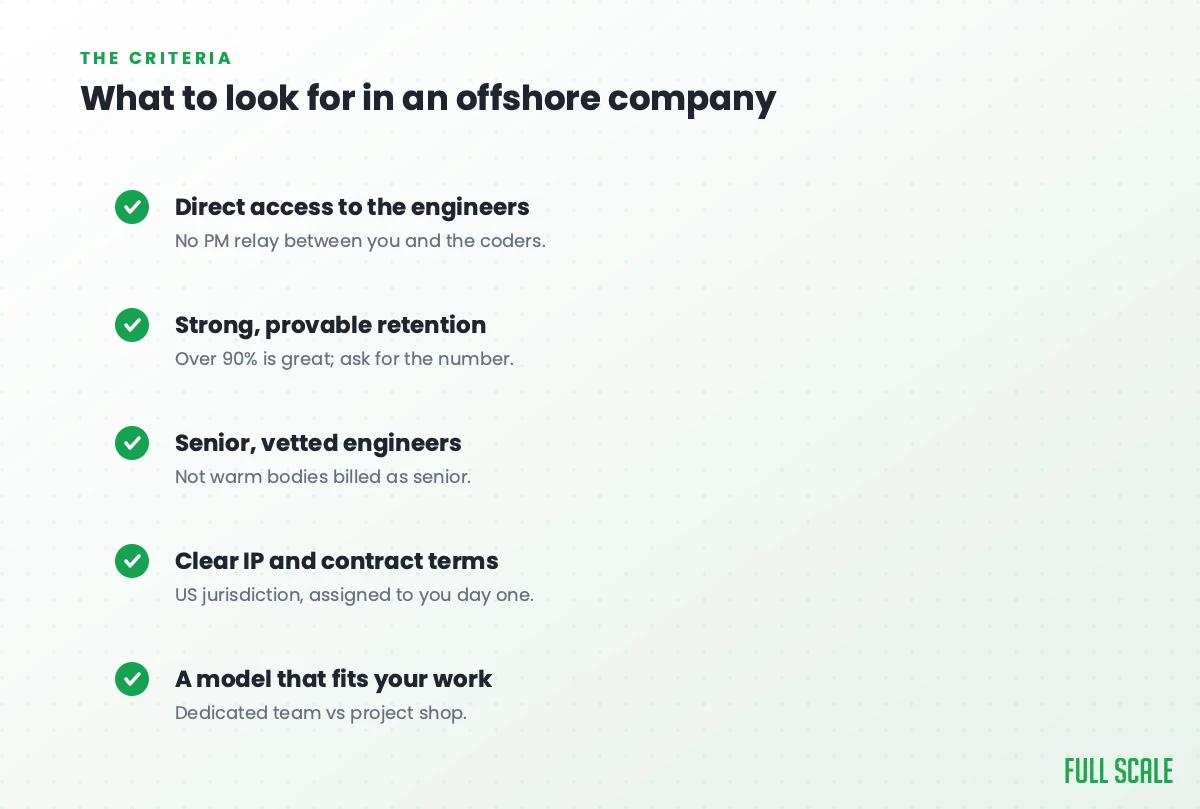
This is the rubric, and it is the actual basis for the order below, not decoration. Most “top 10” posts skip straight to the logos, and that is why they read like ad copy. I score firms on seven things. The first three come straight from the two forks above: pricing transparency and dedicated-versus-shared both expose the engagement model, and retention is the other fork. The last four are how you separate firms once the model is right.
Pricing transparency. A real offshore firm tells you the hourly rate before the sales call. If the answer is “let’s set up a discovery session to scope your needs,” that is a project shop. Project shops bill at agency rates and pay developers a fraction of that. The math gets worse over time, not better.
Dedicated versus shared. Are the engineers full-time on your work, or are they billing fifteen hours a week to your project and the rest to three others? A dedicated engineer thinks like an employee. A shared one thinks like a consultant who is running out the clock.
Retention. Ask the firm what their annual developer turnover is. If they cannot answer the question, the answer is high. Without it you pay to re-onboard a new engineer onto your codebase again and again, and the team never gets to the point where it knows your product cold.
Time-zone overlap. “Async-first” is a real model, but you still need some daily overlap for code review, standups, and the conversations where someone tells you the spec is wrong. Three to four hours of overlap is the minimum for most teams.
Engineering quality and seniority mix. A team with one senior architect and four juniors is not a senior team. Ask for the mix. Ask for years of experience. Ask whether you get to interview the engineers before they start. Seniority matters most on the backend, which is why we wrote a full guide to offshore backend development.
Communication. English fluency is the floor, not the ceiling. The deeper question is whether a developer will push back when the spec is wrong and ask questions when they do not understand. Cultures vary on this and it matters more than the hourly rate.
Reference clients and outside proof. Anyone can put a logo on a homepage. Ask for two reference clients you can actually talk to, and look at what third parties say: verified review platforms like Clutch, public filings, growth rankings. If the only proof a firm offers is its own marketing, that is the answer.
What offshore actually costs, by region
Rate is the part buyers fixate on and the part that means the least on its own. A $45/hour engineer who rotates off in six months costs you more than a $40/hour engineer who stays three years. That said, you need a map of the market, so here is the honest range by region in 2026. These are blended client billing rates for senior engineers, not developer salaries.
| Region | Typical senior rate (per hour) | What you are paying for |
|---|---|---|
| Philippines | $30-$45 | English fluency, US cultural fit, strong communication, the lowest senior rate that still buys seniority |
| Latin America | $45-$85 | Real-time overlap with US time zones, strong for nearshore collaboration |
| Eastern Europe | $50-$100 | The deepest benches for complex systems and platform work |
| India and Vietnam | $25-$50 | The lowest rates and the largest scale, with more variance in seniority and communication |
| United States (benchmark) | $80-$150 | The fully loaded cost of a domestic senior hire, for comparison |
The Philippines sits where it does for a reason: it is the lowest senior rate that still buys genuine seniority and clean communication. I broke down what each region costs in detail in our guide to offshore rates by country. The broader point is the one above the table. The offshore software development market is on track to clear $200 billion in 2026, growing around 14% a year, and the spread of rates inside that market is wide enough that “competitive pricing” can mean almost anything. Make the firm show you the number before the sales call.
The 10 firms at a glance
Here is the shortlist before the detail. Skim the table, then read the writeups for the firms that fit how you want to work. The last column is the strongest outside proof point each firm has, because a ranking you cannot check is just an opinion.
| Company | Headquarters | Engineers | Model | Outside proof | Best for |
|---|---|---|---|---|---|
| 1. Full Scale | Kansas City, USA | 350+ | Dedicated staff aug | Inc. 5000 five years running | Long-term dedicated teams for companies with in-house leadership |
| 2. BairesDev | San Francisco, USA | 4,000+ | Staff aug + delivery | Clutch 4.9 (60+ reviews) | Latin America time-zone alignment at large scale |
| 3. EPAM Systems | Pennsylvania, USA | ~63,000 | Engineering + consulting | NYSE: EPAM, Forbes Global 2000 clients | Enterprise digital transformations |
| 4. GlobalLogic | San Jose, USA | ~35,000 | Digital engineering | Hitachi-owned ($9.5B acquisition) | Connected-product engineering inside a stable parent |
| 5. Vention | New York, USA | 3,000+ | Custom dev for startups | Clutch 4.9 | Venture-backed startups wanting Eastern European talent |
| 6. FPT Software | Hanoi, Vietnam | 30,000+ | Enterprise IT services | Public (HOSE: FPT), $2B+ revenue | A large Asia partner with a strong Japan presence |
| 7. ELEKS | Estonia (Ukraine, Poland) | 2,000+ | Custom dev + consulting | Clutch 4.8 (31 reviews) | Experienced Eastern European mid-market work |
| 8. ScienceSoft | Texas, USA | ~750 | IT consulting + custom dev | Clutch 4.8 (40 reviews) | A US contracting entity with Eastern European delivery |
| 9. Andela | New York, USA | 150,000+ network | Talent marketplace | ~135-country network | Hiring individual engineers with wide geographic reach |
| 10. Turing | Palo Alto, USA | Large network | AI-vetted matching + AI services | $2.2B valuation, builds for OpenAI | AI-driven matching and LLM-adjacent engineering |
1. Full Scale
Founded: 2018 | Headquartered: Kansas City, USA (delivery across the Philippines) | Engineers: 350+ | Client billing rate: $30-$40/hour | Model: Dedicated staff augmentation
Full Scale builds long-term dedicated development teams for tech companies that already have engineering leadership in-house. We are not a project shop. We do not bid on six-month scope-of-work contracts. We hire a senior Filipino engineer, integrate them with your existing team, and they stay on your work full-time for the long haul. The average Full Scale engagement runs for years, not months.
I co-founded Full Scale in 2018 after running into the same problem at every company I built. US engineering hiring is slow and expensive, and you are competing with every other company for the same people. The old offshore model is broken in its own ways. What actually works is hiring senior engineers in the Philippines to work directly for the customer, with no middleman, on the same Slack, the same standups, and the same code reviews as the in-house team.
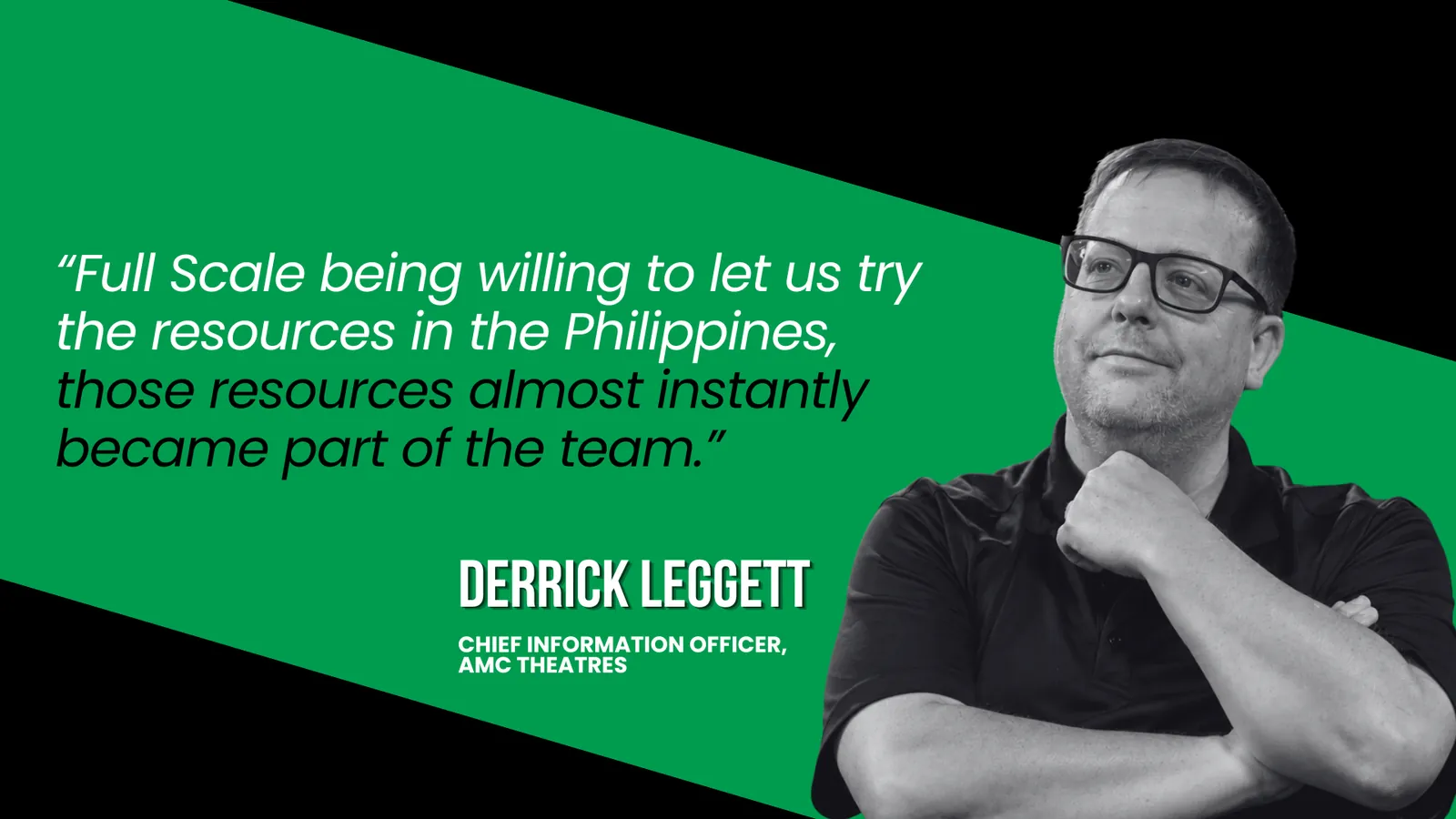
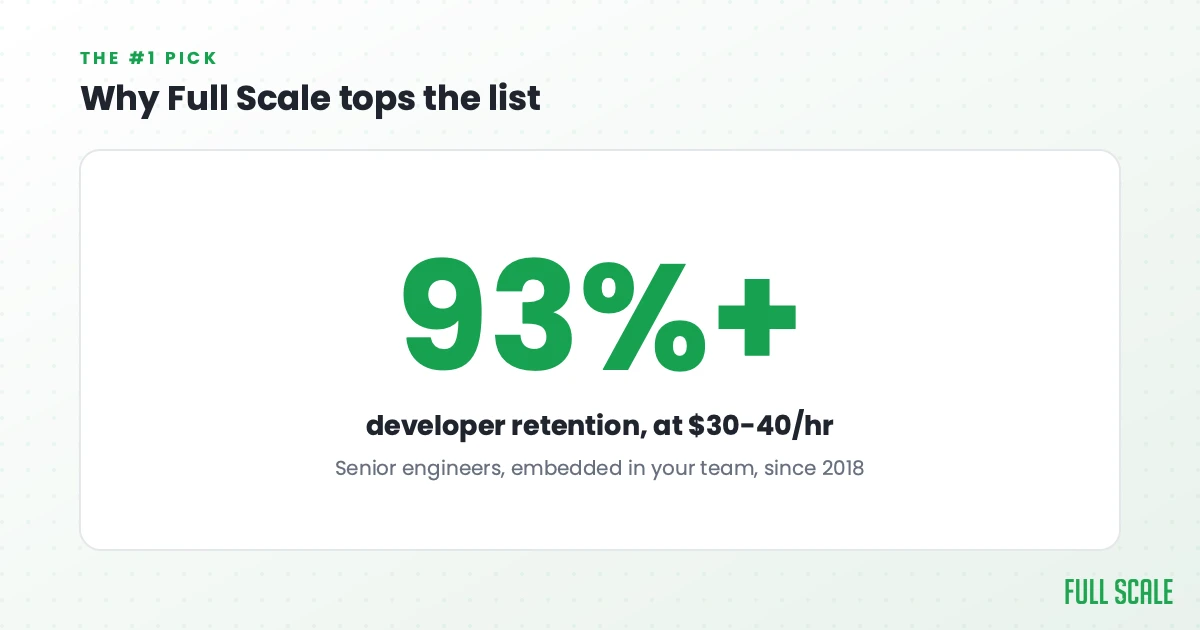
The numbers behind that pitch are concrete. Full Scale has 350+ engineers across the Philippines, 93%+ annual developer retention, and has been on the Inc. 5000 five years running. AMC Theatres has built a global engineering organization with us where our Filipino developers are full AMC engineers, not contractors. LendingStandard came to us after their local Kansas City hiring stalled and now runs roughly 30% of US affordable multifamily property loans on software our joint team built. We have placed 700+ developers with clients since we started.
Our pricing is on the homepage. Our engineers’ senior experience ranges from 7 to 15+ years. You interview every candidate before they join your team. There are no long-term contracts: if it is not working in the first two weeks you get your money back, and after that you can release a developer with 30 days’ notice. You can hire developers in the Philippines for almost any modern stack. And the engineers are trained on Product Driven, the engineering philosophy from my 2025 book. They think about the product the same way the in-house team does, instead of waiting for tickets.
Best for: US tech companies with existing engineering leadership who want a long-term dedicated team rather than a project. Companies that value engineering ownership and direct communication over a vendor relationship.
2. BairesDev
Founded: 2009 | Headquartered: San Francisco, USA | Engineers: 4,000+ | Model: Staff augmentation and end-to-end delivery
BairesDev is the largest pure-play offshore software development firm out of Latin America and one of the most recognizable names in the category. The delivery teams are spread across more than fifty countries with a heavy concentration in Argentina, Mexico, Colombia, and Brazil. Annual revenue is reported around $800 million, and the firm holds a 4.9 rating on Clutch across 60-plus verified reviews. The model is similar to Full Scale’s in that engineers work directly with the client, but the scale is an order of magnitude bigger and the pricing reflects it.
The trade-off with BairesDev is consistency. A 4,000-engineer firm cannot guarantee the same hands-on relationship a smaller firm can. The vetting is rigorous and the senior engineers are strong, but a Fortune 500 buyer and a Series A startup get very different experiences from the same logo. Time-zone overlap is excellent across the Americas. Rates land in the same ballpark as Full Scale’s senior tier and a bit higher in some geographies. For the full rate comparison against Full Scale, seniority tier by seniority tier, see our BairesDev pricing breakdown.
Best for: Mid-market and enterprise companies that want Latin America time-zone alignment and the comfort of a large established brand.
3. EPAM Systems
Founded: 1993 | Headquartered: Newtown, Pennsylvania, USA | Engineers: ~63,000 | Model: Digital engineering and consulting
EPAM Systems is the closest thing the offshore world has to a public benchmark. It is listed on the NYSE under EPAM and serves Forbes Global 2000 enterprises across financial services, healthcare, media, and travel. The engineering centers are concentrated in Eastern Europe, India, and Latin America, and the company built its name as one of the fastest-growing public tech firms.
EPAM is not a staff-aug shop in the way the smaller firms on this list are. It is a digital engineering and AI transformation consultancy that happens to deliver offshore. Engagements are typically multi-million-dollar enterprise deals with a consulting wrapper around the engineering. The rates are higher and the procurement cycle is longer, but the engineers are genuinely senior.
Best for: Enterprise buyers running complex digital transformations who need consulting plus delivery and have the budget for a tier-one brand.
4. GlobalLogic
Founded: 2000 | Headquartered: San Jose, California, USA | Engineers: ~35,000 | Model: Digital engineering services
GlobalLogic was acquired by Hitachi in 2021 for $9.5 billion and now sits inside the Hitachi Group as its digital engineering arm. The focus is design-led product engineering for industrial, automotive, healthcare, and communications clients. Engineering centers span India, Eastern Europe, Latin America, and the US.
The Hitachi acquisition has pushed GlobalLogic toward larger and more integrated engagements that combine product design with backend engineering. The firm has continued to grow through additional acquisitions and now reports around 35,000 professionals globally. As with EPAM, this is enterprise tier and not a fit for smaller buyers who want a single dedicated team.
Best for: Enterprise companies building connected products and platforms who value an integrated design-and-engineering approach inside a stable parent company.
5. Vention
Founded: 2002 | Headquartered: New York, USA | Engineers: 3,000+ | Model: Custom software development for startups and growth-stage companies
Vention is the firm formerly known as iTechArt and rebranded in 2023. The positioning is squarely on venture-backed startups and growth-stage companies, and the firm reports having helped over 500 startups build software. It holds a 4.9 rating on Clutch. Delivery is concentrated in Eastern Europe with offices in twenty-plus cities. The model is closer to an embedded team than a project shop, which is the right shape for the startup audience.
The Eastern European engineering talent pool that Vention draws from is one of the deepest in the world. Time-zone overlap with US East Coast is workable. Rates are higher than the Philippines but the seniority skews high, and the firm has a long track record of building products that go on to raise meaningful capital.
Best for: Venture-backed startups and growth-stage companies who want Eastern European engineering talent and a firm experienced with the startup operating cadence.
6. FPT Software
Founded: 1999 | Headquartered: Hanoi, Vietnam | Engineers: 30,000+ | Model: Enterprise IT services and digital transformation
FPT Software is the largest IT services firm in Vietnam and a public subsidiary of FPT Corporation. Annual revenue is past $2 billion and the firm serves Fortune 500 clients across Japan, the US, and Europe. Japan is FPT’s biggest market and a real differentiator if you sell into Japan or have partners there. The engineering centers are concentrated in Hanoi, Da Nang, and Ho Chi Minh City.
The Vietnamese talent market has matured significantly in the last decade and rates remain competitive with the Philippines. English fluency varies by team, which is worth probing if direct daily communication is critical. The strength here is the depth of the bench and the established Japan presence.
Best for: Enterprise buyers who want a large established offshore partner with strong Asia presence and competitive rates.
7. ELEKS
Founded: 1991 | Headquartered: Estonia (delivery primarily in Ukraine and Poland) | Engineers: 2,000+ | Model: Custom software development and consulting
ELEKS is one of the longest-tenured firms on this list. It has been delivering offshore software development for over thirty years, has built up an Eastern European engineering bench of more than 2,000 professionals, and carries a 4.8 rating on Clutch across 31 reviews. The firm has delivered 650+ projects across financial services, logistics, healthcare, and energy. ELEKS sits in the middle of the size spectrum, which means clients get more attention than they would at EPAM but with deeper organizational depth than a boutique.
The wartime context in Ukraine has changed how ELEKS operates and the firm has shifted significant delivery to Poland and other European countries to maintain continuity. Anyone evaluating Ukrainian firms in 2026 should ask directly about delivery resilience.
Best for: Mid-market companies that want experienced Eastern European engineering with a longer firm track record than most.
8. ScienceSoft
Founded: 1989 | Headquartered: McKinney, Texas, USA | Engineers: ~750 | Model: IT consulting and custom software development
ScienceSoft is a US-headquartered firm with delivery in Eastern Europe and a focus on mid-market and enterprise custom software, cybersecurity, and data analytics. The firm has been around since 1989, holds a 4.8 rating on Clutch across 40 reviews, and has built up a reputation for AI engineering, business intelligence, and complex backend work. The US headquarters is meaningful for buyers who want a domestic contracting entity even when the delivery happens offshore.
ScienceSoft is smaller than EPAM or GlobalLogic, which translates to a more attentive engagement model. The trade-off is less geographic redundancy if delivery in one region is disrupted.
Best for: Mid-market companies that want a US-contracting entity with Eastern European delivery and a focus on specialized engineering domains.
9. Andela
Founded: 2014 | Headquartered: New York, USA | Engineers: 150,000+ in the talent network | Model: Talent marketplace
Andela is structurally different from the rest of this list. It is not a software development firm. It is a talent marketplace that connects companies with vetted remote engineers from a network of 150,000+ technologists spanning more than 135 countries, with an original heavy emphasis on Africa. The internal team supporting the marketplace is about 1,300 people. Engineers on the network are independent contractors matched to clients through an AI-powered platform.
The marketplace model is faster for finding individual engineers than a dedicated-team firm is, and the geographic breadth is unmatched. The trade-off is that you are managing the engineer directly rather than working with a firm that handles employment, retention, and team structure on your behalf. If you want flexibility over institutional support, that is a feature. If you want a managed team handling employment and retention for you, the marketplace model leaves a hole.
Best for: Companies hiring individual senior engineers rather than building a long-term dedicated team. Buyers who want geographic flexibility and are comfortable managing the relationship directly.
10. Turing
Founded: 2018 | Headquartered: Palo Alto, California, USA | Engineers: Large remote talent network | Model: AI-vetted engineer matching, with growing AI services arm
Turing is the youngest firm on this list and is positioned at the intersection of remote engineering talent and AI services. The original model was an AI-driven platform that matches companies with vetted remote engineers worldwide. More recently, Turing has built a substantial business contributing engineering work to AI labs including OpenAI, helping train and build large language models. The company raised $111 million at a $2.2 billion valuation in 2025.
Like Andela, Turing is closer to a marketplace than a firm, with the AI-matching layer doing more of the work that an account manager would do elsewhere. The talent pool is concentrated in India and other lower-cost geographies. The AI services arm is interesting if your engineering work intersects with LLM training or generative AI applications.
Best for: Companies that want AI-driven matching for individual remote engineers, or companies whose work intersects with AI lab engineering.
How to pick
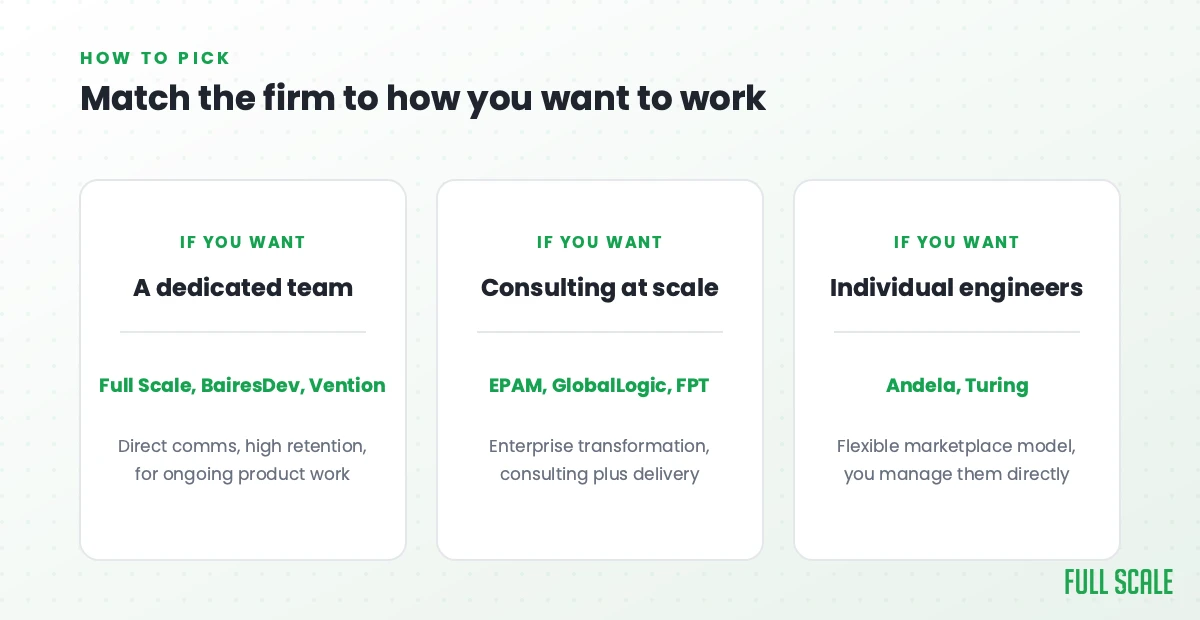
The ten firms above span a full range of size, geography, model, and price. The real decision is not which one is “best.” It is which one matches how you actually want to work.
If you want a dedicated long-term team and direct daily communication, the firm needs to be a staff augmentation shop with transparent pricing and high retention. That points to Full Scale, BairesDev, and Vention. If you want consulting plus engineering at enterprise scale, that points to EPAM, GlobalLogic, or FPT. If you want individual engineers on a flexible basis, that points to Andela or Turing.
The other dimension is geography, and the rate table above shows what each market buys you. The short version: the Philippines leads on English fluency and cultural fit with US teams, Latin America on time-zone overlap for US East Coast teams, Eastern Europe on the deepest benches for complex systems work, and India and Vietnam on price and scale. Africa, through Andela, brings geographic breadth at the cost of a managed firm relationship.
One more thing has changed the math, and it is worth saying out loud in 2026. AI coding tools make a good engineer faster, but they do not replace the judgment about what to build or how to build it safely, and they raise the bar on seniority rather than lowering it. A junior leaning on AI ships plausible code nobody fully understands. A senior using AI ships more of the right thing. That is the opposite of a reason to chase the cheapest offshore developer. It is a reason to weight seniority and retention even more heavily, because the engineer who knows your product and uses AI well is now worth more, not less, than the one who churns out in nine months. We train our own engineers on AI tooling for exactly that reason.
If you are still mapping which model fits, run the firm through the 27 questions to ask offshore development companies and the offshore development due diligence checklist before you take a single sales call.
A note on this list
Every “top 10” list on the internet for offshore software development companies puts the publisher’s own firm at the top, including this one. I am not pretending otherwise. The order here reflects how I would rank these firms if I were on the buying side, with the obvious caveat that I run Full Scale. The companies below us are real firms with real engineering benches, and they are on this list because a buyer might legitimately pick them over us depending on their situation.
What I will not do is pretend that pricing is “competitive” when one firm charges 4x another. And “global delivery” does not mean the same thing whether you are working with 35,000 engineers across forty countries or 350 working directly for their clients. The categories are real and the trade-offs are real. One thing worth noticing as you read other lists: most of them name retention as something to look for and then never put a turnover number next to a single firm, including their own. Ours is 93%+. It is a fair question to ask of anyone you are considering.
Maybe your situation looks like the one I described at the top, where US hiring has stalled and you need senior engineers who think like owners. If so, Full Scale is the right firm to start with. If your situation is different, one of the other nine probably is.
If that first situation is yours, book a call and let’s talk about building your team. We can usually have senior engineers working in your codebase in a matter of weeks, not the months a US hire takes.
FAQ
What is an offshore software development company?
An offshore software development company is a firm that builds software for clients using engineering talent located in a different country, typically a lower-cost region. The work happens remotely, usually with some daily time-zone overlap with the client. Offshore is distinct from nearshore, which is delivery from a country in a similar time zone like Mexico for US clients. It is also distinct from outsourcing, which means handing over a whole project to a vendor instead of integrating dedicated engineers with your team.
How much do offshore software development companies cost?
Hourly rates vary widely by region and firm. Senior engineers in the Philippines run $30 to $40 per hour at firms like Full Scale. Latin America and Eastern Europe sit in the $45 to $100 range depending on country and seniority. If you are still deciding where to build, our guide to which countries work best for offshore development walks through the tradeoffs. Enterprise firms like EPAM and GlobalLogic charge higher day rates that include consulting and project management overhead. Compare these to US senior engineer fully loaded costs of $80 to $150 per hour and the math is what makes the model work.
What is the difference between offshore and nearshore software development?
Offshore means delivery from a country with a significant time-zone difference from the client (the Philippines for US clients, for example). Nearshore means delivery from a country in a similar or adjacent time zone (Mexico, Colombia, or Argentina for US clients). The trade-off is real-time collaboration versus cost, with offshore typically cheaper and nearshore typically faster for synchronous work.
How do I choose the right offshore software development company?
Start with what model you want. Dedicated long-term team, individual contractor, or enterprise consulting engagement are three different shapes. Then look at pricing transparency, retention, engineering seniority, and time-zone overlap. Ask for two reference clients you can actually talk to. If the firm cannot answer those questions cleanly, keep shopping. For the wider buyer’s view across software development outsourcing companies, we break down how to vet them by what you’re building.
How do I manage an offshore development team?
Manage them like employees, not like a vendor you check in on once a week. The teams that work are the ones on the same Slack, the same standups, and the same code reviews as the in-house engineers. Give them context on why the product matters instead of just tickets to close. The biggest failures I have seen come from treating offshore developers as a black box you throw requirements at. If you want the full playbook, here is how to manage and work with offshore developers and the team structure that makes it click.
Who owns the IP when you use an offshore software development company?
You should, completely, and the contract is where you lock it down. Under a staff augmentation model the engineers work as part of your team, so what they build is work-for-hire that belongs to you the same way an employee’s would, with IP assignment written into the agreement. The questions to ask any firm: does the contract assign all IP and source code to you, who controls repository and systems access, and what are the confidentiality and data-handling terms. For regulated or security-sensitive work, ask whether the firm carries SOC 2 or ISO 27001 and how it manages access control and offboarding. A firm that gets vague on IP ownership or cannot answer the security questions cleanly is telling you something.
Which countries are best for offshore software development?
It depends on what you optimize for. Among the top software development companies in the Philippines, you get English fluency, cultural fit with US teams, and cost efficiency, which is why we built Full Scale there. Latin America wins on time-zone overlap for US East Coast teams. Eastern Europe has the deepest benches for complex systems work. India and Vietnam bring the lowest rates and the biggest scale. I compared the two markets I know best in India versus the Philippines.
Why do offshore software development projects fail?
Almost never because the developers are bad. They fail because the model is broken before anyone writes a line of code. A project shop puts a middleman between you and the engineers, nobody owns the outcome, and the team turns over before it learns your codebase. The fix is structural, not a matter of trying harder. We documented the most common offshore development challenges so you can spot the pattern before you sign.
What is the difference between offshore development and staff augmentation?
Offshore is about where the work happens. Staff augmentation is about how you engage the people doing it. You can have augmented offshore staff, which is what Full Scale does: dedicated engineers in the Philippines who work as part of your team instead of a separate vendor shipping a fixed scope. For the Philippines specifically, I cover Philippines outsourcing vendors and which model each one actually runs. The opposite is project outsourcing, where you hand over the whole thing and hope it comes back right. We pulled apart the staff augmentation versus outsourcing question if you want the longer version.