
Best Countries for Offshore Software Development in 2026: A CEO’s Honest Ranking

In this article
- How I’d choose an offshore country
- The best countries for offshore software development at a glance
- Asia: the cost leaders
- Latin America: the time-zone play
- Eastern Europe: technical depth at a premium
- Rates vary by city within a country too
- So which country is best for offshore software development?
- Why we built Full Scale in the Philippines
- Frequently asked questions
- The bottom line
Quick Answer: There’s no single best country for offshore software development; it depends on what your team needs most. The Philippines wins on English and communication, India on talent-pool depth and scale, Mexico and Colombia on time-zone overlap, and Poland and Romania on technical depth. At Full Scale we rank the Philippines first for most US teams, because communication drives outcomes more than rate does. Match the country to what your project needs, not the cheapest rate on the table.
I’ve hired developers in Russia, Belarus, Uruguay, Colombia, India, Pakistan, and the Philippines. Some of those bets paid off and some of them blew up in my face. So when people ask me which country is best for offshore software development, I don’t start with a map. I start with a warning. A lot of the challenges of recruiting in another country have nothing to do with which country you pick. If the Philippines makes your shortlist, here is how to vet IT companies in the Philippines before you sign.
There are brilliant developers in every country on this list. Talent is the easy part. Communication, time zones, and how you run the team are what decide whether you can actually work with them, not the flag on the invoice. It is the same point behind the broader IT outsourcing industry trends: where a team sits matters less than whether they can think.
That’s the lens I’ll use for the whole guide. You’ll get real 2026 rate ranges and honest pros and cons for each country. You’ll also get a way to narrow the field. The goal is simple. Don’t end up six months into a contract, wondering why nobody on the team will tell you the spec is wrong. And whichever country you choose, the broader offshore software development trends reshaping the work in 2026 matter more than any rate card.
Want the deep cost breakdown, with junior, mid, and senior rates for every region? That’s the table below, plus the city-level detail and earn-vs-bill math further down. This section is about how to choose.
How I’d choose an offshore country
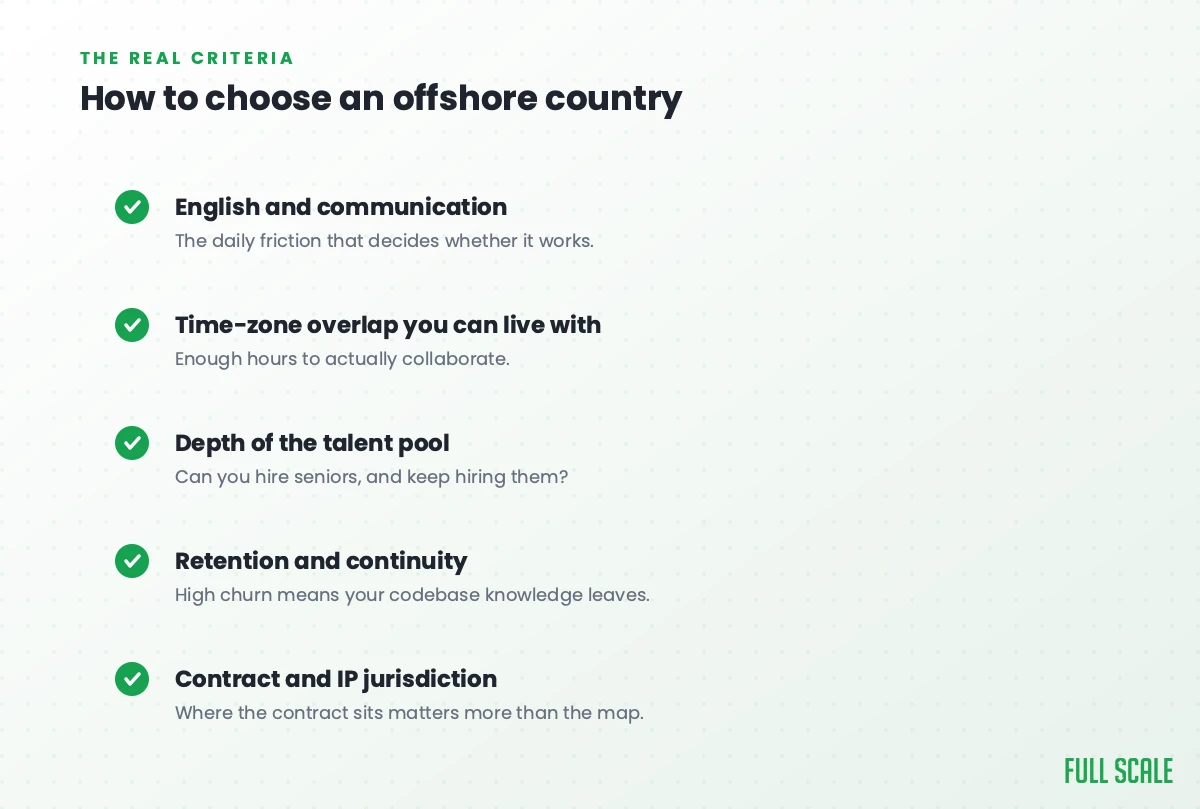
Most companies pick the cheapest country first, then discover the real cost later. I’d flip the order. Here are the five things that decide whether an engagement works, roughly in the order they matter.
Communication comes first. Can the developers read your technical writing, join a standup, and push back when a requirement is wrong? English fluency is part of this, but so is culture. I’ve talked to founders whose entire offshore team hides behind one project manager. Nobody else will speak to the client. That’s a team you can’t really work with, and no hourly rate makes up for it.
Time zone overlap is second. A four to six hour overlap with your team is usually plenty. Less than that and you’re trading real-time collaboration for cheaper rates, which is a fine trade for some work and a terrible one for others.
Talent pool depth and technical fit are third. A country with five million developers and one with a hundred thousand are not the same hiring problem. Depth matters most when you need a specific stack or you’re scaling fast.
Cost comes fourth. The rate matters, but it sits downstream of the first three. It’s only one of the dozen factors that drive software development cost. A cheap developer you can’t talk to is the most expensive hire you’ll ever make.
Stability is fifth. Currency swings, politics, and war all change the math. Three years ago Ukraine was the default Eastern European hire. Then 2022 happened, and it's worth reading the honest tradeoffs of outsourcing to Eastern Europe before you assume the old math still holds.
Pick the country last, after those filters. The rest of this guide walks through how the major destinations score on each one.
The best countries for offshore software development at a glance
Here’s the quick comparison. Rate ranges are 2026 offshore hourly figures pulled from current market rate guides and our own hiring. The English ratings come from the EF English Proficiency Index 2025. EF sorts countries into five bands, from Very high to Very low. The 2025 score is in parentheses. Talent-pool sizes are 2025 developer-population estimates.
| Country | Region | Rate range (offshore/hr) | English (EF 2025) | US time overlap | Talent pool | Best for |
|---|---|---|---|---|---|---|
| Philippines | Asia | $15–40 | High (569) | 3–4 hrs (staffed) | ~180K | English-first teams, long-term staff aug |
| India | Asia | $20–50 | Low (484) | 2–4 hrs | 5M+ | Deep talent pool, scale, specific stacks |
| Vietnam | Asia | $20–50 | Moderate (500) | 1–3 hrs | ~550K | Cost plus a fast-growing pipeline |
| Pakistan | Asia | $15–30 | Low (493) | 2–4 hrs | Growing | Tightest budgets, scoped projects |
| Indonesia | Asia | $15–45 | Low (471) | 0–2 hrs | Growing | Emerging cost play |
| Brazil | Latin America | $30–55 | Low (482) | Near full | ~630K | Largest LatAm pool, real-time work |
| Mexico | Latin America | $25–80 | Very low (440) | Full | Large | Best US time alignment |
| Colombia | Latin America | $20–70 | Low (480) | Full (ET) | Growing | Nearshore on a tighter budget |
| Argentina | Latin America | $18–55 | High (575) | Near full | Large | Strong English plus senior talent in LatAm |
| Poland | Eastern Europe | $55–90 | Very high (600) | 1–2 hrs (AM) | ~420K | Complex backend, EU alignment |
| Romania | Eastern Europe | $25–60 | Very high (605) | 1–2 hrs (AM) | ~165K | Technical depth at a better EE rate |
| Ukraine | Eastern Europe | $25–60 | Moderate (526) | 1–2 hrs (AM) | ~285K | Elite engineering, with caution |
A note on the English ratings before anyone writes in. The EF index measures a self-selected sample of online test-takers, so it tells you the national average rather than the ceiling. India and Brazil both land in the “Low” band and still have huge populations of fluent, world-class English speakers. The rating is a starting filter for the country. And if India tops your shortlist, read what the evidence says about outsourcing software development to India before you commit. It says nothing about any one developer you’d actually interview.
Asia: the cost leaders
Asia is where the rate math gets aggressive. It’s also where communication is the make-or-break variable, because the time zone gap is real and English fluency varies more than the rate cards suggest. For Laravel specifically, the Philippines stands out even within Asia: the country has been building PHP for twenty years and Laravel is the modern standard, making offshore Laravel hiring one of the deepest talent pipelines in the region.
Philippines
The Philippines is where we built Full Scale, so treat this as a biased opinion backed by seven years of payroll. Developers here earn $20 to $30 an hour depending on experience, and Full Scale’s own published rate starts at $35 an hour, fully loaded, on our pricing page. For the full earn-vs-bill breakdown across every country, see the FAQ further down this page.
The reason to look here is communication. The Philippines is the third-largest English-speaking country in the world, and English is taught from grade school. It lands in the “High” band on the EF index at 569. Manila on its own scores 603, a “Very high” mark that beats most European capitals. Filipino developers read American technical writing, joke around with your team, and push back on a bad spec in fluent English. The cultural fit with US companies is the part you can’t put on a rate card.
The honest tradeoff is the clock. The Philippines is 12 to 14 hours ahead of the US, so you don’t get free real-time overlap. We staff around it three ways. Most clients pick a half-day overlap of three to four hours, which is usually plenty. Others run full US hours, or go async with a daily standup. If your work needs constant real-time collaboration and you won’t manage the schedule, Latin America is a cleaner fit.
Best for: English-first teams building long-term, integrated staff augmentation rather than handing off a scoped project. Here’s our deeper case for why companies outsource to the Philippines, and what it looks like to hire Filipino developers through us. Once the country is picked, the next question is which city, and the honest answer is that it matters less than the ranking lists say. I break down the best cities to hire developers in the Philippines separately.
India
India has the largest offshore talent pool on earth, north of five million IT professionals. It’s the default for a reason. If you need an unusual stack, a huge volume of engineers fast, or 24-hour coverage, no country matches the depth. Rates run about $20 to $50 an hour, averaging in the low $30s.
The catch is variance. India lands in the “Low” EF band at 484, and English among senior developers ranges from flawless to frustrating. The country also carries the heaviest baggage from the old body-shop model. You talk to an account manager and never meet the people writing the code. Plenty of excellent Indian firms have moved past that, but you have to screen for it. We compare the two destinations head to head in India vs the Philippines for offshore development.
Best for: Teams that need raw scale, deep specialties, or round-the-clock coverage and are willing to vet communication hard.
Vietnam
Vietnam is the fastest-growing offshore destination right now. It has roughly 550,000 developers and a strong engineering-school pipeline. Rates sit close to the Philippines and India at about $20 to $50 an hour, so cost isn’t the differentiator. The draw is a young, technically sharp workforce that’s especially strong on mobile and modern web frameworks. We put the full head-to-head against our own destination in vietnam software development outsourcing.
English is the soft spot. Vietnam sits in the “Moderate” band at 500, below the Philippines, so communication takes more screening and more structure. The talent is real, but you’ll work harder to find the developers who can operate independently with a US team.
Best for: Cost-sensitive teams that want a growing, technically strong pipeline and will invest in communication structure.
Pakistan
Pakistan is one of the cheapest destinations on this list, with offshore rates around $15 to $30 an hour, and I’ve hired there myself. The technical talent is genuinely good, and for a tight budget or a scoped, well-specified project it can be a smart play.
I’d go in with eyes open. English lands in the “Low” EF band at 493, and the developer pool is smaller and less mature than India’s. You’ll also want to weigh the political and infrastructure stability questions you’d apply to any emerging market. This is a place where the engagement model matters more than the country. A well-managed scoped project beats an open-ended team you can’t see.
Best for: The tightest budgets and well-scoped projects where you can define the work precisely.
Indonesia
Indonesia is an emerging option with rates around $15 to $45 an hour and a fast-growing developer base. The cost is competitive and the pipeline improves every year. The constraint is English. At 471 it sits in the “Low” band, so communication overhead is the thing to plan for. It’s worth a look if cost is the primary driver and you have the bandwidth to bridge the gap.
Best for: Cost-first teams comfortable building communication scaffolding.
Latin America: the time-zone play
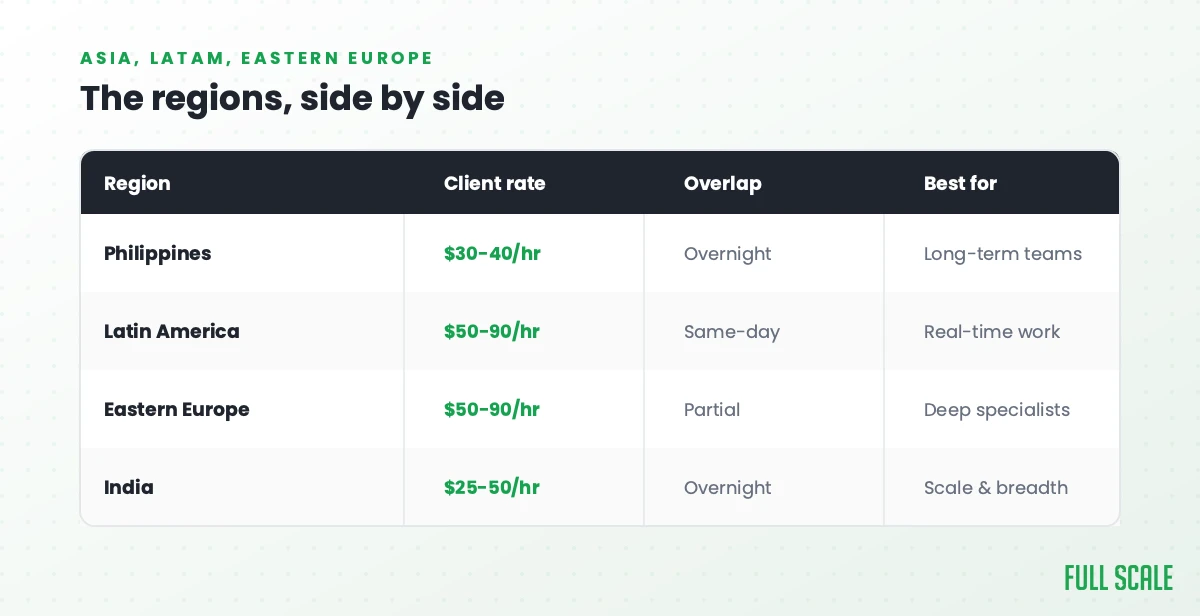
Latin America buys you something Asia can’t: a workday that overlaps with yours. If your team lives in standups, pair programming, and same-day code review, that overlap is worth real money. The trade is rate. LatAm runs 30 to 50 percent higher than the same talent in the Philippines or India, a gap current nearshore rate guides confirm. We weigh the full decision in offshore versus nearshore, and compare the region directly in Latin America vs the Philippines. For the cost side, our offshore development cost analysis runs the numbers.
Brazil
Brazil has the largest developer pool in Latin America, around 630,000 engineers. The tech scene is deep and mature. Rates run about $30 to $55 an hour. You get near-full overlap with US business hours and a strong culture of modern engineering practices.
English is the watch-item. Brazil lands in the “Low” band at 482, below regional leader Argentina, so fluency varies and you’ll screen for it. The talent depth usually makes up for the extra vetting.
Best for: Teams that want the biggest LatAm talent pool and real-time collaboration.
Mexico
Mexico has the tightest time zone alignment with the US of any country here, full overlap including Pacific hours, plus easy travel and strong cultural fit. That convenience puts it at the top of the LatAm rate range. Senior developers run as high as $80 an hour, with rates from about $25 to $80 across seniorities.
English lands in the “Very low” band nationally at 440, though the developer population skews more fluent than the average suggests. The real consideration is cost. Mexico is one of the pricier offshore options, so you’re paying for proximity and overlap rather than savings.
Best for: US teams that prioritize time zone alignment and easy collaboration over cost.
Colombia
Colombia has become a nearshore favorite. You get exact US Eastern time alignment and rates of roughly $20 to $70 an hour, a bit cheaper than Mexico. The developer pool is growing fast, and the government has invested heavily in tech education.
It lands in the “Low” band at 480, in line with the rest of the region, so the same fluency screening applies. For a US East Coast team that wants nearshore overlap without Mexico’s price tag, it’s a strong middle option. I hired developers in Colombia myself during my Stackify years, and the time zone made a real difference.
Best for: East Coast teams wanting real-time overlap on a tighter nearshore budget.
Argentina
Argentina is the LatAm standout on communication. It lands in the “High” band at 575, the top score in Latin America, and it has a deep bench of senior engineering talent. Rates are competitive for the region at about $18 to $55 an hour, helped by a weak peso, and you get near-perfect East Coast overlap.
The risk is economic. Argentina’s currency swings have produced some of the strangest offshore rate behavior of the last five years. That instability cuts both ways over a multi-year deal. The talent and English are the best in the region, but you take on real economic uncertainty to get them.
Best for: Teams that want the strongest English in LatAm plus senior talent, and can tolerate currency risk.
Eastern Europe: technical depth at a premium
Eastern Europe is where you go for hard computer-science problems: complex backends, security, and algorithm-heavy work. You pay for it. The region sits at the top of the offshore rate range. The overlap with the US is limited to your morning and their late afternoon.
Poland
Poland is the premium Eastern European hire, with rates around $55 to $90 an hour. You’re paying for EU regulatory alignment, a deep technical pipeline of roughly 420,000 developers, and engineers who are genuinely strong on complex, architecture-heavy work. It lands in the “Very high” English band at 600, and the work culture maps cleanly onto Western expectations.
The constraints are cost and clock. Poland is among the priciest destinations here. The six-to-seven-hour gap limits your overlap to the US morning. For a European company, none of that is a downside. For a US one, it’s the price of technical depth.
Best for: Complex backend and security work, and companies that value EU alignment.
Romania
Romania gives you much of Poland’s technical strength at a better rate, roughly $25 to $60 an hour. At 605 it has the highest EF English score of any country in this guide, a “Very high” rating. It also has a strong technical-talent pipeline of around 165,000 developers.
The pool is smaller than Poland’s or Ukraine’s, so scaling a large team fast is harder. But for technical depth at a more reasonable Eastern European price, with excellent English, Romania is underrated.
Best for: Teams wanting Eastern European technical depth and strong English without Poland’s premium.
Ukraine
Ukraine built one of the best engineering reputations in the world before 2022, and that talent didn’t disappear. Many developers relocated, and plenty of teams continue to deliver excellent work at rates around $25 to $60 an hour. The technical quality is elite.
The honest part is risk. The war introduces operational uncertainty that no rate card captures, from infrastructure to mobilization to relocation. I’m not telling anyone to avoid Ukraine, and many engagements run fine. But you have to weigh continuity risk as a first-class factor. I’d treat Russia and Belarus as off the table for new engagements in 2026, no matter how good the rate looks.
Best for: Teams that want elite engineering and will actively manage continuity risk.
Rates vary by city within a country too
Country is the headline, but it isn’t the whole picture. The same pattern that makes a developer in Manila cost less than one in San Francisco shows up inside a country too, because cost of living changes from city to city.
In Poland, the gap between the priciest tech city and the cheapest runs about 74 percent. Kraków developers average the most, while smaller cities like Białystok and Rzeszów sit far below, per Bulldogjob’s 2025 survey. In India, developers in metros outside Bangalore run roughly 8 to 22 percent below it for equivalent roles, with Pune 15 to 25 percent lower, per kaam.work’s 2026 salary report. In the Philippines, Manila and Makati sit a notch above Cebu and Davao.
It’s the same force every time, and it’s the whole argument in our companion piece on why the cost to hire a software developer depends on their location: pay tracks the local cost of living. Picking a lower-cost city inside a strong talent market is one of the quieter ways to get senior skill for less.
So which country is best for offshore software development?
There’s no single winner here, which is exactly why a ranked top-ten list misses the point. The right answer depends on what you’re optimizing for. Here’s how I’d match the decision to the destination.
If communication and English are your top priority, look at the Philippines in Asia, Argentina in Latin America, and Romania or Poland in Eastern Europe.
If real-time collaboration is non-negotiable, Latin America wins on time zones, with Mexico and Colombia offering the tightest US overlap.
If you need raw scale or a specific stack, India’s five-million-strong talent pool is hard to beat, with Brazil leading in Latin America.
If cost is the hard constraint, the lowest-rate destinations are Pakistan, the Philippines, India, Vietnam, and Indonesia. Of that group, the Philippines gives you the best English.
If you need deep technical specialty in security or complex architecture, Eastern Europe is the region, with Poland and Romania leading.
And if you’re optimizing for a long-term, integrated team rather than a scoped project, the country matters less than the engagement model. A team you treat like employees will beat a cheaper team you treat like a vendor, every time. That’s what building a real offshore team takes. It’s the core argument in Product Driven, and it’s why our offshore development best practices guide spends more time on the cheapshoring trap than on rates.

Why we built Full Scale in the Philippines
Since I’m ranking countries, I owe you a straight answer on ours. We picked the Philippines, and after 350-plus employees of offshore software development in the Philippines since 2018, the bet has held up.
It came down to communication. There’s no language barrier with Filipino engineers. The cultural fit with American teams is natural, and they take to remote work. The same traits that make Filipinos great at hospitality jobs worldwide carry over to engineering. They’re attentive, they want to get the details right, and they show up for the team.
The cost-of-living math is the other half. My brother-in-law in the Philippines works at Jollibee, the country’s largest fast food chain, for about $1.25 an hour. My sister-in-law works as a virtual assistant for $5 an hour, four times his pay. A $30-an-hour developer salary is a career-building professional wage there, and that’s what drives retention. Our developer retention runs over 93 percent.
The proof is in the clients who stayed. AMC Theatres treats the developers we placed as full AMC engineers rather than contractors. They even flew their Kansas City team to our Cebu office for in-person time. LendingStandard processes roughly 30 percent of affordable multifamily property loans nationwide. Its CEO says collaborating with the team is the highlight of his day. Full Scale has been named to the Inc. 5000 for five straight years on the back of work like that.
None of that means the Philippines is right for you. It was right for us, for reasons you can apply to your own choice. Roughly 90 percent of software developers live outside the United States. So the real question was never whether great talent exists abroad. It was which country let us build a team we could truly work with.
Our own clients describe it the same way. Jason Flowers at AG Mednet, who tried India and Latin America first, says the thing skeptics never expect is the communication:
A lot of people have had bad experiences offshoring to other countries. They’d be pleasantly surprised at how good the English is and the quality of the work.
Jason Flowers, Head of Software Engineering and DevOps at AG Mednet, on working with Full Scale
Frequently asked questions
What is the best country for offshore software development?
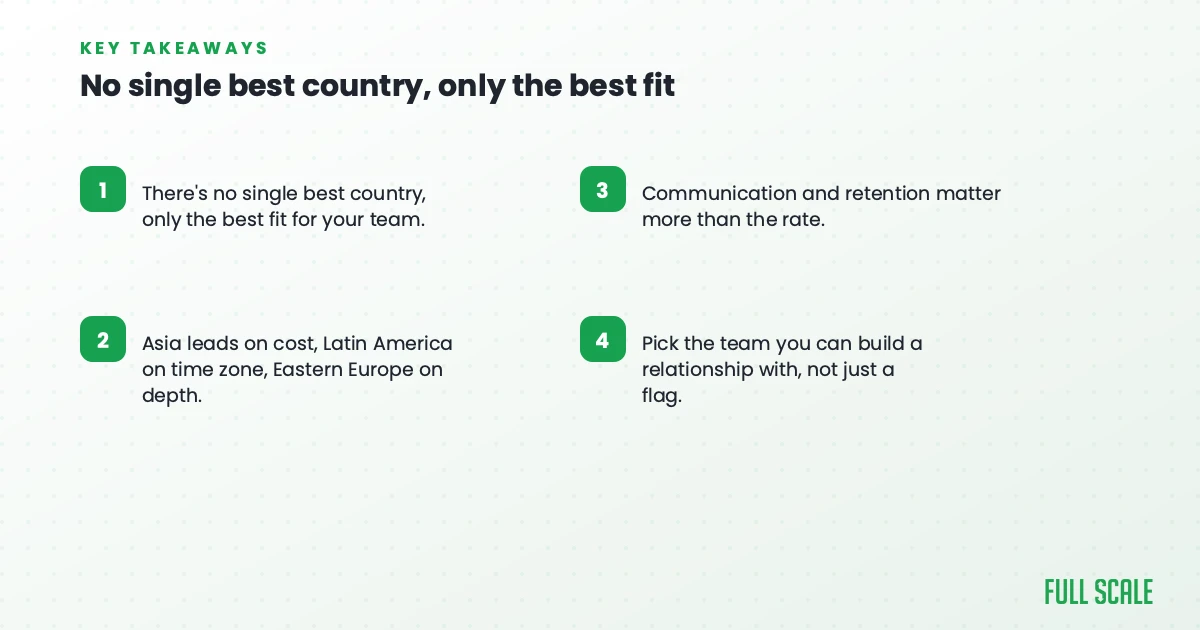
There’s no universal best country. The Philippines wins on English and communication for US teams, India on talent-pool depth and scale, Mexico and Colombia on time zone overlap, and Poland and Romania on deep technical work. Pick communication first, time zone second, talent depth third, and cost fourth, then let the country fall out of those filters.
Which country has the cheapest offshore developers?
Pakistan, the Philippines, India, Vietnam, and Indonesia sit at the bottom of the rate scale, with Pakistan and Indonesia the cheapest of that group. The tradeoff is what you screen for at that price: English fluency and communication structure, not technical skill, which is usually fine everywhere. For exact rate ranges by country, see the table above.
Is the Philippines or India better for offshore development?
It depends on what you need. The Philippines has stronger English and cultural fit with US teams, which makes it better for integrated, communication-heavy work. India has a far larger talent pool and more specialists, which makes it better for scale, unusual stacks, and round-the-clock coverage. Our India vs Philippines comparison breaks the decision down in detail.
Is nearshore in Latin America worth the higher cost over Asia?
If your work depends on real-time collaboration, standups, and same-day code review, the time zone overlap is often worth the 30 to 50 percent rate premium. If your work can run on a half-day overlap or async handoffs, Asia gives you most of the value at a lower cost. It’s a decision about collaboration speed more than a decision about cost.
Does English proficiency really matter more than the hourly rate?
In my experience, yes. Software work is communication more than anything else. The most expensive offshore hires are the ones you can’t actually talk to. A team that speaks up when a spec is wrong saves you far more than a slightly lower rate ever will. That’s why I put communication at the top of the list and let cost sort itself out afterward.
How do I choose an offshore country for my project?
Start by ranking your own priorities: communication, time zone overlap, talent depth, cost, and stability. Match those to the destinations in this guide. Then check how each vendor handles communication, and whether you’ll get direct access to the developers. Our roundup of the top offshore software development companies is a good place to start that vendor search. The country narrows the field, but the engagement model decides whether it works.
What is the average hourly rate for offshore software developers?
Senior offshore developers earn roughly $20 to $55 an hour locally and get billed to US clients at roughly $30 to $90 an hour, depending on country. In the Philippines, senior developers earn $20 to $30 and Full Scale bills $35. Eastern Europe and nearshore Latin America sit at the higher end. The gap between what a developer earns and what you’re billed covers the partner’s overhead and margin, and the country-to-country spread comes down to cost of living.
Do offshore rates include benefits and overhead, or just wages?
The rate ranges in the table above are wages, what the developer actually takes home. What you get billed includes the partner’s overhead: recruiting, payroll, benefits, management, and margin. That gap is normal, and it’s why comparing a developer’s take-home pay to your invoice is comparing two different numbers.
How do you calculate offshore software development cost?
Add the agency billing rate, communication and tooling overhead (typically 10 to 15 percent of base), and the management time you’ll need on your side. For a senior Philippines developer billed at $35 per hour, the all-in cost runs roughly $40 to $45 per hour including your team’s coordination time.
The bottom line
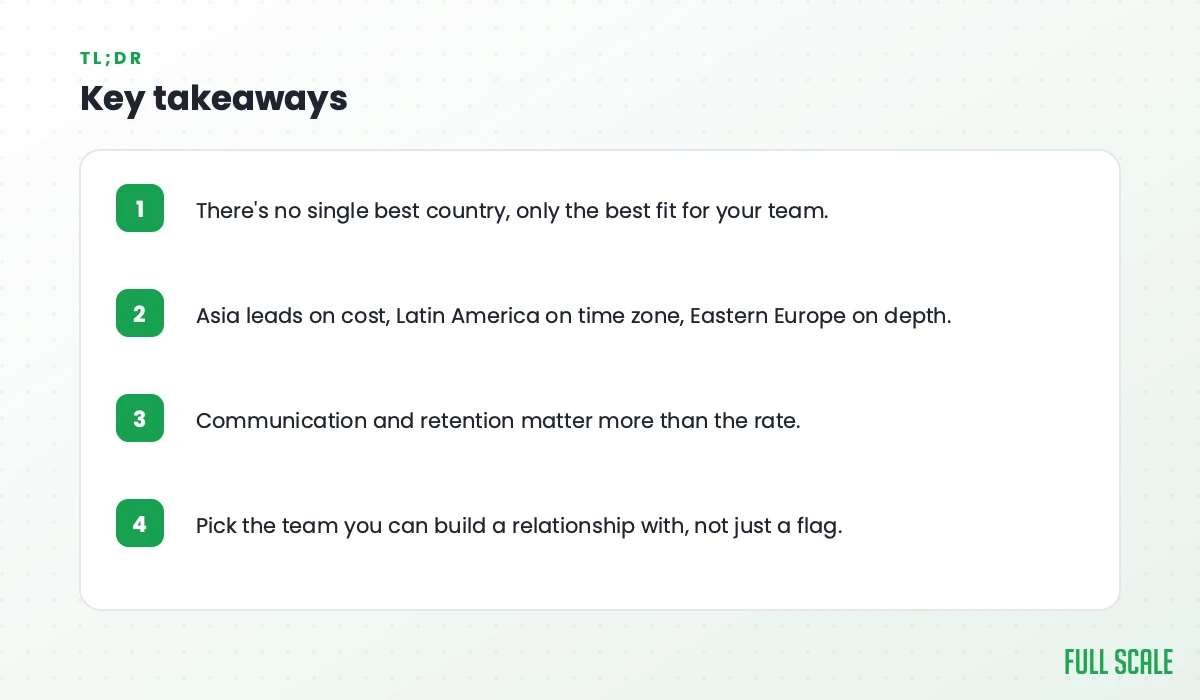
The best country for offshore software development is the one that clears your communication bar, fits your time zone needs, and gives you a team you can build with for years. It’s rarely the one with the lowest rate. Get the first three filters right and the country mostly picks itself.