
Software Development Outsourcing Companies: A Buyer’s Selection Guide

In this article
Quick Answer: The key success factors when outsourcing software development are matching the engagement model to your situation, vetting for direct access to the engineers rather than an account manager, and checking retention before you sign, not after. Most “best outsourcing company” lists are paid rankings, the company that published the list is usually sitting at number one on it, so judge on your own checklist: who directs the work, whether the same people stay on the project, and what the all-in rate actually covers.
Most “software development outsourcing companies” lists are a wall of rankings: Top 25 this, Top 28 best that. Read a few and you notice the same trick: the company that published the list is sitting at number one on it. Those lists are ads wearing a ranking’s clothes.
Since 2018 I have built and run Full Scale, where we manage hundreds of developers in the Philippines. Before that I co-founded VinSolutions, bootstrapped it to $35 million in revenue, and sold it, and I built and sold Stackify. I have hired engineers outside the US for almost twenty years, and I have been the buyer getting it wrong as often as the seller getting it right.
This guide skips the ranking and shows you how to pick instead. The honest version of that is uncomfortable for someone in my seat to admit.
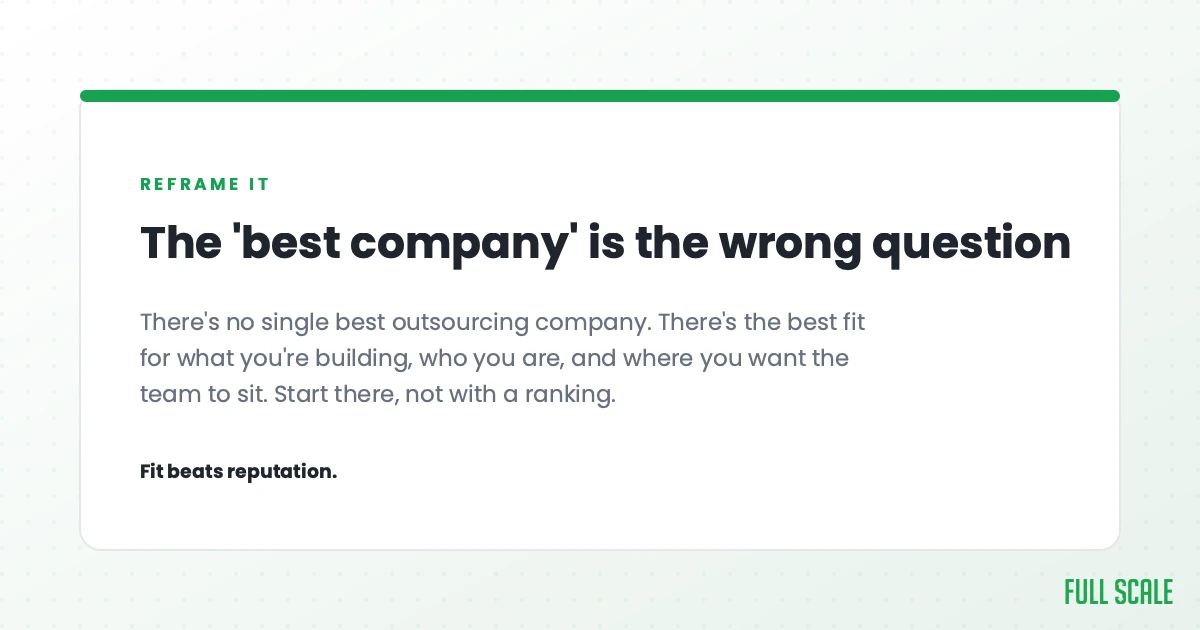
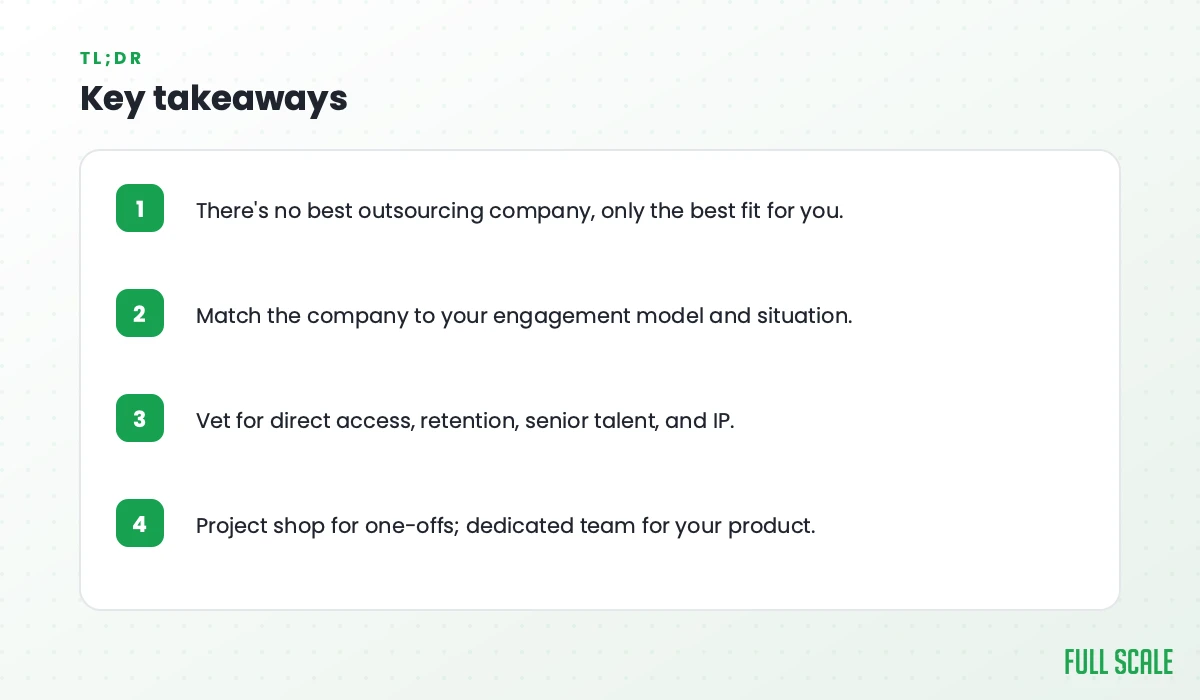
There is no single best software development outsourcing company. There is only the best fit for what you’re building, who you are, and where you want the team to sit.
A firm that is perfect for a Fortune 500 legacy migration will sink a two-person startup, and the shop that nails a quick scoped project is the wrong call for a product you’ll run for five years. So instead of handing you a ranking, this guide hands you a way to build your own.
The “best company” is the wrong question
The right one is narrower: best for what, for whom, and from where. Those three axes decide your shortlist before you ever read a sales deck, and they pull in different directions.
| Axis | The question it answers | What it changes |
|---|---|---|
| What you’re outsourcing | A scoped project, or an ongoing product? | Whether you want a project shop or a team that stays |
| Who you are | Startup, enterprise, or a non-tech company? | How much product and architecture help you need |
| Where the team sits | Onshore, nearshore, or offshore? | Cost, time-zone overlap, and how you’ll run the day-to-day |
Get clear on your own three answers first. Most bad outsourcing decisions trace back to skipping this and grabbing the cheapest name on a list. If you do want a vetted starting point to compare against, we keep a ranked list of the top offshore software development companies, but read it the way you’d read any list a vendor published, including ours. If you want the broader background on models and definitions before you go further, I wrote a full software outsourcing guide that covers the 101. This piece assumes you’re past that and ready to choose. If the choice is between talent platforms, start with how Toptal and Turing compare.
How to vet a software development outsourcing company
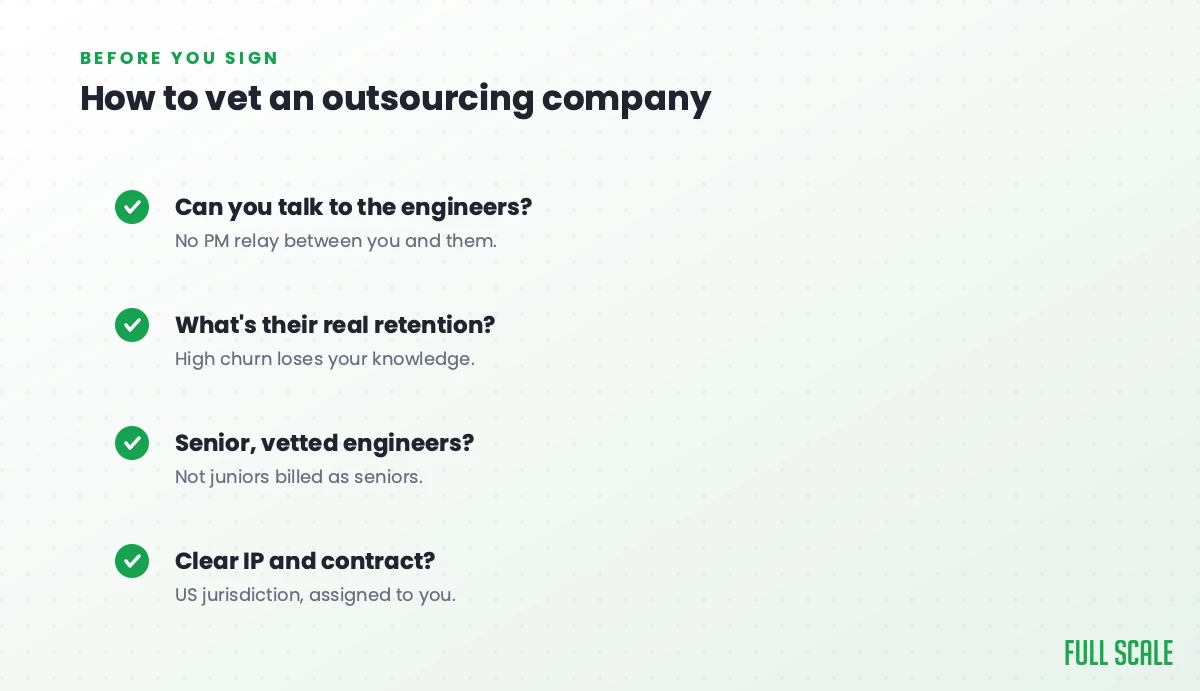
Vetting is a process you run deliberately, and price comes last, after everything else has checked out. Part of that is knowing how to vet a software development company using the review platforms everyone links to but nobody reads carefully. Here is the scorecard I’d run, drawn from sitting on both sides of these conversations for two decades.
| What to check | What good looks like | The red flag |
|---|---|---|
| Technical depth | They let you interview the actual engineers who’d do the work | You only ever talk to sales and account managers |
| Communication | Clear written English, real-time overlap with your team, fast replies | Vague answers, slow responses, everything routed through one handler |
| Retention | Low turnover, they commit named people to you for the long haul | High churn, “we’ll assign someone,” no continuity guarantee |
| Proof | Case studies you can verify and references who pick up the phone | Logos with no stories, or no references offered at all |
| Security and IP | NDAs, access controls, contracts that assign ownership to you | Thin answers on security, fuzzy IP terms |
| Pricing | Transparent rates and a model that matches your work | A number suspiciously below everyone else’s |
| Escalation | A clear path and a named owner when something breaks | No answer for “what happens when this goes wrong?” |
A few of those deserve more than a table cell.
Interview the engineers who would actually build your software. The people who walk you through the sales deck won’t be writing your code. If a company won’t put you in a room with the real team, that tells you what they’re hiding.
Weigh retention heavily, because it is the quiet thing that wrecks engagements. When a project team disbands, everything it learned about your product walks out the door, and you start the next change from zero. The two failures that have bitten me hardest over the years were knowledge and control, and both come down to whether the people stay.
Then there’s price, which is where most buyers start and where most of them get burned.
The cheap engagement that fails is the most expensive one you will ever buy.
A rate far below the market usually means juniors billed as seniors, or a team you’ll churn through twice before the project ships. I call buying offshore on price alone cheapshoring, and it’s the single most common way companies talk themselves into a bad partner. Cost is a real and fair reason to look offshore. It just can’t be the only one, because when it is, you optimize for the wrong thing and buy the cheapest body you can find.
I learned this the hard way, from the buyer’s seat. Early on I outsourced projects for WordPress, Elasticsearch, and other things I didn’t know much about, and I picked on price and availability. It went about how you’d expect. Another time an IT recruiter charged me a 25% ransom fee to fill a role I’d struggled to hire for, and I paid it because I was stuck. The pattern in both was the same. I hadn’t done the vetting, so I let cost and convenience decide.
I’ve watched it from the outside too. A friend of mine had 16 developers in Pakistan and kept asking why the team wasn’t shipping. The problem was never the headcount or the hourly rate. He had nobody leading them, and piling cheaper bodies onto a team with no direction just buys you more of nothing.
Red flags worth walking away over
- They won’t give references or let you talk to the engineers
- Rates well below everyone else, with no clear reason why
- They can’t commit specific people, or their turnover is high
- No documentation or knowledge-transfer practice
- Evasive answers on security, IP, or who owns the code
One or two of these, ask harder questions. Several of them, walk. When you do, the cost of switching development vendors is real but manageable if you overlap the transition instead of cutting over all at once.
Match the company to your engagement model
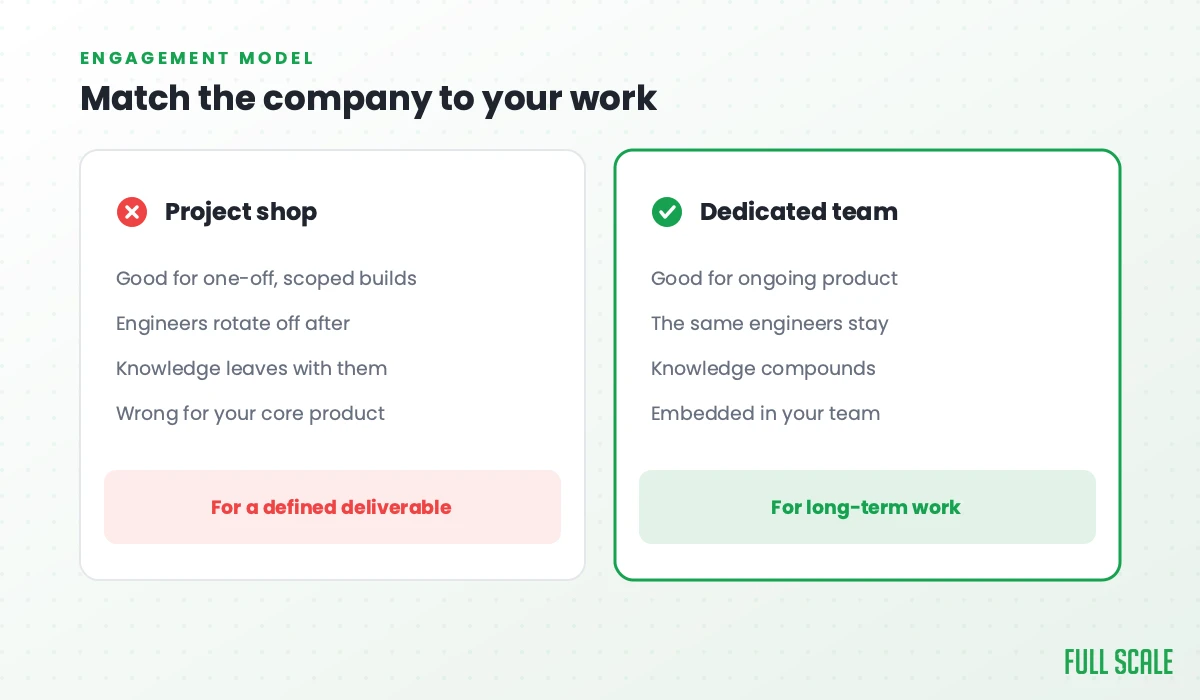
The first axis is what you’re outsourcing, and it splits cleanly into a scoped project versus ongoing product work. The company that’s right for one is usually wrong for the other, and a lot of buyers hire the wrong type without realizing the type exists.
| Model | What to look for in the company | Who it fits | Main risk |
|---|---|---|---|
| Scoped / SOW project | Fixed-bid track record, strong project management, a clear spec | A finite build with stable, well-defined requirements | Scope creep, and the team vanishing the day it ships |
| Staff augmentation | Fast access to vetted individuals who slot into your process | You have a team and need to extend it with specific skills | Weak management if you can’t direct the people yourself |
| Dedicated team | Recruiting, retention, and management built in; people who stay | Ongoing product work that runs for years | Paying for a standing team you don’t keep busy |
Scoped project work is legitimately the right answer sometimes. If you have a finite, well-defined build, a statement of work project with a fixed-price shop can be exactly what you need: predictable budget, a clear deliverable, and a clean handoff. The trouble starts when companies use a project shop for work that never actually ends, like a product they’ll keep shipping for years. That’s when the disband-and-restart problem turns into a tax you pay over and over.
For ongoing product work, a dedicated team or staff augmentation is the model that holds up, because it keeps the cost and talent upside while fixing the control and continuity problems that sink project outsourcing. The deciding question is simple: when this work is “done,” is there more like it coming? If yes, hire a team that stays.
Match the company to your situation
The second axis is who you are. A startup, a large enterprise, and a non-tech company shopping for a tech build are three completely different buyers, and the right partner looks different for each. This is the part the ranked lists never touch. If the work is .NET, the right partner is one you can hire a dedicated C# developer through directly, not a reseller.
You’re a startup or founder building a product
You’re short on time, money, and people, and you need to ship something real without burning your runway. The temptation is to chase the lowest rate. Resist it. What you actually need is continuity and product sense, a small team that sticks around as your MVP turns into a real product and that can think past the literal ticket.
Prioritize a partner who’s in it for the long haul and can scale with you, instead of one that hands you a finished project and disappears. Your biggest risk is cheapshoring your way into a freelancer or project shop that ghosts you mid-sprint, which leaves you worse off than if you’d never started.
You’re an enterprise modernizing a legacy system
You have a large, complex, often mission-critical system, real compliance and security requirements, and a multi-year program rather than a project. Your selection bar is different. You’re buying domain depth, the ability to staff senior people consistently, disciplined knowledge transfer, and a partner that won’t lose continuity halfway through a migration.
For a build this big, some enterprises use a build-operate-transfer arrangement, where the partner stands up the team and eventually hands it to you. Your biggest risk is a shop that wins on price but can’t hold senior talent or institutional knowledge across the length of the program, so the modernization stalls two years in when the people who understood the old system leave.
You’re a non-tech company with a big tech project
This is the hardest seat to be in. You have a serious software need, no engineering team, and no easy way to judge whether a vendor is any good. You can’t interview the engineers on technical depth because you don’t have the in-house expertise to run that interview.
What you need is a partner that brings product and architecture guidance on top of the people who write the code. The danger is hiring a pure body shop that builds exactly what you spec, on time, and delivers the wrong thing because nobody pushed back on the plan. Lean harder on references from companies like yours. Insist on a partner who asks uncomfortable questions about what you’re really trying to do, and start with a small paid pilot before you commit to the whole build.
| Your situation | Top priority | What to avoid | Model that usually fits |
|---|---|---|---|
| Startup / founder | Continuity and product thinking | Cheapest freelancer or project shop | Dedicated team or staff aug |
| Enterprise legacy | Senior depth, security, knowledge transfer | Low-bid shop that can’t hold talent | Dedicated team or build-operate-transfer |
| Non-tech company | Product and architecture guidance | A body shop that just builds the spec | Dedicated team with a strong partner layer |
Where in the world to outsource
The third axis is geography, and there’s no universal winner here either. Every region trades something. The honest framing I’ve landed on after hiring in several countries is communication first, then cost, then country, because a cheaper developer you can’t understand or reach is no bargain. With that order in mind, here’s a fair read on the major regions.
| Region | Senior rate (market range) | US time-zone overlap | English | Strong for | Watch out for |
|---|---|---|---|---|---|
| India | $30-55/hr | Low (night for US) | Widespread | Scale, huge talent pool, lowest cost | Quality varies widely; big-shop churn |
| Latin America | $50-90/hr | High (same business day) | Strong | Nearshore overlap with US teams | Smaller senior pool; rates climbing |
| Eastern Europe | $50-90/hr | Low to partial | Strong | Deep engineering, complex systems | Regional instability; rising rates |
| Vietnam | $30-50/hr | Low (night for US) | Improving, variable | Low cost, fast-growing, mobile | English variance; younger market |
| Philippines | $30-45/hr | Low (night, workable) | Strong | English fluency, US cultural fit, retention | Senior architect depth thinner in some niches |
A few honest notes on that table. India has the deepest talent pool and the lowest entry cost on earth, and plenty of world-class engineers, but the variance is real and the big shops churn people. Latin America wins on time zone if same-day overlap matters most to you, which for some teams is worth more than anything else. Eastern Europe has genuinely deep engineering talent for hard, complex systems. Vietnam is a fast-rising low-cost option that’s strong in mobile, with English that’s still catching up. See the full outsourcing software vietnam comparison against the Philippines for the honest breakdown. The Philippines, where we operate, leads on English (it’s the third-largest English-speaking country in the world) and cultural alignment with US companies, with a night-shift overlap that’s workable but real.
The rates above are rough market ranges for budgeting, and they move. For a deeper cut, we keep offshore rates by country current, and we’ve written head-to-head breakdowns on India vs the Philippines and Latin America vs the Philippines. If you’re weighing how far to go from home at all, the offshore vs nearshore comparison lays out that tradeoff.
The thing no region fixes for you is the model. A great developer in any of these countries on the wrong engagement model will still leave you with the control and continuity problems from earlier. Geography is the third question, not the first.
What it actually costs
Cost is why most companies look offshore in the first place, and a Deloitte survey still puts it as the top driver. The gap is large and real. A senior US software developer runs roughly $150,000 to $185,000 in base salary alone per the Bureau of Labor Statistics, and once you add benefits, payroll taxes, equipment, and recruiting at the standard 1.25 to 1.4 times multiplier, the all-in cost lands north of $200,000. Offshore can cut that by 50 to 70 percent.
But the hourly rate is only part of the cost. The real number also includes your time managing the relationship, the ramp-up while the team learns your product, and the rework when communication slips. How you structure the deal decides who carries that risk.
| Engagement model | Best for | How it’s priced |
|---|---|---|
| Time and materials | Evolving requirements | Hourly or daily |
| Fixed price | Stable, well-defined scope | One project fee |
| Dedicated team | Long-term product work | Monthly team cost |
| Staff augmentation | Extending your own team | Per person, hourly or monthly |
Fixed price feels safe because the number is certain, but you pay a risk premium and you lock the scope. Budget for what the whole engagement really costs, and remember the cheapshoring warning: a low rate with high churn costs more than a fair rate with a team that stays.
How Full Scale does it, and where we fit
Everything above is the even-handed version, and it’s how I’d tell a friend to shop regardless of whether they ever called us. Here’s the part where I tell you what we actually are, so you can decide if our flavor fits.
Full Scale is one of the software development companies in the Philippines built around dedicated teams. We sit on the dedicated-team end of everything above, well away from project shops and freelancer marketplaces. We recruit the engineers, put them on our payroll with benefits and HR, and they work as a long-term extension of your team. Our whole model is built around the two things I said matter most: continuity and control. Our developer retention runs over 93 percent, and 95 percent of our Philippines team says it’s a great place to work, against 65 percent at a typical company (Great Place to Work). That’s not a vanity stat. In an industry where turnover runs brutally high, it’s the reason your team and its knowledge stay put. We’ve made the Inc. 5000 five years running, and the model is the same one behind our work with clients like LendingStandard and AMC Theatres.
So who are we right for? Companies doing ongoing product work who want developers in the Philippines or staff augmentation services that integrates with their own engineers and sticks around. We also believe the engineers themselves should care about the product they’re building, beyond the ticket in front of them, which is the whole argument in my book Product Driven.
And who are we not right for? If you have a one-off, fixed-bid project with a hard spec and no future work behind it, a scoped project shop will serve you better and probably cheaper. I’d rather tell you that now than sell you a dedicated team you don’t need. If you’re not sure which camp you’re in, that’s exactly the conversation worth having.
Book a discovery call with Full Scale
Frequently asked questions
What is a software development outsourcing company?
A software development outsourcing company, also called a software outsourcing company, is an external firm you hire to handle software work instead of doing it with your own employees. That can mean handing off a whole project, extending your team with specific skills, or running an ongoing dedicated team, all under a contract that defines the work, the timeline, and who owns the code.
What are the best countries to outsource software development to?
The major destinations are India (largest pool, lowest cost), Latin America (best US time-zone overlap), Eastern Europe (deep engineering talent), Vietnam (low cost, fast-growing), and the Philippines (strong English and US cultural fit). There’s no universal winner; the right country depends on whether you weight cost, time-zone overlap, or English communication most heavily.
Should I choose project outsourcing or staff augmentation?
Choose project outsourcing for a finite, well-defined build you can hand off and walk away from. Choose staff augmentation or a dedicated team for ongoing product work that runs for years, because those models keep your team and its knowledge in place instead of disbanding the moment a project ships.
How do I vet a software development outsourcing company?
Insist on interviewing the actual engineers, check retention and turnover, verify case studies by calling references, confirm security and IP terms in the contract, and judge pricing against the market rather than chasing the lowest bid. A rate far below everyone else’s is usually juniors billed as seniors.
How much do software development outsourcing companies charge?
Senior offshore rates run roughly $25 to $90 an hour depending on the region, against $120 to $200-plus for a senior US developer. Remember the hourly rate is only part of the picture; budget also for management time, ramp-up, and any rework from communication gaps.
What’s the biggest risk when outsourcing software development?
Losing control and continuity. When a project team disbands, the knowledge it built about your product leaves with it, and quality or security gaps tend to surface only after the work is integrated. A team that stays, plus documentation and code reviews from day one, manages most of it. If you want names, I broke down IT outsourcing companies in the Philippines specifically by which model each one runs.