
Latin America vs Philippines Outsourcing: A CEO’s Honest Comparison (2026)

In this article
- Why Latin America and the Philippines Both Show Up on Your Shortlist
- Latin America vs Philippines Developer Costs (2026)
- What the Time-Zone Question Actually Misses
- Why Most Offshore Engagements Actually Fail
- Why I Picked the Philippines (After Trying Two Latin American Countries Myself)
- Is offshore hiring in the Philippines exploitation?
- When Latin America Actually Wins
- FAQ
- The Bottom Line
- Talk to Full Scale About Your Team
Quick Answer: Latin America and the Philippines are close on cost in 2026: $30-55/hour in Latin America versus $30-40/hour for a senior Philippine developer, both roughly 30-70% less than a comparable US hire. Latin America wins on real-time overlap with US business hours; the Philippines wins on English proficiency (28th globally on the EF index) and a deeper, more consistent talent pool. Full Scale runs the Philippines side of this comparison, built on staff augmentation with direct access to the developer, not a bundled account-manager model.
There are smart people all over the world. I’ve personally hired developers in Uruguay, Colombia, Russia, and the Philippines, and worked with engineers in Belarus, India, and Pakistan along the way. None of those teams failed because the developers weren’t smart. The ones that struggled struggled with one thing: communication.
So when a CTO asks me whether they should hire offshore software developers in Latin America or the Philippines, I tell them the real question is which team they can actually build a working relationship with. If you want the full version of why I bet on the Philippines, I wrote that up separately. Which one can speak up when the spec is wrong. Which one will push back instead of nodding through a meeting. That’s the answer that decides whether the engagement works.
This post walks through Latin America vs Philippines outsourcing the way I’d talk a founder through it over coffee. Real 2026 costs, real communication tradeoffs, and what actually goes wrong when offshore goes wrong. For 2026 rate ranges across every major offshore destination, my full breakdown is at comparing offshore software development rates by country.
Why Latin America and the Philippines Both Show Up on Your Shortlist
When companies start comparing nearshore options, Latin America almost always comes up first. Brazil, Mexico, Argentina, Colombia, Costa Rica, and Uruguay all have growing IT sectors and time zones that line up nicely with the US. Geographic proximity is the headline, but it’s not the whole story. The talent pool in the region is real, English fluency is improving in pockets, and the governments in most LatAm countries actively recruit foreign tech investment with tax breaks and special economic zones.
The Philippines plays a different role on the same shortlist. The country has spent the last 20 years building one of the deepest IT talent pools in Asia, and it consistently ranks as one of the most English-fluent non-native English countries in the world. Manila and Cebu have mature tech infrastructure, decades of BPO experience, and a workforce that grew up consuming American culture. That last part matters more than most ranking pages admit.
The shortlist makes sense. The decision rarely comes down to which country has more developers on paper. It comes down to which one your team can actually work with. For the broader shortlist, see our guide to the best countries to outsource software development.
Latin America vs Philippines Developer Costs (2026)
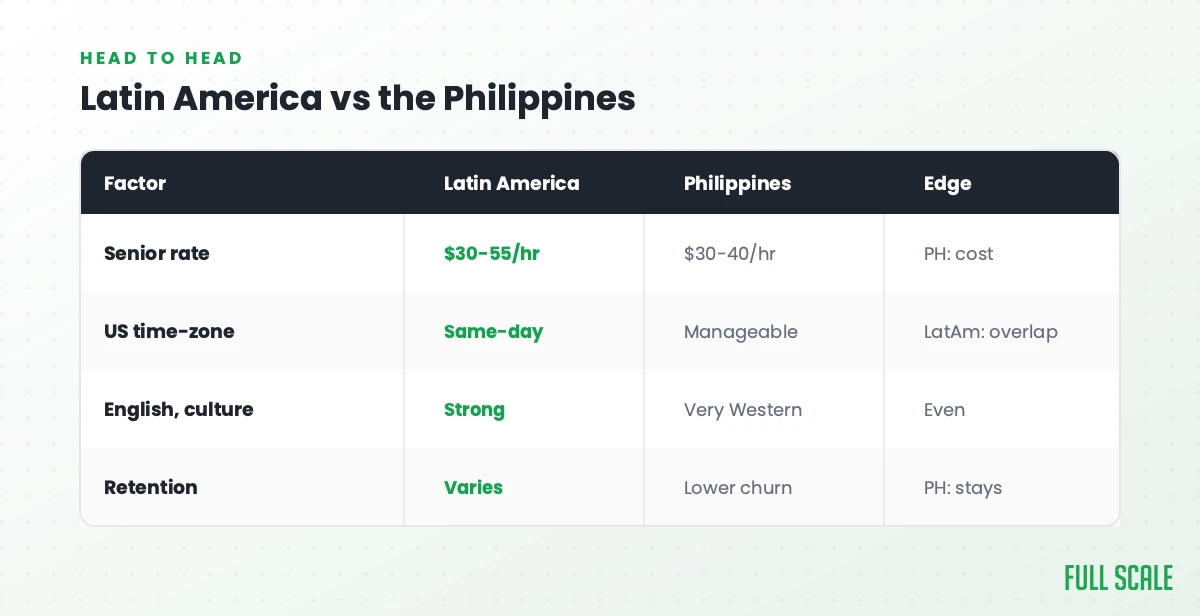
The honest version: developer rates in Latin America and the Philippines are closer than the older “Philippines is way cheaper” narrative suggests. What used to be a clean 30 percent gap is now a much smaller window, and the comparison has shifted from “which is cheapest” to “what does the rate actually buy.”
| Category | Latin America | Philippines |
|---|---|---|
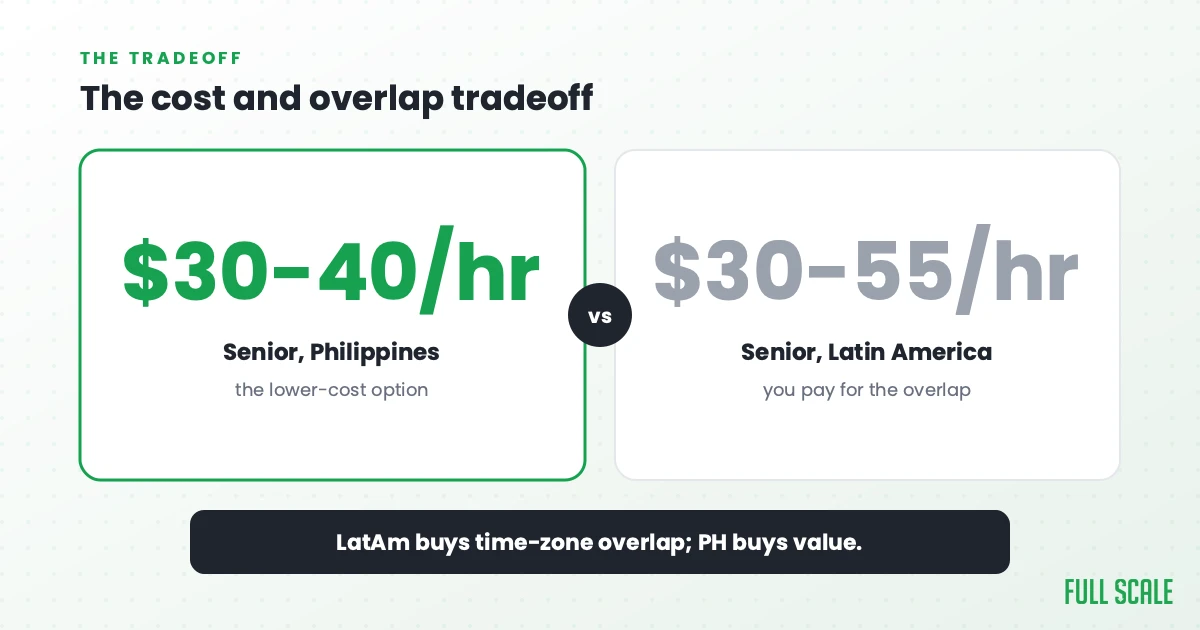
| Senior dev hourly rate (2026) | $30-$55/hour, varies by country | $30-$40/hour (Full Scale senior PH rate) |
| Cost reduction vs US rates | 30-60% | 50-70% |
| English proficiency (EF EPI) | Varies: Costa Rica and Argentina top, Brazil mid-tier, others lower | Ranked 28th globally, high-proficiency band, 2nd in Asia (2025) |
| Time zone | 0-3 hours from US business hours (nearshore advantage) | UTC+8; works half-day overlap, full US hours, or async |
| Cost-of-living dynamic | Senior salary supports a comfortable urban life in most countries | Senior salary supports a stable middle-class life; rate gap is cost-of-living arbitrage, not skill arbitrage |
| IP protection | Improving but inconsistent across the region | Strong legal framework, follows international data standards |
The honest version: developer rates in Latin America vs the Philippines aren’t dramatically different on paper anymore. What is different is what you’re paying for. In the Philippines, you’re paying for a developer who will be on your Slack, in your standups, and accountable to your product manager. In a typical Latin America engagement, you may be paying for a developer who works through a project manager who relays everything for them. That comes down to the vendor, not the country, and it shows up in both regions. But it shows up in a specific way in LatAm engagements that I’ll get into in a minute.
If you want the full math on what offshore developers actually cost when you include retention, ramp-up, and overhead, that’s all in the offshore cost analysis I walk founders through. If you’re comparing to what a US developer actually costs after benefits and overhead, the in-house alternative isn’t what most CTOs think.
What the Time-Zone Question Actually Misses
The argument I see most often for Latin America over the Philippines is the time zone. Brazil and Argentina sit 1 to 3 hours from the US East Coast. Mexico and Costa Rica are on US Central Time. Colombia overlaps with Eastern Time. The Philippines sits 12 hours off. That sounds like a clean win for Latin America, until you actually look at how an offshore team schedules.
Full Scale staffs three common patterns for companies hiring developers in the Philippines:
- Half-day overlap (most common). Filipino engineers work late afternoon to midnight Philippines time, which gives 3 to 4 hours of overlap with US working hours. Most clients find this is plenty for code review, standups, and product decisions.
- Full US hours (graveyard shift). Some engineers work 9 PM to 5 AM Philippines time and are on the same business day as a Kansas City team. We use this for roles that need real-time customer collaboration.
- Async-first. Daily standup overlap only, then independent ship-and-pick-up-the-next-task work the rest of the day. Works well for senior engineers and well-scoped tickets.
Most Full Scale customers find half-day overlap is plenty. The country is incidental. What matters is the hours your team actually works.
This is the part most posts on Latin America vs Philippines outsourcing skip. They treat the geographic time zone as fixed when it isn’t. A LatAm team and a Philippines team on the same overlap schedule operate the same way from your perspective. The real time-zone wins for Latin America show up in two specific cases: real-time customer support during US business hours where async won’t cut it, or in-person travel where a 4-hour flight to Mexico City is meaningfully different from a 16-hour flight to Manila. For most product engineering work, the day-to-day rhythm is identical. For more on when nearshore actually wins and when offshore wins, see the nearshore-vs-offshore question for English-speaking US clients.
Why Most Offshore Engagements Actually Fail
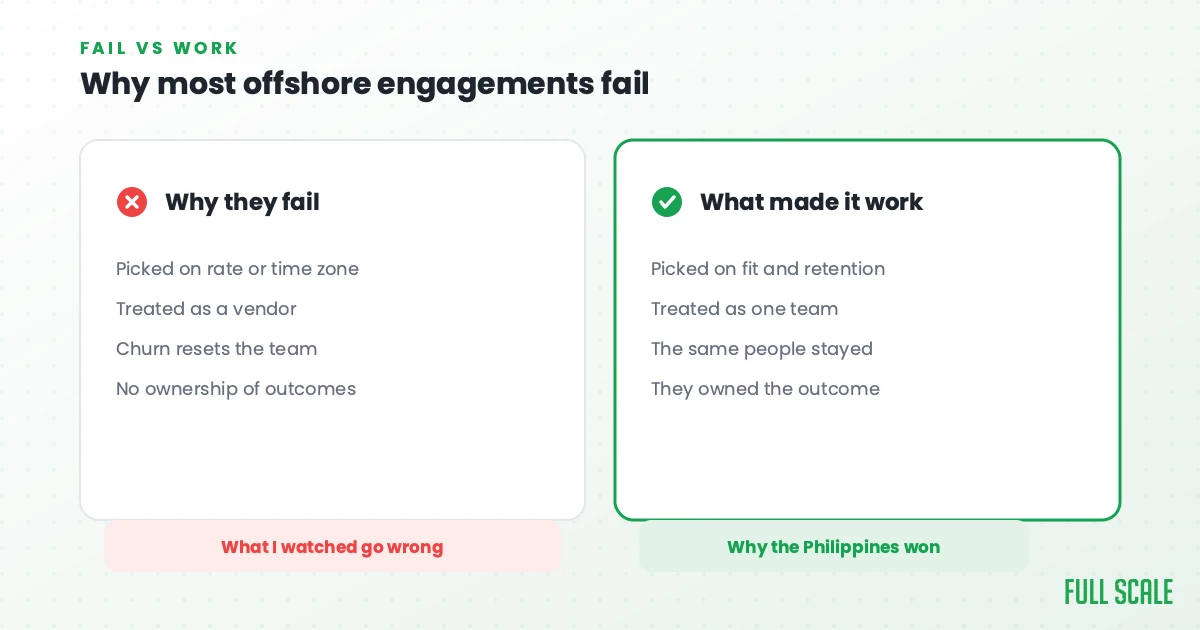
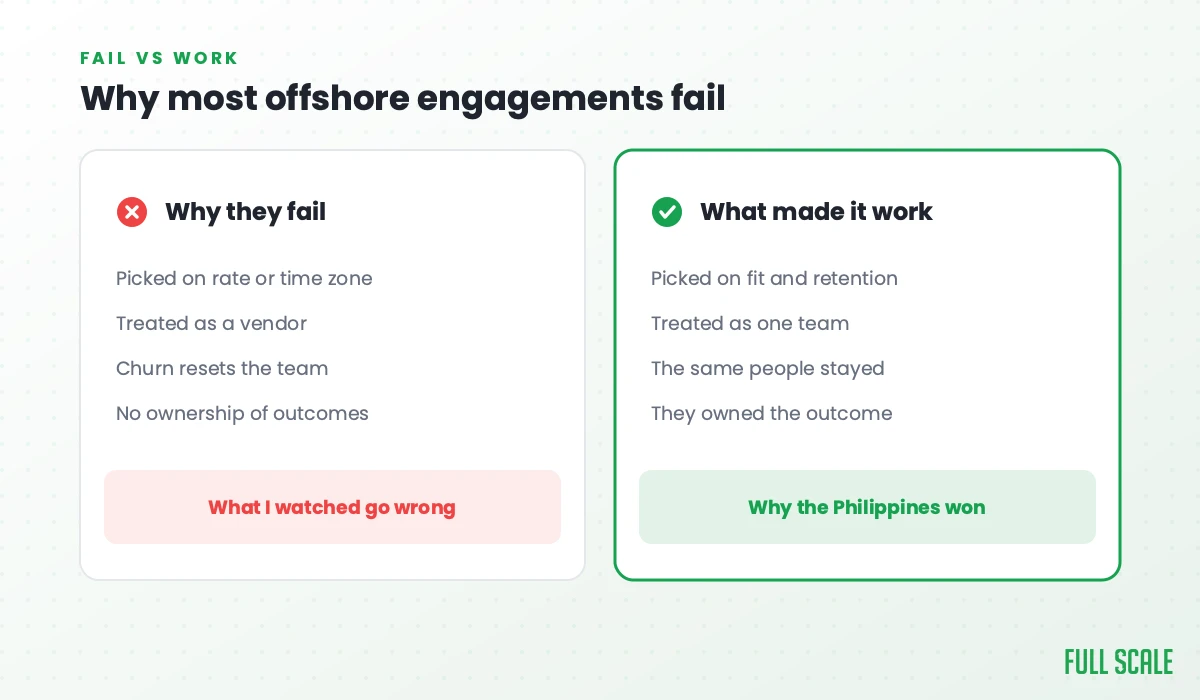
Software development is about communication more than anything else. That’s where most offshore engagements break, not on talent. I’ve talked to founders running teams in Latin America and the Philippines and everywhere else, where they’ve only ever spoken to one person, the technical project manager, while every other developer hides behind that person. Sometimes it’s a language gap. Sometimes it’s a cultural rule about who is allowed to talk to the client. Either way, the client ends up with a team they can’t actually communicate with, and a middleman in the way of every decision.
At Full Scale, the goal is the opposite. The developers we place in the Philippines are on the client’s Slack, in the client’s standups, and accountable to the client’s product manager, not to a Full Scale internal PM relaying decisions. It’s the opposite of how a lot of outsourcing companies in the Philippines operate. There’s no middleman. AMC Theatres is the best example I can point to. The developers we placed in the Philippines are treated as full AMC engineers, not contractors. Same code review, same Slack, same standards as the Kansas City team. That is what makes offshore actually work, and it’s the structural difference that breaks down with most LatAm outsourcing firms running the project-manager-as-middleman model.
Why I Picked the Philippines (After Trying Two Latin American Countries Myself)
Before Full Scale, I ran engineering at Stackify and hired developers in four countries. Two of those were in Latin America: Uruguay and Colombia.
The Uruguay engagement was good. Strong team, gave us a proxy product owner who could carry the vision when I couldn’t, built a separate product line that eventually got shelved. The Colombia engagement was smaller, but the technical talent was strong and the time-zone alignment with Kansas City made coordination easy. Both teams were smart, and both teams shipped real work. So when I say “the Philippines is where we landed,” I’m not saying it from a Philippines-only perspective. I’m saying it after hiring in Latin America twice.
The Philippines team I started in 2018 grew to 20+ developers and was a meaningful part of Stackify’s 2021 exit. Then it kept growing into Full Scale. There are a few specific things that line up there in a way they didn’t in Uruguay or Colombia: English fluency, the comfort with US working culture, and a temperament that fits remote engineering work specifically. The Latin American teams I hired could communicate in English well, but the Philippines team understood the references, the Slack rhythm, and the conversational style of a US team in a way that didn’t need any adjustment period. That’s the part that ranks pages on Latin America vs Philippines software development almost never capture, because it doesn’t show up in an English proficiency index.
I give the Filipino developers on the Full Scale team most of the credit for why Full Scale has been as successful as it has. That’s not marketing. After hiring developers in four countries at Stackify and many more at Full Scale, the Philippines is where the communication piece consistently shows up.
I am not the only one who ran this experiment. Jason Flowers, who leads engineering and DevOps at AG Mednet, nearshored to Brazil before he moved his QA work to the Philippines. His math was blunt:
For the same cost as one developer nearshore in Brazil, I can get two QA people at Full Scale.
Jason Flowers, Head of Software Engineering and DevOps at AG Mednet, on working with Full Scale
Is offshore hiring in the Philippines exploitation?
It’s a fair question. I answer it directly, including with my own family’s numbers, in the ethics of offshoring.
When Latin America Actually Wins
I’m not going to pretend the Philippines is the right answer for every team. Here’s where Latin America has a real case.
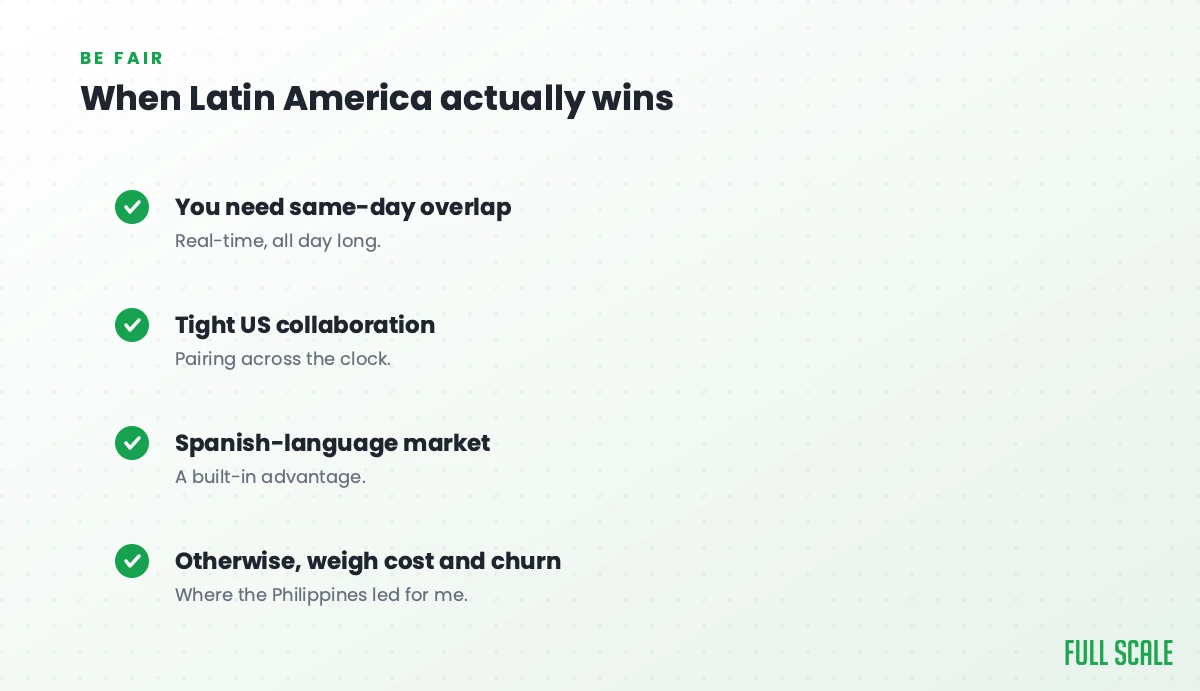
If your product needs real-time customer support coverage during US business hours and async genuinely won’t work, a nearshore LatAm team on US Central or Eastern time runs the play more naturally than a Philippines graveyard shift. If your engineers need to fly to the offshore office quarterly and the cost of a 16-hour flight is a real friction, Mexico, Costa Rica, or Colombia have a clear advantage. If your company has Spanish-speaking customers and the offshore team will be doing customer-facing work, Latin America is the obvious pick. And if you’re building a team of 3 to 5 senior engineers and don’t need the staffing depth Asia gives you, LatAm boutique firms can match the Philippines on quality.
These are real cases. They aren’t most cases, but they’re enough cases that I’d never tell a founder LatAm is wrong by default. For most product engineering work, where the team needs to scale, retain, and integrate with US engineers on Slack, the Philippines still wins for me on communication and retention. For the specific cases above, nearshore Latin America is the right call.
FAQ
Is the Philippines really cheaper than Latin America for software development?
The rate gap has narrowed. Senior Philippines developers at Full Scale run $30 to $40 an hour. Senior Latin American developers run $30 to $55, depending on country, with Mexico and Argentina at the lower end and Costa Rica closer to the top. The honest comparison is no longer about which is cheaper on the hourly rate. It’s about which team retains longer, communicates more directly, and integrates more cleanly with your in-house engineers. When you include retention and ramp-up costs, the Philippines tends to come out ahead on total cost of ownership.
Will I have communication issues with Filipino developers vs Latin American developers?
English proficiency in the Philippines ranks 28th globally on the 2025 EF English Proficiency Index, in the high-proficiency band. Latin American countries vary widely, with Argentina and Costa Rica strong and Brazil and Mexico more mid-tier. But raw English scores are only half the story. Filipino developers grew up on American media, US tech blogs, and Silicon Valley work culture, so the shared context layer that most ranking pages can’t measure is what actually makes the communication land. Latin American developers can communicate in English fluently, especially in the strongest English-proficient countries, but the cultural-reference layer is different.
How does outsourcing in Latin America vs the Philippines work on time zones?
Latin America has the geographic nearshore advantage with 0 to 3 hour offsets from US business hours. The Philippines is 12 hours off, but Full Scale staffs three patterns: half-day overlap (the most common, 3 to 4 hours of overlap with US hours), full US hours (graveyard shift, same business day as a Kansas City team), and async-first (standup overlap only). The geographic time zone is incidental. The schedule the team actually works on is what matters, and that’s a vendor decision, not a country one.
Is outsourcing Latin America vs Philippines a better fit for long-term teams or short projects?
Both regions can support either model, but staff augmentation with a long-term dedicated team is where the Philippines model is built. Project-based outsourcing, where you hand off requirements and expect a finished product back, tends to fail in both regions for the same reason: communication breaks down without an integrated team. If you’re building a long-term engineering team, see staff augmentation pricing in 2026 for what dedicated developer engagement actually costs.
What’s the typical hire developers Philippines vs Latin America timeline?
Full Scale’s typical timeline from initial call to integrated developer is 2 to 3 weeks, with vetted candidates on a video call with your team inside the first week. Latin American firms vary widely. Boutique firms can sometimes match this. Larger staff aug firms in either region often run 4 to 6 weeks for full integration. The bottleneck is almost always the client’s interview pipeline, not the offshore firm’s bench.
How does Full Scale compare to BairesDev for Latin America outsourcing?
BairesDev is one of the largest Latin America-focused outsourcing firms, with a scale and marketing budget Full Scale does not try to match. The real comparison is not size, it is model: Full Scale runs staff augmentation with direct access to the developer and a fully loaded rate you can see, while a firm operating at BairesDev’s scale more often layers in account managers and bundled pricing that is harder to fully unpack. If the question is Philippines instead of Latin America specifically, retention is the number worth asking either vendor for; Full Scale’s runs 93%+.
The Bottom Line
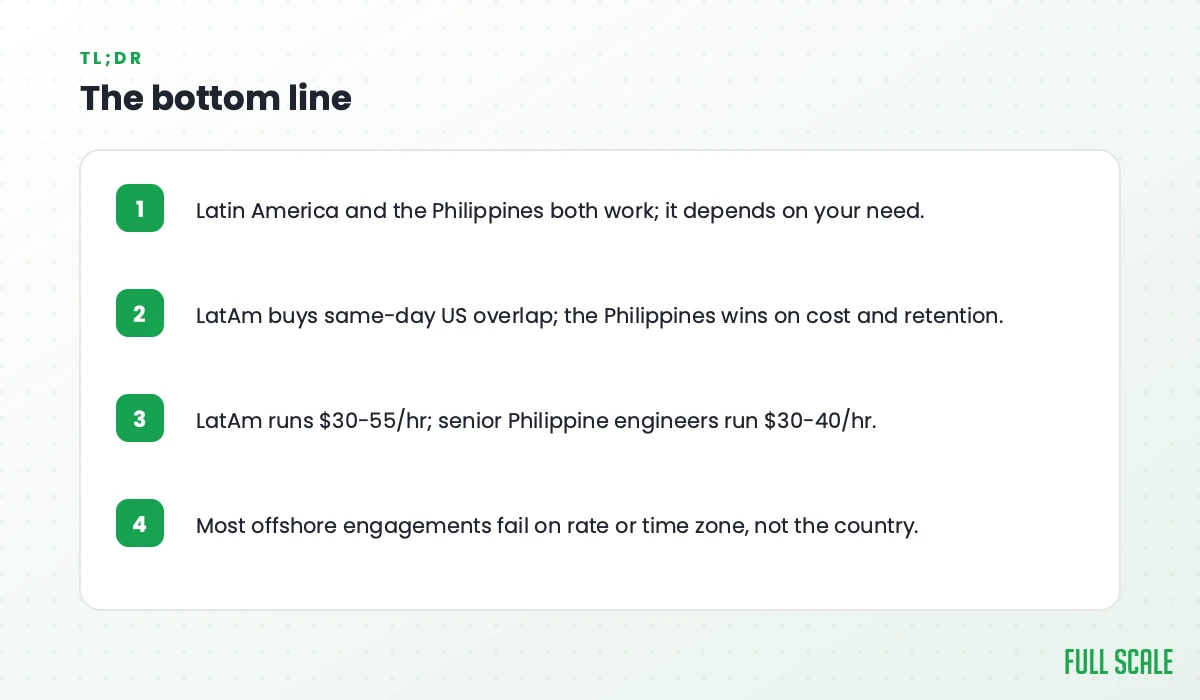
Latin America vs Philippines software development really comes down to whether you can build a long-term team that actually communicates. The Philippines wins for me because the communication piece lines up, and after hiring in two Latin American countries myself, I have the comparison to back that up. Latin America is a real option for specific cases: real-time US-hours customer work, easy travel, Spanish-language work, or small senior boutique teams. For most product engineering at scale, the Philippines wins. And once the country is settled, where to hire developers in the Philippines is a smaller decision than the listicles make it out to be. Skill first, city last.
If you’re ready to talk through what offshoring in the Philippines would look like for your specific team, schedule a call and we can map out the right model.