
BairesDev Alternatives: Why Pay Nearshore Rates for a US Price Tag?

In this article
Quick Answer: If you’re comparing BairesDev alternatives, the reason is usually price: their senior and specialist rates run $80 to $180 an hour, which lands inside or above a loaded US developer’s cost, so the nearshore savings mostly disappear at senior level. You also can’t interview or choose the engineer BairesDev assigns you. Full Scale publishes a $35/hr+ rate and lets you interview and pick your own developer before you commit.
BairesDev’s pricing, at the level most companies actually hire at, is close to what you’d pay a US developer. Paying that rate to go nearshore is just hiring domestically with extra steps, and it’s the actual reason most people search “bairesdev alternatives” or “bairesdev competitors” in the first place.
I run Full Scale, a software staffing company, so I’m one of the businesses that would show up on that same list. I’d rather tell you that than pretend otherwise.
Companies come to us after talking to BairesDev, or after using them, and the story is the same every time: the price was high, and they never got to interview or pick who they’d be working with. Both complaints are real. Let’s start with the one that matters more.
What BairesDev Actually Charges
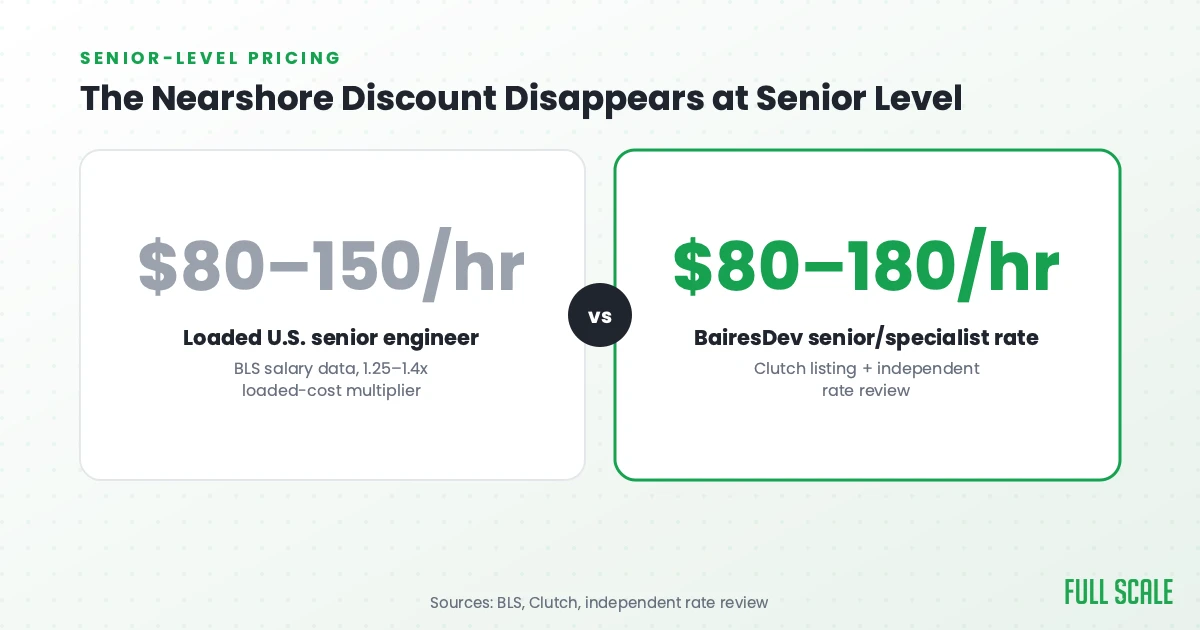
BairesDev’s senior and specialist engineers run roughly $80 to $180 an hour, but the company doesn’t publish a rate card. You talk to sales first, sometimes for weeks, before anyone tells you a number or introduces you to an engineer. Their own Clutch profile lists a $50-99/hr range and a $50,000 minimum project size, which tells you this isn’t built for a two-person startup testing an idea.
That listed range blends every engagement type BairesDev sells, from a junior tester to a specialist architect, so it undersells what you’ll actually pay once you’re hiring anyone senior. Independent reviews that break rates out by seniority tell a pricier story. A breakdown published by Howdy, a competing staffing firm, puts effective rates at $80 to $130 an hour for senior engineers and up to $180 for specialists. Getting there takes a sales cycle that runs two to six weeks before you see a rate or meet a candidate.
Nobody, us included, has a single clean source for this. Treat these as ranges built from what’s public plus what clients actually report.
Either way, you’re well past what most people assume “nearshore” means. “Nearshore” is supposed to signal a discount for a small time-zone tradeoff, not a rate that needs a sales team to explain it.
Why That’s the Same as Hiring in the US
A loaded senior engineer in the US, salary plus benefits plus overhead, runs $80 to $150 an hour, based on BLS senior developer salary data run through the standard 1.25 to 1.4x loaded-cost multiplier employers actually pay. BairesDev’s senior rate falls inside that US range, and its specialist rate runs past the top of it. At the seniority level where most of the budget actually goes, you’re paying US prices for the privilege of going nearshore, or paying more.
I think I know how this happened. A few years ago the US developer market was on fire. Good engineers were nearly impossible to hire at any price, and companies paid whatever it took just to fill a seat. Against that backdrop, BairesDev’s rates looked like a discount. Compared to nothing available, anything available looks cheap.
That market cooled off. Hiring in the US got easier and rates came back down to earth. BairesDev’s pricing didn’t move with it. Once a company sets a rate that clients will pay, there’s no incentive to lower it just because the market that justified it went away.
According to their own marketing, BairesDev counts Google, Pinterest, and Adobe among its clients. That checks out fine if you’re a company with a trillion-dollar market cap and a rate that’s a rounding error on the annual report. Most companies searching “bairesdev alternatives” are not currently a trillion-dollar company, and for them the math looks different.
To be clear, this isn’t an argument against nearshore or offshore hiring. I’ve spent over 20 years hiring developers across Latin America, India, and the Philippines, and the reason to go outside the US was never that talent is scarce here. It’s cost of living. A senior developer in Manila or Buenos Aires costs less to employ than one in Austin, and that gap is real and it’s durable. A vendor charging US rates while the underlying cost of living hasn’t budged is just charging US prices with a nearshore label on them.
At Full Scale, our starting rate is $35 an hour, fully loaded. BairesDev is charging roughly two to three times that for comparable seniority. We publish our rate on our pricing page before you ever talk to a salesperson. You can go check it right now, which is more than BairesDev’s website will tell you. We’ve broken down real offshore rates by country for the full picture beyond BairesDev specifically.
This is the opposite of the cheapshoring mistake, where a company chases the cheapest developer it can find and gets burned instead. Here you’re paying premium prices and getting nothing extra for it.
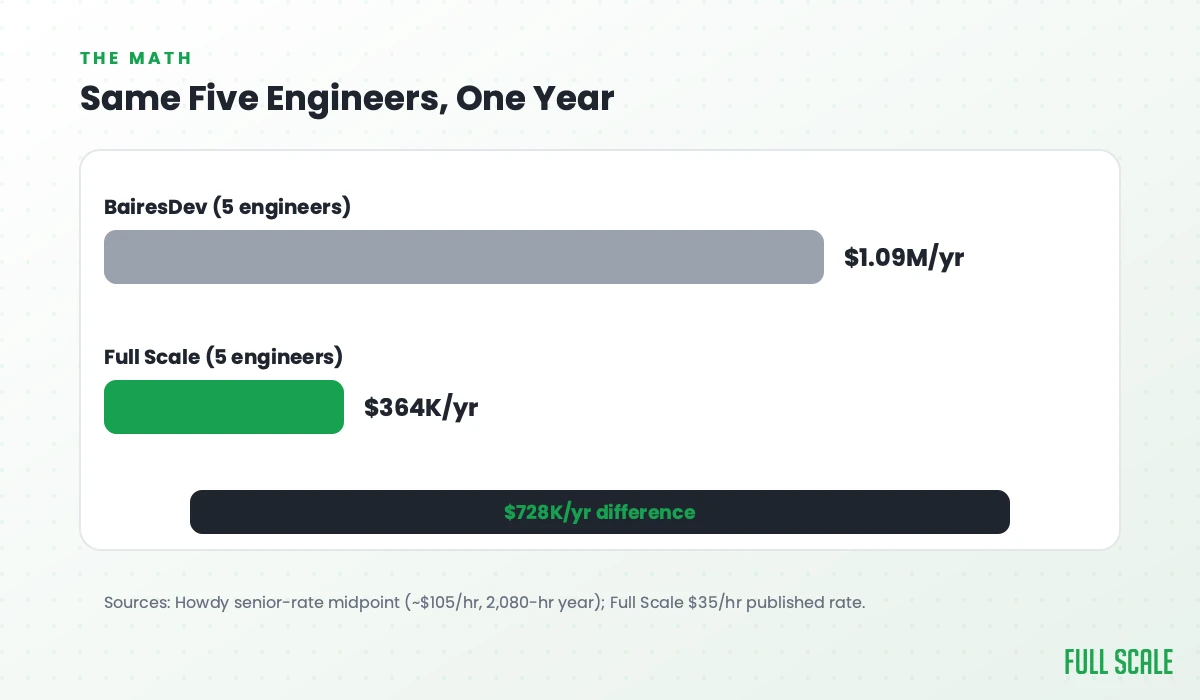
Run the math on a real team and the gap stops being abstract. Using Howdy’s senior-engineer midpoint of roughly $105 an hour, five senior engineers working a standard 2,080-hour year runs about $1.09 million a year. The same five engineers at Full Scale’s $35 rate costs about $364,000. That gap, more than $700,000 a year, is most of a Series A.
When the Higher Price Might Still Make Sense
BairesDev isn’t a bad company, and its price isn’t always the wrong price. A large enterprise staffing dozens of roles fast, with existing procurement relationships and a nine-figure budget, can absorb a premium without blinking. Legal and compliance teams at that size often need a vendor with a decade of enterprise contracts behind it, and that requirement genuinely costs money.
The natural objection is that the price buys something: tougher screening, a decade of delivery history, clients like Google on the roster. Screening rigor and price aren’t the same axis, though. Full Scale interviews and vets too, at a third of the rate. And the next section shows BairesDev’s own screening process varies by client rather than scaling with the price.
A 15-person startup or a mid-size product team paying enterprise rates for the same reason enterprises do, without checking what the market actually costs right now, is just paying for nothing it needs.
The Other Recurring Complaint: You Don’t Pick Your Developer
The second thing we hear, almost every time, is that clients don’t get to interview the engineer they’re assigned. BairesDev pulls someone from their internal bench and hands them to you. It’s closer to being assigned a seat than screening candidates and choosing one.
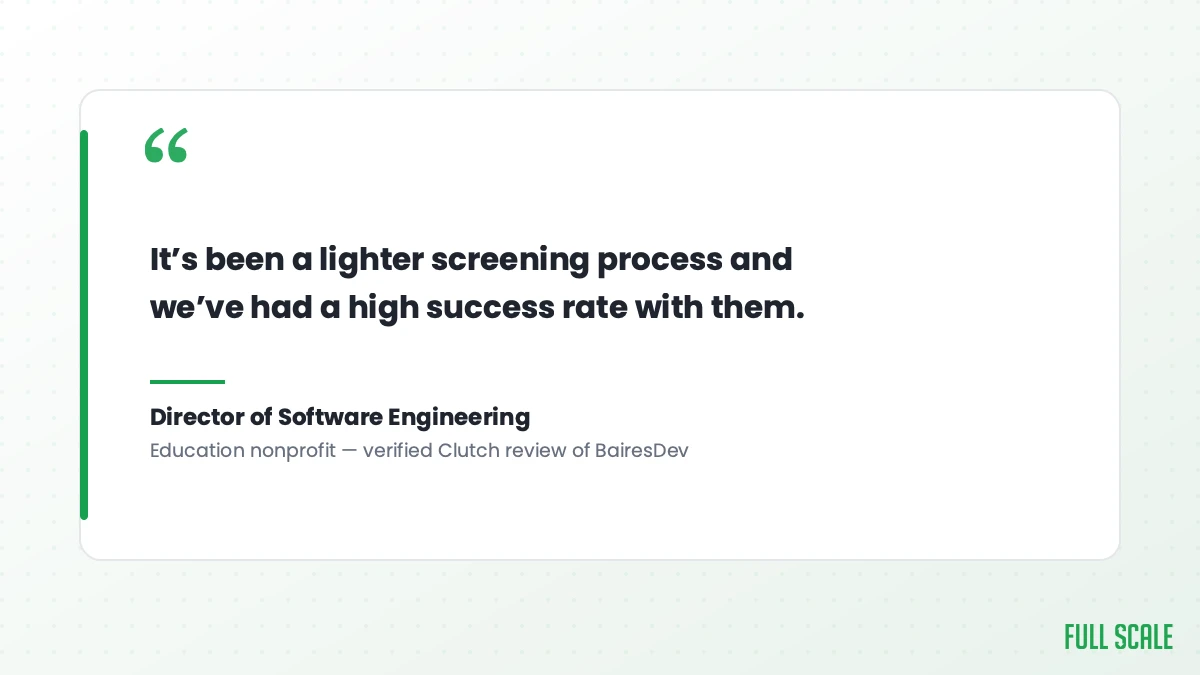
Some clients genuinely prefer this. One verified client review on Clutch, a director of software engineering at an education nonprofit, described it as “a lighter screening process” and said they’d had a high success rate with it. If you don’t want to run interviews and you trust the vendor to match well, that setup will suit you fine. Reading a vendor’s review-platform profiles the right way is worth doing before you decide which model fits.
But if you want to know who’s writing your code before they start, and most engineering leaders do, that’s a different kind of company. You’re adding someone to a team that already has its own habits, tools, and way of talking to each other, and whether that person fits the group matters just as much as whether they can code.
At Full Scale, you interview and pick your own developer. Figure out which one you are before you sign anything, because the two experiences are not close to the same.
BairesDev Alternatives Worth Actually Comparing
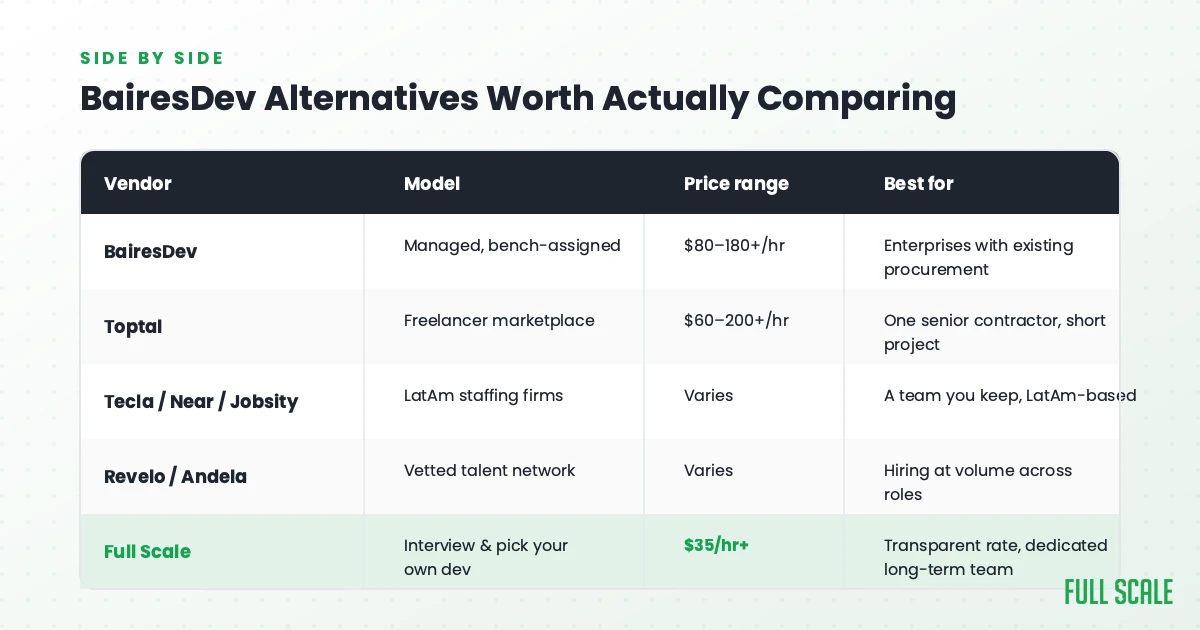
The main BairesDev alternatives fall into four groups: freelancer marketplaces, LatAm staffing firms, large talent networks, and matching platforms. Here’s the honest map of what’s out there, without fourteen separate write-ups.
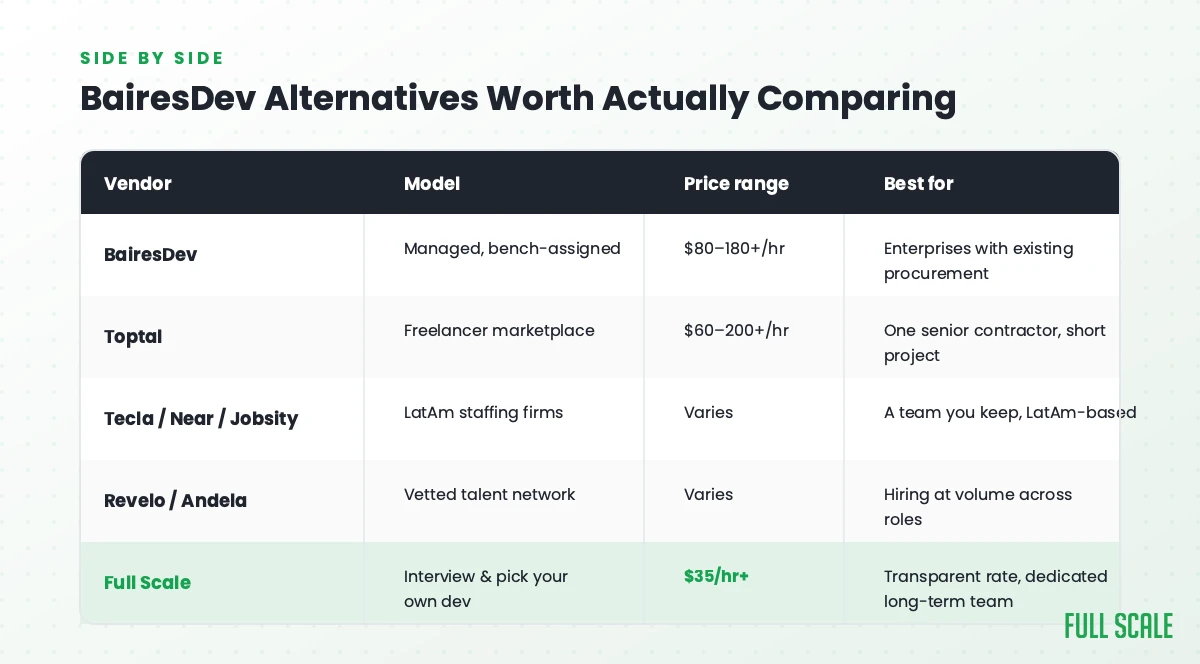
Toptal runs a freelancer marketplace with real, tough screening. It’s a good fit for one senior contractor on a short, well-defined project. It’s not built for a team you keep long term, and it isn’t cheap either. We went deep on Toptal’s pricing and where it actually fits if that’s the comparison you’re making.
Tecla, Hire With Near, and Jobsity are LatAm-focused staffing firms in the same general category as BairesDev, closer to Full Scale’s model than to a marketplace. Rates and process vary enough between them that a real conversation with each one beats reading a comparison table.
Revelo and Andela run larger vetted-talent networks across Latin America and Africa, useful if you’re hiring at volume across multiple roles rather than filling one seat at a time.
Arc.dev and Howdy sit closer to platforms than staffing partners, matching you with independent developers and stepping back from the day-to-day relationship. That’s fine for a lighter-touch engagement. It’s less fine when something goes wrong at 11 p.m. and you’re trying to figure out who to call.
None of these fixes the two problems that probably brought you here unless you check both boxes: a rate you can see up front, and the ability to interview the actual person who’ll be writing your code. That’s the whole pitch for Full Scale: $35 an hour and up, published, and you pick who you hire.
Frequently Asked Questions
How much does BairesDev charge?
Their own listing shows a $50-99/hr range with a $50,000 minimum project. Independent reviews of actual client engagements put senior and specialist rates higher, between $80 and $180 an hour, reached only after a multi-week sales process. There’s no single public rate card, so treat any number, including ours here, as a range built from the best available sources.
Who are BairesDev’s main competitors?
BairesDev’s closest competitors are the other Latin America-focused staffing firms, Tecla, Hire With Near, and Jobsity, along with the larger talent networks Revelo and Andela and the freelancer marketplace Toptal. Arc.dev and Howdy sit closer to matching platforms. Full Scale is the alternative that publishes its rate, starting at $35 an hour, and lets you interview and pick your own developer.
What is the difference between BairesDev and Toptal?
BairesDev staffs you from an internal bench as part of a managed engagement. Toptal is a freelancer marketplace where you’re matched with an independent contractor after a screening process. Different models, similar price range at the top end. See our full Toptal alternatives breakdown for how to pick between the two.
Is nearshore hiring still cheaper than hiring in the US?
Yes, when the vendor’s rate actually reflects the local cost of living. A Filipino or Latin American senior developer genuinely costs less to employ than a US-based one, and that gap holds up. It only breaks down when a vendor’s price stopped tracking that math, which is the whole point of this article.
Can you interview and choose your developer with Full Scale?
Yes. You review candidates, run your own technical interview, and pick the person who joins your team. If it’s not a fit in the first two weeks, you get your money back, and after that you can end the engagement with 30 days’ notice, no long-term contract required.
See the Rate Before You Talk to Anyone
You shouldn’t need a sales call to find out what something costs. Full Scale’s rate starts at $35 an hour, it’s published, and you interview and choose the developer who joins your team. If you’ve already been through the BairesDev sales cycle and want to compare, book a call and we’ll show you the math on your specific project.