Best Software Outsourcing Companies in the Philippines: Staff Augmentation & Project Shops

In this article
- Staff augmentation vs outsourcing
- The case for software development outsourcing in the Philippines
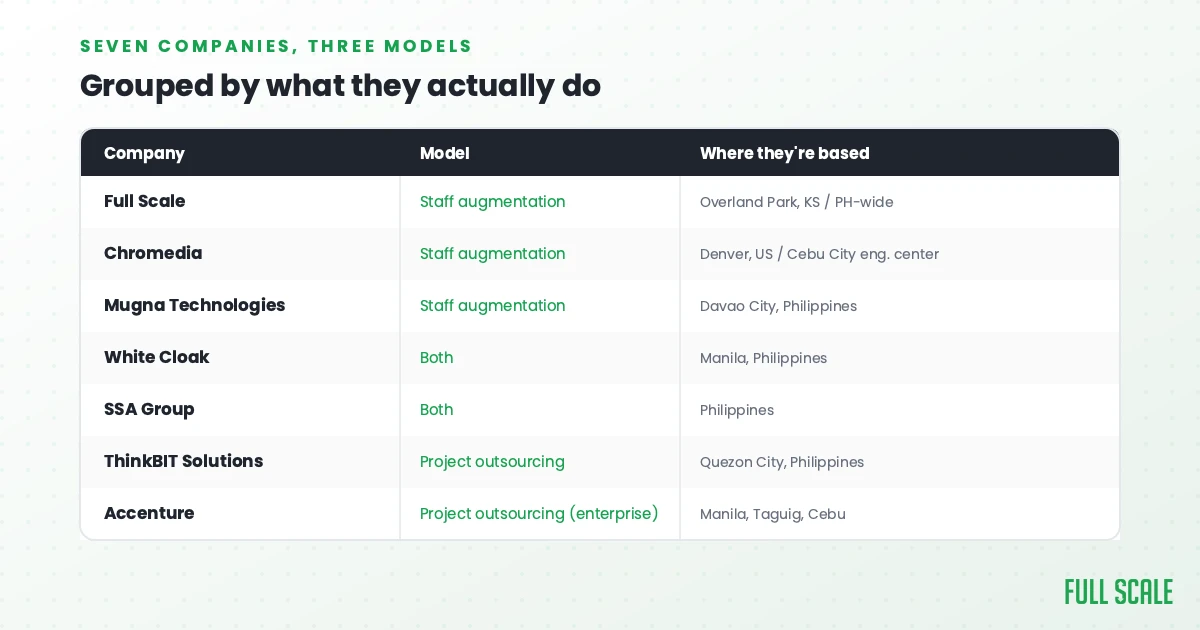
- The best software outsourcing companies in the Philippines, grouped by what they do
- Which of these companies fits your situation
- What decides whether the engagement works
- Frequently asked questions
- The list isn’t the decision
I own one of the companies featured here, so let’s address that up front. Full Scale is a software development staffing company based in the Philippines. My opinion on how to choose between them is as valuable as a car salesman’s advice on which vehicle to purchase.
I’ll also be candid about when we’re not the right choice for you, since the type of company is more important than the brand, and it would be disingenuous to publish a listicle from someone who is selling something.
One detail that these lists typically omit is: some of these firms assemble a long-term team for you; others complete a project for you, and then depart. They perform different tasks. A firm that excels at one tends to struggle with the other. Choosing a company from a top-ten list without clarifying whether they provide staff augmentation or project completion is why many of these projects fail.
Quick Answer: The best software outsourcing companies in the Philippines fall into two groups that do genuinely different work. For a long-term team working inside your codebase, look at staff augmentation firms: Full Scale, Chromedia, and Mugna Technologies. For a fixed-scope build delivered and handed off, look at project shops like ThinkBIT Solutions, with Accenture handling enterprise-scale programs. White Cloak and SSA Group sell both. Philippine rates through a staffing partner start around $35 an hour for a senior engineer, 50 to 70 percent below a comparable US hire.
So, first, a brief explanation. Then, the companies, organized into three categories by function.
Staff augmentation vs outsourcing
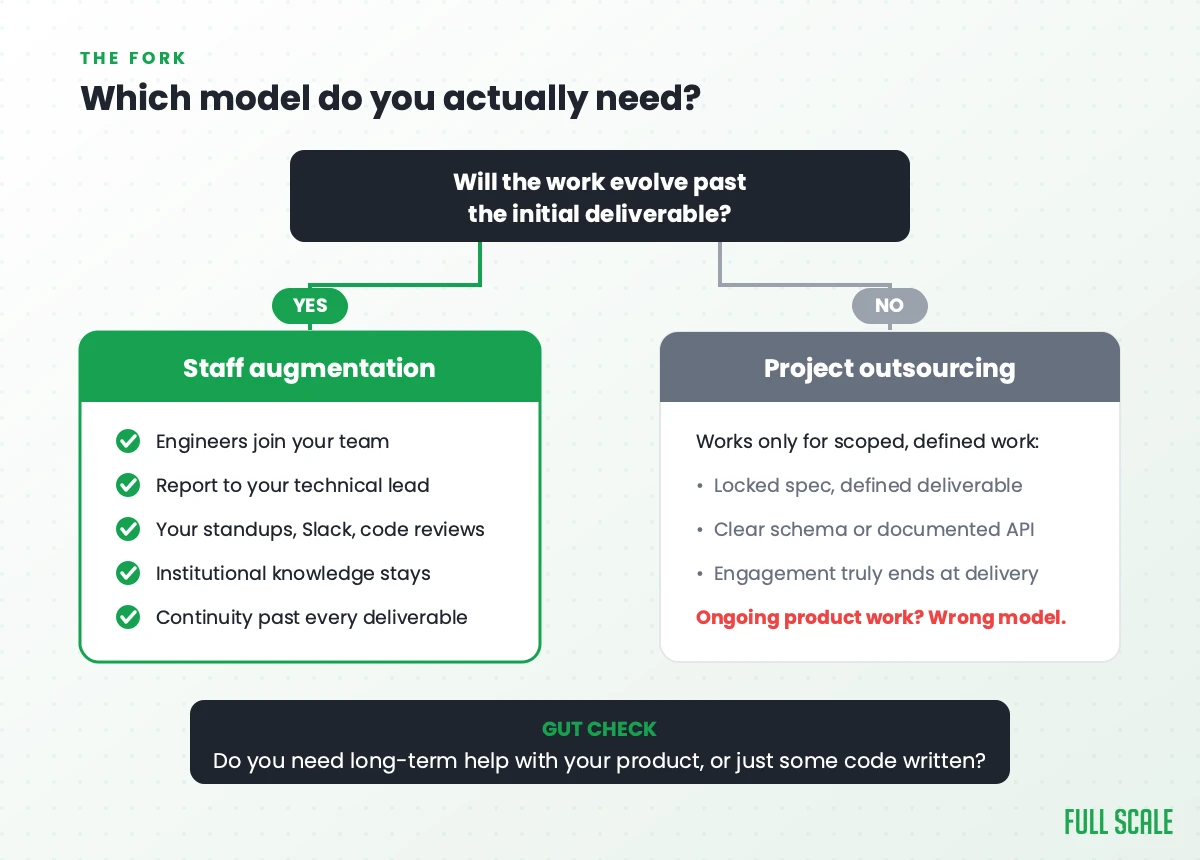
Do you want long-term help with your product, or do you just want some code written?
Long-term help means staff augmentation: devs working in your code base, attending your standups, staying for years. Some code written means project outsourcing: a vendor takes your requirements, writes the code, delivers, and leaves. If you already know staff augmentation is the model you need, I cover the specialists specifically in IT staff augmentation companies in the Philippines.
Check their site rather than taking their word for it. A staff augmentation company will advertise its ability to build a team, featuring words like dedicated engineers and long-term collaboration on the front page. A project outsourcing shop will advertise its ability to build the software for you.
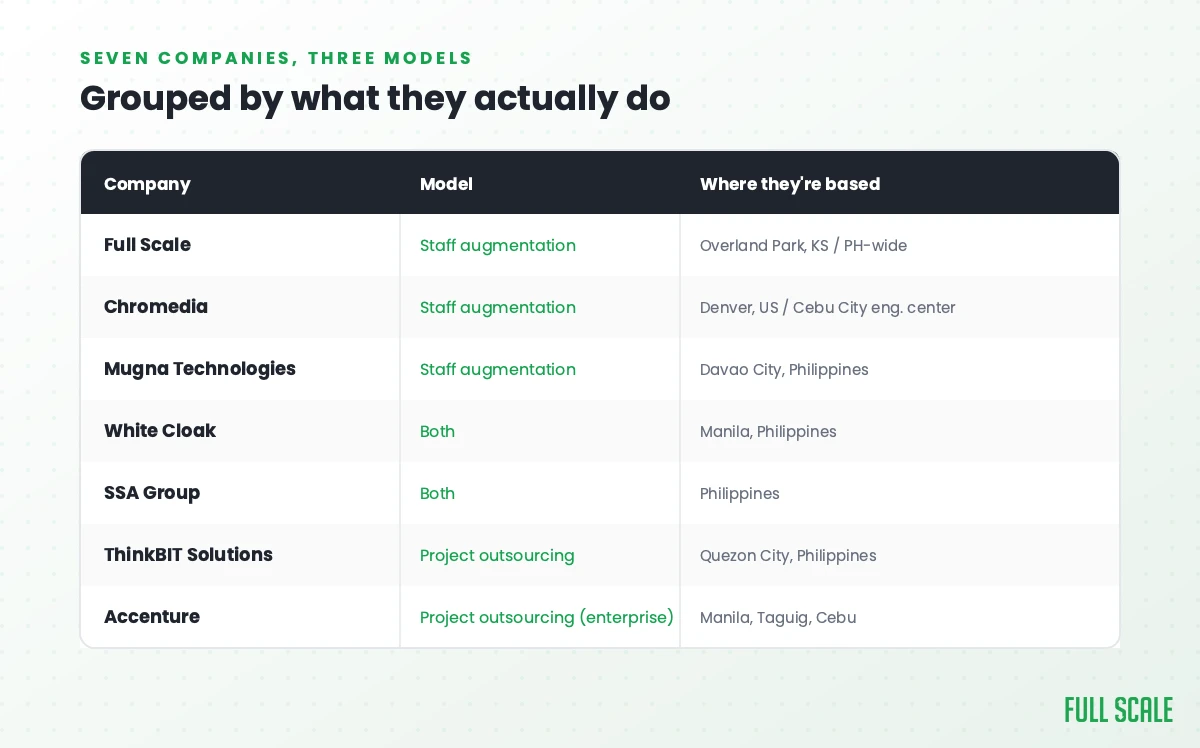
Some companies do both and we show that below as we categorize them.
For a more thorough breakdown, including a comparison chart and a four-question decision framework, check out our article on staff augmentation vs. outsourcing.
The case for software development outsourcing in the Philippines
Philippine software outsourcing has been around for years. The Philippine IT-BPM industry’s own reporting puts the sector at tens of billions of dollars a year, supporting nearly two million jobs. English is taught from grade one, the culture runs on American business norms, and the local cost of living means local wages are also less.
An offshore provider like Full Scale starts rates for senior developers around $35 an hour, roughly 50-70 percent less than a comparable US rate. Those are real savings, but they’re only half the equation. Focusing on the cheapest rate alone is what we call cheapshoring, and it’s exactly why the model you pick matters as much as the hourly rate.
The best software outsourcing companies in the Philippines, grouped by what they do
There are plenty more companies worth your consideration. Here are six of them, plus where Full Scale slots in. I stuck to companies that offer primarily software services, not traditional offshoring or BPO companies that list software development as one capability among many. I also grouped them by engagement model instead of a linear ranked list. It’s like comparing apples and oranges to rank a staff augmentation company and a project shop in the same numbered list.
Staff augmentation: companies built to join your team
Full Scale
That’s us. Headquartered: Overland Park, KS, with engineers across the Philippines | Founded: 2018 | Engineers: 350+ | Retention: 93%+ We hire, manage, and retain software engineers in the Philippines who plug into your team directly, work in your codebase, and report to your own manager. We achieve 93%+ retention rates and have staffed over 200 companies since 2018. Our specialty is full-stack engineering across the common web and mobile stacks. If you have a one-time build with a fixed scope and just want it shipped, we’re not for you. Skip to project outsourcing.
We’re also Great Place to Work Certified in the Philippines, and we’ve made the Inc. 5000 list of fastest-growing private companies five years running. Best for: companies with in-house engineering leadership who want a long-term dedicated team, not a one-off build.
Chromedia
Headquartered: Denver, CO (engineering center in Cebu City) | In business: 25+ years, per their own site | Employees: 70+ | Clutch: 4.9/5 (14 reviews) | Best for: startups wanting a small, US-led team with fintech and healthcare compliance experience
Chromedia says on its own site it’s been in business for over 25 years, based out of Denver, CO, with a local engineering center in Cebu City. Their homepage copy talks about building “a scalable, high-performance team in the Philippines” and offers staff augmentation as a core service alongside their custom software development offering. Clutch rates them 4.9 out of 5 across 14 reviews, with named clients including Cambium Networks and the Philippine car marketplace Autodeal. Their specialty is MVP-to-enterprise web and mobile apps, with a track record in fintech and healthcare compliance.
Mugna Technologies
Headquartered: Davao City, Philippines | Founded: 2019, per their “Our Story” page (Clutch lists 2020) | Employees: 50+ engineers and designers on the bench | Clutch: 4.9/5 (7 reviews) | Best for: small businesses wanting frontend or web staff augmentation on a tighter budget
Mugna Technologies‘s about page puts the company in Davao City, not Cebu, so double-check the city before you assume. They tout dedicated engineers and staff outsourcing for ongoing web, mobile, and software projects (yes, outsourcing is in their own company name). Looking at their services page, though, it’s really team augmentation, centered around dedicated engineers and not a one-time project deliverable. Clutch rates them 4.9 out of 5 across 7 reviews; one named client, revenue-ops platform Setvi Inc., cited their pricing and culture fit as the reason they hired them. Their specialty runs toward Python/Django, TypeScript, Kotlin, Swift, React, and Vue.js.
Both models: companies that do staff augmentation and project work
White Cloak
Headquartered: Manila, Philippines | Founded: 2014 | Employees: 147 | Clutch: 4.9/5 (27 reviews) | Best for: companies wanting a proven enterprise-grade partner with a banking and healthcare track record
White Cloak‘s website cites enterprise customers like UnionBank of the Philippines and Ayala, and Clutch backs that up with a 4.9 out of 5 rating across 27 reviews. Staff augmentation is listed as a service, and separate from that, software development and managed services are listed as project-style delivery options. Their specialty is mobile apps, backend and API development, and managed agile services. Find out what model you’re entering before you assume.
SSA Group
Founded: 2007 (Kharkiv, Ukraine, with Philippine operations) | Employees: 120+ professionals | Clutch: 4.8/5 (16 reviews) | Best for: buyers who want the cooperation model spelled out up front instead of guessing
SSA Group is the most transparent of all these companies about offering both models. Their website explicitly describes three ways to cooperate: fixed price, time and materials, and dedicated team. Both a project shop and a staff augmentation shop under the same banner, with clear labeling instead of ambiguous wording. Clutch rates them 4.8 out of 5 across 16 reviews. Their specialty spans the full development lifecycle, frontend through DevOps, and they carry ISO/IEC 27001 certification.
Project outsourcing: companies built to hand you a finished deliverable
ThinkBIT Solutions
Headquartered: Quezon City, Philippines | Founded: 2014 | Employees: 50-249 | Clutch: 5.0/5 (12 reviews) | Best for: a scoped build with real compliance requirements, ISO 27001, HIPAA, or SOC2
ThinkBIT Solutions lists clients on its website such as Globe Telecom and international NGOs, and carries a perfect 5.0 out of 5 rating on Clutch across 12 reviews. Their marketing talks about delivering finished, high-performance web applications, which sounds like a company that wants to build a site and hand it over. Their specialty leans toward DevOps and compliance work, ISO 27001, HIPAA, and SOC2 among their clients. If you have a specific project with a completion date in mind, this is the kind of company you want.
Accenture
Headquartered: Dublin, Ireland (Philippine operations in Manila, Taguig, and Cebu) | Employees in the Philippines: roughly 50,000 to 85,000 | Outside proof: NYSE: ACN, a Fortune Global 500 company | Best for: a large business with a complex initiative and the budget to match
Accenture is the biggest company on this list by far, publicly traded on the NYSE under the ticker ACN. They specialize in consulting, cloud work, and custom development for large global brands. It doesn’t really fit either bucket. I’m putting it here because Accenture runs enterprise programs and long-running managed engagements, not a small dedicated team you manage daily like the companies above. That’s the wrong choice if you’re a startup looking to hire three engineers.
Which of these companies fits your situation
The engagement model narrows the field, but buyers rarely arrive with a question that abstract. They arrive with a SaaS product that needs ongoing feature work, or a mobile app with a deadline, or a legacy system nobody left on staff understands. Here is how the seven software outsourcing companies above map onto the situations we get asked about most at Full Scale.
| Your situation | Model you want | Best-fit company |
|---|---|---|
| Long-term SaaS product, with in-house engineering leadership | Staff augmentation | Full Scale |
| Fintech or healthcare build with compliance exposure | Staff augmentation, US-led | Chromedia |
| Web or frontend team on a tighter budget | Staff augmentation, smaller bench | Mugna Technologies |
| Mobile or API work that needs an enterprise track record | Either, so confirm which you are signing | White Cloak |
| You want the cooperation model named in the contract | Either, labeled explicitly | SSA Group |
| Scoped build with ISO 27001, HIPAA, or SOC 2 requirements | Project outsourcing | ThinkBIT Solutions |
| Multi-year program with an enterprise budget | Managed enterprise engagement | Accenture |
| Legacy system nobody on staff understands anymore | Staff augmentation, not project work | Full Scale, Chromedia, Mugna Technologies |
The legacy-system row is the one buyers get wrong most often. A legacy system looks like a scoped project, so it gets handed to a project shop, and the engineers who finally worked out why the code does what it does deliver their spec and leave. Full Scale takes that work as a staffing engagement for exactly that reason. The knowledge has to stay in the building, and the only way it stays is if the people do.
What decides whether the engagement works
Choosing the right model takes you most of the way there. What’s left is the same set of questions no matter which vendor you pick. Are you dealing with the engineers directly, or just one project manager whose name is all you ever learn? Is the company actively recruiting, or do they just post the job and forward whoever applied? What happens to all that expertise when the project ends?
That last question shouldn’t be taken lightly. On a project outsourcing engagement, the engineer who knows why something was done goes home the day the invoice gets paid, and eighteen months later you’ll have to pay someone else to figure out why it was done by digging through your own source code.
A company that gets your model right and your vetting wrong will still burn your budget. None of those considerations show up in a directory listing, which is the other reason top-10 lists are generally useless.
Frequently asked questions
What is the best software outsourcing company in the Philippines?
There’s no single best vendor overall, since staff augmentation and project outsourcing serve different purposes. For long-term engagements, look at companies built for staff augmentation, such as Full Scale, Chromedia, and Mugna Technologies. For a defined, one-time project, a vendor with a project-focused delivery model like ThinkBIT Solutions is a better fit, and for large-scale programs, you’d want to work with a big global enterprise like Accenture.
What’s the difference between staff augmentation and project outsourcing?
With staff augmentation, developers are added to your team and work under your direction for as long as the engagement runs. Project outsourcing is when a vendor takes a defined project and delivers a finished result. The easiest way to tell which one you need is to ask whether you want someone working on your product over time, or just a piece of code they write and hand off.
Are IT outsourcing companies in the Philippines reliable?
Established ones are. The country has a proven track record with both its infrastructure and talent pool, backed by a business-process industry worth tens of billions of dollars annually. On the company level, reliability depends on whether you chose the right engagement model and vetted the particular vendor, not on the country.
How much does software outsourcing in the Philippines cost?
Through a staffing partner, expect roughly $30 to $40 an hour for a mid-to-senior engineer. Full Scale’s fully loaded rate starts at $35 an hour, which lands 50 to 70 percent under a comparable US hire. Project shops usually quote a fixed price for the whole build rather than an hourly rate, so the two numbers aren’t directly comparable. The rate on the quote is the easy part; what actually costs you is the rework and turnover that follow whichever number looked cheapest.
Can one company do both staff augmentation and project outsourcing?
Yes. Some of the companies listed here, such as White Cloak and SSA Group, provide both types of services. This in itself isn’t a bad thing, but it means that you should double-check the terms before you sign.
The list isn’t the decision
These companies are just the beginning. The right one is whichever matches the job you actually have. If you choose correctly, the Philippines will be one of the best countries in the world to develop software. If you get it wrong, you’ll blame the country for a mistake that has nothing to do with the country.
If you’ve gone through the primer and decided you want staff augmentation, book a call with Full Scale and we’ll see if we’re the right fit for your project.