
5 Real Benefits of Staff Augmentation

In this article
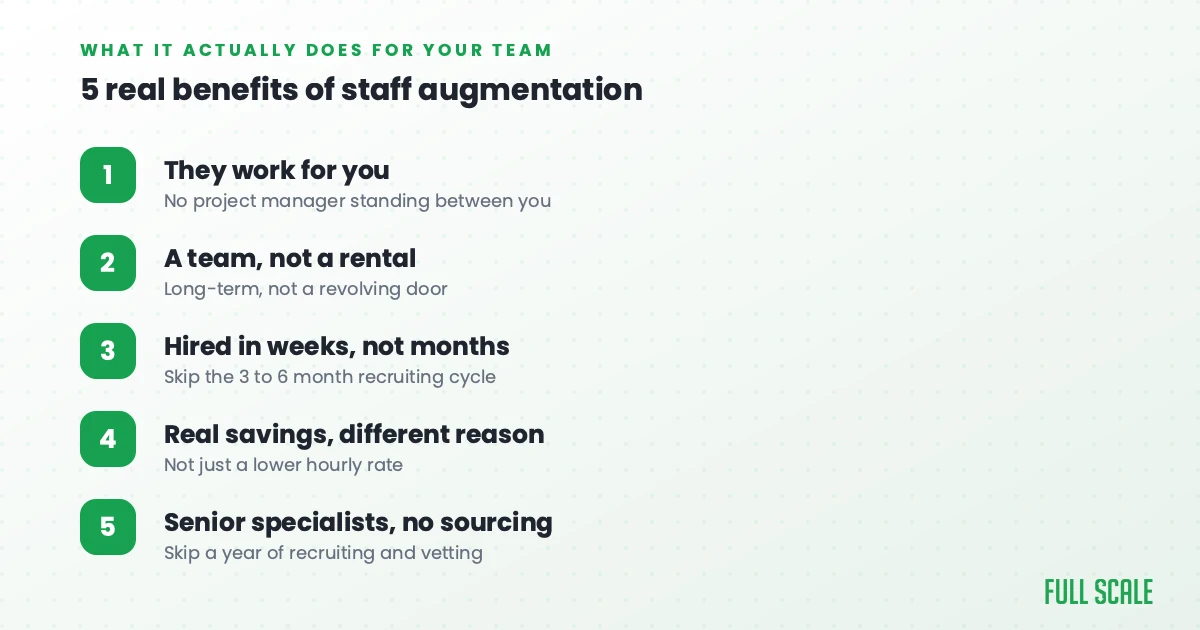
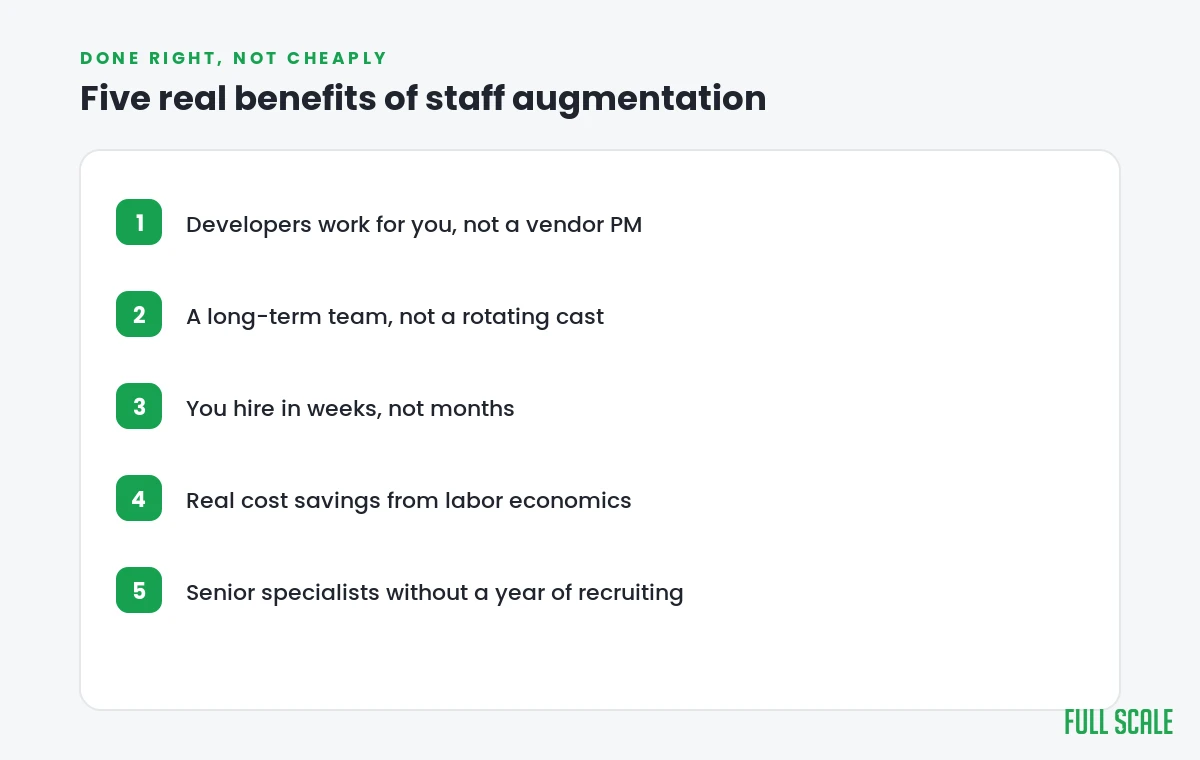
- 1. Your developers work for you, not for a project manager
- 2. You build a long-term team instead of renting one
- 3. You hire in weeks, not months
- 4. The cost savings are real, but not for the reason most posts say
- 5. You get senior specialists without a year of recruiting
- When staff augmentation isn’t the right call
- Frequently asked questions
Quick Answer: The real advantages of staff augmentation for businesses are direct access to the developers, a team you keep for years instead of renting for a project, and hiring in weeks instead of months. Full Scale runs this model with senior developers in the Philippines, at a fully loaded rate that runs 50-70% less than a comparable US hire, and the savings hold up because retention runs 93%+, not because the rate is a race to the bottom.
For most of my career, I heard nothing but horror stories about offshore development. These days the horror stories start earlier than that, in the proposal itself, if you know what to look for. It also helps to know how staff augmentation compares to a PEO or EOR.
The complaints were always the same: language barriers, late-night meetings with people who barely followed the conversation, low-quality code that needed to be rewritten anyway, and a vendor project manager standing between you and anyone who actually wrote a line of code. Most engineering leaders I talk to today still operate inside that frame. I get it, because I used to too. You only capture these benefits if you follow a few staff augmentation best practices once the team is in place.
Then in 2012 I accidentally hired Java developers in St. Petersburg through a friend’s agency. These days you can hire a dedicated Java developer on purpose, with real vetting behind the match. A few years later I had built a team of more than 20 Filipino engineers at Stackify that helped carry us to a 2021 exit. I now run Full Scale, where we’ve helped over 200 tech companies build long-term engineering teams the same way.
The difference between the nightmare version of offshore and the version that actually works has almost nothing to do with where your developers sit. It’s the difference between handing a project to a vendor and hiring developers to work for you, on your team, for the long haul. For a funded startup, that is also how you keep spending a fresh round wisely: senior capacity for the work you have validated, not permanent headcount you might not need.
Staff augmentation means hiring developers who work directly for you on a long-term basis, embedded into your team and your process, instead of handing a project off to a vendor. Extended teams are the small-scale version of this model, with one to three external engineers added to your existing team under your engineering manager rather than a full unit standing up alongside it. Here are the five real benefits this model delivers when you do it right. The team extension model is the same engagement marketed under a different name in Europe and LATAM, so the benefits below apply to both.
The benefit teams underrate most is retention, which is the whole point of comparing employer of record vs staffing agency in the first place.
1. Your developers work for you, not for a project manager
Pick any offshore horror story and the same character keeps showing up. A vendor project manager sits between you and the engineers, and every piece of feedback, every question, every clarification has to pass through that PM before it reaches anyone who can actually do something about it. By the time it lands, half the meaning is gone.
Staff augmentation removes that layer entirely. The developers are on your daily standups, in your code reviews, and assigned to tickets in whatever tracker you actually use (Jira, Linear, GitHub Issues). They follow your branching strategy, your testing standards, and your release process. You don’t ask a vendor PM what’s going on with feature X. You ask the engineer building it. Getting the benefit at a real price also means understanding how IT staff augmentation services price out before you sign anything.
What “embedded into your team” actually looks like in practice:
- They’re in your daily standups, planning meetings, and retros
- Code reviews go through your normal process, reviewed by your senior engineers
- Tickets get assigned in whatever you actually use, not pulled from a vendor backlog
- They follow your branching strategy, your testing standards, your deployment process
- They hear product context directly from your PMs and your customers, not filtered through a vendor
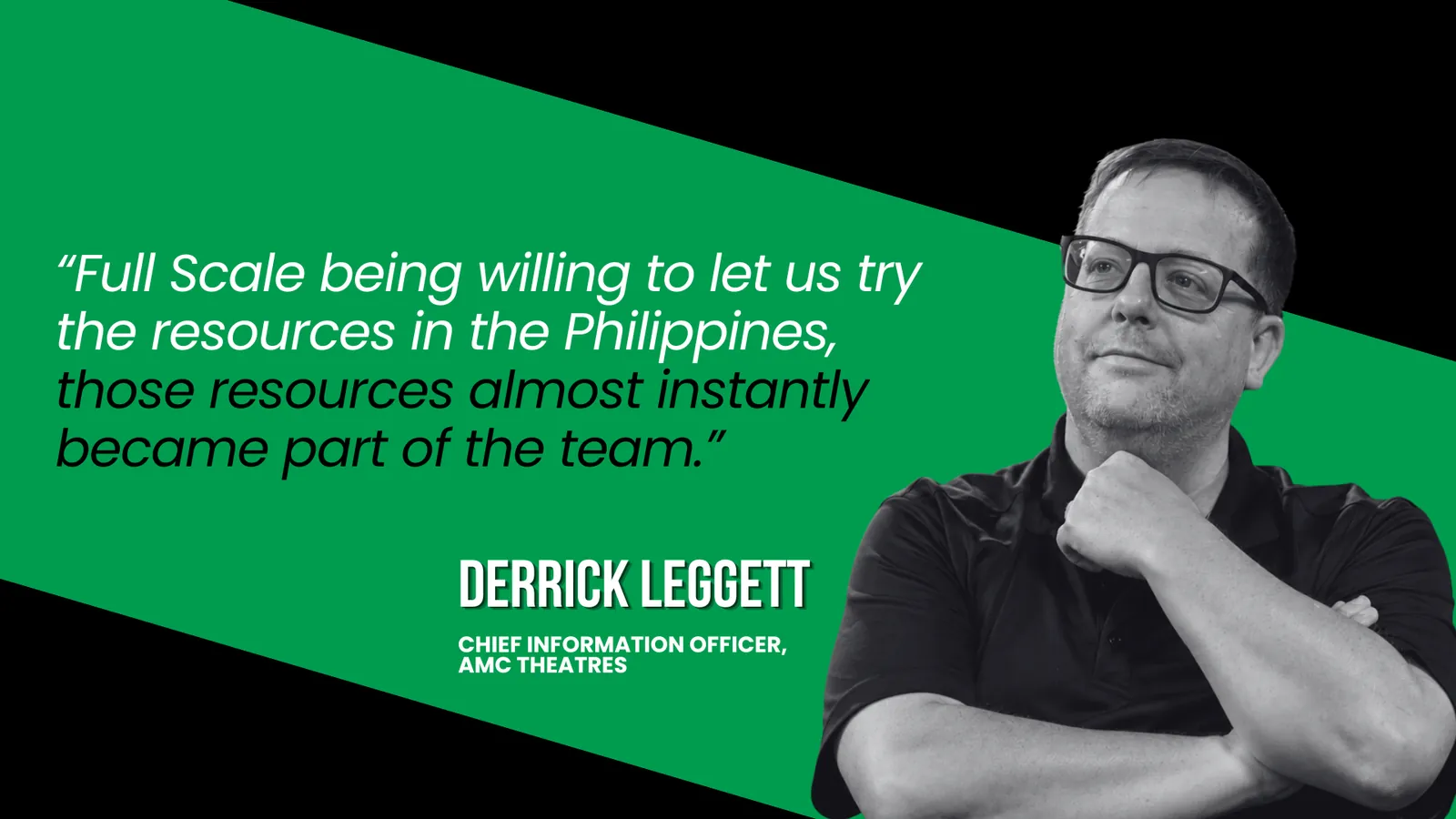
Derrick Leggett, CIO at AMC Theatres, has built a global engineering organization around exactly this idea. The Full Scale developers on Derrick’s team in the Philippines are AMC engineers, full stop. They’re in the same Slack threads, the same code review process, and held to the same standards as every other engineer at AMC. There is no agency PM sitting between them and the rest of the AMC org, because that would defeat the entire point.
Make sure you work with a dev agency that cares about your product, not just your project.
That’s the test. A vendor that wants to put a PM between you and your engineers is selling you a project even if the contract says staff augmentation. The real version puts you in the driver’s seat from day one. That PM wall is usually a sign the engagement was scoped as a SOW in spirit even when the paperwork says otherwise; I wrote up the team vs. contract debate in full elsewhere.
2. You build a long-term team instead of renting one
The unspoken fear about offshore is that you’re getting a rotating cast of contractors who’ll be gone the next time a higher-paying gig opens up. In most outsourcing arrangements, that fear is warranted. The vendor’s economic interest is to keep their developers booked across as many clients as possible, so the same five engineers who built version 1 of your product are unlikely to be the ones building version 4.
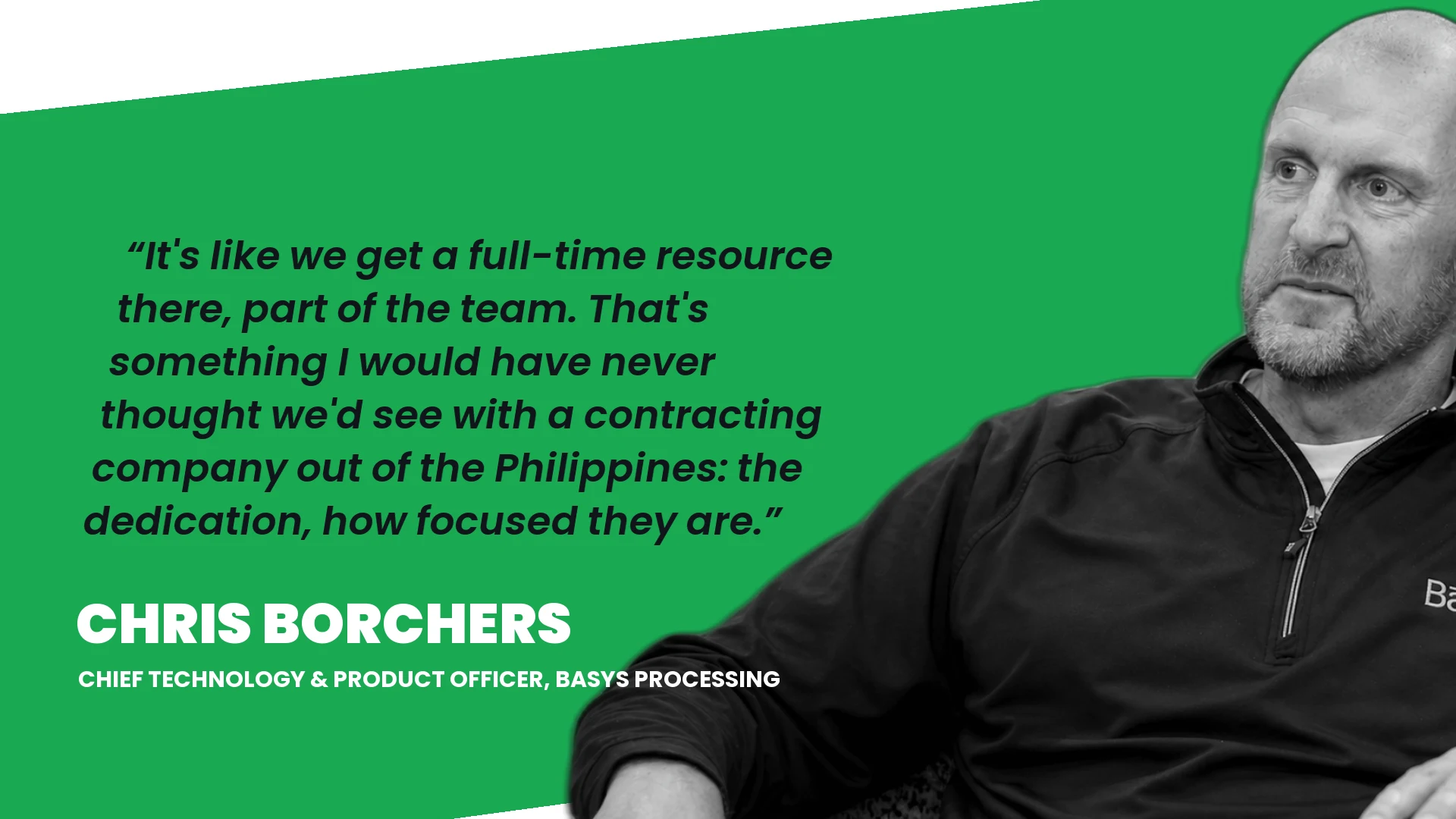
Real staff augmentation works differently. The developers we place at Full Scale don’t rotate between accounts every six months. They stay on one client, learn the codebase, and grow with the product. Our developer retention runs over 93 percent. For comparison, the BLS Job Openings and Labor Turnover Survey puts annual US tech turnover at 13 to 15 percent, which means our Philippine teams turn over less than the local engineers you’d hire at home.
That continuity compounds. The engineer who built your billing system in year one is the same engineer who knows where every weird edge case is buried by year three. You don’t get that from a project handoff.
At Stackify, we opened a small office in the Philippines in 2018. By the time we exited in 2021, the team had grown past 20 developers, and many of them are still working on the same products today. They weren’t a hiring trick or a cost-cutting move. They were the people who knew the product cold and shipped it every day. That team was a big key to our exit, full stop.
LendingStandard’s CEO Andy Kallenbach put it directly in their case study with us:
“Waking up each morning to collaborate with the Full Scale team has become the highlight of my day. Their work ethic, pride in craftsmanship, and the sheer quality of their output have not only met but exceeded our expectations. The most significant impact has been the seamless integration of their team with ours, making every challenge surmountable and every success sweeter.”
We aren’t in this for some 3-month project.
I wrote a whole pillar in my 2025 book Product Driven on ownership: engineers can’t think like owners if they’re on a contract that ends when the deliverable ships. Long-term team continuity is what makes ownership possible in the first place.
3. You hire in weeks, not months
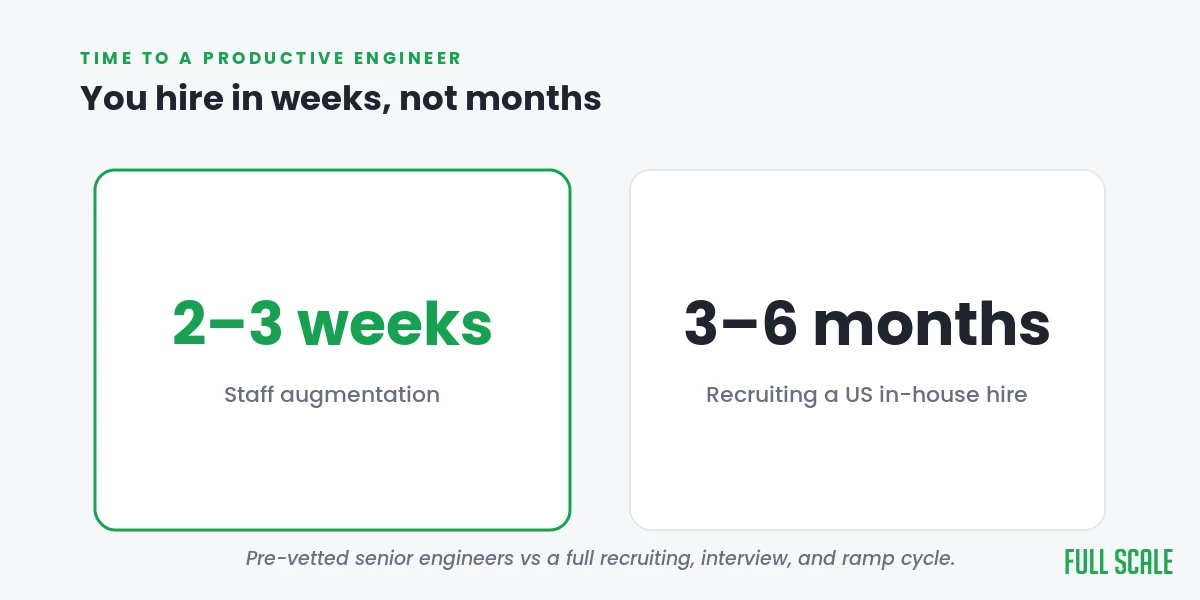
Most engineering leaders I work with have at least one senior role that’s been open longer than they want to admit. The US technical hiring market is brutal. By the time you finish recruiting, screening, interview loops, offers, and counter-offers, three or four months can go by, and that’s before you account for two weeks of notice and another four to six weeks of ramp-up.
Staff augmentation collapses that timeline. Our developers at Full Scale are pre-vetted senior engineers with seven or more years of experience on average, and they can join your standups in about two weeks. You’re not waiting on a recruiter to find someone, you’re picking from people who’ve already been evaluated and are ready to start.
The cost of an open seat is real: roadmaps slip, your existing engineers cover the gap and burn out, and launches that should have shipped this quarter keep getting pushed. Closing that gap in two weeks instead of two quarters changes what you can actually commit to.
Here’s how the three main hiring options stack up:
| Dimension | US in-house hire | Staff augmentation | Project outsourcing |
|---|---|---|---|
| Time to a productive engineer | 3 to 6 months | 2 to 3 weeks | Days, for a project, not a teammate |
| Who they work for | You | You | The vendor |
| Long-term continuity | High (if they stay) | High (93%+ retention) | None |
| If it doesn’t work out | Severance, legal risk, weeks of cleanup | Replace within a week | End the contract |
| Best fit | Anchor roles you’ll keep for years | Scaling a real team | Scoped deliverables |
The point isn’t that staff augmentation replaces local hiring. It’s that you stop choosing between “wait three months for a perfect local hire” and “ship nothing.” You can do both.
4. The cost savings are real, but not for the reason most posts say
Every other “benefits of staff augmentation” post leads with cost, usually with a number that looks suspiciously precise. I’m going to handle this differently.
The cost difference between a senior developer in the Philippines and a senior developer in San Francisco is real. It’s not because the Philippine developer is less skilled, it’s because the cost of living is different, the local salary market is different, and the labor economics are different. Same skill level, different cost basis. That’s the actual mechanism. Roughly 90 percent of software developers don’t live in the United States (per the Stack Overflow Developer Survey), so the global talent pool is far bigger than the local one, with very different local economics.
When the framing collapses to “cheap offshore labor,” everybody loses. Buyers expect lower quality and project it onto whatever they get, developers feel disposable, and the working relationship starts adversarial from day one. The only way to keep the savings real over time is to keep churning through bodies, which kills the long-term team benefit that makes this model actually work.
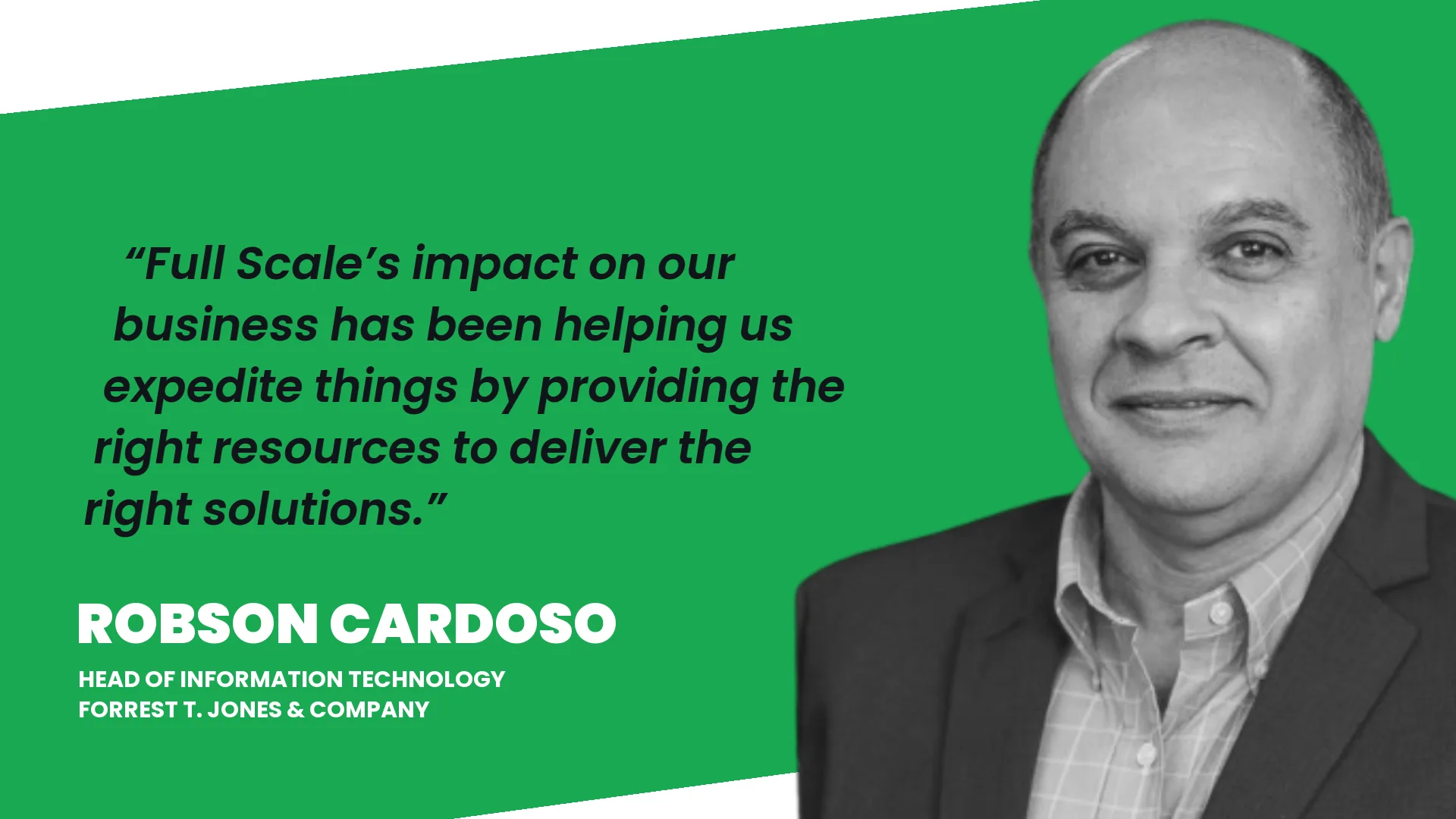
The honest version is simpler. If you’re building software you’ll keep developing for years, staff augmentation lets you grow a senior team at a sustainable cost per engineer. The savings show up in the engineering budget, but the value shows up in how much more team you can afford to put on a roadmap that’s getting bigger every quarter.
There’s a tradeoff worth naming. For one-off, scoped deliverables, traditional project outsourcing can sometimes pencil out better on cost alone. I’ve personally hired outsourced developers for WordPress builds and for an Elasticsearch project, because I didn’t need a long-term Elasticsearch specialist on staff after the work was done. That’s the right call for that kind of work. For the product you’re actually going to keep building, the team you can afford to keep is worth more than any project you can hand off cheaply. (For the budget conversation in particular, I wrote a whole separate post on how to justify offshore development to finance.)
5. You get senior specialists without a year of recruiting
If you’ve ever tried to hire a senior mobile engineer, a security specialist, or anyone who knows your specific cloud stack inside out, you already know the local market is thin. Specialists are the hardest hires in technical recruiting. Most teams either wait six months for the right person to surface, settle for someone less qualified, or rebuild a junior into a senior over a couple of years.
Staff augmentation gives you another lane. A vetted pool of senior engineers with deep experience in specific stacks means you can put a senior specialist on the team in weeks rather than waiting for one to walk in the door at home.
The catch is that this only works if you’re hiring for a long-term role. Senior specialists don’t want to be brought on for a 90-day engagement, and you don’t want to invest the onboarding cost on someone who’ll be gone before they hit their stride. The Elasticsearch work I outsourced is a fine counter-example: I genuinely didn’t need an Elasticsearch person after the project shipped, so paying for a long-term seat would have been wasteful. Every long-running specialist role I’ve had to fill (senior backend, DevOps, data engineering, mobile, security) has been better staffed through augmentation than through local hiring alone.
When staff augmentation isn’t the right call
I’m not going to pretend this model fits every situation. Two scenarios in particular are better served by traditional project outsourcing.
The first is when there’s no engineering leadership in-house. Staff augmentation requires someone on your side directing the work, reviewing code, making architectural calls, and owning the technical outcome. If you don’t have a CTO, a VP of engineering, or at least a senior tech lead, you don’t need a team that needs direction, you need a vendor that owns the outcome. You always need technical leadership in-house for staff augmentation to actually work.
The second is scoped, self-contained deliverables. Think marketing site rebuilds, one-time data migrations, integrations with a third-party API that won’t change much. Anywhere the work has a clear start, a clear end, and a clear definition of done, and where the technology behind it isn’t something you’ll need a full-time person on afterward. For that kind of work, hire a vendor, hand them the spec, and pay for the deliverable.
Most companies I work with end up doing both. Staff augmentation for the long-term product team, traditional project outsourcing for the scoped one-offs outside the core. That hybrid is how I’ve actually run engineering organizations, and it’s the honest answer when someone asks which model wins. They both win at different things. (If you want the full comparison between the two models, I wrote that up in detail here.)
Frequently asked questions
What is staff augmentation?
Staff augmentation means hiring developers who work directly for you on a long-term basis, embedded into your team and your process. They report to your managers, follow your standards, and join your standups. The staffing provider handles employment, payroll, and benefits while you direct the actual work. That’s the short version; the benefits of IT staff augmentation only make sense once the definition is straight.
What’s the difference between staff augmentation and outsourcing?
Outsourcing is a project handoff. You give a vendor requirements, they give you back a deliverable, and a project manager sits between you and the engineers. Staff augmentation puts developers on your team directly. They work for you for months or years, with no PM in the middle filtering communication.
Is staff augmentation cost-effective?
For long-term product engineering work, yes. The savings come from labor market dynamics like cost of living, not from lower skill levels. For one-off scoped deliverables, traditional project outsourcing can sometimes pencil out better because you’re not paying for an ongoing team relationship you don’t need.
When does staff augmentation not work?
Two situations. First, if you don’t have engineering leadership in-house to direct the work. Without a CTO or senior tech lead, staff augmentation lacks the leadership it needs to function. Second, for short scoped deliverables. A one-time integration or a marketing site rebuild is better hired as a project than staffed as a team.
Staff augmentation isn’t a workaround for hiring. It’s the right way to scale a software team when you have engineering leadership and a product you’re going to keep building for years.
Full Scale as an IT staff augmentation company runs this model with senior developers in the Philippines. If you have an engineering team and you need to grow it, book a 15-minute call and let’s talk.