
Team Augmentation Is Staff Augmentation, With More People

In this article
- What team augmentation actually means
- Team augmentation vs. staff augmentation: same thing, more people
- When team augmentation makes sense, and when it doesn’t
- Team augmentation vs. outsourcing, freelancers, and dedicated teams
- Why most offshore teams fail, and what actually works
- What I’ve learned hiring offshore in three different countries
- How to evaluate a team augmentation provider
- Common objections we hear from CTOs
- The Full Scale approach
- Frequently asked questions
- The bottom line
Open most articles about team augmentation and you’ll get a long explanation of why it’s fundamentally different from staff augmentation. It isn’t. It’s the same model. The only real difference is whether you’re bringing on one person or more than one. Everything else is marketing. Not sure which model fits? Start with PEO vs EOR vs staff augmentation.
That’s the whole answer to the naming question.
The thing buyers actually want to know is different: when does this model make sense, when does it fall apart, and how do you pick a provider without ending up with another offshore horror story. I’ve personally hired offshore developers in three different countries over the last 14 years, and I run a company that places more than 200 of them today. Here’s what I’ve learned. The biggest determinant of success is how well you communicate with an augmented team across the whole engagement. Part of picking that provider well is knowing how software development staff augmentation vendors actually price and allocate their engineers. It is worth knowing the payment, rate, IP, and cancellation terms before you sign the contract.
What team augmentation actually means
Team augmentation is a staffing model where you add external developers to your existing in-house engineering team. The developers work inside your tools, follow your processes, and report to your managers. They sit in your standups. They write code in your repos. From a workflow standpoint, they’re indistinguishable from your full-time hires, except that the legal employment relationship lives with a staffing partner rather than you. That line between a partner and a rental is the whole point of weighing alternatives to Toptal and Turing. When the work involves AI, the same model shows up as AI staff augmentation services, with the screening tuned to AI skills.
The model exists because most companies that need to scale engineering can’t hire fast enough locally, or can’t find the specific skills they need at a price they can pay. Team augmentation fills the gap without the multi-year commitment of full-time hires and without the loss of control that comes with handing a project to an outsourcing vendor.
If you came here looking for a textbook definition, that’s it.
Team augmentation vs. staff augmentation: same thing, more people
The dev-shop industry has tried to convince buyers that team augmentation and staff augmentation are different models. They aren’t. Wikipedia files them under the same entry. The terms get used interchangeably across the industry, and some vendors fold in resource augmentation as one more label for the same thing. The vendors who insist there’s a real distinction usually frame it like this: staff augmentation means a single contractor, team augmentation means a group of engineers embedded as a unit. Plenty of vendors, especially ones based overseas, call the same setup outstaffing, and what outstaffing actually gets you is the same thing under a different name.
It’s the same model. You’re contracting with a staffing partner to add engineers to your team under your management. If you add one, the industry calls it staff augmentation. If you add three or five or twelve, somebody coined the term team augmentation. The contract structure is the same, the relationship is the same, the day-to-day is the same.
The distinction that actually matters is buried under all of this: are you trying to outsource a project, or are you trying to build a long-term team? That’s the real fork in the road, and it has nothing to do with whether you call it team or staff augmentation. We covered that decision in depth in our staff augmentation vs. outsourcing post.
When team augmentation makes sense, and when it doesn’t
Team augmentation works when you have engineering leadership in-house and you need to scale a long-term team faster than local hiring allows. It falls apart when neither of those is true. When you only need a quick, scoped piece of work instead, a freelance marketplace fits better, and the right Toptal alternative comes down to the job.
When it’s the right call
Three scenarios come up over and over with the companies we work with.
The first is when you have a CTO or VP of engineering who can direct the work, but local hiring can’t keep up with the roadmap. Most growth-stage companies. The team is real, the leadership is real, the problem is throughput.
The second is when the product is going to keep being developed for years. The code outlives the contract, the institutional knowledge needs to stay with the team, and you don’t want to rebuild the relationship every quarter. Work with a dev agency that cares about your product, not just your project.
The third is when the roadmap shifts quarter to quarter. Fixed-scope outsourcing contracts can’t handle priority changes without scope-creep arguments. Team augmentation can, because the team works for you and follows your roadmap.
When it isn’t
I’ve outsourced work plenty of times when team augmentation wasn’t the right move. At Stackify we hired an Elasticsearch consulting firm to do a heavy upgrade rather than staff a specialist we’d never need full-time again. I’ve outsourced WordPress builds for marketing sites the same way. The work was scoped, the expertise was specialized, and the result didn’t need to be maintained by us afterward. When the work really is a scoped project like that, I laid out how to outsource software development without getting burned in a separate guide.
If you don’t have in-house engineering leadership, team augmentation is probably the wrong call. Augmented developers need someone to direct them. Without that person, you’re better off with a vendor who owns the outcome end to end, or a fractional CTO who can build the muscle before you start scaling the team.
Team augmentation vs. outsourcing, freelancers, and dedicated teams
Most articles on this topic compare two models. Buyers are usually choosing between four. Here’s how they actually stack up.
| Model | Best for | Who manages the work | Risk if it goes sideways |
|---|---|---|---|
| Team augmentation | Long-term product development with in-house engineering leadership | You manage the work | Mediocre developers stay because you didn’t define the bar early |
| Project outsourcing | One-off deliverables, marketing sites, one-time integrations | Vendor manages the work | Vendor optimizes for the contract terms instead of the product |
| Freelancers | Solo specialist work with a short fuse | You manage the work, but loosely | Coverage gaps, no continuity, no institutional memory |
| Dedicated team | A fully owned team you don’t have to recruit yourself | You manage the work | Same as team augmentation, plus harder to flex headcount |
The thing nobody tells you up front: these aren’t mutually exclusive. The companies that get this right use multiple models for different work. Team augmentation for the long-term product team. Outsourcing for scoped one-off deliverables. Maybe a freelancer for a two-week specialist job. The model fits the work, not the other way around.
If your team works well remotely, it will work well globally, too. That’s the underlying truth that makes all four of these work.
Why most offshore teams fail, and what actually works
Most offshore collaboration fails because people simply hand a bunch of requirements over to an outsourcing firm. Then, they expect to get back a successful project. That’s project outsourcing dressed up to sound like team augmentation.
The companies that succeed with offshore teams do three things differently.
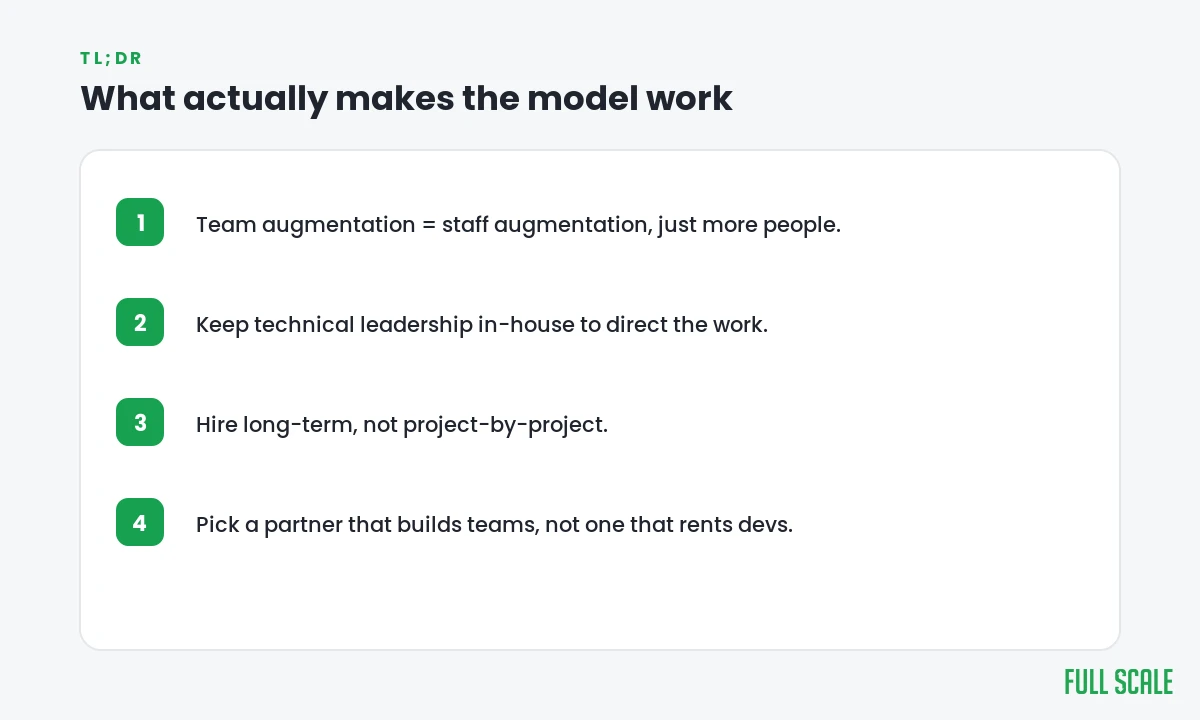
They keep technical leadership in-house. You always need someone who owns the architecture, the roadmap, and the code review bar inside your company. Augmented developers are great at execution, but they can’t direct the work if there’s no one to direct them. If you don’t have a CTO or a strong tech lead, fix that before you start hiring.
They hire long-term, not project-by-project. The companies that treat offshore developers as long-term team members get the institutional knowledge, the cultural fit, and the velocity gains. The companies that churn through developers every 90 days never get past the onboarding tax. Hire talent to work directly for you on a long-term basis. Don’t hire them just for a project.
They pick the right agency model. There’s a difference between a staffing partner whose business model is renting developers and one whose business model is helping you build a team. The first one wins on price. The second one wins on outcomes. The contract paperwork can look identical; the operating reality is not. The same divide runs through outstaffing services, where the providers selling on rate are rarely the ones that build real teams.
“Most offshore collaboration fails because people simply hand a bunch of requirements over to an outsourcing firm. Then, they expect to get back a successful project.”
This is also why the staff-aug-vs-team-aug naming debate is mostly noise. The real question is whether you’re adding people to a team that you own and lead, or handing the work off to someone else to manage. Headcount has nothing to do with it.
What I’ve learned hiring offshore in three different countries
I came up on the same offshore horror stories every CTO has heard. Late-night meetings, language barriers, code we’d have to rewrite anyway. For most of my early career, I avoided it. Three different experiences changed my mind.
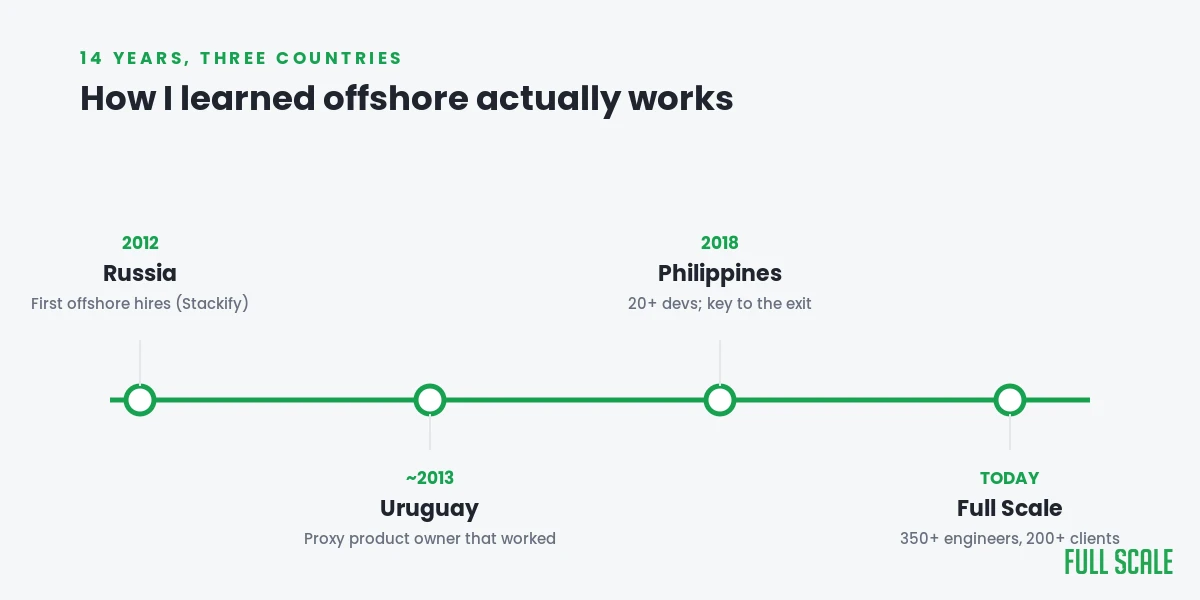
Russia, 2012
The first was at Stackify. A friend’s dev agency placed two Java engineers from St. Petersburg on my team. I didn’t actually know they were in Russia until the first phone call. The English was strong, the code was excellent, and they shipped. We worked together for about two years. This was 2012, long before the Ukraine conflict, and I won’t hire there today. But it was the first time I saw offshore actually work, and it broke the assumption I’d been operating under since the early 2000s.
Uruguay, late Stackify years
Around the same time, I had a side project I wanted to build while running Stackify. I hired a Uruguay firm to take it on. What made the engagement work wasn’t the developers themselves, though they were strong. It was that the firm provided a proxy product owner who managed product vision in my absence. That’s the rare version of outsourcing that actually works: when the vendor genuinely takes ownership of direction, not just execution. I later hired several of their developers directly onto the Stackify team.
Philippines, 2018 to today
The third experience is the one that built everything that came after. In 2018, I had another friend with developers in the Philippines. I’d had personal connections to Filipinos for years and always thought they were the nicest people I’d ever met, with impeccable English. We opened a small office. The team grew to over 20 developers on Stackify, and that team was a big key to our success and to the eventual sale of Stackify in 2021.
When the model worked that well, friends started asking for access. We set it up as its own company so we could hire for them. That accidental business turned into Full Scale. We hired 100 developers in the first year. We’re now over 200 tech companies served, with 93%+ developer retention and an average developer experience of more than seven years.
“Hire talent to work directly for you on a long-term basis. Don’t hire them just for a project.”
The pattern across all three: long-term teams, not projects. The right people, paid fairly, working for the same company for years. Everything I’ve ever seen go wrong with offshore was a failure of one of those.
How to evaluate a team augmentation provider
If you’ve decided this is the right model, the next question is how to pick a partner. Most checklists on this topic read like procurement bingo. The criteria that actually matter are short.
- Retention. Ask for retention numbers, not placement numbers. Anyone can place a developer. Keeping them on the same team for years is the hard part. Ours runs at over 93 percent.
- Seniority of the bench. Junior developers cost less, but they eat your tech leadership’s time. The math only works if the engineers are senior enough to operate without hand-holding. We aim for seven-plus years of experience as the average.
- Time to hire. A real placement window in weeks, not “we’ll find someone soon.” Our typical timeline is around two weeks from request to a developer integrated into your standups.
- Direct interview access. You should be interviewing every developer who joins your team. If the staffing partner manages the interview and just sends you the result, that’s outsourcing, not augmentation. Walk away.
- Month-to-month flexibility. No multi-year lock-ins. The whole point of this model is that it adjusts to your roadmap. A vendor that demands a three-year contract is selling you something else.
- Client references with the CTO on the phone. Anyone can show you logos. The signal you want is a 30-minute call with the actual engineering leader of a current client. We can put you on the phone with Andy Kallenbach at LendingStandard or others. If a provider can’t, ask why.
We aren’t in this for some 3-month project, and the partners worth hiring aren’t either.
Common objections we hear from CTOs
The buyer concerns about team augmentation tend to be the same five every time. Here’s the honest version of each.
“Won’t quality drop?” Quality varies more by individual developer than by location. I’ve hired offshore in three different countries and the spread inside each country was wider than the gap between countries. Vet hard, interview directly, and the quality question takes care of itself.
“What about time zone overlap?” Our Philippines developers commonly work an evening shift to overlap with US business hours. The typical overlap window is four hours, which is more than enough for standups and pair programming. The 14-hour time difference becomes a feature for on-call coverage and asynchronous work.
“How does IP protection work?” The contract is between you and the staffing partner, not between you and each individual developer. Same IP protections as a local contractor agreement, with the staffing partner indemnifying.
“My team is going to push back.” Usually they’re pushing back on the version of offshore they’ve seen go wrong, which is the project-outsourcing version. When the new developers join the same Slack channels, the same code review process, and the same standards as everyone else, the cultural objection mostly dissolves. AMC Theatres has built a global engineering organization on exactly that principle.
“Cheaper labor means lower quality, right?” Different cost of living, not different skill level. You can hire global talent for 50 to 70 percent less than US rates because the labor market is different, not because the developers are worse. If your team works well remotely, it will work well globally, too.
The Full Scale approach
We do staff augmentation and build long-term dedicated dev teams for our clients. Our clients aren’t hiring us for a short-term engagement. They’re trusting us with their long-term teams.
The model that worked at Stackify is the model we run now. We hire experienced developers in the Philippines and place them inside your engineering team. They work your hours, follow your standards, and stay for years. The thing Andy Kallenbach said about us still captures it better than I can:
“Waking up each morning to collaborate with the Full Scale team has become the highlight of my day. Their work ethic, pride in craftsmanship, and the sheer quality of their output have not only met but exceeded our expectations. The most significant impact has been the seamless integration of their team with ours, making every challenge surmountable and every success sweeter.”
Andy Kallenbach, CEO, LendingStandard
Frequently asked questions
What is team augmentation?
Team augmentation is a staffing model where a company adds external developers to its in-house engineering team. The developers report to the company’s managers and follow its processes. It’s used to scale faster than local hiring allows or to fill specialized skill gaps. The model is the same as staff augmentation; the only difference is whether you’re adding one person or more than one.
What is an example of staff augmentation?
A US product team needs two senior backend developers in six weeks, but local hiring takes three to four months. The company contracts with a staffing partner to place two developers from the Philippines who work US business hours, join the company’s Slack and GitHub, and report to the in-house engineering manager. They stay on the team for years rather than the length of one project.
What is the difference between team augmentation and staff augmentation?
There isn’t a meaningful difference. Some vendors try to draw a distinction (staff augmentation means a single contractor, team augmentation means a group), but the underlying model is the same. If a vendor makes a big deal of the distinction, it’s marketing.
What does job augmentation mean?
Job augmentation is a different concept that doesn’t apply to software development. It refers to using technology, often AI, to extend what a single worker can do. If you’re trying to scale your engineering team, the term you want is team or staff augmentation.
The bottom line
Staff augmentation is the right way. Whether you call it staff or team is just vocabulary.
If you’re trying to build a long-term engineering team and your local hiring can’t keep up with the roadmap, this is the model that gets you there. The honest answer to most of the rest of the questions you have is the same answer: it depends on whether you treat the people as part of your team or as someone else’s developers temporarily assigned to your project. Treat them as your team. The rest works out.
Ready to talk?
Full Scale places vetted senior developers from the Philippines into your engineering team in about two weeks. If that sounds like what you’re looking for, schedule a call and we’ll show you who’s available.