
Are Staffing Agencies Worth It? Why I Stopped Paying 20% Placement Fees

In this article
The first time someone quoted me a recruiting fee for a single developer, I had to read the contract twice. It was twenty percent of the hire’s first-year salary, due the day they started. On a developer making $133,000, that was a $27,000 check for the privilege of hiring someone, and I still had to pay the salary on top of it. That number is what got me looking hard at in-house recruiting as the alternative. We also feed that in-house engine by recruiting straight from Cebu’s universities. The fee is not the only problem, the evaluation is too, so I wrote about a better way to interview developers than the usual screen. Compare that fee to how the staff augmentation process sources talent from a standing bench instead.
For senior or hard-to-fill roles, the fee climbs past a third of first-year pay, and retained search with guarantees pushes the all-in number higher still.
So here is the honest answer to the question everyone is too polite to give straight. Are staffing agencies worth it? For most of the engineering roles you are trying to fill, no. You can hire an offshore developer who does the same work for a fraction of what the fee alone costs, and keep paying less every month after that. A recruiter is only one option; there are other ways to hire software engineers that cost far less.
There is one real exception, and I will get to it, because it matters and most of the internet pretends it doesn’t exist. But the default answer is no.
Quick Answer: Staffing agencies typically charge 15% to 30% of first-year salary for a direct hire, with software and IT roles landing around 20% to 25%, or a markup of 20% to 75% on the hourly rate for contract placements. For most developer roles the fee isn't worth it: an offshore developer can do the same work for a fraction of what the fee alone costs, before you even pay the salary. The real exception is a genuinely hard-to-find local specialist where finding the person, not the cost, is the hard part. Full Scale's own offshore rate runs $30 to $40 an hour, well under what a single US placement fee costs on its own.
How much do staffing agencies actually charge?
A staffing or recruiting agency makes money in one of two ways, and both are bigger than people expect.
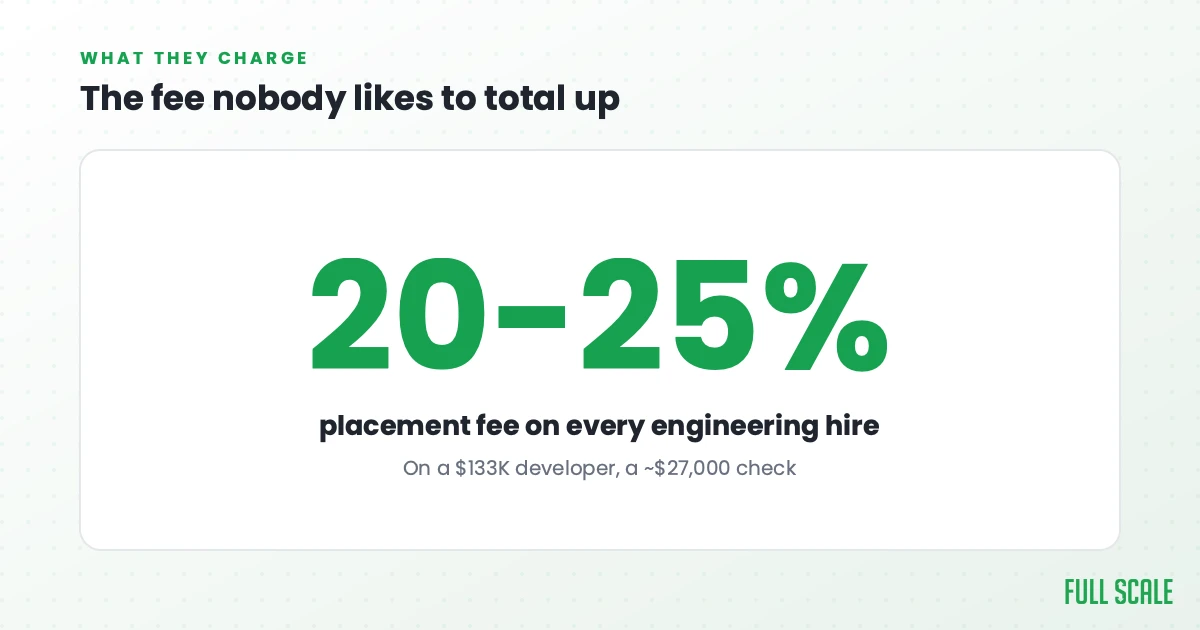
For a permanent, direct hire, the agency charges a placement fee that runs 15% to 30% of the new hire’s first-year salary. Skilled support roles sit at the low end, software engineers and IT roles land around 20% to 25%, and senior or executive searches reach 30% or higher, with retained search often wanting a chunk of that upfront before they have found anyone.
For contract or temp work, the agency adds a markup to the hourly rate, usually somewhere between 20% and 75%. That one is sneakier, because it does not show up as a single scary number. It quietly recurs on every invoice for as long as that person works for you.
Put a real salary against the first model. A US software developer earns a median base of about $133,000 a year, and senior engineers run higher. A 20% placement fee on that is roughly $27,000. At 30% it is around $40,000. That is the cost of the introduction. The salary, the benefits, and the equipment are all still yours to cover, and the average cost to hire a software developer already runs 1.25 to 1.4 times the salary before the fee.
The math nobody on the first page does
I read a lot of the articles ranking for this question before I wrote this one. Most of them list the same pros and cons and then shrug out an “it depends.” None does the loaded-cost math that actually decides it.
Here is the math.
That $133,000 base is not what the developer costs you. The fully loaded cost of a US employee runs about 1.25 to 1.4 times their base salary once you add payroll taxes, benefits, equipment, and overhead. For a senior engineer that lands north of $200,000 a year, all in. Now stack a $27,000 to $40,000 placement fee on top of that, in year one, just to get them in the door.
Compare it to what the same work costs offshore. At Full Scale we bill clients $30 to $40 an hour for a senior Filipino engineer’s time, which works out to roughly $5,000 to $6,500 a month. A US engineer of the same caliber bills $80 to $150 an hour through an agency or a contract shop.
So the placement fee alone, the part you pay before any work happens, is about four to six months of an offshore developer.
You are paying a finder’s fee that could have bought you half a year of the actual work. And the gap does not close after year one. It widens every month you keep that person on payroll.
That gap comes down to cost of living, not skill. There are smart people all over the world, and a senior developer in Manila lives well on a salary that would not cover rent in San Francisco. It is the same skill at a different cost base, and there is nothing exotic about it.
The placement-fee model is broken for engineering
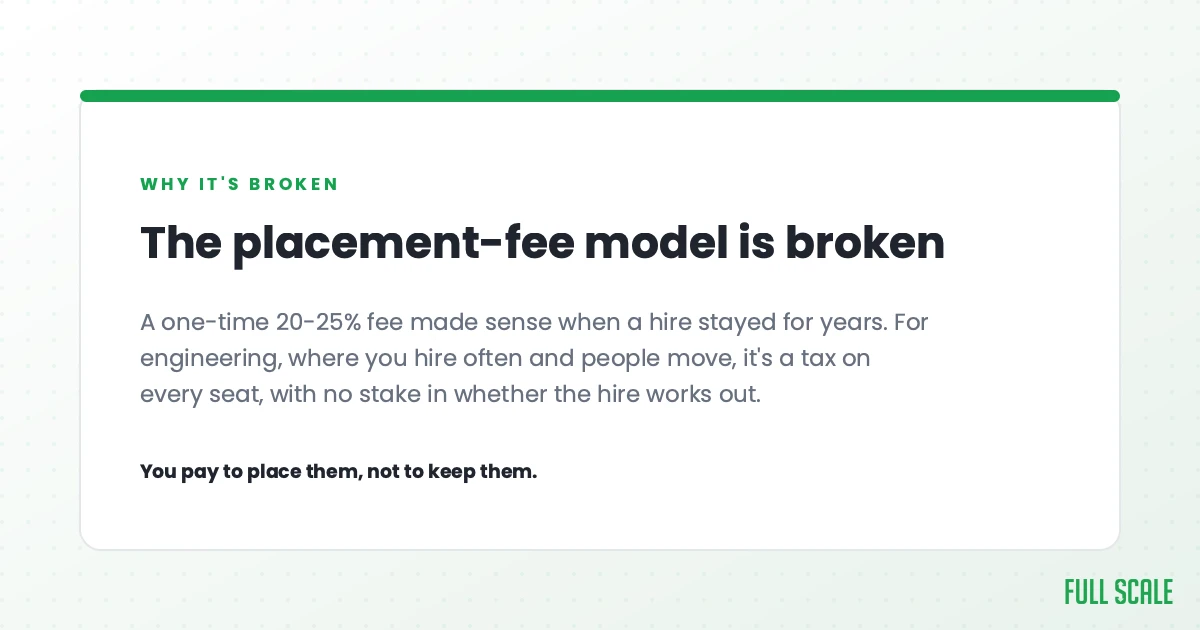
The bigger problem with the fee is not the size of it. It is what you get for it, which is one introduction and nothing else.
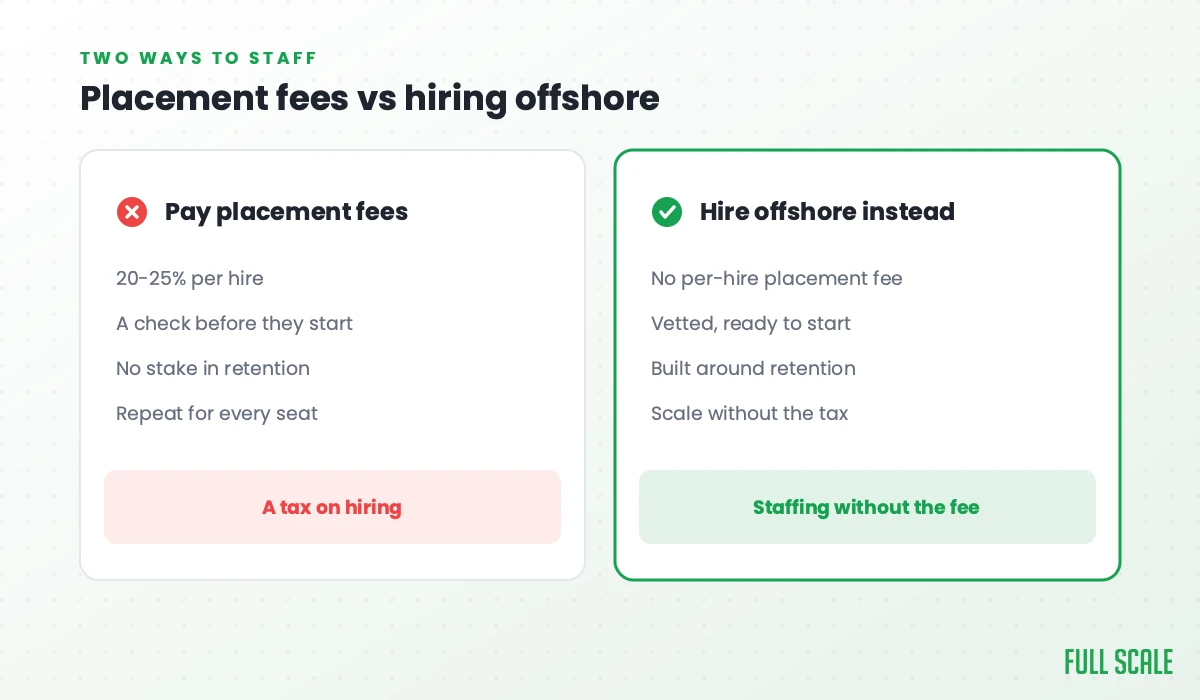
Once the agency collects the placement fee, the relationship is over. If the hire quits in four months, that is your problem. If they were never a great fit, that is your problem too, and the next search starts the fee clock all over again. The agency got paid to make a match, and once the match was made it had no stake in whether it lasted.
Most contingency placements come with a replacement guarantee, usually 30 to 90 days, where the agency will re-run the search for free if the hire washes out early. That sounds like protection, but the window is short, your own time is still gone, and engineering churn often shows up well after the guarantee lapses.
That structure is bad for any role. For engineering it is worse, because engineering churns. In my experience tech turnover runs in the low double digits every year, so the expensive hire you paid a fee for in January has a real chance of walking by December, and then you are writing the check again to backfill them.
I have lived the cost of that. On an old episode of Startup Hustle I put it plainly: staffing companies “can be expensive,” and the shortage of programmers in the US “makes the cost go up, which makes bad hiring decisions expensive.” A placement fee buys you a candidate. It does not buy you someone staying.
This is the part I changed my mind on years ago. I would rather hire people who work directly for us on a long-term basis than rent an introduction and own all the risk that comes after. At Full Scale we recruit, assess, retain, and employ the developers our clients work with, which is why our teams hold a 93%+ annual retention rate. When the people who placed the developer are also on the hook for keeping them, the incentives finally point the same direction. If you are weighing whether to use a software developer recruitment agency at all, it helps to know exactly what that placement fee buys and what it does not.
When a staffing agency is actually worth it
Now for the exception, because it is real and I am not going to pretend otherwise.
A placement fee earns its keep when you are hiring someone genuinely hard to find, locally, where the search itself is the value. That might be a senior engineering manager, a niche specialist with a security clearance or deep domain experience, or a leader who has to be in your city and in your building, sitting across the table from your other executives. For that person the fee buys real work, someone going out to find a needle, and a good search firm with the right network can do it faster than you can.
I know how hard that hire is because I have been on the wrong side of it. On Startup Hustle, Neelima Paraskar, the CEO of SnapIT, described building a local engineering team and competing for talent against Sonos and Sprint and every other big employer in town. The kicker stuck with me: “I have three of them quit all within about a three or four month period because they all got recruited away. One went to Microsoft, one went to Amazon, and one went somewhere else.”
That is the local senior market. It is brutal, it is competitive, and finding the right person is a real job. If that is the hire you are making, pay the fee. It is worth it.
The mistake is treating every developer hire like that hire. Most of them are not. Most of them are roles you can fill with a strong offshore engineer at a quarter of the all-in cost and none of the placement fee.
What to do instead: hire the rest offshore
When it comes to recruiting tech talent for every role that is not the rare local leader, there is a better option than writing a placement-fee check. This is where offshore IT staffing earns its place.
Hire offshore, and hire for the long term. Staff augmentation is the right way to do it: bring on developers who sit on your team and your roadmap, instead of a shop you hand a spec to and hope for the best. Hire talent to work directly for you on a long-term basis. Do not hire them just for a project. Most IT staff augmentation vendors will not walk you through that math, which is exactly why it is worth reading somewhere that will.
Speed is the objection that comes up every time, and it usually cuts the other way. The whole case for an agency is that it fills the seat faster than you can. In practice the offshore route is the quicker one. The guy who runs our sales spent years in traditional IT staffing before Full Scale, and over there a placement could drag on for weeks. We can put vetted senior engineers in front of you within days and have them working on your team in about two to three weeks, with no placement fee attached.
There is one warning, because the cost savings can pull you in the wrong direction. Do not go shopping for the cheapest developer you can find on the internet. I call that cheapshoring, and it fails for the same reason a bad local hire fails. The thing that makes offshore work is communication, not the hourly rate on the invoice. You want engineers who speak up when they do not understand something, push back when the spec is wrong, and care about the product the way your in-house team does.
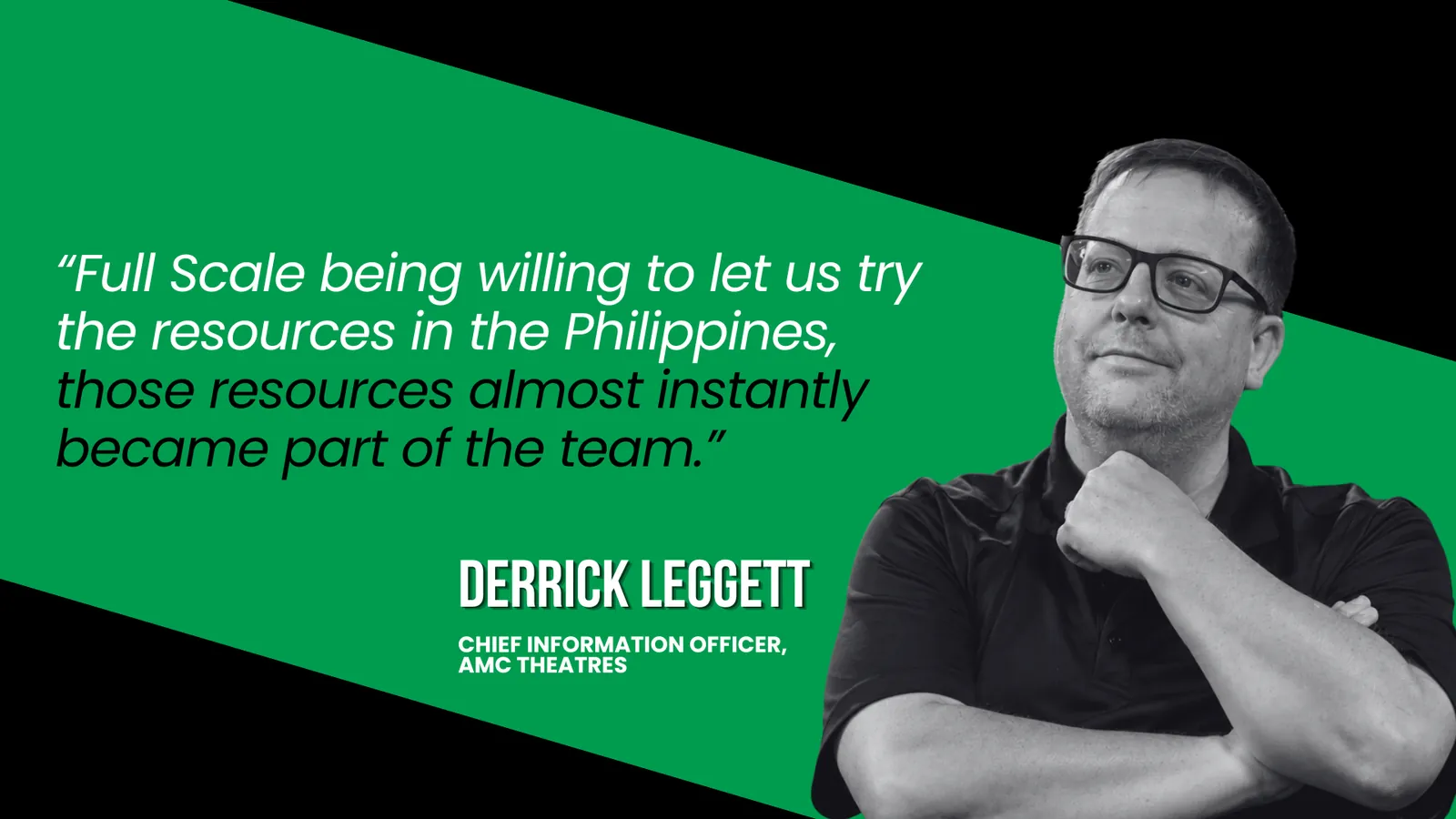
Get that right and it stops feeling like outsourcing and starts feeling like one team. Andy Kallenbach at LendingStandard came to us after local hiring stalled out, with college recruiting and vocational programs that could not keep pace. Offshore is what let them keep building. Derrick Leggett, the CIO at AMC Theatres, put it the way I wish more people understood: “It’s a fully integrated team. It’s just some of the people happen to be living in the Philippines.” AMC scaled from around 170 theatres to more than 900 worldwide with engineers spread across the US, South America, India, and the Philippines, and no middleman in between.
That last part is the point. When developers are connected to your product and your outcomes instead of a spec you threw over a wall, you get better software. It is the whole argument of Product Driven, and an integrated offshore team is one of the cleanest ways to get there.
That is the alternative the placement fee is competing with. For most roles, it is not close.

So, are staffing agencies worth it?
Here is the rule I would give any founder or engineering leader asking the question.
Pay the fee for the hire you genuinely cannot find on your own, and hire everyone else offshore.
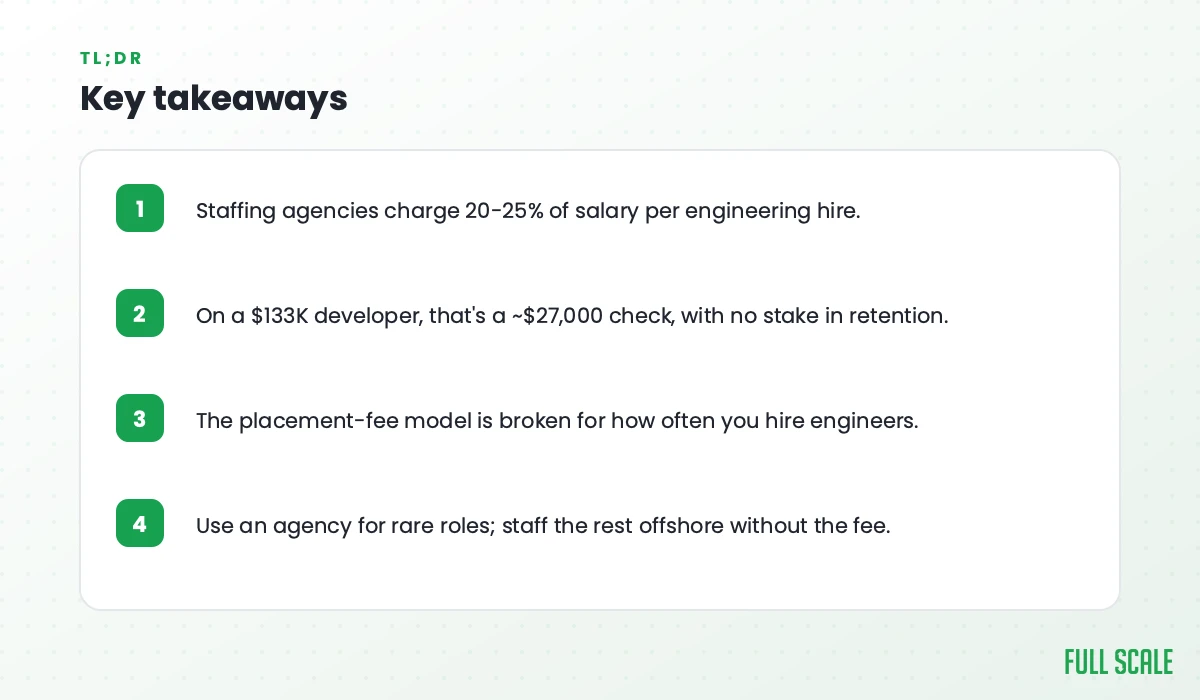
The senior local leader or the niche specialist where the search is the hard part is worth the placement fee. For everyone else, the developers who make up the bulk of your team, skip the agency and hire offshore for a long-term seat on your team. The placement fee on one US developer can buy you months of an offshore engineer who is just as good, and the savings compound from there.
Staffing agencies are not a scam. They are a tool with a narrow job. The trouble starts when you use them for the wide one. A traditional staffing agency is only one of several models that get called “staffing.” I break down the rest of the staffing models, project-based staffing, managed services, EOR arrangements, in one place.
If you want to see what hiring offshore actually looks like before you write another placement-fee check, that is the entire reason Full Scale exists. I built it as the alternative I wished I had.
Frequently asked questions
How much do staffing agencies charge?
For a permanent, direct hire, agencies charge a placement fee of 15% to 30% of the first-year salary, with software and IT roles usually landing around 20% to 25% and senior searches reaching 30% or more. For contract and temp roles, they add a markup of roughly 20% to 75% on top of the hourly rate, billed for as long as the person works for you.
Should I use a staffing agency to hire developers?
For most developer roles, no. A placement fee sits on top of an already high US salary, and you can hire an equally strong engineer offshore for a fraction of the all-in cost without paying the fee at all. Use an agency when you are filling a genuinely hard-to-find local role, like a senior engineering manager or a niche specialist, where finding the person is the hard part.
Are recruitment agencies worth it?
They are worth it for a narrow set of hires and not worth it for the rest. The fee buys you one introduction, and the agency carries no responsibility for whether the hire stays. For roles you can fill another way, that is an expensive trade. For a rare specialist you cannot reach on your own, a good agency’s network is worth paying for.
Is it cheaper to hire offshore than to pay a placement fee?
Almost always, yes. A 20% placement fee on a typical US developer runs around $27,000 before you pay any salary. At Full Scale’s published offshore rate of $30 to $40 an hour, that fee alone is about four to six months of a senior engineer’s time, and the monthly cost stays lower for as long as they work with you.
When is a staffing agency not worth it?
When you are hiring at any real volume, when the role is one you could fill offshore, or when budget matters and you want the cost to stay low over time. The placement-fee model is built for one-off, hard-to-find hires. Run your whole engineering team through it and the fees stack up fast.