
Switching Offshore Development Providers: A Step-by-Step Transition Plan

In this article
- First, be sure the problem is the vendor and not one developer
- Keep engineering leadership in house, so no vendor can hold you hostage
- The vendor transition checklist: secure access before you give notice
- The outsourcing transition plan: start small and shift the work slowly
- The knowledge transfer plan is mostly about product knowledge
- How long switching offshore development providers takes, and what it costs
- A second vendor keeps the first one honest
- AI made switching cheaper than it used to be
- What the switch looks like from the vendor you are switching to
- Frequently asked questions
- Run the pilot before you need it
Quick Answer: Switching offshore development providers works best as a slow overlap, not a cutover. Start one or two developers at the new vendor, run a 30-day pilot while the current team keeps working, transfer product knowledge deliberately, and only scale down the old team once the new one is fluent, which takes about 90 days. Secure your code, credentials, and IP before you give notice.
Companies usually decide to switch offshore development providers about a year later than they should, and then they try to do the whole thing in two weeks.
I run Full Scale. We're often the vendor people switch to, so I've watched a lot of these transitions from the receiving end. I've also seen what happens when a company cuts over from one development team to another all at once, and I wouldn't wish it on a competitor.
Everything below comes down to one idea.
Switching providers is a staffing transition, not a cutover event.
The companies that switch well move slowly. They run both vendors in parallel for a while and treat domain knowledge like the asset it is. Do it badly and you save six weeks of overlap billing, then spend the next year paying it back with interest.
First, be sure the problem is the vendor and not one developer
Before you plan an exit, separate a vendor problem from a people problem. One struggling developer is normal, and usually fixable, because most of the time it turns out to be a matching problem rather than a talent problem. I wrote about how we handle a developer who isn't working out. The first question there is whether the person is on the right team, long before anyone asks if they are good enough.
A vendor problem looks different. It is a pattern across the whole account:
- Quality issues that keep coming back after you have raised them, more than once, in writing
- Timelines that slip without an honest explanation of why
- Every conversation routed through an account manager instead of the people doing the work
- Invoices that grow while output shrinks
- The strong engineers quietly vanishing from your account while the billing stays the same
Most offshore collaboration fails because people simply hand a bunch of requirements over to an outsourcing firm and expect to get back a successful project. If that's the setup, some of the failure is the model, and a new vendor inherits the same problem.
And if you picked the current vendor on price alone, the pattern was predictable. I call this cheapshoring, and the fix is not an even cheaper vendor.
Keep engineering leadership in house, so no vendor can hold you hostage
A vendor transition gets dramatically easier when leadership inside your company ultimately controls all the work. If your own engineering leader owns the roadmap, the repositories, the infrastructure, and the standards, then a vendor is a group of people executing work you direct. Swapping vendors becomes a staffing decision instead of an existential one.
Without that person, the vendor effectively owns your product, whatever the contract says. You feel it the moment you think about leaving.
You should never be one bad vendor away from losing control of your own product.
This is the oldest advice I give, and it has nothing to do with switching specifically. You can buy the building of software. The vision, the product decisions, and the accountability for outcomes need to live in your company. If your company can afford it and you have existing local talent, augmenting them with offshore is always the best formula.
If you're reading this without an engineering leader in house, fix that first. It will improve your current vendor and every future one.
The vendor transition checklist: secure access before you give notice
Hold the keys before anyone knows you're leaving.
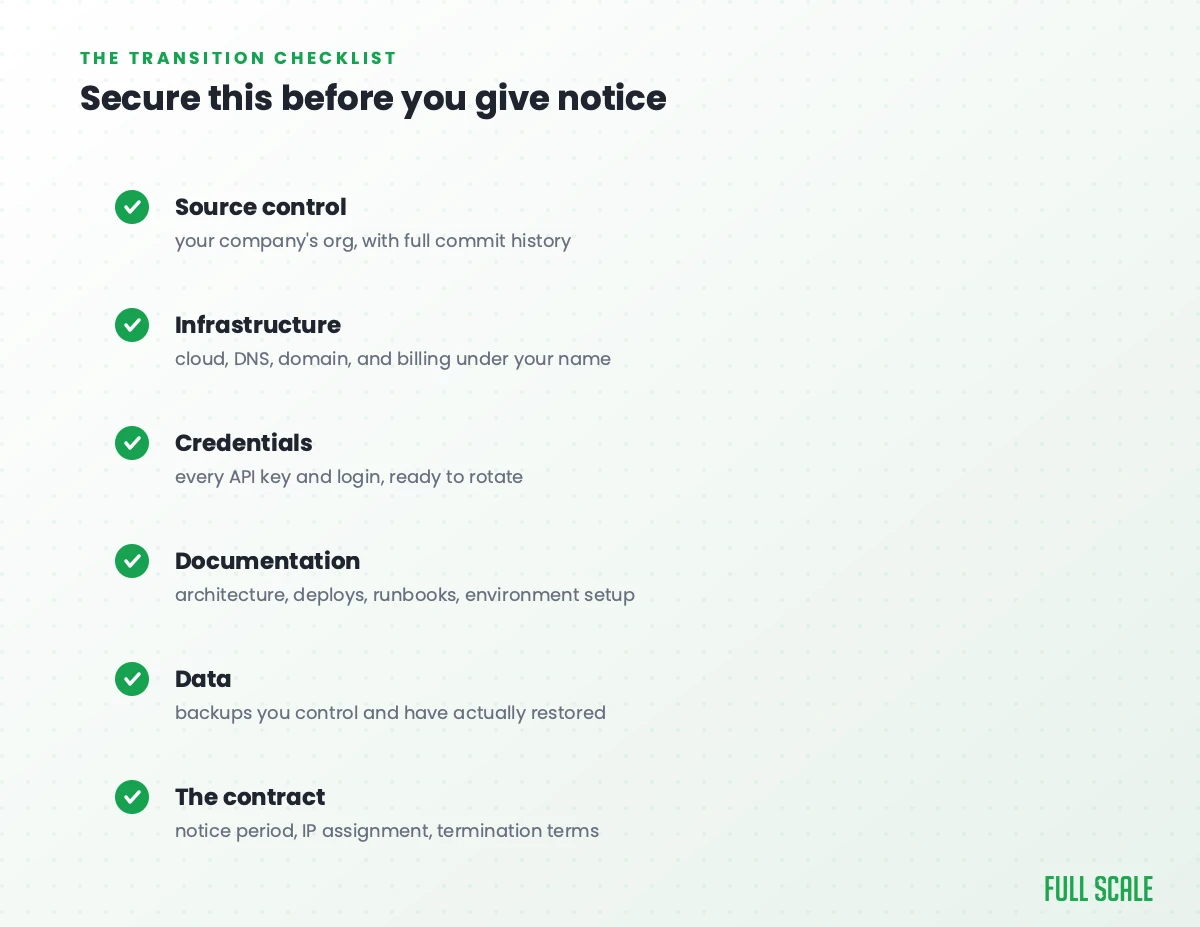
I push every new Full Scale client to build an access inventory in their first week, switch or no switch. The cheapest time to secure your own product is before the incumbent has any reason to be difficult about it. The vendor transition checklist I'd run:
- Source control. The GitHub or GitLab organization belongs to accounts your company owns, with full commit history. A zip file doesn't count, because the history is where half the "why" lives.
- Infrastructure. Cloud accounts, DNS, domain registrar, and billing sit under your company's ownership, with your leader holding root access.
- Credentials. Build an inventory of API keys, admin logins, and third-party services, then rotate all of them once the transition ends.
- Documentation. Architecture notes, deployment steps, runbooks, and environment setup. If none of this exists, that by itself is a finding about your vendor.
- Data. Backups that you control and have actually restored once. An untested backup is just a hope with a filename.
- The contract. Read the notice period, the IP assignment language, and anything about deliverables on termination before you signal anything. I broke down the staff augmentation contract terms that matter if you want the clause-level detail.
Most vendors behave professionally on the way out. Think of the checklist as sequencing rather than paranoia: everything on it is easy while the relationship is warm, and awkward after notice is given.
If the vendor currently owns your accounts, ask for the transfers under ordinary, true reasons: a security review, an insurance or SOC 2 requirement, plain ownership hygiene. A professional vendor treats those requests as routine. A vendor who resists handing over what you paid for has answered your question for you. Getting the transfer done becomes the first order of business, before any notice.
The outsourcing transition plan: start small and shift the work slowly
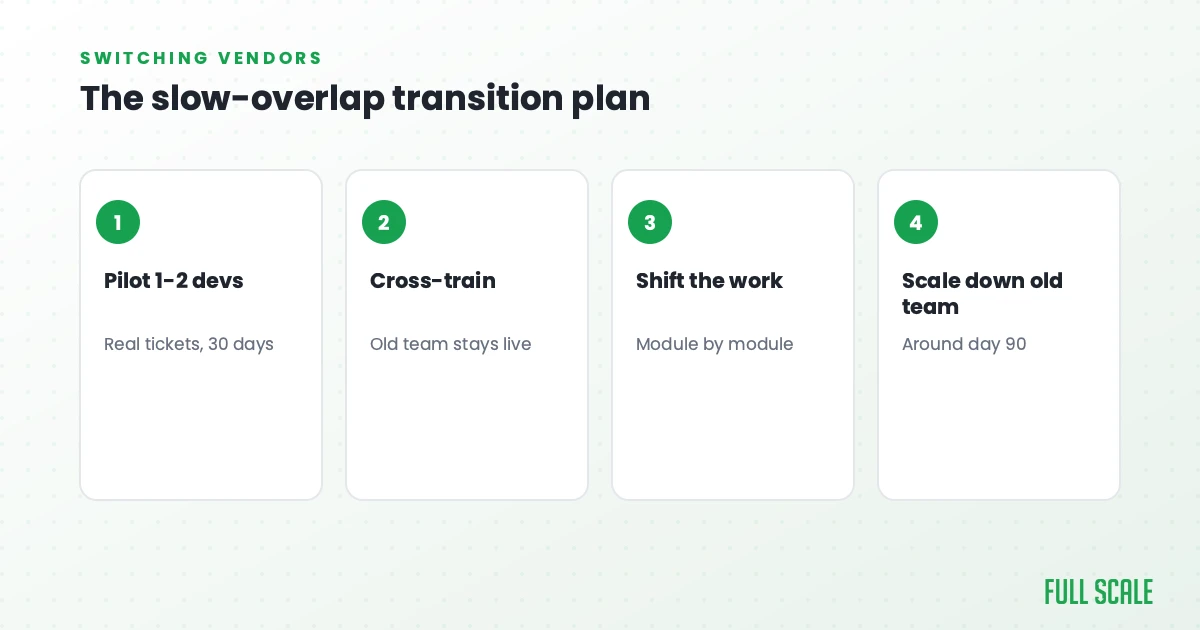
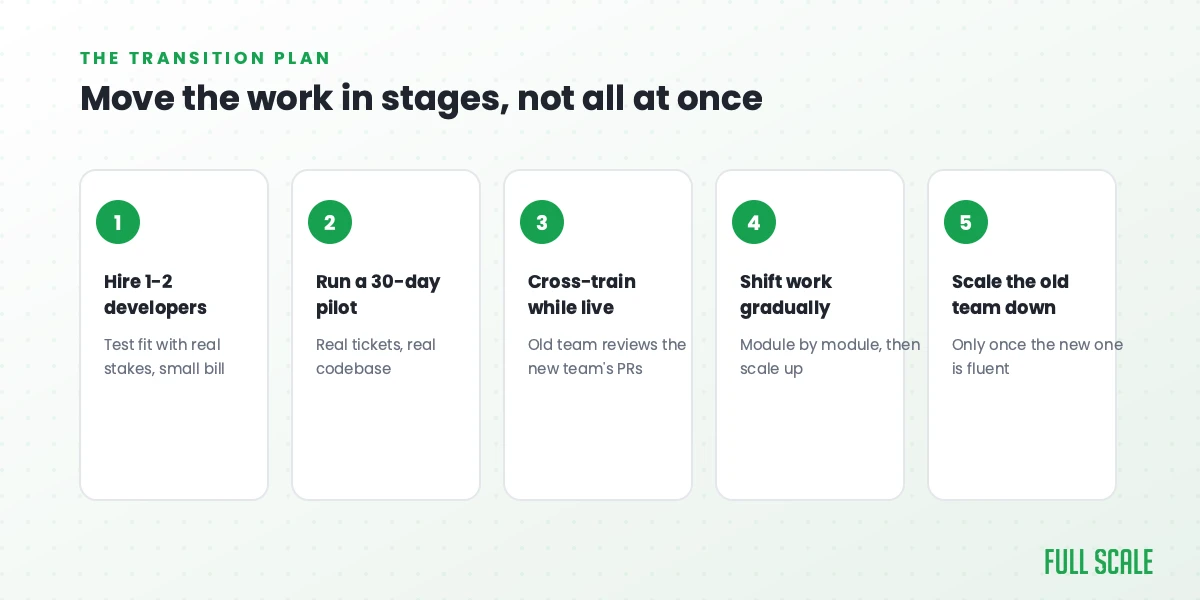
A good outsourcing transition plan moves work in stages instead of all at once. Full Scale has been onboarding teams that came from other vendors since 2018, and the version I recommend looks like this:
- Hire one or two developers at the new vendor. A pair is enough to test communication, quality, and fit with real stakes and a small bill.
- Give them 30 days of real work. Put them on real tickets in the real codebase, and make sure things are going smoothly before anything else changes.
- Cross-train while both teams are live. Pair the new developers with the people who hold the domain knowledge. Have the old team review the new team's first pull requests. This overlap is the whole point of going slowly.
- Shift the work gradually. Move a module, a service, or a product area at a time, and let the new team own each piece fully before taking the next.
- Scale up as trust builds. Your first one or two fluent developers make every later addition easier, because now somebody at the new vendor carries the context and can onboard their own teammates.
- Scale the old team down last. Keep the people who know the system until the new team truly doesn't need them. Do this respectfully; you may want these people's help again.
Everyone wants the clean cutover date because it looks great on a board slide. The codebase doesn't care about the board slide.
Give the new team time to get up to speed before you lose the people who already have the domain knowledge.
The knowledge transfer plan is mostly about product knowledge
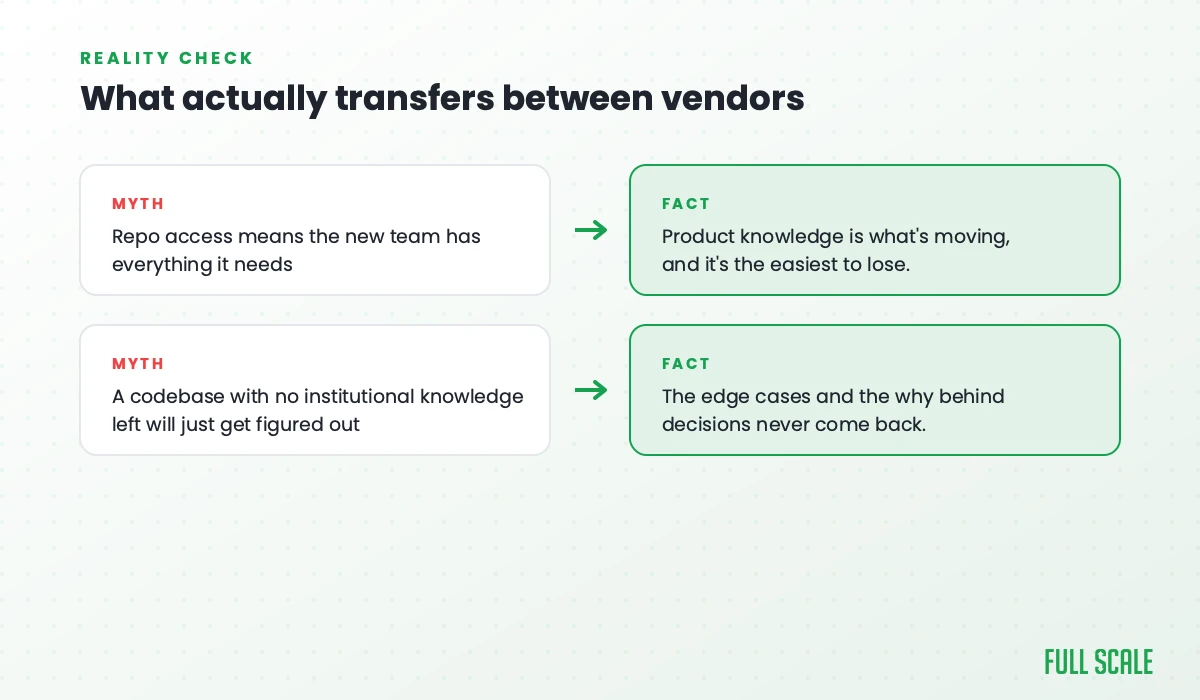
The understanding of why your product works the way it does is the hardest thing to move between vendors, and the easiest to lose. Software development has become product development, and product knowledge is now the biggest thing to worry about moving.
It can easily take a developer 90 days to get up to speed on the domain knowledge and working practices of a new company. That number comes from watching hundreds of engineers onboard at Full Scale.
I have seen the other version up close. A new team walks into a codebase and nobody is left who knows anything about it. People figure it out eventually, they always do. What never comes back are the little edge cases and the decisions about why things were done a certain way. The version I keep seeing goes like this: six months in, somebody deletes a strange-looking check in the billing code, and that check turns out to be the fix for an outage nobody left at the company remembers.
In Product Driven I put it this way: "If your product depends on one person, it's fragile. Real product ownership has to live in everyone." A vendor switch is where that fragility stops being theoretical.
A knowledge transfer plan that works is a short list of concrete deliverables:
- Recorded walkthroughs of the architecture and the deploy process, done by the outgoing team
- Written runbooks for the top ten "when X breaks, do Y" situations
- Pairing sessions between old and new developers on live tickets
- A written list of the product's known landmines, in plain language, from the people who stepped on them
You'll know the transfer worked by watching the team rather than the calendar. The new team handles an incident without pinging the old one. Their pull requests stop drawing domain corrections, and they start answering the "why does it work this way" questions in planning instead of asking them. Until you see that, keep the old team.
How long switching offshore development providers takes, and what it costs
Switching offshore development providers takes roughly 90 days end to end for a small team, and the budget should include paying for overlap on purpose. At Full Scale a new developer can start in as little as 7 days when the right person is available. Onboarding into a codebase takes about two weeks, and real product fluency takes the rest of that window. Starting and being fluent are different milestones, and vendor transition plans go wrong by pretending they are the same one.
The cost of switching development vendors is mostly the overlap
The overlap is the cost everybody tries to skip, because it means paying two vendors at once for a while.
Pay it.
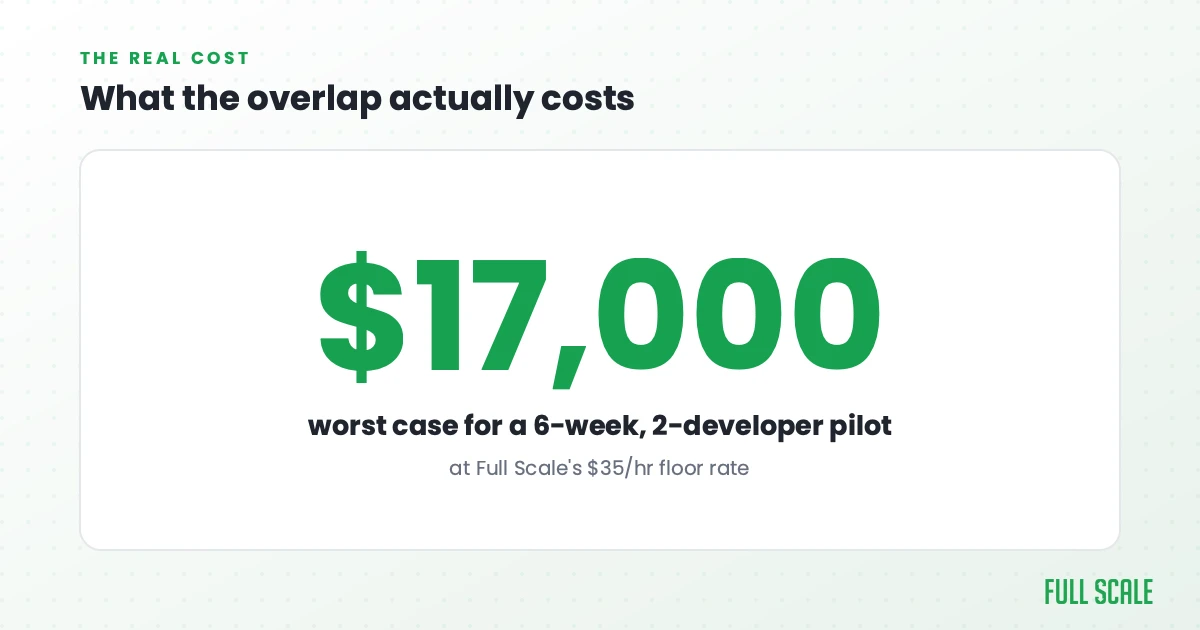
You won't pay double for the whole 90 days, either. As the work shifts, the old vendor's bill shrinks by whatever the new team now owns, so the real premium is the pilot pair. Here's the worst-case math at Full Scale's rates: six weeks of full overlap on two developers, starting at $35 an hour, comes to about $17,000. A single production incident nobody on the new team understands costs more than that. And the outage doesn't send an invoice you can budget for.
The risk side of the math depends on your situation:
| Your situation | How to run the switch |
|---|---|
| Quality is slipping but the relationship is intact | Slow shift: 1-2 developer pilot, 90-day overlap, scale gradually |
| Contract renewal is 60-90 days out | Start the pilot now, so the renewal decision is informed by real evidence |
| The vendor controls your repos or infrastructure | Secure access and ownership first, before any notice, then run the slow shift |
| The vendor has already collapsed or walked away | Move fast, but hire for product-archaeology patience, and expect the 90 days regardless |
| You no longer trust the vendor inside your systems | Compress the overlap: rotate credentials at notice, lean hard on documentation, and accept some knowledge-loss tax |
Vendor terms decide how expensive the pilot is to unwind. Ours is a two-week money-back guarantee and then 30 days' notice to cancel, with no long-term contracts, so a pilot that isn't working costs you two weeks of learning. If your prospective new vendor wants a 12-month commitment before the first commit, that tells you how confident they are in month one.
A second vendor keeps the first one honest
You don't have to frame a vendor switch as a divorce. This also answers the question the transition plan raises: what do you tell the incumbent when new developers show up in the repo? You tell them the truth, which is that you're adding capacity. That framing keeps their incentives intact through the cross-training, and it's accurate, because the outcome genuinely is open.
Bringing on a second vendor, even at pilot size, changes the incumbent's behavior all by itself. The new vendor is nervous and trying to earn the account, while the old one suddenly remembers how to return email the same day. That reason alone makes having more than one vendor a positive.
Some of the best outcomes are the switches that never finish: the client adds a second team, the original vendor wakes up and fixes what was broken, and the client keeps both, holding the upper hand in every conversation after that.
If somebody asks me whether they should fix the relationship or leave, this is my honest answer: hire one or two offshore developers somewhere else and let the results decide.
It converts an emotional argument into an A/B test.
Yes, I sell the B side of that test, and I would still rather win it on the evidence.
AI made switching cheaper than it used to be
The scariest part of a switch, handing your codebase to strangers, has gotten genuinely easier in the last few years. AI makes it easier than ever to work productively in a codebase you have never seen before. The 2025 Stack Overflow Developer Survey found 84% of developers using or planning to use AI tools, and about half already lean on them specifically to learn an unfamiliar codebase. GitHub's controlled study, back in 2022 on a bounded coding task, measured developers finishing 55% faster with an AI assistant. The tools have only improved since. In my experience the gap is widest exactly where a transition hurts most: code nobody on the team wrote.
A new developer with a good AI assistant can ask the repository questions all day without burning the outgoing team's patience: what calls this service, where is this configured, what breaks if I change this.
The caveat matters, though. AI can tell the new team what the code does, but never why the last team built it that way or which customer the weird workaround exists for. The tools shrink the code-reading half of onboarding while doing almost nothing for the product-knowledge half, and that part still transfers through people. This is exactly why you keep the old team around during the overlap.
What the switch looks like from the vendor you are switching to
Why buyers actually leave their last vendor
The burned buyer is most of who we meet, and three reasons come up over and over when I ask why they left the last team.
Turnover is the biggest one. The team churns so often that nobody sticks around long enough to actually know the product, and the client is tired of re-explaining the same context every few months.
The second is AI, and it's a newer one. If a client's old team only ever talked through a project manager and the developers never touched the actual stakeholders, that team wasn't asking enough questions even before AI showed up. Now that gap is the difference between shipping fast and standing still, because moving fast with AI is still mostly about communication. A walled-off team can't keep up no matter how good the tools get.
The third reason is the simplest: they hired a team that just wasn't very good, and they stopped accepting that as the cost of doing this offshore.
Our staff augmentation clients rarely walk in excited about offshore. Most show up carrying one of those three, and the pilot has to prove itself against that history.
The proof: Forrest T. Jones & Company
Forrest T. Jones & Company came to us exactly that way. FTJ is a family-owned insurance firm in Kansas City that has been operating for more than 70 years, and before Full Scale they had been through offshore vendors that delivered mediocre work on slipping timelines. The trust was gone, but their core .NET and SQL Server systems still needed modernizing, so they tried offshore again, carefully, with us.
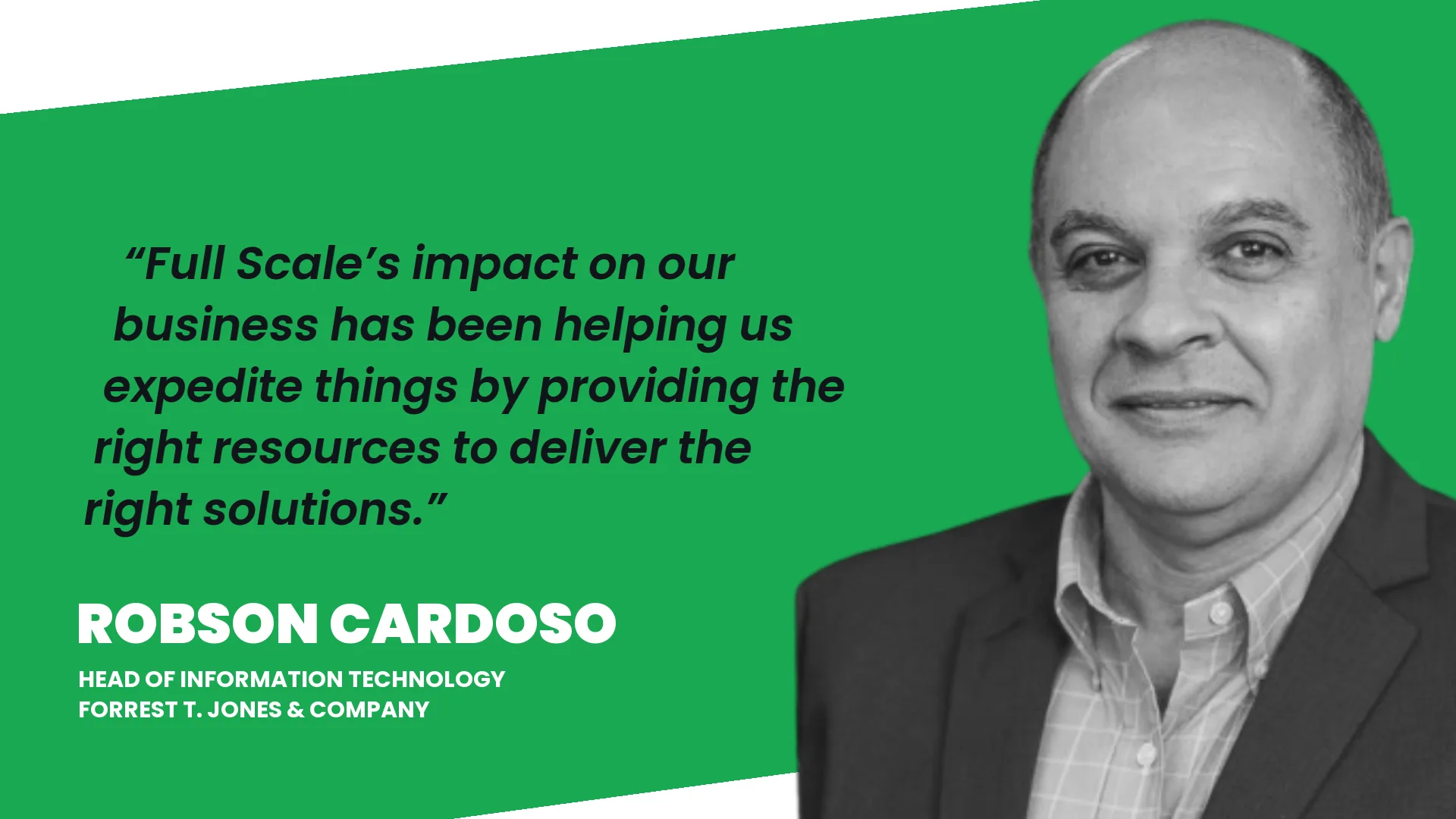
That engagement worked the way this whole post says a switch should. It grew as trust grew, and Robson's own estimate is that FTJ now gets the resource it needs with the right skills more than 90% of the time. Robson Cardoso, their head of IT, put the result simply: "Full Scale's impact on our business has been helping us expedite things by providing the right resources to deliver the right solutions."
We aren't in this for some 3-month project, and a slow, verifiable start is how both sides find out whether the long version is real.
One tell worth watching for in any new vendor, including us
One pattern to watch with any new vendor, including us. When a developer inherits somebody else's code and announces "I could rebuild this in a month," listen closely. What that often means is "I don't understand what I'm looking at yet." Sometimes a rebuild really is the right call. Make them earn that recommendation with specifics: which parts, at what cost, and what happens to the edge cases the old system already handles. That kind of patience is the heart of offshore development best practices, and it's the mark of the team you want holding your product.
Frequently asked questions
Can you switch software development vendors mid-project?
Switching software development vendors mid-project works when you run an overlap instead of a hard handoff. Bring one or two developers from the new vendor into the existing codebase, let them ship real work alongside the current team for about 30 days, and shift ownership area by area. The one genuinely bad time to switch is all at once, right before a major release.
How many developers should you start with at a new vendor?
Start with one or two developers and give them about 30 days of real tickets before scaling further. The first fluent developer carries context to every developer hired after them, which makes the rest of the transition to a new development team faster and safer.
What if the old vendor holds your code hostage?
Code hostage situations are rare with real companies and more common with individual freelancers. I've heard the story from founders more than once: a fired developer tried to hold the product hostage as the only person with a copy of the code. Protect yourself with structure before paperwork. Your accounts own the repositories and infrastructure from day one, and your contract assigns IP on creation. Above all, your vendor is a company you can actually enforce against in a court you can reach.
Is it normal to switch outsourcing providers?
Switching outsourcing providers is normal and always has been. Deloitte's 2012 global outsourcing survey found nearly half of companies had terminated an outsourcing contract, with perceived quality of service the top reason at 71%, and Whitelane Research's 2025/2026 European IT sourcing study shows buyers have only gotten more deliberate about grading vendors since. A good share of Full Scale's own clients come to us because their last team had too much turnover, couldn't move fast enough once AI entered the picture, or just wasn't good enough.
Run the pilot before you need it
If your vendor relationship is wobbling, the worst plan is waiting until it collapses and then switching in a panic. Secure your access this month, get your engineering leadership sorted, and then run a small pilot somewhere else so the evidence can make the call for you.
If you want that somewhere else to be us, schedule a call and we'll tell you honestly whether the slow shift fits your situation. And if the pilot wakes your current vendor up and you stay, that's a fine outcome too. You'll have paid a few thousand dollars to find out your product is safe, which is the cheapest insurance in this whole post.