
Statement of Work in Software Development: Why It Never Works (and What Does)

In this article
- What a statement of work in software development is supposed to do
- What goes into a statement of work for software development
- The timeline and the cost are the two lines that are always wrong
- Why the timeline in a SoW is always off
- Why the cost in a SoW is always off
- A perfect statement of work is the wrong goal
- The SoW quietly turns you and your vendor into opponents
- The alternative: build your own team, not a statement of work
- When a statement of work is actually fine
- Frequently asked questions
- Stop writing the perfect statement of work and build the team instead
Every statement of work I have ever signed had two numbers in it that turned out to be fiction.
The timeline and the cost are the two things the whole document exists to pin down, and they are exactly what a software project blows past almost every time. I have been on both sides of this. As the buyer, I have handed a vendor a statement of work and watched the date slide. As the vendor, I have stared at a scope I quoted six months earlier, knowing the number was wrong the day I signed it.
So here is the contrarian take, and I mean it. A detailed statement of work does not protect your software project. It just documents your guesses and makes everyone pretend they were promises.
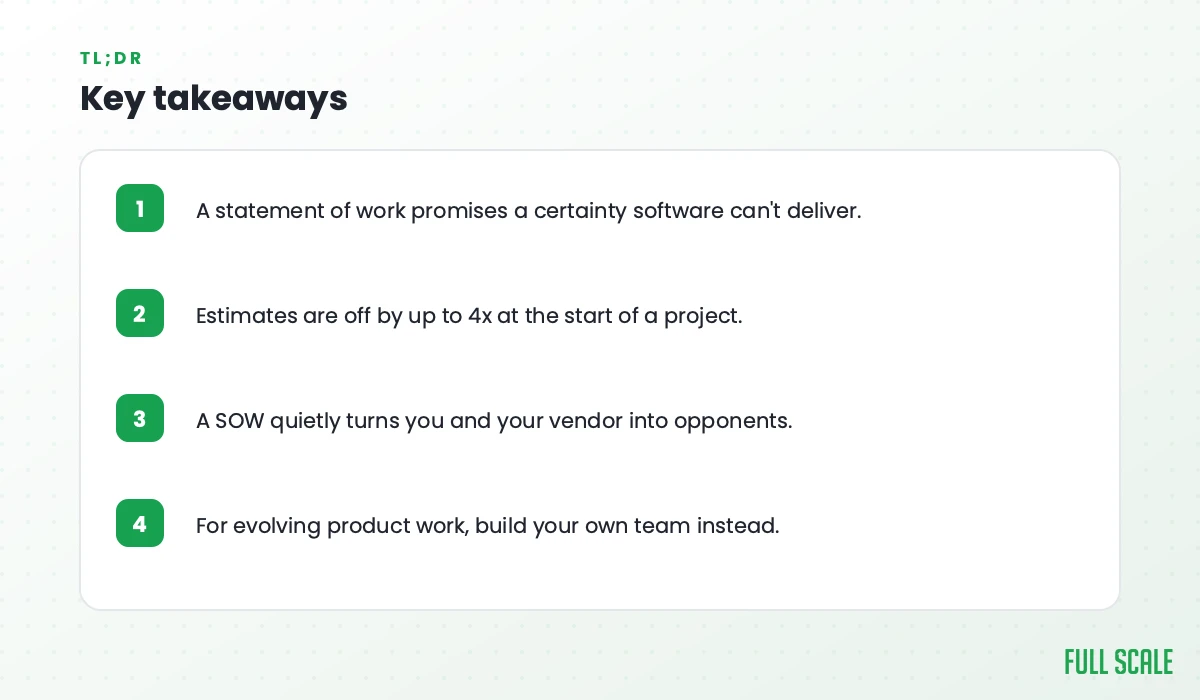
Quick Answer: A statement of work in software development is a contract that locks in scope, deliverables, timeline, cost, and acceptance criteria before work starts. The problem isn't the document structure, it's that the timeline and cost are estimates made before anyone writes a line of code, and the Cone of Uncertainty shows those early estimates can be off by up to 4x. A SOW is a reasonable fit for small, well-understood work outside your core product, like a marketing site or a one-time data migration. For ongoing product development, a dedicated team billed monthly, not a fixed-scope project, adapts as requirements change instead of locking in a guess. Full Scale staffs exactly that kind of dedicated team.
What a statement of work in software development is supposed to do
A statement of work, or SoW, is the document that defines a software project before anyone writes code. It lays out the scope, the deliverables, the timeline, and the cost. It says who does what, by when, and for how much. The sow process is meant to remove ambiguity so the client and the vendor agree on the same thing.
That is the theory, and on paper it sounds responsible. You scope the work, the vendor quotes a price and a date, you both sign, and now there are no surprises.
The problem is that software is not the kind of work you can describe accurately before you do it. A statement of work for software development tries to write down the future, and the future of a software project does not hold still long enough to be written down.
What goes into a statement of work for software development
If you are writing one or reviewing one, here is what a standard statement of work for software development actually contains. Most SOWs run through some version of these seven components.
| Component | What it defines |
|---|---|
| Scope of work | What the vendor will build, feature by feature or module by module |
| Deliverables | The specific outputs the vendor hands over at each stage |
| Timeline and milestones | When each deliverable is due and what “done” looks like at each checkpoint |
| Cost and payment terms | The total price, how it is structured (fixed bid, milestone-based, retainer), and when payments are due |
| Acceptance criteria | How the client decides whether a deliverable meets the spec |
| Change order process | How scope changes are requested, priced, and approved once work is underway |
| Assumptions and dependencies | What both sides are counting on to stay true (third-party APIs, client-provided data, access to systems) |
That list looks complete, and a well-written SOW does cover all of it. The problem is not the document structure. It is that the two numbers everyone cares about most, the timeline and the cost, are estimates made before anyone writes a line of code. The rest of the document is built on top of those estimates. When they are wrong, and they almost always are, everything downstream breaks.
The timeline and the cost are the two lines that are always wrong
McKinsey studied this with Oxford and found that large IT projects run 45 percent over budget and deliver 56 percent less value than predicted. That is not a list of bad teams. That is the average. The plan is wrong nearly half the time on money alone, and that is before you ask whether the thing you built was worth building.
A statement of work puts a date and a dollar figure at the top of the page and asks both sides to treat them as commitments. Then reality shows up. Let me go into why each number breaks, because the reasons are different.
Why the timeline in a SoW is always off
The honest answer is that nobody can estimate work they have not done before, and almost all software is work nobody has done before.
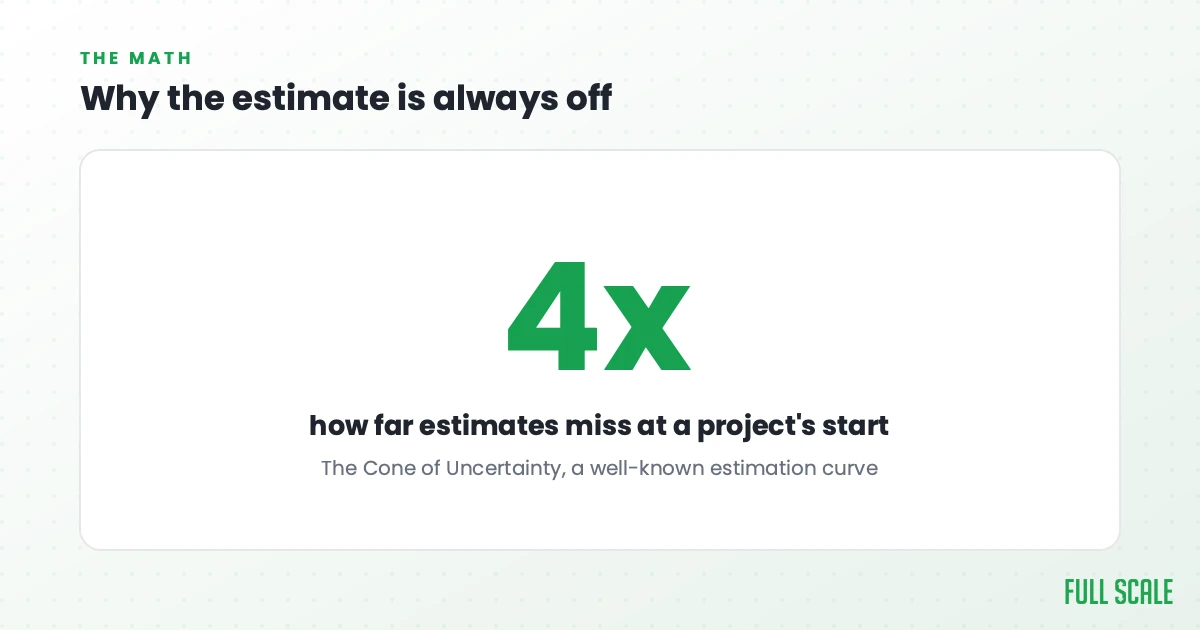
There is a well-known idea in engineering called the Cone of Uncertainty, documented by Steve McConnell. At the start of a project, software estimates are off by a factor of four in either direction. Even after you have gathered requirements and planned carefully, the estimate is still give or take 50 percent. That is not a skill problem you can hire your way out of. It is the math of guessing at work that is new.
Asking a developer to estimate a brand-new feature is like asking a chef who only cooks pasta how long it takes to make sausage from scratch. They have seen it done. They understand the idea. But they have never actually done it, so the answer is a guess wearing a confident face.
Then the statement of work makes the guessing worse. The developer who knows a feature will take twelve weeks gets pushed to say ten, because the buyer wants a smaller number to sign. Ten becomes eight. Eventually somebody signs a date nobody believes, and the date is now in a contract. The SoW takes the most pressured guess anyone made on day one and freezes it as the deadline for the next six months.
And when that frozen date starts to slip, the reflex is to add more developers, which usually backfires. Brooks’s Law is the old observation that piling people onto a late software project tends to make it even later, because the new hires need ramp-up time and pull the people who know the code into onboarding instead of building.
If you want the longer version of why software dates slip, I wrote about software project timelines separately. The short version is that new work always takes longer than you think, and the document does nothing to change that. It just raises the stakes when it happens.
Why the cost in a SoW is always off
The cost breaks for a related reason, plus one the buyer rarely sees.
The reason you see is scope. The product changes because you learn something, the market moves, or a customer asks for the thing you did not plan for. Every change runs into the same wall: it was not in the statement of work. So now you file a change order. You stop building and start negotiating. In my experience, scope on a project like this grows 20 to 40 percent past the original quote, and every point of that growth is a separate fight.
The reason you do not see is the padding. No serious vendor signs a fixed number they know is a guess and then eats the overrun out of kindness. They protect themselves by padding the quote 30 to 50 percent up front, so the price you got was never the real price. It was the real price plus a buffer for the risk they knew was coming. Either you overpay for a cushion you cannot see, or the vendor cuts corners when the hard parts arrive. Usually both, a little. I went deep on the pricing math of this in a separate piece on fixed cost software development, because the contract structure deserves its own argument. The statement of work is just where that structure gets written down.
A perfect statement of work is the wrong goal
The old advice, including the advice this very post used to give, was to write a more detailed SoW with tighter scope, clearer acceptance criteria, and more precise deliverables. Get the document right and the project goes right.
I do not believe that anymore. The more detailed the statement of work, the more confidently wrong it tends to be, because detail feels like certainty and there is no certainty to be had. You are writing a longer, more specific description of a future you cannot see.
The people who wrote the Agile Manifesto figured this out twenty-plus years ago. They said to value customer collaboration over contract negotiation, and responding to change over following a plan. A statement of work is contract negotiation, and it is a plan. It is the exact thing agile development was a reaction against. You can pick whichever software development methodology you like, but if you bolt a rigid SoW on top of it, you have quietly gone back to waterfall and put it in writing.
I say this as someone whose whole book is about getting requirements right. You don’t need rockstar developers. You need rockstar requirements. But “rockstar requirements” means staying close to the problem as you learn it, not locking a guess into a contract in month one. The Product Driven approach is about teams connected to outcomes, and a statement of work cuts that connection the moment it is signed.
The SoW quietly turns you and your vendor into opponents
Here is the part that costs you the most, and it never shows up as a line item.
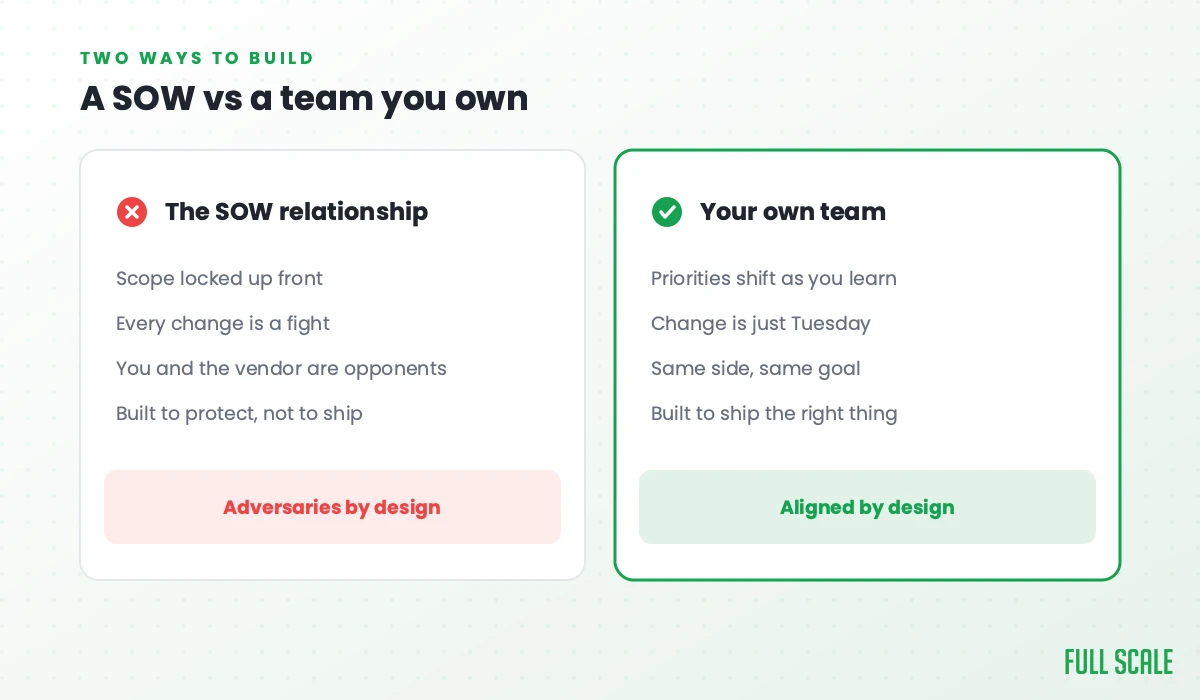
The day the statement of work is signed, you and your vendor want different things. You want the best product. They want to deliver exactly what the document says and not one hour more, because every hour past the scope is an hour they are not getting paid for. Now every conversation has a lawyer in the room, even when there is no lawyer in the room. Is that in scope? Is that a change order? Whose fault is the delay?
Most offshore collaboration fails for exactly this reason. People hand a pile of requirements to an outsourcing firm, then expect a great product to come back. A contract can buy you a vendor who cares about the document, but it can never buy you a partner who cares about your product. Make sure you work with a team that cares about your product, not just your project.
That is the whole game. The statement of work protects the project and sacrifices the product, which is the thing you actually care about.
The alternative: build your own team, not a statement of work
Stop buying a project defined by a document. Start funding a team that builds with you. I have walked through that exact fork, staff augmentation vs a statement of work, in more detail elsewhere.
This is the model we run at Full Scale, and it is the opposite of the SoW. You don’t write a fifty-page scope and hope. You hire a dedicated development team of senior engineers who work directly for you, full time, at a predictable monthly cost. That is what staff augmentation services are built to do. When the product needs to change this month, you do not open a change order. You have a conversation in your own standup, and the team builds the new thing. Nothing has to be renegotiated, because nothing was contracted except the team showing up and doing the work you direct.
The cost is the part that surprises people. A senior US developer runs 80 to 150 dollars an hour, and that is if you can hire one at all. Through offshore staff augmentation, a senior engineer bills in the range of 30 to 40 dollars an hour, which works out to a flat monthly number you can actually plan around. That is why so many teams now hire developers in the Philippines instead of signing a fixed-bid contract at home. The gap comes from cost of living. It has nothing to do with how good the engineers are. The Philippines is the third-largest English-speaking country in the world, and Filipino engineers communicate as well as anyone I have worked with in twenty years of hiring developers across half a dozen countries.
Here is how the two models stack up.
| What you are buying | Statement of work | Your own monthly team |
|---|---|---|
| The unit | A delivered scope | A team’s ongoing time |
| When scope changes | File a change order | Talk it through in standup |
| Who carries the risk | You, once the padding and change orders land | You, but with no markup and full visibility |
| The relationship | Client versus vendor | Your engineers, who you direct |
| At the end | A finished project, no team | A team that knows your codebase cold |
| The cost | A guessed number, revised upward | A predictable monthly rate per engineer |
Look at the last two rows. With a SoW, the day the project ends, the team walks and every hard-won lesson about your codebase walks with them. With your own team, that knowledge compounds. That is why staff augmentation beats project work for anything you plan to keep building.
There is a real cost difference in the people, too. US tech turnover runs 13 to 15 percent a year, so even an in-house team churns. Our developer retention is over 93 percent, which means the engineer who learned your product last year is still on it this year.
This is not hypothetical. AMC Theatres runs a global engineering organization where the developers we staff are treated as full AMC engineers rather than outside vendors, sitting in the same standups and held to the same standards as the Kansas City team. You can read how that works in the AMC Theatres case study. No statement of work produces a relationship like that. A team does.
When a statement of work is actually fine
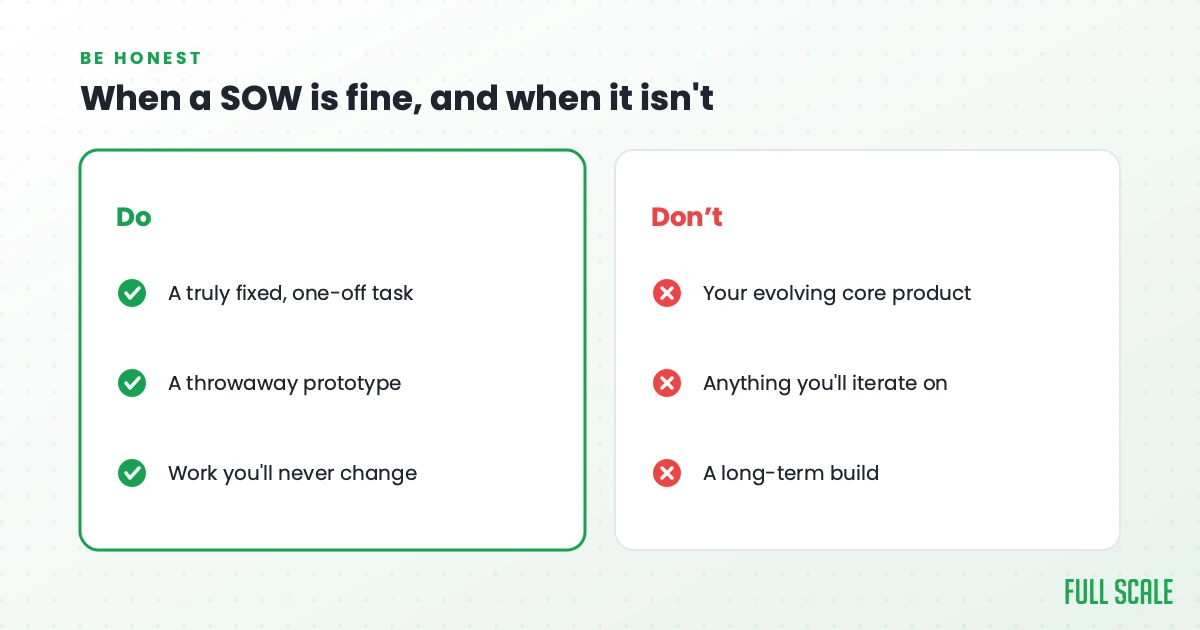
I am not against every statement of work. I outsource scoped work on a fixed scope regularly, and it works great. I have used a SoW for WordPress builds and a one-off Elasticsearch project, and I would do it again.
Three things were true every time. The scope was fully understood before I asked for a price. The work had been done a thousand times by the people I hired. And I had no interest in keeping a full-time WordPress person on staff afterward. A statement of work is the right tool for work that is small, well understood, and not part of your core product, like a marketing site, a clean data migration, or an integration against a stable spec. The moment the work is fuzzier than that, you are back in the world of communication problems in software development, where the spec and the build quietly drift apart.
The trouble starts when people use that same document to buy real product development, where the entire point is to learn what to build as you build it. We aren’t in this for some three-month project, and neither is any product worth funding. Hire talent to work directly for you on a long-term basis. Don’t hire them just for a project.
Frequently asked questions
Why do software projects always go over the statement of work timeline?
Because software estimates are guesses about work that has never been done before. The Cone of Uncertainty shows estimates are off by up to 4x at the start of a project and still off by 50 percent after planning. A statement of work freezes that early guess as a commitment, and the pressure to quote a small number makes the guess optimistic on top of that. The date slips because the date was never real, not because the team failed.
Does a more detailed statement of work prevent budget overruns?
Usually not. More detail feels like more certainty, but it is a longer description of a future you cannot predict. The cost overruns come from scope changes you could not have known about on day one, plus the risk padding the vendor builds into any fixed quote. A thicker document does not remove the uncertainty. It just raises the stakes when reality arrives and turns each change into a formal change-order fight.
What is the alternative to a statement of work for software development?
Hire a dedicated team that works directly for you at a predictable monthly cost instead of buying a fixed-scope project. With staff augmentation, you direct the work, adapt as priorities change, and keep the institutional knowledge in-house. Offshore staff augmentation makes this affordable, with senior engineers in the Philippines billing 30 to 40 dollars an hour versus 80 to 150 for a US developer. You are paying for a team’s ongoing time instead of a fixed deliverable.
Is a statement of work ever the right choice?
Yes, for work that is small, well understood, and outside your core product. A marketing website, a one-time data migration, or an integration against a stable spec are all good fits, because the scope really is knowable in advance. The model breaks down for ongoing product development, where the requirements change as you learn and the team needs to stay with the codebase for years.
Stop writing the perfect statement of work and build the team instead
The best statement of work in the world is still a guess about the future dressed up as a promise. The timeline will slip and the cost will climb, not because your vendor is bad, but because that is what software does. The fix is a better arrangement, where your own engineers build your product and adapt the work as you learn.
Schedule a call and we will talk through what a long-term team would look like for your product.