
How to Hire an Offshore Development Team: 8 Steps to Day 90

In this article
- Name who on your side will direct the work
- Pick the engagement model before the country
- Pick the country last
- Decide who employs the engineers
- Write a 90-day scope for every seat
- Interview the people who will do the work
- Sign one contract with a company you can reach
- Run the first 14 days like a local onboarding
- How long it takes to hire an offshore dev team
- What an offshore team costs per seat
- Where Full Scale fits in the sequence
- Frequently asked questions
- Take the eight steps to a real conversation
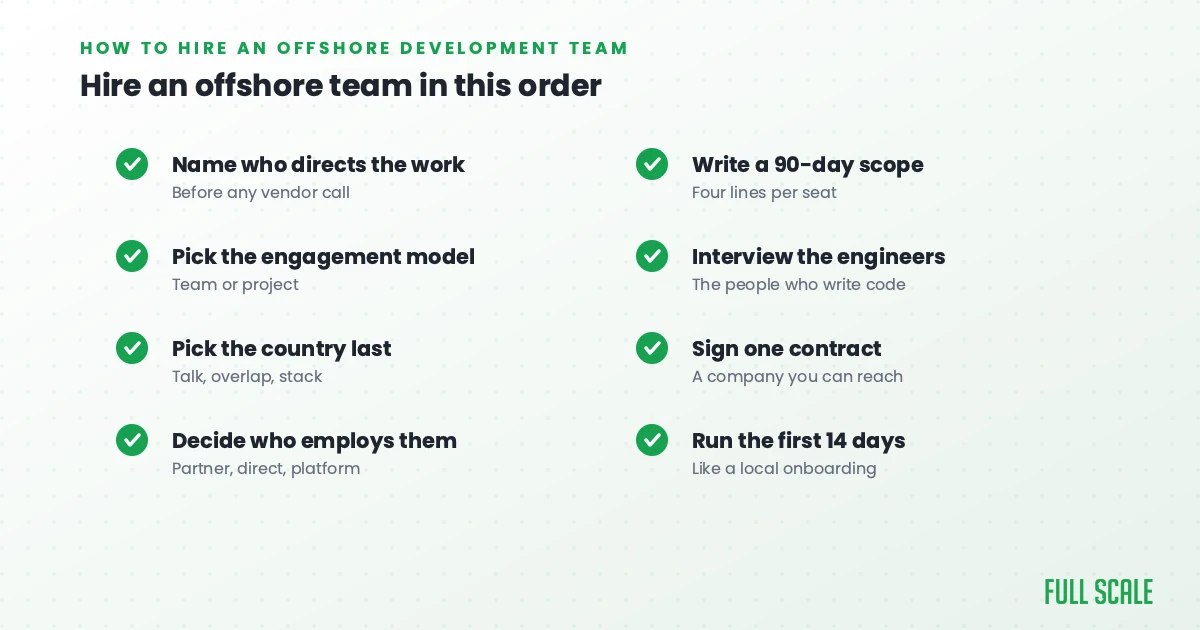
Quick Answer: To hire an offshore development team, make eight decisions in order: name who on your side directs the work, pick the engagement model, pick the country, decide whether a partner employs the engineers, scope the first 90 days, interview the people who will do the work, sign one contract, and run the first 14 days like a local onboarding. At Full Scale, engineers can start in as little as 7 days, and the slowest step is usually the buyer's own approval process.
At Full Scale, we can have developers working in as little as 7 days. The bottleneck is almost always getting approval within your organization. Hiring an offshore development team is 8 decisions and each decision eliminates others. Pick the country too early and you might be shopping for a service the country doesn't provide. Hire a vendor before you've named who on your side will direct the work and you're just paying for idle time.
Most of these steps already have their own articles, so I won't cover all the details here. Instead, this is how the sequence works, and I'll link out to other articles for more detail. If you already know you want to hire developers in the Philippines, Full Scale staffs them through our hire developers in the Philippines page. You'd still follow the same process outlined in this article. If you've already decided you want a dedicated team, we have a guide to how to hire a dedicated development team which adds a five-question vendor screen.
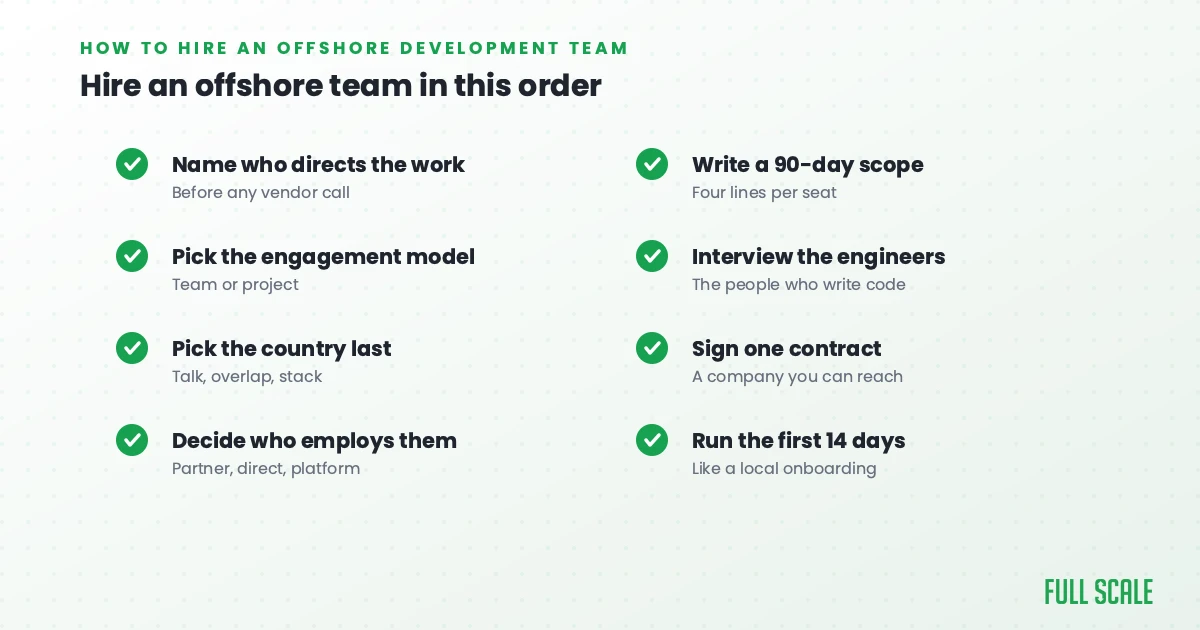
Name who on your side will direct the work
A team in another country needs someone in your company who can prioritise, code review and reject a bad idea. I have always been a fan of in-house tech leadership, and offshore development does not change that. If anything it increases the importance. Because nobody walks past a developer's desk and notices they're stuck. Check that person's calendar, not their job title. If a director is fully booked then they cannot answer a question in the 3-4 hours of overlap time. And if a developer cannot get an answer then they will wait, or guess. Waiting is costly. Guessing is even worse. If you cannot name that person, stop reading, go and read whether your company is ready for offshore development, which explains what to do if you cannot answer yes.
Pick the engagement model before the country
The model determines if you're purchasing a team or a project. That alone disqualifies most vendors before you've even looked at a single rate. If your work has specifications and a deadline, then a project-based model works. If your product is always evolving, you need people who will be with you for the long term, and you'll need either staff augmentation or a dedicated team.
For many years, my advice has been the same: hire people to work for you for the long-term, not for a single project. Collaborating offshore rarely works when you drop a list of requirements off at an outsourcing company and hope a finished product comes back. This guide to offshore development models walks through each model and its cost, and this article on what a dedicated team is covers the model that most product companies end up opting for.
Pick the country last
Picking a country first is like picking a wedding venue before deciding whether to get married. The venue is great and now you've lost your deposit.
You can determine whether a country will work with your team using three questions that will eliminate most options faster than a rate card:
- Is there anyone there who can communicate with your team in English without a translator?
- Can they work at least 3-4 hours per day when your team is available?
- Does that country's talent pool have your stack at the seniority you need?
Full Scale's standard is a 3-4 hour daily overlap. Engineers will adjust their schedule to ensure they can meet this requirement. Some teams do full US hours while others will only have one stand-up call during that window and then work asynchronously. Overlap is therefore determined by business need and not by geography. I write more about this in my article about time zone differences on remote software teams here.
I have hired teams from Uruguay, Colombia and the Philippines and all have had varying degrees of success. The ones that didn't work all had the same problem: nobody was accountable for the product. This goes right back to that initial director you needed to find and it's why I suggest fixing your end of things first before looking elsewhere.
I selected the Philippines in 2018 in part because of its large population of English speakers. The Philippine Embassy calls it the third largest English-speaking country in the world, which makes the first question an easy yes. If you want to compare each individual country, please see our blog post about the best countries for offshore software development, and if time zones are your primary concern, offshore vs nearshore is the place to settle it.
Looking only at the hourly rate is what we refer to as cheapshoring. Often, what you save up front comes back to bite you later in the form of rework.
Decide who employs the engineers
How to hire offshore software developers: through a partner, direct, or on a platform
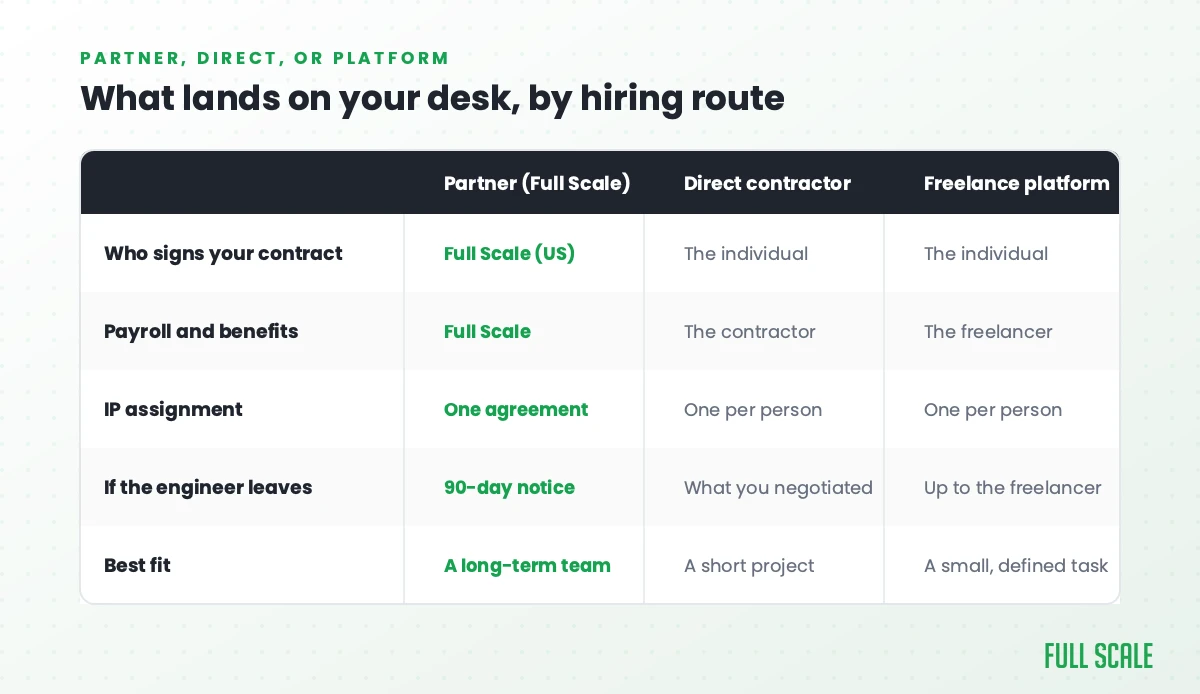
You can get offshore developers through a partner who employs them, directly as contractors, or via a freelancing site. The question is how many employer responsibilities wind up on your plate. The table below details where each option places responsibility.
| What lands on your desk | Partner that employs the engineers (Full Scale) | Direct contractor | Freelance platform |
|---|---|---|---|
| Who signs your contract | One company: Full Scale, a US company | The individual contractor | The individual, under the platform's terms |
| Payroll, benefits, equipment | Full Scale handles payroll, benefits, equipment, and HR | The contractor handles their own | The freelancer handles their own |
| IP assignment | One agreement with Full Scale; the contract chain runs from you to Full Scale to the engineer | A separate assignment for each person | A separate assignment for each person |
| If the engineer leaves | Engineers sign a contract requiring 90 days' notice | Whatever you negotiated | Whatever the freelancer decides |
| Best fit | A long-term team in your own codebase | A short project with a clear end date | A small, well-defined task |
Most people gloss over the IP row. According to the US Copyright Office's Circular on works made for hire, a commissioned work qualifies as a work for hire if it falls into one of nine specified categories and if both parties execute a written agreement. Software is not one of the nine categories, and an atlas is. Additionally, if the contractor is based overseas, DLA Piper's lawyers warn that the concept of a work made for hire may not be recognized in foreign jurisdictions and that present assignment clauses may not be enforceable according to local laws. I am not a lawyer, so let your lawyer review the language.
Or you might want to find your own talent. Our how to hire software developers article covers the sourcing process.
Hiring them directly in another country also brings local employer obligations. The Philippine Department of Labor and Employment handbook on statutory benefits requires employers to provide rank-and-file employees with a thirteenth month's pay of no less than one-twelfth of their basic salary, due by December 24.
That's just one thing on your plate, so we can see why a partner would be helpful. Our legal requirements for hiring developers in the Philippines article covers everything else. And our due diligence checklist shows you how to vet a partner before you choose them.
Write a 90-day scope for every seat
Write down what each seat will own in the first 90 days before you call a single engineer. Ninety days is short enough to be real, but long enough to prove a team works. Four lines per seat is all you need. Write what piece of the product they'll own, write the first pull request you expect them to submit, write who will review their work, and write what a good day-90 review looks like.
The last line will pay you back twice. First, it tells the interviewer what you want to evaluate. Second, it gives you a measuring stick at the end that doesn't rely on the opinion of anyone involved.
This is also where I'd add the line that really matters in my book, Product Driven: you don't need rockstar developers, you need rockstar requirements. A seat with a defined scope will outperform a rockstar with a loose one.
Interview the people who will do the work
The best interview is the one where the person sitting across from you is the person who will be writing your code. Every candidate passes through four steps at Full Scale: a recruiter screen; an engineering-manager interview evaluated using a six-part scorecard; a meeting with our sales team that results in a recommendation instead of a stack of resumes; and then you. Every placement is dedicated and full-time, so the engineer you approve is the engineer who shows up. The only positions that aren't full-time are project managers and UX designers, and that's only if you request them as such. You can see the full process on our page about how Full Scale hires engineers.
No matter which approach you use, always insist on meeting the people in video interviews before you agree. How to handle those interviews is described in how to interview offshore developers and how we evaluate them is in how we interview developers.
Here's a practical note for buyers new to outsourcing. We use an independent company in the Philippines to conduct eight background checks, which takes roughly two weeks. We'll frequently begin an engineer's work while the background check is still in progress, on the condition that a bad result is grounds for immediate termination. But if you want the results in hand before anyone touches your systems, just tell us during the first call and we'll finish it before they get access. You can read more about how we background check developers.
Sign one contract with a company you can reach
Sign a single agreement with a company that has a legal address and a real employment relationship with the engineers. In an offshore situation, the contract is where most of your protections lie because you can't just go next door and rectify a problem later.
Understand four things in a contract: billing, rate changes, ownership, and exit strategy. At Full Scale, all the responses are brief. Payment is done upfront via ACH, with terms of Net 10. There's an automatic 6% per year escalator in the rates, broken up into two 3% increases, disclosed in the contract from day one. We never reuse code we've created for you elsewhere. There's a two-week money back guarantee, then 30-day notice to drop a developer, with no lock-in periods. See our checklist of staff augmentation contract terms and a step-by-step review of what to look for in a software development agreement template for more detail.
Run the first 14 days like a local onboarding
Treat the first 14 days the way you'd treat a local hire's: the same daily stand-ups, the same code access, the same pull request process.
Engineers from Full Scale are added to your team, and they report to you, not a third party who translates between you and whoever writes your software.
A good 14 days consists of: No setup tickets on day one because the accounts, repository access, and architecture overview have been set up ahead of time; a small, real pull request in week one; by day 14, your new hire is already in your stand-ups and contributing code. At this stage, we consider them onboarded.
Our developer onboarding guide contains the complete checklist, and how to manage a dedicated development team explains who's accountable for what after that. Then, go back to the 90-day scope you created earlier.
Every Full Scale customer has a Customer Success Manager who meets weekly with the developer team and monthly with you. Every account also receives a quarterly business review with leadership at Full Scale.
Conduct your own day-90 review against the four criteria above, and tell us honestly if it's a "no." 30 days is our standard notice period.
How long it takes to hire an offshore dev team
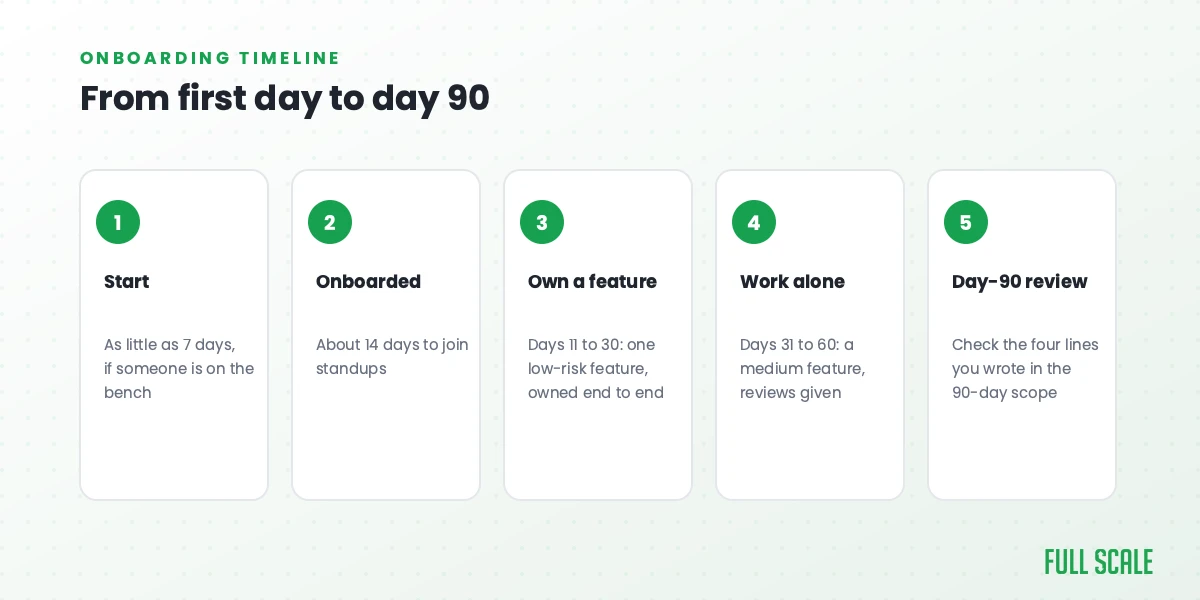
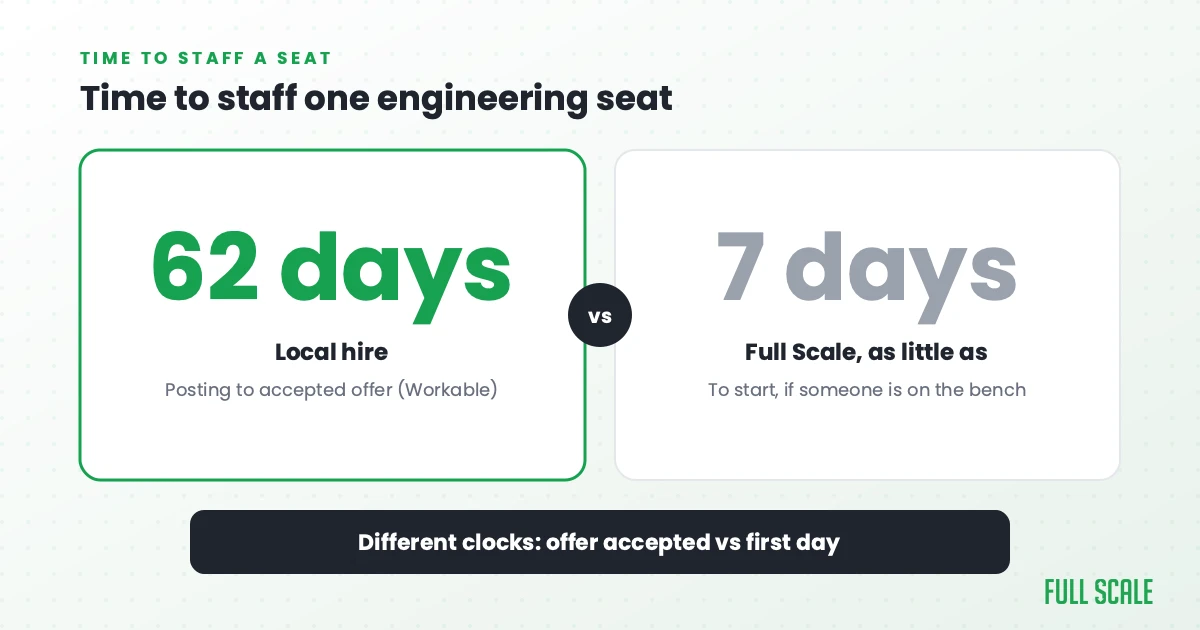
Full Scale can usually start an engineer in as little as 7 days and a dev already on the bench can join an existing team in as little as 24 hours. A fully onboarded engineer takes about 14 days. The long half of the calendar is yours. Workable reports that global average for filling a tech role at 62 days from posting a job to an accepted offer. Factor in a notice period and a local hire still has no desk. Here's where the time goes with an offshore team.
| Stage | Who sets the pace | Where the time goes |
|---|---|---|
| Director, model, country | You | Internal agreement on who owns the work |
| Partner or direct | You | Comparing partners, reading references |
| 90-day scope | You | Writing four lines per seat |
| Interviews | Full Scale for the shortlist, you for the decision | Candidate recommendation, then your calendar |
| Contract | You | Legal review, which runs on geological time |
| Onboarding | Both | About 14 days to be in your standups |
It can take some clients weeks to clear a master services agreement. Full Scale will typically interview and staff an engineer before a client clears its legal review. To fast-track the process, send the MSA to your lawyer on the day you select a partner, not the day you select an engineer.
What an offshore team costs per seat
The rate for a Full Scale engineer begins at $35 an hour fully loaded. In a typical month with about 173 working hours, that's roughly $6,000 per month for one full-time developer. A loaded US senior developer will charge between $80 and $150 an hour, which comes out to between $13,800 and $26,000 per month. That's why Full Scale customers generally save between 50 and 70 percent versus hiring the same person in the United States.
That's the US side of the equation, but it's public information. The Bureau of Labor Statistics says that the median software developer salary was $135,980 in May 2025, and wages are 70% of what private employers spend on compensation. So if you divide one by the other, you'll find that the median US software developer costs about $194,000 per year all in.
We start our rates at $35, but it isn't a flat fee: the final rate depends on experience level, skills, and team size. You can learn more on our pricing page.
Where Full Scale fits in the sequence
Full Scale will assign engineers based throughout the Philippines to your team via staff augmentation from $35/hr fully loaded with a US contract, single employer, and 93%+ retention. You still select the director, the engagement model, the country, and the 90-day scope, since no one can do that for you. We handle the sourcing, vetting, payroll, employment agreement, and equipment, leaving you with the steps that relate to your business.
If it isn't working out in the first two weeks, you get your money back. After that, you can let go of a developer with 30 days' notice. These terms are detailed in when it isn't working out. If you have chosen another country or another structure, the order remains the same.
Frequently asked questions
How do you hire an offshore development team?
Hire an offshore development team in eight steps: name who on your side directs the work, choose the engagement model, choose the country, decide whether a partner or you employ the engineers, scope the first 90 days, interview the engineers who will do the work, sign one contract with a reachable company, and run the first 14 days like a local onboarding. At Full Scale, engineers can start in as little as 7 days, and the first two weeks carry a money-back guarantee.
How long does it take to hire an offshore dev team?
Through Full Scale, an engineer can start in as little as 7 days when someone suitable is on the bench, and full onboarding into your codebase takes about 14 days. The slower part is usually the buyer's own process, such as internal interviews and contract approval. Workable puts the global average for filling a tech role at 62 days from posting to accepted offer, so a partner with a bench is faster even before any notice period.
How do you hire offshore software developers without a recruiter or a vendor?
You can hire a contractor directly or use a freelance platform, but you then carry the vetting, the contract, the IP assignment, and the local payroll rules yourself. If you set up your own entity in the Philippines, you also take on employer duties such as the mandatory 13th-month pay. For a long-term team inside your own codebase, a partner that employs the engineers puts all of that into one contract.
What is the cost of hiring an offshore development team?
At Full Scale, dedicated engineers start at $35 an hour fully loaded, which is about $6,000 a month for one full-time developer at roughly 173 working hours. A loaded US senior engineer runs $80 to $150 an hour, so Full Scale clients typically save 50 to 70% against a comparable US hire. The final rate depends on seniority, skill, and team size.
Should you hire an offshore team directly or through a partner?
For ongoing product work, a partner that employs the engineers is usually the safer route, because one contract covers payroll, confidentiality, and IP assignment for every engineer. Direct contractors and freelance platforms fit a short project with a clear scope and an end date. Full Scale employs every engineer it places, and the client contract is with Full Scale, a US company.
What if the offshore team is not working out?
At Full Scale, the first two weeks carry a money-back guarantee, and after that you can drop a developer with 30 days' notice and no long-term contract. Schedule a review before day 14 so the decision lands inside the guarantee window.
Take the eight steps to a real conversation
Come with your 90-day plan and the most difficult questions you have. Schedule a call with Full Scale and we'll go through the process with you, including the step where we tell you when offshore may not be ready for you yet.