
How Do I Know If My Company Is Ready (or Not) for Offshore Development?

In this article
- When to outsource software development, in one sentence
- Is my company ready for offshore development? Ask this first
- What “yes” actually looks like
- What “no” actually looks like
- Can you offshore with zero in-house leadership? Technically, yes
- What “ready” looks like in practice, not headcount
- When you should wait
- Frequently asked questions
- Ready to find out for sure?
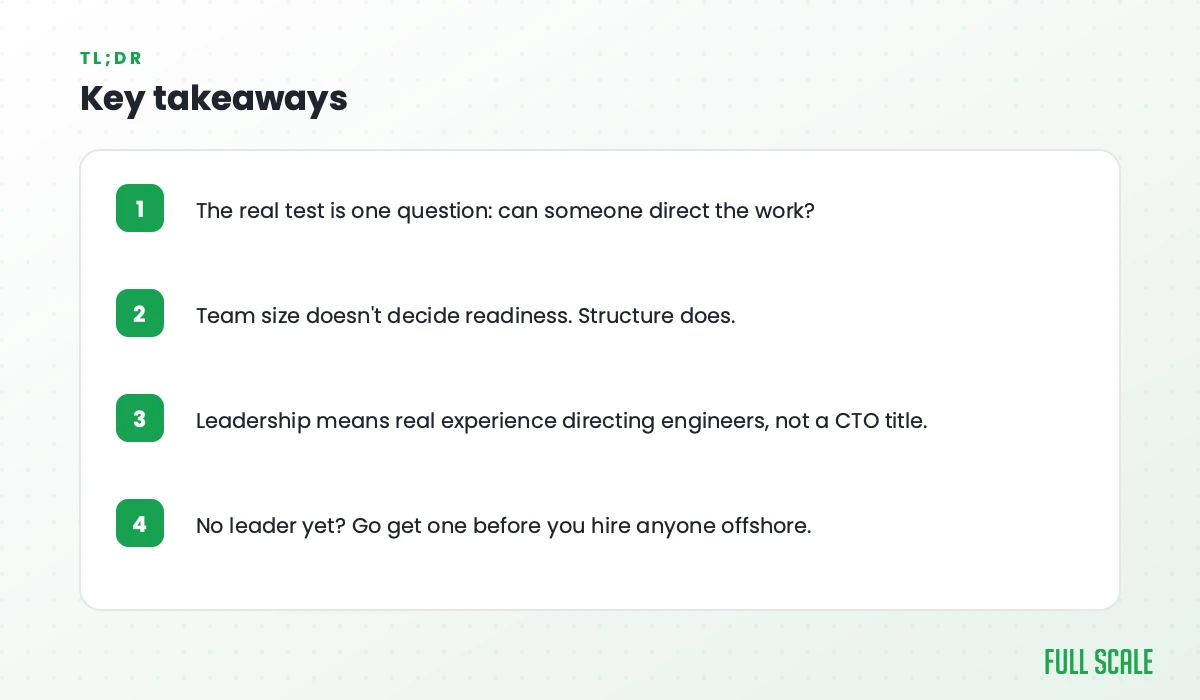
Quick Answer: Your company is ready for offshore development when someone inside it can already direct engineers. It’s not a checklist of budget or deadline pressure. The real test is one question: do you have an in-house engineering or product leader? If yes, even without a formal title, offshore staff augmentation works well. If no, go get that person before you hire anyone offshore.
If you’re thinking about hiring offshore developers, how do you know if you’re actually ready?
Missed deadlines, a team stretched thin, skills you can’t find locally, a budget that’s too tight, those tell you why you’re looking. They don’t tell you whether you’re ready to manage what you find. I’ve watched companies hit every item on that list and still fail, and I’ve watched companies that looked underqualified on paper succeed without a hitch. The difference was never the symptoms. It was one thing: whether somebody on the inside could actually direct the work.
When to outsource software development, in one sentence
The right time to outsource software development is when your roadmap has outgrown what you can staff locally, and someone in your company can already direct the people you bring in. That’s the same math I laid out for startups specifically weighing offshore development: get the timing right without the second half, and you’ve just outsourced the confusion.
Is my company ready for offshore development? Ask this first
If I only get to ask a prospect one thing on a discovery call at Full Scale, it’s this: do you have an in-house engineering or product leader?
That’s not “do you have a budget,” and it’s not “is your roadmap bigger than your team.” Those questions tell me why you’re calling. This question tells me whether calling is going to work.
Staff augmentation adds developers to a team that already exists. It doesn’t build you a team from nothing. You need people to augment to. It works best when you already have in-house leadership to manage the additional engineers before you bring in staff augmentation at all. Skip that part and you haven’t hired help, you’ve hired more of the same problem.
What “yes” actually looks like
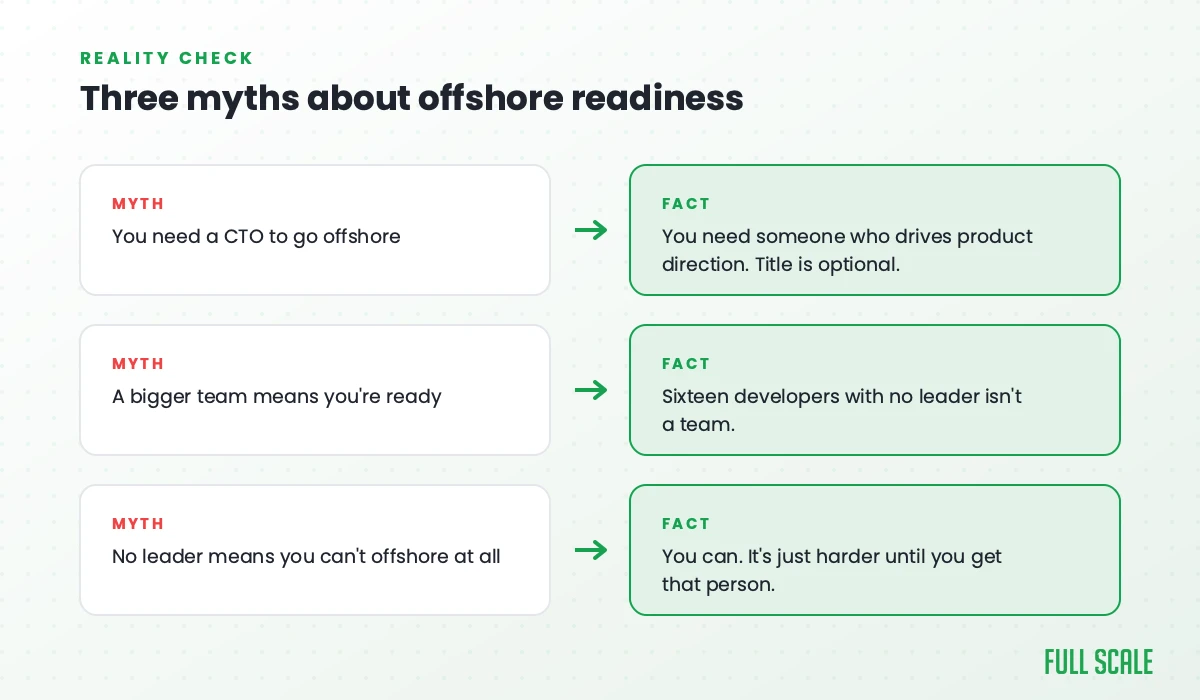
Here’s where most of these checklists get vague, so let me be specific. A “yes” doesn’t require a CTO with a fancy title. It requires someone with real experience directing engineers or building software, whether or not that’s what their business card says.
One of the best developers I ever worked with at Stackify never had a management title. He owned our APM monitoring support across every open-source language we touched, Java, Node.js, PHP, Python, all of it. He decided which frameworks we’d support and what “done” meant for each one. Nobody appointed him to that. He just did the job of a leader while carrying the title of senior developer. That’s the standard. Ownership is a mindset and a set of reps, not a line on an org chart.
So when I say “in-house leadership,” I mean a real technical reviewer, someone who can look at a pull request and know if it’s actually good, who can tell an offshore engineer “that’s not what I asked for” and be right, who can make the fifty small technical calls a week that never make it into a meeting. If that person exists, even without the title, you’re closer to ready than a company with a framed CTO business card and nobody who can explain what the product actually does.
That leadership test is necessary, but I won’t pretend it’s the only thing that decides whether an offshore engagement works. A well-led team can still get burned by a bad vendor, a rotating cast of developers instead of a dedicated team, or a company that doesn’t actually vet who it hires. Leadership is the variable you control. Vendor quality is the one you’re trusting someone else to get right, so check it before you sign anything.
I built exactly this at Stackify. I had strong developers in Kansas City, a roadmap that needed roughly ten more engineers, and no version of the math where I could afford ten more US salaries. I built the extra capacity in the Philippines instead. That team grew past twenty people, and it survived two acquisitions, Netreo bought us in 2021 and BMC bought Netreo in 2024, without a single one of them leaving either time. None of that works if there isn’t someone already steering the ship when the new engineers show up, and it’s the same reason Full Scale’s own developer retention runs north of 93%, against an industry that churns 30 to 50 percent a year: the teams that stay are the ones with somebody worth staying for.
What “no” actually looks like
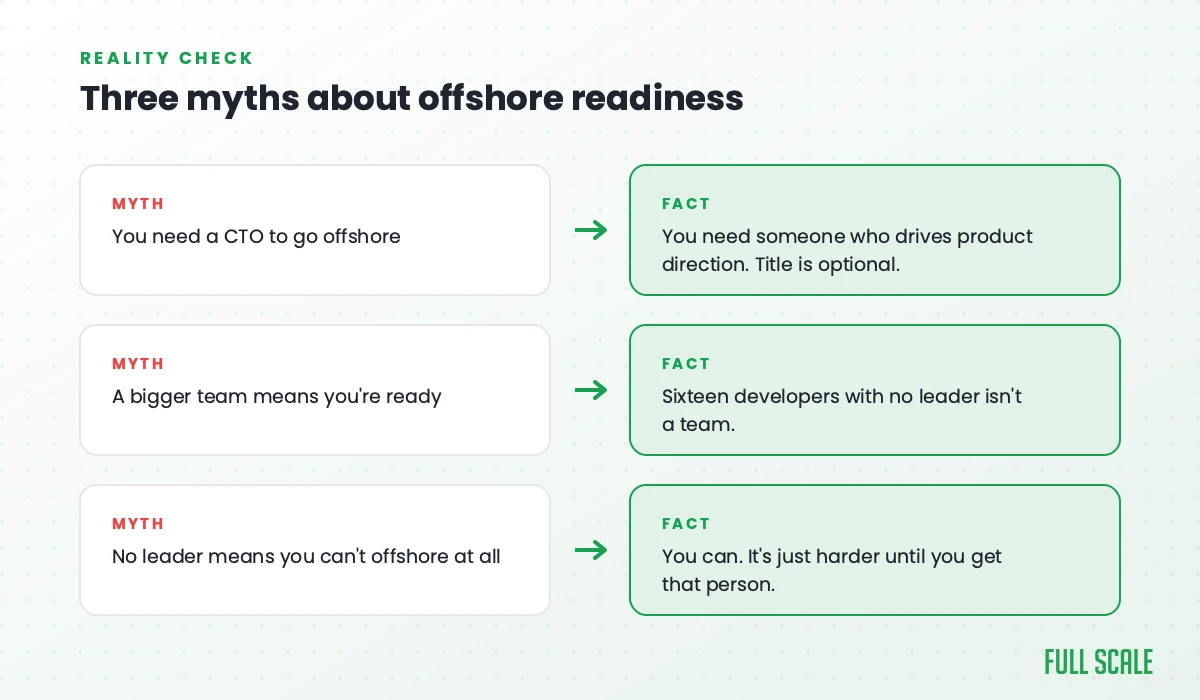
A friend of mine has sixteen software developers in Pakistan. He calls me all the time, frustrated, because something is clearly wrong with the team and he can’t figure out what.
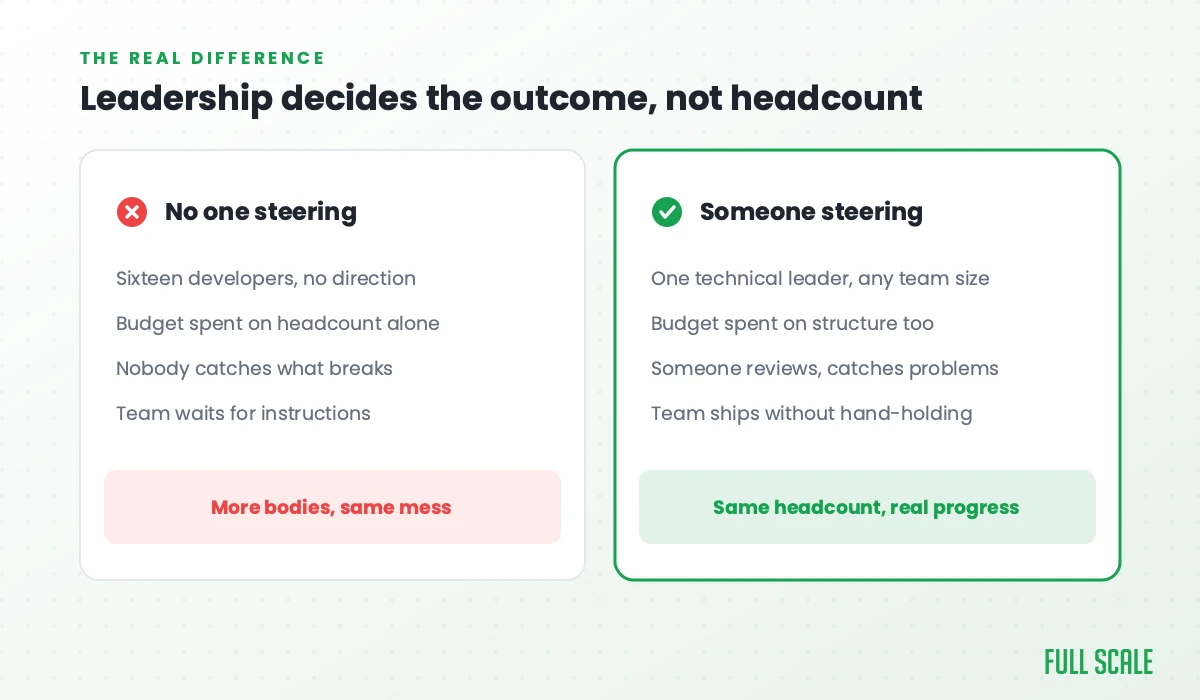
Every time, I tell him the same thing, and every time he’s surprised to hear it. The sixteen developers were never the issue. What he skipped was everything that has to sit around them, someone directing the work, someone managing the project, someone thinking about product, someone catching what breaks. He spent his whole budget on headcount and none of it on the structure that makes headcount useful. Betting everything on the cheapest bodies you can find instead of the right structure is common enough that I have a name for it, and it costs more than it saves.
Sixteen developers looks like a real team on paper. It isn’t one. A team without anyone to set direction is just sixteen people waiting for instructions nobody’s giving them. I’ve told him this for years and he still calls, which either means he hasn’t fixed it or I’m a terrible consultant. Possibly both.
Can you offshore with zero in-house leadership? Technically, yes
I won’t tell you it’s impossible, because it isn’t. You can hire offshore developers with no internal technical leadership at all. It’s just a lot harder, and it stays hard until you either learn to manage the work yourself or hire someone who already knows how. That’s the real fork, not a third option, so pick a side of it deliberately instead of drifting into offshore hiring and hoping it sorts itself out.
If you’re a non-technical founder who wants to hand the whole thing off and disappear, don’t drift toward staff augmentation, because it’s the wrong tool for that job. What you actually want, at least for now, is a consulting firm that owns the outcome and supplies the engineering leadership as part of the deal, someone accountable for a shipped result, not just billed hours, because that direction is the expensive part you’re trying to skip. Offshore staff augmentation gives you excellent engineers at a great rate. It does not hand you a CTO, and no vendor who tells you otherwise is being straight with you. Use the consulting route as the bridge while you build or hire the leadership yourself, not as a permanent substitute for having it.
What “ready” looks like in practice, not headcount
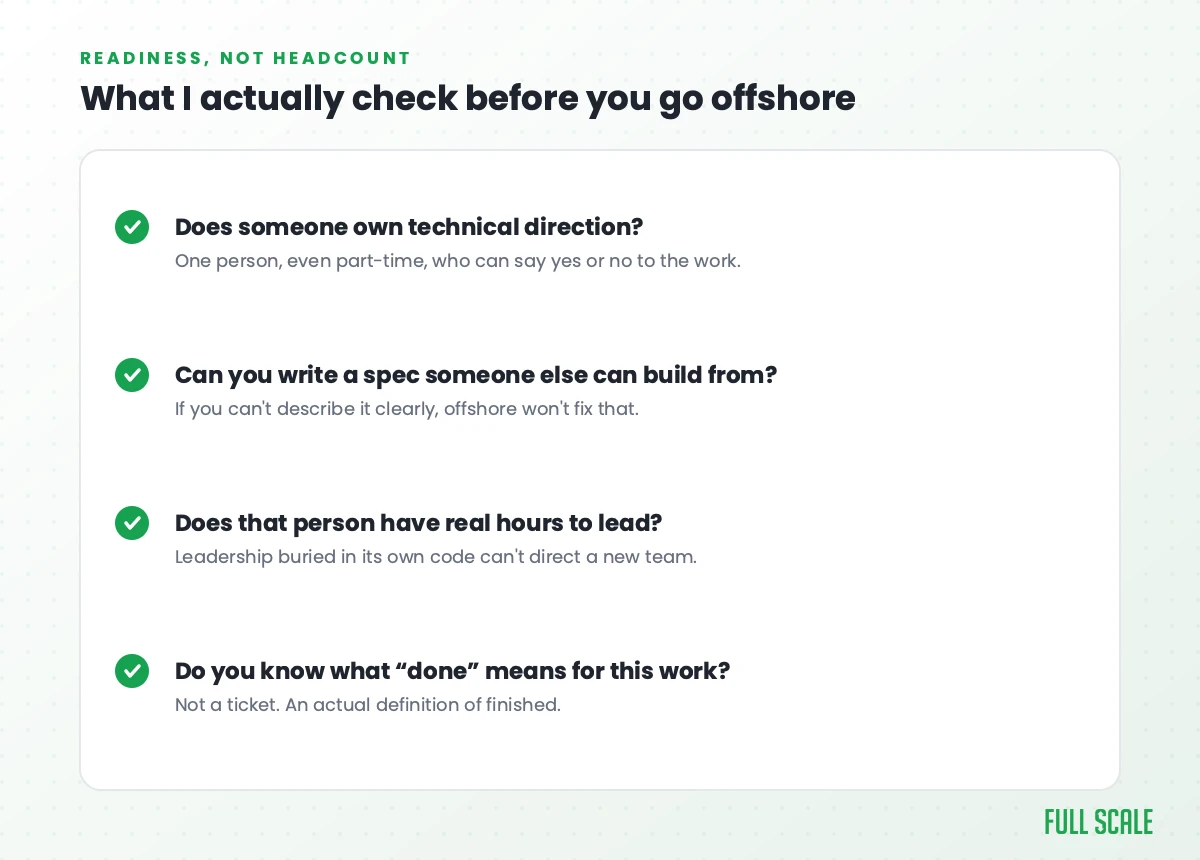
Assuming you’re either building toward that leadership or you already have it, forget team size next. I’ve seen a two-person shop that was completely ready and a twenty-person shop that wasn’t, because size was never the variable. Structure was. In my book, Product Driven, I break this down into three kinds of clarity a team needs before it can move fast at all: what you’re building and why, what’s in scope and what isn’t, and how it should actually get built. Offshore developers don’t create any of those three. They execute against them. Here’s what that looks like in practice, split into the four things I actually check for:
Someone owns technical direction. One person, even part-time, who reviews the work and can say yes or no to it. Doesn’t need the CTO title. Needs the judgment, and the willingness to actually use it instead of rubber-stamping whatever shows up in the pull request.
You can write a spec someone else can build from. If you can’t describe what you want clearly enough for another engineer to start, the gap is internal, and offshore developers won’t paper over it. They’ll just build the wrong thing faster and cheaper than a local team would have.
Somebody has the hours to actually direct people. Leadership on paper that’s too buried in its own coding to answer a Slack message for three days isn’t leadership a new team can work with. Standups need a human in them, not a calendar invite that gets declined every week.
You know what “done” means for the work you’re handing off. Not a Jira ticket. An actual definition, even a rough one, of what finished looks like, so nobody’s guessing at the finish line three weeks in.
Three or four of these, even loosely, and you’re in better shape than most companies twice your size.
When you should wait
If you have no one who can direct technical work, and no plan to get that person before your first offshore hire starts, wait. Most articles selling offshore development won’t tell you that, because it costs them a sale. I’d rather tell you now than take your money and watch it go sideways, then have you tell everyone at your next conference that offshore doesn’t work.
Go find that person first, whether that’s hiring a technical co-founder, promoting your best engineer into the role, or bringing on a fractional CTO. Do that before you call anyone, including me. The developers you hire after that point will be dramatically more useful than the same developers hired six months earlier into a leadership vacuum, and you’ll spend a lot less time writing frustrated emails about a team that was never actually broken.
Frequently asked questions
When should a company outsource software development?
When your roadmap needs more engineers than you can hire affordably or quickly enough locally, and you have someone in-house who can direct the technical work. Waiting until you’re desperate makes the decision worse, not more careful. Companies that outsource from a position of growth, with the leadership question already answered, get a working team fast. Companies that wait until they’re in crisis end up rushing both decisions at once and get neither right.
Is my company too small for offshore development?
Probably not. Team size matters less than structure. A two-person company with one person who can set technical direction is more ready than a twenty-person company with nobody steering. What matters is whether someone can own the work, not how many people are on the payroll.
What do I need in place before going offshore?
Someone who owns technical direction, and enough clarity to describe what you’re building well enough for another engineer to start on it. If writing that description is hard, that’s the real gap, and no amount of offshore talent fixes it.
What’s the difference between staff augmentation and traditional outsourcing?
Staff augmentation means dedicated developers who join your team, take your direction, and work in your codebase. Traditional outsourcing means handing a whole project to a vendor who manages it separately, direction included. If you have no in-house leadership at all, traditional outsourcing or a consulting engagement is the better fit, because it comes with the direction you’re missing. If you do have that leadership and just need to decide whether the new hires sit offshore or local, that’s a separate, smaller decision.
What if we tried offshore before and it failed?
Most failures trace back to the leadership gap, not the developers or the geography. If you handed off a project and hoped for the best, that’s usually the real story. Fix the direction problem first, and the same model that failed once can work the second time.
How long until offshore developers are productive?
With a good provider, you can start as little as 7 days after you sign, depending on how deep the bench already is for what you need. But “productive” still depends on you. A developer with clear direction and a real spec contributes within their first couple of weeks. A developer with neither will spin for a month waiting on answers nobody’s giving them.
Ready to find out for sure?
If you’ve got someone who can steer the technical work, even one strong engineer without the title, you’re ready to go look at dedicated offshore developers and see what the fit actually looks like. If you don’t have that person yet, that’s the actual project, not the offshore hire. Either way, schedule a call with our team and we’ll tell you honestly which situation you’re in.