
How to Interview Offshore Developers: What’s Different and What Isn’t

In this article
- How to interview offshore developers: start with the interview you already run
- What you’re really testing is communication
- Run the remote technical interview during their actual working hours
- The offshore developer interview questions worth asking
- Make sure the person you interviewed is the person who shows up
- Decide how you’re paying them before you decide to hire them
- You’re also judging whoever screened them
- The one time I skipped the interview entirely
- Frequently asked questions
Quick Answer: Interviewing offshore developers uses the same interview you’d run for a local hire — same technical bar, same project-history questions — because distance doesn’t change whether someone can do the job. What’s different is weighting communication more heavily, since that’s what breaks on distributed teams, and adding two steps a local hire skips: a real background check, and running the technical interview during the candidate’s actual working hours. At Full Scale, we treat both as non-negotiable for every offshore hire.
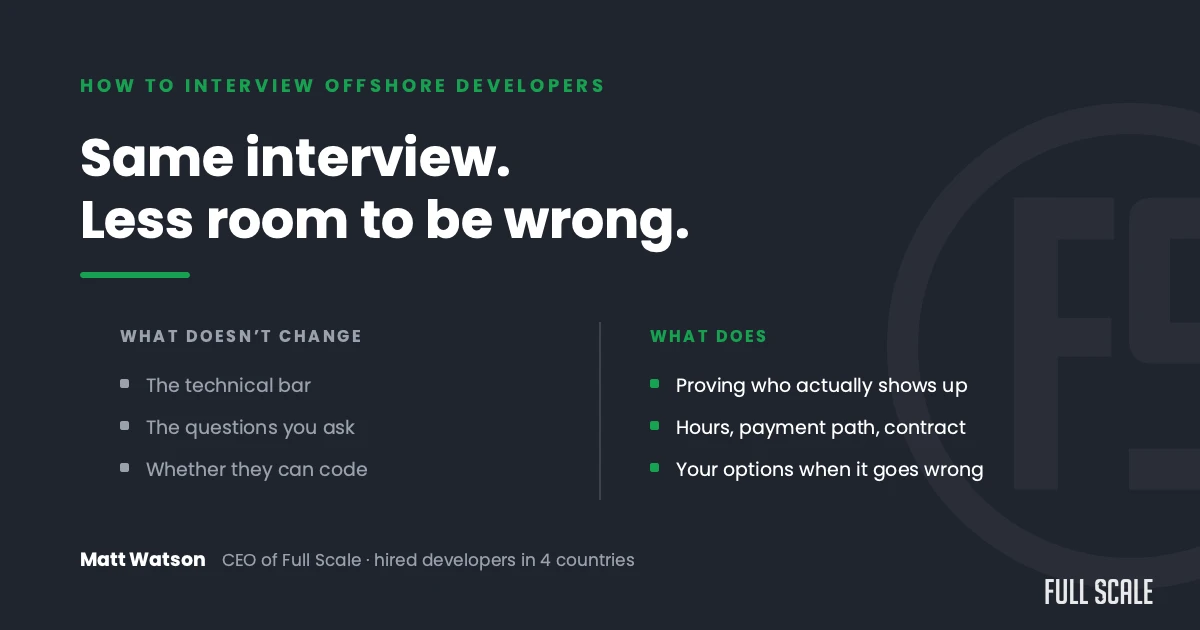
I’ve hired folks in Uruguay, Colombia, Russia, the Philippines… and the most important thing I learned was very unexciting. The interview process barely changes. You’re asking a developer in Cebu the same questions you’d ask a developer in Kansas City, and listening for the same responses.
What changes is what you do if you screw it up. Hire the wrong person in your hometown and you get an awkward conversation, a notice period, and a call to an employment lawyer who already knows the rules. You’ll still pay for it. Engineering jobs take about 62 days to fill, so you’re starting that clock over.
But if you hire the wrong person via a freelance marketplace thousands of miles away, you can quickly find yourself out of options. You may not be able to contact them. You may not own the code they produced. You might not even know who they are. And that’s the whole point of why offshore hiring requires any extra effort whatsoever; the added effort is primarily logistical.
You need to confirm that the person you spoke to actually exists. You need to come to terms with how they’re going to get paid. You need to draft a legal contract that stands up to scrutiny.
How to interview offshore developers: start with the interview you already run
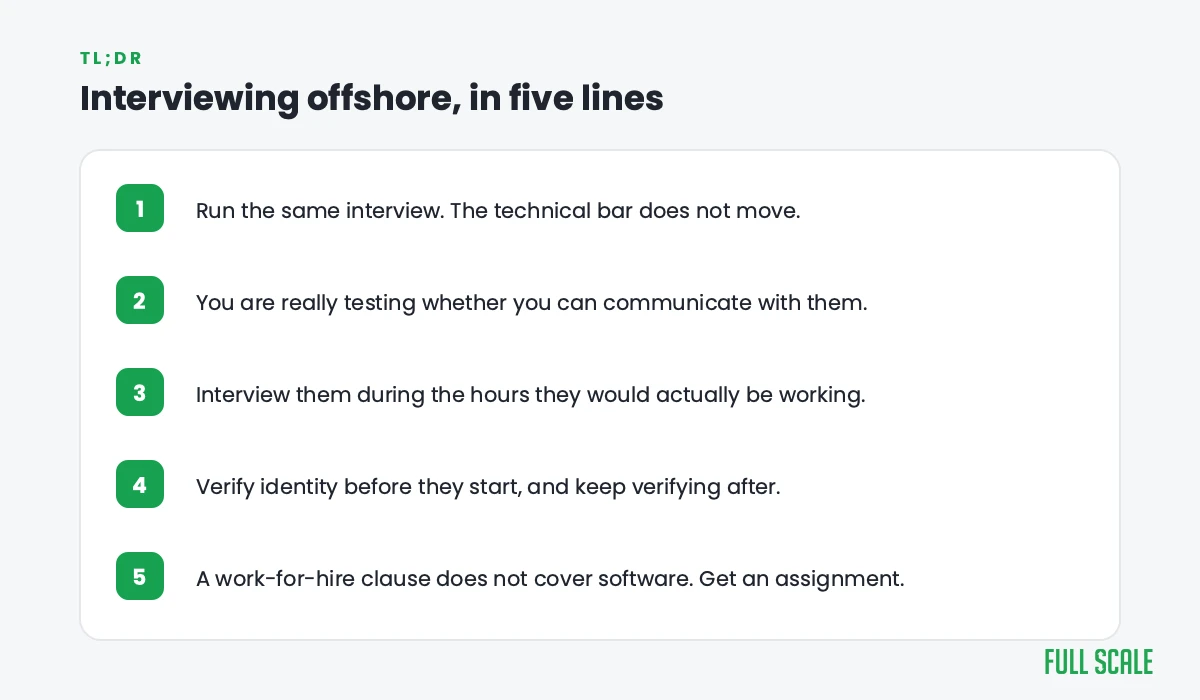
Virtually every element of a strong engineering interview travels well. The bar for technical competency shouldn’t shift because someone is eight hours from you; if it does, that’s how you get the shambles I’ve dubbed cheapshoring. Cheap and far is not a strategy.
Questions should travel too. Have them describe a recent project they’ve delivered, and then dig into the details. What went wrong, and how did they fix it? Share your screen and let them explain some actual code, rather than asking trivia questions. Or better yet, hire them for a small amount of real work and see what they turn in. No set of questions you can ask in an hour will tell you more than a couple of days working on the actual job. If you’d like the full writeup, check out our guide on how to interview a software engineer. None of it is specific to hiring offshore.
It contains one assertion that deserves restating: AI is now capable of acing your coding assessment, which means a perfectly correct response to a standard question reveals very little about the person who wrote it. This was true even before you began considering international hires.
The failure of your interview process when dealing with remote candidates is not a function of their distance from you.
What you’re really testing is communication
Number one thing in software development: communication. More important than how fast you can type, more important than which algorithms you can recite from memory, more important than the length of the framework list on somebody’s resume. Most of building a product is people understanding each other well enough to make good decisions. Everything else comes downstream of that.
The thing you really want to know in an offshore interview is whether you can communicate with this person. Can you follow their explanation of a hard problem? Do they ask a clarifying question when your description of the work is vague, or do they nod and go build the wrong thing? If you say something ambiguous, does it get caught on the call, or does it get caught three weeks later?
There’s one answer I’ve learned to distrust. That answer is yes. Ask a developer whether they understood the requirements and almost everyone will say yes, because yes is the polite answer in every country on earth. Don’t ask that question anymore. Have them tell you back what they’re about to build, in their own words, and listen carefully for where they got it wrong. Yes is the scariest answer you can get in an offshore interview.
This is also why you have to do the interview over video. You need to see someone’s face as they explain your own project back to you. You can’t do that on the phone, and you definitely can’t read it in Slack.
This is the first of the three skills I write about in my book, Product Driven: communication, curiosity, and courage. It’s especially important on a distributed team because none of this stuff is happening organically anymore. If you have an office, someone overhears an issue and then walks over to ask about it. On a remote team, that free-flowing information is no longer there, which means it needs to be intentional from the start, starting with hiring those who are strong communicators.
English language proficiency is one such skill. It’s a huge filter. This is why, back in 2018, I opted to hire from the Philippines rather than a less expensive location. The Philippines is home to the third largest population of English speakers in the world. That’s why our engineers speak directly to clients instead of hiding behind an account manager. I’ve written more about why Filipino developers are a great fit for US teams. The takeaway is simple: your engineering team doesn’t need a translator.
Run the remote technical interview during their actual working hours
Make sure you’re aligned on working hours first. This is the thing that ends up causing relationship trouble because “we’ll figure it out when we get there” never works.
At Full Scale, we typically have a 3-4 hour daily overlap with the client as the baseline and the engineers will adjust their day accordingly. Overlap is a scheduling decision rather than a fact of geography. We have some teams that work US hours all day, and others that run asynchronously except for a daily standup in that overlap window. The client determines what works best. We go deeper into the issue of time zones on remote software teams over here.
This is the thing that nobody ever mentions: Do the technical interview during the hours the person will actually be working. If the 2pm standup is important to the team, then interview them at 2pm your time. The difference between the person who is clear-headed at 9am in Manila and the person who’s exhausted at 11pm tells you way more than any schedule agreement will. Anyone can sacrifice one night for an interview. You want to know how they are when you’re going to be collaborating on a regular basis.
The offshore developer interview questions worth asking
Don’t make the list very long. A big list makes you feel like you’re being comprehensive and mostly just checks if they did interview prep.
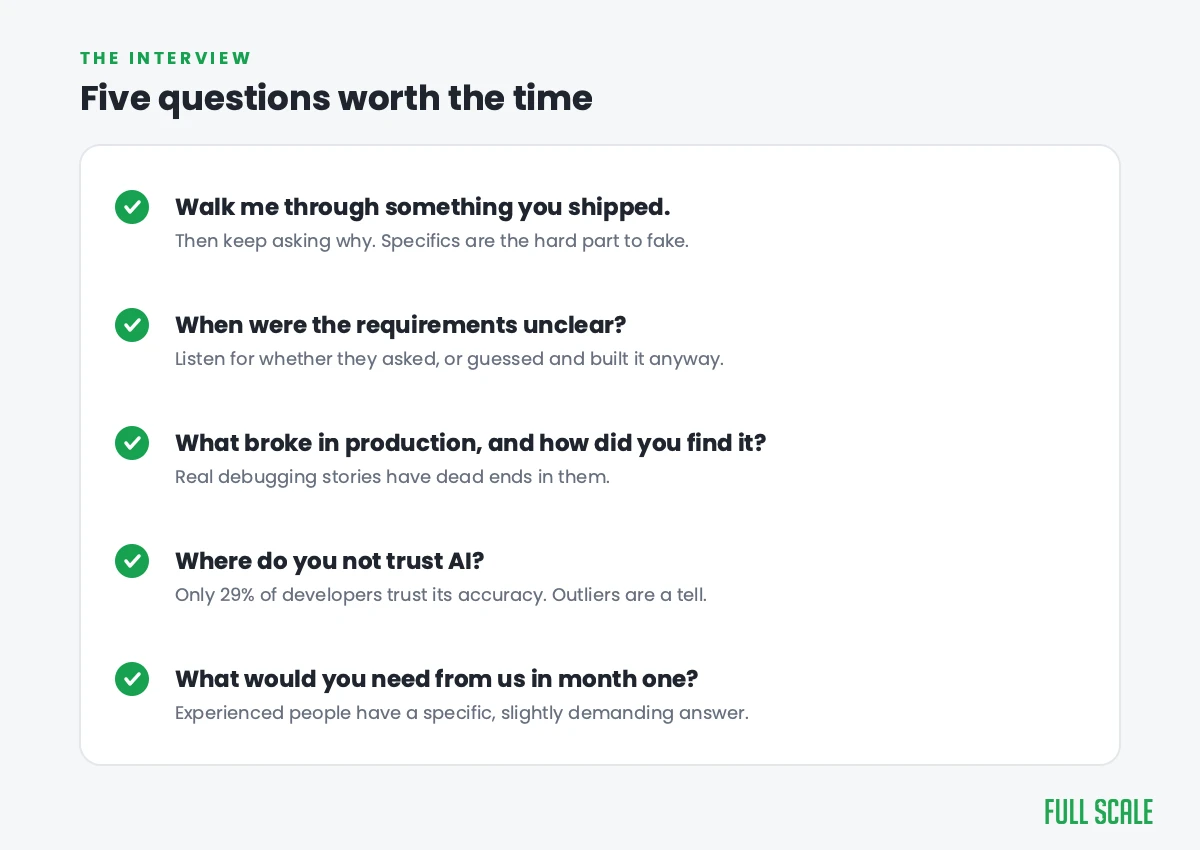
- “Describe a project you’ve worked on that shipped recently. What role did you play in that?” Then keep pushing “why.” Generic answers are easy to fake and specifics aren’t, and any rehearsed answer will break down by the third iteration.
- “Describe a situation where you were handed vague requirements. What did you do?” You’re listening to see if they asked questions or if they guessed and implemented their guess anyway. On a remote team, someone who guesses can get expensive.
- “What broke in production? How did you discover that?” The best debugging stories have false leads.
- “How does AI help you as an engineer, and when does it not?” This is a fast separator. The 2025 Stack Overflow Developer Survey says 84% of developers are using or planning to use AI tools but only 29% trust the accuracy of its output, so any candidate who tells you they rely on it for everything is either unaware or lying.
- “What do you need from us in order to be productive in your first month?” Solid answers here are specific and somewhat aggressive. Anyone who has been hired before knows what they need.
Make sure the person you interviewed is the person who shows up
The one with no local equivalent is the one I would exercise extra caution with.
Check who they are before they start
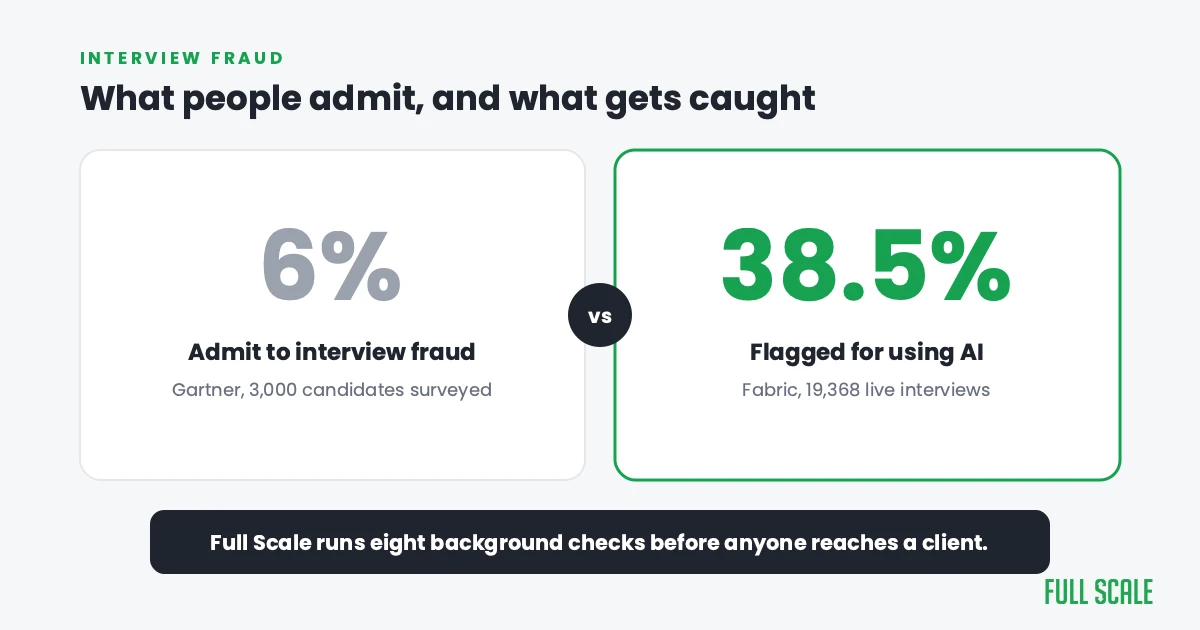
Actually run a background check. This is about verifying the identity of the person, verifying the work history, and making sure the references actually exist. Full Scale runs eight separate checks on every hire through an independent Philippine firm, including work history confirmed with each former employer across borders, and grades the result as a pass or a fail rather than filing a PDF somewhere. Most of the industry does not do this and refuses to admit so, so I have written about our approach here.
Keep checking after they start
And then you keep looking at them once they’re hired. You want to see them on video during standups and code reviews, and not just to keep tabs on them. You want to see them because the horror stories always have the same shape: a company hires someone, and a few weeks later they’re never on video again and it doesn’t sound like the same person anymore. This seems far-fetched until you see the candid confessions from people taking these tests. In a survey of 3,000 applicants conducted by Gartner, 6 percent admitted to having committed interview fraud, for example, pretending to be someone else or getting someone else to pretend to be them. And that’s what people were willing to admit to a pollster; the actual rate is likely higher. Gartner predicts that one in four job applicants globally will be faking their identity by 2028.
Some of these are just scams, but others are newly invented. Face-swapping on a live video call got cheap at roughly the same moment it got convincing. It’s more widespread than most hiring managers realize, and it isn’t an offshore problem at all. One analysis of about 19,368 live interviews found that the percentage of candidates who were identified as using AI increased from 9 to 45 percent within several months before settling at around 38.5 percent. We’ve had live interviews in which we could tell the candidate was reading answers from a second monitor. There’s also a subtler form. If you hire a freelance developer on the other side of the planet, you may be their second job, or their third, and you will have almost no way to know. That risk largely evaporates if you hire a firm that has a true employment relationship with its workers.
It’s all we have in place of walking down the hall and being able to see someone.
Decide how you’re paying them before you decide to hire them
There are three different ways that you can do it, and it dictates what will happen afterwards. First, you can hire offshore developers through an agency like Full Scale. Second, you can hire someone as a contractor directly. Third, you can use a freelance platform.
We see clients coming in through all three channels, and the choice tracks the work itself more than the budget. Here’s our summary of the best approach for each scenario:
| Your situation | What fits best | What you compromise on |
|---|---|---|
| Short project with clear scope and end date | Freelance platform or direct hire | Most cost-effective and quickest to get going. You have to vet and handle contracts/IP risk. |
| Long-term collaboration within your own product and codebase | Agency or staff augmentation | Single contract with employer liability, non-disclosure and IP rights on all engineers. Less flexible pricing. |
| Work involving customer data, sensitive systems, or core IP | Agency with a real employment relationship | Background checks and IP assignment happen at the company level, not person by person. |
The contract is where that choice bites
That’s what makes contracts important. They’re where you secure confidentiality and intellectual property rights, and the second one is less automatic than people assume.
One thing that surprises many people: a work-made-for-hire provision likely doesn’t give you ownership of the code you’ve paid for. The U.S. Copyright Office only recognizes nine categories of commissioned work as work made for hire, and software is not one of them. An atlas, however, is. If you commissioned an atlas, then you’ll be protected by the work-made-for-hire clause, but if you commissioned the application that powers your business, then you won’t. We cover what kind of clause you actually need in our guide to the legal requirements for hiring developers in the Philippines.
And the situation becomes even murkier when you cross borders. According to DLA Piper’s guidance on cross-border IP issues, “work made for hire principles may not exist and broad present assignment provisions are not always enforceable under local law.” So your contract could stipulate anything you want, but whether the courts in the country where that developer lives will honor that language is up in the air. I’m not a lawyer, so don’t forget to run your real-life agreements by one.
All this brings us back to why we believe staff augmentation is a better option than direct contracting. When you engage with one firm, there’s a single set of terms and conditions negotiated upfront, and that firm is responsible for making sure every single engineer it deploys complies with all the relevant legal provisions, including employment agreements, confidentiality agreements and IP assignments. You don’t have to build a different agreement for every single developer, and worry about whether they’ll abide by their contract. We discuss this further in our offshore development IP protection framework.
And one final contractor-only point that isn’t very exciting but is worth considering. If you’re relying on one person’s home office, ask about it: power, backup internet, and what happens during typhoon season. It’s a valid question to ask for any freelance gig anywhere, but if you’re going through an agency, then that’s taken care of by the company.
You’re also judging whoever screened them
Hiring locally means you control the entire hiring funnel. With offshore talent, there’s usually a third party that has pre-screened the candidate for you, which means some of your job during the interview is to figure out just how effective that screening was.
Ask the agency or marketplace what their screening process actually involves, and how many candidates they reject. We’ve published ours. In the first six months of 2026, 4,869 people applied to Full Scale, 430 were interviewed by a recruiter, 99 were recommended for an offer, and 43 were hired. Roughly 90 percent of applicants did not pass the initial screens. A huge chunk of those were applicants from countries we don’t hire from, or people who had sent the exact same resume to every company online. Keep that in mind for any selectivity metric you come across, ours included. A ratio like this is trivial to manipulate by changing the denominator. The full Full Scale rubric is in how we interview developers, and our offshore development due diligence checklist has more questions to ask a vendor.
Note also that seniority doesn’t transfer. The “Senior Developer” title at a big outsourcing firm, and the Senior Developer at a US-based product company, could mean totally different things, and the pay rate will tell you even less. Your candidate’s cost is determined largely by where they’re living, and doesn’t tell you anything about their actual quality. You have to evaluate their level during the interview, and during their work.
The one time I skipped the interview entirely
Back in 2012 I needed a Java monitoring agent created, and I hired a team through a friend’s dev shop in Kansas City. It later transpired that the team was in St. Petersburg, Russia. I never interviewed a single one of them, the engagement ran two years, and it worked out fine.
I wouldn’t base a hiring process on this. It was 2012, and I wouldn’t hire in Russia today. But it’s a useful check on everything above, because an interview is not a ritual you perform. It exists to reduce the cost of being wrong.
Because the engagement was small, well-defined, and easy to walk away from, the interview wasn’t as important. The larger the bet, and the harder to unwind, the more value there is to the verification. Which is the entire argument.
You run the same interview. But you do more work to ensure you can trust the answer. And you structure the engagement such that if you’re wrong, it’s survivable. That’s why clients interview each engineer before committing, and why we back the engagement with a two-week money-back guarantee. I’ve written about what happens in that scenario here: what happens when it isn’t working out.
Giving someone an easy escape route is the quickest way to convince them they don’t need to take it. If you’d prefer not to do all this yourself, that’s pretty much what we do. Schedule a call and we’ll put some pre-vetted engineers in front of you.
Frequently asked questions
How do you conduct remote technical interviews?
Conduct the technical interview remotely via video with screen sharing, have the candidate walk you through code they’ve actually written, instead of solving a riddle on a whiteboard. Pose open-ended questions about projects they’ve worked on, and drill down on details. Anyone can fake an answer to a single question with AI’s help, but a faked answer falls apart on the follow-up. Run the interview at the time they’ll be working, so you’re interviewing who they really are.
Is interviewing an offshore developer different from interviewing a local one?
The interview will be much the same, and the bar shouldn’t change because someone lives in another country. But there are additional things that happen outside of the interview, like doing a background check, confirming periodically that the person you hired is the same person doing the work, getting explicit confirmation of hours, and having an agreement about NDA and IP that’s enforceable in the country the developer resides. All of these steps are necessary because you have less recourse if the hire goes wrong.
Do you need a background check for an offshore developer?
Yes, and it counts for more than it would locally, because there is no informal way to check someone’s identity or job history from another country. Full Scale puts every engineer it places through eight separate checks, handled by an independent firm in the Philippines: identity, criminal records, address, schooling confirmed with the registrar, every previous employer contacted, references, and sanctions screening. If you go the contractor route on your own, budget for the same thing, because a resume and a friendly video call will not get you there.
What questions should you ask offshore developers?
Skip the trivia and ask about actual work: what they shipped last and which part of it was theirs, a time the requirements were fuzzy and what they did about it, an incident that hit production and how they tracked it down, and where they rely on AI versus where they don’t. Follow up on each answer at least twice, because details are difficult to fake and a generic answer usually unravels with one additional question. It’s also worth asking what they’d want from you in their first month to be effective, since a seasoned engineer always has a specific answer.