
How to Manage a Dedicated Development Team: What You Own and What You Don't

In this article
Quick Answer: To manage a dedicated development team, own direction and outcomes yourself, let the team own how the work gets done, and let the vendor own employment and engineer wellbeing. At Full Scale, a Customer Success Manager meets the dev team weekly and the client monthly, so you spend your time on the product instead of on HR.
You manage a dedicated development team the same way you manage any employee, except for the pieces that make employees expensive. They attend your standup meetings, follow your roadmap, and answer to your standards, while the vendor pays salaries, provides benefits, supplies equipment, and has those awkward HR conversations no one wants to have.
That division is the entire game, and most problems with dedicated teams come from breaking it. Clients that take on too much management end up doing HR for people they don't employ, while clients that take on too little management end up with a highly efficient team that builds the wrong thing.
In this post I'll outline the division of ownership, the cadence that keeps things running, and the warning signs that indicate when you need to intervene. If you haven't yet picked a team, check out our guide on how to hire a dedicated development team, and for details about the dedicated team model itself, refer to our dedicated team guide. If you've already hired individual developers who don't belong to a managed vendor team, then read how to manage remote developers for day-to-day best practices.
Three layers, three owners
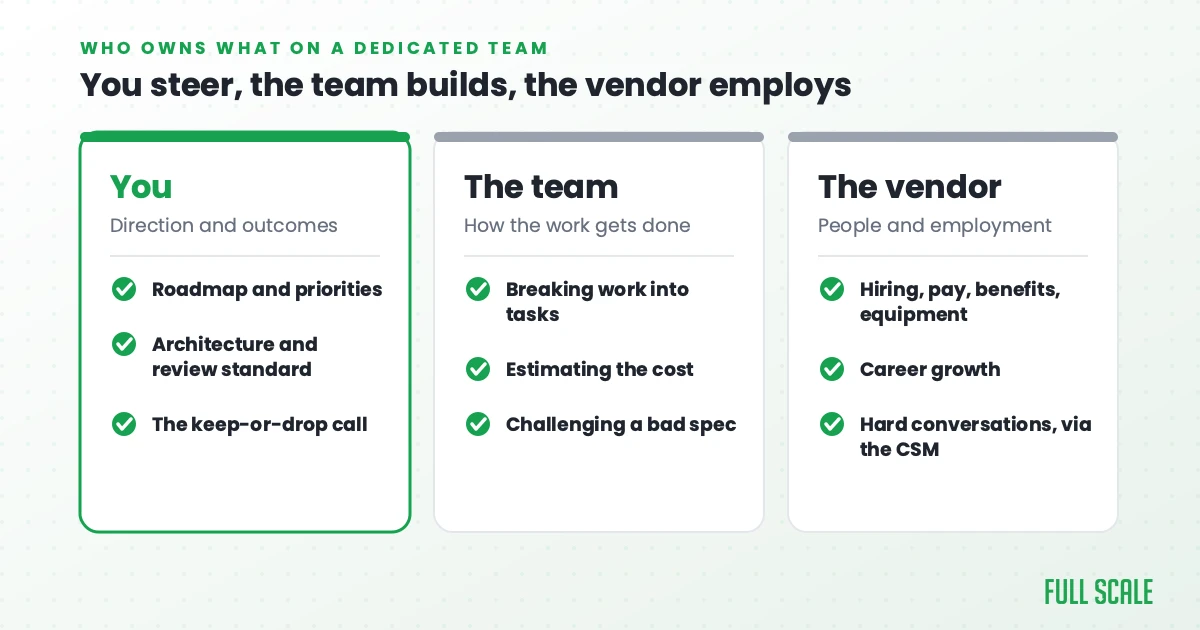
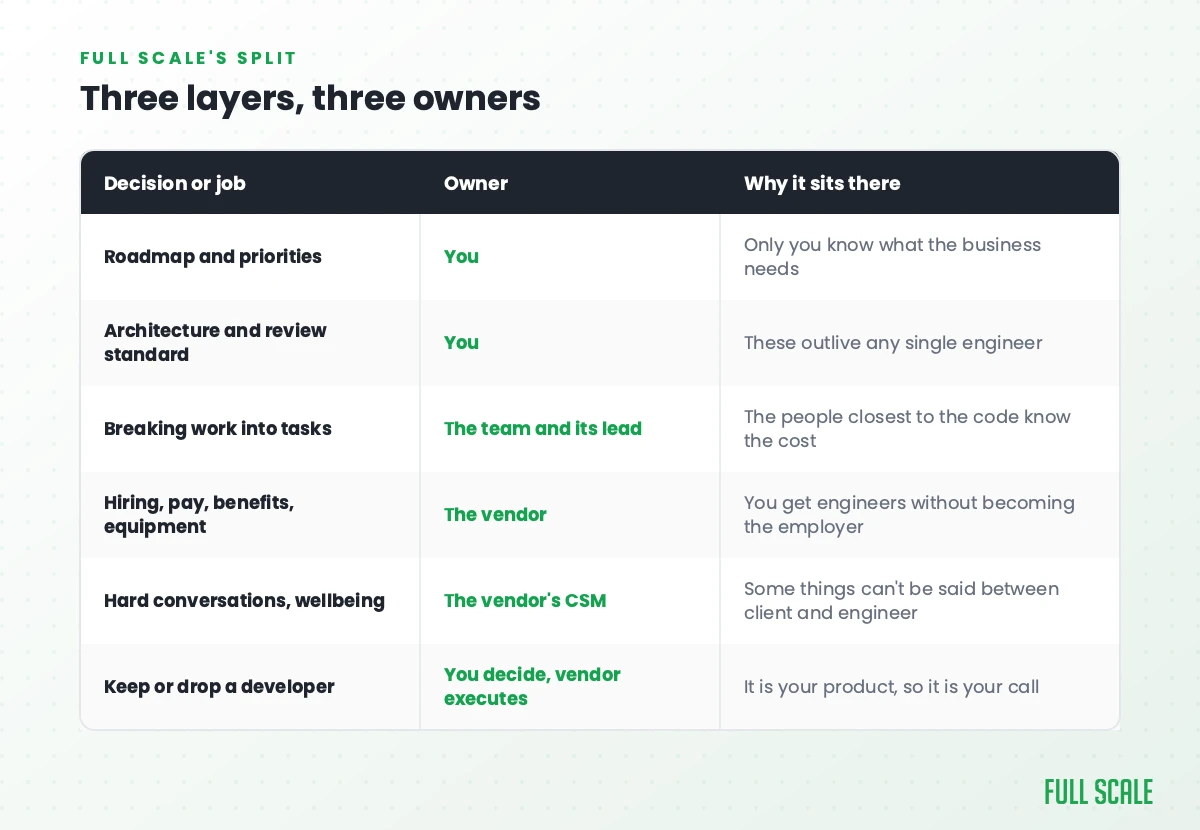
There should be three levels of ownership within the dedicated team, and you need a single person on your end who takes ownership of each one. Here is how Full Scale divides up responsibility on its dedicated team projects (it is a good baseline even if you work with a different company).
| Decision or job | Owner | Why it sits there |
|---|---|---|
| Roadmap and priorities | You | Only you know what the business needs this quarter |
| Architecture and the code review standard | You | These decisions outlive any single engineer |
| Breaking work into tasks and estimating it | The team and its lead | The people closest to the code know the cost |
| Hiring, pay, benefits, equipment, career growth | The vendor | You get the engineers without becoming their employer |
| Hard conversations and engineer wellbeing | The vendor's Customer Success Manager | Neither you nor the engineer can raise some things with each other directly |
| Deciding to keep or drop a developer | You decide, the vendor executes | It is your product, so it is your call |
If the first two rows in the above table look like your situation, great. Those responsibilities belong with you regardless of how far you outsource. This mirrors a point I've made repeatedly over the years: you always need technical leadership in-house. A dedicated team without someone leading it is a very efficient way to produce the wrong output.
Give the team context, and let them argue with it
A team will deliver its best work when it understands the purpose of a feature. When we hand teams completed tickets and a polite request to build exactly that, we'll get exactly that, complete with any bugs hidden in the specs. We want to retain engineers who challenge poor requirements. Those only exist when challenging is allowed.
Put the customer need on the ticket, before the proposed solution. Let engineers join meetings where decisions about features are discussed, and consider their concerns a complimentary review. This is the core concept of my book Product Driven: engineers who understand the desired outcome will always outperform engineers who await tickets. The individuals are the same in both cases. The only difference is if you allow them to think.
How to pair new engineers with your own, and hold their pull requests to your bar, is covered in our article on lessons from running offshore dedicated teams. Please read it together.
A weekly rhythm that fits on one page
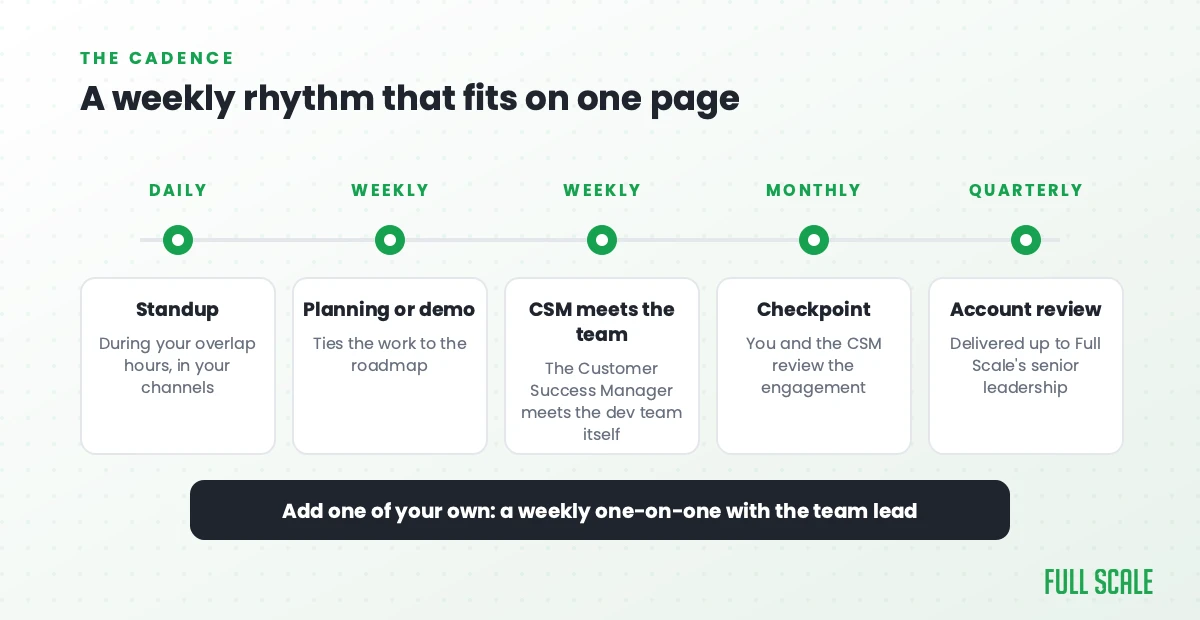
A dedicated team doesn't require a ceremony calendar resembling a conference agenda. They require a brief list of recurring meetings. The chart below details our typical meeting cadence at Full Scale, with items relevant to you indicated.
| How often | What happens | Who is in the room |
|---|---|---|
| Daily | Standup during your overlap hours, in your channels | You or your lead, plus the whole team |
| Weekly | Planning or demo that ties work to the roadmap | You, the team lead, the team |
| Weekly | The Customer Success Manager meets the dev team itself, not just the client contact | The CSM and the team |
| Monthly | A checkpoint on the engagement as a whole | You and the CSM |
| Quarterly | A formal account review, delivered up to Full Scale's senior leadership | You, the CSM, senior leadership |
Of those, two warrant comment. The weekly CSM meeting with the full development team, rather than only the client contact, serves as a mechanism for surfacing issues before they become crises. The quarterly business review ensures the project has oversight from higher-level management beyond your regular point of contact. Very few clients request this level of accountability until absolutely necessary.
One meeting you should add is a weekly one-on-one with the team lead. Fifteen honest minutes with the person who sees the whole team beats any dashboard you can build, and I have yet to encounter a system that admitted to being lost.
Measure the team, and be careful what you reward
It's tempting to measure everything in a remote work situation because you can't see your colleagues working, and measuring things feels like getting some control over the situation. But it doesn't. Measure what the customer would notice about your product's delivery, and have delivery metrics act as a boundary condition around that.
We suggest the metrics set defined by DORA. Its metrics guide outlines five metrics: change lead time, deployment frequency, failed deployment recovery time, change fail rate, and deployment rework rate. DORA lists "setting metrics as a goal" as a pitfall in its guide, noting that when companies impose these metrics broadly, teams may be incentivized to try and manipulate the metrics to meet their goals.
That's certainly true, and we'd add another note here: because these numbers are about a team, they should be applied to a team. If you rank engineers based on the number of deployments they complete, you'll get more deployments, most of which will be minor and won't improve your product.
Two of our other posts go further: measuring software engineering productivity and which team metrics actually predict performance.
The 2025 DORA report also warns teams that use AI coding assistants: AI amplifies whatever the team is doing anyway. Poor code review standards stay poor, just at a higher speed.
Use the vendor layer for what it is built for
The Customer Success Manager is the release valve. At Full Scale, CSMs facilitate difficult conversations that must happen behind the scenes. There are some things the client can't tell the offshore engineer, and there are some things the offshore engineer can't tell the client. CSMs also make sure the client gets what they really need from the engagement, as opposed to what's written in the contract. When the client reports that the developer is having difficulties, the CSM creates a remediation plan and sees it to completion. Each CSM is responsible for no more than 70 people, ensuring that the CSM is still close enough to the team members to be effective. You can read the entire explanation of their job in our blog post why customer success managers are the reason offshore works.
Dustin Johnson, co-founder and CTO of SOTA Cloud, explains how he views the importance of retention: "We really highly value retention and so Full Scale has been a great partner on the retention front to ensure that we have continuity with the folks that we really value on our team." Continuity is what you are getting with the vendor layer, because engineers who stick around remember your context.
There is one way to misuse it: do not route daily work through the CSM. That is the exact opposite of avoiding the middleman. Eventually someone becomes the go-between for all decisions, and the engineers will stop interacting with you. The CSM manages the relationship and the humans; you communicate directly with the engineers about the work itself.
When to step in, and how
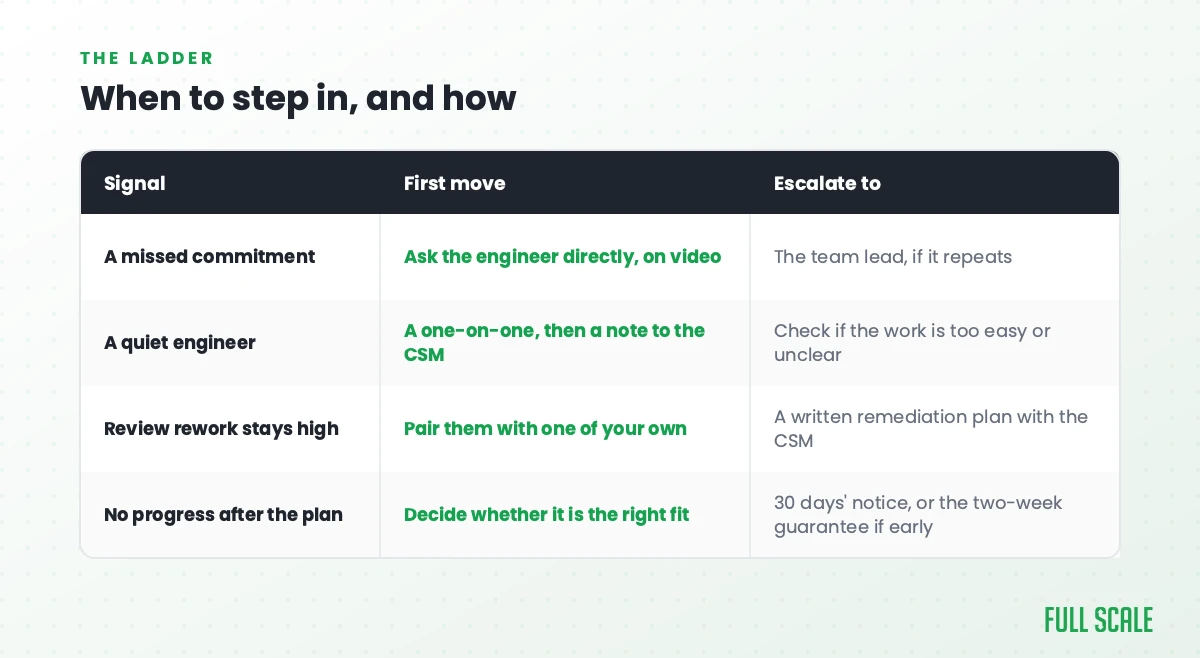
Very few engagements require escalation, and fewer still begin that way. They start with a missed promise, a silent engineer, or a PR that requires too much rework. I would climb the following ladder.
| Signal | First move | Escalate to |
|---|---|---|
| A missed commitment | Ask the engineer directly what happened, on video | The team lead, if it repeats |
| A quiet engineer who stops asking questions | A one-on-one, then a note to the CSM | A check on whether the work is too easy or too unclear |
| Review rework that stays high | Pair the engineer with one of your own | A written remediation plan with the CSM |
| No progress after the plan | Decide whether this is the right fit | Drop the developer with 30 days' notice, or use the two-week guarantee if it is early |
If you want the full picture of how an engagement goes off the rails, read when it isn't working out. The long and short of it is: You're not trapped. That's why it pays to intervene early.
Frequently asked questions
How do you manage a dedicated development team?
Manage a dedicated development team by owning direction and outcomes yourself: the roadmap, the priorities, the architecture, and the review standard. Let the team own how the work gets done, and let the vendor own employment, pay, and engineer wellbeing. At Full Scale, a Customer Success Manager meets the dev team weekly and the client monthly so problems surface early.
How much time does it take to manage a dedicated development team?
It takes about as much as managing the same number of engineers you employ, minus the HR work. You still run planning, review code standards, and give feedback, but the vendor handles payroll, benefits, equipment, and retention, so your attention goes to the product.
What is the difference between managing a dedicated team and managing in-house developers?
The daily work is the same: priorities, context, code review, and feedback. The difference is the vendor layer, where the vendor handles employment and the hard people conversations. At Full Scale, a Customer Success Manager carries that second layer so you do not have to.
How do you measure the performance of a dedicated development team?
Measure the team on outcomes your customers feel, and use delivery metrics such as change lead time and change fail rate as guardrails. Treat them as signals for the whole team, not scores for individual engineers, because a metric turned into a target gets gamed.
What should you do when a developer on a dedicated team is underperforming?
Talk to the engineer directly first, then bring in the team lead and the vendor's Customer Success Manager for a written remediation plan. If it still is not working, Full Scale clients get a two-week money-back guarantee at the start and can drop a developer with 30 days' notice after that.
Run the team, leave the HR to us
Need a ready-to-go team where the management structure is predefined? Schedule a call with Full Scale to see how the cadence and CSM functions would apply to your product.