
How to Hire Software Developers: What Changes at 1, 5, and 20 Hires

In this article
- The number you need decides the method
- One hire: it's a sourcing problem
- Five hires: it's a throughput problem
- Twenty hires: you're running a recruiting function
- A worked example: ten hires in a quarter
- What to do before you post a job
- How Full Scale hires developers for you
- Frequently asked questions
- Tell us how many developers you need
Quick Answer: How to hire software developers depends on how many you need. One hire is a sourcing problem. Five is a throughput problem, because interviews pull your engineers off the product. Twenty means you are running a recruiting function, with fees of roughly $400,000 to $670,000 at typical recruiter rates. At Full Scale, we accept fewer than 3% of applicants, so the screening work is already done before you meet anyone.
Most articles on hiring developers describe one hire and then multiply it. The only problem with this is that it stops working when you start doing it five times. What takes six weeks to find one developer will steal a quarter of your engineers' time if you do it five times at the same time.
The one-by-one version of the steps is already covered in how to hire software engineers (four ways to find them, how to interview them). This article covers the part the other article doesn't: how things change when you scale up.
The number you need decides the method
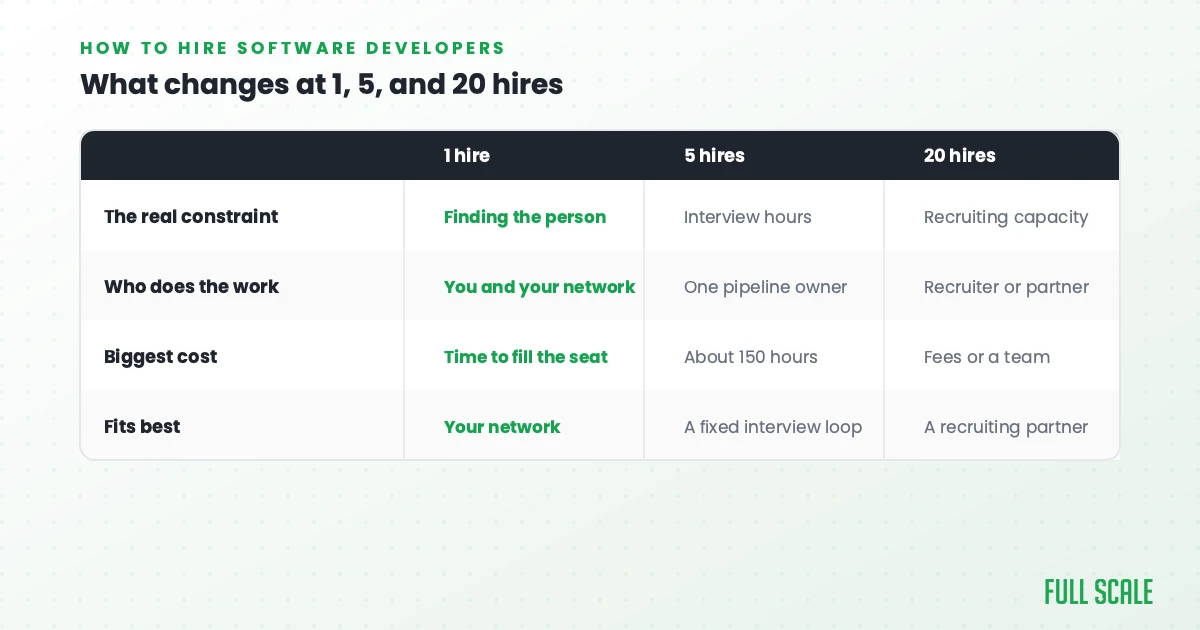
Hiring one, five and twenty developers are three entirely different jobs, despite sharing a job title. For one, it's a matter of finding the person. For five, it's a matter of the number of hours your developers spend interviewing. For twenty, you've effectively created a recruiting department, whether or not you intended to.
| 1 hire | 5 hires | 20 hires | |
|---|---|---|---|
| The real constraint | Finding the right person | Engineer hours spent interviewing | Recruiting capacity and employer brand |
| Who does the work | You, plus a trusted network | One owner running a consistent process | A recruiter or a partner, plus your engineers |
| Biggest cost | Time to fill the seat | About 150 interviewer-hours | Fees or a recruiting team |
| Fits best | Your network, or one in-house search | A written rubric and a fixed interview loop | A partner that recruits for you |
The interviewer-hour figures aren't a survey, but rather Full Scale's illustration. We assume each position receives six candidates in the final round and five interviewer-hours go into each candidate. That gives thirty hours per position, one hundred fifty for five positions and six hundred for twenty positions. At about 173 working hours per developer-month, six hundred interviewer-hours equals about three and a half months of one developer's time, which is time not spent developing.
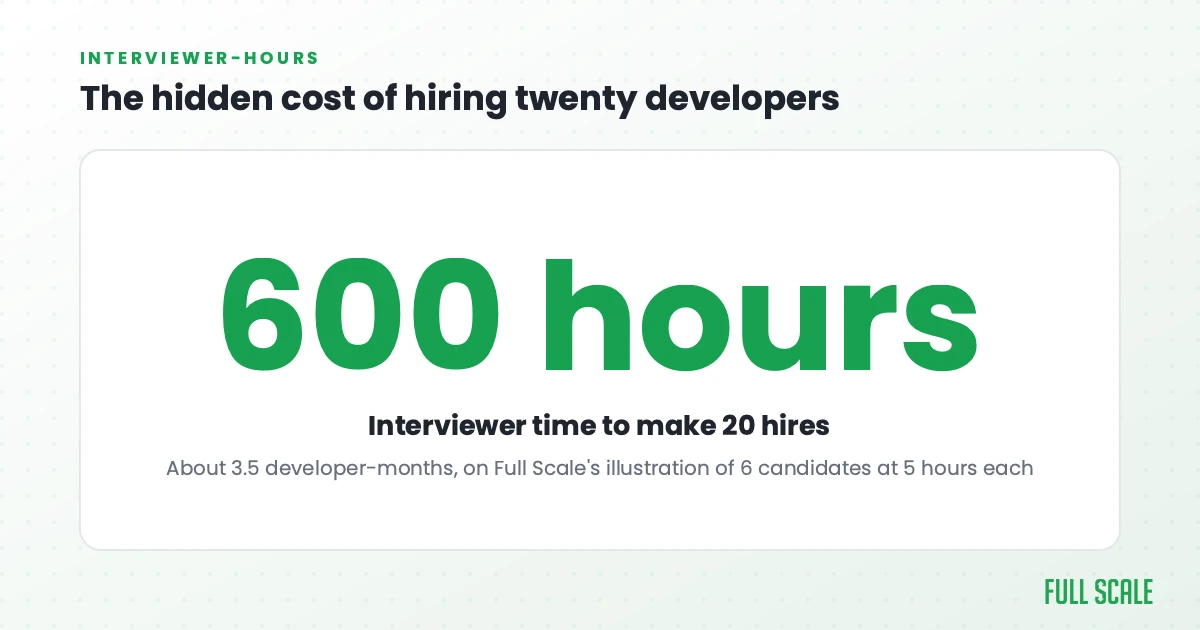
Hiring more developers ends up costing the developers you already have. I'd write that on the wall of any engineering office contemplating posting another 10 job openings.
One hire: it's a sourcing problem
And when you need a single developer, you need to know where to find one. And the answer is usually: somewhere you already know.
The first developer I ever hired at VinSolutions was a brother-in-law, and he's still working there 20+ years later. Again, I'm not advocating for nepotism as a strategy. But I am saying a candidate that comes with a reference you can verify is preferable to a stranger with a great LinkedIn profile.
If your network doesn't provide a candidate, the same four options from our single-hire guide apply: freelancer, full-time employee, offshore partner, or recruiter. I won't rehash these here, except to note that the interview is rarely the place where the one-hire decision goes wrong. It is picking the wrong path.
For startups looking to hire their first developer, this piece on hiring a developer for a startup walks through who to hire first and how to vet if you don't know how to code.
Five hires: it's a throughput problem
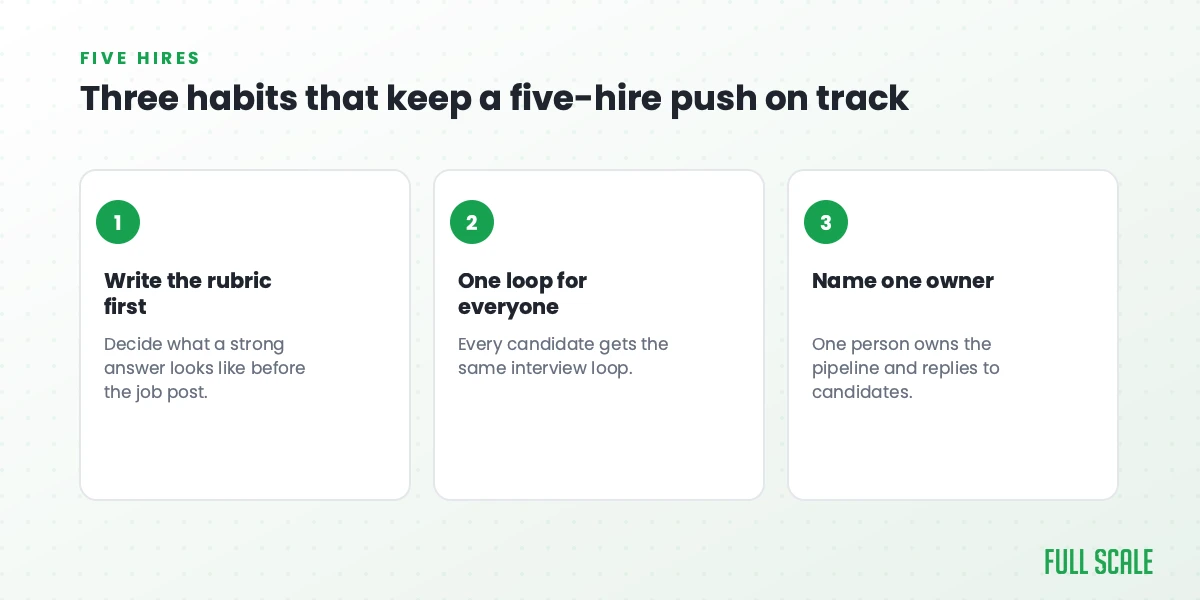
With 5 hires, the bar for your hiring process isn't "perfect" but "consistent," and the cost is measured in your team's time. Every hour spent interviewing cuts directly into the time the new hire can spend contributing to the very product they were hired to build. To make sure you do the 5 hires successfully:
-
Have a rubric written before the job description. Define what a good answer looks like for each skill you want to assess. You need to ensure that 10 interviewers are evaluating against the same criteria.
-
Use the same interview loop for every candidate. If the third candidate gets a different loop than the first, you're not comparing people anymore, you're comparing moods.
-
Have an owner for your interview pipeline. If there's no pipeline owner, then your candidates might sit for a week without hearing back from you, by which time the most promising candidates will have accepted another offer.
Candidates are also using AI during the interview itself now. According to Fabric's data based on 19,368 interviews, the rate of candidates being flagged for AI-assisted cheating climbed from 9% to 45% in a few months and has stabilized at around 38.5%.
We've witnessed it firsthand at Full Scale. We've had candidates whom we're pretty certain relied on AI tools to respond during the interview. The use of a consistent interview loop including a live technical exercise will reduce the risk of candidates using AI during the interview.
As for the interview itself, How to interview a software engineer has the questions, while How we interview developers has Full Scale's process.
Twenty hires: you're running a recruiting function
By 20 hires, the problem isn't recruiting anymore. It's capacity. You need someone to find candidates, organize interview loops, follow up on references, and make offers. All at the same time. For many months. There are three paths to get that capacity. Each path has a cost.
| Route | What it costs at 20 hires | What you still own |
|---|---|---|
| In-house recruiting team | Salaries plus tools, and the time to build it | Everything |
| Recruiter or agency | Roughly $400,000 to $670,000 in fees, at 15 to 25% of the BLS median salary | Interviews and the employment relationship |
| Staff augmentation through Full Scale | Starting at $35 an hour per dedicated developer, no recruiting fee | Directing the developers' work |
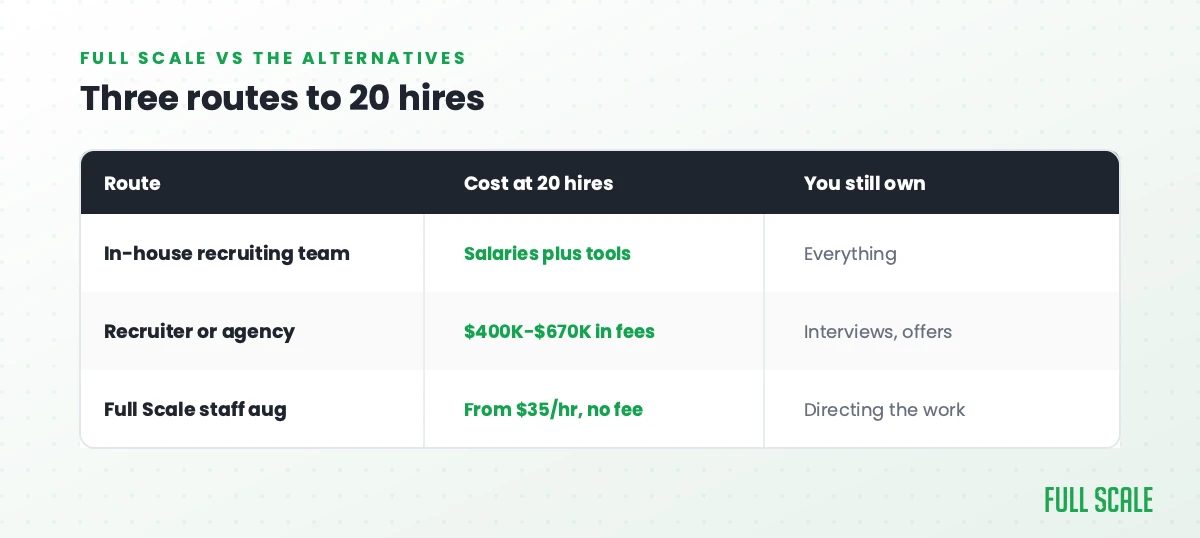
The agency math assumes the BLS median of $134,040 for software developers, quality assurance analysts, and testers. The fee uses a 15 to 25% fee range based on the first year's salary. Twenty hires at the median salary equals about $2.7M in first-year salary, which makes the fee a significant line item even before the developers write a single line of code. To learn more about what each type of agency actually offers, read our guide to software developer recruitment agencies.
Full Scale's internal recruiting does the same funnel in reverse. We hire under 3% of candidates, so we must be reviewing at least 33 candidates for every single engineer that clears our bar. All of the vetting your company would spend weeks or months doing has already been done by the time we schedule your first interview. We have 350+ engineers on staff and 80+ active clients, so the bench is real, but you still interview the person you'll work with, and that person is the one you get.
The only thing that a full service partner won't eliminate for you is the hiring decision itself. That still takes up your time. In fact, most of our clients take more time to interview, make a decision, and approve a contract than we do to source candidates, so the sooner you make a decision, the sooner the position is filled.
A worked example: ten hires in a quarter
Let's say you've just raised some money and the business plan says you should have ten developers by the end of the quarter. At 300 interviewer hours (as per our chart above) that's around 1.7 months of one developer's time before the first developer gets hired. If your recruiter charges 20% of the $134,040 median, then the recruiting fees will total approximately $268,000 on top of the developer salaries.
There's also a calendar problem. Engineers have a product roadmap and the roadmap doesn't stop to accommodate hiring. If you attempt 10 hires in one quarter, you're usually going to have to choose between hiring slowly and shipping slowly, and skipping both is not on the menu.
What to do before you post a job
All three of these questions must be asked at any level. They're easy enough to ask in advance of posting the role.
- What is this person's mandate for the first 90 days? If you don't know, it's time to stop talking about the role.
- Who does this person report to? A developer without someone to direct them is simply excess headcount, whether they're on your payroll or in a vendor contract.
- What is the definition of success after the interview process? You should have this written down well before you talk to any candidates.
In the age of AI, this final question becomes all the more critical. Google's 2025 DORA report describes AI as an amplifier, noting how increased output at an individual level can be negated by deficiencies in other areas of the pipeline. An engineer with good judgement benefits from AI. Without it, they'll just produce subpar code more quickly.
And if your plan is to "just hire the cheapest person who can get past the technical interview," then I suggest you pause and learn about cheapshoring, which is the term I use for cost-based hiring decisions. This leads to the most costly hire you'll ever make. You only learn that lesson once for each employee.
How Full Scale hires developers for you
Full Scale provides individual developers from all over the Philippines via staff augmentation, starting at $35 per hour fully loaded. The rate will depend on the seniority, skill and the size of your team. You can also look at the stacks that we staff for on our hire developers by stack and role page.
Work can start in as little as 7 days. If it isn't working out for you within the first 2 weeks, you get your money back. If it's still not working out later on, you can drop a developer on 30 days' notice without being tied into any long-term contract, as explained in full on our page when it isn't working out.
If you're interested in hiring an entire team, read about how to hire a dedicated development team, and how to build a software development team. My ideas on how we select and place people are also covered in my book, Product Driven.
Frequently asked questions
How do you hire software developers?
Decide how many you need first, because the answer changes the method. One hire is mostly a sourcing choice, five is a question of how many interview hours your engineers can spare, and twenty means running a recruiting function. Then write down what the person owns in their first 90 days and who directs their work, before you post anything.
How long does it take to hire a software developer?
It depends on your own interview process more than on the market. Full Scale can typically interview and place a developer faster than clients can get through their internal interviews, decisions, and contract approval. Our post on time to hire a software engineer walks through where the weeks go.
How much does a recruiter charge to hire a software developer?
Recruiters commonly charge 15 to 25 percent of the hire's first-year salary. On the Bureau of Labor Statistics median of $134,040 for software developers, that is about $20,100 to $33,500 per hire. Twenty hires at those rates cost roughly $400,000 to $670,000 in fees alone.
Is it better to hire one developer or a team?
One developer works when the product is small and someone on your side can direct the work. A team makes sense when the work needs more than about two people to move, or when one person leaving would stop the project. Our guide to building a software development team covers the order to add people.
Should I hire developers in-house or through staff augmentation?
Hire in-house for the few seats that carry your product knowledge, and consider staff augmentation for capacity beyond that. At Full Scale, dedicated developers start at $35 an hour and join your team under your direction. You get a two-week money-back guarantee, then 30 days' notice to cancel, with no long-term contract.
Tell us how many developers you need
The number determines the process. Tell us how many developers you're hiring and what they'll be working on, and we'll show you who's on our bench and what it costs from our $35-an-hour starting rate.