
The Complete Guide to Software Outsourcing: Models, Costs, and How Not to Get Burned (2026)

In this article
- What is software outsourcing?
- The three types of software outsourcing
- Why companies outsource software development
- Software outsourcing vs software houses
- What software development services can be outsourced
- How to choose a software outsourcing company
- Software outsourcing costs and ROI
- The risks of software outsourcing, and how to manage them
- What is IT outsourcing, and how software fits in
- Where software outsourcing is going
- Build your software outsourcing team with Full Scale
- Book a discovery call with Full Scale
- Frequently Asked Questions
I have been hiring software engineers outside the US for almost two decades. I co-founded VinSolutions and bootstrapped it to $35 million in revenue before it sold. I built Stackify. Since 2018 I have run Full Scale, where we manage hundreds of developers in the Philippines. So I will say upfront that I sell software outsourcing for a living. Read this guide knowing that, because I am going to be honest about where it works and where it blows up.
Most of what gets written about software outsourcing is either a sales pitch or a “top 25 companies” list. This is neither. It is the practical version: what software outsourcing actually is, the models and what they cost, how to pick a partner, and how not to get burned. The short version of my thesis: the model you choose matters more than the country, and most failures come down to control and continuity, not cost. When the country does matter, outsourcing your IT to the Philippines is where I keep landing.
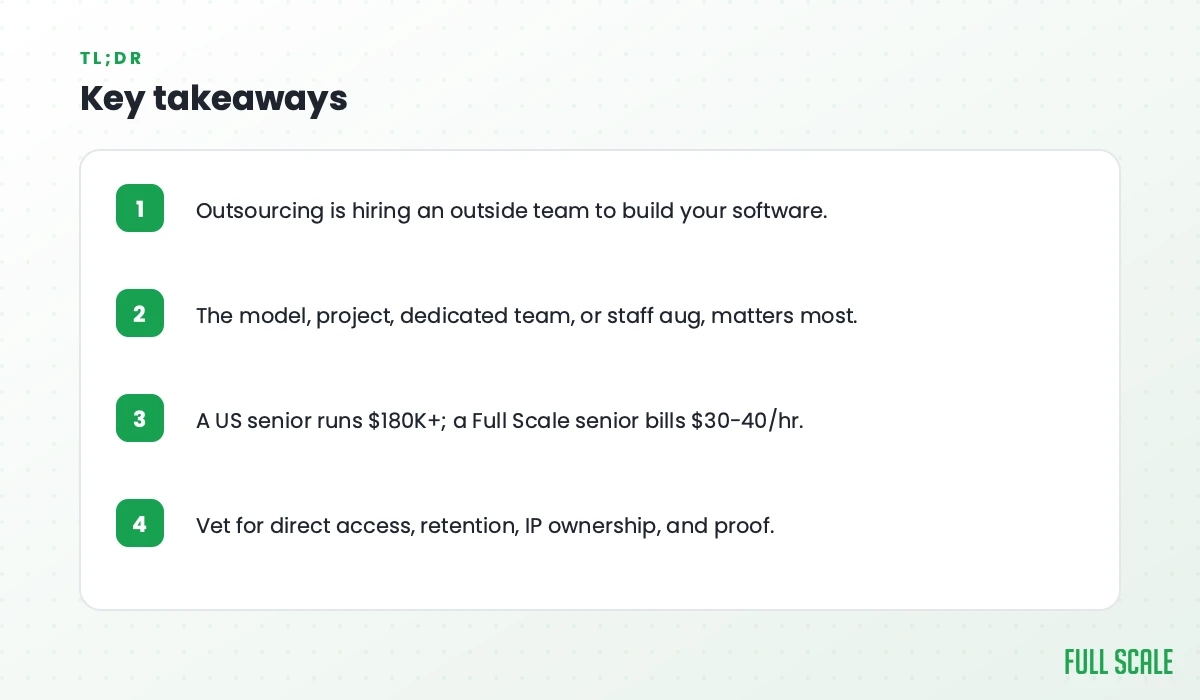
Quick Answer: Software outsourcing is hiring an outside company or team to handle development work instead of doing it with employees, from a single feature to your whole engineering function. The three common models are project-based work, staff augmentation, and a dedicated team, and the model you pick affects cost and control more than which country the team sits in. Full Scale runs dedicated teams in the Philippines built this way.
What is software outsourcing?
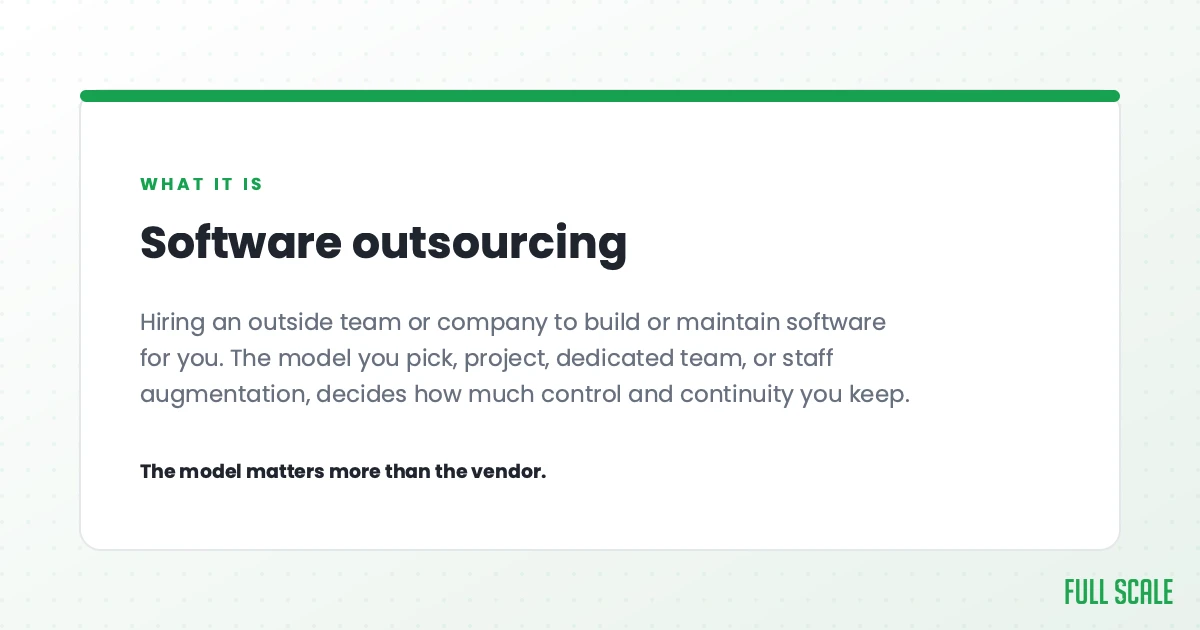
Software outsourcing is hiring an outside company to handle software development work instead of doing it with your own employees. That can mean handing off a whole project, or pulling in specific skills like UI/UX design or QA that you do not have in-house. The arrangement runs on a contract that spells out the work, the timeline, and who owns what. The payoff for getting that arrangement right is the full set of benefits of IT outsourcing: real savings without giving up control.
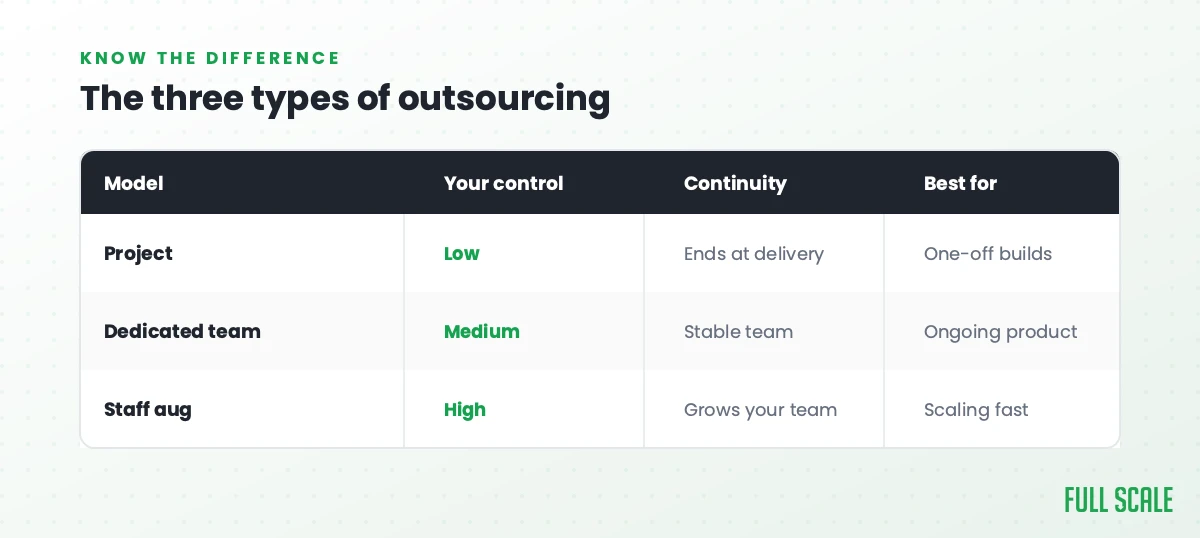
It helps to separate two things people lump together. Buying a finished project from a vendor is one model. Hiring dedicated engineers who work as part of your team is another. Get that part right and you avoid the bad offshore developers that give the whole model a bad name. They look similar on an invoice and behave nothing alike, which is the first place founders get it wrong. If you want the full breakdown of the upside and downside before you go further, I wrote a separate piece on the pros and cons of outsourcing software development.
In-house vs outsourced development
Here is how the two approaches compare on the factors that actually drive the decision. It is the same fork we walk through for outsourcing the backend specifically.
| Factor | In-house | Outsourced |
|---|---|---|
| Cost structure | Fixed: salaries, benefits, office, equipment | Variable, based on what you actually need |
| Talent access | Your local market or whoever you can relocate | A global pool |
| Speed to staff | Slow, a full recruiting cycle | Fast, the people already exist |
| Day-to-day control | Direct | Depends entirely on the model you pick |
| Knowledge retention | High, it stays in the building | Varies, and this is where most teams get hurt |
| Specialized skills | Limited to who you have | You can buy the exact expertise you need |
Neither column is the right answer for everyone. The honest read is that in-house wins on control and continuity, outsourcing wins on cost and speed, and the model you choose decides how much of each you actually get. If you’re still stuck on that tradeoff, here’s how I think through outsourcing developers versus hiring in-house. Cost is usually what pulls teams toward outsourcing in the first place, and there is a fuller playbook on how to cut software development costs without giving up quality.
The three types of software outsourcing
Software outsourcing comes in three flavors based on where the team sits: onshore, nearshore, and offshore. The trade is always the same, you give up time-zone overlap to gain cost savings and a bigger talent pool.
| Type | Where | Time-zone gap | Cost |
|---|---|---|---|
| Onshore | Your own country | 0-3 hours | Highest |
| Nearshore | A neighboring country or region | 1-4 hours | Middle |
| Offshore | A distant country | 5+ hours | Lowest |
Onshore means same country, same time zone, no language gap, and the highest bill. It is the safe choice when the work is sensitive or you need to be in the room. Nearshore splits the difference: decent overlap, modest savings, fewer cultural gaps. Offshore is where the real cost savings live, along with the real coordination work. When the engagement is ongoing product engineering rather than a one-off build, the version of offshore that works is an extended team that integrates with your engineers and stays for years, not a project you throw over a wall. There is more nuance to each in the offshore engagement models guide.
Why companies outsource software development
I have written separately on why companies outsource software development, but it comes down to four reasons, and after twenty years of doing this I still think they hold up.
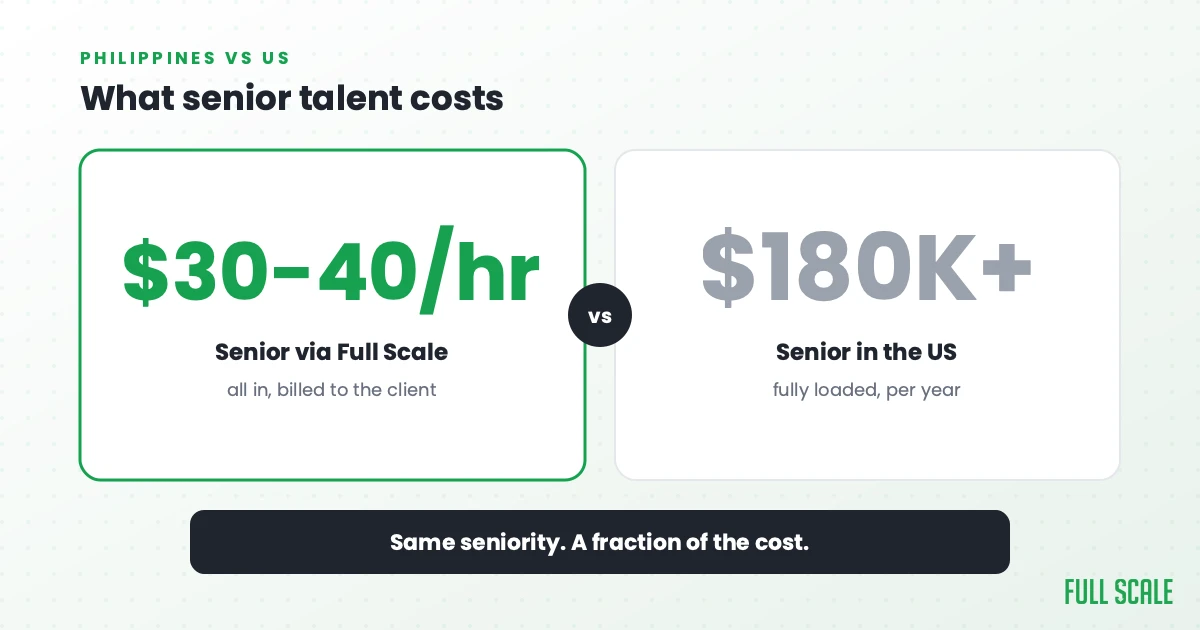
Cost. A senior developer in the US runs $180,000 to $250,000 all-in once you count benefits, payroll tax, and recruiting. A strong developer in the Philippines bills at $30 to $40 an hour. That is not a rounding error you negotiate over. It is the difference between affording two engineers and affording five, which for most companies decides what you can build this year.
Talent. You stop hiring from one city and start hiring from the world. The US has had a real shortage of senior engineers for years, and Stack Overflow’s developer survey shows demand still outrunning supply. The Philippines is the third-largest English-speaking country in the world, which is a big part of why we built our teams there.
Speed and scale. You can add four engineers for a push and scale back when it ends, without the cost and human cost of hiring and laying people off. The people already exist at the partner, so you skip the recruiting cycle. The same flexibility applies when you build an offshore backend team, though the backend raises the stakes.
Focus. Handing routine build work to a dedicated team frees your core people for the parts only they can do. For a cash-strapped startup, that focus is often worth more than the savings. A Deloitte survey still puts cost as the top driver, but the companies that get the most out of outsourcing treat it as a way to move faster, not just to spend less.
Software outsourcing vs software houses
People mix up outsourcing companies and software houses. A software house builds finished products and takes real ownership of the product decisions. An outsourcing company gives you development capacity that executes against your direction. The difference shows up in who owns the “how.”
| Factor | Software house | Outsourcing company |
|---|---|---|
| Focus | End-to-end product | Specific functions or roles |
| Ownership | Heavy input on product decisions | Executes your specifications |
| Duration | Usually longer-term | Often project-based |
| Relationship | Strategic partner | Directive, you lead |
Once you know which fits, our list of the top offshore software development companies shows who delivers each model.
What software development services can be outsourced
Software development outsourcing can cover the whole lifecycle, or just the parts you are short on. The common ones:
- Full-cycle custom application development
- Front-end, back-end, and API development
- Mobile apps, native and cross-platform (React Native, Flutter, .NET MAUI)
- Quality assurance and testing
- DevOps, cloud, and infrastructure
- Legacy modernization and maintenance
- Specialized work like AI, machine learning, and data engineering
Most companies do not outsource everything. They keep the core product and architecture close and send out the well-scoped, supporting work. That single decision, what stays in-house, matters more than any vendor choice you make later.
How to choose a software outsourcing company
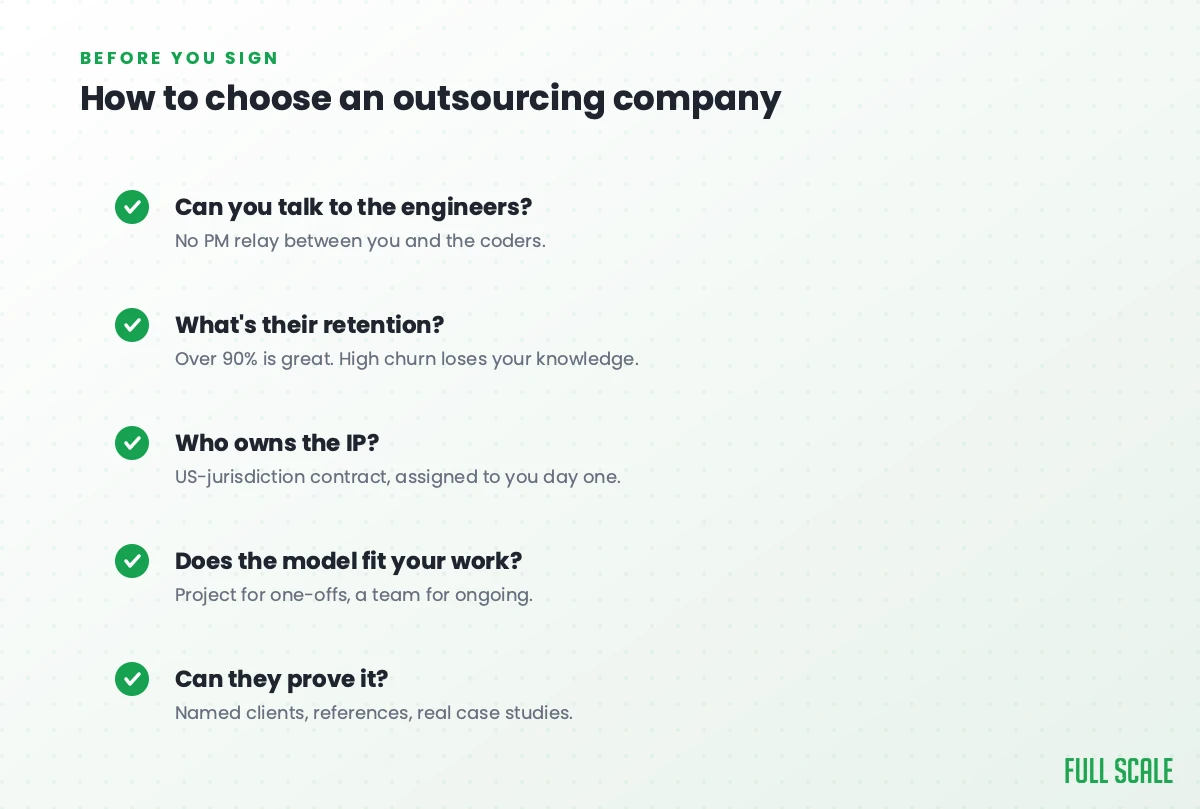
Choosing a partner is a process, not a gut call. Here is the order I would run it in, and if you want the deeper buyer’s version, we wrote a full guide on choosing a software development outsourcing company.
- Write down what you actually need and what success looks like
- Find providers with real experience in your space
- Check technical depth, not just a polished sales deck
- Test communication and cultural fit early
- Read the case studies and call the references
- Verify security and compliance practices
- Interview the actual engineers who would work on your project
- Compare pricing models and contract terms
- Start with a small pilot before you commit
Red flags to watch for
I have sat on both sides of these conversations. The warning signs that have proven real every time:
- They will not give you client references or let you talk to the engineers
- Vague answers to direct technical questions
- Rates that are suspiciously low, which usually means juniors billed as seniors
- High turnover, or they cannot commit specific people to you
- No clear escalation path when something goes wrong
- Thin answers on security, IP, and documentation
One or two of these, ask harder questions. Several of them, walk. The vetting matters more than the rate, because the cheap engagement that fails is the most expensive one you will ever buy. It is also how you end up getting burned hiring on a freelance marketplace.
Software outsourcing costs and ROI
Rates vary by region, seniority, and how you structure the engagement. These are market ranges, useful for budgeting, not quotes. For a deeper read, we keep offshore development rates by country current.
| Region | Mid-level ($/hr) | Senior ($/hr) |
|---|---|---|
| North America | $80-120 | $120-200+ |
| Western Europe | $70-100 | $100-150 |
| Eastern Europe | $40-60 | $60-90 |
| Latin America | $45-70 | $70-100 |
| Philippines / SE Asia | $30-45 | $45-60 |
| India | $30-50 | $50-80 |
One warning on rates: the hourly number is not the cost. The real cost includes your time managing the relationship, the ramp-up while the team learns your product, and the rework when communication slips. A cheap rate with high churn costs more than a fair rate with a team that stays. Budget for the whole thing, not the line item.
Software outsourcing models
How you structure the deal decides who carries the risk.
| Model | Best for | Pricing |
|---|---|---|
| Time & materials | Evolving requirements | Hourly or daily |
| Fixed price | Well-defined, stable scope | One project fee |
| Dedicated team | Long-term product work | Monthly team cost |
| Staff augmentation | Extending an in-house team | Hourly or monthly per person |
Fixed price feels safe because the number is certain, but you pay a risk premium and you lock the scope. Time and materials is flexible but needs active management. For ongoing product work, a dedicated team is the one I trust, because it keeps the cost and talent advantages while fixing the control and continuity problems that wreck project outsourcing. Most companies land somewhere between 15% and 30% in real first-year savings, with the bigger return coming from shipping faster, not from the hourly rate alone.
The risks of software outsourcing, and how to manage them
Outsourcing brings in a team you do not see every day, which means problems hide longer. The deeper version is in our piece on the risks of outsourcing and our breakdown of real outsourcing failures and the mistake behind each, but here is the working summary.
| Risk | How to manage it |
|---|---|
| Communication and time zones | Set protocols, require a few hours of daily overlap, write requirements down |
| Quality and tech debt | Code reviews, automated tests, clear acceptance criteria |
| Security and IP | NDAs, access controls, contracts that assign ownership to you |
| Missed delivery | Clear milestones, change management, weekly progress you can see |
| Knowledge walking out | Require documentation and knowledge transfer from day one |
| Vendor instability | Check the partner’s track record and retention before you sign |
The two that have bitten me hardest are knowledge and control. When a project team leaves, everything they learned about your product leaves with them, and you start over on the next change. That is why I push people toward a team that stays. Our developers stay because we treat the job like a career, not a gig. 95% of our Philippines team says it is a great place to work, against 65% at a typical company (Great Place to Work), and retention runs above 90%.
What is IT outsourcing, and how software fits in
Software development is one slice of the broader category people call IT outsourcing. IT outsourcing means contracting out technology functions instead of staffing them yourself, and software is usually the biggest piece but not the only one. Companies also outsource:
- Infrastructure and cloud operations
- Network administration and security
- Help desk and technical support
- Database administration and data engineering
- Disaster recovery and business continuity
People also confuse IT outsourcing with managed services. The simple line: with outsourcing, you direct the work and the vendor supplies the people and execution. With managed services, the provider takes operational ownership of an entire function and runs it to a service level. Most companies use both, software development through an outsourcing or dedicated-team model where they want control, and managed services for commodity operations where they do not.
Where software outsourcing is going
The biggest shift is AI, and the takes on it are mostly wrong in both directions. AI is not going to replace your outsourced engineers, and it is not a magic productivity multiplier either. What it does is raise the floor: routine code gets faster, so the value moves to the people who can decide what to build and architect it well. That is the whole argument in my book, Product Driven, and it is why I care more about whether an outsourcing partner builds engineers who think about the product than whether they can type fast.
Critics will tell you offshoring is a race to the bottom on wages and that cheaper means worse. I disagree, and the work my teams have shipped is the argument. But the critique has a real core: treat people like interchangeable headcount on a spreadsheet and you get exactly the bad outcomes that give offshoring its reputation. Treat them like your own team and the quality follows. The companies that win with software outsourcing over the next few years will be the ones who figured that out. The outsourcing examples worth studying are the ones that already did.
Build your software outsourcing team with Full Scale
Finding and keeping good engineers is the hard part, and it is the part we handle. Full Scale builds and manages dedicated development teams in the Philippines with the exact skills your roadmap needs, from custom application development to QA, DevOps, and mobile. We handle recruiting, payroll, benefits, and HR, so you get engineers who work as part of your team without the overhead of running an offshore office. We have made the Inc. 5000 five years running, and the model is the same one behind our work with clients like LendingStandard. If you would rather extend your team than rent a project, that is what our developers in the Philippines and staff augmentation services are built for. For teams with web application work specifically, our web application development services cover the full React and Node-based stack.
Book a discovery call with Full Scale
Frequently Asked Questions
What is software outsourcing?
Software outsourcing is hiring an external company to handle software development work instead of doing it with your own employees. It lets you access specialized skills, lower your costs, and ship faster while your core team stays focused on the product.
What are the three types of software outsourcing?
Onshore (same country), nearshore (a neighboring country or time zone), and offshore (a distant country). Onshore costs the most but gives you the easiest collaboration; offshore saves the most but takes the most coordination; nearshore sits in between.
What is IT outsourcing in a company?
IT outsourcing is contracting external providers to run technology functions instead of staffing them in-house. Software development is the largest piece, but it also covers infrastructure, cloud, security, help desk, and database work.
How much does software outsourcing cost?
Senior developer rates run roughly $120-200+ an hour in North America, $60-90 in Eastern Europe, and $45-60 in the Philippines. The real cost also includes your management time and ramp-up, so budget for the whole engagement, not just the hourly rate.
What is the difference between a software house and software outsourcing?
A software house builds finished products and takes ownership of product decisions. An outsourcing company supplies development capacity that executes against your direction, so you keep control of the product and the vendor provides the people and the build.
What are the biggest risks of software outsourcing?
Losing control of how your code gets built, tribal knowledge leaving when a project team disbands, and quality or security gaps that surface after the work is integrated. A dedicated team that stays, plus documentation and code reviews from day one, manages most of them.
What should a software outsourcing contract include?
A solid software outsourcing contract spells out the scope of work, the timeline, and who owns the code and IP once it ships. It should also cover data security and NDAs, how change requests get handled, and a clear escalation path if the relationship goes sideways. Getting this in writing up front is what keeps a cheap engagement from becoming an expensive one.