
10 Outsourcing Mistakes That Explain Why Outsourcing Fails

In this article
- Why outsourcing fails: the strategy leaves the building
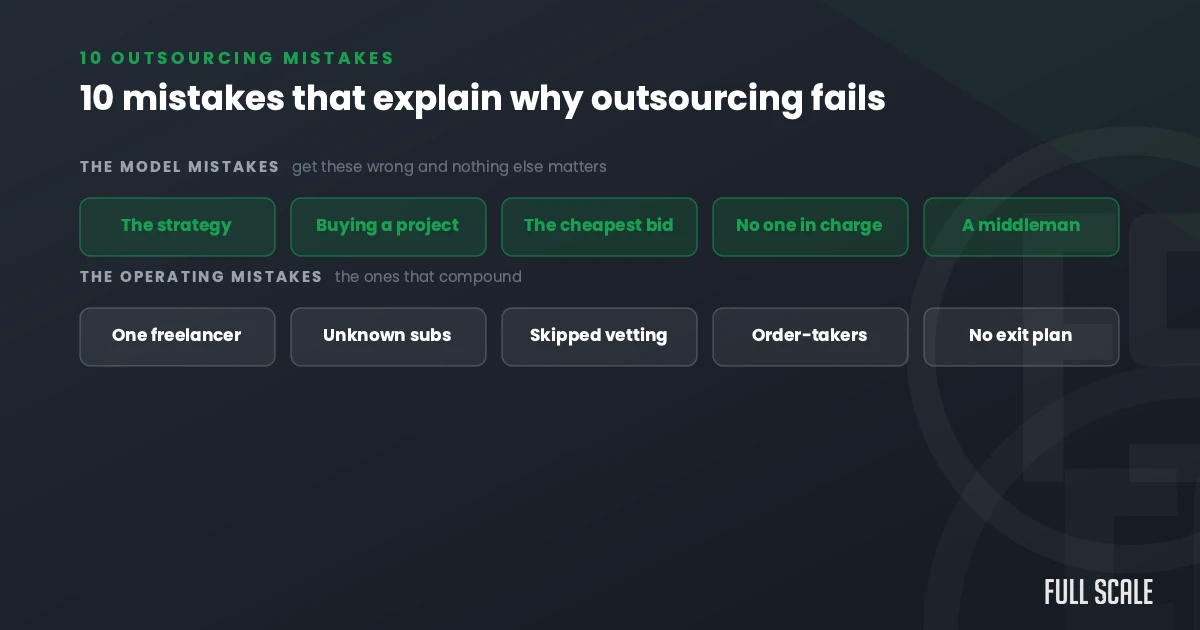
- The 10 outsourcing mistakes that do the damage
- 1. Outsourcing the strategy
- 2. Buying a project when you needed a team
- 3. Chasing the cheapest bid
- 4. Having nobody in-house to direct the work
- 5. Accepting a middleman between you and your developers
- 6. Betting your product on one freelancer
- 7. Not knowing who's actually doing the work
- 8. Vetting the company but not the engineers
- 9. Treating developers like order-takers
- 10. Signing without an exit plan
- Real outsourcing failures, and the mistake behind each
- When outsourcing is the right call
- Why the IT outsourcing challenges list never changes
- Frequently asked questions
- Outsource the work, keep the strategy
Quick Answer: Outsourcing fails when companies hand over more than the work. The deadliest outsourcing mistakes, like buying a project when you needed a team, letting a middleman own communication, and handing the vendor your product decisions, trace back to one root: outsourcing the strategy itself. That's the pattern Full Scale founder Matt Watson has watched for 20+ years from both sides of the contract. The fix stays the same: outsource the execution, never the ownership.
Before I ever hired a developer outside the US, I heard ten horror stories for every success. For years I believed them and stayed away, which I now count as its own expensive mistake. I finally hired offshore developers in 2012, two Java developers in St. Petersburg I didn't even know were in Russia until our first phone call. I went on to hire in Latin America and the Philippines, and those engineers helped me scale Stackify to its exit. My first company, VinSolutions, sold for about $150 million. Today I run Full Scale, where placing developers with US companies is the whole business. That means I've now sat on both sides of the outsourcing contract: the founder writing the check, and the vendor cashing it.
The view from the vendor's chair is different. When an engagement falls apart, the client blames the developers, the country, or the whole idea of outsourcing. The risks of outsourcing are real, but after twenty years of watching engagements succeed and fail from both chairs, I keep seeing the same pattern.
The deadliest outsourcing mistakes are one mistake wearing different costumes.
Why outsourcing fails: the strategy leaves the building
The biggest mistake in outsourcing is trying to outsource strategy.
If you don't know how to build your product, market it, or sell it, handing that problem to someone else rarely goes well. This is your business. You should understand its nuances better than anyone on the planet, and if you can't figure it out, a developer you hired at an hourly rate certainly won't figure it out for you.
Real strategy help does exist. It's called an expert consultant, it bills like one, and it sits at the opposite end of the market from outsourced execution. The fatal version of this mistake is expecting strategy as a free bonus from people you hired to knock out tasks at the lowest rate you could negotiate.
Outsourcing is genuinely great at what it's actually for: skilled execution, at scale, faster and cheaper than you could hire locally. The engagements that blow up are almost always the ones where somebody quietly handed over ownership of the thinking along with the typing.
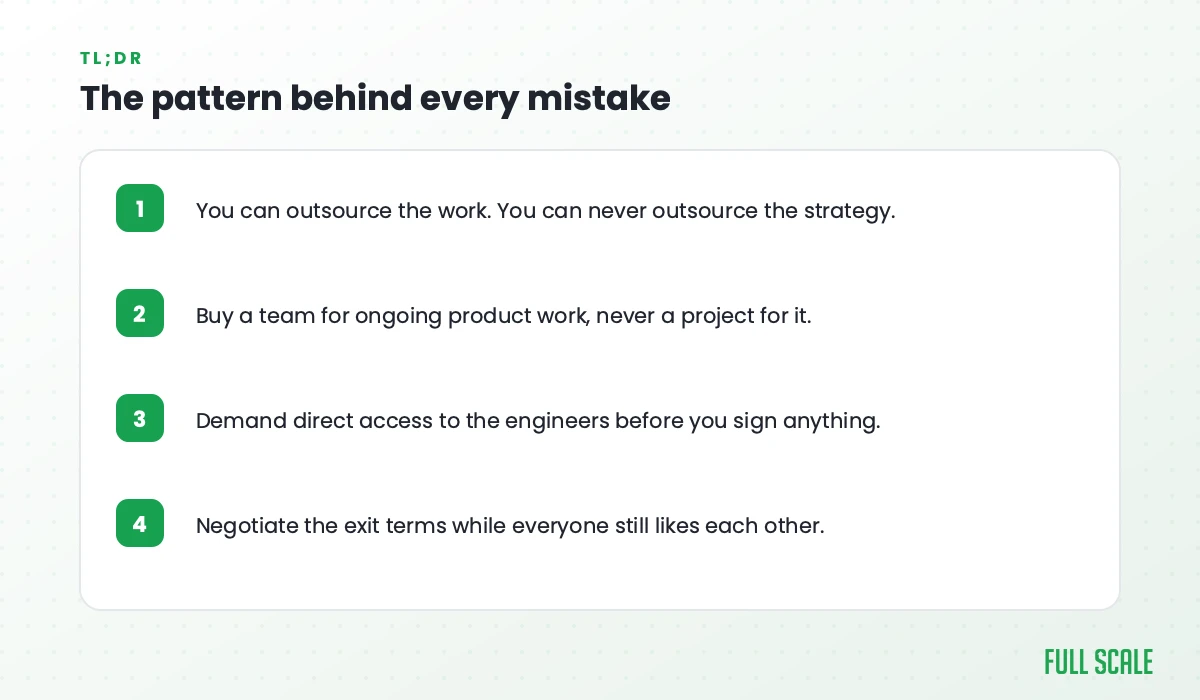
You can outsource the work. You can't outsource the strategy.
Keep that rule in your head, because half the list below is that rule being broken in a costume.
The 10 outsourcing mistakes that do the damage
Here's the list I wish someone had handed me twenty years ago, with what each mistake looks like, why it kills engagements, and what to do instead.
1. Outsourcing the strategy
Outsourcing the strategy usually shows up disguised as delegation. A founder decides the product roadmap is too hard, or the technical direction is too confusing, so they hand it to the vendor along with the tickets. The vendor accepts, because vendors get paid either way.
An outsourced team can execute a strategy brilliantly. It can't invent one, because strategy comes from understanding your customers, your market, and the hundred small trade-offs only an owner sees. When strategy questions land on people who are paid by the hour and judged by output, you get motion instead of progress. Features ship, and the product goes nowhere.
If you need strategic help, hire a high-powered expert consultant with real expertise in your problem and pay their rate. What you should never do is expect the low-cost team you hired for execution to carry the strategic weight of your company.
2. Buying a project when you needed a team
Project outsourcing means handing a vendor a spec and getting back a deliverable. That model works fine for work with a finish line. Most companies use it for their actual product, which has no finish line, and then act surprised when the wheels come off after version one.
The most famous public example is Hertz, which hired Accenture to rebuild its website and app, watched the deadline slip from December to January to April, and then sued to recover $32 million after alleging the work was buggy, insecure, and unusable. (Accenture denied the allegations.) A big invoice and a name-brand vendor didn't matter, because Hertz handed over a spec and expected a finished product to come back on its own.
The sibling mistake is signing before anyone defines what done looks like. A vendor can't hit a success bar you never set, and a scope you can't write down completely is a project contract you shouldn't sign.
Ongoing product work needs an outsourced development team that someone inside your company actually runs. If the code will still matter in two years, buy the team version. It has a name, staff augmentation, and it's the model to demand for ongoing product work.
3. Chasing the cheapest bid
Chasing the cheapest bid has wrecked more engagements than any other single decision I've watched, and I gave the habit a name: cheapshoring. You sort the vendor list by hourly rate, pick the bottom, and congratulate yourself on the savings.
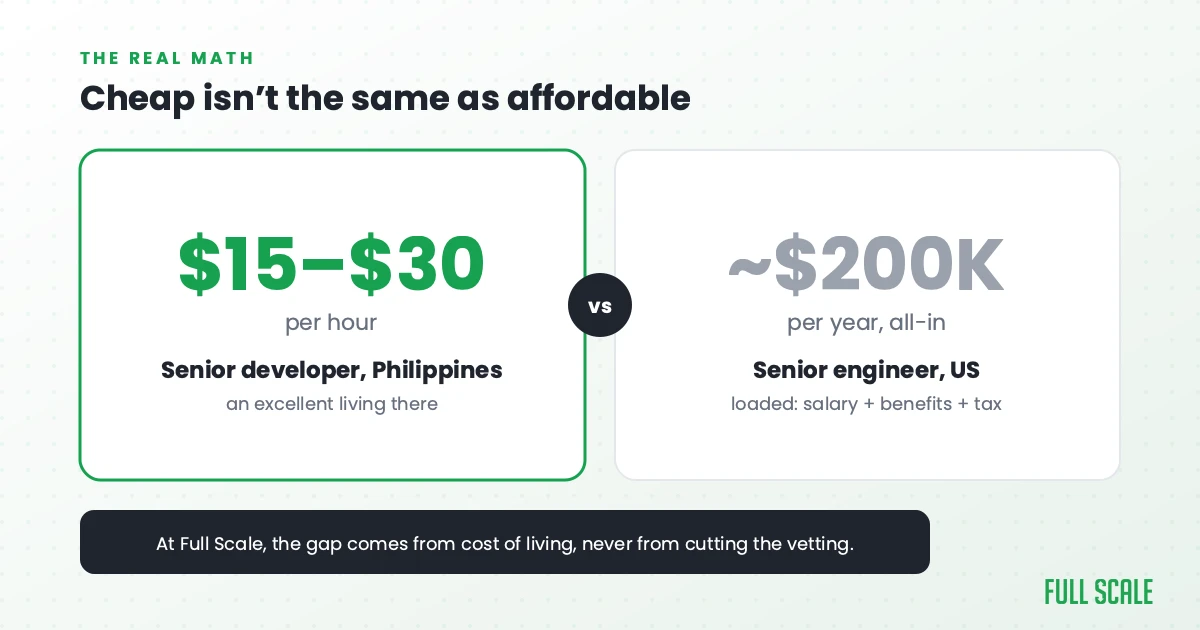
The savings from hiring globally are real, and you don't need the bottom of the list to get them. A strong developer in the Philippines earns $15 to $30 an hour, and that's an excellent living there. A US software developer runs near $133,000 in median salary, seniors run well above it, and the 1.25 to 1.4x in benefits, taxes, and overhead pushes a senior's real cost toward $200,000. That gap exists because living costs less there, and it says nothing about the talent.
The $8-an-hour bid sits below even that math. What it usually buys is a shop that skipped the vetting, skipped the management, and stopped caring once they'd been paid. Add up the rework, the re-hiring, and the lost quarter, and the cheap developer turns out to be the most expensive one you ever hired. Even the industry has moved on from cost worship. In Deloitte's Global Outsourcing Survey, executives now rank skilled talent and agility alongside cost as the main reasons they outsource.
4. Having nobody in-house to direct the work
I know a founder with 16 developers in Pakistan, and I've fielded the same worried call from him more than once. He's convinced the team is broken. I keep telling him it isn't.
Headcount is not a substitute for a boss.
What that team is actually missing has nothing to do with the developers. Nobody owns technical direction, decides what gets built next, or has the authority to say a piece of work isn't done yet. Add people to a group with no direction and you've added more hands waiting to be told what to do, not a fix for the slide backward. This is the self-inflicted offshore mistake I see most often, and it's really the strategy mistake again: technical direction is strategy, and he outsourced it by default, to whoever happened to be closest to the keyboard.
When outsourced developers deliver inconsistent quality, the cause usually sits upstream of the developers, with nobody on the client side owning direction and quality standards. Before you hire your first outsourced developer, know exactly who at your company directs the work. If the answer is "the vendor will handle it," stop and fix that first.
5. Accepting a middleman between you and your developers
I've talked to a lot of founders running overseas teams who have only ever spoken to one person: the technical project manager. Every actual developer sits behind that PM, sometimes because of a language gap, sometimes because of a cultural rule about who's allowed to talk to the client. Plenty of shops run this model on purpose, because it lets them swap developers behind the curtain without you noticing.
Software development is about communication more than anything else, and an outsourcing engagement lives or dies on communication. Small misunderstandings compound for weeks when every question routes through a proxy, and by the time you see the work, it's the wrong work.
If you can't talk directly to the people writing your code, you can't steer them.
Demand direct access to your engineers before you sign.
6. Betting your product on one freelancer
One talented freelancer at a great rate feels like a hack. It works right up until they take a bigger client, accept a full-time job, or simply stop answering, which is one of the classic ways hiring on Upwork goes sideways. When they vanish, there's nobody to call, because you didn't hire a company. You hired a calendar with one name on it.
The freelancer usually isn't the villain. A good one juggling six clients will prioritize whoever pays the most, and that's rarely you. The structural problem is yours: you bought a single point of failure and called it a development team.
Freelancers are great for small, contained work.
7. Not knowing who's actually doing the work
The bottom of the price list survives on volume, and one way those shops protect margin is by quietly subcontracting your work to someone even cheaper. You think you hired one company. You actually hired a chain of them, and somewhere down that chain, people you've never heard of are holding your code, your credentials, and your customers' data. They sit in a place where you have no realistic way to hold them accountable.
This is where outsourcing stops being a budgeting decision and becomes a security decision. Ask directly: who employs the people touching my code, where do they work, and what happens contractually if one of them walks off with something? If your vendor can't answer cleanly, assume the worst answer is the true one.
8. Vetting the company but not the engineers
Companies run a serious process on the vendor: references, security questionnaires, procurement review. Then they accept whatever humans the vendor assigns, sight unseen, which is like carefully choosing a restaurant and letting the waiter order for you. Except dinner is your codebase.
Interview the actual engineers before they join, the same way you'd interview an employee. Ask how they were vetted, and expect a real answer with numbers in it. At Full Scale we accept fewer than 3% of applicants, we verify education and employment history, and an investigator physically visits each new hire's address in the Philippines as part of the background check. I'm not saying every vendor needs that exact process. I'm saying you should know what the process is, and "trust us" isn't one. Ask about retention too, because a strict screen only matters if the people stay, and ours has held above 93%.
9. Treating developers like order-takers
Some companies pick the right model and the right vendor and still end up with a mediocre team, because they feed their outsourced developers fully-formed tickets and expect silent obedience. The tickets arrive stripped of product context, customer problems, and reasons, with an unspoken instruction to build it and skip the questions.
Engineers treated like ticket machines behave like ticket machines: they build exactly what the ticket says, including when the ticket is wrong. The whole argument of my book Product Driven is that great engineers act like owners, not order-takers, and ownership requires context. Share the product vision, explain who the customer is, and let your outsourced engineers push back when a spec doesn't make sense. The pushback is the value, and AI raises the stakes: engineers who think like owners compound with the new tools, wherever they sit.
You hired brains. Don't use them as fingers.
10. Signing without an exit plan
Nobody reads the exit terms until things aren't working, which is the one moment you can't negotiate them. Companies discover at the worst time that they're locked in for a year, that there's no refund window, or that "replacement" means whoever happens to be on the bench.
Sometimes the engagement fails with nobody at fault. We've had engineers struggle at one client and become heroes at the next, because one client was building rocket science and the other needed steady maintenance work. Fit is real, and no interview fully predicts it. That's why what happens when it isn't working out belongs in the contract: at Full Scale that means a two-week money-back guarantee and a 30-day notice to cancel, with no long-term contract holding you hostage.
Negotiate the exit before you sign, while everyone still likes each other.
Real outsourcing failures, and the mistake behind each
Outsourcing gone wrong scales with the budget: the biggest failures happen at companies with procurement departments and lawyers, and each one maps to a mistake on the list above.
Hertz and Accenture. The product-bought-like-a-project mistake, compressed to one line: $32 million spent and a lawsuit claiming nothing usable shipped.
Boeing. For the 787 Dreamliner program, Boeing handed about 70% of the design, engineering, and manufacturing of entire modules to more than 50 partners, according to UCLA professor Christopher Tang. The goal was to move fast and cut cost. Forbes now calls Boeing "a case study in how not to outsource a supply chain." Boeing outsourced ownership of design and engineering, and design ownership is strategy. Two decades and several crises later, the company is still re-learning where that line was.
The State of Florida. Florida outsourced its People First payroll and HR system, and the work was improperly subcontracted down a chain until state personnel files were being indexed in India. The state ended up warning roughly 108,000 current and former employees that their personal data may have been exposed. Nobody at the top of the chain knew who was actually touching the information. That's the subcontracting-chain mistake with a government seal on it.
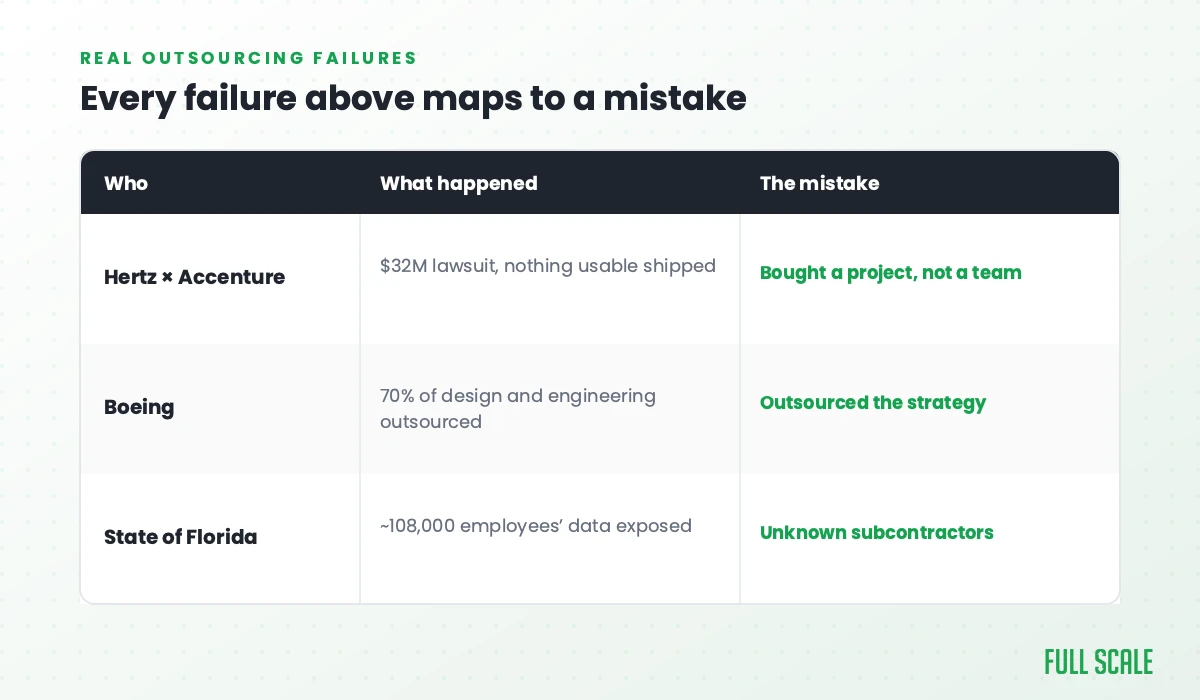
None of these organizations were dumb. They outsourced decisions they should have owned, and I've collected a few smaller outsourcing horror stories of my own that follow the same script.
When outsourcing is the right call
I'd be lying if I told you outsourcing projects never works, because I've done it happily. I've outsourced WordPress builds and an Elasticsearch project, and I'd do both again. They were quick, well-scoped jobs in technologies I had no interest in mastering, and a specialist shop did them better than my team would have.
Project outsourcing makes sense in two situations:
- A scoped, well-defined job with a real finish line: a marketing site, a one-time integration, a statement of work you can actually write down completely.
- A company with no in-house engineering leadership at all, where a vendor owning the outcome beats pretending you can direct work you can't evaluate. If that's you, weigh it honestly against hiring in-house, and keep the strategic decisions in the building either way.
For everything else, meaning your core product and any code that outlives the contract, hire people who join your team and answer to your leadership. And one more piece of honesty, because the fixes in this list add up to real work on your side. Outsourcing never removes the management. What it removes is the recruiting, the employment overhead, and the local salary floor. Anyone who promises to also remove the management is selling you the mistake list above.
Why the IT outsourcing challenges list never changes
Communication problems, quality issues, time zones, security, hidden costs, vague requirements: every roundup of IT outsourcing challenges from the past twenty years carries the same entries. Those are symptoms. The ten mistakes above are the causes.
Communication breaks when you accept a middleman or skip the vetting, no matter which country the developers sit in. Time zones surrender to scheduling. Most Full Scale client teams run a half-day of overlap hours, which turns that whole "challenge" into a calendar setting. Even vague requirements are a cause wearing a symptom's costume, because a scope you can't write down is thinking you haven't done. Fix the mistakes and most of the challenges of software development outsourcing, including the classic offshore versions, quietly stop applying to you.
Frequently asked questions
Why does outsourcing fail?
Outsourcing fails most often because companies hand off strategy along with execution. An outsourced team can write excellent code, but only the owner knows what the product needs to become. The visible symptoms, like missed deadlines, poor quality, and communication breakdowns, usually trace back to a buyer decision. The cheapest bid won, a project contract was signed for ongoing product work, or nobody in-house was directing the team.
What is the real problem with outsourcing?
The real problem with outsourcing is that it gets sold as hands-off and only works hands-on. Vendors market a world where you hand over requirements and receive software, and buyers want to believe it. Successful outsourcing looks different: your leadership sets direction and you talk directly to your engineers. The vendor's job is supplying great people and taking care of them, not replacing your judgment.
When should you not outsource?
Don't outsource work you can't describe or evaluate, and never hand strategy to the low-cost team you hired for execution. If the work is your core product and you have no in-house technical leadership, fix that gap before adding outsourced developers, or scope the engagement so a vendor can genuinely own the outcome. Real strategy help comes from an expert consultant you chose for their expertise, never as a side effect of an hourly contract.
Outsource the work, keep the strategy
Twenty years in, I still think outsourcing is one of the best tools a software company has. It's how I scaled Stackify, and it's the business I run now. But the tool has a manual, and page one says the ownership stays with you.
If you want the version where you keep the strategy and skip the hiring headaches, that's what staff augmentation is: vetted engineers who join your team and answer to your leadership. They stick around long enough to actually know your product. Bring the strategy, and schedule a call when you're ready for the people.