
How Knowledge Transfer in Software Development Changed With AI and Remote Teams

In this article
- What knowledge transfer in software development means
- What poor knowledge transfer costs a software team
- How remote and offshore teams expose weak knowledge transfer
- How AI changed knowledge transfer
- A knowledge transfer plan that actually works
- Why team structure decides whether knowledge transfer sticks
- Frequently asked questions
- Ready to build a team that keeps its knowledge?
For most of my career, knowledge moved between developers by proximity. You sat near the person who knew how the billing system worked, you asked, and they rolled their chair over to show you. Nobody called it knowledge transfer. It was just how the work happened.
Two things broke that. Teams stopped sitting together, and AI showed up inside the codebase.
I’ve hired developers in Russia, Uruguay, Colombia, and the Philippines, and I’ve run engineering at three companies. Full Scale, the company I run now, places senior developers with software teams around the world. So I’ve watched this shift from a few angles, and most teams are still managing knowledge the way they did when everyone was in one room.
That’s a problem, because the room is gone. And the newest member of your team might be an AI that knows nothing about why your code looks the way it does.
Quick Answer: Knowledge transfer in software development is the process of moving what one person knows about the code, architecture, and decisions behind them into a form the rest of the team can use, both the explicit knowledge already written down and the tacit knowledge that only lives in someone's head. It used to happen by proximity, sitting near the person who knew the system, but remote teams and AI coding tools both broke that: AI reads a codebase like a new hire but can't see the reasons behind the code unless they're written down. The fix is a handful of habits, not a heavy framework: write it down as you go, never let one person own a critical system alone, and make onboarding a real path. Full Scale treats offshore developers as full teammates with shared standups and reviews, which is also why it keeps 93%+ retention.
What knowledge transfer in software development means
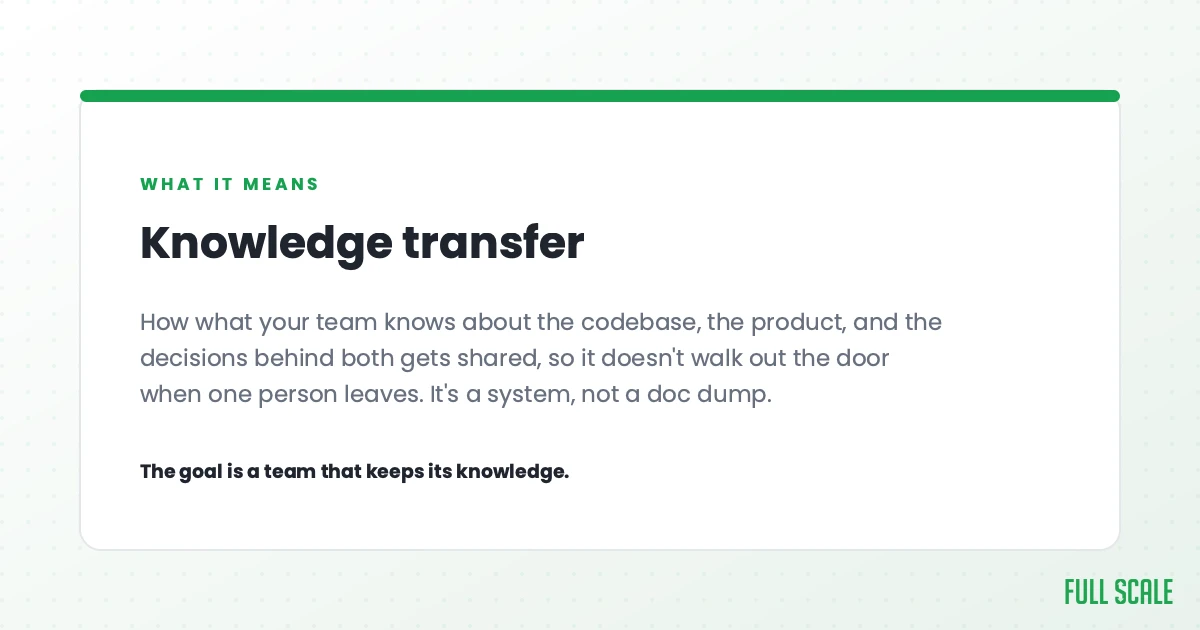
Knowledge transfer is moving what one person knows into a form other people can use. In software, that splits into two kinds of knowledge.
The first kind is explicit. It’s written down: the code itself, the README, the API docs, the runbook. Anyone can read it.
The second kind is tacit. It lives in someone’s head. It’s knowing why you chose Postgres over something fancier, which service falls over under load, and what the client in Dallas actually meant when they asked for “real-time.” None of that is written anywhere, so it walks out the door when the person does.
Side by side, the two kinds look like this:
| Explicit knowledge | Tacit knowledge | |
|---|---|---|
| Where it lives | Written down in code, READMEs, API docs, and runbooks | In someone’s head |
| What it looks like | Coding standards, setup steps, the deploy script | Why an odd workaround exists, which service buckles under load, what a client really meant |
| How it moves | Anyone can read it | Only by asking the person, while they’re still around |
| The risk | Low, as long as it stays current | High, because it leaves when they do |
Almost every painful knowledge gap is tacit knowledge that nobody wrote down. Researchers who study knowledge transfer in software teams keep landing on the same point: the hard part isn’t the documentation you have, it’s the understanding you can’t see.
That understanding is exactly what remote work and AI both expose.
What poor knowledge transfer costs a software team
Poor knowledge transfer mostly costs you a little speed every week, and rarely one big disaster. When people picture losing knowledge, they picture the disaster. Your one senior engineer quits, and suddenly nobody can deploy. That risk is sharper on a thin .NET team, which is why teams hire C# engineers in pairs rather than leaning on one person.
That happens, and it hurts. But it’s rare. The cost you actually pay is quieter.
It shows up in small, recurring ways:
- A new hire takes months to get productive, because the answers they need live in someone’s memory instead of the repo.
- The same handful of questions get asked and re-answered in Slack every few weeks.
- Work grinds to a halt the week the one person who understands a system takes vacation.
- A feature ships late because only one engineer understood the part it touched, and she was buried in something else.
None of that shows up as a line item. It just makes the whole team slower, all the time.
It gets worse when people leave. US tech turnover runs around 13 to 15 percent a year, and every departure takes a chunk of tacit knowledge with it. If that knowledge only ever lived in one head, you’re not down a person. You’re down everything that person knew and never said.
Distributed teams feel this sooner, which turns out to be a good thing.
How remote and offshore teams expose weak knowledge transfer
When everyone sits together, you can fake your way through bad knowledge transfer for years. Someone has a question, they lean over and ask. The knowledge never gets written down, but it gets shared, so nobody notices the gap.
Take away the shared room and the gap shows up right away. A developer in Cebu can’t lean over and ask the lead in Kansas City. So either the answer is written down somewhere they can find it, or they’re blocked.
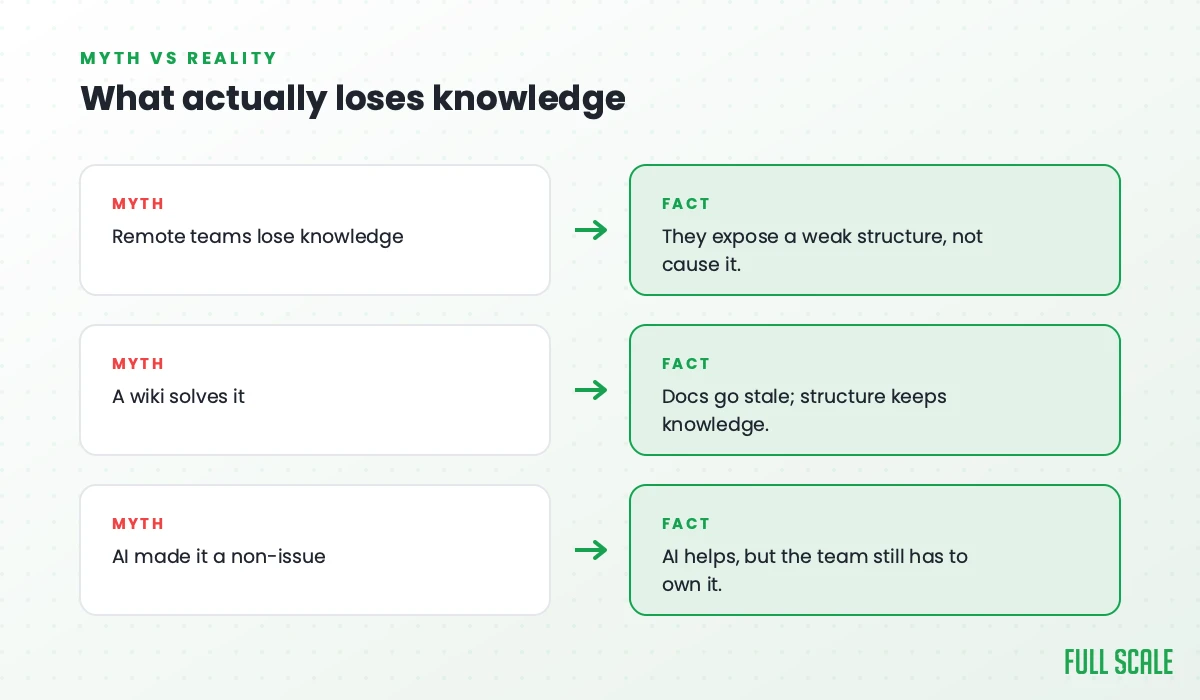
Remote work doesn’t add the problem, it just makes it impossible to ignore. You build the documentation you should have had all along, because there’s no other way to function. If your team works well remotely, it will work well globally too, because the discipline is the same. Most of that discipline comes down to how a remote team communicates, not which tools it buys.
Randy Silver, a product leader I had on my podcast, put it well: people are the hardest part of technology, the only thing harder is lots of people, and almost every team is at least partly remote now, so communication has to be deliberate or it quietly stops happening. That gap is exactly how communication problems quietly sink software projects: the context lives in one person’s head and never reaches the people writing the code.
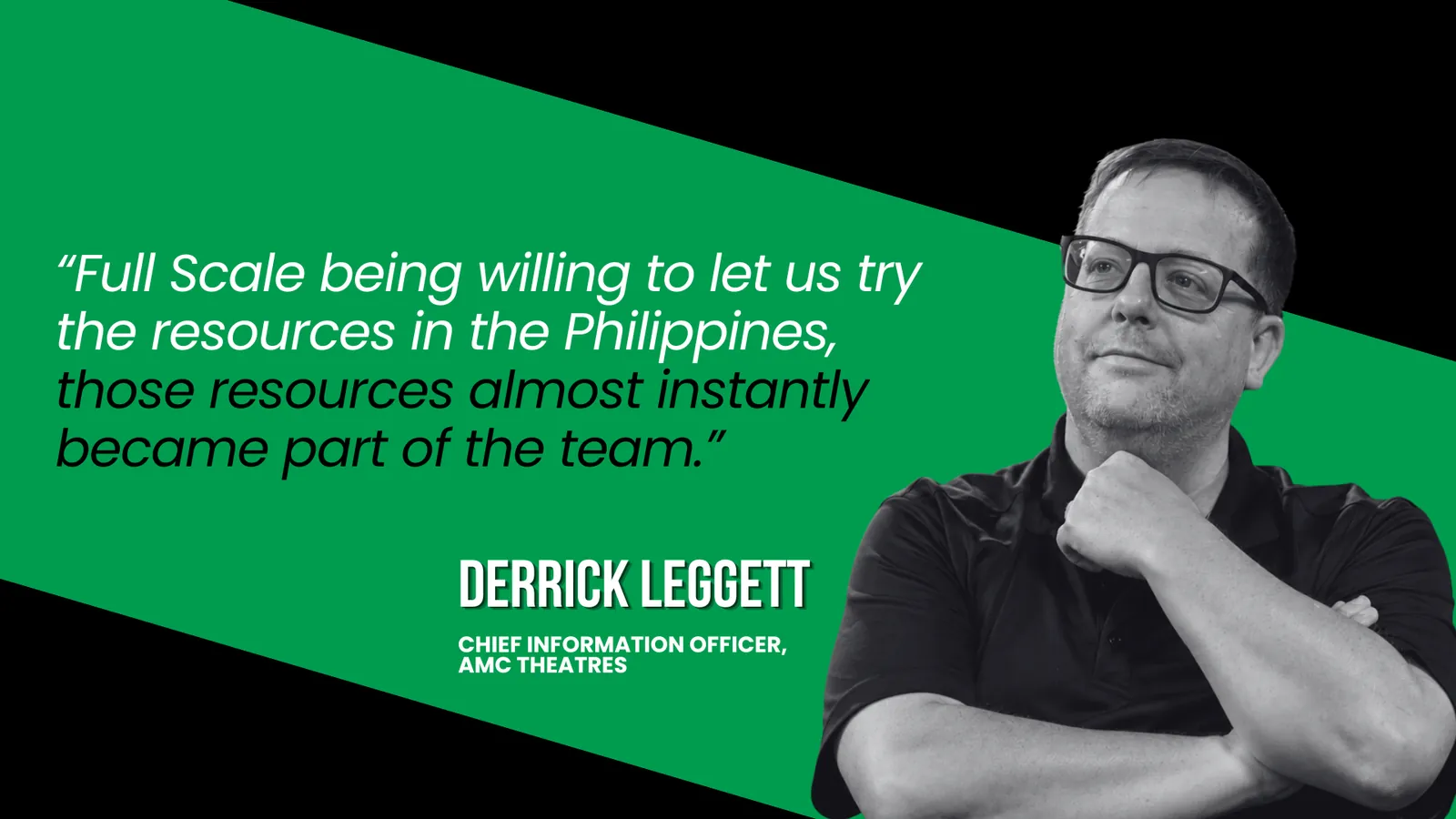
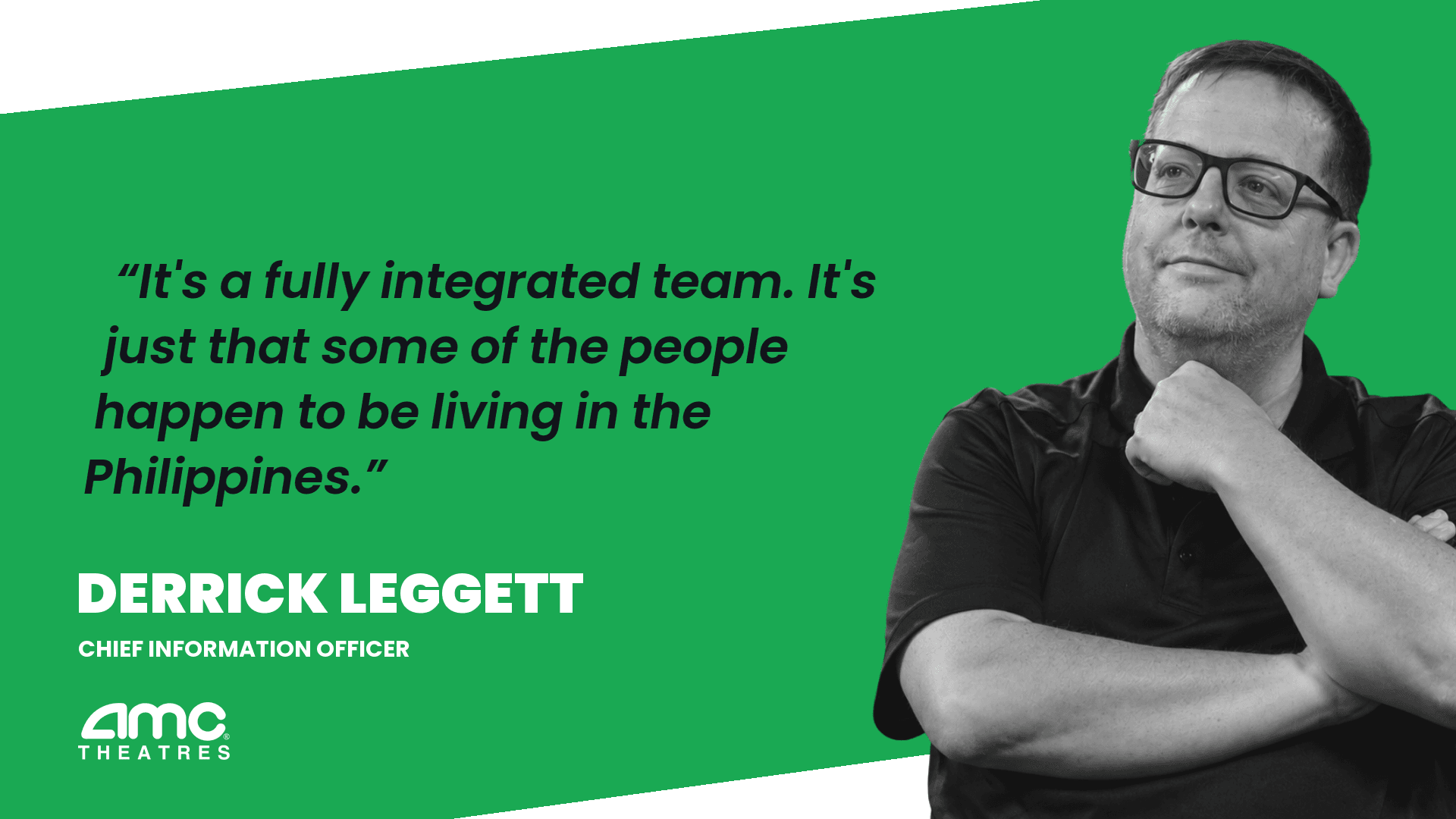
I’ve watched this play out at AMC Theatres, where Full Scale has placed engineers for years. Their CIO, Derrick Leggett, doesn’t treat the developers in the Philippines as a vendor on the other side of a wall. As he puts it, “It’s a fully integrated team. It’s just some of the people happen to be living in the Philippines.” They sit in the same standups, run the same code reviews, and work in the same tools as everyone else. The knowledge moves because everyone is on the same team, with no vendor wall for it to get stuck behind. The lessons from running teams like that all come back to the same habit: write things down so anyone can pick them up.
How AI changed knowledge transfer
Your documentation has a new reader, and it isn’t a person. Everything you write down for the next engineer is now also the context an AI uses to understand your code.
When a developer points GitHub Copilot, Cursor, or Claude at your codebase, the AI hits the same wall a new hire does. It can read all your code, but it can’t read the reasons behind it. It doesn’t know your conventions, the tradeoffs your team agreed on, or the landmine in the one module everybody steps around.
AI is great at building what you asked for. What it can’t do is know the things your team never wrote down. That gap, the why behind the code, is the same tacit knowledge sitting in your most irreplaceable engineer’s head. If it isn’t captured, neither the new hire nor the AI can use it.
This is why the demos feel like magic and the real work doesn’t. You describe an app, the AI builds it in half an hour, and the demo works. Then you point the same tool at 200,000 lines of legacy code with fifteen internal frameworks, and the wheels come off. The difference is context. The greenfield demo has none to miss, while your real system is held together by a decade of decisions nobody recorded.
So good documentation, clear specs, short notes on why a decision was made, and a solid test suite stopped being just nice-to-have for humans. They’re the context that makes AI useful on your codebase instead of a generic one.
This isn’t only my read. David Mitchell, the CTO for the Americas at VML, told me on my podcast that his enterprise clients have finally gotten comfortable letting AI read their own source for context, and that his teams now build smaller models trained on data those clients own. The companies pulling real value out of AI are the ones feeding it their own context.
There’s a catch, and it matters. More context is not automatically better. Chroma’s research on “context rot” found that every frontier model degrades as you cram more into it, and Microsoft’s own testing found models quietly corrupt content over long sessions in ways that look fine in a diff. Dumping your entire wiki into a prompt actually makes the output worse. What wins is documentation that’s accurate, current, and close to the code, so the right context is easy to find and easy to trust.
Tests deserve a special mention. A test is knowledge you can run. It says “this is what correct looks like” in a form that doesn’t go stale and that an AI can’t quietly rewrite past. Of everything you can document, the tests are the part that defends itself.
One warning from my own past. Years ago at Stackify, I had a brilliant engineer whose feature kept confusing customers. I told him people were struggling. He said, “It’s all documented. Tell them to read the support documentation.” He was right that it was documented. He was wrong that it transferred. Documentation existing is not the same as knowledge transferring, and that’s true whether the reader is a new hire or a machine. AI is a powerful tool, but relying on it to generate code nobody understands just creates tomorrow’s technical debt today. The hard part of software development was never writing the code. It’s understanding the problem you’re trying to solve.
Or, the shorter version I’ve said before: “no code” is someone else’s code. The understanding still has to live somewhere.
And the cost of getting this wrong keeps rising. Derrick Leggett, AMC’s CIO, told me people who don’t learn to use AI well “are going to be working at 30%, 50%, 80% of what the person sitting next to them is.” The teams that win that race are the ones whose knowledge is already written down where both their engineers and their AI can reach it.
A knowledge transfer plan that actually works
You don’t need a 40-page framework. You need a handful of habits the team will actually keep.
Here’s what works, roughly in order of how much it pays off:
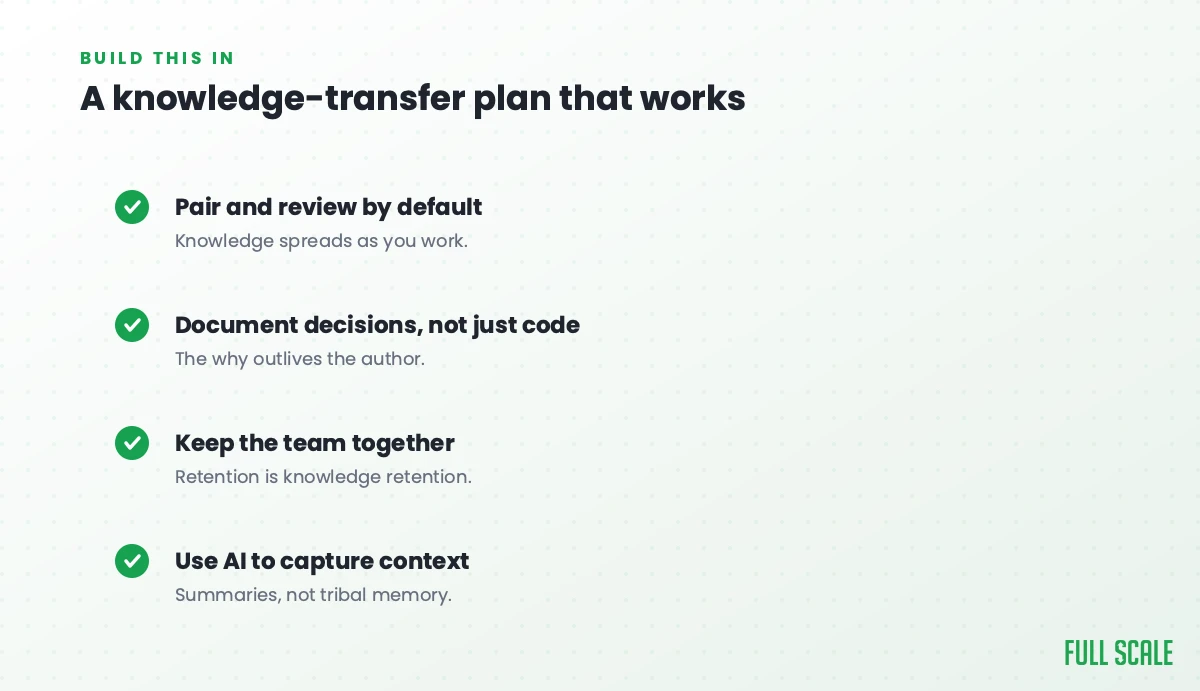
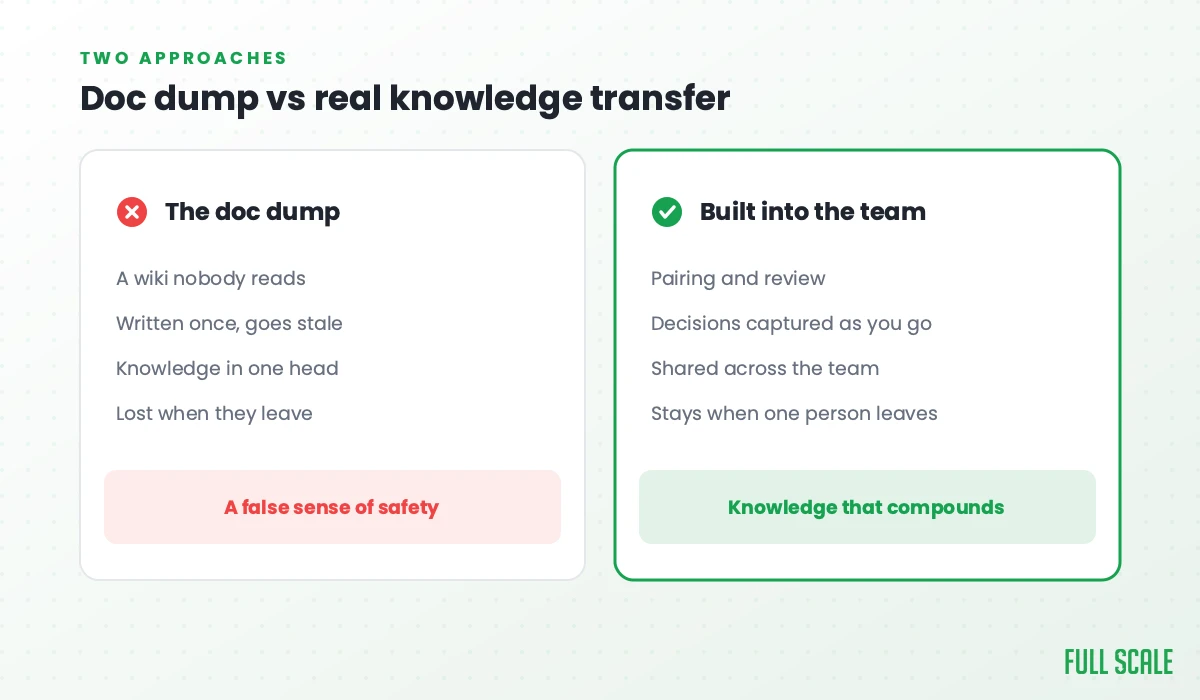
- Write it down as you go. Documentation written in one heroic push goes stale in a month. Capture decisions when you make them, in small notes that live next to the code.
- Never let one person own a critical system alone. Pair programming, even remotely, means a second person has touched the thing before you need them to. Rotate who owns what, and review each other’s work. That’s how you kill the single point of failure.
- Make onboarding a real path. Don’t hand a new developer a firehose and wish them luck. They should know what to read, who to ask, and what to ship first. We get developers into a client’s standups within about two weeks, and a clear onboarding path is most of why that works.
- Treat tests and specs as knowledge. They are the runnable version of “here’s how this is supposed to behave,” worth more than a doc nobody opens.
- Record the why, briefly. A short architecture decision record, even a paragraph on why you went one way instead of another, saves the next person, and the AI, from guessing.
- Keep the docs next to the code and current. Stale docs are worse than none, because people and models both trust them.
If you manage people across time zones, these stop being optional. The same habits anchor any good approach to managing hybrid and distributed teams, and they’re the backbone of agile offshore practices too. Skip them and you don’t just lose knowledge, you build up technical debt nobody can explain a year from now.
Why team structure decides whether knowledge transfer sticks
You cannot document your way out of a team that turns over every nine months. If people leave constantly, you’re refilling the same buckets forever, and the tacit knowledge never has time to settle. The best wiki in the world won’t save a team that treats engineers as interchangeable headcount.
The structural fix is boring, and it works: build long-term teams of people who stay and care about the product. Staff augmentation done right means hiring people to work directly for you for the long haul, the way you would hire anyone you expect to keep.
That’s the whole model at Full Scale. We build dedicated development teams that stay with a client for years, and our developer retention runs over 93 percent in a country where call-center turnover is among the highest in the world. A team that doesn’t churn is a team that doesn’t keep losing its knowledge. You get there by how you hire, long before any wiki does its job.
Both halves matter now. A stable long-term team still has to write things down, because AI is reading the codebase too. And the best documentation still loses to a team that won’t stay long enough to build any. This is the same argument I make in Product Driven: the bottleneck was never typing speed, it was whether the people doing the work understood it well enough to share it.
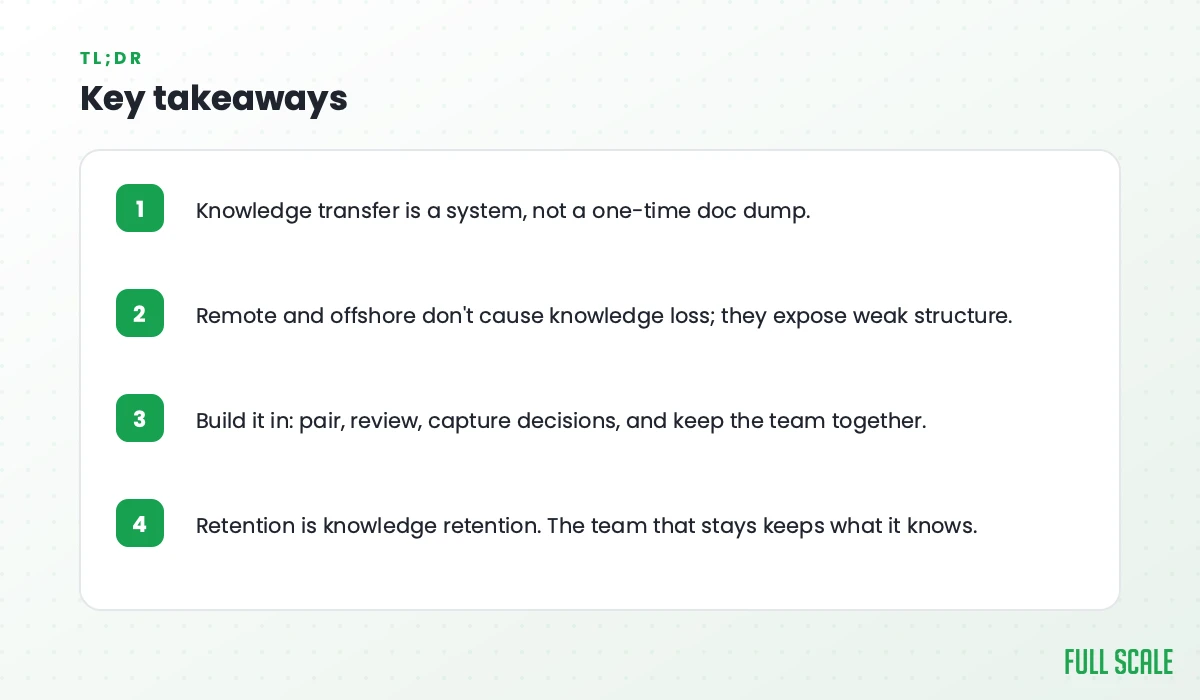
Knowledge that lives in one head is a risk, whether that head is down the hall or across an ocean. Write it down, share it, and build a team that sticks around long enough for it to matter.
Frequently asked questions
What is knowledge transfer in software development?
Knowledge transfer in software development is the process of moving what one person knows, about the code, the architecture, the product, and the decisions behind them, into a form the rest of the team can use. It covers both explicit knowledge that is already written down and the tacit knowledge that only lives in someone’s head.
How do you stop one developer from being a single point of failure?
Never let one person be the only one who has touched a critical system. Pair programming, code review, and rotating ownership all force a second person to understand the work before you need them to. Backing that up with short written notes on key decisions means the knowledge survives even when someone is out or leaves.
How is AI changing knowledge transfer in software development?
AI coding tools read your codebase the way a new hire does, but they can’t see the reasons behind the code unless those reasons are written down. That makes documentation, specs, and tests do double duty: they onboard humans and they give AI the context it needs to work well on your specific codebase instead of a generic one.
How do you handle knowledge transfer with remote or offshore teams?
Remote and distributed teams can’t rely on hallway conversations, so knowledge has to be written down and easy to find. The teams that do this best treat their offshore developers as full members of one team, with shared standups, code reviews, and tools, rather than as a vendor receiving handoffs. Treating them as full teammates is also how you build culture on a distributed team that retains its knowledge.
How do dedicated development teams handle knowledge transfer and long-term retention?
They keep the same people on the codebase for years, so knowledge builds up instead of resetting. At Full Scale, developers work directly for the client as a long-term dedicated team, join the client’s standups and code reviews, and retention runs over 93 percent. Pairing, rotating ownership, and short written notes on key decisions mean the knowledge also survives when one person is out or moves on.
How do you handle knowledge transfer when you switch vendors or move off an offshore team?
Start from what the old team has already written down. Decision notes, tests, and runbooks show the new team what the code is supposed to do and why, so the handover is mostly reading and running them instead of guessing. Where those are missing, have the outgoing developers walk the new team through the critical systems while they are still around, because tacit knowledge only moves by asking the person. Our guide to switching offshore development providers covers the full transition plan.
What’s the difference between documentation and knowledge transfer?
Documentation is the artifact. Knowledge transfer is whether anyone actually absorbs it. You can have thorough docs that nobody reads or understands, which means the knowledge never transferred. Good knowledge transfer is measured by whether the next person, or the AI, can actually do the work. Page count has nothing to do with it.
How long does it take to onboard a developer onto an existing codebase?
It depends almost entirely on how well the team has captured its knowledge. On a codebase with clear docs, tests, and a defined onboarding path, a strong developer can be contributing within a couple of weeks. On one where everything lives in people’s heads, the same developer can take months and still be guessing.
Ready to build a team that keeps its knowledge?
Talk to us about building a long-term development team that treats your codebase, and the knowledge inside it, like its own.