
Outsourcing Examples: 10 Companies That Did It Right

In this article
- What “outsourcing” actually means for these examples
- 1. WhatsApp outsourced its early engineering to Russia
- 2. Slack outsourced design and branding to MetaLab
- 3. Skype was built in Estonia by outsourced developers
- 4. Klout outsourced its beta build to Singapore
- 5. Stackify scaled engineering through an outsourced Philippines team
- 6. AMC Theatres has been running an outsourced .NET team for years
- 7. GitHub outsourced its early product design
- 8. Microsoft outsources Xbox customer support
- 9. Headspace built its offshore center in Mexico in 30 days
- 10. Baxus scaled its blockchain engineering through Colombia
- What these 10 examples have in common
- How to apply these examples to your own decision
- Frequently Asked Questions
- Ready to start?
Quick Answer: Companies that outsourced software development and won include WhatsApp (early engineering in Russia), Slack (design and branding), Skype (built by outsourced developers in Estonia), GitHub, Microsoft (Xbox support), and Headspace, along with Fortune 500 companies like AMC Theatres, which has run an outsourced .NET team for years. The pattern across all of them is the same: they treated the outsourced team as part of the company, not a vendor at arm’s length. Full Scale runs client engagements the same way.
The outsourcing examples worth knowing about aren’t the ones in management consulting decks. They’re the specific companies that built real products using outsourced teams, took the bet, and either ended in an acquisition or a flame-out. Studied together, they show what IT outsourcing actually gets you when the model is right.
I’m partial to that frame because I’m one of them. I built an outsourced engineering team in the Philippines for Stackify starting in 2018, scaled it to more than 20 developers, and watched that team transfer through two acquisitions (to Netreo in 2021, then to BMC in 2024) without losing a single person.
This post is 10 outsourcing examples worth studying, with the real backstory on each and what they teach about the model. Some are household names and a few you’ve probably never heard of, but the common thread is that all of them outsourced specific, well-scoped work to teams who could actually do it, rather than handing entire products to vendors and hoping.
If you want the broader frame for how outsourced engineers fit into a high-functioning org from day one, that’s what my book Product Driven covers in depth.
What “outsourcing” actually means for these examples
Outsourcing is a broader category than offshoring. It covers anything you contract to an outside team: a freelancer in your city, a design agency in another country, a development partner in the Philippines or Eastern Europe. For the corporate offshoring-specific stories (IBM in India, GE in Bangalore, JPMorgan in Cebu, Apple and Foxconn), I’ve written that one separately.
The post you’re reading is the broader cut: tech startups and growth companies that outsourced specific functions to specific partners and got somewhere because of the choice.
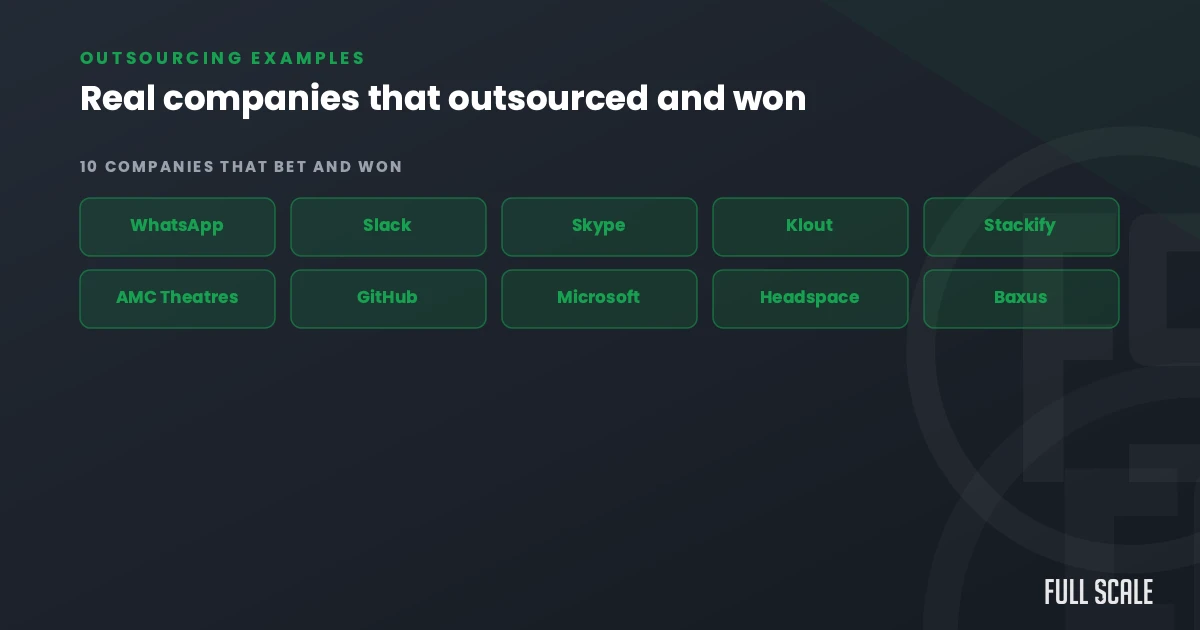
Here are 10 outsourcing examples that worked, and what each one teaches about getting the model right.
1. WhatsApp outsourced its early engineering to Russia
When Brian Acton and Jan Koum started WhatsApp in 2009, they didn’t have the cash to hire US-based engineers. They outsourced their iOS development to a small team in Russia and ran the company on a tight founder duo plus a handful of remote engineers for years. It is still the cleanest argument for outsourcing software development for startups that I can point to.
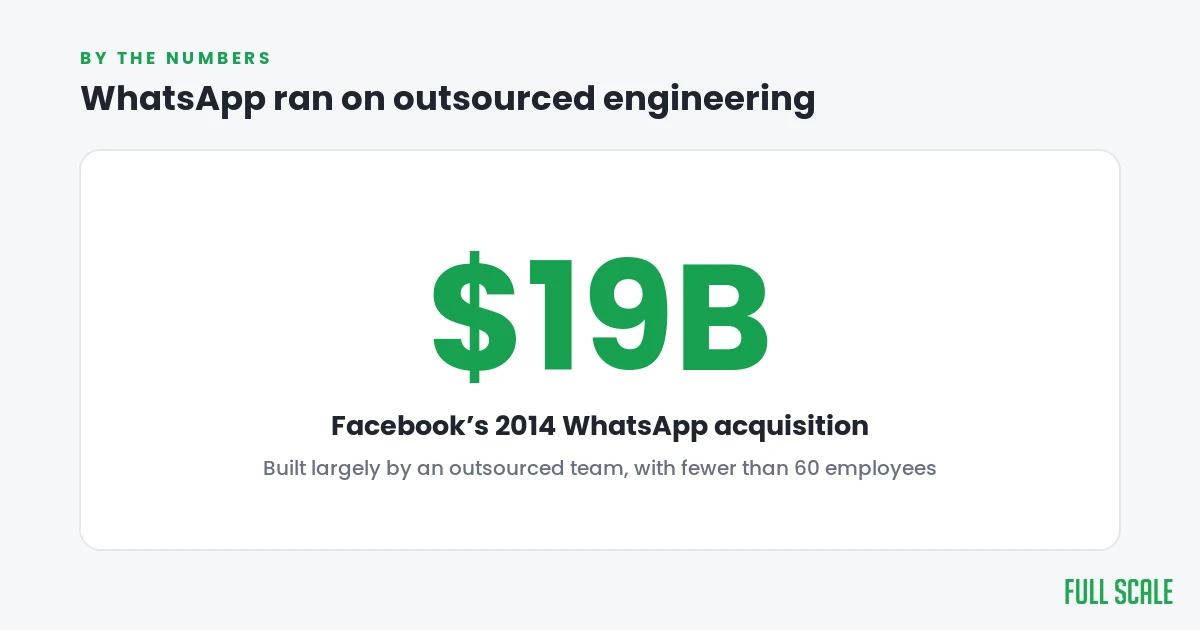
That model scaled WhatsApp to hundreds of millions of users on a headcount that never crossed 55 people. When Facebook acquired WhatsApp in 2014 for $19 billion, the company still had fewer than 60 employees total. Outsourcing wasn’t a stopgap for WhatsApp; it was the operating model that let two founders build the biggest messaging product on earth without ever scaling the engineering org to typical Silicon Valley size.
2. Slack outsourced design and branding to MetaLab
Before Slack was Slack, it was a struggling gaming company called Tiny Speck. When the team pivoted to the internal chat product that became Slack, they didn’t have a design lead. They brought in MetaLab, a Canadian product design studio, to do the UI, the iconography, the branding, and the early marketing site.
MetaLab’s work on Slack became one of the more famous examples of outsourced design that defined a company’s identity. The polish, the friendliness, the visual language Slack used to differentiate from clunky enterprise software, all of that came from an outsourced team, not an in-house design org. Slack’s valuation crossed $17 billion before Salesforce acquired it in 2021.
3. Skype was built in Estonia by outsourced developers
The founders of Skype, Niklas Zennstrom and Janus Friis, were Swedish and Danish entrepreneurs running the company out of Luxembourg. But the actual peer-to-peer voice and video software that made Skype work was built by an outsourced engineering team in Tallinn, Estonia.
That Estonian team stayed with the product through eBay’s $2.6 billion acquisition in 2005, the spinoff back to independence, and Microsoft’s $8.5 billion acquisition in 2011. The “Estonia tech mafia” that came out of the Skype team went on to seed Wise (formerly TransferWise), Bolt, Pipedrive, and Veriff. That entire wave of European tech is downstream of one outsourcing decision in the early 2000s.
4. Klout outsourced its beta build to Singapore
Joe Fernandez founded Klout, the social influence scoring company, after a jaw injury left him unable to talk. He needed to build a beta product fast and couldn’t afford US developers. He hired a development team in Singapore to build the first version of the social analytics platform.
Klout was acquired by Lithium Technologies in 2014 for over $200 million. The Singapore-built beta was the version of the product that actually attracted the acquisition.
5. Stackify scaled engineering through an outsourced Philippines team
This is my own example, and it’s the proof point I keep coming back to.
I founded Stackify), the application performance monitoring (APM) company, in 2012. By 2018 we needed to scale engineering faster than US hiring would let us. I opened an office in Cebu City, Philippines, and built an outsourced development team that grew to more than 20 engineers.
That team is the reason Stackify was acquisition-ready. When Stackify sold to Netreo in 2021 and Netreo sold to BMC in 2024, every engineer on the Philippines team transferred to the new owner both times, without renegotiation and without attrition. The engineering team became an asset that survived the company. That’s only possible when the outsourced team is structured as a real team, not as a project arrangement.
The model I built at Stackify is what I now run at Full Scale, where we apply it across every client we work with.
6. AMC Theatres has been running an outsourced .NET team for years
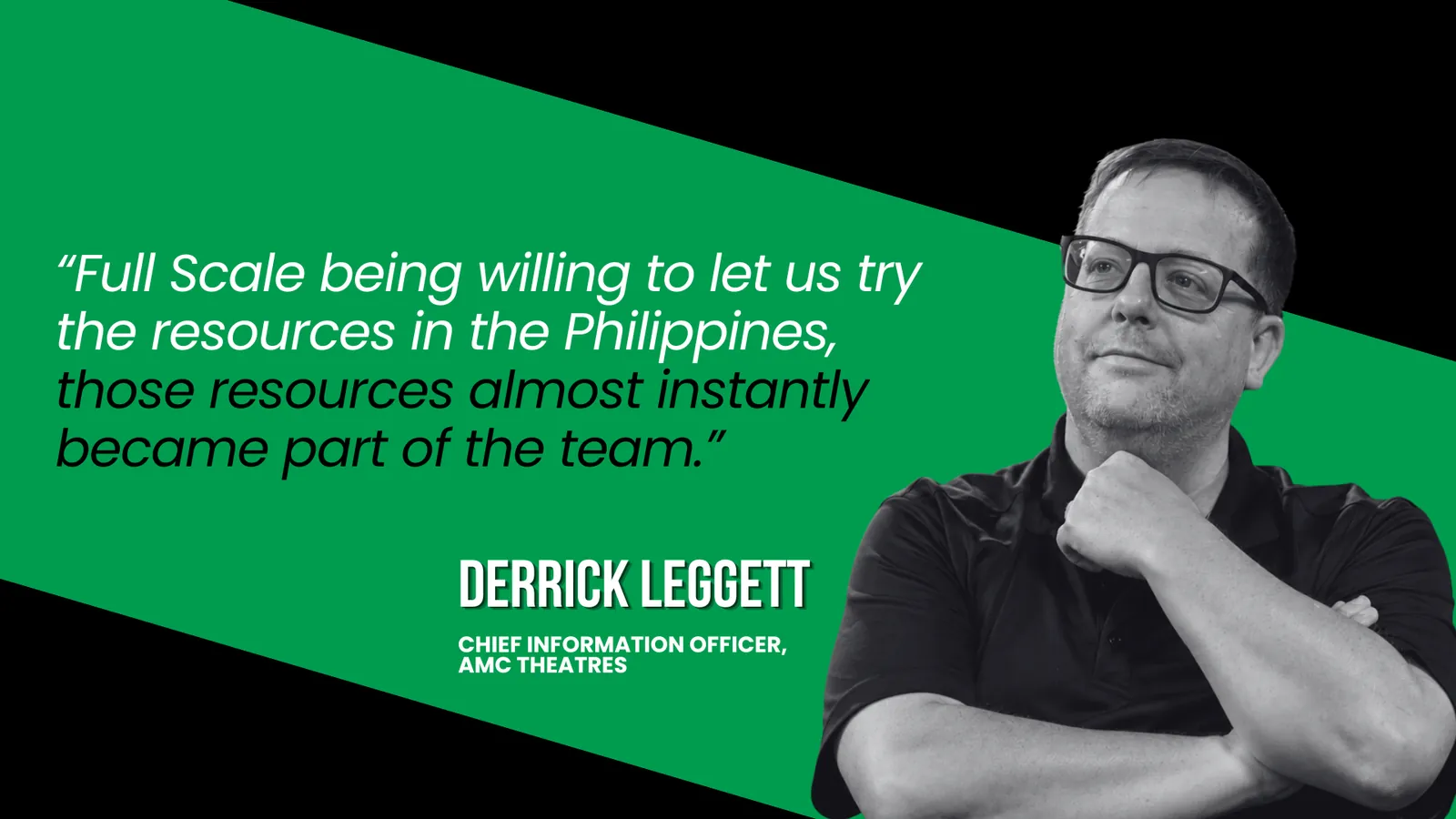
One of Full Scale’s longest-running clients is AMC Theatres, the largest movie theater chain in the world. AMC has been using offshore .NET developers through Full Scale for years as part of their core engineering team. Every developer is dedicated to AMC, attends AMC’s standups, ships code into AMC’s repositories, and reports to AMC’s tech leads.
The lesson here isn’t “AMC saved money” (though it did). It’s that a Fortune 500-scale public company runs its real engineering work through outsourced developers when the model is set up correctly. The “you can’t outsource serious engineering” objection is mostly noise. AMC’s example is the antidote.
AMC isn’t the only one. SOTA Cloud, an FDA-cleared dental-imaging platform, runs its .NET and Angular engineering the same way through Full Scale, with our engineers embedded in their team. Their CTO has said the developers we placed are top performers in the company, even relative to the staff they have in the US. Two very different companies, a Fortune 500 cinema chain and a regulated healthcare-software startup, both run real, core engineering through an integrated outsourced team.
7. GitHub outsourced its early product design
Before Microsoft acquired GitHub for $7.5 billion in 2018, the company famously ran with a deliberately small core team and outsourced more of its product design and visual work to specialist agencies than most tech companies its size. Octocat, the GitHub mascot, was originally illustrated by Simon Oxley as a freelance commission. The early site design and a lot of GitHub’s iconic visual identity came from outsourced contributors who never went on payroll.
GitHub’s model wasn’t strict “do everything internally”; it was “decide what’s core and outsource the rest carefully.” That’s the practical version of the outsourcing decision most companies face.
8. Microsoft outsources Xbox customer support
Microsoft, the company that ships some of the most consequential software in the world, outsources large chunks of its consumer customer support. Xbox and Microsoft Store phone, chat, and email support is handled by outsourced BPO providers in the Philippines, Costa Rica, and other locations, with multiple thousands of agents handling consumer issues 24/7.
The lesson is that even the biggest software companies pick the boundary between “what we do” and “what we contract” deliberately. Microsoft does the engineering. They outsource most of the operational support around the engineering. That’s the same logic behind outsourced customer support: a dedicated team runs support so the core team can focus on the product.
9. Headspace built its offshore center in Mexico in 30 days
The meditation app Headspace opened an offshore engineering center in Mexico to speed up product development. The interesting part is the speed: Headspace completed its entire first round of offshore hiring for the new center within 30 days of signing the contract with their partner.
That timeline is the operational benefit founders most consistently underestimate. Hiring a US engineer takes about two to three months. Hiring through a vetted outsourcing partner takes 2 weeks per developer. The compounding effect of that hiring-velocity advantage over 18 months is what separates startups that ship from startups that miss the window.
10. Baxus scaled its blockchain engineering through Colombia
Baxus, a growing blockchain startup, needed senior engineering capacity fast and on a startup budget. They partnered with a nearshore outsourcing provider in Colombia to add full-stack developers without the US hiring overhead or the time-zone friction of farther-shore options.
Latin America is the underrated story in outsourcing right now. Time-zone alignment with US business hours is closer to free than offshore Asia, English proficiency is high in tier-1 hubs (Mexico City, Bogota, Buenos Aires), and rates run roughly $40 to $70 per hour for senior developers, higher than Philippines but lower than Eastern Europe. The country-by-country rate breakdown covers this in detail.
What these 10 examples have in common
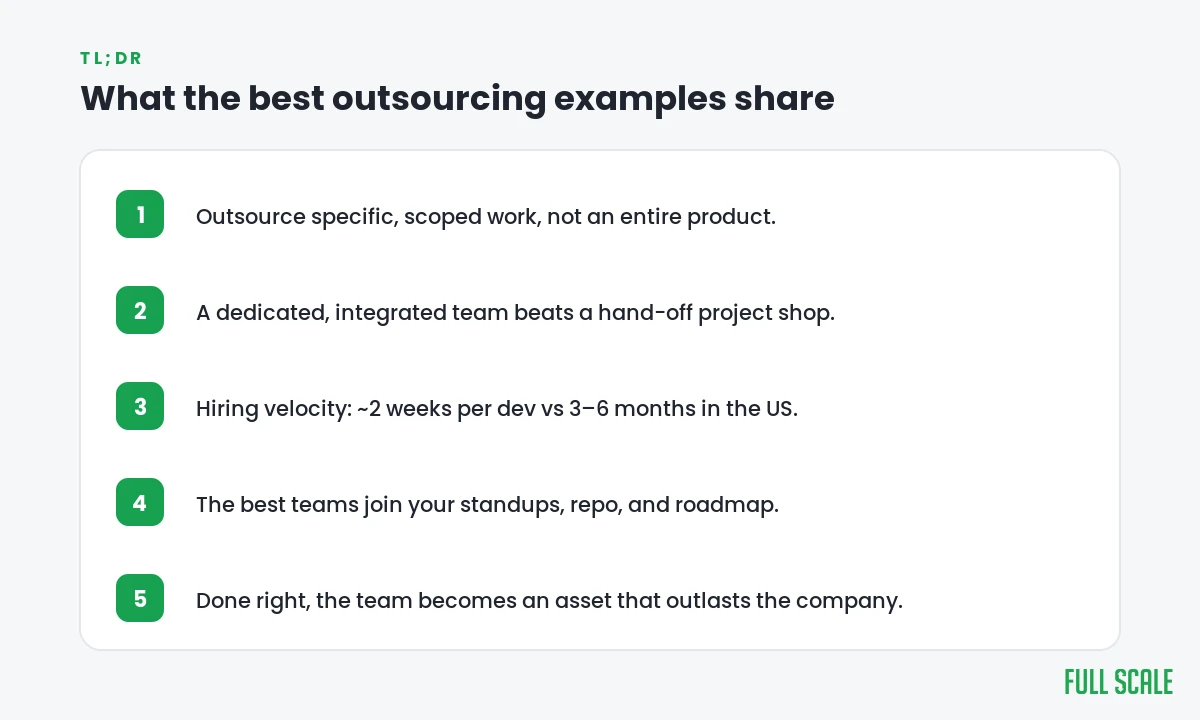
The common pattern across all 10 isn’t geography. It’s a clear answer to two questions: what work is being outsourced, and what model is being used.
WhatsApp, Skype, Klout, and Stackify outsourced engineering work to dedicated teams who actually shipped product. Slack and GitHub outsourced specialized creative and design work to specialist partners. AMC, SOTA Cloud, Headspace, and Baxus extended their internal teams with outsourced developers who work as part of the company, not separately from it. Microsoft outsources the operational support functions around its core software.
None of them handed entire products to a vendor and asked for the vendor to come back with a finished product. The data on outsourcing failures traces back, in almost every case, to that one anti-pattern: project outsourcing with no shared ownership. Staff augmentation, dedicated teams, and well-scoped specialist contracts work, while project outsourcing with no shared ownership usually does not.
How to apply these examples to your own decision
If outsourcing is on the table for your company, the patterns above are the right starting point. The signs you’re ready to outsource software development is the readiness check. The due diligence checklist for picking an outsourcing partner is what to do once you’ve decided.
The version of outsourcing I’d recommend (and the one I use at Full Scale) is dedicated developers, staff augmentation model, real time-zone overlap, full integration into your team. That’s the version Stackify scaled with, that AMC has been running for years, and that 6 of the 10 examples above are some flavor of.
Frequently Asked Questions
What are some real examples of outsourcing?
Some of the best-known examples are WhatsApp (early iOS engineering outsourced to a team in Russia), Skype (built by an outsourced team in Estonia), Slack (design and branding by the agency MetaLab), and GitHub (early product design by outside contributors). On the operations side, Microsoft outsources much of its Xbox customer support. The pattern that connects them is scoped work handed to a capable team, not an entire product handed to a vendor.
Which big companies outsource software development?
Plenty, and often for their core work. AMC Theatres runs a dedicated offshore .NET team through Full Scale, SOTA Cloud runs its dental-imaging engineering the same way, and WhatsApp and Skype were both built largely by outsourced engineers before billion-dollar acquisitions. The companies that do it well treat the outsourced engineers as part of their own team rather than as a separate vendor.
Does outsourcing actually work for startups?
It can be the difference between shipping and missing the window. WhatsApp reached hundreds of millions of users with fewer than 60 employees, and Klout’s Singapore-built beta was the version that drew a $200 million acquisition. The catch is the model: startups that outsource specific, well-scoped work to a dedicated team tend to win, and the ones that hand a whole product to a project shop tend to lose.
What is the difference between outsourcing and offshoring?
Outsourcing means contracting work to an outside team, wherever they are, including a freelancer or agency in your own country. Offshoring specifically means having that work done in another country, so offshoring is one type of outsourcing. A US company hiring a dedicated development team in the Philippines is doing both at once.
Is it safe to outsource core engineering work?
Yes, when the structure is right. A Fortune 500 company like AMC Theatres runs real, core engineering through outsourced developers, and Stackify’s outsourced team transferred cleanly through two acquisitions. Safety comes from the model: a dedicated team integrated into your standups and codebase under a contract with clear IP assignment, not a black-box project handed to the cheapest vendor.
Ready to start?
If the examples above are pointing you toward outsourcing as a real option for your company, that’s what we do at Full Scale. We run a Philippines engineering operation of more than 350 developers, we’ve been on the Inc. 5000 list five years in a row, and the staff-augmentation model we use is the same one I built at Stackify.
Talk to us about hiring developers in the Philippines or read more about our offshore software development services. We can usually have qualified candidates in front of you inside a week.