
Outsource Backend Development: How to Pick the Right Model

In this article
- Build, buy, outsource: what each one actually means
- The real question isn’t build vs. buy. It’s project vs. team.
- When to keep the backend in-house
- When to outsource backend development
- The integrated-team model, with a real example
- What outsourcing the backend actually costs
- The hybrid most teams actually land on
- Frequently asked questions
Quick Answer: Outsourcing backend development usually means one of two models: project outsourcing, where a vendor delivers a fixed-scope system and walks away, or staff augmentation, where backend engineers join your team and own the work long-term. For most backends, staff augmentation wins because the logic, data, and scaling keep evolving long past any fixed spec. Full Scale places senior backend engineers in the Philippines under this model, the same integrated-team approach AMC Theatres uses for its ticketing platform.
Every article on this question hands you the same framework. Build the stuff that’s your competitive advantage. Buy the commodity stuff. Most teams end up with a hybrid. Then a decision tree and a contact form.
That framework is fine as far as it goes. It’s just framed wrong for the backend.
I’ve been on both sides of this. I bootstrapped Full Scale‘s predecessor thinking by building VinSolutions in-house, the number one CRM in automotive, before it sold. Then I built Full Scale, which is now the outsourced backend team for more than 80 companies. So I’ve made the build call with my own money, and I’ve been the team on the other end of the outsource call hundreds of times.
Here’s what I’ve learned: for the backend, the build-vs-buy question is the wrong fork. The real decision isn’t “build it ourselves or buy a finished thing.” It’s “hand the backend to a vendor as a walled-off project, or build a long-term team that owns it with you.” Those are completely different bets, and the backend is exactly the place where the difference matters most.
Let me walk through it.
Build, buy, outsource: what each one actually means
The three words get used loosely, so here’s what they mean for a backend.
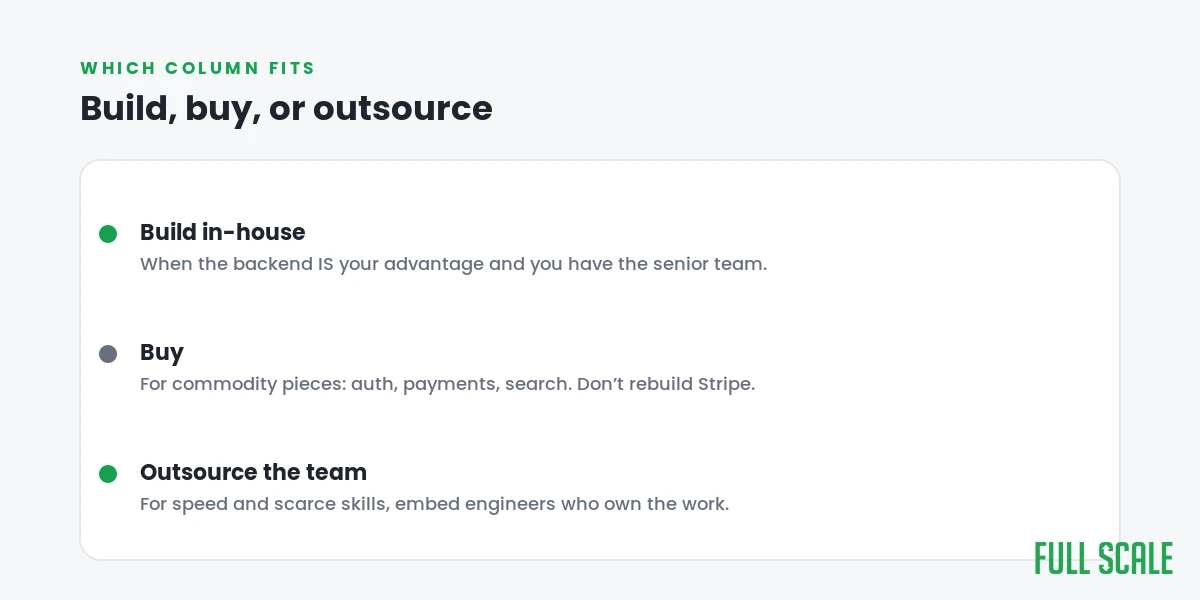
| Option | What it is | Best for |
|---|---|---|
| Build in-house | You hire and manage the backend engineers yourself | Backend logic that is your core competitive advantage and that you’ll iterate on forever |
| Buy | You use an existing product or platform instead of writing it | Commodity capabilities: auth, payments, email, search. Don’t rebuild Stripe |
| Outsource | A team outside your payroll builds and runs the backend | Speed, scarce skills, or scale you can’t hire for fast enough |
The “buy” decision, choosing a SaaS product over writing custom code, is its own question. We wrote about build vs. buy software separately, and AI has shifted that math a lot. This post is about the third column: when it makes sense to outsource backend development, and how to do it without handing away the part of your product you most need to control.
The real question isn’t build vs. buy. It’s project vs. team.
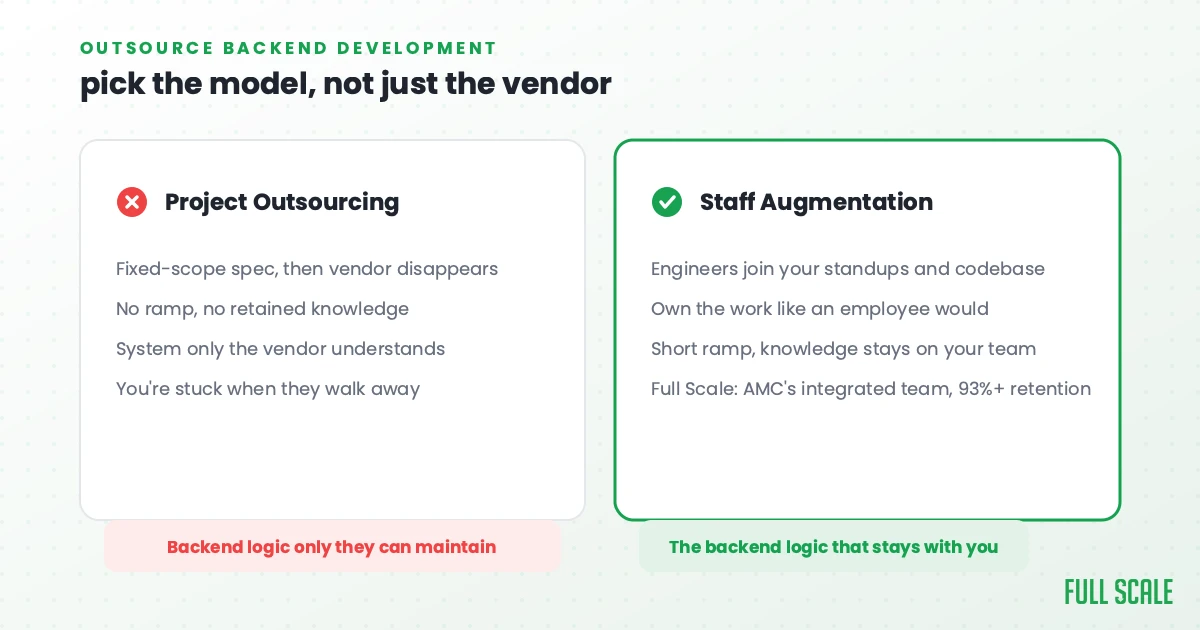
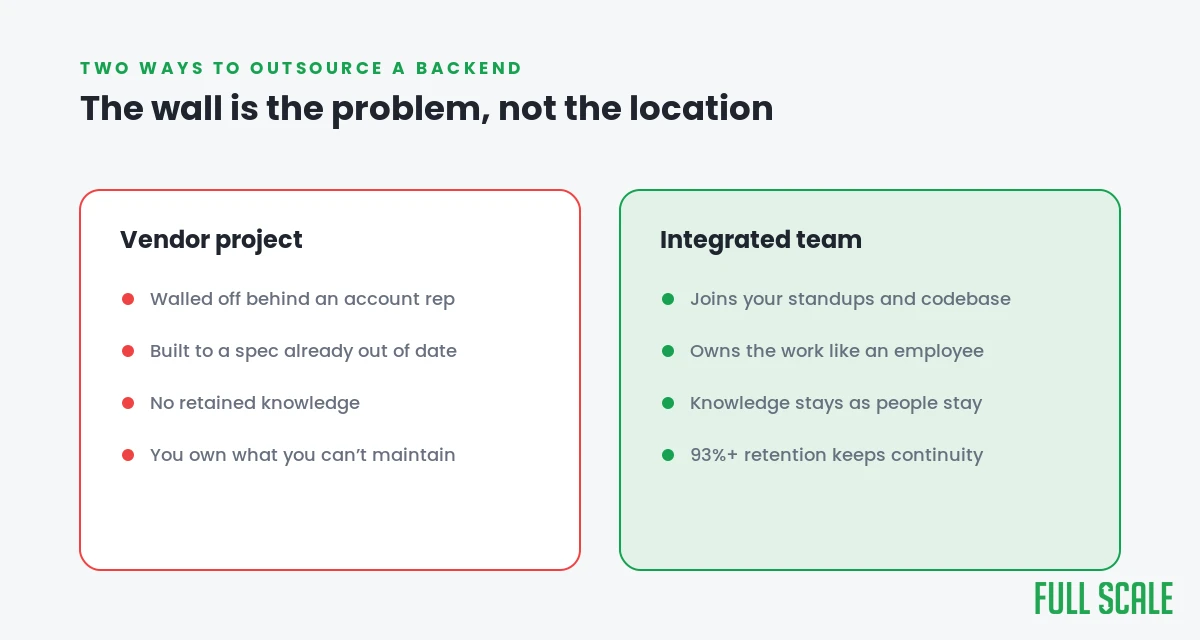
When most people say “outsource the backend,” they picture a vendor. You write a spec, they disappear, and a few months later you get a system back. That’s the project model, and for a backend it’s where things go wrong.
A backend isn’t a thing you buy once. It’s the logic, the data, the security, and the scaling that you live with for years. When you hand that to a vendor as a fixed project, you get a system only they understand, built to the letter of a spec that was already out of date when you wrote it. The day they walk away, you own something you can’t maintain.
I’ve been a backend developer my whole career, and the thing I’d want every founder to feel in their gut is how asymmetric the risk is. A front end is forgiving. You can redesign a screen, move a button, rework the whole interface, and ship the fix that same afternoon. The backend isn’t like that. Once real data and real traffic are running through your data model and your contracts, changing it is slow and expensive. That’s the whole reason the team you put on the backend matters more than the one you put on the front end. You’re choosing who owns the part of your product that’s genuinely hard to change.
I learned the version of this that works at Stackify. We worked with a development firm in Uruguay, and it worked because they didn’t operate like a vendor behind a wall. They genuinely owned the product direction, and I later hired those developers directly onto our team. The setups that failed were the ones where nobody owned the product. The wall was the problem, not the location.
So the better question is: are you outsourcing a project, or building a team? For a backend, you almost always want the team. That’s the whole idea behind staff augmentation, and it’s why I make the distinction so hard.
When to keep the backend in-house
Keep it in-house when the backend itself is your competitive advantage and you have the people to build it.
If your backend is the product, the matching engine, the pricing algorithm, the thing customers can’t get anywhere else, you want that knowledge living inside your walls. The same is true if you already have a strong senior engineering team that can hire and mentor more. You don’t outsource what you’re already great at.
The catch is cost and speed. A senior backend engineer in the US runs about $200,000 a year all in once you count benefits, recruiting, and overhead, and the search to find one drags on for months. If you can afford that and wait for it, in-house is a fine answer for your core backend.
Most companies can’t afford to do all of it that way, which is where the next option comes in.
When to outsource backend development
Outsource the backend when you need speed, when you need skills you don’t have, or when building the team in-house would eat a budget you’d rather put into the product.
The cost gap is real. You can hire senior global talent for 50 to 70 percent less than US rates, and that’s a cost-of-living difference, not a skill difference. Smart backend engineers are everywhere. The hard part is screening for the right backend developer skills. The trap is treating that gap as a reason to buy the cheapest possible hour. I call that cheapshoring, and the backend is where it does the most damage, because a cheap engineer’s bad architecture decision is invisible until it’s expensive.
And cost is no longer even the main reason companies outsource. Deloitte’s 2024 Global Outsourcing Survey found cost as the number one driver fell from 70 percent in 2020 to 34 percent in 2024, with talent access and speed now ranking as high or higher. People outsource the backend to get good engineers fast, not just cheap ones.
The way to do it without losing control is to outsource the team, not the project. You want vetted senior engineers who join your standups, your codebase, and your roadmap, and who own their work the way an employee would. No middleman, no project manager you have to talk through, no developers hidden behind an account rep. That’s staff augmentation, and it’s the model I built Full Scale around precisely because the walled-off project model kept failing the people I talked to.
The integrated-team model, with a real example
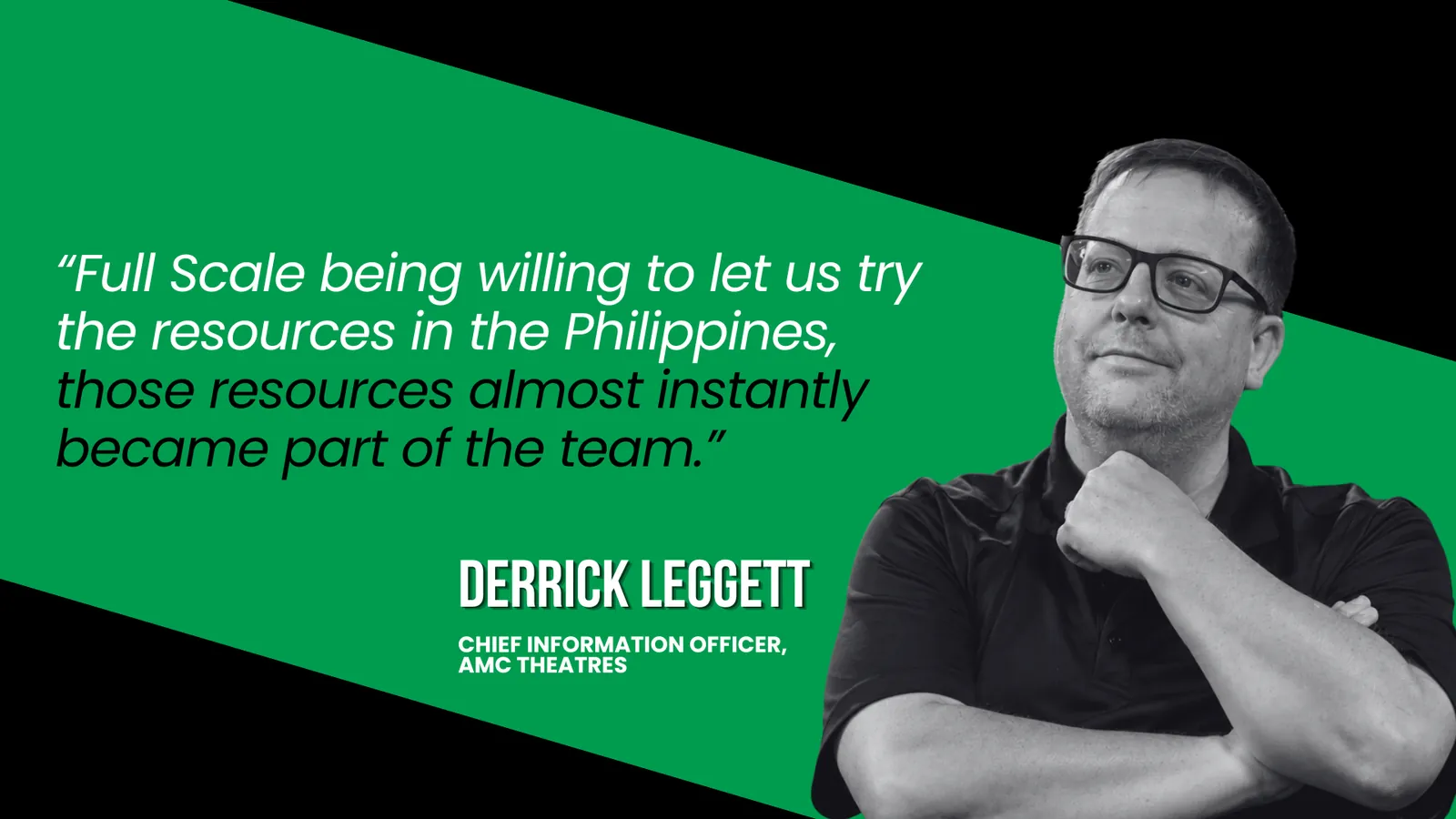
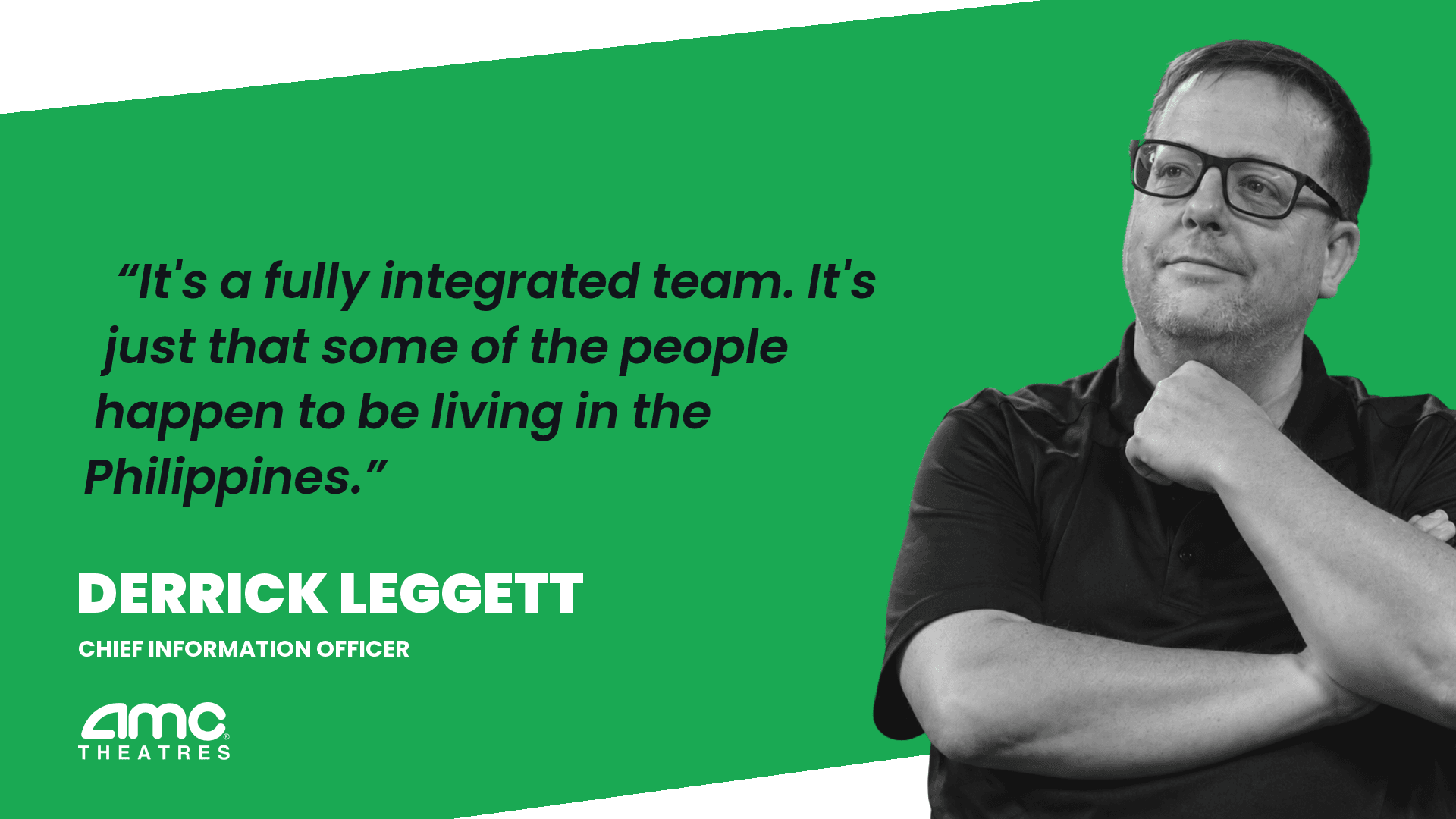
The clearest proof that you can outsource the backend without losing ownership is AMC Theatres. They run the world’s largest movie-theatre ticketing platform, and their engineering team spans the US, South America, India, and the Philippines, mostly remote. The Full Scale engineers in the Philippines aren’t a vendor AMC files tickets with. They’re full AMC engineers.
Their CIO, Derrick Leggett, put it better than I can:
> “It’s a fully integrated team. It’s just some of the people happen to be living in the Philippines.”
That’s the model. The backend is core to AMC’s business, and they didn’t keep it all in-house and they didn’t buy it as a project. They extended their team with engineers who own the work. The retention holds because of it: ours sits above 93 percent, so the team that learns your backend this year is the team that still has it next year. That continuity is the whole point with a backend, and it’s the thing a project vendor can never give you.
What outsourcing the backend actually costs
The honest cost picture has three parts.
The rate is the obvious one. A fully-loaded offshore engineer through a team model runs around $35 an hour, against $80 to $150 or more for a US contractor. But as I argued in the backend development cost breakdown, the rate is the least important number. The architecture judgment behind it costs or saves far more.
The second cost is integration. A team you embed has a real but short ramp: a couple of weeks to learn your system, not months. A project vendor has no ramp and no retained knowledge, which feels cheaper and costs more the moment you need a change.
The third cost is the one nobody quotes: what you pay later if you outsource the wrong way. A black-box backend you can’t maintain is the most expensive thing on this list, even though it never shows up as a line item.
The hybrid most teams actually land on
In practice, most companies don’t pick one column. They build the backend logic that’s their advantage, buy the commodity pieces, and outsource the rest to a team that works as an extension of theirs.
That hybrid is the right answer for most teams, and it’s a core idea in my book, Product Driven: put your own people on the problems that are uniquely yours, and get great help on everything else. The mistake is letting “outsource” mean “hand it to a vendor behind a wall.” For a backend, outsource the team, keep the ownership.
If you’re weighing whether to build your backend team in-house or extend it with senior engineers who own their work, schedule a call with us and we’ll talk through what your situation actually calls for.
Frequently asked questions
Should I outsource backend development or build in-house?
Build in-house when the backend is your core competitive advantage and you already have a strong senior team to grow. Outsource backend development when you need speed, skills you don’t have, or want to put budget into the product instead of a long, expensive hiring search. The key is to outsource a long-term team that owns the work, not a fixed project handed to a vendor behind a wall, which is the staff augmentation model Full Scale builds around.
Is it cheaper to outsource backend development?
Usually yes. Senior global engineers cost 50 to 70 percent less than US rates because of cost-of-living differences, not lower skill. But cost is no longer the main reason companies outsource. Deloitte found cost fell from the top driver for 70 percent of companies in 2020 to just 34 percent in 2024, with talent access and speed now ranking as high. Outsourcing the backend is mostly about getting good engineers fast.
What’s the risk of outsourcing backend development?
The biggest risk is the project model: handing the backend to a vendor as a walled-off, fixed-scope job. You end up with a system only they understand, and when they leave you own something you can’t maintain. The fix is to outsource an integrated team that joins your standups and codebase and owns the work long-term, so the knowledge stays with people who stick around.
What backend work should you never outsource?
There’s no backend you can never outsource, but the logic that is your actual competitive advantage should stay close, owned by people who think of it as theirs. That can still mean an embedded offshore engineer rather than a US employee. AMC’s core ticketing backend is built by an integrated team that includes engineers in the Philippines. What you should never do is let your core backend become a black box only an outside vendor understands.
What does it cost to outsource backend development?
A fully-loaded offshore backend engineer through a team model runs around $35 an hour, versus $80 to $150 or more for a US contractor. But the rate is the smallest part of the real cost. The bigger drivers are integration time, architecture quality, and what you pay later if a black-box build leaves you with a backend you can’t maintain.