
Scaling with Staff Augmentation vs Independent Contractors

In this article
- The real comparison: vetted firm vs. random freelancer
- The risks most comparison articles won’t tell you
- What staff augmentation actually buys you
- Side-by-side comparison
- When a freelancer actually is the right call
- What a real long-term team looks like
- How to choose: a quick decision framework
- Frequently asked questions
- The bottom line
A friend of mine, Brad Parker, got a ransom note from a developer he hired on Upwork. It is a textbook case of the scams on Upwork that hit the person paying for the work. A vetted staff augmentation agency exists precisely to prevent this kind of outcome.
The dev had wrapped up the project. Technically. Then he threatened to release the source code if Brad didn’t pay extra, and added a side threat to start a competitive business with it. I wrote about the situation on LinkedIn at the time. It was the cleanest version of a pattern I’ve been hearing for years: a founder hires a freelancer off a marketplace, things look fine for a few weeks, and then something goes sideways at the worst possible moment. The same tradeoff shows up the moment you put freelance marketplaces like Toptal and Gigster next to a dedicated team.
The decision between hiring an independent contractor and using a staff augmentation firm comes down to who’s actually on the other end of the line, who’s on the hook when something breaks, and whether the person sitting at the keyboard is the person you think you hired. How the contract is structured matters far less than that. That uncertainty is the real divide in marketplace developers versus a dedicated team. The rules also shift by country: hiring independent contractors in the Philippines puts you under a four-fold test that looks at who controls the work, not at what the contract calls it.
I’ve done both. I’ve personally hired freelancers for WordPress builds and an Elasticsearch tuning project. I’ve also spent the last seven years building Full Scale, a staff augmentation firm with developers in the Philippines that has served over 200 tech companies. The honest comparison looks different depending on what you’re actually trying to build. It is the same trap people hit when they try leasing offshore staff on the cheap instead of building a team they keep.
The real comparison: vetted firm vs. random freelancer
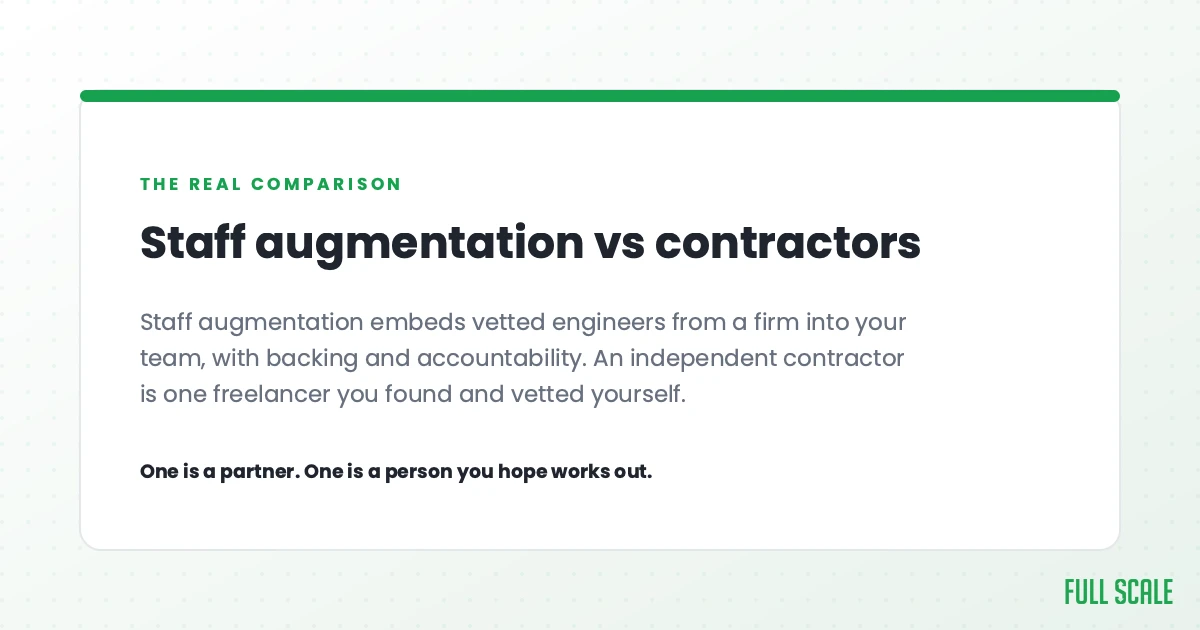
If you read the typical “staff augmentation vs independent contractor” article, you’d think the two sides are clean equivalent categories, one labor relationship next to another. The real comparison is messier than that. “Independent contractor,” in the way the term gets used by people actually buying developer time, means a freelancer pulled off Upwork, Fiverr, or Toptal. A solo person, vetted by a marketplace algorithm, working out of an apartment somewhere, juggling two or three other clients at the same time. And if Upwork specifically is one of the options on your list, I broke down why it works for a quick task but not a long-term team. If you have narrowed it to the two best-known platforms, here is a head-to-head on comparing Toptal and Upwork specifically.
That’s the actual choice you’re making. Not a clean abstract comparison.
What an independent contractor really looks like
You find them on a marketplace or through a referral chain. Their profile says senior. The reviews look fine. You do a video call (if you got one), they say the right things, and you sign a contract directly with them or with their LLC. They handle their own taxes, their own tools, their own schedule. They’re committed to you until something more interesting comes along, and they’re working on at least one other client’s code at the same time.
Textbook definition: an independent contractor is a self-employed individual you contract with directly. They handle their own taxes, insurance, and tools, and you pay them for a deliverable or for hours worked. That’s the legal frame. The practical reality is the rest of this article.
What staff augmentation really looks like
A staff augmentation firm employs the developer. The firm vets them, runs their payroll, handles benefits and taxes, and signs a master services agreement with you. The developer joins your team. They show up in your standup, work in your repo, follow your code review process, and report to your tech lead. You manage them like an embedded team member, and the firm is on the hook if the relationship doesn’t work.
I’ve put this in my own words before: outstaffing is hiring long-term full-time contractors to join your team. It’s a staff augmentation model. Those team members work directly for you, and you have complete control over what they do.
The line that matters
An independent contractor is a transaction. Staff augmentation is a team member with a different name on their paycheck. The same setup is also called the development team extension model by Eastern European shops and extended team by LATAM partners, and the engagement is the same in all three cases. The contractor trap hits European buyers hardest, which is why I broke down the four legal routes for hiring from Europe separately.
The risks most comparison articles won’t tell you
Most of the SERP for this comparison is allergic to specifics. The standard treatment lists “potential challenges” like cultural integration or communication overhead, then waves at the reader to be careful. That’s no way to actually evaluate this decision.
The risks worth thinking about are concrete. I’ve been collecting them for years.
The ransom note
Brad’s developer wrapped up the work and then threatened to release the source code if he didn’t get paid additional money. He also threatened to start a competitive business with what he had. The original story is on LinkedIn if you want the full read.
My advice to Brad was to tell the guy to go pound sand. Source code on its own isn’t a business, it’s a folder of files. The business is the customer base, the people who understand the problem, and the team that can keep building. Change your credentials, monitor for any actual leak, move on.
The point isn’t that Brad’s case was unique. I hear too many of these horror stories from Upwork and random freelancers, and his was just the cleanest version of a pattern that runs through this category. If you are torn between a freelancer and a longer-term team, it helps to match the hiring channel to the job you actually have.
You may not know who’s actually doing the work
Different story. A business owner I talked to had hired a developer on Upwork who said he was from Ukraine. Normal Shopify project, normal start. The developer refused to ever turn on his webcam during meetings. After he was added to the company Slack, his display name changed to something that looked Chinese. Then he started asking for admin permissions to systems he had no reason to access.
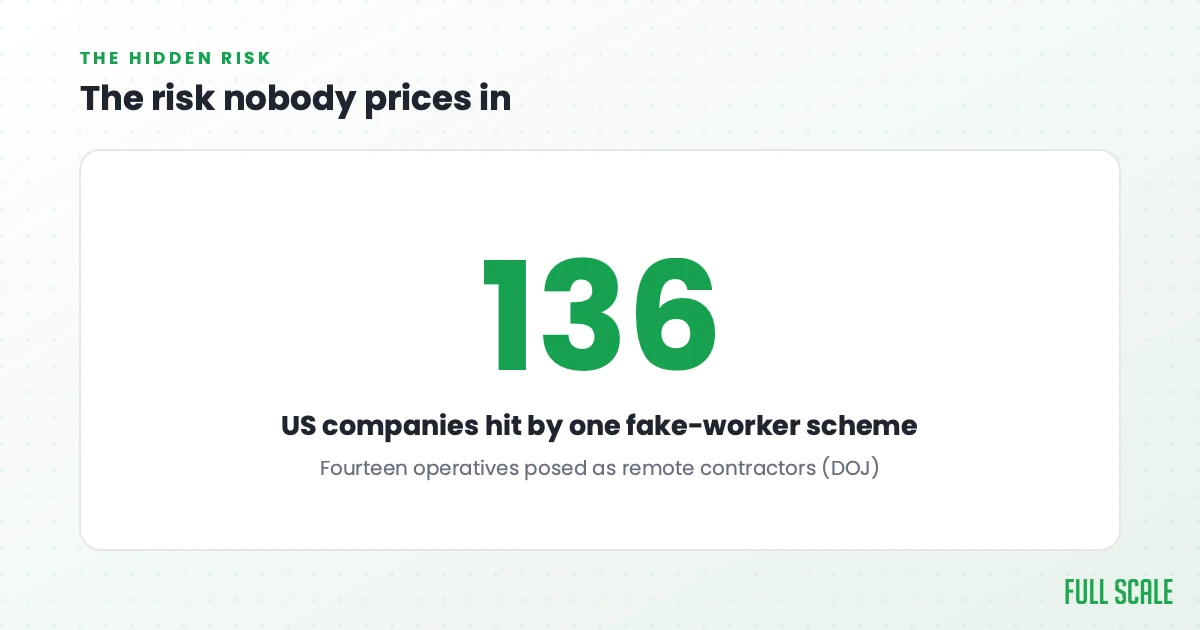
There’s a real chance the developer wasn’t who he said he was. The US Department of Justice has indicted multiple North Korean IT worker fraud rings over the past two years. The December 2024 indictment named fourteen North Korean nationals running an operation that hit at least 136 US victim companies and generated roughly $88 million in revenue for the DPRK regime over six years. The follow-up January 2025 indictment specifically named freelance-platform fraud, including a website called “Upworksell.com” that helped North Korean operatives buy stolen US identities to use on Upwork.
Upwork is the wild wild west.
The fraud isn’t in the contract. It’s in who is actually at the keyboard, looking at your codebase, and what they’re being instructed to do once they have admin access.
IP risk is real and enforcement is hard
You can ask a freelancer to sign an IP assignment. Most will. Enforcing that assignment against a freelancer in another country, with no real assets, working under a name that may not be their real name, is a separate exercise entirely.
The default under US copyright law is that the contractor owns the work unless there’s a written agreement that assigns IP to you. Even with an assignment, what happens when the contractor disputes it from another jurisdiction? You hire a lawyer, you spend money, you get nowhere. The deliverable was a few thousand dollars of work. The legal bill to defend it can run an order of magnitude higher.
And that’s before we get to misclassification. If you’re directing a freelancer’s daily work, dictating their hours, providing their tools, and treating them like a member of your team, you may have legally created an employment relationship without meaning to. The back-tax and benefits exposure on that is real, and it’s the kind of thing nobody thinks about until an auditor brings it up.
The structural alternative, the one that actually makes IP enforceable instead of theoretical, is covered in the 7-layer offshore IP protection framework.
The hidden cost of churn
A freelancer ghosts mid-project. It happens. You’re back to a job posting, a marketplace shortlist, more video calls, and weeks of ramp time on a codebase the original developer was the only one who fully understood. There’s no one standing behind the work. There’s no continuity. The context lived in their head, and now it’s gone.
I don’t have a clean dollar figure for this because nobody does. The honest version: every time you start over, you’re paying the ramp-up cost twice. Sometimes three times. For a six-month build, that’s the difference between shipping on time and not shipping at all.
What staff augmentation actually buys you
The staff augmentation model exists because every one of those risks has a structural answer. Not a marketing answer. A structural one. A software development staff augmentation firm gives you that structure instead of a handshake.
A firm that’s on the hook
This is the single biggest difference. A staffing partner has a US business presence, recurring revenue, reputation, and a contract with you that says they’re responsible for what their developers do. A random freelancer has none of that.
A few years ago, on the back of the North Korea fraud stories surfacing, I wrote that our team at Full Scale are all our employees. We don’t want to find random contractors and just hand them off to our clients. That’s the actual structural difference. When a Full Scale developer is staffed onto your project, the firm vetted them, employs them, pays them, and stands behind their work. When a marketplace places a freelancer onto your project, the platform takes a cut of the invoice and reserves the right to update its terms next quarter.
Real vetting, not platform reviews
Full Scale runs identity verification, background, work history, and technical evaluation on every developer before they’re available to clients. A marketplace review system is a different mechanism doing a different job. It tells you what previous clients thought after the fact. It doesn’t tell you whether the person on the video call is the same person whose name is on the profile.
For context: 200+ tech companies served, 7+ years average developer experience, and developers based in the Philippines who run roughly 50-70% below the all-in cost of an equivalent US developer hire. That cost gap is a cost-of-living difference.
You are never left stranded
If a developer isn’t working out early, a good partner stands behind the match: the first two weeks come with a money-back guarantee. After that you’re on a month-to-month arrangement with no long-term lock-in, so you can change course with reasonable notice instead of restarting from a job posting. Because the engineer is the firm’s employee, continuity and retention are the firm’s problem to solve. With a freelancer, a bad fit or a sudden exit means starting over from scratch.
Continuity of context
Full Scale’s developer retention is over 93%. The developer who learned your codebase eighteen months ago is still on it today. That continuity is invisible until you lose it, and once you lose it, you spend the next several months paying for it.
This is the part of the comparison that doesn’t show up on an hourly rate card. We aren’t in this for some 3-month project. Our clients trust us with their long-term teams, and the value they get out of that compounds over years.
IP and contract protections built in
One contract with a US business. The master services agreement covers IP assignment, confidentiality, security, and remedies. The developer is employed by the firm under matching obligations. The relationship survives a developer leaving the firm, and the protections survive a developer leaving the country.
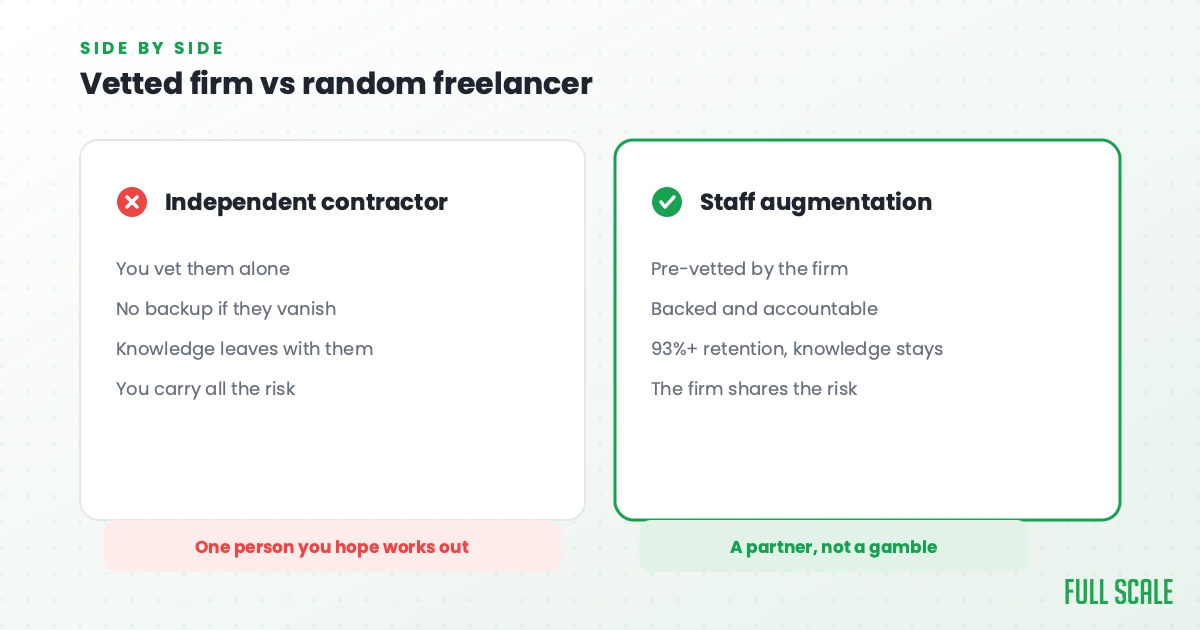
Side-by-side comparison
A specific, practitioner-grade comparison. More useful than the generic versions you’ll find elsewhere on this topic.
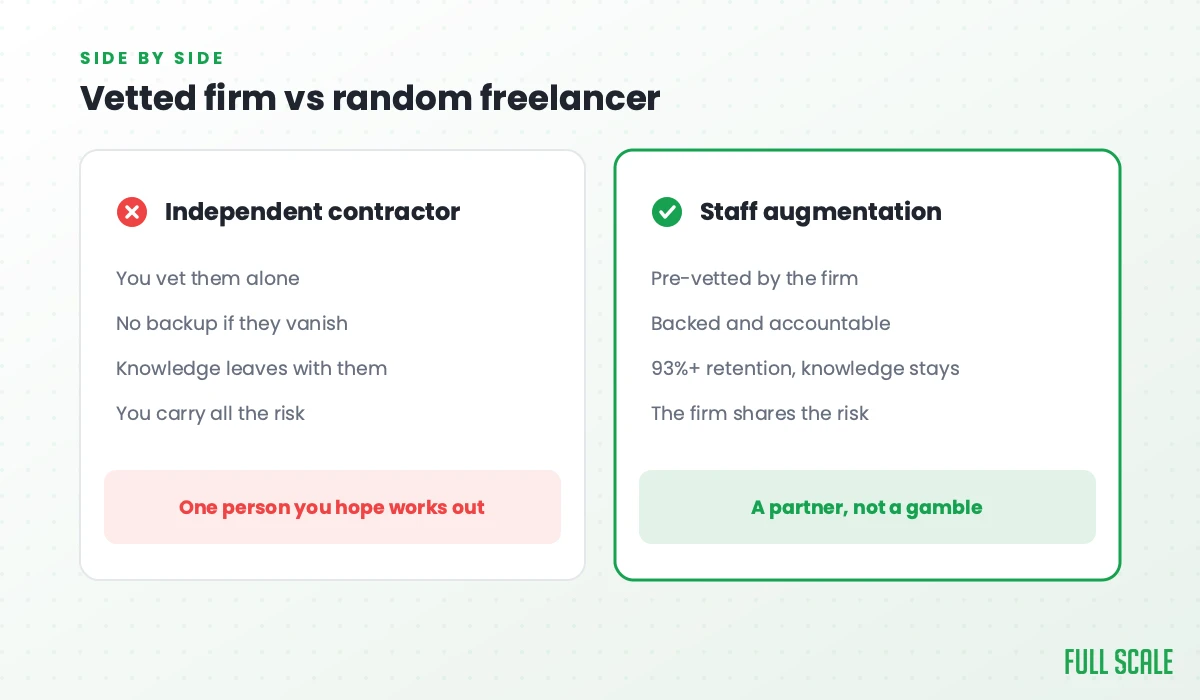
| Dimension | Independent contractor (Upwork-style freelancer) | Staff augmentation (vetted firm) |
|---|---|---|
| Hiring channel | Marketplace listing, friend of a friend, or referral | Vetted by the staffing partner; you interview the shortlist |
| Identity verification | You do it yourself, if at all | Firm verifies identity, background, location, work history |
| Who owns the contract | Direct with the individual or their LLC | With the staffing firm, typically a US business |
| Who’s on the hook if it goes wrong | You are | The firm is |
| IP protection | Depends on your contract; enforcement varies by jurisdiction | Built into the firm’s master agreement and the developer’s employment contract |
| Replacement if they ghost | None. You start over. | The firm employs the developer and owns continuity |
| Tax and classification risk | High if you direct day-to-day work | Low. The firm employs the developer. |
| Day-to-day management | You manage them as a contractor at arm’s length | You manage them like an embedded team member |
| Continuity of context | Walks out the door at end of contract | Stays with your codebase for years (Full Scale: 93%+ retention) |
| Cost shape | Lower hourly, higher total when rework and ramp are included | Predictable monthly rate, higher per-hour, lower total for product work |
| Best for | Bounded one-off deliverables | Long-term product development |
The honest read: every row that involves trust, continuity, or what happens when something breaks lands on the same side.
When a freelancer actually is the right call
This isn’t a “never hire a freelancer” article. I’ve hired freelancers myself, more than once, and I’d do it again for the same kinds of work.
It’s a bounded one-off
Marketing sites, one-time integrations, a logo, a WordPress build, an Elasticsearch tuning project. I outsourced both the WordPress work and the Elasticsearch project because each one had a defined start and a defined end. I didn’t need a long-term WordPress person on staff. I needed someone who already knew the technology cold to ship the work and move on. That kind of scoped engagement is what most people actually mean by project-based staffing, one of several labels that get lumped in with staff augmentation without ever being the same purchase.
You need niche expertise you’ll never touch again
A compliance build, an obscure protocol implementation, a one-time data migration, a specialty integration. The work has a clean end and nobody on your team needs to learn the technology afterward. Hiring a senior freelancer who lives in that niche is often the right call.
The budget is small and the risk is small
A two-week project where the worst case is “you start over” is acceptable risk. A six-month build where the worst case is “the codebase walks out the door and nobody on your team can extend it” is not. The freelancer model is fine for the first kind of work. It’s a bad fit for the second.
The mistake isn’t using freelancers. It’s using them for work that needed a team.
What a real long-term team looks like
If the rest of this article is the case against a random freelancer, here’s the case for what staff augmentation done well actually looks like.
LendingStandard is a commercial real estate platform out of Kansas City. They process roughly 30% of affordable multifamily property loans nationwide, so the software has to work and it has to keep working. Andy Kallenbach, the CEO, came to Full Scale after trying to hire locally first, including through vocational programs and direct college recruiting. Local hiring couldn’t keep up with their growth.
Here’s what he wrote about the team after a couple of years working with us:
“Waking up each morning to collaborate with the Full Scale team has become the highlight of my day. Their work ethic, pride in craftsmanship, and the sheer quality of their output have not only met but exceeded our expectations. The most significant impact has been the seamless integration of their team with ours, making every challenge surmountable and every success sweeter.”
At the two-year mark, that’s a team description.
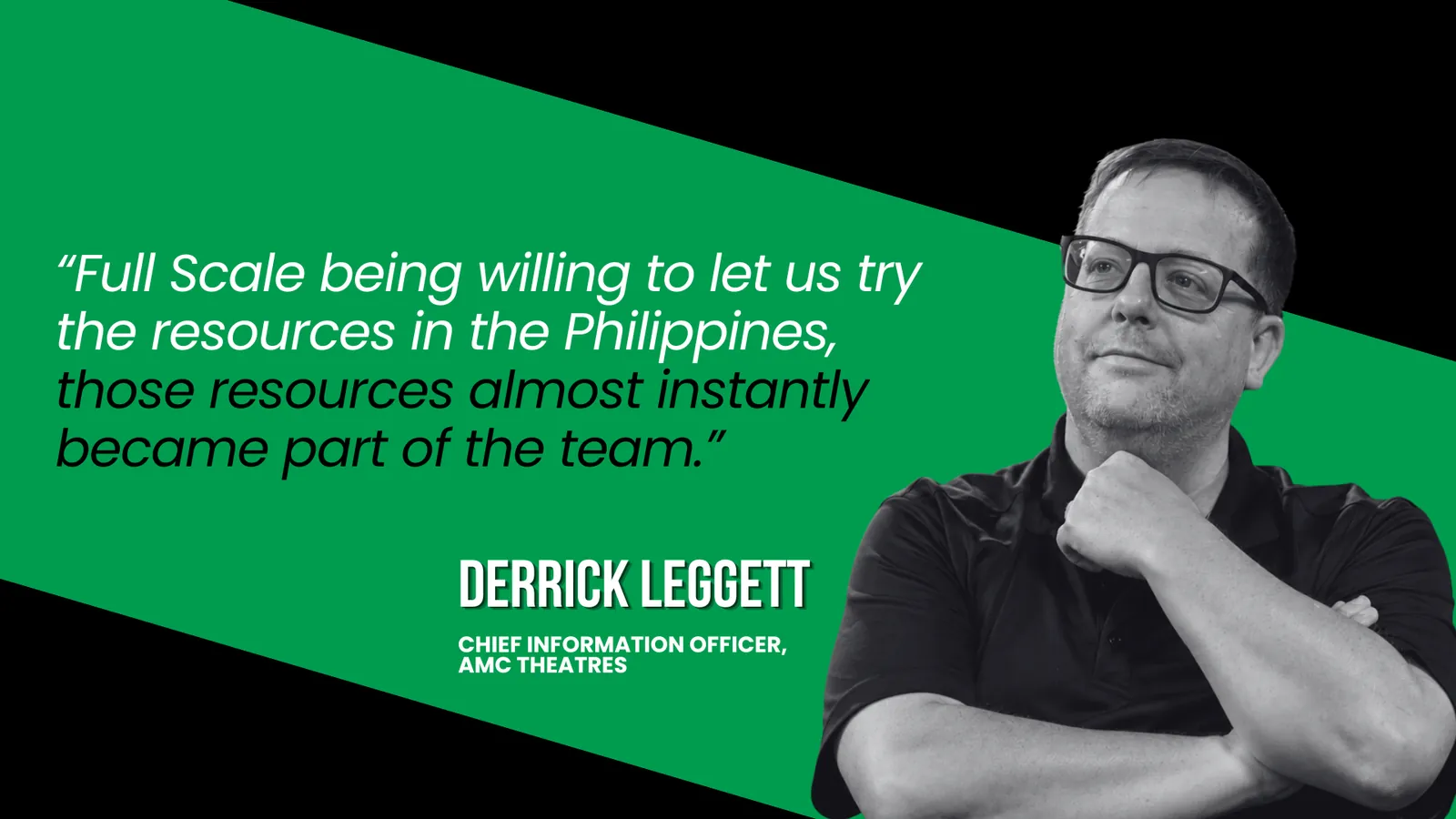
AMC Theatres, under CIO Derrick Leggett, runs a similar structure: their Filipino engineers are treated as full AMC engineers, in the same Slack threads as the KC-based staff, going through the same code review process. The longer telling of how that team works lives in our staff augmentation vs. outsourcing post.
Make sure you work with a dev agency that cares about your product, not just your project. That’s the difference between a Full Scale developer and a freelancer placed by a marketplace.
How to choose: a quick decision framework
Four questions. Walk through them honestly.
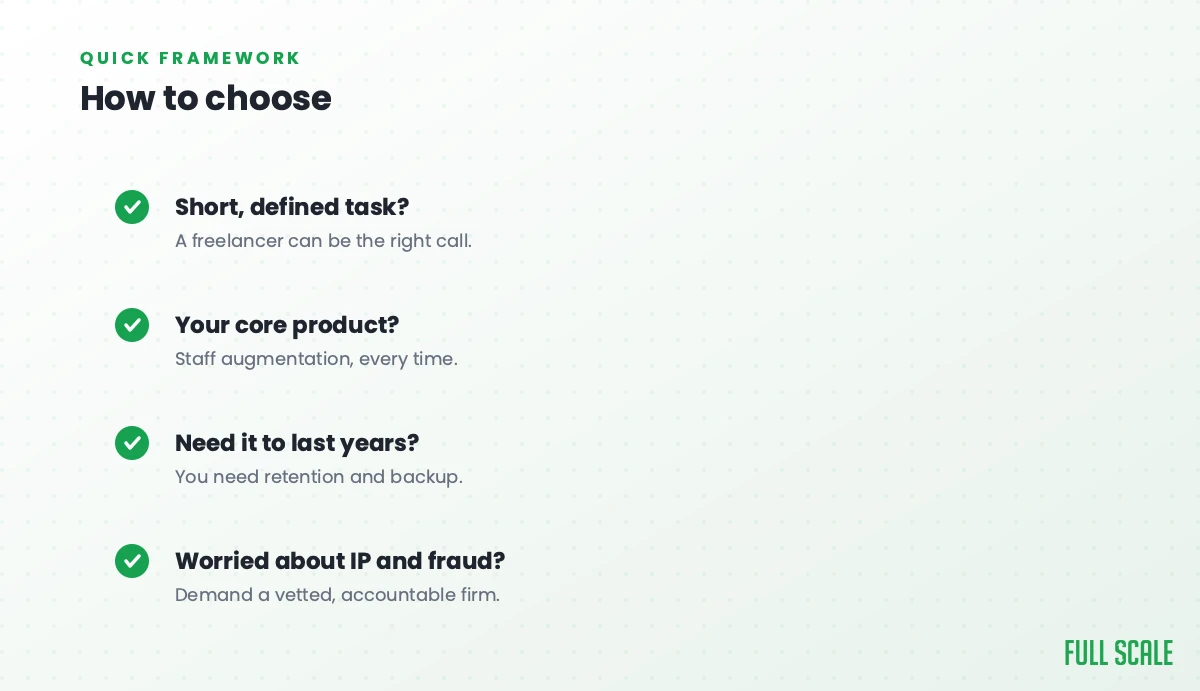
- Will you keep developing this past the initial deliverable? Yes, staff augmentation. No, a freelancer can work.
- Does the institutional knowledge need to stay with your team? Yes, staff augmentation. No, freelancer is fine.
- Is the scope going to change month over month? Yes, staff augmentation. No, fine to scope and ship as a freelancer engagement.
- Can you afford a do-over if the person ghosts mid-project? No, staff augmentation. Yes, either model works.
There’s a fifth question that nobody asks out loud: how much do I actually trust the person at the keyboard? With staff augmentation, the firm did the work of answering that question. With a marketplace freelancer, you’re answering it yourself with whatever you can verify from a profile, a portfolio, and one video call.
Frequently asked questions
What’s the difference between staff augmentation and an independent contractor?
Staff augmentation adds a developer to your team through a staffing firm that handles vetting, payroll, and contractual responsibility for the developer. An independent contractor, or freelancer, is a self-employed individual you contract with directly. The biggest practical difference is who carries the risk. With staff augmentation, the firm is on the hook for the developer. With an independent contractor, you are.
Is staff augmentation a 1099 or W-2 relationship?
Neither, from your side. The developer is typically a W-2 employee of the staffing firm. You pay the firm a fee per developer. That structure is one of the main reasons staff augmentation removes the misclassification risk that comes with a long-term 1099 contractor relationship.
Can a freelancer be misclassified as an employee?
Yes. If you control the day-to-day work, dictate hours, provide tools, and treat the freelancer like a member of your team, the IRS or state labor agencies can reclassify them as an employee. The consequences include back taxes, penalties, and benefits exposure. Staff augmentation moves the employment relationship to the firm, which removes this risk for you.
Who owns the code an independent contractor writes for you?
Not automatically you. Under US copyright law, the contractor owns the work unless there’s a written agreement assigning IP. Even with an assignment, enforcement against an overseas freelancer is difficult and expensive. Staff augmentation firms build IP assignment into the master agreement with you and into the developer’s employment contract, which is materially stronger protection.
Is staff augmentation more expensive than hiring a freelancer?
On hourly rate, often yes. On total cost over the life of a project, often no. Freelancer pricing doesn’t include the coordination overhead, the replacement risk, the ramp time when the original developer leaves, or the cost of vetting them yourself. Staff augmentation through an offshore partner like Full Scale typically runs 50-70% below the all-in cost of an equivalent US developer hire, with predictable monthly pricing. For anything past a short scoped deliverable, the math favors staff augmentation.
Is Upwork safe for hiring developers?
It’s safe in the sense that no money disappears off the platform without a refund mechanism. It’s not safe in the sense that you have limited visibility into who is actually doing the work. There’s a documented pattern of North Korean operatives posing as US, Eastern European, or Latin American developers on freelance platforms, with the US Treasury and Department of Justice actively pursuing the operations. If the work involves your codebase, customer data, or admin access, this is worth taking seriously.
The bottom line
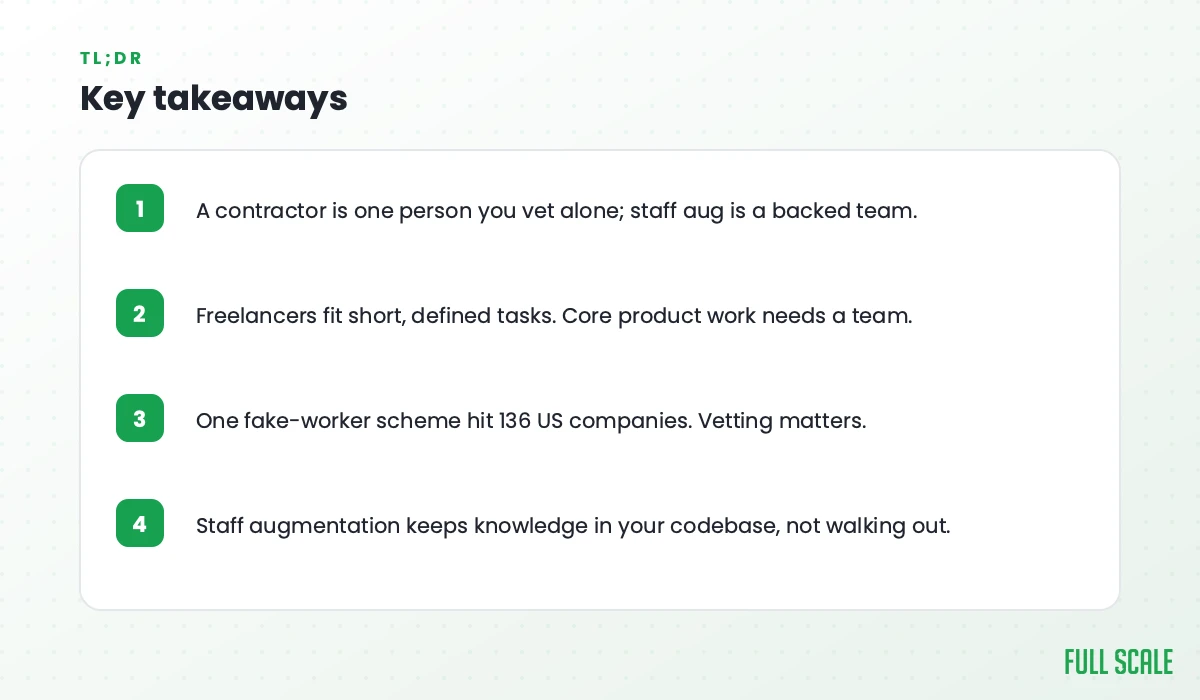
The standard comparison treats independent contractor and staff augmentation as two adjacent labor relationships. They aren’t. One is a transaction with a marketplace stranger. The other is a team member with a different name on their paycheck. For bounded one-off work, the marketplace is fine. For anything you’ll keep building past month three, it isn’t.
We aren’t in this for some 3-month project. Our clients aren’t either. That’s the comparison that actually matters.
If you’re building a long-term team and want a vetted developer instead of a marketplace gamble, that’s what Full Scale does. Book a discovery call to see how we’d staff your team.