
Why IT Outsourcing in the Philippines Works So Well

In this article
- IT outsourcing means more than software development
- Why it works so well: the people
- The cost math, told honestly
- What a real partner actually does for you
- Security, intellectual property, and keeping the lights on
- When IT outsourcing to the Philippines is the wrong call
- Frequently asked questions
- Build a software team that actually sticks
Almost everyone I know who has hired a virtual assistant in the Philippines tells the same story. They were a little nervous going in, and a month later they couldn’t imagine working without one. The person was friendly, picked things up fast, communicated clearly, and actually cared about doing a good job. For the full rundown on how to evaluate an IT company in the Philippines, we put together a buyer’s guide on exactly that. If you are wondering who really outsources software to the Philippines, the honest answer surprises most people.
IT outsourcing in the Philippines works for the exact same reason.
I’ve hired developers in Russia, Latin America, India, and the Philippines over the years, with different levels of success in all of them. After comparing offshore developers country by country, I set up a Philippines team at Stackify in 2018, and it worked well enough to become the seed of Full Scale. For offshore Python development specifically, the Philippines is the clearest choice among those markets, with strong Python talent depth and an English-first communication culture that suits what modern Python work actually demands. For Rails specifically, the Philippines stands out: offshore Rails work in the Philippines benefits from both a real talent pool and the communication culture that Rails’s convention-heavy discipline requires.
The Philippines is special, and I don’t say that lightly after the other places I’ve tried.
It works so well because of the people. Most articles on this topic lead with cost savings and bury the part that actually decides whether your team ships. The price tag matters, but the people are what carry an engagement. I get into that gap in detail when I lay out the upside of IT outsourcing and the trap that erases it.
IT outsourcing means more than software development
When people say “IT outsourcing,” they usually picture developers writing code. That’s part of it, but it’s a smaller slice than most buyers realize. The Philippines has a deep IT and business process outsourcing (BPO) industry that covers a lot of ground. Before signing with one of the many IT staffing agencies, it is worth knowing which type actually fits the role you are filling.
The list is longer than most buyers expect:
| IT function | What it covers |
|---|---|
| Help desk and IT support | Tier 1/2 support, ticketing, end-user troubleshooting |
| Infrastructure and network management | Servers, networks, monitoring, system administration |
| Cybersecurity | Security operations, monitoring, compliance support |
| Cloud and DevOps | Cloud setup, deployments, CI/CD pipelines |
| Data management | Data entry, migration, analytics support |
| Quality assurance (QA) | Manual and automated software testing |
| Software development | Building and maintaining your actual product |
Knowing which slice you need matters, because the providers are not interchangeable. A call-center-style shop that runs help desks is built differently than a team that builds software. For Laravel specifically, that slice question is easy: the Philippines’ twenty-year PHP history means Laravel development offshore taps a talent pool deeper than most other offshore markets can offer.
Full Scale lives in one slice: building dedicated development teams in the Philippines. If you need someone to run your help desk or manage your network, look elsewhere. What we do is put senior engineers on your team to build your product alongside your own people. Full Scale is my company, so treat everything here as coming from someone with a stake in it. I’ll still be straight about where this doesn’t fit. That same model applies specifically to companies that want to outsource Python development: the Philippines gives you both the engineering talent and the communication culture that Python team work requires. For Rails-based products, that dedicated team model is what makes outsourcing Ruby on Rails development work: engineers who stay on the engagement accumulate the institutional knowledge the framework demands. For Angular specifically, that dedicated team model is what makes outsourcing Angular development work: engineers who stay on the engagement learn the service architecture and module structure that Angular’s conventions require over time.
I’ll use software teams as the running example for the rest of this piece, because that’s what I’ve lived. The reasons it works are the same whether you’re outsourcing a help desk, a security team, or a group of developers: the people, the communication, the retention, and a partner who handles the hard parts.
Take a security operations team, the kind that watches your systems around the clock. The reasons it works in the Philippines are the same ones I spend this piece on: an analyst who speaks up clearly the moment something looks wrong is worth more than a cheaper one who stays quiet, and a partner who vets and retains people keeps your monitoring from resetting every time someone quits. Swap in a help desk or a data team and the specifics shift, but the people-and-partner logic carries straight over.
Why it works so well: the people
Software development is about communication more than anything else. You can hire the smartest engineer on earth, but if you can’t explain what you need and they won’t tell you when something’s wrong, the work falls apart. This is where the Philippines pulls ahead.
There’s no language barrier. Filipinos speak English fluently and grow up consuming American culture, music, movies, and sports. The Philippines is the third-largest English-speaking country in the world. You’re not stuck guessing whether your point landed or whether a joke fell flat, because the person on the other end grew up on the same shows you did.
Then there’s the service mindset. Filipinos dominate service jobs all over the world, on cruise ships, in hospitals, in hospitality, for a reason. They want to do a great job and have a lot of fun doing it. That’s the perfect personality for building a remote team, where attitude and communication matter as much as raw skill.
This is the same thing that makes the virtual assistant experience so good. When a VA anticipates what you need before you ask, stays warm on every call, and treats your problem like their own, you’re seeing the culture at work. Bring that same person onto an engineering team and you get a developer who speaks up in standup, asks the right questions, and owns the outcome.
I give the Filipino team most of the credit for why Full Scale has been as successful as it has. I go deeper on English proficiency of Philippine developers, and the rest of the argument for hiring there, elsewhere. Any company can buy the same tools and rent the same cloud. The hard part is the people, and that’s where the Philippines delivers.
It’s worth saying what AI changes here. As AI automates more of the mechanical coding, the parts that decide who succeeds are the human ones: communication, curiosity, and courage. I wrote about those three in Product Driven, and they’re what I tell our engineers will keep them safe as the work changes. Stay curious and you adapt. They also happen to be the strengths that make Filipino developers such good teammates, so AI sharpens the case for hiring there.
The cost math, told honestly
Cost is a real reason to hire in the Philippines, and it’s also where buyers get into trouble, because they mistake a cheaper invoice for the thing that actually makes an engagement succeed.
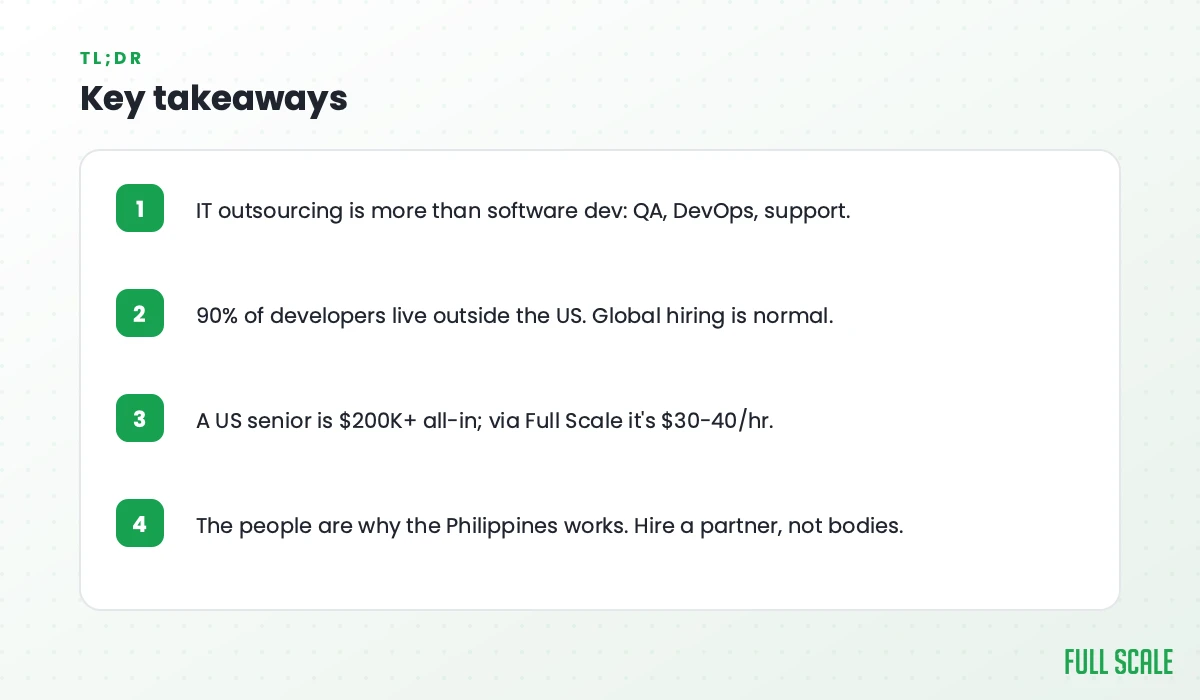
The reason companies hire globally isn’t talent scarcity. It’s cost of living. Roughly 90% of software developers don’t live in the United States, and the ones who live in lower-cost countries get paid according to their local economy rather than yours. You can hire excellent global talent for 50 to 70 percent less than US rates. A developer in Cebu gets paid for the cost of living in Cebu, which is a small fraction of what San Francisco costs. The skill is the same caliber.
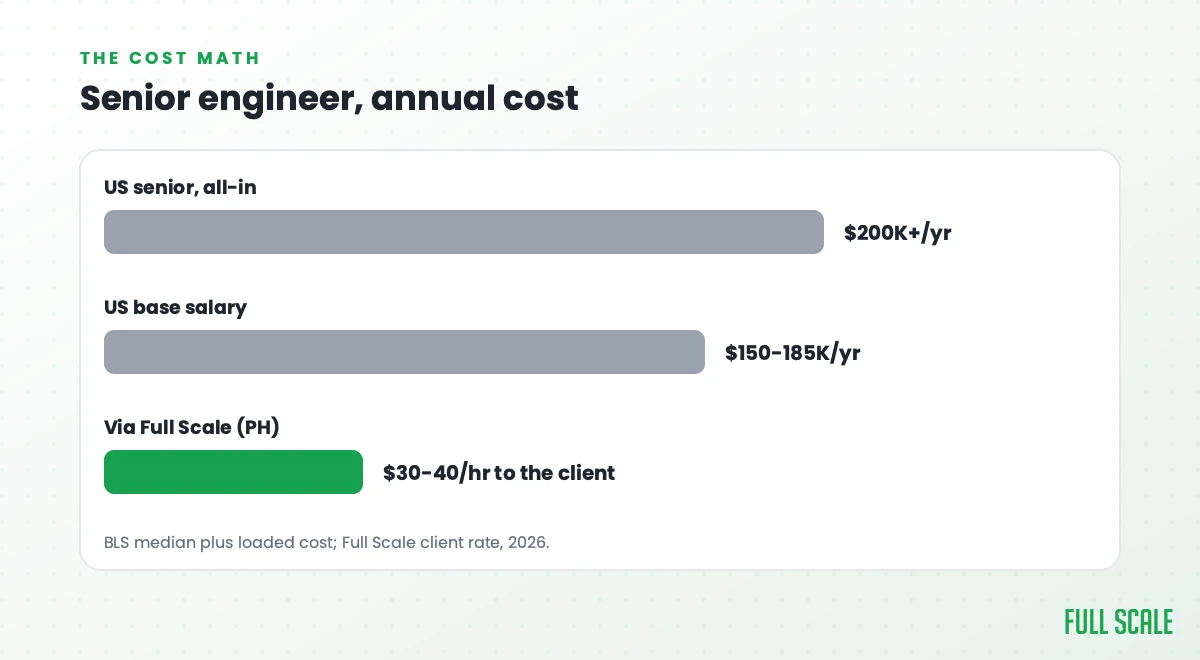
The math looks like this. A senior Filipino developer earns somewhere around $15 to $30 an hour locally. A US senior engineer’s base salary runs about $150,000 to $185,000, and once you add benefits, taxes, equipment, and overhead at the standard 1.25 to 1.4 times multiplier, the real cost lands north of $200,000 a year. The gap is enormous, and the work can be just as good.
There’s a fair objection buried in here: you get what you pay for. On a freelancer marketplace that’s usually true, where a rock-bottom rate buys rock-bottom work. The savings with a real partner come from cost of living rather than from hiring weaker engineers, and a good partner vets hard for senior people before they ever reach you. How that vetting works is something I come back to below.
What looks low to an American is often life-changing locally. My sister-in-law in the Philippines works as a virtual assistant for about $5 an hour. My brother-in-law works at Jollibee, the country’s biggest fast food chain, for around $1.25 an hour. The VA job pays four times what the Jollibee job pays. That’s not a hypothetical. That’s my actual family.
Some people will call a $5-an-hour job exploitation. I understand why it sounds that way from the outside. But my brother-in-law would do anything for a job like my sister-in-law’s, because what people need more than anything is a shot. We call it a win-win-win: a win for the developer, a win for the client, and that’s what makes it a win for us.
Here’s the trap, though. If cost is the only reason you’re doing this, you’ll buy the cheapest thing you can find, which is usually a freelancer who vanishes mid-sprint or a project shop that bills for ten people while three do the work. I call this cheapshoring, and it’s how most people who “tried offshore once and got burned” got burned. The cheapest developer is usually the most expensive mistake you’ll make.
What a real partner actually does for you
No matter which kind of IT outsourcing you’re doing, the hard part comes after you’ve decided to do it: finding the right people, keeping them, and bridging the gap between how your company works and how a team halfway around the world works. That’s where a partner like Full Scale earns its keep. If your build runs on .NET, the partner evaluation questions specific to that stack are covered in our outsource .NET developers
Three things matter most, and they’re the three things companies underestimate.
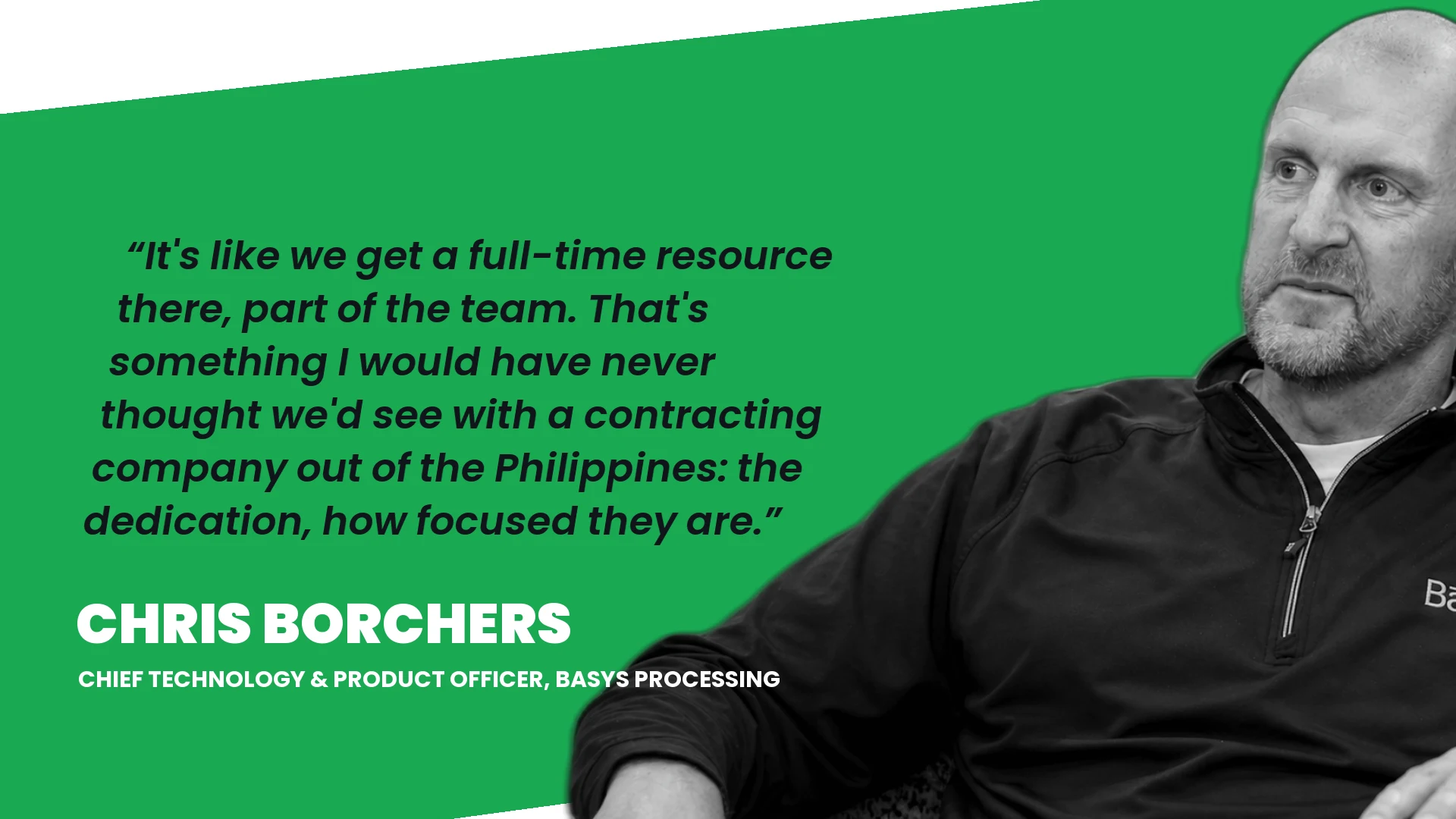
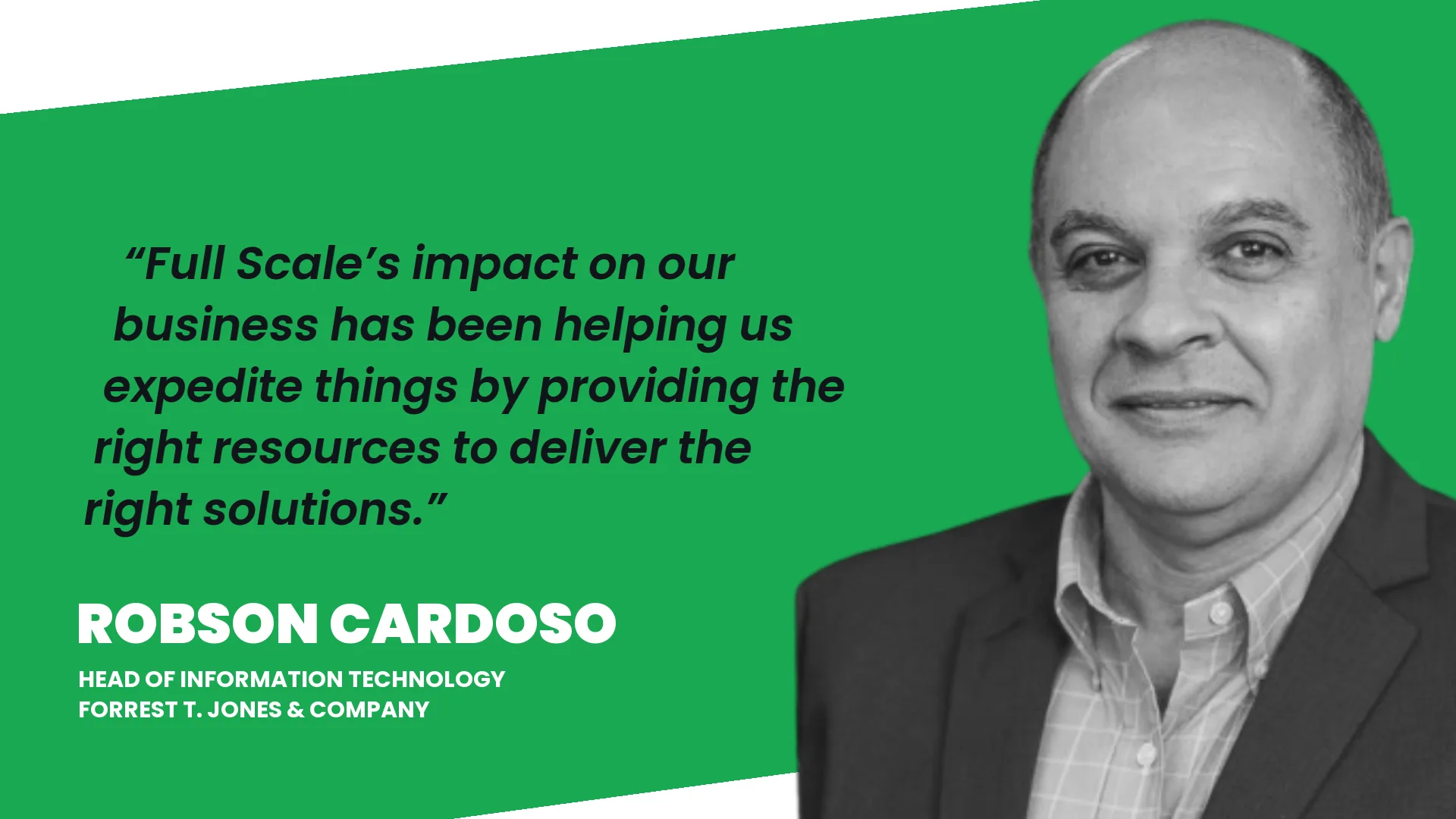
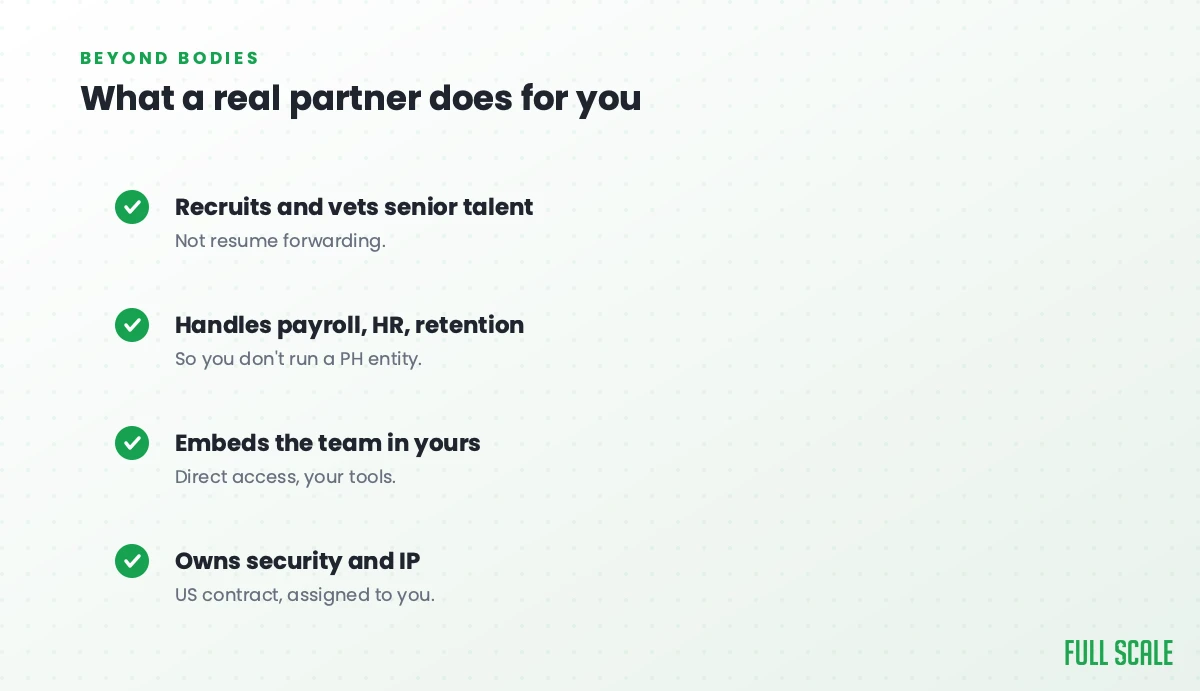
First, sourcing the talent. Recruiting good engineers is hard in your own city. Doing it in a country you don’t live in, where you don’t know the schools, the salary bands, or the red flags, is much harder. A good partner already knows how to find and vet senior people, so you get the developer you actually need instead of whoever answered the ad. Our engineers average seven-plus years of experience and clear a real technical screen before they ever reach a client. That screening is the honest answer to the quality question: every developer who reaches you has already been judged senior by people who would have to work alongside them.
Second, retention. A developer who quits after nine months takes all their context with them, and you start over. Our developer retention is 93 percent, which is rare anywhere and almost unheard of in Philippine outsourcing, where call-center attrition runs around 30 percent or higher. Full Scale is Great Place to Work Certified in the Philippines, with 95 percent of employees saying it’s a great place to work, against 65 percent at a typical company. A partner who can’t keep people is selling you a revolving door.
Third, making the relationship work day to day. We put a customer success manager (CSM) on every engagement, and a big part of their job is keeping the engineers happy and supported, every bit as much as the client. They have the hard conversations behind the scenes that a client can’t always have directly with an offshore engineer, and that the engineer can’t always raise directly with the client. That role is a big reason the retention number holds.
The model matters as much as the partner. Offshore staff augmentation is the right way. You hire talent to work directly for you on a long-term basis, as part of your team, instead of handing requirements to an outsourcing firm and hoping a finished project comes back. Most offshore collaboration fails because someone tosses a spec over the wall and waits.
The best setups have no middleman. At a lot of offshore firms, you only ever talk to one technical project manager, and every other developer hides behind that person, either because of English gaps or rules about who’s allowed to talk to the client. You end up with a team you can’t actually communicate with. The fix is direct contact between your people and the engineers on your offshore team who care about the product as much as you do.
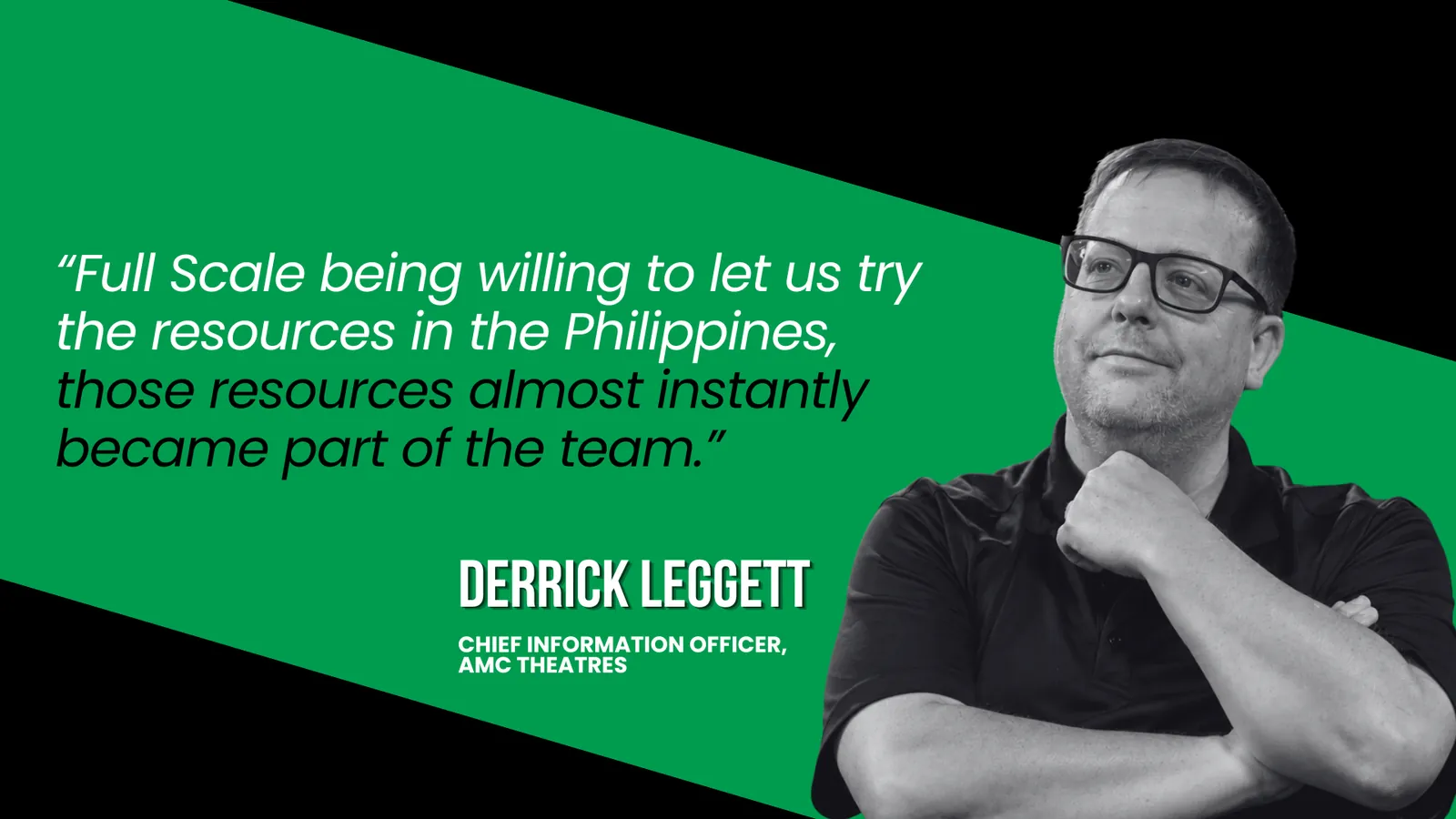
AMC Theatres is the clearest example I can point to. Their CIO, Derrick Leggett, built a global engineering organization where the Full Scale developers in the Philippines sit in the same standups, tools, and roadmap as everyone else. As he puts it, “It’s a fully integrated team. It’s just some of the people happen to be living in the Philippines.” Nobody filters the conversation through a vendor account manager. That’s the same approach I write about in Product Driven.
One worry I hear is lock-in: if the team lives inside a vendor, how hard is it to leave? With staff augmentation it’s close to the opposite. The engineers work in your repositories, your tools, and your processes, so the code, the context, and the documentation are already yours. If you ever want to bring the team in-house or move on, there’s nothing to untangle and no ransom to pay. If a model traps you, it has stopped earning your business.
Security, intellectual property, and keeping the lights on
If you’re outsourcing IT and not just software, security is usually the first thing you ask about. Who are these people? What happens to your data and your intellectual property? Who is actually on the hook if something goes wrong? These are the right questions, and they are the single best argument for working with a real partner instead of hiring strangers off a freelancer marketplace.
Start with who you’re hiring. We run background checks on every Full Scale employee that go further than what’s normal in the US. Our investigators literally go talk to a candidate’s neighbors to understand who they are. You can’t do that yourself from another country, and a freelancer platform won’t do it at all.
Then there’s the legal side. A good in-country partner already knows the local employment and labor laws, the security best practices, and the contracts you need, so you don’t have to learn a foreign legal system to stay compliant. The part that matters most when something goes wrong: our contracts with clients are directly with Full Scale as a US company. If there’s ever a dispute or a problem, you’re dealing with a US-based business under US law instead of chasing down a freelancer halfway around the world and trying to figure out what country they’re even in.
Retention belongs in this conversation too. Every time a developer churns out, a new person gets access to your systems and your code. A team that stays, backed by ongoing training, mentoring, and real engagement, is more secure than one that turns over every year.
Infrastructure is the last piece, and the honest answer is that it’s rarely a problem. Remote setups work well the large majority of the time, easily 95 percent or more. Once every couple of months one of our developers might lose internet for a few hours, and async work absorbs that without anyone noticing.
The calculation changes if you’re running something that can never go dark, like an inbound call center where every call has to be answered. For those, plenty of firms offer in-office setups in business parks with backup generators and redundant internet. Match the setup to the work: a software team can ride out a short outage, an always-on call center can’t, and a good partner helps you pick the right arrangement.
When IT outsourcing to the Philippines is the wrong call
I’d be doing you a disservice if I pretended this works for everyone. It doesn’t.
If you have a true scoped project, a one-off build with a clear finish line and no plans for a long-term team, a dedicated staff-augmentation model is overkill. A statement of work (SOW) shop or a fixed-price contractor fits that better. We’re built for ongoing offshore software development rather than hand-it-off-and-leave jobs.
If you genuinely can’t tolerate any time-zone gap, think hard about it. The Philippines is about 12 to 14 hours ahead of the US. Most of our clients find a half-day overlap of three to four hours is plenty, and some teams work full US hours when the role demands it. But if your work needs your whole team in a room at the same minute, that’s a real constraint to weigh.
And if you have no technical leadership in-house, slow down. You always need someone on your side who can set direction and review the work. Offshore developers extend your team, but they can’t replace the person who decides what to build in the first place.
Frequently asked questions
What IT services can you outsource to the Philippines?
A wide range, including help desk and IT support, infrastructure and network management, cybersecurity, cloud and DevOps, data management, quality assurance, and software development. Most of the well-known providers in the Philippines specialize, so match the provider to the specific function you need. If you are hunting specifically for an IT solutions provider in the Philippines rather than a generalist, we break down exactly how to tell them apart.
Why is the Philippines good for IT outsourcing?
Mostly the people. Filipinos speak English fluently, grow up immersed in American culture, and have a strong service and communication culture that makes remote collaboration smooth. The cost of living also makes the rates far lower than US rates without a drop in quality.
How much does IT outsourcing to the Philippines cost?
It varies by function and seniority, but you can generally hire strong talent for 50 to 70 percent less than comparable US rates. A senior Filipino developer earns roughly $15 to $30 an hour locally, compared to a fully loaded cost north of $200,000 a year for a senior US engineer.
Is outsourcing to the Philippines ethical?
Yes, when it’s done well. The pay that looks low to an American is often several times the local alternative and genuinely life-changing. The ethical issues come from cost-only “cheapshoring” that treats people as disposable. Offshore work done well, with people paid fairly by local standards, is good for everyone involved.
How do you protect data and intellectual property when outsourcing to the Philippines?
The strongest protection is a real partner rather than a freelancer. A good partner runs thorough background checks, knows the local labor and security laws, and signs a contract you can actually enforce. Full Scale contracts directly with clients as a US company, so any dispute is handled under US law instead of across an unknown jurisdiction.
Is IT outsourcing to the Philippines worth it?
For ongoing software and IT work with a partner who can recruit, retain, and manage the team well, yes. It goes wrong when companies chase the cheapest option or skip building a real long-term team. For companies on Microsoft’s .NET stack, offshore .NET development in the Philippines pairs technical depth with the English fluency and service culture that makes remote collaboration actually work.
Build a software team that actually sticks
If you want senior engineers who communicate well, stay for the long haul, and work as part of your team instead of behind a vendor wall, that’s exactly what we do. Book a 15-minute discovery call and we’ll talk through what your team needs.