
Outsource Angular Development: How to Pick the Right Model

In this article
- Angular Staff Augmentation or Project Outsourcing?
- When Angular Project Outsourcing Works
- Three Ways Outsourced Angular Projects Fail
- What to Look For in an Angular Outsourcing Partner
- Philippines for Angular Outsourcing
- What the Cost Comparison Looks Like
- What AI Changes About Outsourcing Angular Work
- Frequently Asked Questions
- Ready to Build an Angular Team That Works Like Your Own
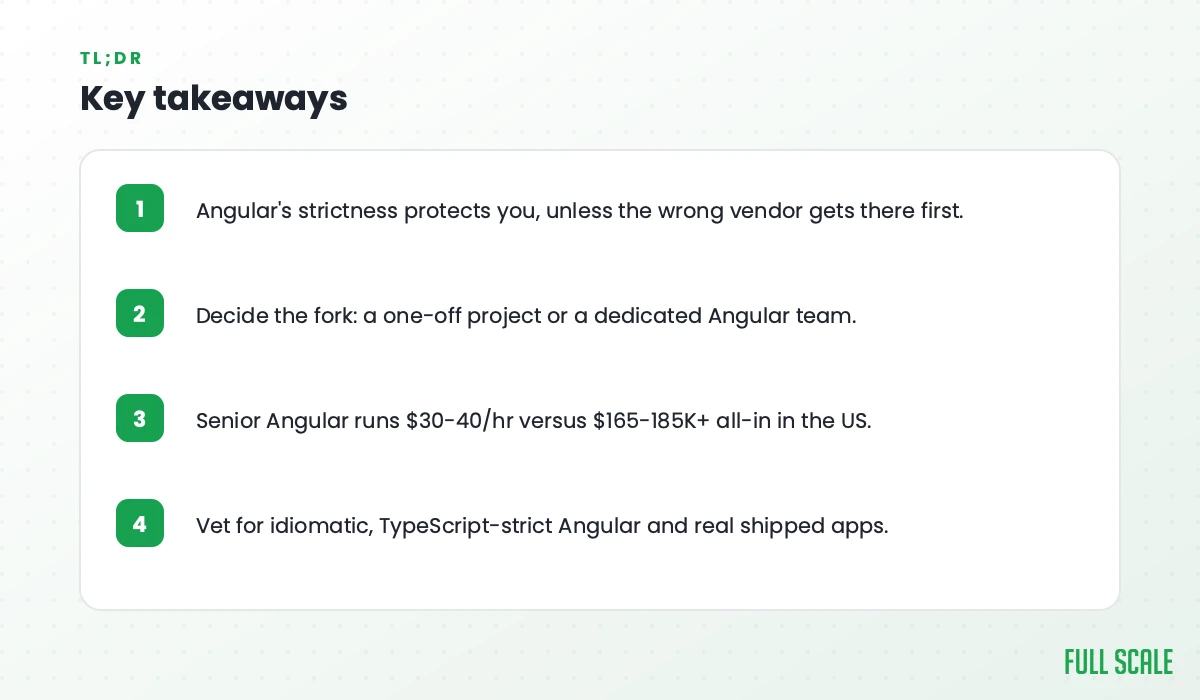
Quick Answer: Outsourcing Angular development usually means one of two models: project outsourcing, where a vendor delivers a fixed scope, or staff augmentation, where Angular engineers join your team directly. For most enterprise Angular applications, staff augmentation wins because the wrong vendor turns Angular’s strictness into technical debt instead of a guardrail. Full Scale places senior Angular engineers in the Philippines under this model, at $30-40/hr versus $165K-185K+ all-in for a comparable US hire.
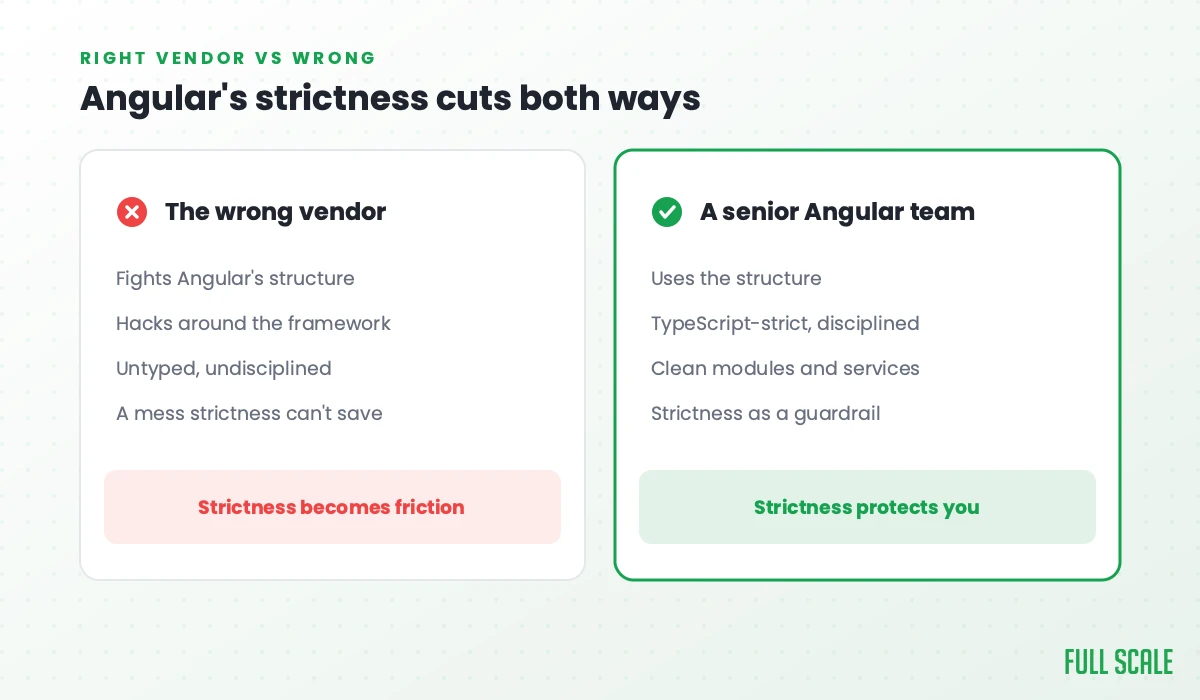
Angular applications are built to last. The framework enforces TypeScript throughout, uses dependency injection to wire the application together cleanly, handles async data with RxJS, and organizes the application into modules or standalone components with clear boundaries. Teams choose Angular for enterprise applications specifically because this structure makes large codebases maintainable over years and multiple contributors. A vague brief is usually the culprit, which is why writing a sharp Angular developer job description comes first.
That structure is also why the wrong Angular vendor creates the worst technical debt in the JavaScript ecosystem. React teams avoid that by hiring for the framework directly; on Next.js you hire Next.js engineers who know its conventions.
A vendor that does not understand Angular’s dependency injection system injects too much into components, creating tight coupling that makes testing and refactoring expensive. A vendor that does not manage RxJS subscriptions correctly creates memory leaks that accumulate silently across user sessions. Both failure modes compile cleanly and pass basic tests, and both become visible six months after delivery, when your engineering team tries to ship a new feature and discovers the service layer is tangled in ways that require rewriting substantial portions of the application.
Angular rewards the right outsourcing partner and punishes the wrong one more visibly than any other JavaScript framework. The model-selection question is therefore more important with Angular than with most alternatives.
I run Full Scale, which staffs offshore software development teams in the Philippines. Angular is one of our enterprise stacks. Here is what I have learned about when outsourcing Angular work produces results and when it creates exactly the problem it was supposed to solve.
Angular Staff Augmentation or Project Outsourcing?
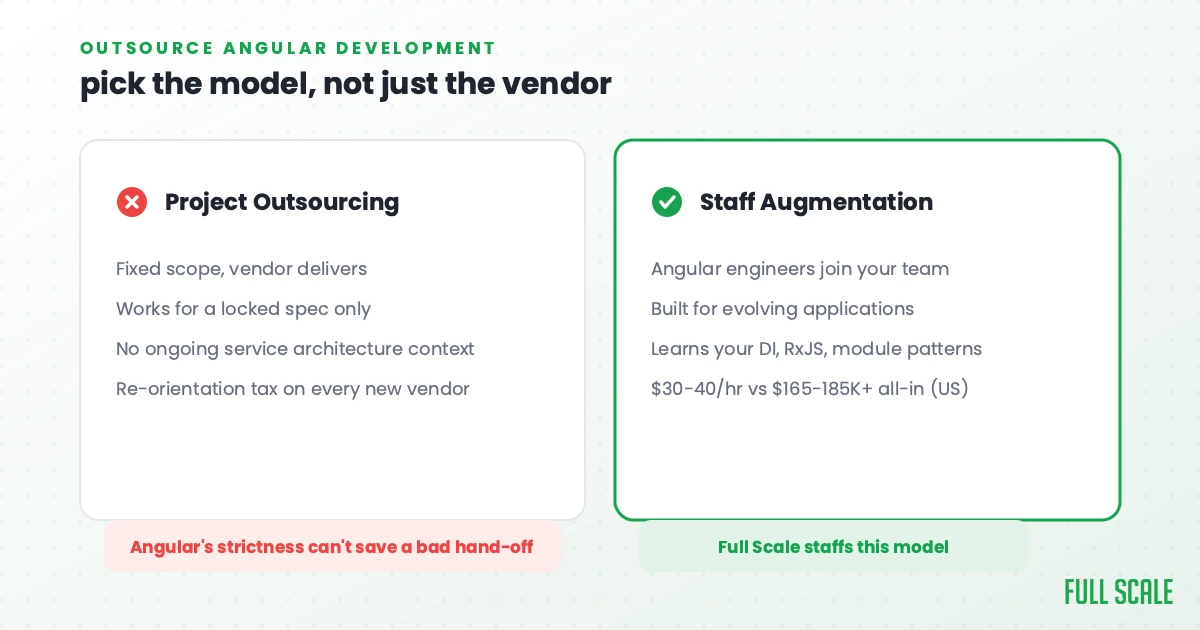
For Angular work that will keep evolving, staff augmentation is the model that works, and project outsourcing fits only work with a locked scope. Pick the wrong one and no amount of vendor vetting saves you.
Staff augmentation means Angular engineers join your team directly. They are in your standups, they understand your module structure, they know your service architecture and your RxJS patterns. For any Angular application that will keep growing, this is the model that works. One of the real benefits of staff augmentation is that engineers develop institutional knowledge of your specific application. Angular’s strictness means they ramp faster than in most frameworks: the conventions are shared before they read a line of your business logic.
Project outsourcing means you hand a scope to a vendor and they deliver it. For genuinely scoped Angular work, this can work. A specific component with a documented API contract. A one-time migration from an older Angular version to a current one with a clear before-and-after state. A greenfield setup where an Angular specialist establishes the module architecture and then your own team takes over. I have outsourced scoped projects myself (an Elasticsearch integration, a WordPress build) when the scope was genuinely locked. The key word is scoped.
The failure mode: signing a project contract for Angular work that is not genuinely scoped. An enterprise application with an evolving product roadmap. A component library that will grow with new requirements. Any feature work where the spec will change when it meets real users. The vendor delivers, the code compiles, the tests pass, and your team inherits an Angular codebase where the service layer fights the framework.
If you already know you want offshore Angular engineers embedded in your team for the long term, our offshore Angular development guide covers that model: why Angular’s strictness makes it the best JavaScript framework for distributed teams, what the DI/RxJS evaluation looks like, and what the Philippines specifically brings to Angular staffing.
The honest filter: if your Angular application will keep evolving, you need engineers who own it. Ask whether you would want the same Angular developers in your standup twelve months from now. If yes, that is staff augmentation. If the work truly ends when the deliverable ships, project outsourcing can work.
When Angular Project Outsourcing Works
Angular project outsourcing works when the spec is locked and the deliverable is verifiable, and those conditions are narrow:
- A specific UI component with a documented input/output API that other components consume: the work ends when the component matches the spec
- A migration from AngularJS or an older Angular version to a current Angular version with a clear source-and-target state
- A greenfield application scaffold where an Angular specialist establishes the architecture and your team takes over ongoing development
- A performance audit where the task is identifying and documenting N+1 HTTP calls and RxJS subscription leaks: they find it, you fix it
The pattern: finite, testable, non-evolving. When the Angular work has a clear endpoint that both sides can verify, a project vendor can deliver it cleanly. When the application needs to grow, the project vendor cannot grow with it.
Three Ways Outsourced Angular Projects Fail
Decorators soup and DI misuse. Angular’s dependency injection system is powerful and easy to misuse. Engineers who do not understand it inject too many dependencies into components, creating tight coupling that makes testing painful. They use services as global state buckets rather than scoped providers. They recreate with complex component inputs the exact problem DI was designed to solve. I call this cheapshoring: hiring the cheapest Angular developer in a framework where the gap between “has used Angular” and “understands Angular’s design” is the widest of any JavaScript option. The code compiles. The architectural debt accumulates until a new feature requires refactoring the entire service layer. Vue has its own version of this gap, and it is the first thing I screen for in offshore Vue.js development.
Spec hand-off loses the service architecture. Enterprise Angular applications have service layers that encode the domain model: how a User relates to an Order, how authentication state flows through the application, how error handling propagates across feature modules. A vendor who receives a feature spec and builds against it has none of the context that explains why the service architecture is shaped the way it is. The spec describes the UI behavior. It does not document the service contracts that the new feature needs to honor. The result is feature code that works in isolation and breaks existing behavior in ways that take weeks to trace.
Scoping ongoing enterprise work as a deliverable. Angular applications at enterprise scale grow in ways that are hard to predict: new feature modules, new service integrations, new requirements from stakeholders who see the product working for the first time. Structure ongoing Angular development as a series of project contracts and you pay a re-orientation tax every time a new vendor encounters your codebase. Angular’s DI and module systems reward engineers who understand the whole application. Project vendors understand only the piece they were paid to build.
What to Look For in an Angular Outsourcing Partner
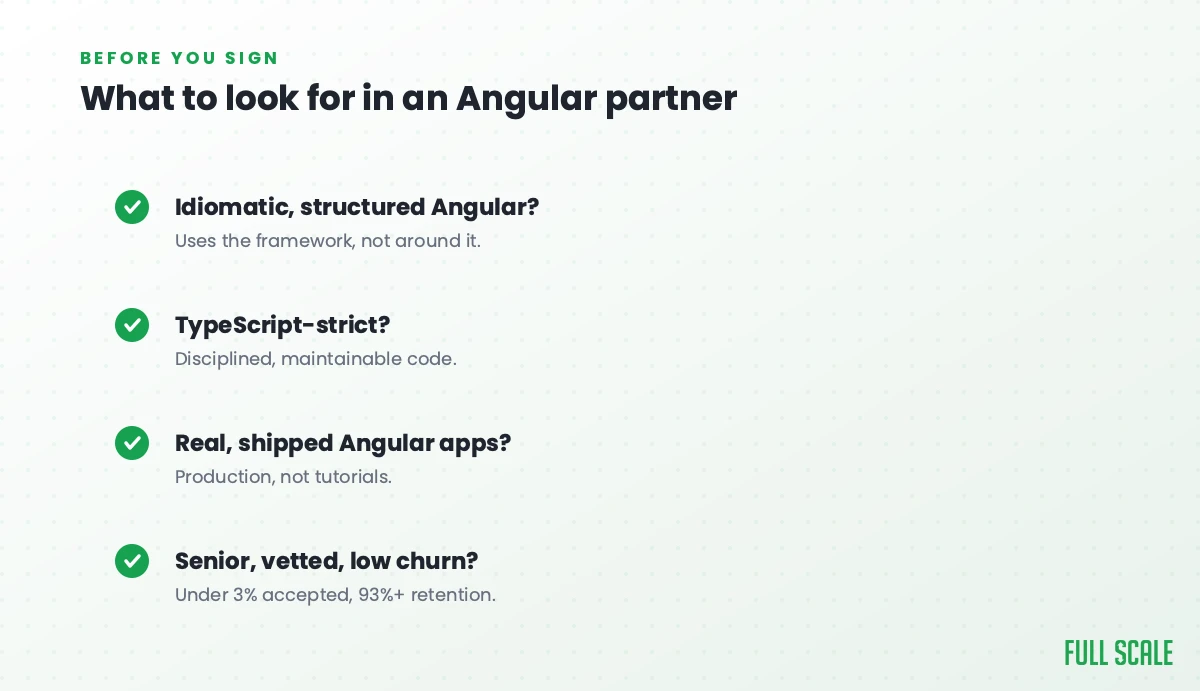
Direct access to the engineers. An Angular vendor who routes all technical conversations through an account manager is telling you something important. Angular’s DI and RxJS patterns require engineers who can explain their architectural decisions and challenge specs that would create coupling. Engineers who cannot communicate directly will not do that.
DI and RxJS depth as the evaluation standard. Ask technical questions before you sign anything. Ask how they structure feature modules and service scoping in a large Angular application. Ask how they handle Observable cleanup in components that get destroyed before an HTTP call returns. Ask their opinion on NgModules versus standalone components. Engineers who know Angular will have opinions rooted in experience. Vendors who know how to win Angular contracts will have answers.
Staffing model versus project model. A vendor whose revenue comes from delivering new project scopes has no incentive to build maintainable Angular architecture. A partner whose engineers stay on client teams has every incentive to, because they will be the ones extending the codebase. When evaluating offshore software development partners for Angular, the business model of the partner is as important as the technical capabilities of the engineers.
Philippines for Angular Outsourcing
Angular rewards the team that has lived in it. The senior Angular engineers in the Philippines are not developers who picked the framework up for one project. They spent the last decade inside enterprise development environments during the years most enterprise JavaScript ran on Angular, building and maintaining real Angular applications across their careers. That depth is exactly what an outsourcing engagement needs, because Angular punishes shallow familiarity faster than a looser framework would.
The old outsourcing model of handing an Angular spec over the wall and getting a deliverable back is increasingly replaceable by AI. Angular’s boilerplate (component decorators, NgModule imports, service injection in constructors) is exactly what AI tools generate well. If your outsourced Angular engineer’s job is to scaffold components from a spec, an AI tool does that job cheaper.
What you need is an engineer who catches when the AI-generated Angular code misuses dependency injection. Who notices an Observable subscription in a component that will never clean up after itself. Who pushes back when the spec asks for a feature that would require injecting five services into a single component. The Philippines is the third-largest English-speaking country in the world, and Filipino Angular engineers bring the communication discipline that Angular’s convention-heavy architecture requires.
What the Cost Comparison Looks Like
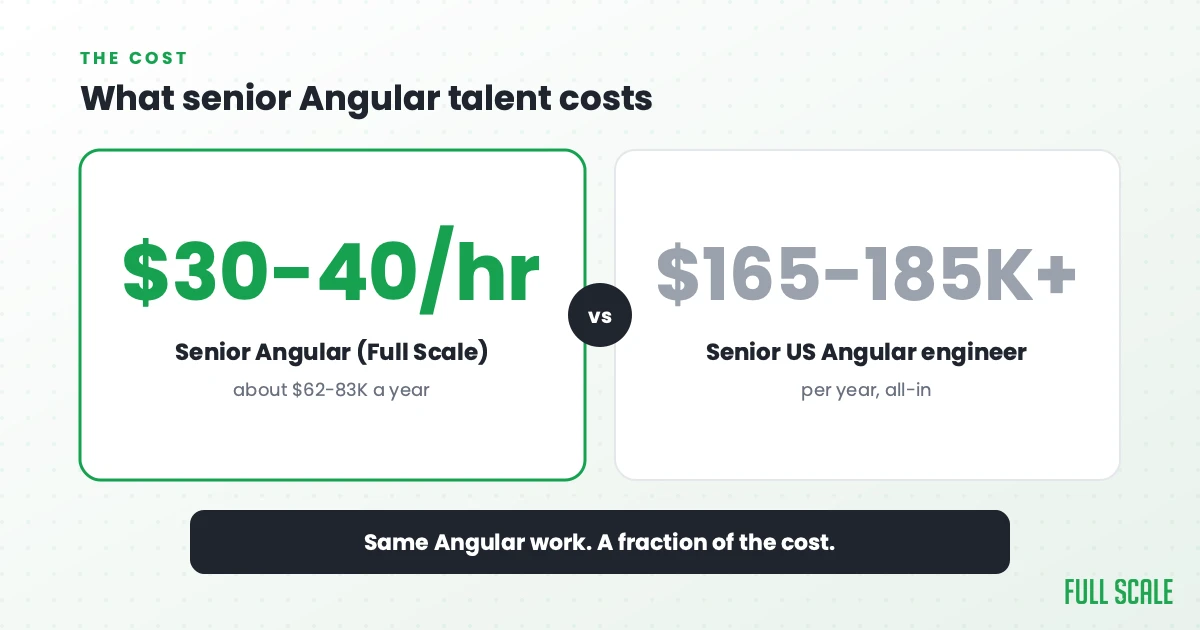
Full Scale clients pay $30 to $40 per hour for senior Angular engineers in the Philippines. A comparable engineer in the US earns a BLS median of around $133,000 per year in base salary, with an all-in cost of $165,000 to $185,000 or more when you add benefits, payroll taxes, and overhead (what MIT research estimates at 1.25 to 1.4 times base salary).
| Full Scale (Angular, Philippines) | US Senior Angular Engineer | |
|---|---|---|
| Hourly / annual cost | $30-$40/hr (~$62K-$83K/yr) | $133K base → ~$165K-$185K all-in |
| Time to staff | ~14 days | 6-12 weeks |
| Recruiting fee | None | 20-25% of first-year salary |
Angular’s enterprise positioning keeps the quality floor higher than in casual JavaScript frameworks. The cost gap is real, but model selection and engineer quality both matter more with Angular than with most alternatives.
What AI Changes About Outsourcing Angular Work
I tell clients half-jokingly that we are all essentially paying developers to babysit AI: to review what it generates, catch what it gets wrong, and steer it toward something useful. For Angular specifically, the AI output is verbose and the review requirement is high.
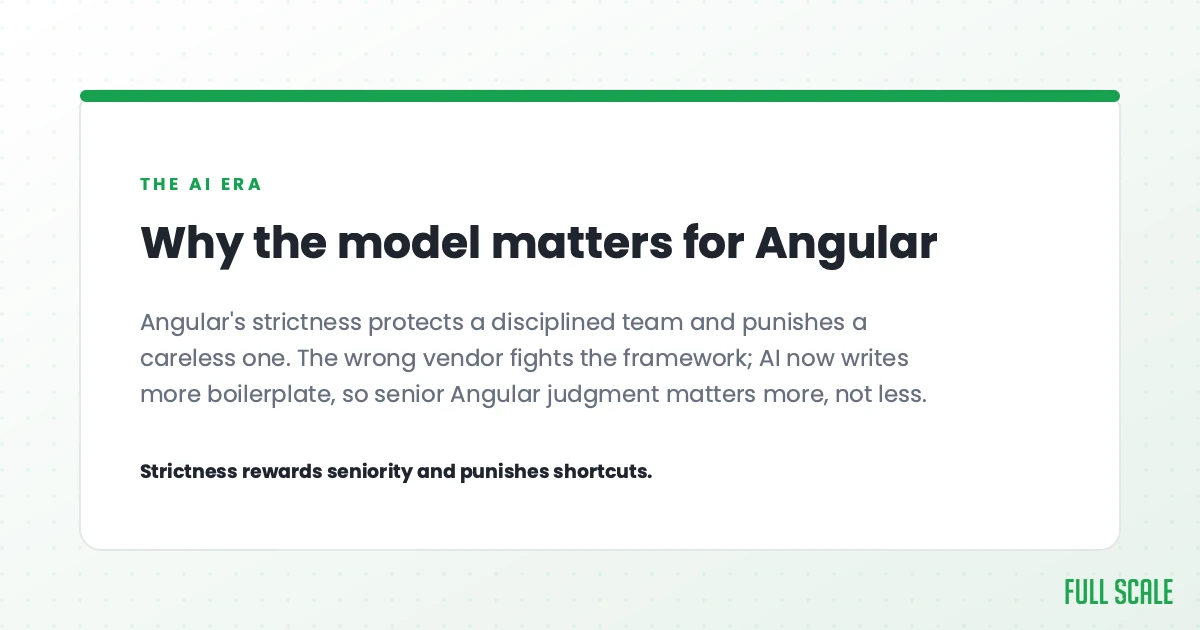
Angular boilerplate is exactly what AI generates well: component decorators, module imports, service constructors, lifecycle hooks. An AI asked to build a new Angular component will produce something that looks complete and compiles. Whether it manages its Observable subscriptions correctly, whether it injects services at the right scope, whether it violates the module architecture of the existing application: these require an engineer who understands Angular well enough to catch what the AI missed.
The difference between a software engineer and a software developer in Angular: one understands the framework well enough to know when AI-generated code is architecturally wrong, not just syntactically correct. Product Driven is about building engineers who own what they build. In Angular, ownership means understanding the DI and RxJS patterns well enough to know when the AI is creating the memory leaks and coupling that compound into technical debt.
Frequently Asked Questions
What does it mean to outsource Angular development?
Outsourcing Angular development means engaging an external partner to staff or build work on your Angular application. The model can be project outsourcing (a vendor delivers a defined scope) or staff augmentation (Angular engineers join your team directly). For most enterprise Angular applications that will keep evolving, Full Scale recommends staff augmentation because the engineers accumulate knowledge of your specific service architecture, module structure, and RxJS patterns.
Why does outsourced Angular development fail so often?
The most common failure is convention violation: a vendor hired from the cheap end of the JavaScript talent market delivers Angular code that compiles but misuses dependency injection and fails to manage RxJS subscriptions. Both failure modes are invisible during delivery and compound silently until the product team tries to extend the application and discovers the service layer is tangled. The fix is choosing staff augmentation for ongoing Angular work, because those engineers stay to extend what they built.
How much does it cost to outsource Angular development?
At Full Scale, senior Angular engineers in the Philippines are staffed at $30 to $40 per hour, with typical onboarding timelines of 14 days. A comparable US engineer costs $133,000 or more in base salary before benefits and overhead. Angular’s enterprise context means the engineers who stay with the framework tend to be senior, so the quality floor is higher than in more casual JavaScript frameworks and the cost gap means more.
Why hire offshore Angular developers in the Philippines?
The Philippines has a decade of enterprise Angular experience built during the period when Angular was the dominant enterprise JavaScript framework. Filipino Angular engineers understand the framework’s DI and RxJS patterns from production applications, not tutorials. Combined with English fluency and a communication culture suited to enterprise technical work, the Philippines produces Angular engineers who can catch what AI generates incorrectly and challenge architectural decisions that would compound into technical debt.
Is nearshore or offshore better for Angular development?
It depends on team size and how much real-time work you need, not on Angular. Nearshore fits when you are hiring one to three engineers or need frequent live meetings. Offshore fits a long-term product team of five or more engineers, where the savings compound and a half-day of overlap is enough. Angular's strict structure helps on the offshore side, because the conventions are shared before an engineer reads a line of your business logic. Full Scale staffs offshore engineers in the Philippines, and our nearshore vs offshore comparison covers the full trade-off.
Can I outsource AngularJS development or an AngularJS migration?
Yes, but treat it as a migration, not a maintenance contract. AngularJS support officially ended in January 2022, so outsourced AngularJS work is mostly moving the application to current Angular. A migration with a clear before-and-after state is one of the cases where project outsourcing works. If the application keeps shipping features during the move, staff augmentation fits better, because the engineers need to know the whole codebase. Our AngularJS to Angular migration guide walks through the move.
Ready to Build an Angular Team That Works Like Your Own
Full Scale has been staffing offshore software development teams since 2018. We have placed 700+ developers with clients across 200+ tech companies. Our Angular engineers work inside enterprise product organizations across North America, maintaining and extending production Angular applications.
If you want to hire Angular developers who understand the framework’s conventions and work inside your team, that is what we staff.
Schedule a call to talk through your Angular team needs.