
Outsource .NET Development: How to Pick the Right Model

In this article
- Staff Augmentation vs. Project Outsourcing: The Fork That Determines Everything
- AMC Theatres Made the Right Call
- Three Things That Break Outsourced .NET Engagements
- What to Look For in a .NET Outsourcing Partner
- Why the Philippines for .NET Outsourcing
- What the Cost Comparison Actually Looks Like
- What AI Changes About Outsourcing .NET Work
- Frequently Asked Questions
- Ready to Build a .NET Team That Works Like Your Own
Quick Answer: Outsourcing .NET development usually means one of two models: project outsourcing, where a vendor delivers a fixed scope, or staff augmentation, where .NET engineers join your team directly. For most ongoing .NET work, staff augmentation wins because the work keeps evolving past any fixed deliverable. Full Scale places senior .NET engineers in the Philippines under this model, the same approach AMC Theatres uses for its .NET team.
Most companies searching “outsource .NET development” are trying to solve a capacity problem. They need .NET engineers who can ship code. They don’t have the time, the budget, or the hiring runway to build a full in-house team. Outsourcing seems like the answer. Many of those teams also take on desktop application work, since .NET is the backbone of Windows desktop software. Before you scope any of that out, it helps to be clear on the .NET developer responsibilities the work really depends on.
The problem is what happens next. They find a development shop, scope out a project, sign a contract, and six months later the thing doesn’t work, the vendor is pointing at the spec, and the whole engagement is in the ditch. They walk away thinking offshore .NET work is a bad idea.
Offshore .NET work is not the problem. The engagement model was wrong.
I built a .NET product at Stackify: APM, logging, and error tracking tools that developers use to find and fix production problems. I’ve hired .NET developers in Russia, Uruguay, Colombia, and the Philippines. I know what good .NET talent looks like and I know what breaks when you structure the engagement wrong.
The mistake most companies make is treating a team problem like a project. “Outsource .NET development” usually means “I want .NET engineers working alongside my team.” What it gets delivered as is “a development shop will hand you a deliverable.” Those are different products. Most of the horror stories come from buying the second one when you needed the first.
If you already know you want offshore .NET engineers embedded in your team long-term, our offshore .NET development guide covers that model end to end. This post is for companies at the earlier decision point: should I outsource a .NET project, hire a staffing partner, or is there a fork here I’m not seeing clearly yet?
Staff Augmentation vs. Project Outsourcing: The Fork That Determines Everything
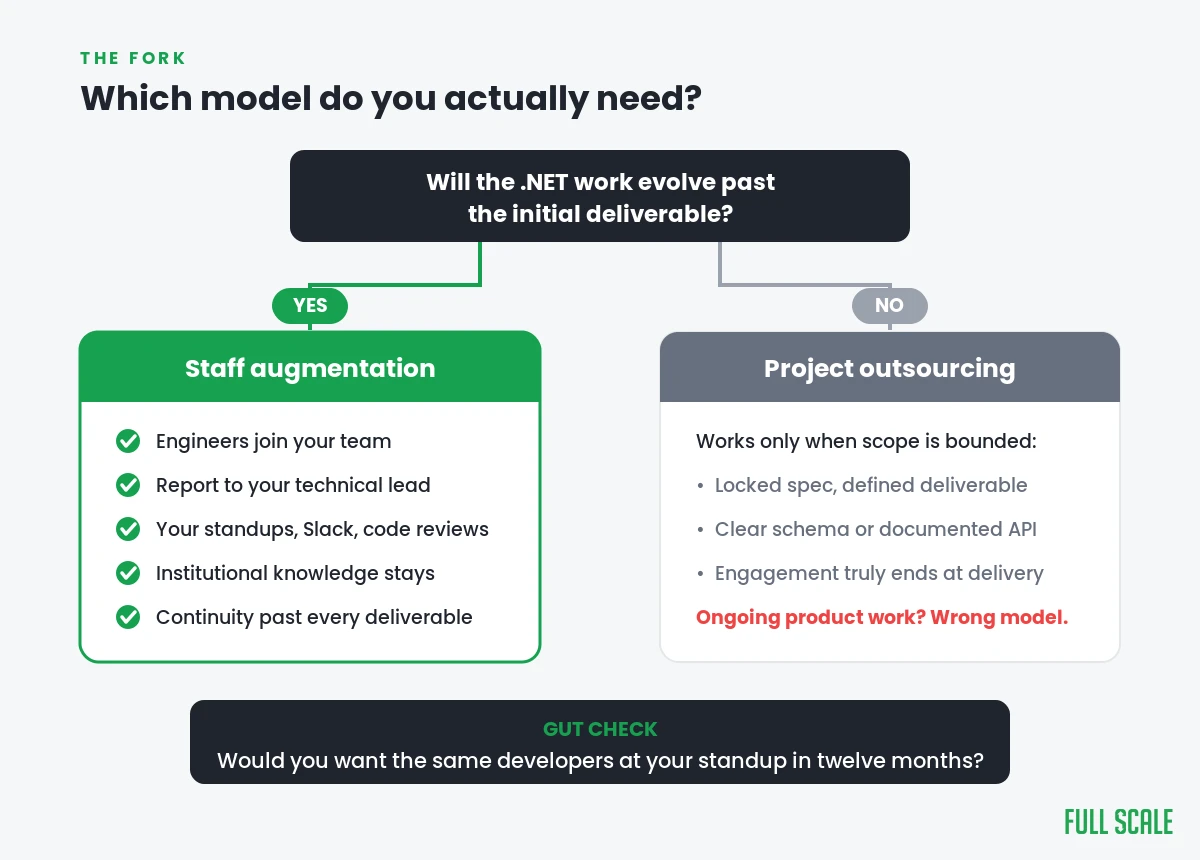
Which model you pick decides more than any vendor selection you make.
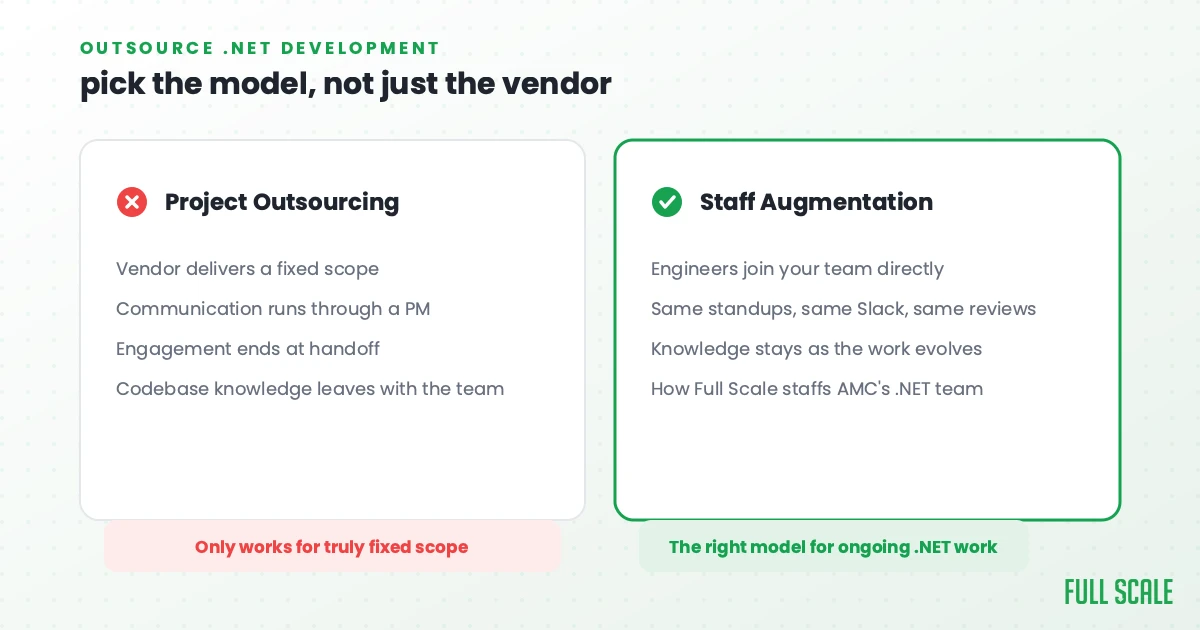
Staff augmentation means you add .NET engineers directly to your team. They report to your technical lead, they’re in your standups, they use your tools. For any engagement where requirements evolve, product judgment matters, or the work continues past a defined scope, this is the model that works. The engineers become institutional knowledge holders. A team model over a project handoff optimizes for the outcome. It’s worth knowing what to check before you hire .NET developers in India specifically, where the model matters more than the rate.
Project outsourcing means you hand a defined scope of work to a development shop and they deliver it. For genuinely scoped work, like a WordPress build with a locked spec, a data migration with a clear schema, or an integration with a defined API, this can work. I’ve outsourced scoped projects myself. A WordPress build for a new site. An Elasticsearch integration with a documented API. Both times the scope was fixed, the deliverable was clear, and the engagement was finite.
The gap between those two is where most .NET outsourcing goes wrong. A CTO looking for ongoing .NET capacity hires a project shop because “outsourcing” is what they searched for. The shop scopes it as a project, delivers to the spec, and closes the engagement. The CTO is left with a codebase they don’t understand and no one who knows it.
Here is the honest filter: if your .NET work will evolve past an initial deliverable, you need engineers on your team, not a project vendor. The question to ask is whether you’d want the same developers at your standup in twelve months. If yes, hire for staff augmentation. If the work truly ends when the deliverable ships, project outsourcing can work. And if you’re hunting for the cheapest hands, read why hiring coders is the wrong goal in the AI era first.
Most .NET engagements are the first kind.
AMC Theatres Made the Right Call
The clearest example I can point to of a company getting this decision right is AMC Theatres. AMC runs the world’s largest movie-theatre ticketing platform on .NET. When they needed to scale their engineering capacity, they did not go looking for a development shop to hand the work to.
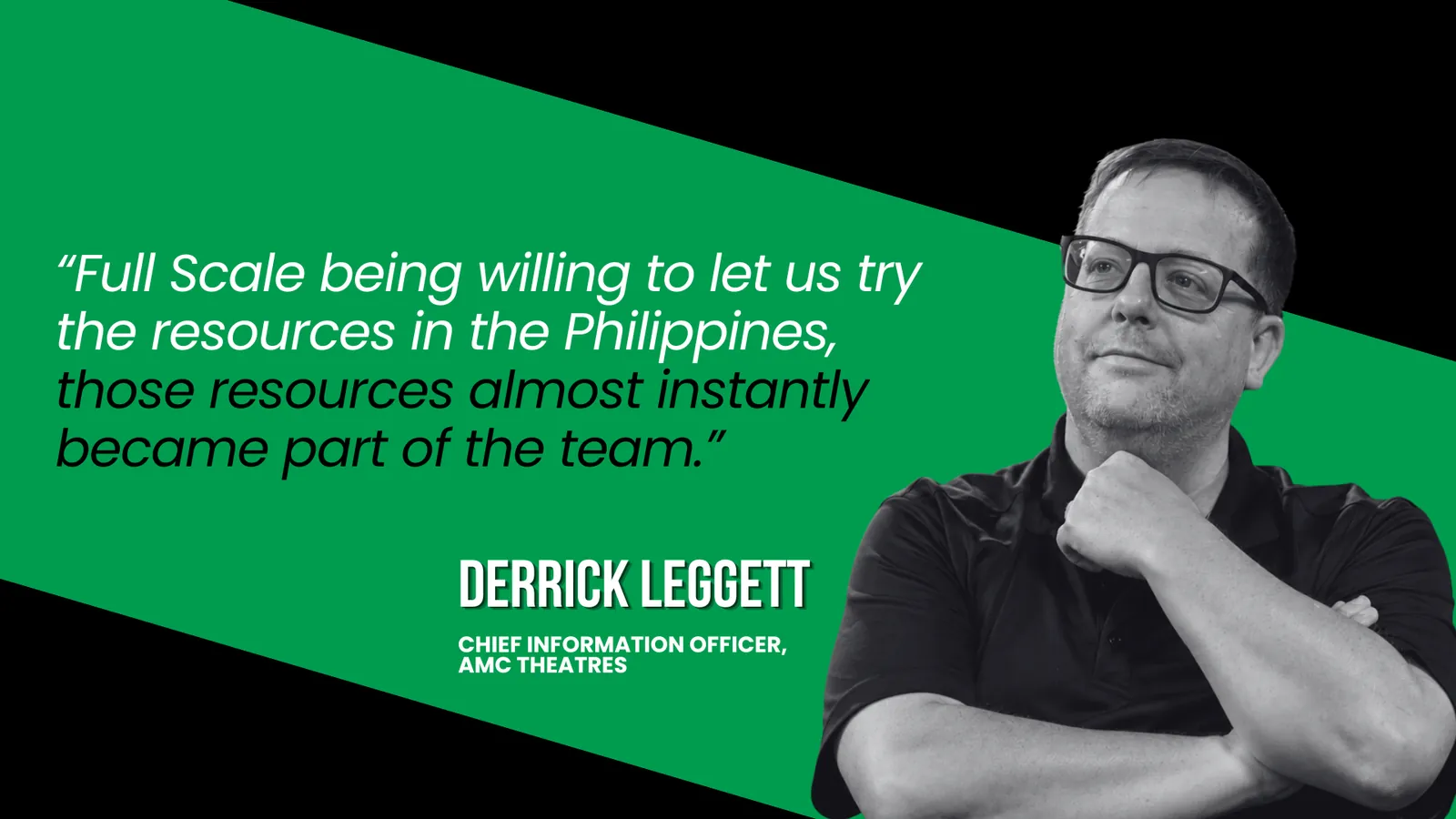
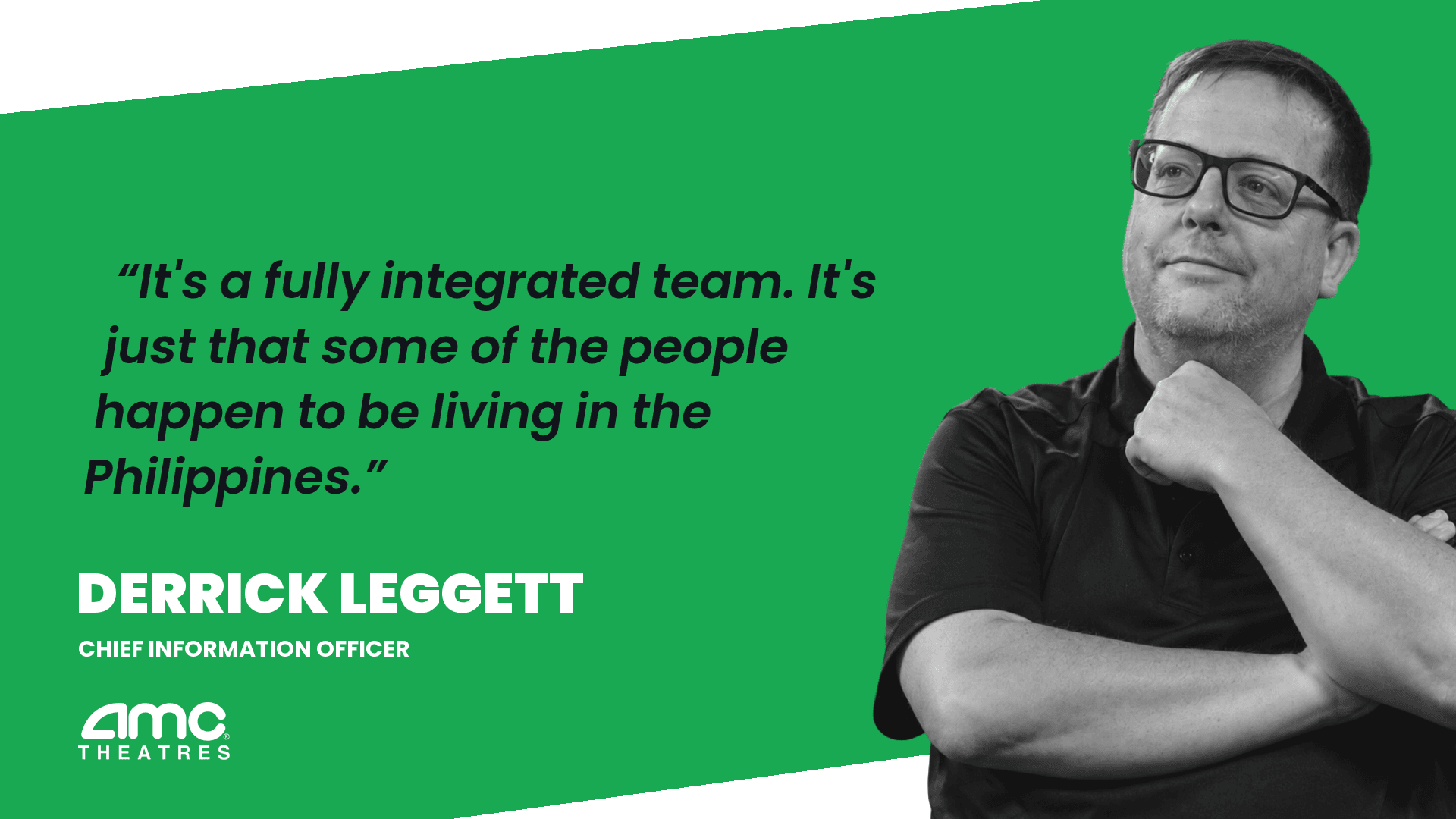
They wanted engineers who would join their team: same standups, same Slack, same code reviews. They weighed the project-shop route and rejected it: handing the .NET work to a vendor would have bought them a deliverable, not a team. AMC CIO Derrick Leggett has been explicit that where an engineer sits is irrelevant; what matters is whether they are treated as part of the team. By that standard, the .NET developers Full Scale placed in the Philippines became indistinguishable from the rest of AMC’s engineers.
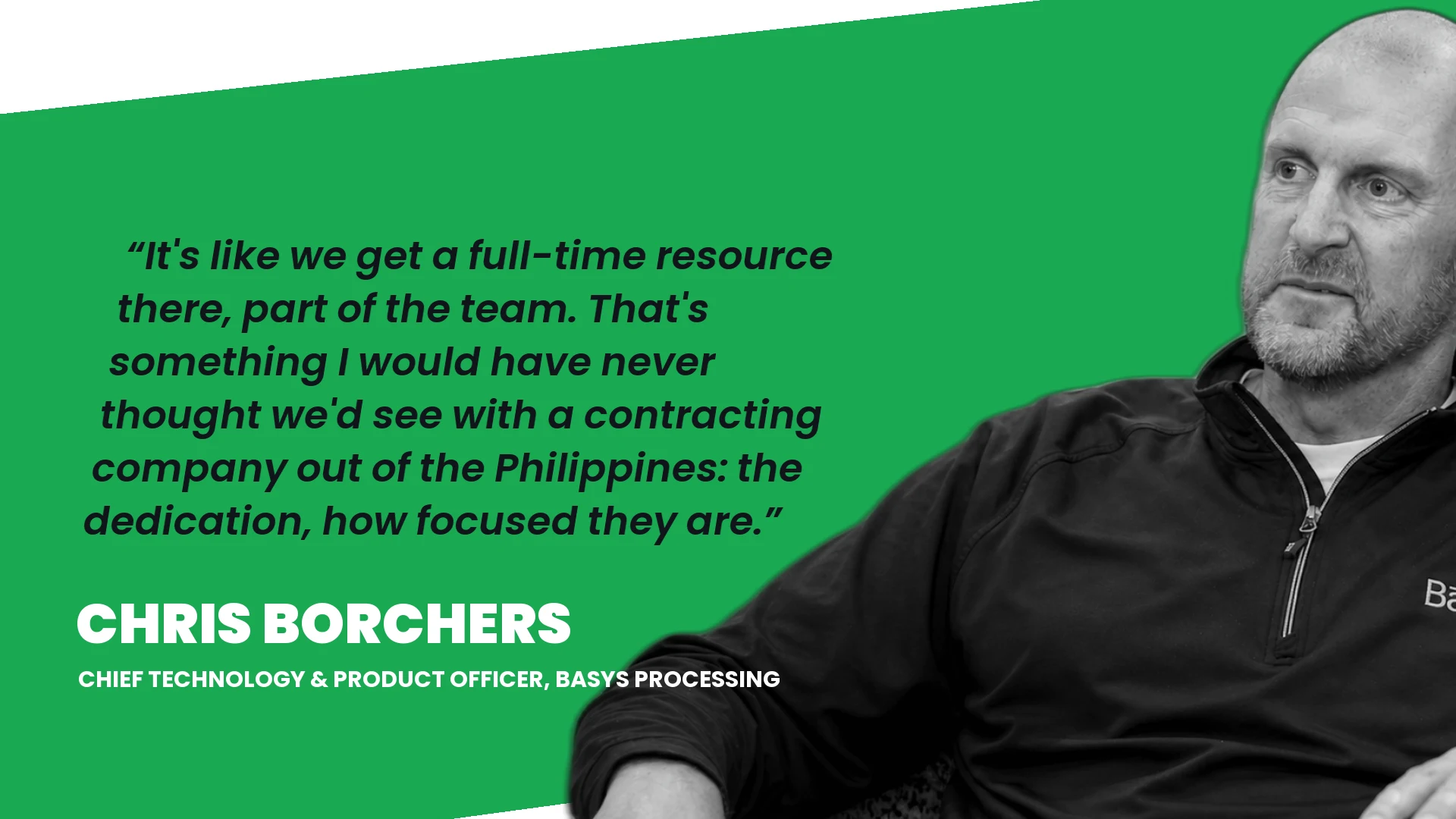
That engagement works because AMC does not treat the Full Scale developers as a vendor delivering work from the other side of a wall. There is no vendor layer in between. The engineers join AMC’s sprints, AMC’s deployments, AMC’s product roadmap discussions. They are AMC engineers.
The part that matters for anyone evaluating outsourcing: AMC could have outsourced that .NET work as a project. They chose not to, and that choice is why the engagement has lasted years and the engineers have become irreplaceable members of the organization.
Three Things That Break Outsourced .NET Engagements
The failure mode is almost never the code quality. It’s the structure.
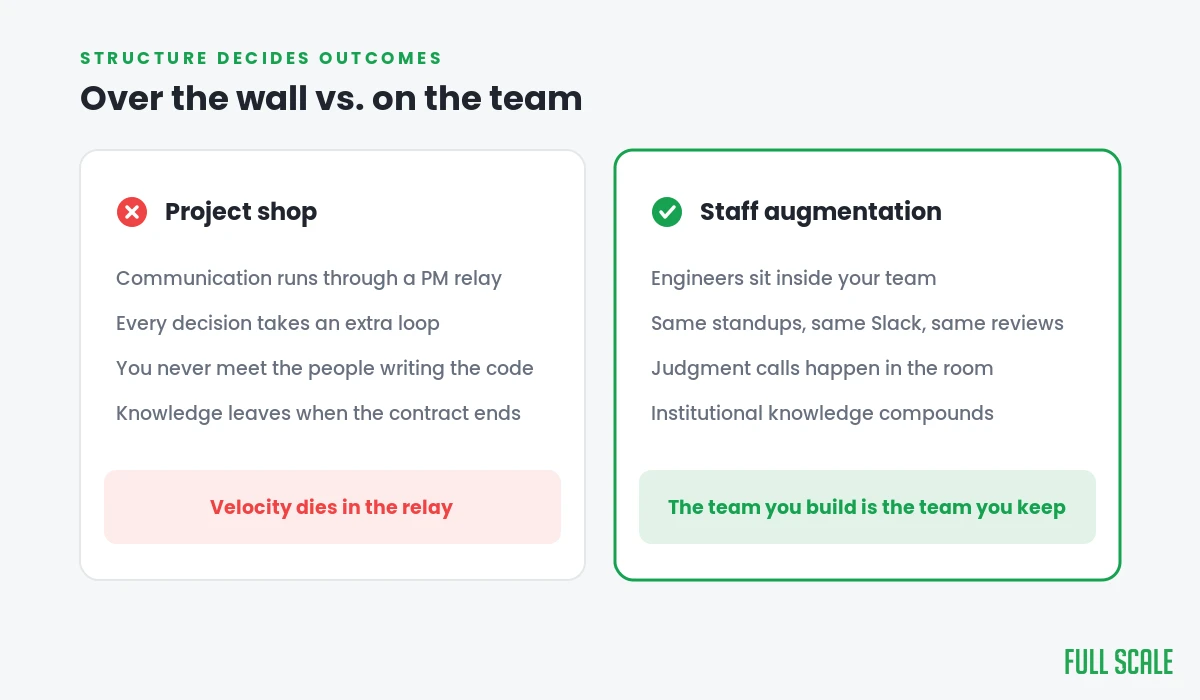
Handing it over the wall. A project shop model means your communication with the engineering team runs through a project manager or account manager who fronts the work. Every question goes through that person. Every decision takes an extra loop. You never build a real relationship with the people writing the code, and the team can’t make judgment calls without running them past the relay. That is cheapshoring in structural form: you bought the cheapest model and paid for it in velocity and quality.
No technical accountability on your side. A senior .NET developer can flag architectural problems and raise scope questions. What they can’t do is set the technical direction for your product. If no one on your side is making daily engineering decisions and reviewing the work, the build loses direction, fast. This is true for any outsourcing engagement, but it compounds when the team is remote.
Scoping ongoing work as a finite project. If your .NET product is going to keep evolving, with new features, new integrations, and new requirements, and you’ve written it as a fixed scope with a defined end date, you’re building in a cliff. The developers who know your codebase go away when the contract ends. The next engagement starts the re-orientation tax from scratch.
What to Look For in a .NET Outsourcing Partner
The hard evaluation for a .NET outsourcing partner is structural, not technical. Most vendor evaluation frameworks look at technical criteria first: C# proficiency, ASP.NET Core experience, Azure certifications, framework expertise. These matter, but they’re the table stakes. Senior .NET developers in the Philippines are building the same production systems as developers anywhere else.
Can you talk directly to the developers? If the vendor won’t put their engineers in your Slack or on your video calls, if every interaction runs through a PM layer, that tells you something about the communication quality of those engineers. Walk away.
Do they run a staffing model or a project model? If the vendor’s business model depends on scoping new projects rather than retaining engineers on long-term client teams, your incentives are misaligned from day one. The staffing model creates a win when the engineer stays and grows. The project model creates a win when the project ends and a new one begins.
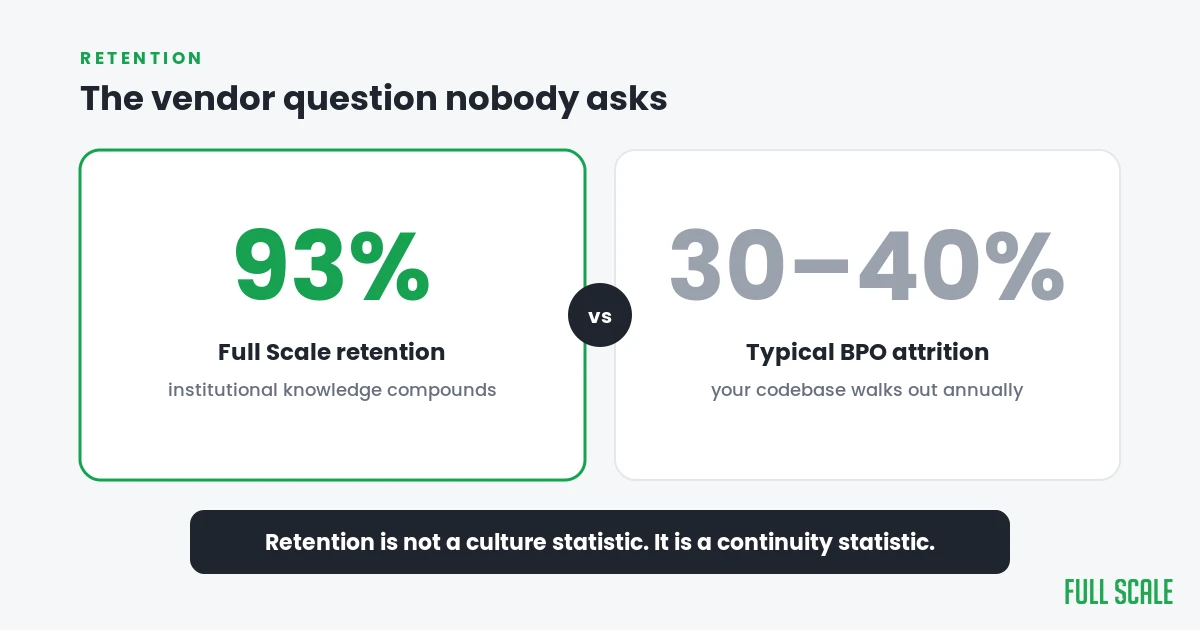
What does their developer retention look like? High attrition in a development partner means the people who learned your codebase are gone, replaced by engineers who haven’t. Full Scale‘s developer retention runs at 93%, against the 30-40%+ voluntary attrition typical in Philippine BPO work. Retention is not a culture statistic. It is a continuity statistic.
When evaluating a potential offshore software development partner, the question is not “can these developers write .NET?” It’s “will these developers still be working on my product in two years?”
Why the Philippines for .NET Outsourcing
The reason Full Scale operates specifically in the Philippines is not the hourly rate. It is the combination that makes remote engineering teams actually function. There are good .NET developers in many countries: I’ve hired in Russia, Uruguay, Colombia, India, and the Philippines.
Think about what the old offshore hand-off model looked like. You handed off requirements, the team built what you described, and handed it back. AI can now do that. If your outsourced team’s only value is executing a spec you hand them, you do not need an outsourced team. You need a better prompt.
What you need in 2026 is a team that helps figure out the requirements. A team that asks the right questions, challenges when a spec doesn’t make sense, and pushes toward the best solution rather than just the requested one. That requires communication skills and a culture of intellectual engagement that not every country brings to software development.
The Philippines is the third-largest English-speaking country in the world. Filipino developers grew up consuming American culture. The communication style suits remote engineering work: direct enough to be useful, warm enough to make collaboration feel like collaboration rather than arm-wrestling with a ticket system. More than fluency, the hospitality culture that makes Filipinos exceptional at service roles translates directly to software development. Filipino engineers ask whether the ticket is the right ticket. That is the quality AI cannot replace.
The Philippine IT-BPM industry generates $40 billion in annual export revenue and employs 1.8 million workers. The .NET talent pool is deep and the infrastructure for remote engineering work is mature.
What the Cost Comparison Actually Looks Like
Full Scale clients typically pay $30-$40 per hour for a senior Filipino .NET engineer. A comparable engineer in the US earns a BLS median of around $133,000 per year in base salary, and when you add benefits, payroll taxes, and overhead (what MIT research estimates at 1.25 to 1.4 times base salary), the all-in cost of a senior US engineer runs $165,000 to $185,000 or more per year.
| Full Scale (.NET, Philippines) | US Senior .NET Engineer | |
|---|---|---|
| Hourly / annual cost | $30-$40/hr (~$62K-$83K/yr) | $133K base → ~$165K-$185K all-in |
| Time to staff | ~14 days | 6-12 weeks |
| Recruiting fee | None | 20-25% of first-year salary |
The math is what it is. The caveat worth making: that cost gap does not matter if the model is wrong. A $35/hr developer on a project-outsourcing contract who delivers the wrong product is not a bargain compared to a $165K in-house engineer who understands your product deeply. Model selection comes first. Cost is the benefit that follows.
What AI Changes About Outsourcing .NET Work
AI is making the code-writing part of software development cheaper by the month. I tell clients half-jokingly that we are all essentially paying developers to babysit AI: to review what it generates, catch what it gets wrong, and steer it toward something useful.
That shift changes the offshore cost argument, but not in the direction most people expect. If supervising and directing AI-generated code is increasingly central to the job, there is less reason to pay $165,000 a year for someone to do it onshore when an offshore developer can do the same work for 50-70% less.
The more important implication runs in the other direction. The real value in software development was never the code. It was always the product thinking: understanding what to build, why the customer needs it, and whether the team is solving the right problem. That is the difference between a software engineer and a software developer. AI is making the engineering part cheaper. Product thinking is not something AI replaces.
At Full Scale, the Spartan Training Academy is how we make sure our engineers are ahead of the curve, not behind it. We run the Claude Masterclass series, live sessions multiple times per month, covering everything from using Claude Code in the terminal for real-time debugging and scaffolding to advanced agentic workflows with MCP integrations connecting Claude to GitHub, databases, and Slack. Every engineer also gets a five-minute training video each week and a thirty-minute video every other week, most recorded by Full Scale engineers themselves. This is peer learning, not top-down mandates. By mid-2026, we have probably put our engineers through more AI training than any of them wanted.
The reason I push it: I don’t want to get a year from now and have clients return developers because those engineers never learned AI and are now behind the times. We refuse to be in that position.
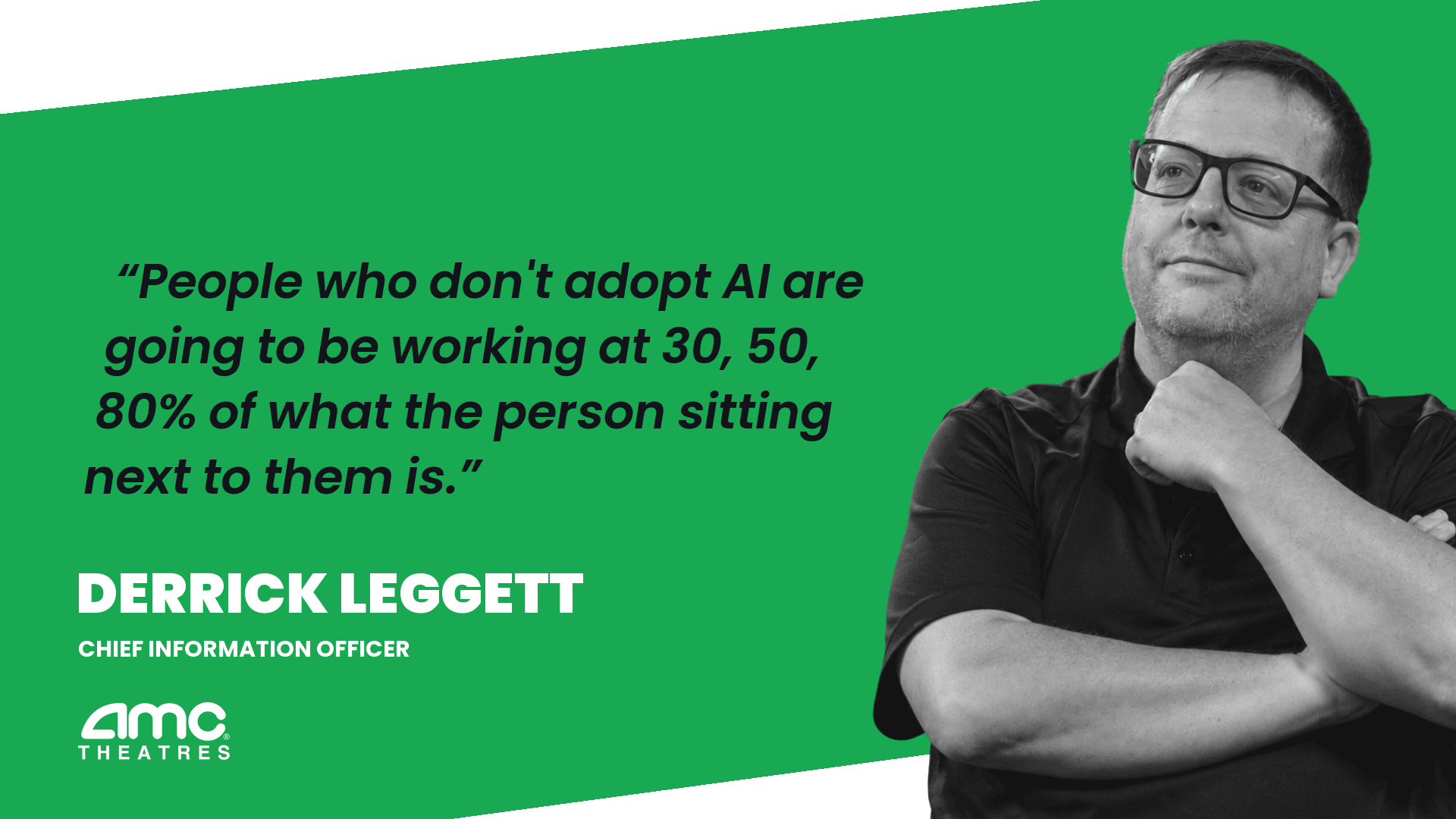
Derrick Leggett put it better than I could: “People who don’t adopt AI and learn how to use it are going to be working at 30%, 50%, 80% of what the person sitting next to them is.”
That is what Full Scale engineers are training toward. It is also what Product Driven is about: building engineers who take ownership of what they are building and why, not just engineers who produce code when handed a ticket.
Frequently Asked Questions
What does it mean to outsource .NET development?
Outsourcing .NET development means engaging an outside partner to staff or deliver work on Microsoft’s .NET platform: C#, ASP.NET Core, Entity Framework, Azure integrations, and related tools. The model can be project outsourcing (a defined scope handed to a shop for delivery) or staff augmentation (engineers who join your team and work within your processes). At Full Scale, we’ve found staff augmentation produces better outcomes than project outsourcing for most ongoing .NET work.
Is outsourcing C# development different from outsourcing .NET development?
No. C# is the primary language of the .NET platform, so outsourcing C# development follows the same staff-augmentation-versus-project-outsourcing decision covered above. The same evaluation criteria apply: can you talk directly to the developers, is the vendor running a staffing model or a project model, and what does their retention look like.
Why do most .NET outsourcing engagements fail?
The most common failure is structural, not technical. A project-outsourcing model creates a communication relay between the client and the developers, misaligns incentives, and ends when the scope does, leaving the client with a codebase no one knows and no engineering capacity to iterate on it. Staff augmentation avoids these failure modes by making the developers part of the client’s actual team.
How much does it cost to outsource .NET development to the Philippines?
At Full Scale, senior .NET developers in the Philippines are staffed at $30-$40 per hour, with typical onboarding timelines of 14 days. A comparable senior engineer in the US costs $133,000 or more in base salary before benefits, payroll taxes, and recruiting overhead. The cost gap is real, but model selection matters more than rate. The wrong model at the right price still produces a bad outcome.
Why choose the Philippines for .NET outsourcing over other countries?
The Philippines wins on communication: English fluency with American-culture context, a service orientation that translates to genuine product engagement, and a communication style that suits distributed engineering teams. The old offshore hand-off model is increasingly replaceable by AI. What survives is the team that communicates, challenges assumptions, and pushes toward the best solution, and that is where the Philippines leads.
Ready to Build a .NET Team That Works Like Your Own
Full Scale has been staffing offshore software development teams since 2018. We have placed 700+ developers with clients across 200+ tech companies. Our .NET engineers are working inside some of the most demanding engineering organizations in North America, including AMC Theatres, where they are full members of the engineering team, not a vendor on the other side of a wall.
If you want to hire .NET developers who work inside your team rather than across from it, that is what we staff.
Schedule a call to talk through what the right model looks like for your engagement.