
Outsource Python Development: How to Pick the Right Model

In this article
- Staff Augmentation vs. Project Outsourcing: The Fork That Decides Everything
- When Python Project Outsourcing Actually Works
- Three Ways Python Project Outsourcing Fails
- What to Look For in a Python Partner
- Python Outsourcing in the Philippines in 2026
- What the Cost Comparison Looks Like
- What AI Changes About Python Outsourcing
- Frequently Asked Questions
- Ready to Build a Python Team That Works Like Your Own
Quick Answer: Outsourcing Python development usually means one of two models: project outsourcing, where a vendor delivers a fixed scope, or staff augmentation, where Python engineers join your team directly. For most ongoing Python work, staff augmentation wins because AI/ML pipelines, data pipelines, and web applications keep evolving past any single deliverable. Full Scale places senior Python engineers in the Philippines under this model, the same staffing approach it has used across 200+ client companies since 2018.
The call I get most often from CTOs evaluating Python work goes something like this: they searched “outsource Python development,” found a dozen companies who do it, and now they want to know how to pick one. Before they’ve answered the question that matters most. A fuzzy brief is usually the root cause, which is why writing a sharp Python developer job description comes first.
The model you use to structure a Python engagement determines more than any vendor decision you will make. A project contract and a staff augmentation arrangement deliver completely different things, at completely different price points, with completely different outcomes after twelve months. Most Python outsourcing goes wrong before a single line of code is written, because the company bought the wrong structure for the work they actually needed. When that work is a Django build, hiring is usually cleaner than handing the whole project to an agency, because you can hire Django developers who embed directly in your team.
I built Python at Stackify, my APM and developer-tools company, where Python was part of the monitoring agent pipeline. I have outsourced scoped Python-adjacent work myself. I also run Full Scale, which staffs Python teams for clients across North America. I have seen both models play out from every seat at the table.
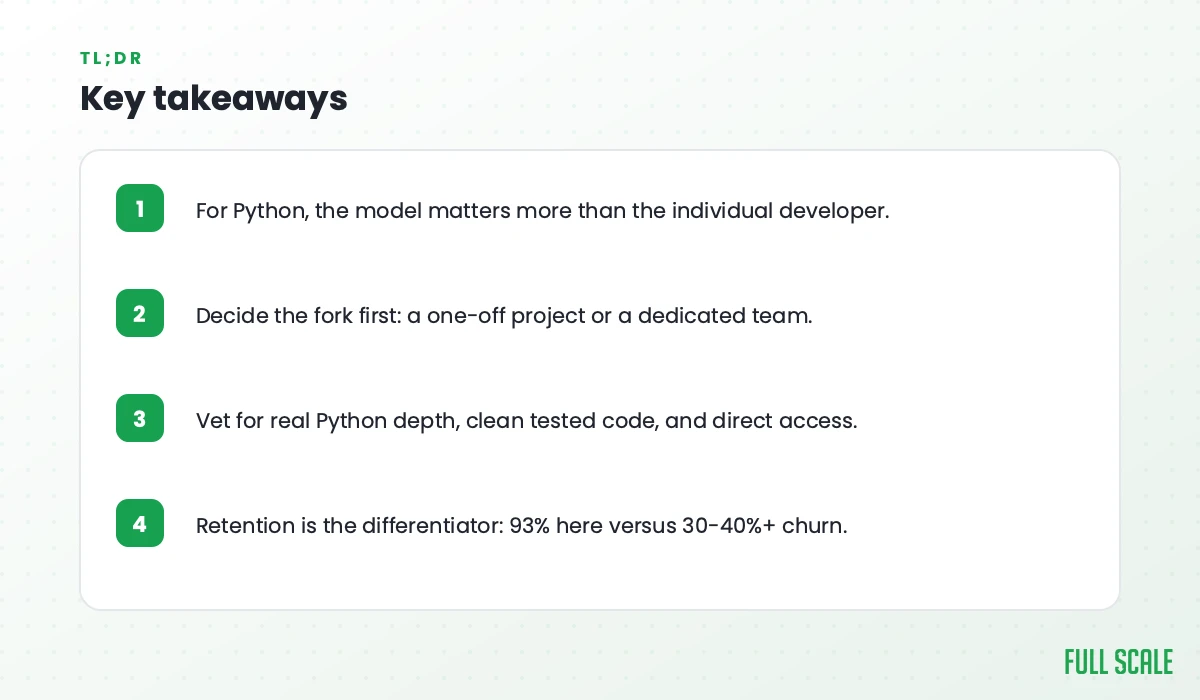
The model matters more than the developer. Here is why.
Staff Augmentation vs. Project Outsourcing: The Fork That Decides Everything
Two fundamentally different things travel under the label “outsource Python development.”
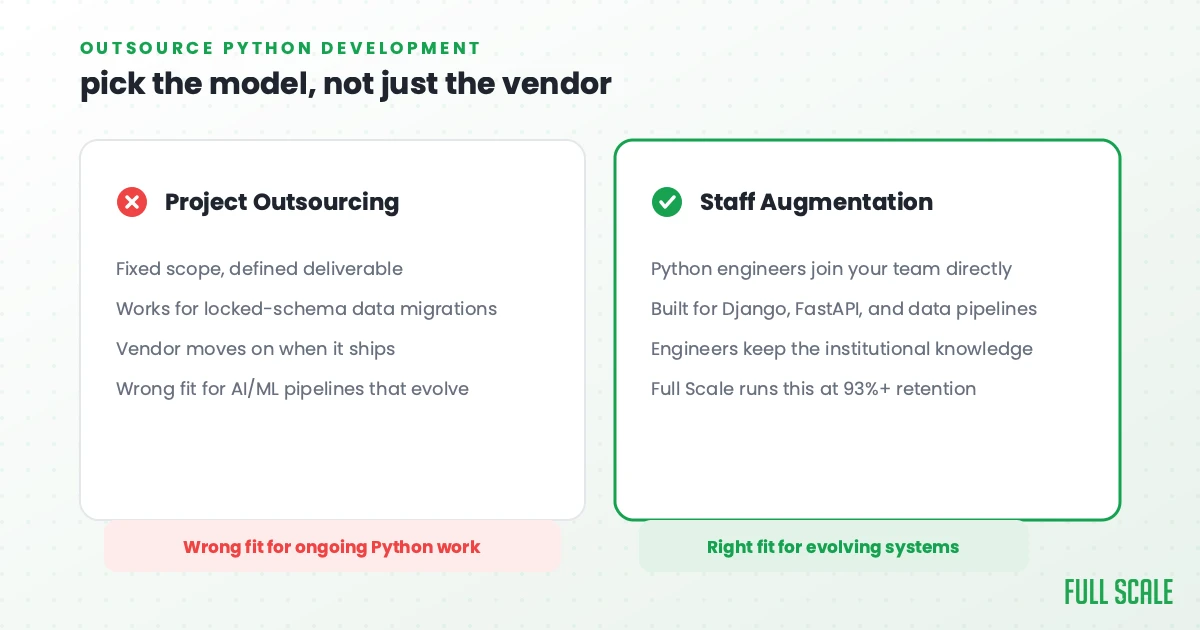
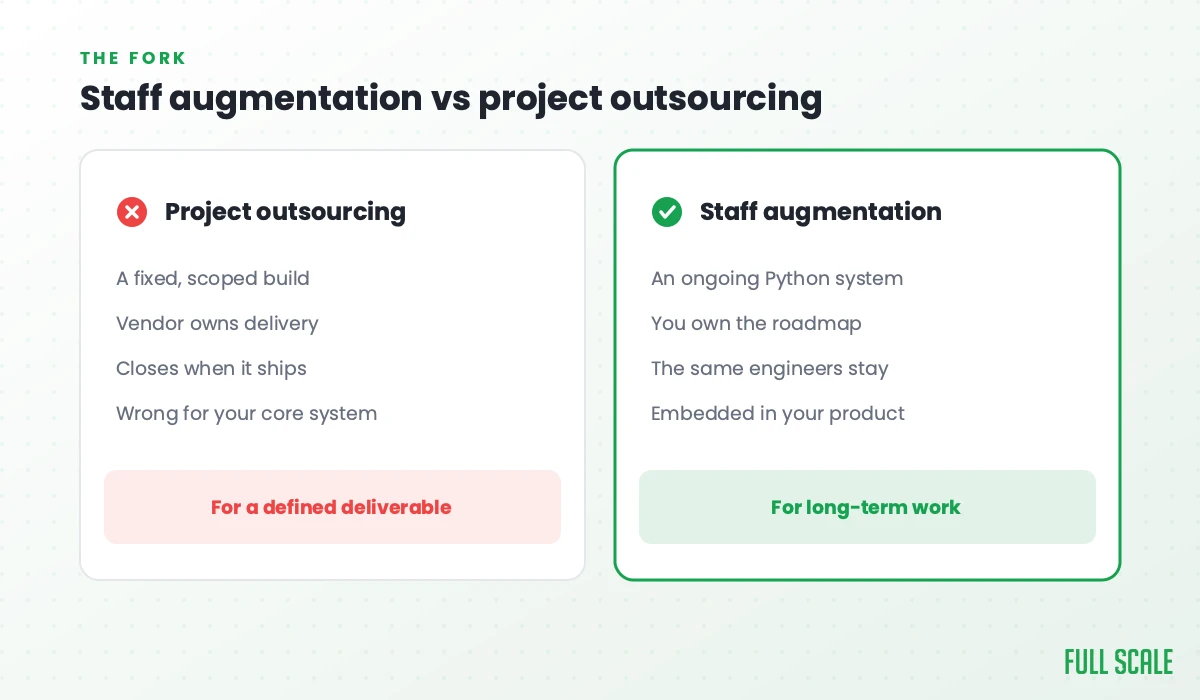
Staff augmentation means you add Python engineers directly to your team. They attend your standups, work in your codebase, report to your technical lead, and own the work alongside everyone else on your team. For any Python engagement where requirements evolve, product judgment is required, or the work continues past a single deliverable, this is the model that produces real outcomes. A team model, not a project handoff, optimizes for the long-term team.
Project outsourcing means you hand a defined scope of work to a development shop and they build and deliver it. For genuinely self-contained Python work, this can work and sometimes works well. I have done it myself: I outsourced an Elasticsearch integration at Stackify when the API was documented, the schema was locked, and the scope would not change. Both sides knew exactly what done looked like. It shipped. I would do it again for work that fits that description. The same scoped-work logic applies to outsourcing Ruby on Rails development: project outsourcing works when the spec is locked; staff augmentation works when the application keeps evolving. The same scoped-work logic applies to Laravel outsourcing: project outsourcing works when the spec is truly locked, but PHP’s enormous talent pool makes the cheapshoring risk higher for Laravel than for almost any other framework. The same scoped-work logic applies to Angular outsourcing: project outsourcing works when the spec is locked, but Angular’s strictness makes the penalty for ongoing project contracts higher than in less opinionated frameworks.
The gap between the two is where most Python outsourcing fails. A CTO who needs ongoing Python capacity for a Django web application, a data pipeline, or a FastAPI service fronting an AI model, searches “outsource Python development,” lands on a project shop, signs a project contract, and gets a deliverable. Six months later the codebase has no institutional knowledge, the vendor has moved on, and the CTO is back to square one.
The honest filter: if your Python work will keep evolving, you need engineers on your team, not a project vendor. Ask yourself whether you would want the same Python developers in your standup twelve months from now. If yes, that is staff augmentation. If the work truly ends when the deliverable ships, project outsourcing can work.
Most Python engagements are the first kind. And Python’s 2026 reality makes that more true than ever: Python is the dominant language for AI/ML work, data engineering, and automation. None of those categories is a finite deliverable. They are ongoing practices that require engineers who live in the codebase.
If you already know you want Python engineers embedded in your team long-term, our offshore Python development guide covers the team-building model end to end: what to evaluate, how the Philippines fits in, and what the quality gap in Python’s global talent pool actually means.
When Python Project Outsourcing Actually Works
Project outsourcing is not always the wrong call. It is the wrong call when the work is not genuinely self-contained.
I have outsourced scoped work myself. The Elasticsearch integration at Stackify had a documented API, a locked data schema, and a defined output format. There was no ambiguity about what done meant, and we would not need those developers on the ongoing application once it shipped. That engagement succeeded because the scope stayed fixed.
Python-specific examples where project outsourcing works:
- A one-time data migration with a locked schema and a clear completion criterion
- A standalone script or automation that runs once or on a fixed schedule with no expected iteration
- An isolated microservice with a fully documented API contract that other systems call but nothing ever changes
- A short-term data analysis or modeling project with a specific question and a deliverable answer
The key word in each of these is scoped. The work has a beginning, a middle, and an end that both sides can verify. When the deliverable ships, the engagement should close without leaving anyone in the lurch.
What does not fit that description: any Python work where the spec will change, the product will iterate, or the engineers need to understand why the code works the way it does. That is most Python work.
Three Ways Python Project Outsourcing Fails
The failure modes are structural, not technical.
The quality-gap problem hits hardest with Python. Python has the largest developer pool of any language in the world, which means the supply pressure at the cheap end of the market is constant. It is easy to find cheap Python developers. I call this cheapshoring: hiring the most affordable option and discovering that the gap between “can write Python syntax” and “can architect a production Python system” is enormous. A project vendor incentivized to win at the lowest price will often fill the engagement with developers from the cheap end of that pool. The client does not find out until the code is in production.
Spec hand-off loses domain context. The more complex the Python work, the more institutional knowledge lives in the developer’s head. A data engineer who has worked in your pipeline for three months knows why the schema has that quirky edge case, why the batch size is set to that specific number, and what breaks when the upstream data source changes format. A project vendor who receives a spec and builds to it has none of that context. When the engagement ends and the vendor moves on, you have a codebase without a brain.
This problem is especially acute for Python’s 2026 use cases. A machine learning pipeline, a FastAPI service fronting an LLM, a data engineering workflow. None of these is static. The schema changes. The model gets retrained. The data source shifts. Outsourcing this work as a project means you will spend more time re-orienting the next vendor than you spent building the thing in the first place.
Treating ongoing work as a finite contract. If your Python product will keep evolving (new features, new integrations, new requirements as the business changes) and you have written it as a fixed scope with a defined end date, you are building in a cliff. The developers who understand your codebase leave when the contract ends. The next engagement starts the re-orientation tax from scratch, and every iteration is more expensive than the last.
What to Look For in a Python Partner
Most evaluation frameworks focus on technical criteria first. Python frameworks, Django experience, FastAPI proficiency, AWS certifications. These are the right questions, but they are table stakes. The hard evaluation is structural.
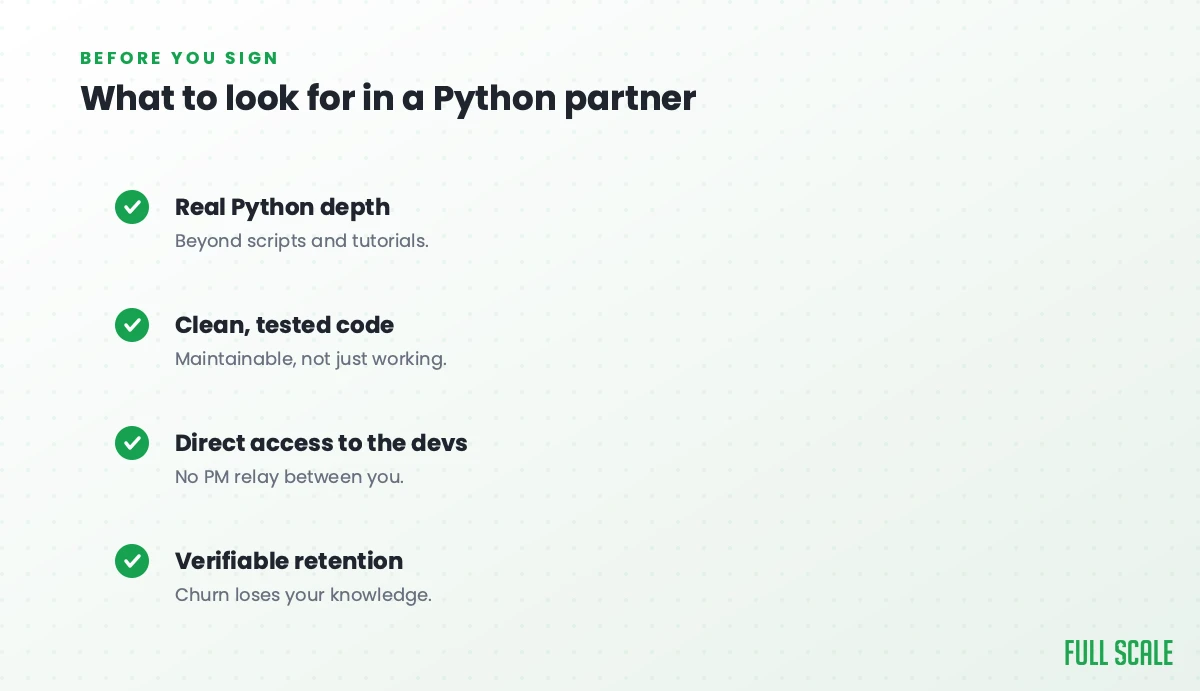
Can you talk to the developers directly? A vendor who routes every conversation through an account manager is telling you something about the communication quality of their engineers. For Python work specifically, where you need engineers who ask questions, challenge assumptions, and flag when a spec is technically impossible. You need direct access. Walk away from vendors who won’t put their developers in your Slack.
Is their business model staffing or projects? A vendor whose revenue depends on scoping new projects, not retaining engineers on long-term client teams, has incentives that are misaligned with yours from day one. Ask directly: do their developers stay with one client long-term, or do they rotate across projects?
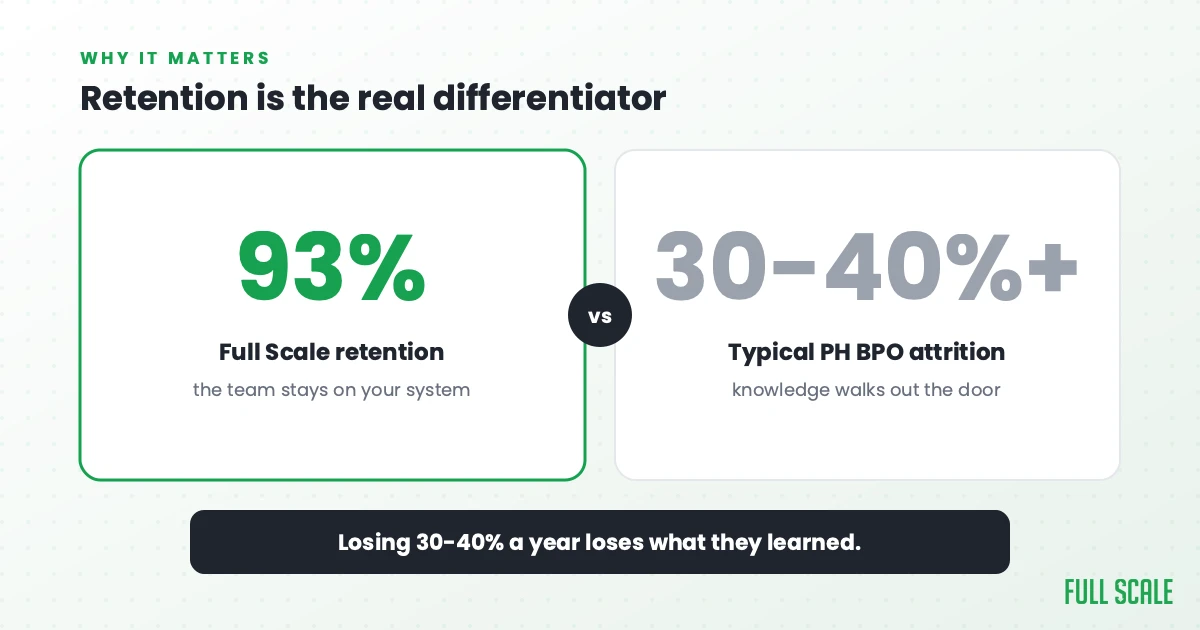
What does their developer retention look like? Retention is not a culture statistic. It is a continuity statistic. Retention is a continuity statistic, not a culture statistic. A development partner who loses 30-40% of their engineers annually means the developers who learned your codebase are gone, replaced by engineers who have not. Full Scale‘s developer retention runs at 93%, against the 30-40%+ voluntary attrition typical in Philippine BPO work.
When evaluating an offshore software development partner for Python work, the question is not “can these developers write Python?” It is “will these developers still be working on my product in two years?”
Python Outsourcing in the Philippines in 2026
Python is the language of AI. That is the current reality, not a passing trend: data pipelines, ML model training, FastAPI services fronting inference layers, LLM orchestration. Python is what this work is written in.
That changes what offshore Python engineers need to be good at. The old offshore model of handing a spec over the wall and getting code back is increasingly replaceable by AI. If your offshore Python engineer’s job is to execute a spec you hand them, you do not need an offshore engineer. You need a better prompt.
What you need in 2026 is an engineer who helps figure out what the spec should be. Who asks whether the data model makes sense. Who flags when the async architecture you’re proposing is going to cause problems at scale. Who catches what the AI-generated code gets wrong. That requires communication skills and intellectual engagement that not every country brings to software development.
The Philippines is the third-largest English-speaking country in the world. Filipino developers communicate with the directness that technical work requires and the collaborative warmth that makes distributed teams function. The Philippine IT-BPM industry generates $40 billion in annual export revenue and employs 1.8 million workers. The Python talent pool is deep.
What the Cost Comparison Looks Like
Full Scale clients pay $30-$40 per hour for senior Python engineers in the Philippines. A comparable engineer in the US earns a BLS median of around $133,000 per year in base salary, and when you add benefits, payroll taxes, and overhead (what MIT research estimates at 1.25 to 1.4 times base salary), the all-in cost of a senior US Python engineer runs $165,000 to $185,000 or more per year.
| Full Scale (Python, Philippines) | US Senior Python Engineer | |
|---|---|---|
| Hourly / annual cost | $30-$40/hr (~$62K-$83K/yr) | $133K base → ~$165K-$185K all-in |
| Time to staff | ~14 days | 6-12 weeks |
| Recruiting fee | None | 20-25% of first-year salary |
The same caveat applies here as everywhere: the cost gap only materializes as a win if the model is right. A cheap Python developer on a project contract who builds the wrong thing is not a bargain. Model selection comes first.
What AI Changes About Python Outsourcing
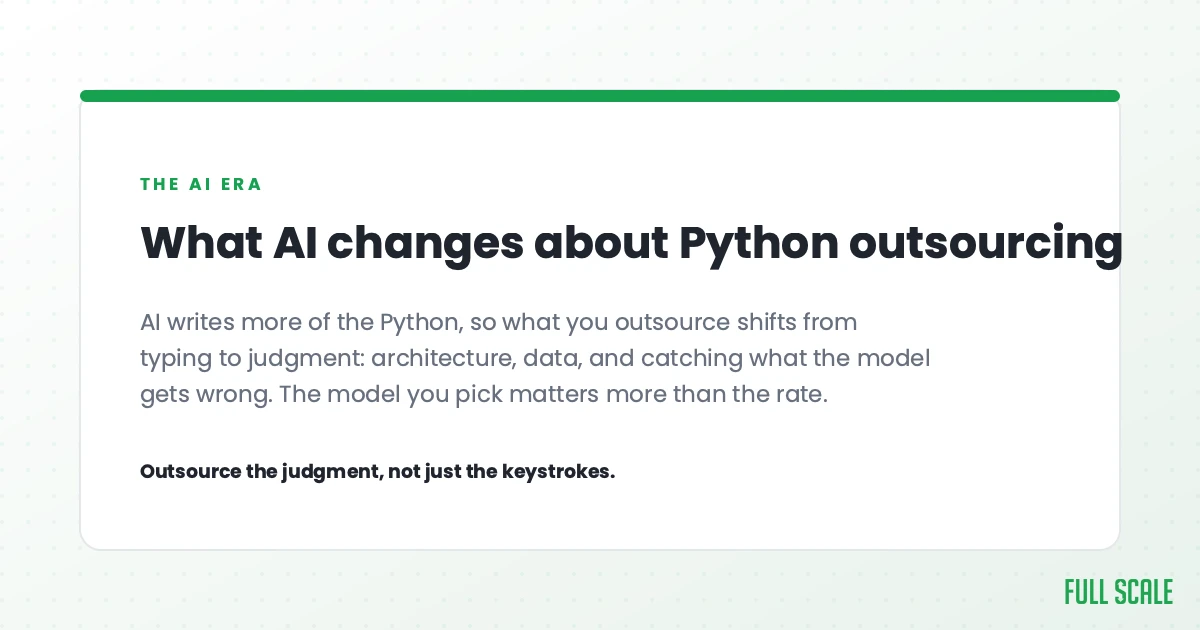
Python is where AI writes the most code, which makes the engagement model matter more, not less. The risk in outsourced Python work is no longer that a developer can’t produce code. A model can do that. The risk is shipping AI-generated code that nobody on the engagement understands well enough to question.
I tell clients half-jokingly that we are all essentially paying developers to babysit AI: to review what it generates, catch what it gets wrong, and steer it toward something useful. The engineers who do that well are the ones who understand the system they are building, not the ones who know the most syntax. That is the difference between a software engineer and a software developer, and it is what Product Driven is about: engineers who own what they build and why.
This is the decisive argument for staff augmentation over a project contract. If the engineers on your Python AI pipelines rotate out when a contract ends, you lose the institutional knowledge of why the pipeline is structured the way it is, what the model was trained on, and where the edge cases hide. None of that lives in the spec. It lives in the engineers who built it, which is exactly why you want them on your team, not on someone else’s.
Frequently Asked Questions
What does it mean to outsource Python development?
Outsourcing Python development means engaging an external partner to staff or deliver Python engineering work: web backends, data pipelines, AI/ML systems, automation, API development, and more. The model can be project outsourcing (a scoped deliverable handed to a shop) or staff augmentation (Python engineers who join your team directly). At Full Scale, we’ve found staff augmentation produces better outcomes than project outsourcing for most ongoing Python work, because the engineers accumulate the institutional knowledge the product requires.
Why does Python outsourcing fail so often?
Most failures are model failures, not technical failures. Companies structure an ongoing Python engagement as a project contract, either because that is what the vendor sold them or because “outsourcing” implied a project to them. When the deliverable ships and the vendor departs, the client has code but no engineers who understand it. The fix is to choose the staff augmentation model for work that needs a team, rather than hunting for a better vendor.
How much does it cost to outsource Python development to the Philippines?
At Full Scale, senior Python engineers in the Philippines are staffed at $30-$40 per hour, with typical onboarding timelines of 14 days. A comparable senior engineer in the US costs $133,000 or more in base salary before benefits, payroll taxes, and recruiting overhead. The cost gap is real, but model selection determines whether that gap translates into a better outcome.
Why is the Philippines the right place to outsource Python development?
The Philippines leads on the combination that makes offshore Python work function in 2026: English fluency with American-culture context, a communication style that suits collaborative technical work, and a track record in Python AI/ML engineering that has grown significantly as Python has become the dominant language for AI. The old offshore model of executing a spec and handing back a deliverable is increasingly replaceable by AI. What survives is the engineer who communicates, challenges assumptions, and catches what AI gets wrong. That is where the Philippines leads.
Ready to Build a Python Team That Works Like Your Own
Full Scale has been staffing offshore software development teams since 2018. We have placed 700+ developers with clients across 200+ tech companies. Our Python engineers work inside engineering organizations across North America on web backends, data engineering, and AI-adjacent systems.
If you want to hire Python developers who work inside your team, own what they build, and stay for the long term, that is what we staff.
Schedule a call to talk through your Python engineering needs.