
Offshore Laravel Development – Hire Trusted, Affordable Talent from the Philippines

In this article
- Why Laravel Offshore Teams Work Better Than Expected
- The PHP Talent Pool Paradox
- The Philippines for Offshore Laravel Development
- What to Evaluate in an Offshore Laravel Developer
- Staff Augmentation or Project Outsourcing?
- What AI Changes About Offshore Laravel Development
- What the Cost Comparison Looks Like
- Frequently Asked Questions
- Ready to Add Laravel Engineers to Your Team?
A lot of companies look at offshore Laravel development and start thinking about Eastern Europe or Latin America. Some of that is reasonable. Some of it misses an obvious answer. Before you bring anyone on, it helps to be clear on what a PHP developer actually does now.
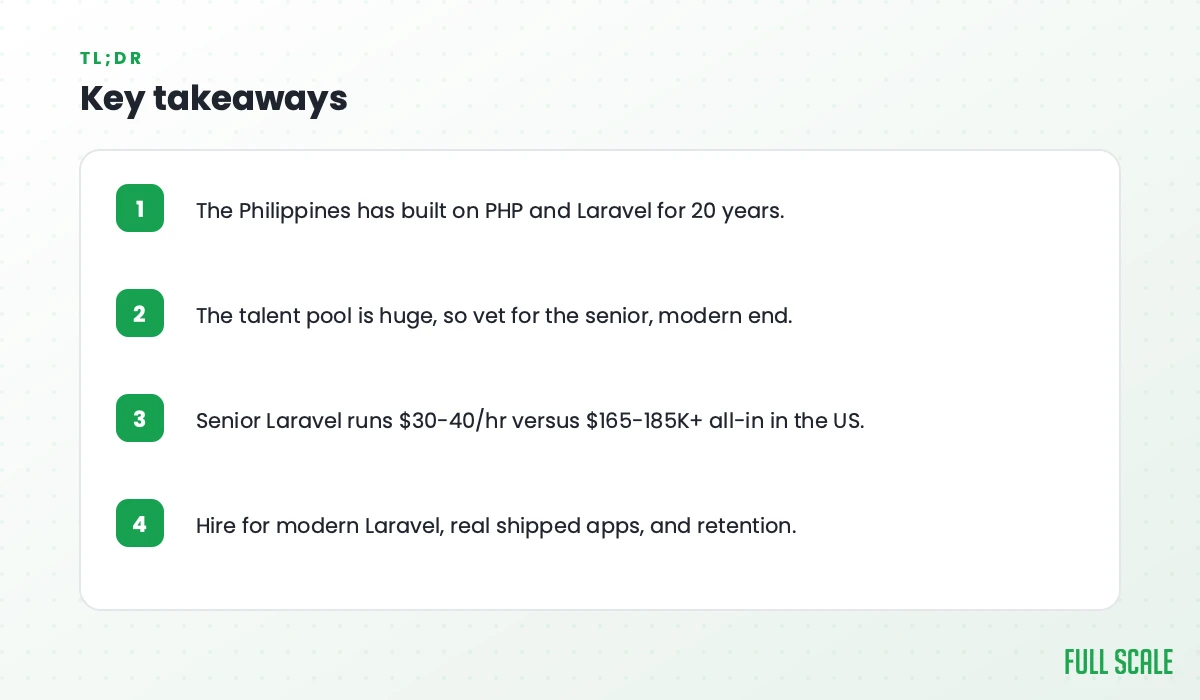
PHP has been the dominant programming language in the Philippines’ software development sector since the early 2000s. The country’s IT boom, the one that produced the $40 billion BPM industry and employed 1.8 million workers, was built substantially on PHP backends. Long before Node.js became the default for APIs and Python claimed the AI/ML space, Filipino engineers were building web applications in PHP. Two decades later, Laravel is the modern expression of that same talent base. That same talent base runs deep in Python too, so you can hire senior Django developers on the identical model.
When you hire offshore Laravel developers in the Philippines, you are not hoping engineers happened to pick up a niche framework. You are tapping a twenty-year talent pipeline where PHP is what developers grew up on and Laravel is the mature, modern standard they moved into.
I run Full Scale, which staffs offshore software development teams in the Philippines. PHP and Laravel are among our most commonly staffed stacks. Here is what that operator experience has taught me about offshore Laravel development and why the Philippines in particular produces better Laravel teams than most clients expect.
Why Laravel Offshore Teams Work Better Than Expected
The “PHP is dead” narrative peaked somewhere around 2015, when Node.js was ascendant and Python was gaining. That narrative was wrong then and it is wrong now. Laravel’s Eloquent ORM is one of the most readable data-layer implementations in any framework. The Artisan command-line interface gives teams a consistent, reproducible way to scaffold and manage the application. Service providers, middleware, and queue management all follow Laravel’s conventions in ways that make the codebase recognizable to any Laravel engineer who joins it.
That convention structure (familiar to anyone who has read our take on why companies still use PHP) is what makes offshore Laravel teams productive. A Laravel engineer who joins your codebase in week one does not spend the first month decoding how your team has structured its data layer. Eloquent looks the same. Artisan commands follow the same patterns. Service class conventions are shared. The offshore team learns your domain, not your architecture.
This is the same convention-over-configuration advantage that makes Ruby on Rails productive in offshore contexts. Laravel brings it to PHP, with the added benefit that PHP’s talent pool is an order of magnitude larger than Ruby’s.

The PHP Talent Pool Paradox
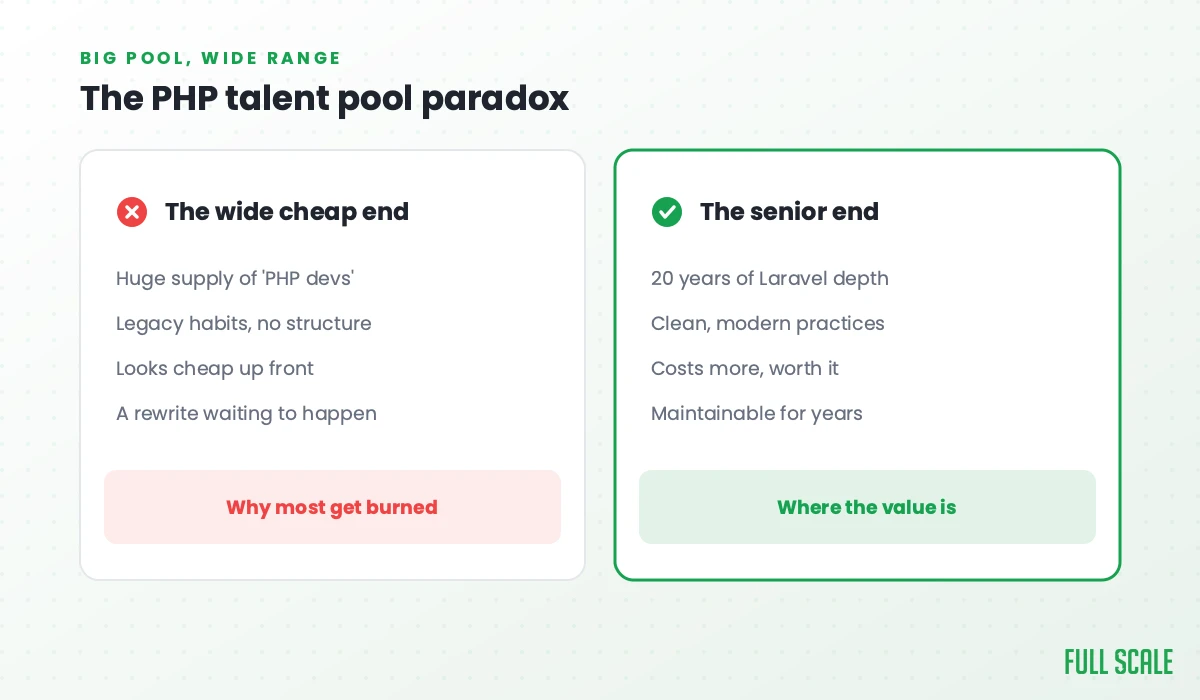
PHP is the most widely deployed server-side language in the world. It powers more than three-quarters of all websites with a known server-side language. That is a very large talent pool.
A very large talent pool has a cheapshoring problem: the cheap end is enormous. PHP’s accessibility (it is genuinely easy to write PHP that runs) means there are more developers who can produce working PHP without understanding its modern idioms than in almost any other language. I call this cheapshoring. With PHP specifically, it is not just hiring a cheap developer. It is hiring a developer who learned PHP for shared hosting in 2009 and never encountered Laravel’s service container, Eloquent relationships, or the concept of a repository pattern.
Laravel is the separator. The framework has enough structure that real Laravel engineers and PHP-syntax knowers produce visibly different code. An engineer who genuinely knows Laravel can explain their Eloquent query chain and why they chose eager loading instead of lazy loading. They can write a Pest test that tests behavior rather than implementation. They can set up a queue worker, configure a service provider, and implement a proper API resource class without looking at the documentation for every line.
That level of Laravel knowledge does not live in the cheap end of the PHP talent pool. It lives in engineers who have used the framework on production applications and understand why its patterns exist. The quality gap is real and it is visible in code review. For the broader PHP-offshore picture beyond Laravel, our offshore PHP development guide covers the full stack.
The Philippines for Offshore Laravel Development
Specific claim, grounded in what I have seen operating in this market: the Philippines produces more production-ready Laravel engineers per capita than any other offshore market Full Scale operates in.
The reason is history. PHP was the go-to language for web development in the Philippines during the critical 2005-2015 decade when the country’s IT workforce scaled from tens of thousands to hundreds of thousands. The engineers who learned to build in that era learned PHP. The engineers who kept building through the 2010s learned Laravel when it became the modern PHP standard around 2012 and matured through the Taylor Otwell-led improvements of 2015-2020.
A senior Filipino Laravel engineer in 2026 is often someone who has been writing PHP for fifteen years and Laravel for eight to ten. That is a different depth than a market where Laravel was adopted more recently as a framework for developers who primarily knew other languages.
The Philippines is the third-largest English-speaking country in the world. For Laravel specifically, the English fluency matters because Laravel’s world is English-first: the documentation, the community forums, the Laracasts educational content, the conference talks. Filipino Laravel engineers are native participants in that world, not translating between it and a different language context.
The Philippine IT-BPM industry generates $40 billion in annual export revenue and employs 1.8 million workers. The Laravel talent pool inside that industry is deep and well-tested.
At Full Scale, the Spartan Training Academy keeps our Laravel engineers current on the AI-era tools that matter. The Claude Masterclass series includes real-time Laravel debugging and scaffolding with Claude Code in the terminal, MCP integrations connecting Claude to GitHub and databases for Laravel projects, and agentic workflows for testing and code review. Weekly five-minute training videos and bi-weekly thirty-minute sessions, most made by Full Scale engineers.
What to Evaluate in an Offshore Laravel Developer
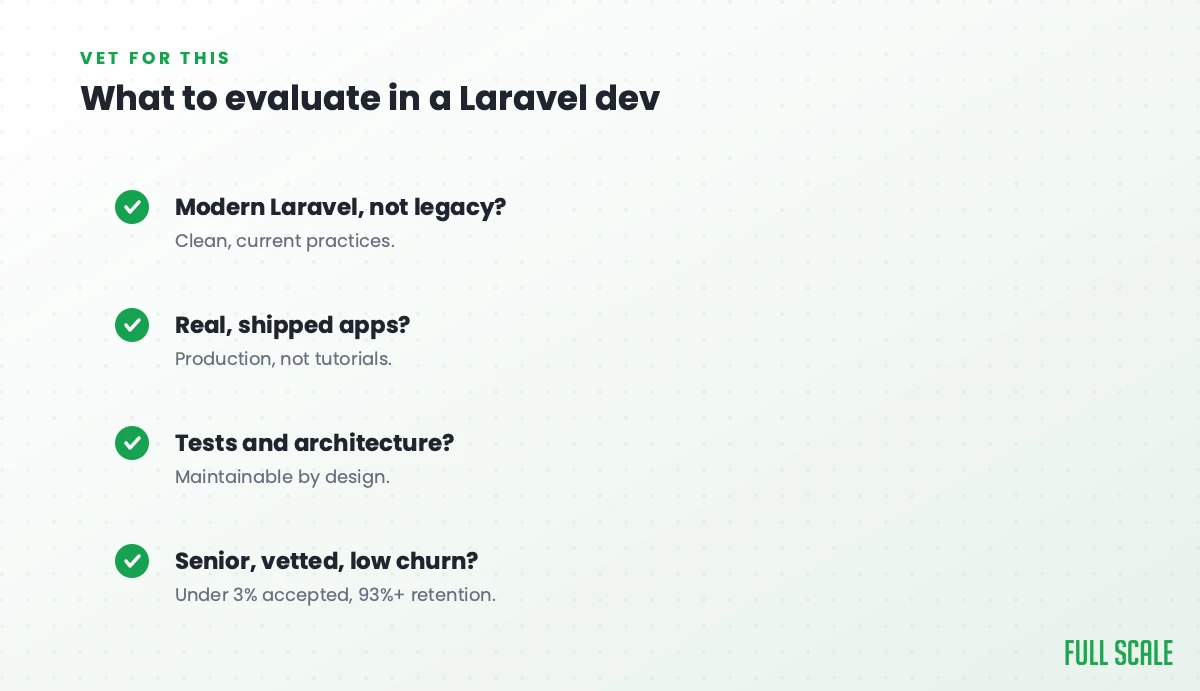
The evaluation questions for Laravel offshore engineers are more diagnostic than most hiring managers expect. Here is what actually separates strong Laravel engineers from ones who have worked with the framework but not deeply.
Eloquent proficiency beyond basic CRUD. Ask candidates how they handle N+1 queries in their Laravel applications. Ask about their approach to model relationships when they need to query across multiple tables. Ask what they know about Eloquent scopes and when they use them. Engineers who have built production Laravel applications will have specific opinions. Engineers who have used the framework lightly will describe what the documentation says.
Artisan usage and custom commands. Laravel’s Artisan CLI is central to how good Laravel teams operate. Ask candidates what Artisan commands they have written themselves. Ask how they structure scheduled tasks and queue workers. A Laravel engineer who has only used built-in generators misses most of what Artisan makes possible.
Testing philosophy. Laravel ships with PHPUnit integration and has strong community support for Pest. Ask candidates what a good Laravel test suite looks like. Ask how they test jobs, events, and listeners. The software engineer vs. software developer distinction is visible in how a Laravel engineer talks about testing: one writes tests that catch regressions, the other writes tests that pass.
Service layer architecture. Laravel’s service container is powerful and frequently misused. Ask candidates how they organize business logic between controllers, models, and service classes. The engineers who understand the service container design the application correctly; the ones who do not put business logic in controllers and call it clean.
Staff Augmentation or Project Outsourcing?
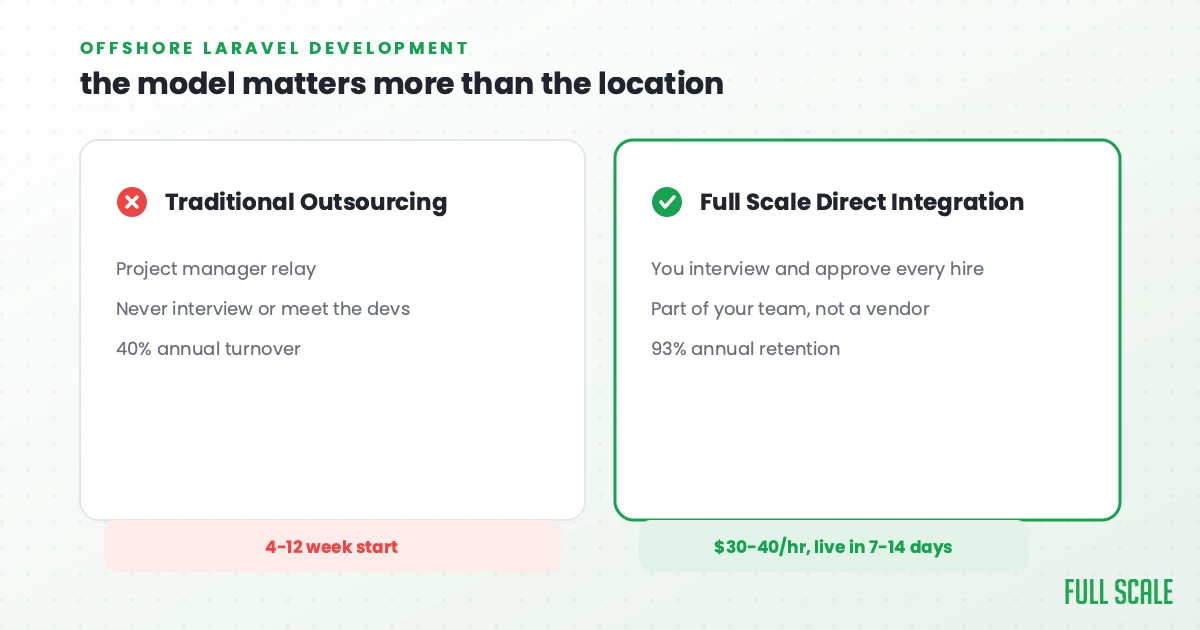
For ongoing Laravel applications, staff augmentation, not a project handoff, is the model that produces results. A Laravel engineer who joins your team, learns your Eloquent models, understands your queue architecture, and contributes to your roadmap over months and years is the one who makes offshore cost savings work in practice.
For scoped Laravel work with a locked spec, project outsourcing can work. An integration with a well-documented third-party API. A one-time data migration with a fixed schema. A feature scoped tightly enough that “done” is unambiguous. I have outsourced exactly this kind of work myself. The key word is scoped.
If you are evaluating whether to outsource a Laravel project or build a long-term team, our outsource Laravel development guide covers the model decision end to end.
What AI Changes About Offshore Laravel Development
Artisan generators scaffold models, controllers, migrations, and tests. Laravel’s Artisan command make:model with the -mcr flag produces a model, a migration, a controller, and a resource class in one command. AI coding tools do the same thing, with more context and natural language instruction.
For Laravel specifically, the AI output is abundant and the review requirement is real. An AI-generated Eloquent model might miss an important relationship. An AI-generated controller might put business logic where a service class belongs. An AI-generated test might test the wrong thing entirely.
The Laravel engineers who catch this are the ones with deep framework knowledge: they know what idiomatic Laravel looks like and they see immediately when AI output diverges from it. That is the difference between a developer who executes and an engineer who owns. Product Driven is about building engineers who own what they build: in a framework as productive as Laravel, that ownership is what determines whether the offshore model delivers or disappoints.
What the Cost Comparison Looks Like
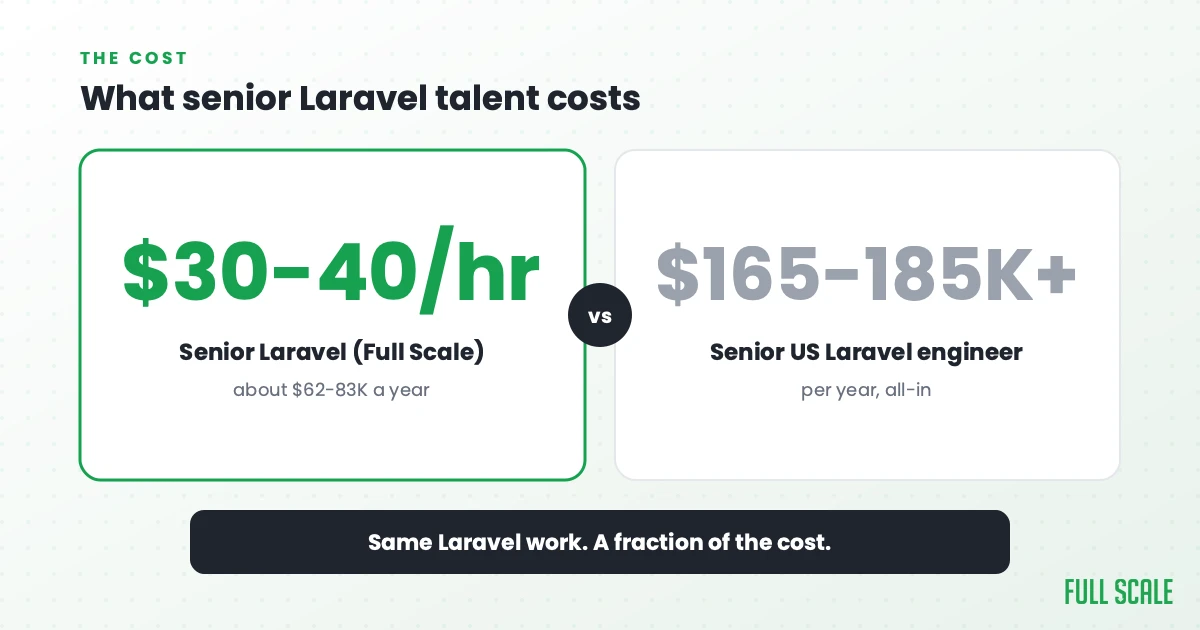
Full Scale clients pay $30 to $40 per hour for senior Laravel engineers in the Philippines. A comparable engineer in the US earns a BLS median of around $133,000 per year in base salary, with an all-in cost of $165,000 to $185,000 or more when you add benefits, payroll taxes, and overhead (what MIT research estimates at 1.25 to 1.4 times base salary).
| Full Scale (Laravel, Philippines) | US Senior Laravel Engineer | |
|---|---|---|
| Hourly / annual cost | $30-$40/hr (~$62K-$83K/yr) | $133K base → ~$165K-$185K all-in |
| Time to staff | ~14 days | 6-12 weeks |
| Recruiting fee | None | 20-25% of first-year salary |
Laravel engineers in the Philippines are priced at the PHP/backend rate rather than a premium stack premium. The framework’s popularity in the Philippines means supply is strong and recruiting timelines are short. Over a multi-year Laravel engagement the gap compounds: an engineer who already knows your Eloquent models and queue architecture is worth far more than the same seat re-hired every eighteen months at a US loaded cost.
Frequently Asked Questions
What is offshore Laravel development?
Offshore Laravel development means engaging engineers based outside your country to build, maintain, or extend your Laravel applications. The model can be staff augmentation (engineers embedded in your team) or project outsourcing (a vendor delivers a defined scope). For most Laravel applications that will keep evolving, staff augmentation produces better outcomes because the engineers accumulate knowledge of your specific Eloquent models, service architecture, and queue configuration.
Why is the Philippines the best destination for offshore Laravel development?
The Philippines has a twenty-year PHP development history. The engineers who built PHP applications during the country’s IT boom in the 2000s and 2010s moved into Laravel as it became the modern PHP standard. That depth of hands-on framework experience is uncommon in markets that adopted Laravel more recently. Combined with English fluency and a communication culture suited to distributed teams, the Philippines produces more production-ready Laravel engineers than any other offshore market in this region.
How do you evaluate offshore Laravel developers?
Focus on Eloquent proficiency beyond basic CRUD, Artisan usage including custom commands and scheduled tasks, testing philosophy with PHPUnit or Pest, and service layer architecture. Engineers who understand why Laravel’s service container exists design applications differently than engineers who have only used the framework’s surface features. Ask for specific examples from production applications, not descriptions of what the documentation says.
How much does offshore Laravel development cost?
At Full Scale, senior Laravel engineers in the Philippines are staffed at $30 to $40 per hour, with typical onboarding timelines of 14 days. A comparable US engineer costs $133,000 or more in base salary before benefits and overhead. The Philippines’ deep Laravel talent pool means you get both cost efficiency and genuine framework depth, rather than having to choose between them.
Ready to Add Laravel Engineers to Your Team?
Full Scale has been staffing offshore software development teams since 2018. We have placed 700+ developers with clients across 200+ tech companies. Our Laravel engineers work inside product organizations across North America, building and maintaining production Laravel applications as full members of the engineering team.
If you want to hire Laravel developers who know the framework deeply and work inside your team, that is what we staff.
Schedule a call to talk through your Laravel team needs.