
Outsource Ruby on Rails Development: How to Pick the Right Model

In this article
- Staff Augmentation or Project Outsourcing?
- When Rails Project Outsourcing Works
- Three Ways Outsourced Rails Projects Fail
- What to Look For in a Rails Outsourcing Partner
- Philippines for Rails Outsourcing
- What the Cost Comparison Looks Like
- What AI Changes About Outsourcing Rails Work
- Frequently Asked Questions
- Ready to Build a Rails Team That Works Like Your Own
Quick Answer: Outsourcing Ruby on Rails development usually means one of two models: project outsourcing, where a vendor delivers a fixed scope, or staff augmentation, where Rails engineers join your team directly. For most ongoing Rails work, staff augmentation wins because Rails’s opinionated conventions punish code written by engineers who won’t stick around to maintain it. Full Scale places senior Rails engineers in the Philippines under this model, built for Rails applications that keep evolving past any fixed deliverable.
Companies that outsource Ruby on Rails development and get burned almost always describe the same thing. They hired a development shop, the shop delivered working code, and then they tried to maintain it. The code runs. It just does not look like Rails. Fat controllers stuffed with business logic. ActiveRecord queries that produce N+1 database calls nobody tested for. Views with embedded logic that the framework specifically exists to keep out of views. Tests that cover lines rather than catch regressions. A vague brief is usually the root cause, which is why writing a sharp Rails developer job description comes first.
In a framework with fewer opinions, this code is just inconsistent. In Rails, it is actively fighting the framework. Every pattern the bad shop used has a Rails-idiomatic fix, and making those fixes requires understanding why the conventions exist in the first place. The result is a codebase that is harder to inherit than bad code written in a less opinionated stack.
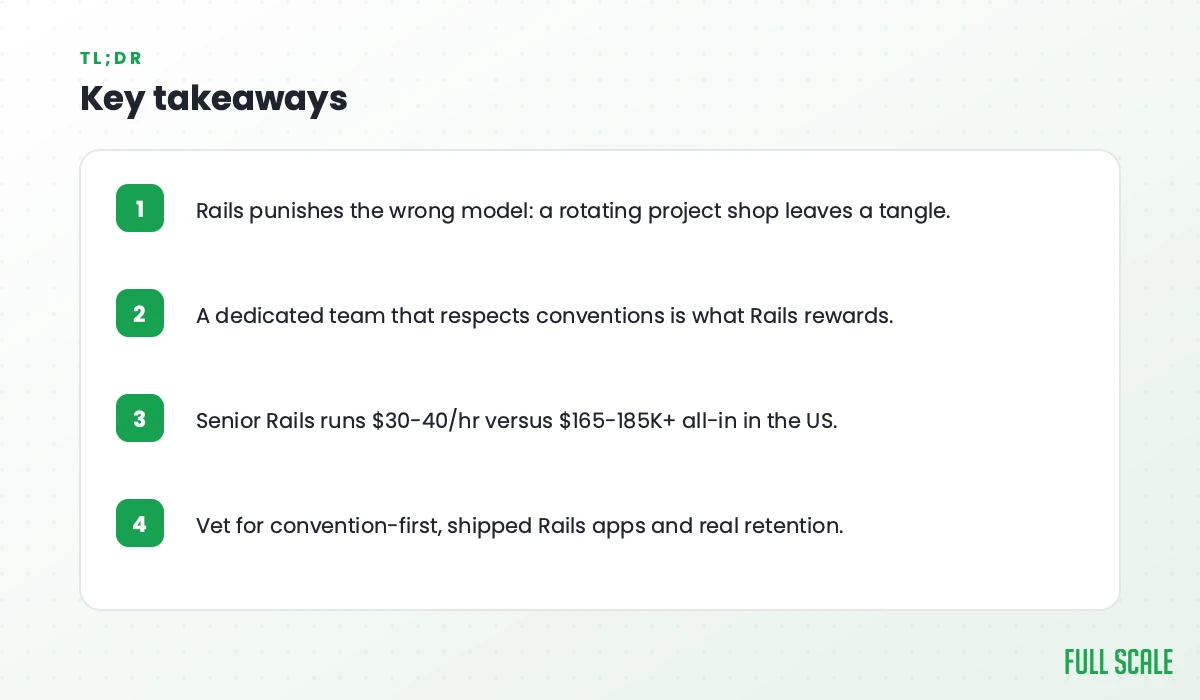
That is the Rails-specific risk in outsourcing: the framework punishes the wrong model more visibly and more expensively than most alternatives.
I run Full Scale, which staffs offshore software development teams in the Philippines. I have also personally outsourced scoped projects: an Elasticsearch integration at Stackify and a WordPress build. I know what makes project outsourcing work and what makes it fail. For Rails, the failure modes are sharper than most.
Staff Augmentation or Project Outsourcing?
This fork determines everything. The wrong answer before vendor selection produces a bad outcome regardless of which vendor you pick.
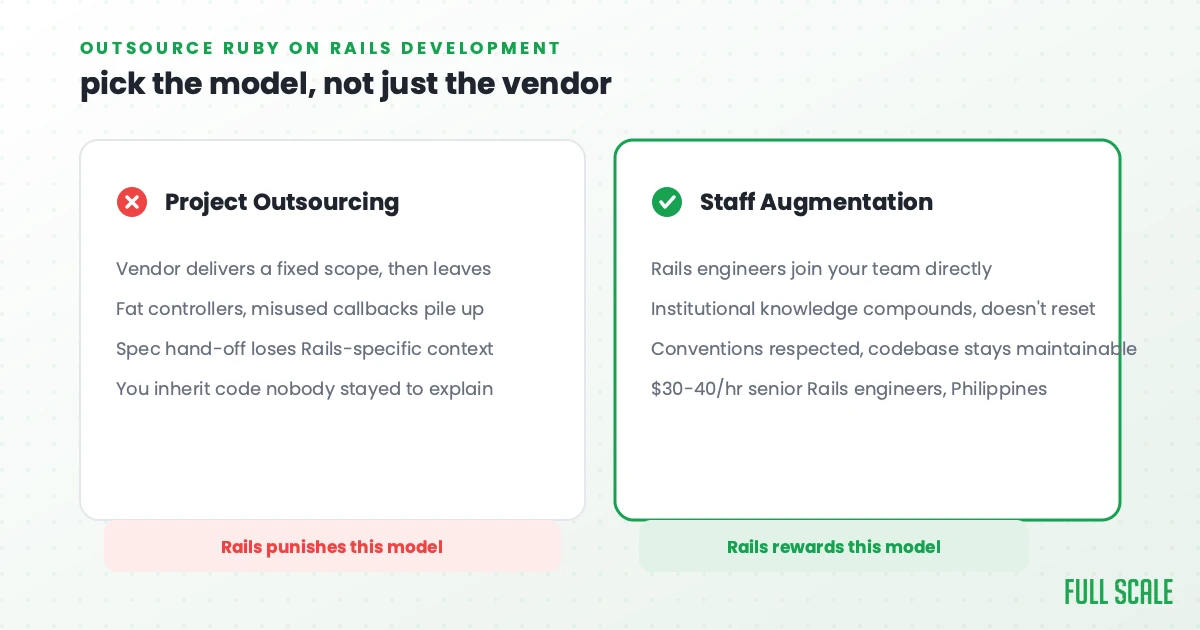
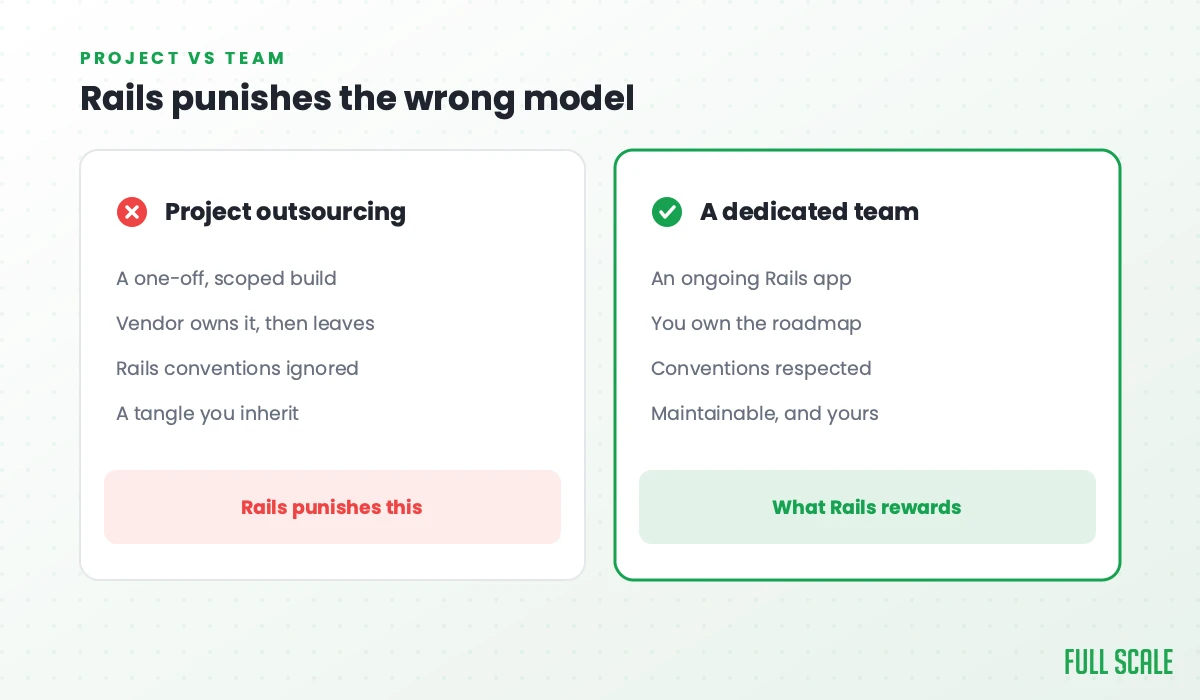
Staff augmentation means Rails engineers join your team directly. They are in your standups, they know your codebase, they follow your team’s conventions alongside your in-house developers. For any Rails application that will keep evolving (new features, new integrations, an expanding product roadmap), this is the model that produces the outcomes the offshore cost argument promises. A team, not a project shop, optimizes for the long-term team.
Project outsourcing means you hand a scope of work to a development shop and they deliver it. For genuinely scoped Rails work with a locked spec and a clear completion criterion, this can work. A well-documented API integration. A data migration with a fixed schema. A feature with no ambiguity about what done means. I have outsourced exactly this kind of work myself and gotten good results.
The gap is where most outsourced Rails engagements fail. A CTO who needs ongoing Rails capacity signs a project contract because “outsourcing” is what they searched for, gets a deliverable from a vendor who does not deeply know Rails, and inherits a codebase that looks Rails but behaves like something else.
If you already know you want offshore Rails engineers embedded in your team long-term, our offshore Ruby on Rails development guide covers that model: the convention-over-configuration advantage, how to evaluate Rails engineers offshore, and what makes the Philippines specifically strong for Rails teams.
The honest filter: if your Rails application will keep evolving, you need engineers who own it. Ask whether you would want the same Rails developers in your standup in twelve months. If yes, that is staff augmentation. If the work truly ends when the deliverable ships, project outsourcing can work.
When Rails Project Outsourcing Works
The model is not always wrong. It is wrong for ongoing work.
I outsourced an Elasticsearch integration at Stackify. The API was documented, the data schema was locked, what “done” meant was clear to both parties. The engagement worked because the scope did not change. The vendor delivered, we integrated, the engagement closed cleanly.
Rails project outsourcing follows the same logic. Cases where it works:
- A data migration with a fixed source schema and a defined target schema: the work ends when the data is in the right place
- A third-party API integration with complete documentation: the vendor builds against a spec, you integrate the endpoint, nothing needs ongoing ownership
- A greenfield setup by a Rails specialist (project structuring, boilerplate, conventions established) followed by your own team taking over ongoing development
- A one-time performance audit by a Rails expert: they find the N+1 queries, document the findings, you fix them
The pattern: scoped, verifiable, non-evolving. When the Rails work is genuinely finite, a project vendor can handle it well. When it requires ongoing product judgment, it cannot.
Three Ways Outsourced Rails Projects Fail
Convention violations compound. Rails’s conventions are designed to prevent specific failure modes. Fat controllers slow down the codebase. Logic in views makes testing hard. Misused callbacks create invisible side effects. A project vendor who does not know Rails deeply will produce all of these patterns, and each one makes the next developer’s job harder than if the codebase had been written in a framework with no conventions to violate. I call this cheapshoring: hiring the cheapest option in a framework this opinionated is the most expensive mistake you can make per line of code inherited.
Spec hand-off loses the context the Rails framework needs. Rails applications are built around domain logic that lives in models, business rules that belong in service objects, and conventions that only make sense if you understand why the framework puts things where it does. A vendor who receives a spec and builds to it lacks the context to make the judgment calls Rails constantly requires. The result is code that does what the spec says and breaks things the spec did not anticipate.
Scoping ongoing work as a deliverable. Rails applications evolve. Schemas change. New features require refactoring existing models. The conventions that make Rails maintainable require that the engineers who extend the codebase understand the decisions the original engineers made. When you structure ongoing Rails work as a series of project contracts, you pay a re-orientation tax every time a new vendor touches the code, because no vendor accumulates the institutional knowledge the application needs.
What to Look For in a Rails Outsourcing Partner
The evaluation criteria are the same for project outsourcing and staff augmentation, but the consequences of getting it wrong are higher with project outsourcing because you inherit the output without inheriting the engineers.
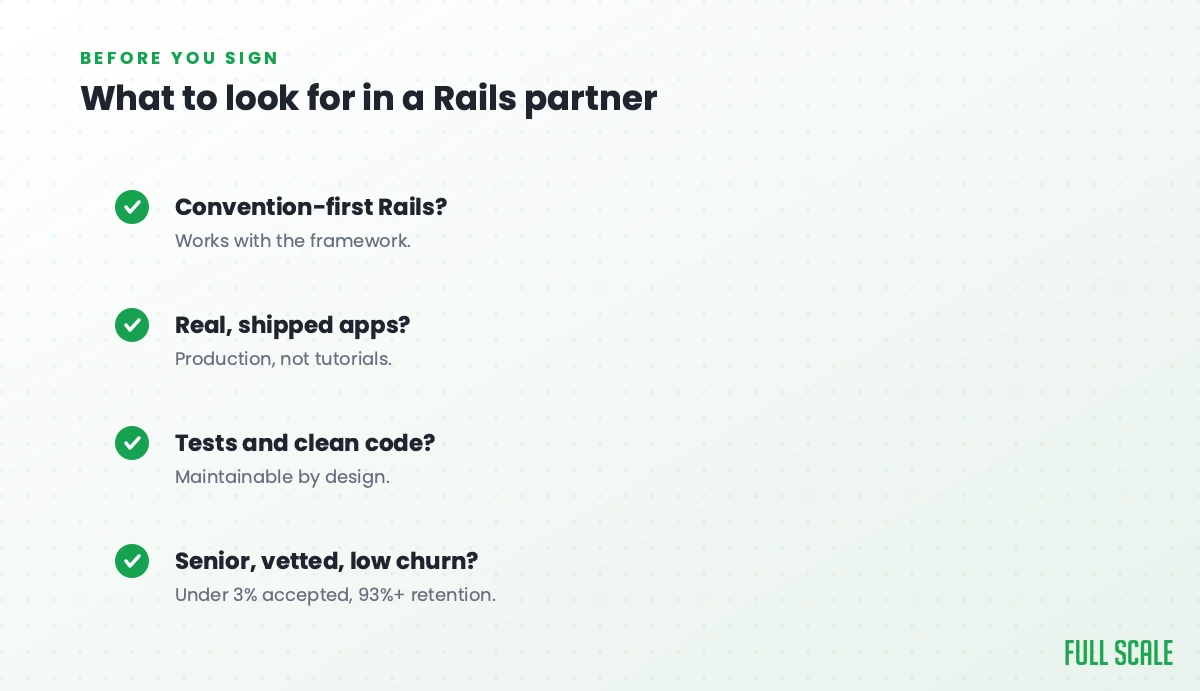
Will they put developers directly in front of you? A Rails shop that routes every technical conversation through an account manager is giving you a signal. The conventions that make Rails productive require engineers who can make judgment calls and explain their reasoning. If the vendor does not let their engineers communicate directly, they either cannot or will not, and either answer is a problem for a framework this opinionated.
Do they actually know the Rails Way? Ask technical questions in the sales process. Ask how they handle N+1 queries. Ask their opinion on fat models vs. service objects. Ask what their test coverage standards look like and how they enforce them. Engineers who know Rails will have opinions. Shops that know how to win Rails contracts will have talking points. Those are different things.
Is their business model staffing or projects? A shop whose revenue comes from scoping new projects has incentives that are misaligned with building maintainable code. A partner whose engineers stay with client teams long-term has incentives to build code that lasts, because they will be the ones extending it. When evaluating offshore software development partners for Rails work, the question is whether their engineers develop institutional knowledge or rotate through engagements.
Philippines for Rails Outsourcing
The Philippines combines the factors that make outsourced Rails work function: strong English, a communication culture built for distributed collaboration, and a real Rails talent pool developed during the framework’s startup adoption years.
The old outsourcing model of handing a Rails spec to a remote team and getting code back is increasingly replaceable by AI. Rails generators and scaffolds now ship from AI tools nearly as fast as they do from the rails generate command. If your outsourced Rails engineer’s job is to execute a spec you hand them, AI does that job cheaper.
What you actually need is an engineer who helps determine whether the spec is right. Who asks what the right Rails abstraction is before building the wrong one. Who pushes back when a feature request conflicts with existing model conventions. The Philippines is the third-largest English-speaking country in the world, and Filipino engineers bring the communication orientation that Rails’s convention-heavy discipline requires to distributed teams.
The Philippine IT-BPM industry generates $40 billion in annual export revenue and employs 1.8 million workers. The Rails talent pool in the Philippines is real and comes with production experience, not just framework familiarity.
What the Cost Comparison Looks Like
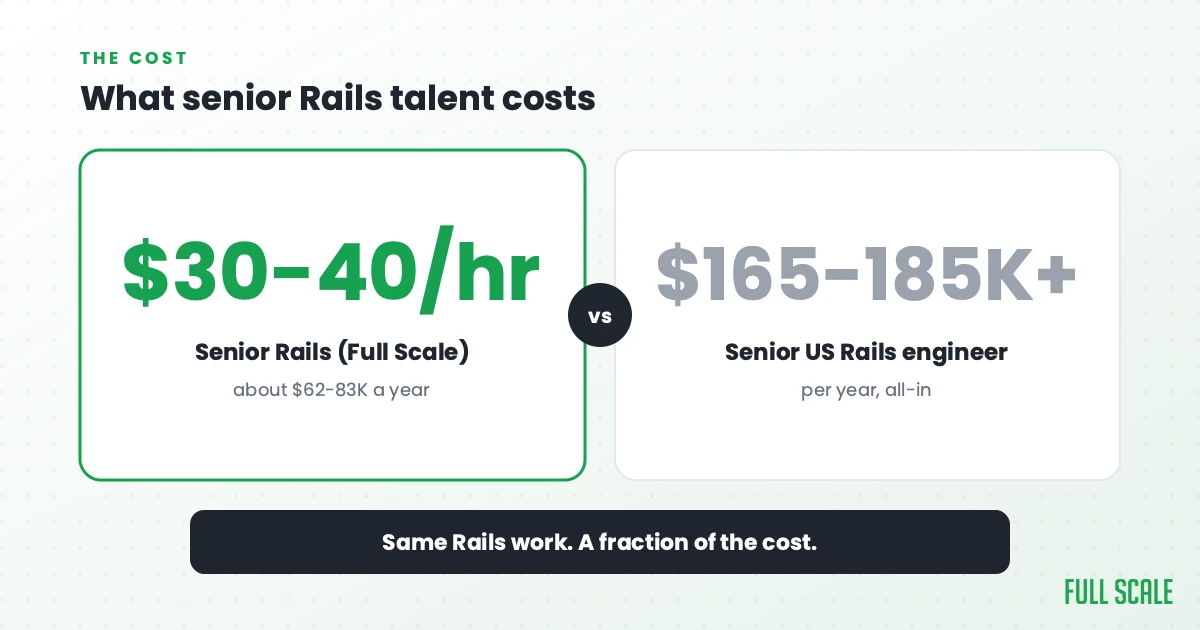
Full Scale clients pay $30 to $40 per hour for senior Rails engineers in the Philippines. A comparable engineer in the US earns a BLS median of around $133,000 per year in base salary, with an all-in cost of $165,000 to $185,000 or more when you add benefits, payroll taxes, and overhead (what MIT research estimates at 1.25 to 1.4 times base salary).
| Full Scale (Rails, Philippines) | US Senior Rails Engineer | |
|---|---|---|
| Hourly / annual cost | $30-$40/hr (~$62K-$83K/yr) | $133K base → ~$165K-$185K all-in |
| Time to staff | ~14 days | 6-12 weeks |
| Recruiting fee | None | 20-25% of first-year salary |
The same caveat applies here as everywhere in this series: the cost gap only materializes as a win when the model is right and the engineers are genuinely strong. In a framework as opinionated as Rails, model selection and engineer quality matter more per dollar than in most stacks.
What AI Changes About Outsourcing Rails Work
I tell clients half-jokingly that we are all essentially paying developers to babysit AI: to review what it generates, catch what it gets wrong, and steer it toward something useful. For Rails, this framing is especially apt.
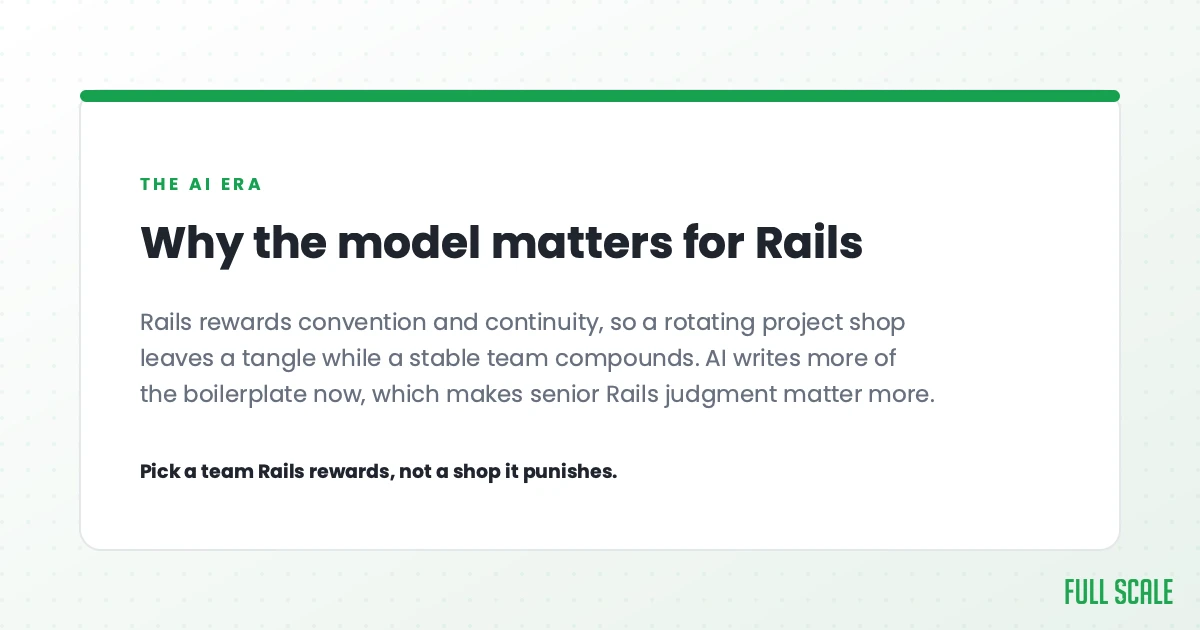
Rails generators produce scaffold code. AI produces scaffold code. The question for both is whether the engineer receiving that output understands the framework well enough to know when it is correct and when it needs to be thrown out. A Rails scaffold for a model with a belongs_to association will produce a migration, a model, a controller, a set of views, and a test file. An AI asked to scaffold the same thing will produce something similar. Whether the resulting code follows Rails conventions for the domain, handles edge cases the generator does not anticipate, and integrates cleanly with existing models is a judgment call that requires deep Rails experience.
The engineers who catch what AI gets wrong in a Rails codebase are the same engineers who would have caught what a bad project vendor gets wrong. They are the ones who understand the difference between a software engineer and a software developer. In a framework this opinionated, that difference shows immediately in the quality of code inherited.
Product Driven is about building engineers who take ownership of what they build, not engineers who produce output when handed a ticket. Rails’s conventions reward that ownership mentality directly: engineers who understand why the Rails Way exists write code that lasts; engineers who just know the syntax write code that has to be rewritten.
Frequently Asked Questions
What does it mean to outsource Ruby on Rails development?
Outsourcing Ruby on Rails development means engaging an outside partner to staff or build work on your Rails application. The model can be project outsourcing (a vendor delivers a defined scope) or staff augmentation (Rails engineers join your team directly). At Full Scale, we’ve found staff augmentation produces better outcomes than project outsourcing for most Rails applications that will keep evolving, because Rails’s conventions require institutional knowledge that only accumulates in engineers who stay.
Why does outsourced Ruby on Rails development fail so often?
The most common failure is model failure, not vendor failure. A project vendor builds to a spec and delivers code that runs but violates Rails conventions: fat controllers, misused callbacks, logic in views. Inheriting that code is harder than inheriting bad code in a less opinionated framework, because the Rails-idiomatic fixes require understanding why the conventions exist. The fix is not a better vendor; it is choosing staff augmentation for work that requires a team.
How much does it cost to outsource Ruby on Rails development?
At Full Scale, senior Rails engineers in the Philippines are staffed at $30 to $40 per hour with typical onboarding timelines of 14 days. A comparable US engineer costs $133,000 or more in base salary before benefits and overhead. The cost gap is real, but it only pays off when the model and engineer quality are both right. In a framework this opinionated, those two factors matter more than rate.
Why hire offshore Ruby on Rails developers in the Philippines?
The Philippines combines the factors Rails outsourcing requires: English fluency with American-culture context, a communication orientation that suits Rails’s convention-heavy decision-making, and a Rails talent pool built during the framework’s startup adoption years. The old outsourcing model of executing a spec and handing back a deliverable is increasingly replaceable by AI. What survives is the engineer who challenges the spec, catches what AI gets wrong, and understands the conventions well enough to know when to use them and when to adapt them.
Ready to Build a Rails Team That Works Like Your Own
Full Scale has been staffing offshore software development teams since 2018. We have placed 700+ developers with clients across 200+ tech companies. Our Rails engineers work inside product organizations across North America, maintaining and extending production Rails applications as full members of the engineering team.
If you want to hire Ruby on Rails developers who work inside your team, know the conventions, and stay for the long term, that is what we staff.
Schedule a call to talk through your Rails team needs.