
Hiring a Developer for a Startup: Who to Hire First, Where to Find Them, and How to Pay Them

In this article
- Hiring a developer for a startup is a different bet than hiring the tenth
- Who to hire first: a generalist, and maybe not a CTO
- Where to find developers for your startup: start with people you trust
- How to vet a developer when you can't read code: borrow someone's trust
- How to pay a first developer: cash is simplest and costs the most
- When one developer becomes a team: don't add people before you know what to build
- Frequently asked questions
- Need a developer you can hold accountable?
Your first developer is one of the few hires where a mistake can end the company. When you only have one developer, your whole business counts on them.
I hired developers at VinSolutions and Stackify, and today I run Full Scale, which sells one of the options below. I'll point out which one when we get there, and you can discount it as much as you like.
Quick answer: Hiring a developer for a startup comes down to trust, because most founders can't judge code. Hire your first developer through your network, someone whose work you know or who comes with a real referral, or through a partner you can hold accountable. Think hard before paying in equity, and add more people only once you know what you're building.
Hiring a developer for a startup is a different bet than hiring the tenth
You don't have ten developers. At a big company, if one engineer isn't very good, the other nine still get things done and the team as a whole keeps moving. With one developer there's nobody to cover. The product, the speed, the quality, and the bad Tuesday when something breaks all sit with one person. If they quit, you don't have a slow week, you have no product.
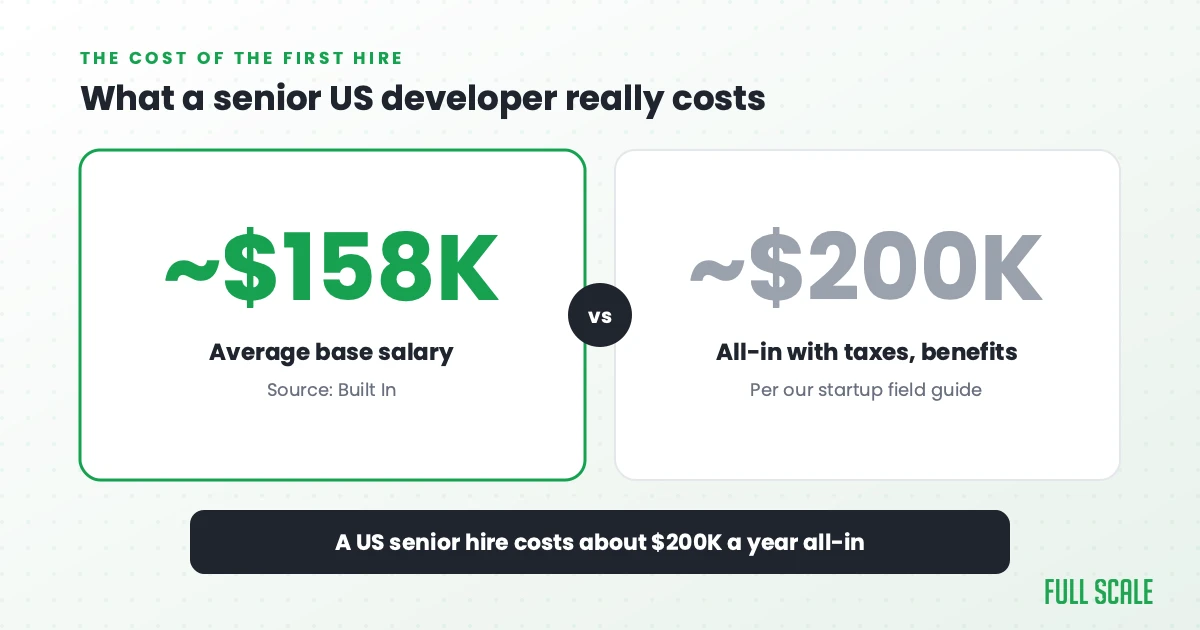
The bill for getting it wrong is also steeper than founders expect. Built In puts the average senior US base salary near $158,000. By the time payroll taxes, benefits, and a laptop are added, you're writing a check closer to $200,000 a year (our startup field guide has the full cost table). Then you have to find the person. Workable puts the global average for filling a tech role at 62 days, before any notice period. A wrong hire means paying that bill again and losing the months in between.
The risk changes as the team grows:
| Developers on your team | What one weak hire does | Who covers for them |
|---|---|---|
| One | The product stalls and nobody else can tell why | Nobody |
| Around five | The team slows down and people notice | The other developers, for a while |
| Twenty or more | It shows up in a quarter | A manager, and the rest of the team |
With one developer, your whole company is the developer.
Whatever route you take, protect yourself while you only have one. This is general practice, not a trick: make sure the company owns the code repository, the cloud accounts, and the domain, have a lawyer paper the IP ownership, and ask for a working demo every week. None of it requires you to read code.
Who to hire first: a generalist, and maybe not a CTO
Your first developer should own the product from end to end. I covered the order of early hires in the startup field guide, so here's the short version: one generalist first, specialists later. If you're not sure which kind of engineer you need, this breakdown of the types of software engineers helps.
Be careful about handing your first developer the CTO title just because they were first. Mark Adler, a fractional CTO who came on Startup Hustle, made the point that a good senior developer and a CTO who has spent decades scaling systems and talking to investors are two different jobs. If you need someone to own the technology for the long haul, that's closer to a technical co-founder decision than a hiring decision.
At EngagePath, my first hire was a product manager, because the thing I was short on was someone to turn what was in my head into work the engineers could pick up.
Where to find developers for your startup: start with people you trust
Start with people you already trust, and only move to the other options once your network runs out. That's how I found my first developers, too.
At one of my first jobs, a startup, we needed a couple more developers. I convinced my boss to hire two of my friends from college. We were all about 19 years old, and it worked out really great for us. Then at VinSolutions, the first developer I ever hired was one of my brothers-in-law. He still works there more than 20 years later. As sourcing strategies go, "people I already knew" has a great track record and a very small sample size.
The reason it works is trust. You already know how they work, so there's no guessing. Your network is also a short list, though, and at some point you run out of friends who can code. After that, here's how the other routes compare, and Full Scale sells the last row.
| Where you look | Speed | How much you can trust it | The catch |
|---|---|---|---|
| Your network and referrals | Slow | High | The list runs out |
| Developer communities like GitHub and Stack Overflow | Slow | Medium | You're messaging strangers, and judging them is on you |
| Freelancers on marketplaces like Upwork and Toptal | Fast | Varies | No ownership of your product, and the good ones move on |
| Job boards | Slow | Low | You mostly reach people who are actively looking, so the strongest candidates are underrepresented |
| A staffing partner like Full Scale | As little as 7 days | Depends on how accountable they are | You still have to direct the work |
For the job board row, our guide to hiring tech talent covers why recruiting beats posting, and the general checklist lives in software engineer hiring tips.
How to vet a developer when you can't read code: borrow someone's trust
If you're a founder, it might be close to impossible to vet a software developer yourself. Interviews, portfolios, and coding tests all assume the person judging them can tell good work from bad. If you can't, those tools give you confidence without giving you information. A founder who can't read code and runs a coding test is mostly grading handwriting.
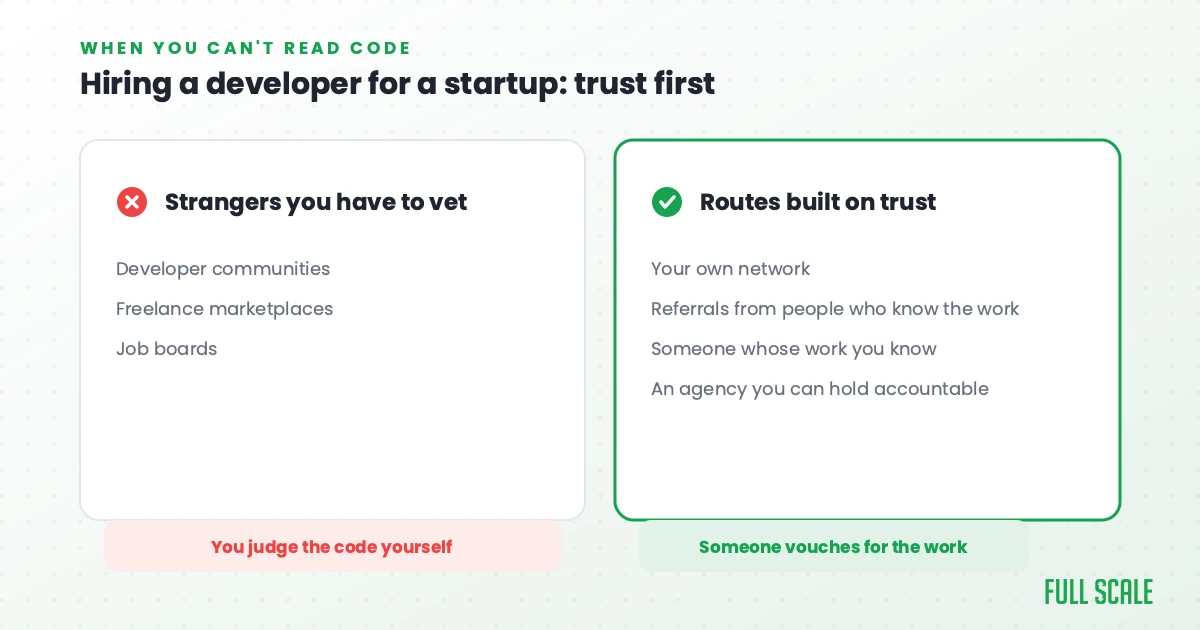
That leaves a few realistic options, and all of them run on trust:
- Ask for referrals. Talk to people who have worked with the developer and can tell you what they actually shipped. Weight a referral by who it comes from. An engineer who has reviewed their code can tell you what they shipped, while another founder mostly tells you they were nice. Ask what they built, whether they'd hire them again, and what went wrong.
- Hire someone whose work you know. That means a person you've worked with before, or someone whose previous work you can see and ask others about.
- Hire through an agency you trust and can hold accountable. You can't judge the code, so you want someone who is on the hook for what gets done.
Hiring through an agency is what we do at Full Scale, so discount that one however much you like. A partner you can hold accountable also gives you an exit. Full Scale clients get a two-week money-back guarantee, and after that it's a 30-day notice to cancel with no long-term contract. We explain how in when it isn't working out. Hiring a partner doesn't remove the owner's job. You still need one person at your company who decides what gets built and can say no to a bad ticket. If nobody can do that yet, a partner is the wrong choice.
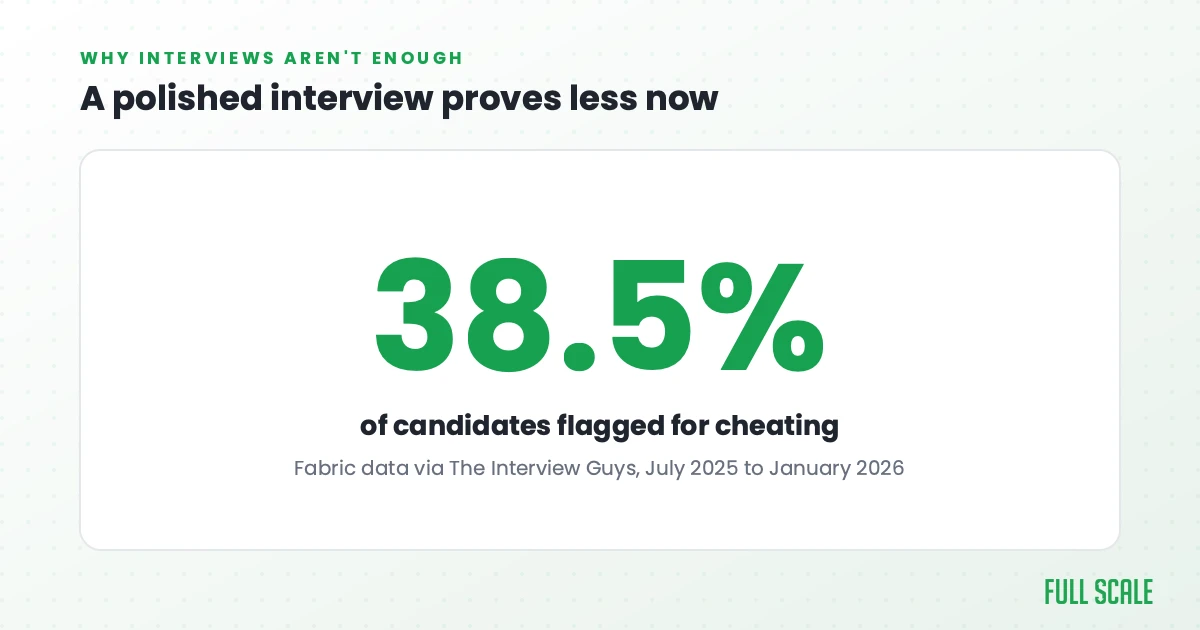
A polished interview is weaker evidence than it used to be. Fabric, a hiring platform, flagged 38.5% of candidates for cheating across 19,368 live interviews, as reported by The Interview Guys. If you do interview, how to interview a software engineer covers what to ask. The non-technical founder guide explains when a fractional CTO can judge the work for you.
How to pay a first developer: cash is simplest and costs the most
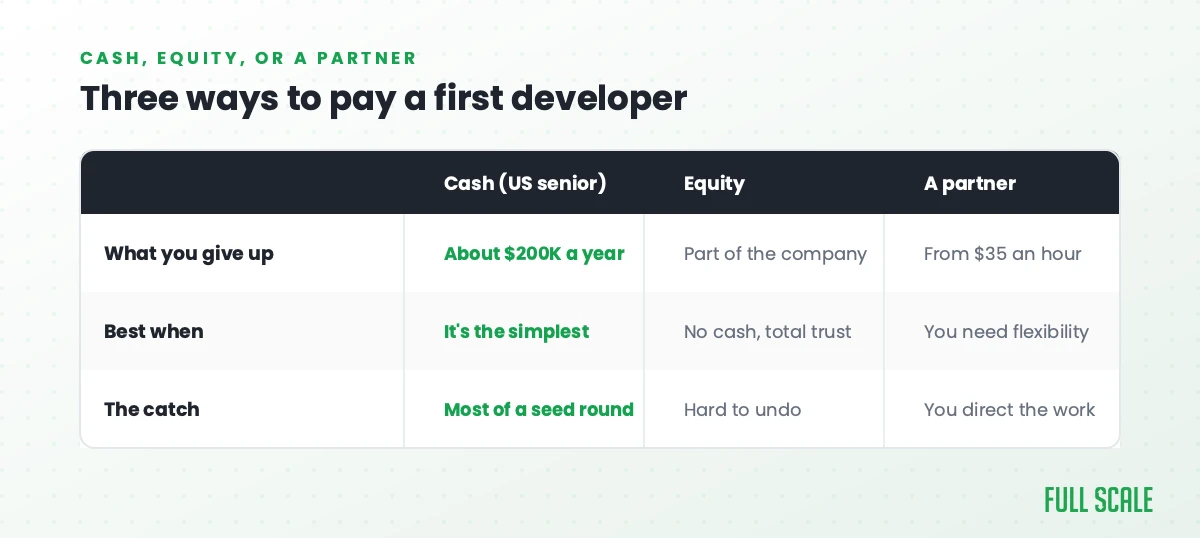
You have three ways to pay for early engineering: cash, equity, or a partner.
Cash is the simplest and the most expensive. At about $200,000 a year loaded for a senior US hire, one developer can be most of a seed round. Be wary of going for the cheapest person to save money. I call that cheapshoring, and it ends up costing more than the salary you saved, because the work you get back isn't the work you needed.
Equity can work when you have no cash and you trust the person completely. Undoing an equity deal later takes lawyers, which is why I'd read how to recruit developers for equity before offering it.
The third option is a partner. The part I like about staff augmentation is how easy it is to add people, and how easy it is to cut back when you were wrong about how many you needed. You can't do that with a payroll full of full-time employees. Full Scale developers work from across the Philippines and start at $35 an hour fully loaded, and a developer can start in as little as 7 days. Cutting back is simple too, with 30 days' notice. It's also one of the reasons startups consider offshore development.
When one developer becomes a team: don't add people before you know what to build
The first hire is the make-or-break one. The second and third are a different problem, because by then a weak hire can get carried by the others.
Adding people too early has its own cost. We learned the other side of this at ProductWave, a startup Full Scale owns. We over-staffed it before we'd found a market, and the extra people mostly produced extra features. The longer version is in our post on seven offshore productivity studies.
Startups often spend too much time, energy, and money hiring developers when they need to spend more of it on sales and marketing. Getting the product to market matters more than chasing more and more features.
Staffing changes with the stage:
| Your startup stage | What I'd do |
|---|---|
| Still testing whether anyone wants it | One developer, maybe two, you hold the vision, and the rest of your energy goes to getting the product in front of customers |
| You know what to build and need to move faster | Add a few developers, and consider a partner so you can scale up and down |
| You have steady demand and a long roadmap | Build a core team you own, and add dedicated developers through a partner |
Get the first hire right and every hire after it gets easier.
Frequently asked questions
How much does it cost to hire a developer for a startup?
A senior software engineer in the US averages about $158,000 in base salary, and the all-in cost, with the extras employers pay on top, is around $200,000 a year. Full Scale developers start at $35 an hour fully loaded, and the final rate depends on seniority and skill. Freelance rates vary widely, so compare what you get for the money and not just the hourly number.
Where do startups find their first developer?
Most good first hires come through trust: a friend, a former coworker, or a referral from someone who has worked with the developer. After your network runs out, the options are developer communities, freelance marketplaces, job boards, and staffing partners, and each one trades speed against how much you can trust the result.
Should a non-technical founder hire a freelancer or a full-time developer?
For ongoing product work, a full-time developer who stays with you is usually the better choice, because freelancers tend to move on and take the knowledge with them. That full-time developer can be your own employee or a dedicated developer through a staff augmentation partner. Freelancers fit a task you could describe in a paragraph and finish in a few weeks.
Should I give my first developer equity?
A startup should give a first developer equity only if it has no cash and trusts the person completely. Equity gives away part of your company, and undoing the deal if it doesn't work out is a legal problem, not a Friday conversation. If you have even a small budget, try a smaller cash hire or a partner first, and read the risks before you offer it.
How long does it take to hire a developer for a startup?
Workable puts the global average for filling a tech role at 62 days, and you still have to add the notice period. Full Scale can often start a developer in as little as 7 days, though it depends on who is available and what skills you need, and getting fully onboarded into your codebase takes about two weeks.
Can I hire a developer for a startup with no budget?
The realistic routes are a friend or former coworker you trust, or an equity arrangement with real protections. Both carry risk. A cheap hire that goes wrong costs more than a careful, smaller one, so keep the scope small until you can afford the right person.
Need a developer you can hold accountable?
A two-week money-back guarantee, no long-term contract, and a partner you can hold accountable. Schedule a call and we'll show you who's available.