
Outsourcing Software Development for Startups: 5 Reasons

In this article
Outsourcing software development for startups is the single decision that most often makes the difference between a founder who ships and a founder who runs out of money first. I learned that the hard way at VinSolutions in the early 2000s, when we couldn’t afford US developers on our seed-stage budget. I learned it again at Stackify, the APM company I founded in 2012 and sold to Netreo in 2021.
Both times, the engineering team that actually shipped the product was an outsourced team. That team was the asset that made each exit possible.
This post is the 5 real reasons outsourcing software development works for startups, written from inside that decision. Not the textbook reasons. The reasons that turn up when you’re trying to extend runway, hire faster than your competitors, and figure out what to build before you run out of money.
If you want the broader frame for how outsourced engineers fit into a startup engineering org from day one, that’s what my book Product Driven covers in depth.
What “outsourcing software development for startups” actually means
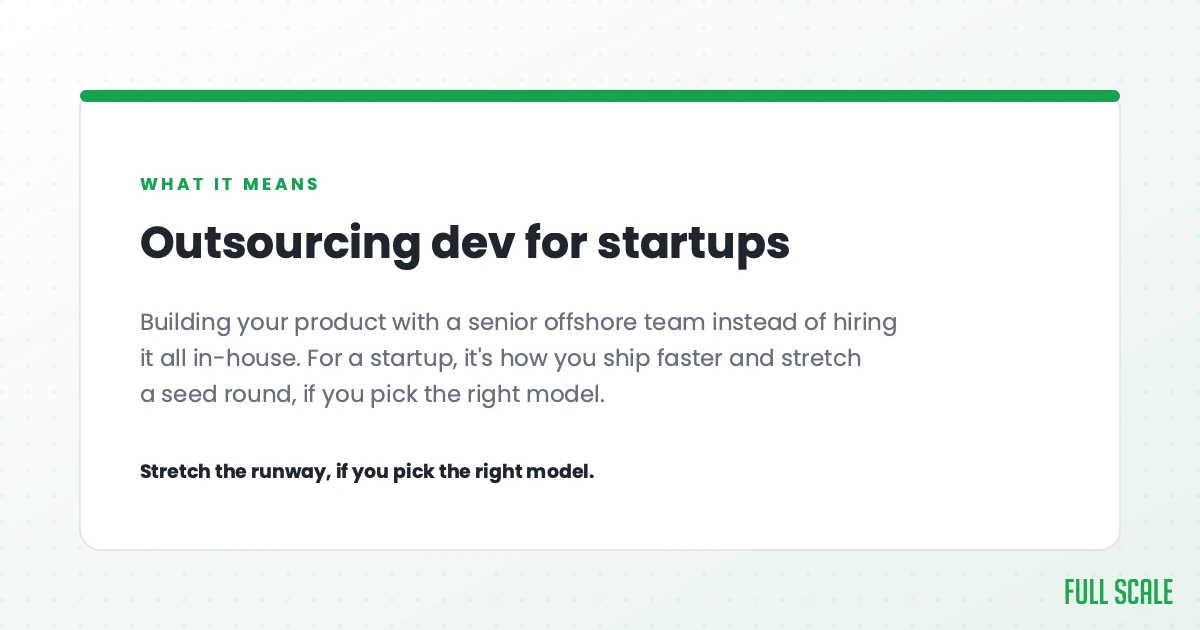
Outsourcing software development means hiring developers who aren’t your direct employees to build all or part of your product. For a startup, that usually takes one of three forms: freelancers (cheapest, riskiest), agencies (most expensive, fastest start), or augmenting your team offshore (best price-to-quality ratio, the model I’d pick today). The freelancer route in particular carries the risks of hiring freelance developers.
The 5 reasons below apply across all three forms. They apply hardest to staff augmentation, because that’s the model where the developers actually integrate with your team. If you want to know whether your startup is ready to outsource at all, that’s a separate decision and I’d start there first.
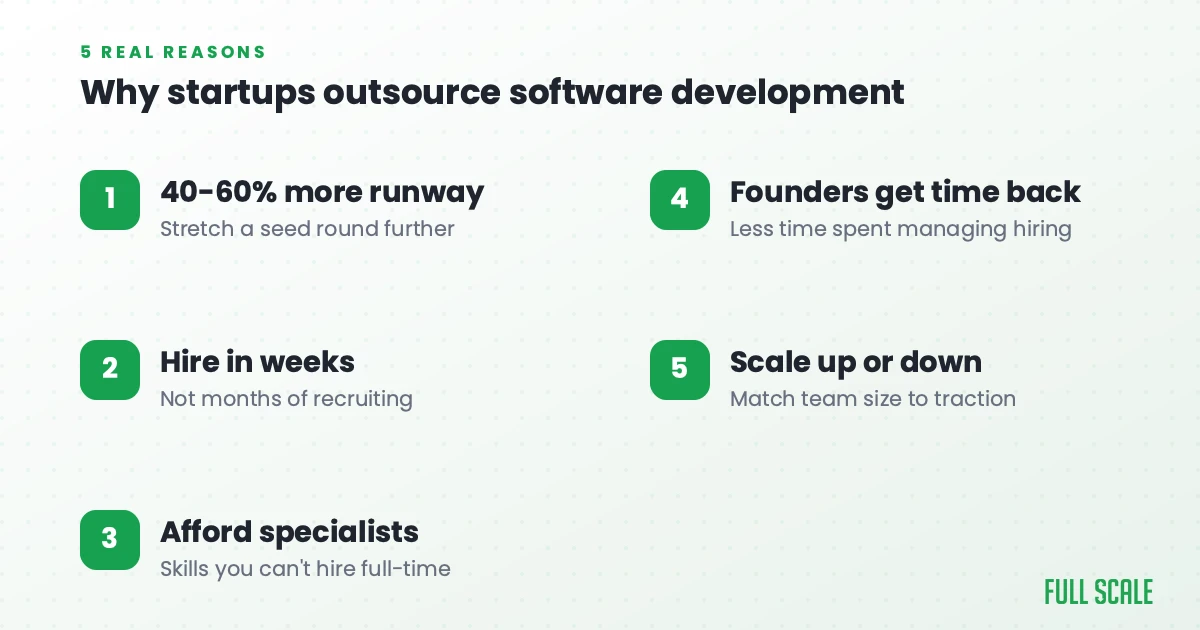
The 5 real reasons outsourcing software development works for startups
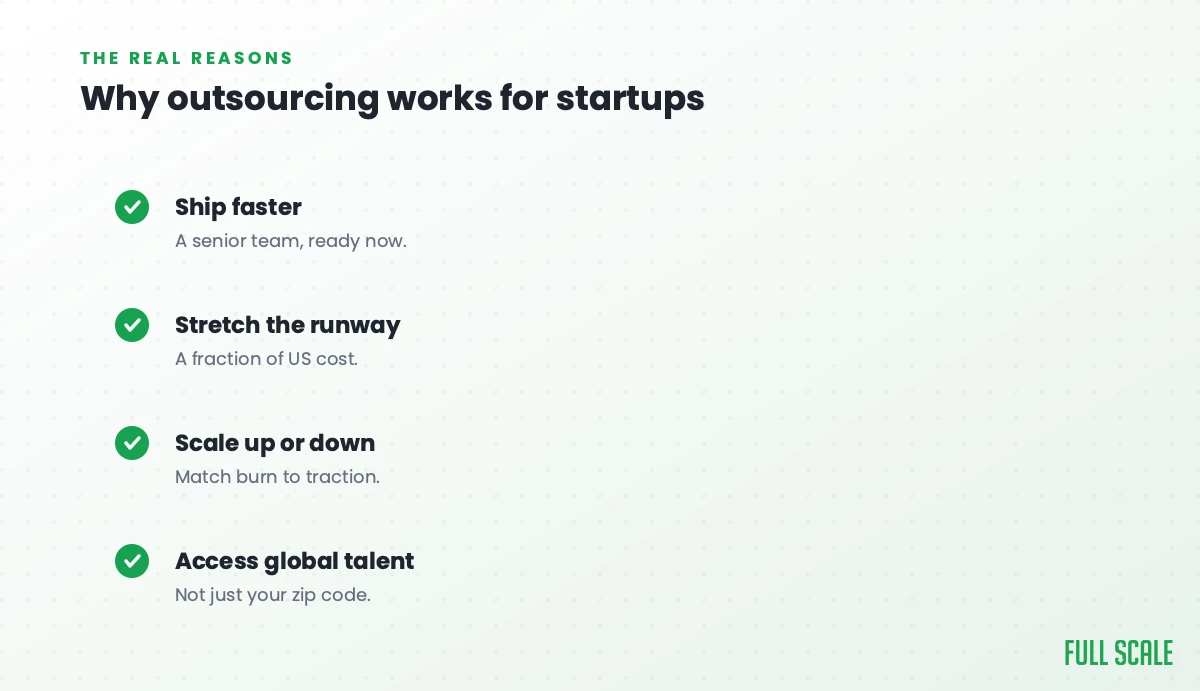
1. You extend runway by 40 to 60 percent
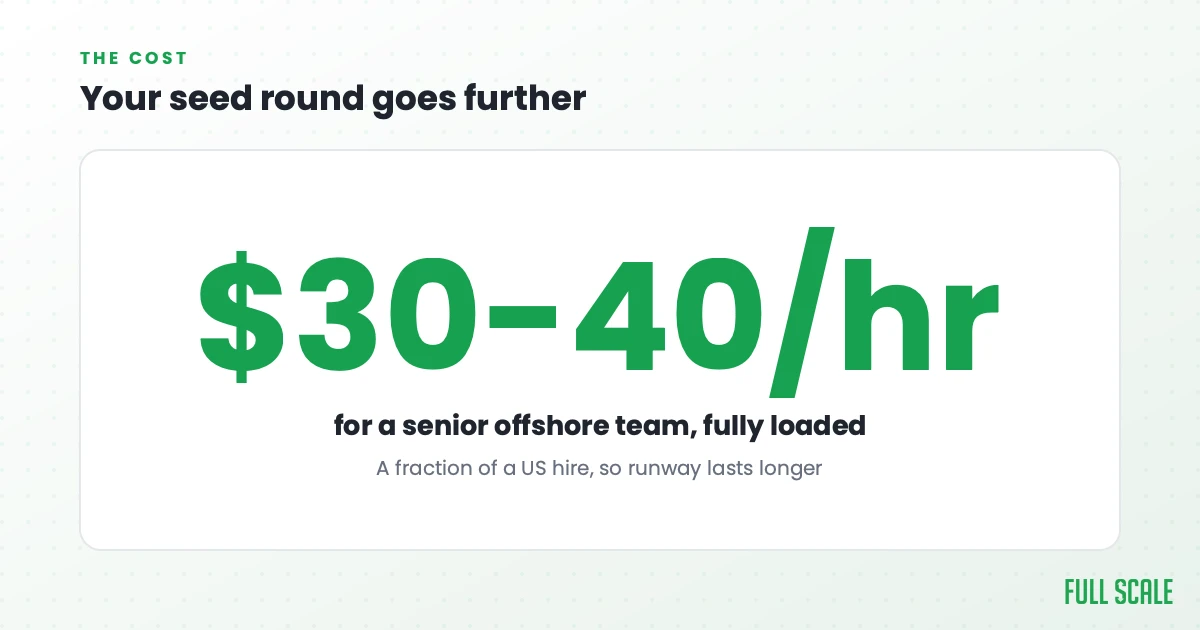
The first reason is the obvious one and it’s also the right one. A startup that outsources its development to a senior offshore team is paying $30 to $40 per hour fully loaded for a developer who would cost $150 to $200 per hour in San Francisco or New York.
That difference shows up directly in runway. If your seed round was $1.5 million and your burn is mostly engineering salaries, the difference between an in-house US team and a dedicated offshore team is the difference between 14 months of runway and 24. The 10 extra months are the most valuable months of your company’s life. They’re the months that let you stop being a feature shop and start being a product company.
According to Deloitte’s Global Outsourcing Survey, 70% of companies that outsource development cite cost reduction as the primary driver. For startups specifically, that 70% number is closer to 100% because every other reason on this list is downstream of having more runway.
2. You hire in weeks instead of months
The second reason isn’t talked about enough. Founders underestimate how much time hiring eats.
The honest math on hiring a senior US engineer is about two to three months from job posting to their first day. You’ll write the JD, screen 200 resumes, do four interview rounds with each finalist, lose two candidates to counter-offers, and finally close one. Then they give two weeks notice, then ramp for a month before they’re productive.
Hiring an outsourced developer through a provider is two weeks. The provider has a vetted bench. You tell them the role, they put 3 to 5 candidates in front of you, you interview the ones you like, you say yes, the developer starts.
The difference isn’t 10x. It’s more like 8x in calendar time and 20x in founder time, because you stop doing the hiring work yourself. If you’re a two-founder team trying to ship a product, the founder hours you reclaim from sourcing and interviewing are the second-biggest hidden cost on this list.
3. You get specialists you can’t afford to hire full-time
Most startups don’t need a senior React developer forever. They need one for the next 3 to 6 months to ship the next milestone, then they need a senior backend developer, then they need a DevOps engineer for a launch sprint.
You can’t hire and unhire US full-time employees on that cadence. The math doesn’t work, the optics inside the company are terrible, and you’ll burn through the goodwill of your existing engineers every time you let someone go because the project shifted.
Outsourced developers operate on contractual terms that match the actual shape of startup work. You can add a Vue.js specialist for a 4-month frontend rebuild and release that seat when it’s done. The same provider can put a Node.js or PHP developer in the seat next quarter when the backend needs work. You buy capacity in the skills you actually need, when you need them. For frontend work in particular, teams that hire Vue.js developers offshore find that Vue’s strong documentation and approachable API make remote onboarding faster than with more complex frameworks.
That flexibility is also why outsourcing is the way most startups access specific stacks like .NET, Laravel, or React Native without committing to a permanent in-house team in that technology.
4. You give your founders back their time
The most expensive resource at a startup is founder attention. Every hour the technical founder spends interviewing engineers, managing payroll, dealing with equipment provisioning, handling benefits enrollment, or running performance reviews is an hour they’re not spending on customer discovery, product strategy, or fundraising.
A good outsourcing partner takes most of that off your plate. The developers are technically the provider’s employees, so payroll, benefits, equipment, HR, sick days, and termination paperwork are all the provider’s problem. You get the engineering capacity without the operational overhead of being an employer.
For a first-time technical founder, this is often the difference between still being technical at series A and accidentally becoming a full-time HR manager by month 18. A good partner handles the hiring and local operations, which is most of what building an offshore team actually takes.
5. You can scale up and down without drama
Startup engineering needs don’t grow on a smooth curve. You hire fast before a launch, you maintain a steady team during validation, you scale up again when a feature ships and traction follows, and sometimes you contract when a market signal forces a pivot.
Doing that with a US in-house team is a year-long process each direction, and the cost of getting it wrong is severance, lawsuits, and the morale hit of layoffs. Doing it with an outsourced team is a 30-day notice clause.
When Stackify started growing, I scaled our Philippines team from 3 developers to more than 20 over 18 months. When we shifted strategy, I could re-allocate developers without restructuring the company. That elasticity is what let Stackify operate like a much bigger engineering organization than its headcount actually was. When the company sold to Netreo and then to BMC, every one of those developers transferred with the company, both times, without a single attrition event.
The catch: pick the right model or none of this works
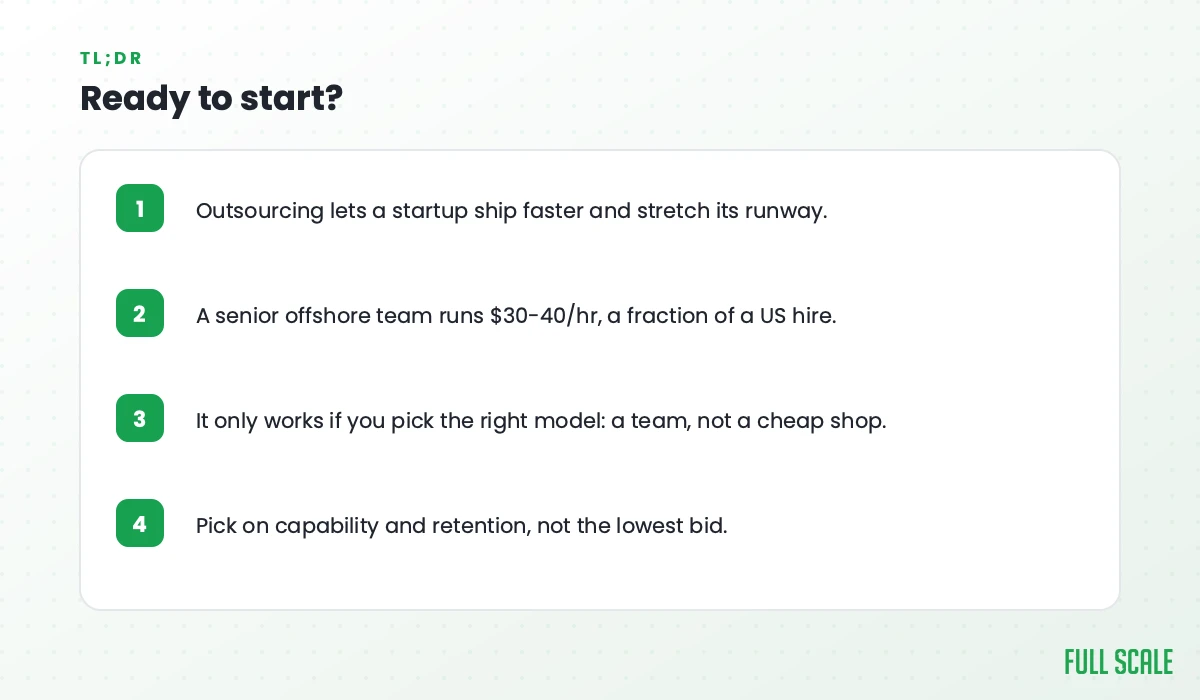
Every one of those 5 reasons depends on outsourcing the right way. The wrong way is project outsourcing, where you hand a spec to a vendor and trust the vendor to deliver finished software. That model breaks for the same reasons it always breaks: misaligned incentives, scope drift, no continuity of knowledge. It’s one of the mistakes that doom offshore development teams, and it’s avoidable.
The right way is staff augmentation, sometimes called outstaffing. The developers are dedicated to your startup, take direction from your technical leads, work in your codebase, and integrate with your standups, code reviews, and roadmap. The only difference between them and an in-house engineer is geography.
Most of the data on why outsourced development fails traces back to project outsourcing. Staff augmentation, done with a provider that vets developers and lets you interview every one, is the version of outsourcing that actually delivers the 5 reasons above.
How to pick the right outsourcing partner
If outsourcing makes sense for your startup, the next question is which provider. The short version of the full due diligence checklist:
- Dedicated developers, not project teams. The provider should commit specific developers to you, not a rotating pool.
- Real time-zone overlap. 3 to 4 hours of synchronous overlap with your team is the floor. Anything less and you’ll be living in async hell.
- You interview every candidate. Any provider that won’t let you interview before they assign developers to your team is hiding something.
- Direct integration with your tools. Your repo, your standups, your code review process. Not their PM tool.
- Transparent pricing. A flat hourly rate per developer, no opaque project pricing or change-order games.
This is the checklist I use, and it’s the checklist we operate against at Full Scale. We’ve been on the Inc. 5000 list five years in a row, we run a Philippines engineering operation of more than 350 developers, and the staff-augmentation model we use is the same one I built at Stackify because it’s the one I needed to exist.
Frequently asked questions
When should a startup not outsource software development?
Skip it if you don’t have technical leadership to direct the work; outsourcing adds hands, it doesn’t replace judgment. It’s also the wrong call for a true one-off with a hard finish line and no ongoing product, since that’s project outsourcing, the model this post already warns against, not staff augmentation. If your product is still pre-idea or pre-funding, hire outsourced help once you have something concrete to build.
At what funding stage should a startup hire offshore developers?
Most founders bring on an offshore team right after a seed or pre-seed raise, once there’s a product to build and a runway to protect. Waiting until Series A usually means burning seed capital on US-only hiring first; starting offshore from day one stretches that same round 40 to 60 percent further.
Should a startup hire offshore or local developers?
For most startups, offshore wins on cost and hiring speed: a senior offshore developer runs $30 to $40 an hour versus $150,000-plus in US base salary, and you can staff someone in weeks instead of months. Local hiring still wins when you need someone in the room daily or the role is founding-team equity, not a build-out hire. See our full offshore-vs-local cost breakdown for the complete math.
Ready to start?
If you’ve gotten this far and outsourcing development feels like the right next move for your startup, the fastest path is talking to a provider that does it the right way. Get a quote for hiring developers in the Philippines or learn more about our offshore software development services. We can usually have qualified candidates in front of you inside a week.
If you’re earlier in the decision, read the 10 real benefits of offshoring for the broader case, or when to outsource software development for the readiness check.