
Hiring Tech Talent: A Practical Guide for Engineering Leaders


In this article
Most hiring-tech-talent advice boils down to the same checklist: post a sharper job description, use their platform, screen faster, run a background check. Every one of those pages is written by a company selling you a hiring tool, and not one of them is written by someone who has actually built and kept a software team. One approach I keep coming back to is watching engineers work instead of interviewing them, which surfaces what a short call never will.
I have. I have hired engineers in the United States, Russia, Colombia, and the Philippines across four companies over more than twenty years. I built VinSolutions into the number one customer relationship management (CRM) software in the auto industry and sold it for $147 million. I founded and sold Stackify. Today I run Full Scale, where we have a team of more than 350 people in the Philippines and have helped over 200 companies build theirs. When you go outside to fill a role, know what a software developer recruiter actually delivers before you pay the placement fee.
So here is the practical version, the one the vendor blogs leave out. Hiring tech talent well comes down to a few hard truths about where good engineers actually are, what you should test them for now that artificial intelligence (AI) writes a lot of the code, what the cheapest hire really costs you, and why the job is not done when they sign the offer. I walk through the full version in this practical guide to hiring software engineers, including our own developer interview rubric.
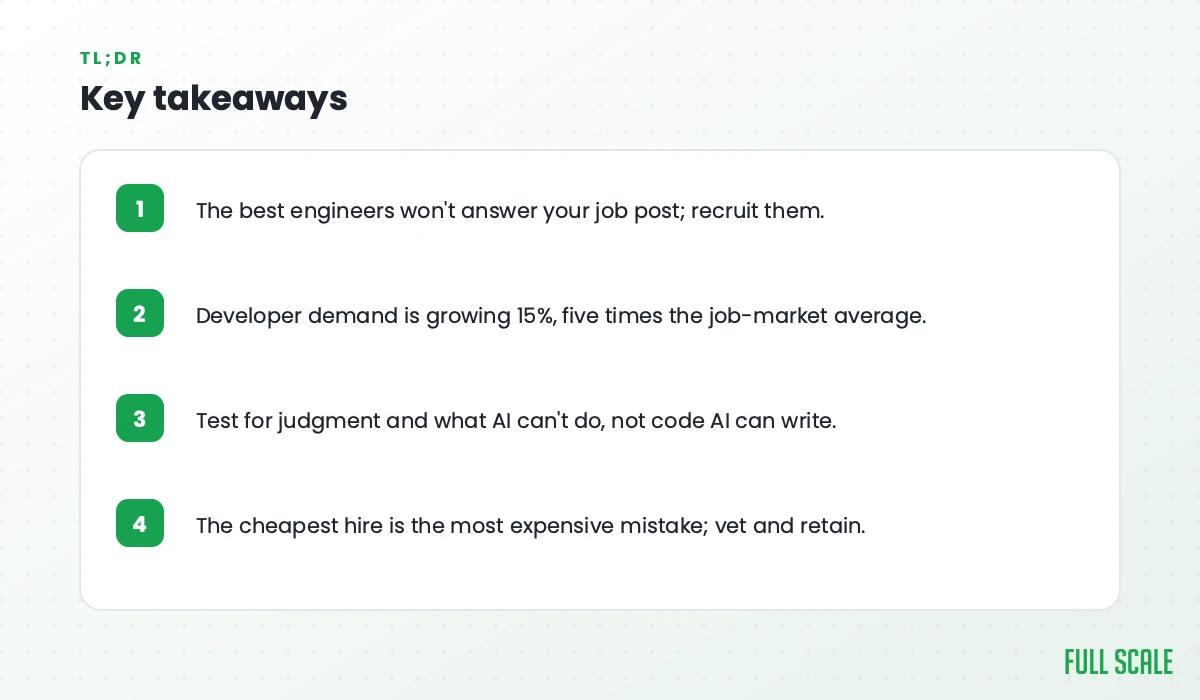
The best engineers will never answer your job post
Here is the thing nobody selling you a job board wants to say out loud.
The best engineers you could hire are not looking for a job.
They already have one. They are good, their company knows it, and nobody is letting them go. You will not find them browsing job listings on a Tuesday night, and if they somehow saw your post, they would not apply.
So who does apply? A lot of the inbound flood is people who have sent out a hundred applications in six months and landed nothing. That is not a knock on them, but it tells you the open market and the talent you want barely overlap. If your whole hiring plan is “write a great post and screen what comes in,” you are fishing in the wrong pond and wondering why the fish are small. If the open market is not producing the talent you need, it is worth weighing the alternatives to Toptal and other talent platforms.
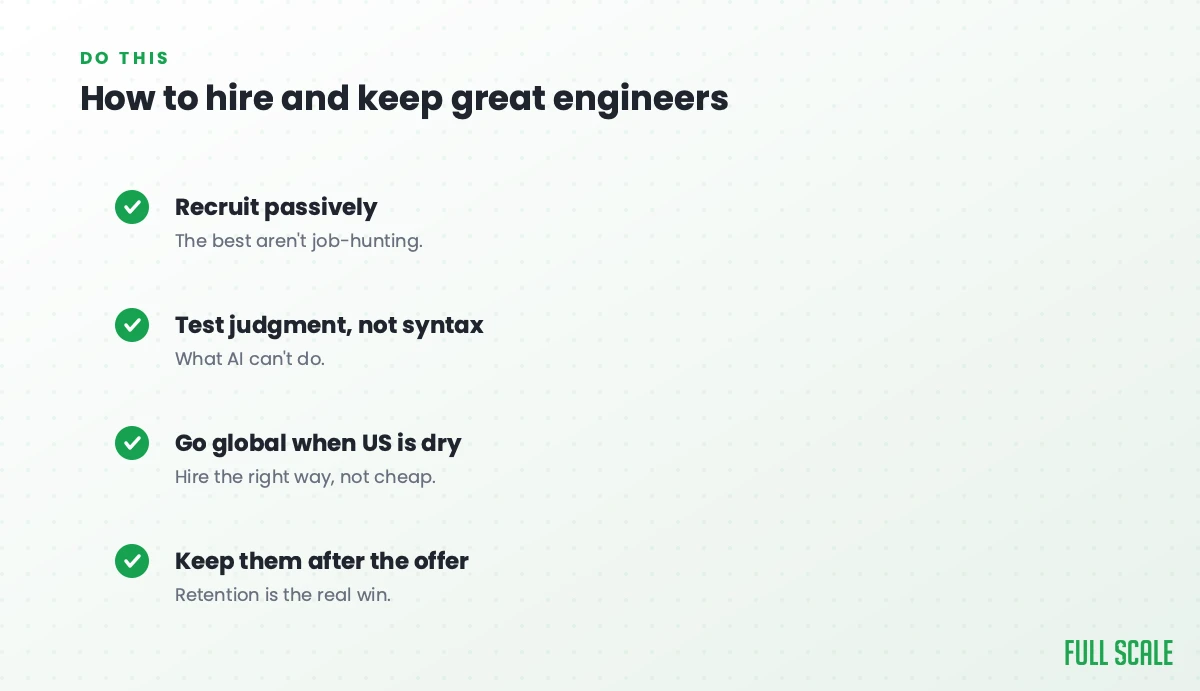
The fix is to stop waiting and start recruiting. You have to go find the people who are not looking and give them a reason to talk. That means:
- Referrals from people you trust. Your best engineers know other strong engineers. That is your highest-signal channel by far.
- Real outreach to passive candidates. The good ones live on GitHub, in niche communities, and inside companies a lot like yours. You reach out to them, not the other way around.
- Moving fast once you find one. Strong candidates are off the market in days. A slow, six-round process loses them to whoever moves first.
This is why a hiring partner’s recruiting muscle matters more than any tool. At Full Scale, the reason we can put a vetted engineer in front of a client in days is that we employ full-time recruiters whose entire job is recruiting passive candidates away from where they work today, plus a steady stream of referrals from our own 350-person team. It is also why a traditional BPO can’t just add software engineers to its hiring mix. That is the part most companies underinvest in, and it is the part that actually decides who you hire. It also helps to be clear on the types of software developers the role actually calls for. Most companies hand this job to an in-house recruiter, which works for most roles and falls short for senior engineers. The same goes for judgment: technical founder mentorship is how you learn what to test for in the first place.
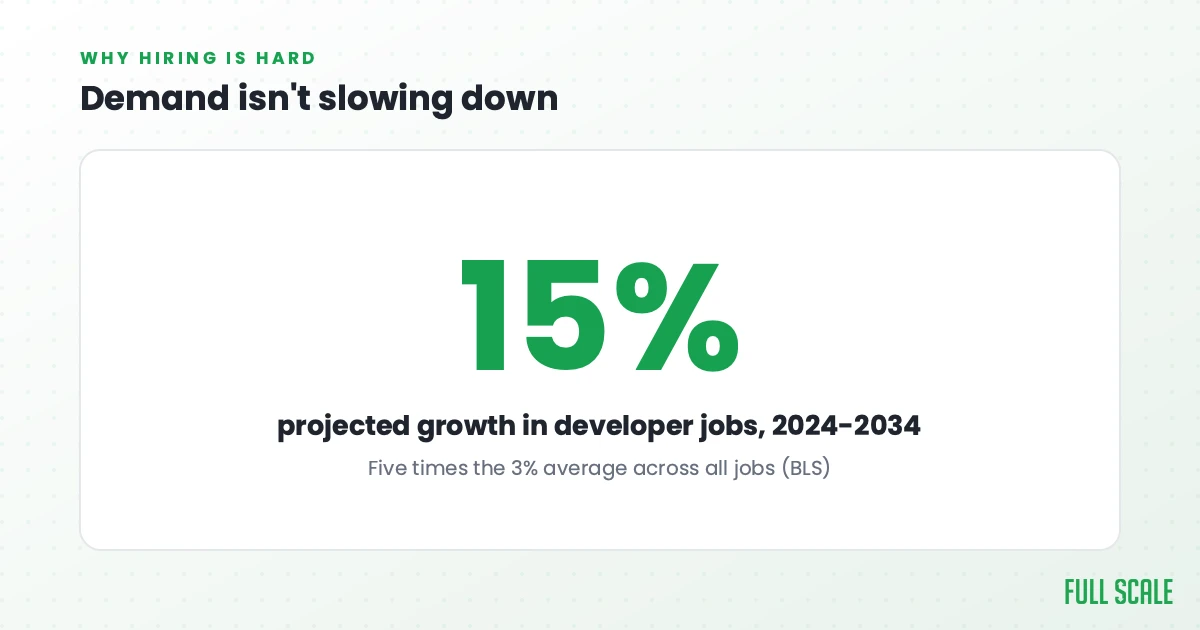
The demand side backs this up. The U.S. Bureau of Labor Statistics projects software developer jobs to grow 15% from 2024 to 2034, far faster than the 3% average across all jobs, with a median pay around $133,000. When a field grows that fast, the good people are never on the market for long. What looks like a developer shortage is often just everyone fishing in the same shrinking pool of active job seekers. You have to go get the ones who are not looking. Our report on IT staffing trends in 2026 shows the same pattern across the whole market: senior demand climbing while the pool of active seekers shrinks.
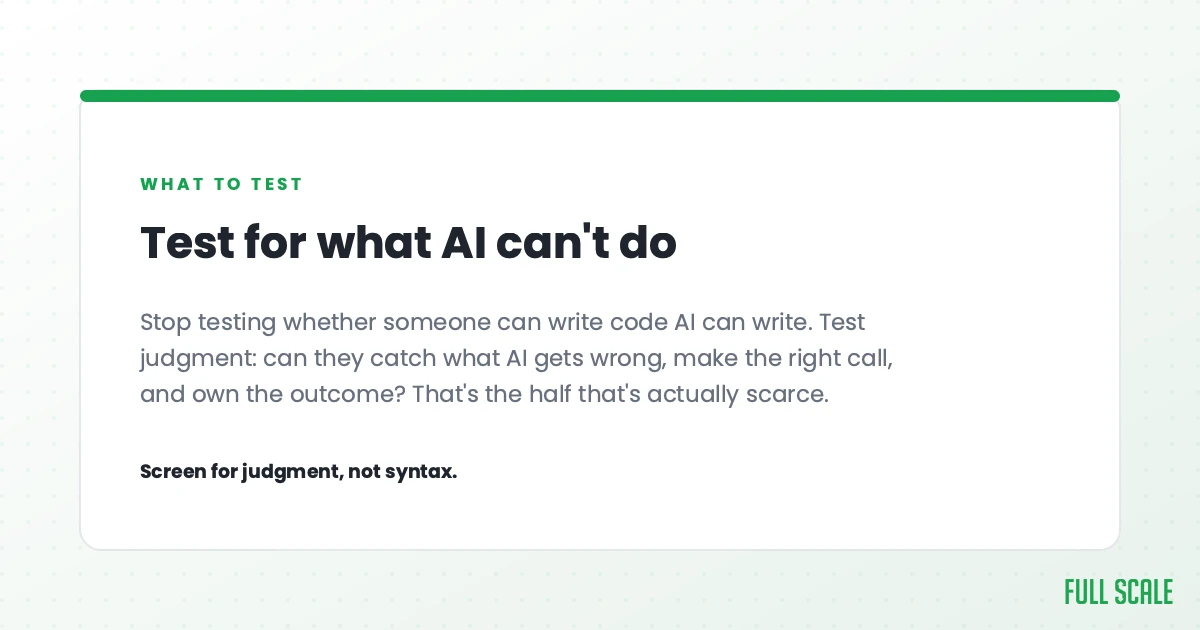
Test for what AI can’t do, not the code
For years, hiring a developer meant testing whether they could write code under pressure, with algorithm puzzles, whiteboard problems, and take-home projects. That made sense when writing code was the hard, slow part of the job.
It isn’t anymore.
AI writes a huge share of new code now. Google’s leadership has said around 75% of new code there is AI-generated, with every line still reviewed and approved by an engineer. In Stack Overflow’s 2025 developer survey, 84% of developers said they use or plan to use AI tools, yet only a third trust the accuracy of what those tools produce, and nearly half actively distrust it.
Read those two facts together and the lesson is obvious.
Hiring for raw coding speed is hiring for the part of the job that is going away.
The skill going up in value is judgment: knowing what to build, spotting where the AI is confidently wrong, and understanding the real problem a customer has before anyone writes a line of code. I have come to think of the durable skills as three things, and they line up with what I argue in my book, Product Driven: communication, curiosity, and courage.
I want chefs, not short-order cooks. A short-order cook makes exactly what the ticket says. A chef asks what you are actually trying to make and tells you when the recipe is wrong. The best engineers I have hired were always the ones asking the most questions, while the fastest typists rarely stood out.
So change what you test for:
- Give them a real problem to chew on. Use a scaled-down version of work your team actually does. You learn more from how someone reasons through a messy, real situation than from whether they remember a sorting algorithm.
- Watch how they communicate. Can they explain a tradeoff in plain language? Do they ask clarifying questions before charging ahead? That is the job now.
- Probe for curiosity. Ask what they have taught themselves lately and why. Curiosity is how a developer survives a field that reinvents itself every couple of years.
If you want to go deeper on this, we wrote separate guides on the soft skills that actually matter in developers and how to assess a developer’s skills. The short version: stop optimizing your interview for the thing a machine now does well.
The cheapest hire is the most expensive mistake
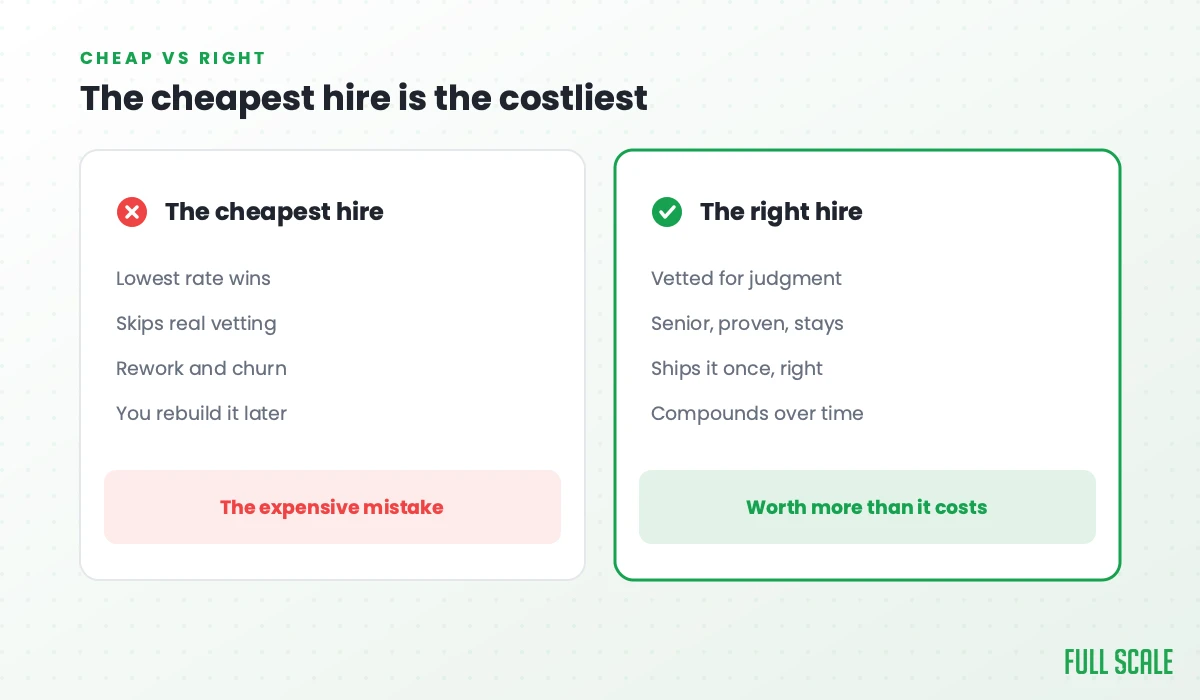
Once you find good people, the next way teams go wrong is optimizing for price. I see it constantly, and it is the most expensive mistake in hiring.
When cost is the only reason you go offshore, you buy the cheapest thing, and the cheapest thing fails.
I call this cheapshoring. If cheap is the only thing you are chasing, you end up with a freelancer who disappears mid-sprint or a project shop that bills for ten people while three do the work. Then you join the long line of founders who tried offshore once, got burned, and swore it off forever. None of that was offshore’s fault. It came down to buying on price alone.
Cost is a fine reason to hire offshore. I have done it for years, and it works because it is cost-of-living arbitrage, not skill arbitrage. The mistake is making cost the only reason. A friend of mine had 16 developers in Pakistan and his project still was not getting better. He did not need cheaper bodies. He needed leadership, and no number of low-cost hires was going to supply it.
The same trap shows up with recruiters. Early in my career, when I needed to fill a role I could not fill myself, an IT recruiter charged me a 25% placement fee. That is a quarter of the engineer’s first-year salary, just for an introduction. I call that a ransom, and it is not unusual. Contingency recruiters in tech routinely charge 20% to 30% of first-year salary. That fee sits on top of an already-expensive U.S. salary and buys you nothing after the handshake.
So here is how I decide now. Pay the recruiter fee only for the rare local hire you genuinely cannot find yourself, a senior engineering manager or a niche on-site specialist where the search itself is the value. For everyone else, you do not need the staffing agency at all. An equally capable engineer costs a fraction of the loaded U.S. number offshore, with no placement fee and no role sitting open for weeks while you wait.
When the US market is dry, hire globally the right way
If the strong people at home are hard to reach and expensive to land, the honest answer is to widen the map. Most of the world’s software talent lives outside the United States, and pretending otherwise just keeps you fighting over the same small, overpriced pool.
Hiring globally and hiring globally the right way are two different things. Offshore fails for the same reason any hire fails, and it almost always traces back to one of two things: undefined work, or no real owner on your side.
Think of it like building a house. You are the homeowner. You stay involved, and you pick a general contractor you trust. The general contractor, your engineering leader, full-time or fractional, manages the trades day to day. The trades, the engineers, build to a clear plan. Take away the plan or the general contractor and the whole project goes sideways, no matter how skilled the trades are. That is true whether the crew is down the street or across the world.
So the order of priorities should be communication first, then cost, then country. Most companies do it backwards. They pick the cheapest country, then discover they cannot communicate with the team and cannot direct the work.
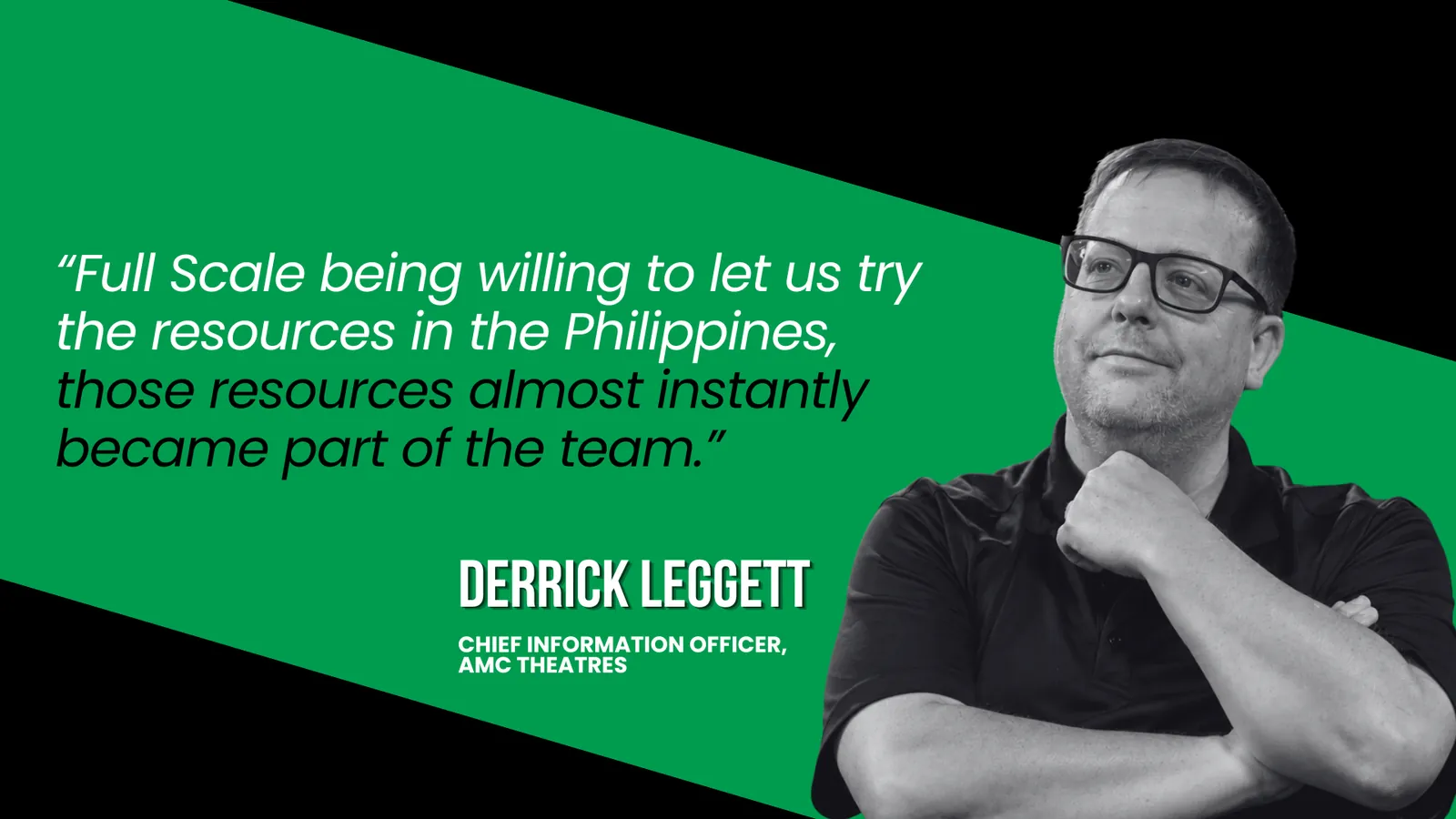
Done right, the team is just your team. One of our clients, AMC Theatres, put it better than I could: it is a fully integrated team, and some of the people just happen to live in the Philippines. Another, LendingStandard, came to us after local hiring had stalled and they could not find the engineers they needed at home. That is the typical path. The local market dries up, and going global stops being a cost play and starts being the only way to actually staff the roadmap.
This is the model we run at Full Scale: our staff augmentation model, where the engineers join your team and take direction from you, not a project shop and not a roster of freelancers. You talk directly to the developers. There is no middleman fronting five people you never meet. When you are ready to widen the search, hiring dedicated developers in the Philippines gives you senior people with strong English and real overlap with your workday.
Hiring isn’t done at the offer, you have to keep them
Almost every guide on hiring tech talent ends at the offer letter. That is exactly where the hardest part begins.
If you can’t keep the people you hire, all you have built is churn with extra steps.
Software engineering has some of the highest turnover of any role. If your people leave every nine months, you never actually build a team. You just keep paying to recruit the same seat over and over. Retention is the back half of hiring, and it is the half the vendor blogs ignore because there is no product to sell you for it.
This is the whole reason a real partner beats the cheapest option. The real value is in all three jobs together: recruiting people, managing them, and keeping them. At Full Scale our developer retention runs about 93%, and our Philippine team is Great Place to Work Certified, where 95% of our people say it is a great place to work versus around 65% at a typical company in the Philippines. That stability does real work for you. It means the engineer who learned your codebase is still on it next year, which is worth far more than the few dollars an hour you would have saved going cheaper.
Keeping good engineers comes down to unglamorous things. Give them interesting problems to work on, a leader worth following, and the day-to-day support of a well-managed team. Pay them fairly and treat them like part of the team instead of headcount on someone else’s spreadsheet. Do that and you stop re-hiring the same role, which is the most expensive hiring of all.
Frequently asked questions
How do I find senior engineers if the best ones won’t apply?
You recruit them instead of waiting for them. Lean hard on referrals from engineers you already trust, do direct outreach to people who are not actively job hunting, and move quickly once you find someone good. If you do not have the time or the recruiting team to do that well, a hiring partner whose core skill is recruiting passive candidates will reach people your job post never will.
Should I use a recruiter to hire tech talent?
For most developer roles, no. A contingency recruiter typically charges 20% to 30% of first-year salary for an introduction, and that fee sits on top of an already-high salary. Pay it only for a genuinely hard-to-find local hire, like a senior engineering manager or a niche on-site specialist. For the bulk of your engineering capacity, hiring offshore through a partner usually costs less and fills roles faster.
What should I test for when hiring developers now that AI writes code?
Test for judgment, communication, and curiosity, not raw coding speed. AI now writes a large share of code, but it is often confidently wrong, so the valuable skill is knowing what to build and spotting where the AI got it wrong. If the candidate sits in another country, how to interview offshore developers changes less than most people expect. Give candidates a realistic, scaled-down version of your actual work and watch how they reason and ask questions, rather than handing them an abstract algorithm puzzle.
Is it better to hire tech talent in-house or offshore?
It depends on the role and on whether you can lead the work. Hire in-house for a rare local leader or an on-site specialist where the search itself is the value. Use offshore to scale most of your engineering capacity alongside your local team, since the talent pool is far larger and the cost is lower. Offshore works when you have defined work and a real owner on your side, and it fails when you have neither.
What does it cost to hire tech talent?
A senior U.S. developer often runs $80 to $150 an hour, and the all-in cost with benefits and overhead can pass $200,000 a year, before any recruiter fee. Offshore, an equally capable senior engineer costs a fraction of that. The bigger cost is rarely the salary, though. A bad hire, or a good hire you fail to keep, costs far more than the difference in rate. Keeping them is partly a developer training problem, because people tend to stay where they are still learning something.
Ready to build your team?
Hiring tech talent comes down to finding the people who are not looking, testing them for the right things, and keeping them once they are on board. If that is the gap between you and your roadmap, that is exactly what we do. Book a 15-minute call and we will talk through what you are trying to build and which roles to fill first.
Screening for a particular stack? See our interview guides for Python, Node.js, Android, and Ruby on Rails developers.
For specific front-end and mobile stacks, see our guides for Angular, Vue, and Flutter developers.