
Software Development for Equity: When It Works and How to Protect Yourself

In this article
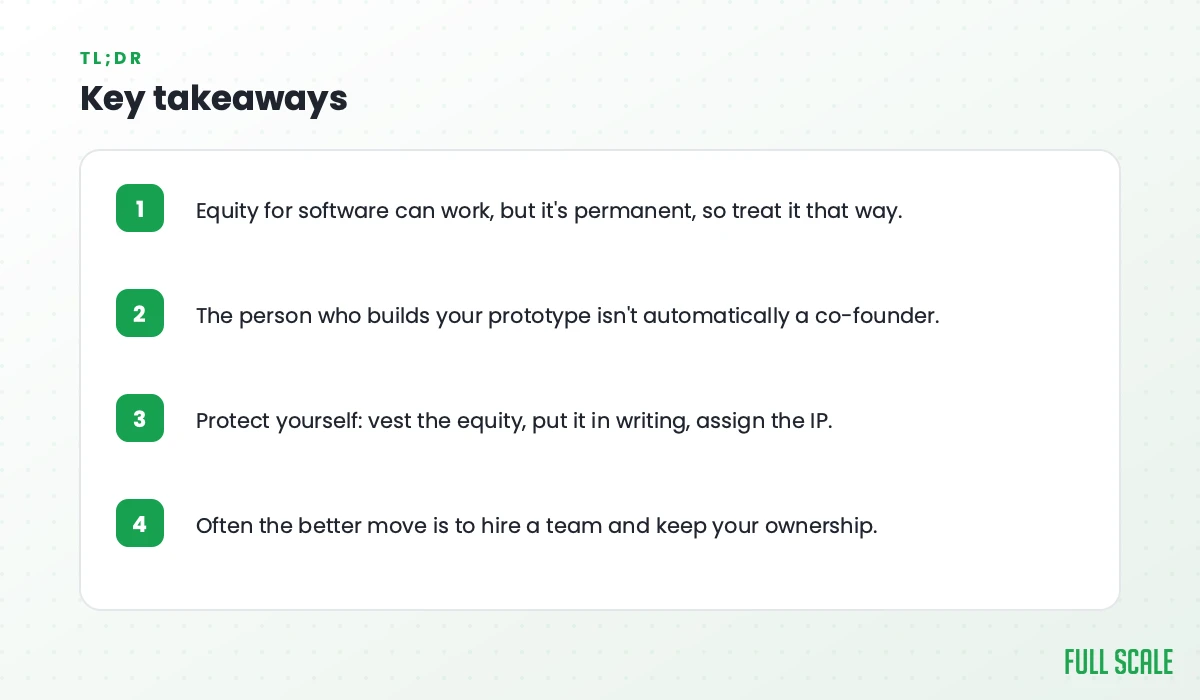
- What software development for equity actually means
- When trading equity for software development makes sense
- The person who builds your prototype is not automatically your CTO
- Trust is the whole deal
- How to protect yourself: vest the equity
- Where to find a developer or co-founder for equity
- How much equity should you give?
- The alternative most founders overlook
- Frequently asked questions
Quick Answer: Recruiting a developer for equity works best when it comes from your own network, and it needs real protection: vest the shares over 4 years with a 1-year cliff, put an IP assignment clause in writing before any code gets written, and treat the search like you’re choosing a co-founder, not filling a role. A technical co-founder at the earliest stage might fairly hold 25% or more; a developer doing a defined build for equity usually lands in the low single digits. If you just need the software built well, staff augmentation through a company like Full Scale gets it done for cash, with zero equity changing hands.
Most founders who start thinking about this are stuck in the same spot. You have a real idea for a tech product, but you can’t build it yourself, and you don’t have the cash to hire a team to build it for you. You have a skills problem and a money problem at the same time. That same money problem shapes what investors scrutinize before writing a check. Equity is one fix; needing to build less is another, which is the whole point of how to start a SaaS company without burning your runway. Equity is one lever among the broader tech hiring trends shaping 2026.
Software development for equity is one way to solve both at once. Instead of paying cash you don’t have, you find a technical co-founder or a developer and trade them ownership in the company for building the product. If you’re a non-technical founder, finding the right technical partner you can trust and giving up some equity to bring them on can be one of the smartest moves you make. A lot of great companies started exactly this way. Equity is just one way to fund startup software development when cash is tight.
But before you hand over a single share, understand what you’re really doing. The moment you pick that person, you’re not making a hire, you’re getting married to them. It’s worth understanding the difference between a mentor and an advisor before you give anyone equity.
And this is the part people skip past when they get excited about the idea.
It’s easier to get a divorce than it is to get rid of a business partner.
Once you hand someone equity, getting it back is hard. You can’t just change your mind in six months when it isn’t working out. The model is real and it can be a great trade, but it ties you to a person far longer and tighter than any job offer ever would.
I’ve been on both sides of this, which is rarer than it sounds. Twice, companies recruited me to be their technical co-founder in exchange for equity, and both turned into successful companies with successful exits for me. So I know firsthand that working for equity can pay off, and pay off well. I’ve also been the founder on the other side of the table. I co-founded VinSolutions with a partner, bootstrapped it to $35 million in annual revenue, and sold it for $147 million, then started Stackify and sold it in 2021. Along the way I’ve had business partners I trusted completely, and I’ve had partner trouble that nearly killed one of my companies more than once. Now I run Full Scale, where founders ask me almost every week if we’ll build their product for a piece of the company. So I’ve lived this question from just about every chair, and the answer is more “it depends” than the agencies selling equity deals will tell you.
Here’s how I think about it.
What software development for equity actually means
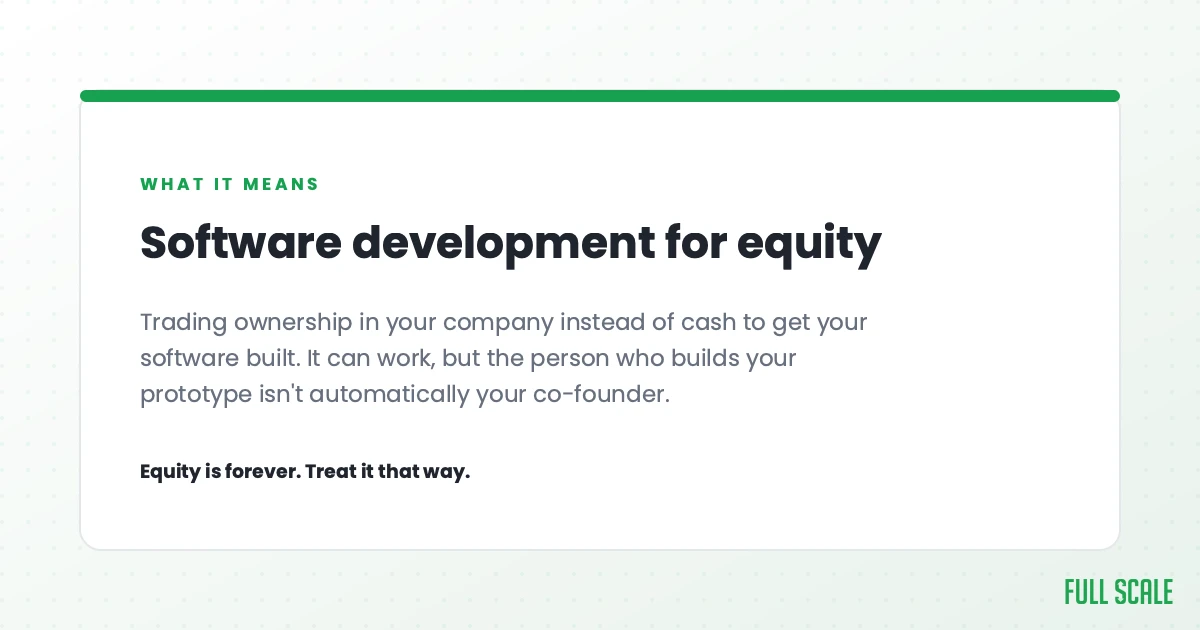
Software development for equity is when you pay for the work with ownership in your company instead of cash. A developer, a technical co-founder, or a development firm agrees to build your product, and in return they get shares, stock options, or a percentage stake. People also call it sweat equity, because the contribution is labor rather than money.
It shows up in three common shapes:
- A technical co-founder who joins to build the product and shares in the company from day one.
- An individual developer or contractor who takes part cash, part equity, or pure equity for a defined build.
- An agency that builds your app for a reduced fee plus a stake. Several firms specialize in app development for equity, like MassLight, which builds startup apps in exchange for equity rather than a full bill.
The appeal is obvious when you’re short on cash. You preserve your runway for marketing, sales, and everything else, and you get a product built by someone who now has a reason to care whether it succeeds. That motivation is real. Someone with ownership treats your roadmap differently than someone billing by the hour.
When trading equity for software development makes sense
The trade works best when the work is foundational: building the first version, getting a minimum viable product in front of real users, and proving the idea is worth funding. That kind of contribution earns ownership, because it’s what creates the company in the first place. If you’re bootstrapping and every dollar matters, equity can be the only currency you have for that early build.
It also works far better when you already know the person. The best version of this deal is a technical partner you’ve worked with before, or someone close enough that people you trust will vouch for them. The worst version is handing a chunk of your company to a developer you found online last month. You can’t build a tech company without someone who can actually ship the tech, but who that someone is matters more than the equity number you land on.
So yes, find a developer for equity if you genuinely can’t build it yourself and you’ve found the right person. Just go in with your eyes open about the two things that wreck these deals.
The person who builds your prototype is not automatically your CTO
The first trap is one I see constantly.
A founder finds a developer to build the prototype for equity, the prototype works, and somewhere in the excitement that developer gets handed the title of CTO or VP of Engineering. The logic feels right. They built the thing, so they must be the person to run all of engineering, forever.
That’s two different jobs, and being good at the first one says almost nothing about the second.
Building a v1 is about speed and getting something working. Running engineering as the company grows is about hiring, architecture decisions, managing people, setting process, choosing the right team structure, and saying no to the wrong work. I wrote a whole book, Product Driven, partly because I learned the hard way that the skills that get a product off the ground are not the skills that scale it. Someone can be a fantastic builder and a poor engineering leader, and that’s fine, as long as you don’t lock them into a role they can’t grow into.
Give them equity for the work they did. Don’t give them a title and an org to run unless they’ve actually earned that separately. You can be generous with ownership and still honest about who’s qualified to lead.
Trust is the whole deal
The second trap is trust, and it’s the bigger one.
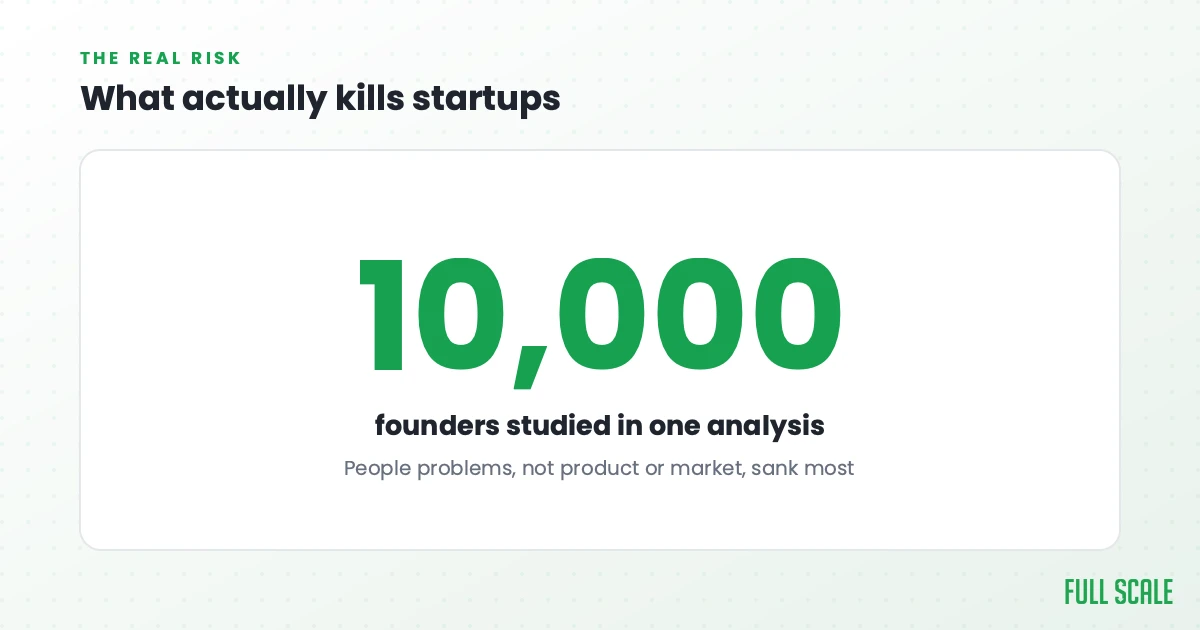
When you give someone equity, you’re choosing a partner who will be tied to the company for years. People problems, especially tension between co-founders, are the single biggest reason startups fall apart. In his book The Founder’s Dilemmas, Harvard Business School professor Noam Wasserman studied nearly ten thousand founders and found that people problems, not the product or the market, are the leading cause of startup failure, behind about 65% of the ones that don’t make it. Far more startups die from the founders falling out than from anything technical.
I’ve lived the version of that statistic, so I don’t say it lightly. I’ve said for years that the foundation of any long-term partnership is trust. You lead with trust through the process, and you adjust with trust when things go wrong, because something always goes wrong. If you don’t already trust the person you’re about to make a co-owner of your company, no equity split or vesting schedule is going to save you.
This is why the casual “hey, want some equity to build my app?” pitch to a developer you met once is so risky. You’re making a near-permanent partner out of a stranger, and as I said up top, the divorce is brutal.
How to protect yourself: vest the equity
If you decide software development for equity is the right move, do not hand over the shares in one lump. Set up vesting.
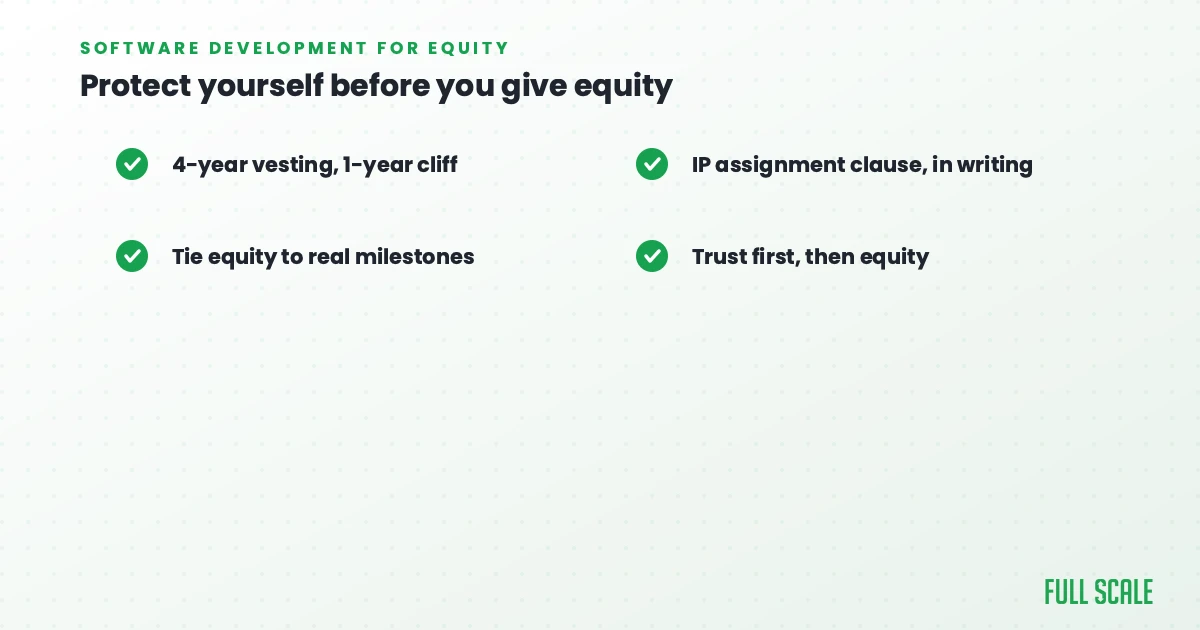
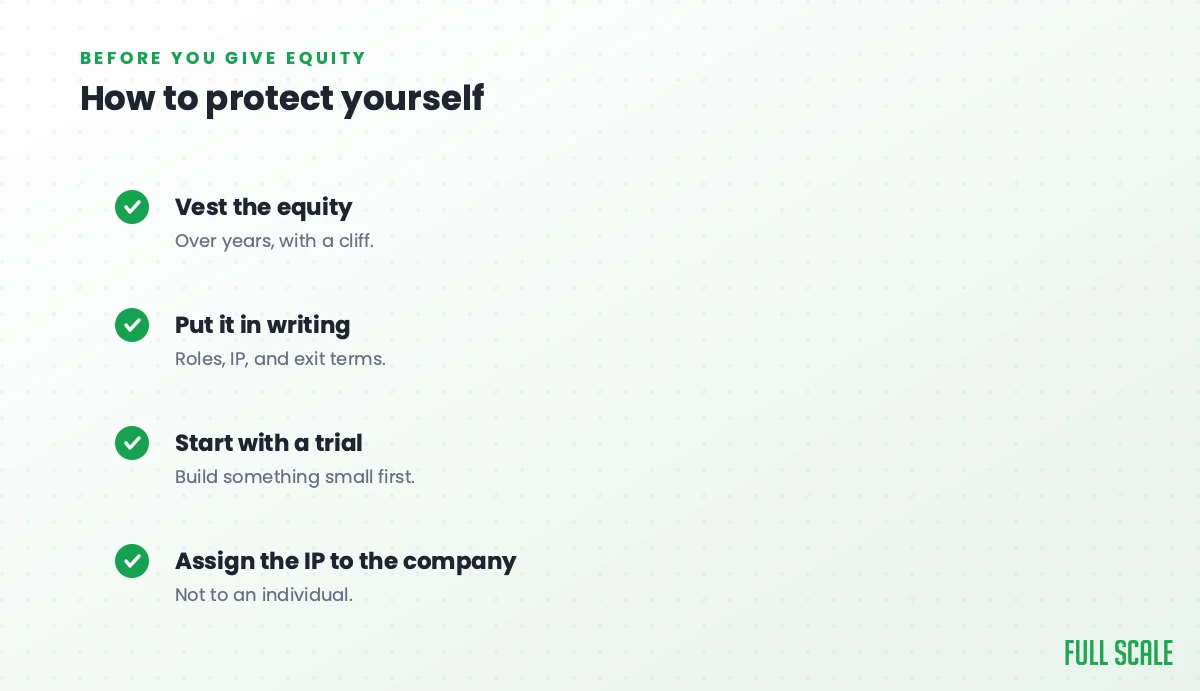
Vesting means the equity is earned over time or against milestones, not granted all at once on day one. The standard in startups is a four-year vesting schedule with a one-year cliff: the person earns nothing until they’ve been around a full year, then the rest vests monthly over the following three years. If they walk away at month ten, they leave with nothing. If they stay and deliver, they earn their full stake.
You can also tie equity to specific goals, like shipping the MVP, hitting a launch date, or reaching whatever usage milestone defines real contribution for your business.
Think of vesting as the prenup. It feels awkward to bring up with someone you’re excited to build with, and a good partner will understand exactly why you’re doing it. Vesting is how you make a near-irreversible decision survivable when it doesn’t work out. It protects you, and honestly it protects them too, because it forces both sides to be clear about what the equity is actually for.
Vesting is only half of protecting yourself. The other half is getting the whole deal in writing before any code gets written. Put the equity grant, the vesting schedule, and the milestones in a real agreement, and make sure it includes an intellectual property assignment clause. This part trips up more founders than they expect: in the US, a contractor’s work isn’t automatically yours, and software doesn’t qualify as work-for-hire by default, so a developer who builds your product for equity can end up legally owning the code unless the contract assigns it to the company. Spend the money on a startup attorney to paper it correctly. It’s cheap next to finding out you don’t own your own product. There’s a tax step too. The person getting the equity will usually want to file an 83(b) election within 30 days of the grant. It’s a short form that can save them a brutal tax bill later, and a good attorney handles it. None of this is legal advice, so get the real documents drawn up by someone who does this for a living. Trading equity for development work is one approach to funding a tech startup when cash is tight.
Where to find a developer or co-founder for equity
Start with the people you already know. The strongest equity partnerships come out of an existing relationship: someone you’ve worked with, a former colleague, or a developer that a person you trust will vouch for. You’re looking for trust first and skills second, and you already have a real read on the people in your own network.
When your network runs dry, a few places are built for this. Y Combinator’s Co-Founder Matching and CoFoundersLab connect founders with technical partners who want exactly this kind of arrangement. Wellfound (formerly AngelList Talent) lists startup roles where equity is part or all of the pay. Startup accelerators, demo days, and hackathons put you in a room with developers who already want to build something of their own.
Wherever you find them, treat the search the way you would when choosing a co-founder, because that’s what you’re doing. Move slower than feels comfortable, build something small together before you talk equity, and make sure the trust is real before you make anyone an owner.
How much equity should you give?
There’s no clean formula, and anyone who gives you one is guessing. It depends on how early you are, how much risk the person is taking, and whether they’re a true co-founder or a contributor on a defined build.
A technical co-founder coming in at the very beginning, taking the same risk you are, might fairly hold a large share, often somewhere from 25% up toward an equal split. A developer doing a defined build for part equity usually lands in the low single digits, and an agency converting part of its fee to a stake is in roughly the same range. Treat those as starting points to react to, not rules. The honest guidance is to be generous enough that the person is genuinely motivated, stingy enough that you still control your company, and disciplined about the fact that equity, like cash, is finite. Once it’s gone, it’s gone.
The alternative most founders overlook
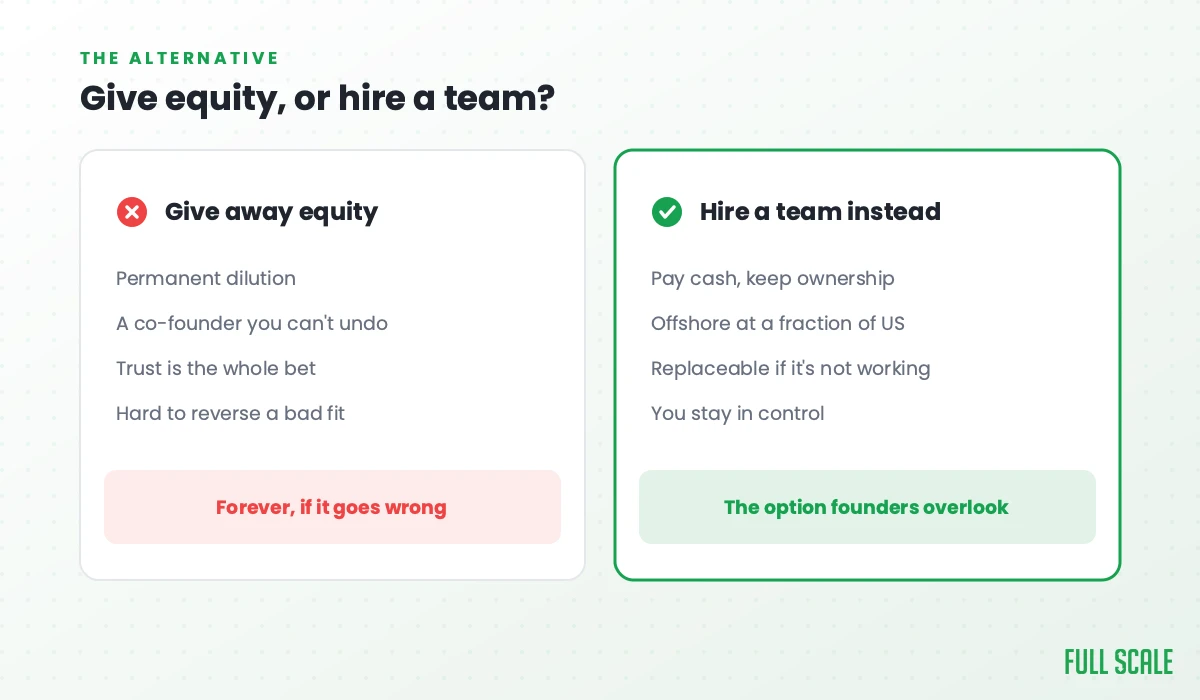
A lot of founders miss the real math here. The reason they reach for equity is to avoid spending cash, but giving away ownership is often the most expensive way to get a product built. You’re trading a permanent piece of the most valuable thing you own to solve a temporary cash problem.
For the build work itself, the part that’s just “I need this software made well and affordably,” you usually don’t need to give up any ownership at all. When it comes to finding and hiring tech talent, you can bring on a dedicated developer or a small team offshore for a fraction of US salaries and keep 100% of your company. That’s the model we run at Full Scale: we recruit, manage, and retain the developers, you direct the work, and there’s no equity changing hands. It’s the cash-efficient version of the same goal. Whether staffing agencies are worth it is a fair question to ask here too, since paying a recruiter a placement fee is just another way to spend cash you would rather keep.
The bar to get something built has also dropped fast. AI coding tools like Cursor, Claude, and GitHub Copilot let a small team get a prototype standing for less time and money than ever, so the early build you used to trade equity for is cheaper to just pay for now. That makes giving away a permanent piece of your company to cover it an even worse deal than it was a few years ago.
One honest caveat on the cash path: it assumes you, or a technical leader you trust, can actually direct the work. If you’re non-technical and have nobody on your side who can, that’s a real argument for finding a technical partner, not against it. Just don’t confuse needing someone to run the build with needing to hand over ownership to get it.
Optimizing purely to avoid spending money is its own trap. I call the cheap-developer version of it cheapshoring, and giving away equity to dodge a dev bill is the founder-side cousin of it. It looks free now and turns out to be the priciest thing you ever signed.
So before you trade ownership for code, ask whether you actually need a partner, or whether you just need the work done. If it’s a partner you can trust to help carry the company, equity can be a great deal. If it’s just the build, there are staff augmentation and offshore development options that get you there without signing a marriage certificate.
If you want to think through which path fits your product, schedule a call with Full Scale and we’ll help you work it out.
Frequently asked questions
What does software development for equity mean?
It means paying for development work with ownership in your company instead of cash. A developer, technical co-founder, or development firm builds your product and receives shares, stock options, or a percentage stake in return. It’s also called sweat equity, since the contribution is labor instead of money.
How much equity should I give a developer?
It depends on timing and role. A technical co-founder taking founder-level risk from day one can land anywhere from 25% to an equal split. A contractor or agency doing a defined build for part equity is usually in the low single digits. Be generous enough to motivate, disciplined enough to keep control.
Is it better to pay developers in cash or equity?
If you need a long-term partner who’ll help carry the company, equity can align everyone and is worth it. If you just need the product built well and affordably, paying cash, often through offshore developers or staff augmentation, is cheaper than giving away a permanent piece of your company. Equity is the most expensive currency you have.
Should the developer who builds my MVP be my CTO?
Not automatically. Building a first version and running engineering as the company scales are two different jobs. Reward the build with equity, but only hand over a leadership title if the person has actually shown they can hire, manage, and lead at scale.
How do I protect myself when giving equity for development?
Use vesting. Grant the equity over time or against milestones instead of all at once. The startup standard is four-year vesting with a one-year cliff, so a partner who leaves early walks away with little or nothing. It’s the prenup for a decision that’s otherwise very hard to undo.