
How to Build a Software Development Team: The First Five Seats, in Order

In this article
Quick Answer: Build a software development team in the order the work breaks, not the order an org chart lists. Seat one is a generalist who owns the product end to end and figures out a little of everything, specialists come as you grow, seat two reviews seat one's work, seat three decides what gets built, seat four tests it, and seat five is the first person who runs the team. Past eight people, communication pairs top 28. At Full Scale, a dedicated developer starts at $35 an hour, about $6,070 a month.
The first developer you hire will be the entire team, and the second developer will be the first test of whether you can run a team. Most advice for how to build a software development team starts with the complete org chart. It's like learning how to cook by buying a restaurant, because you will eventually get to the part where food comes out.
I sell developers, so I'd love to tell you to hire 8 starting tomorrow. But the order in which you hire matters more than the total headcount, and the right order is pretty much common sense once you know what breaks at each size.
Build the team in the order the work breaks
The reason you add a seat isn't because there's a hole in your org chart. It's because something's started to suck. Code that no one ever looks at. Features that were never asked for. Bugs that aren't caught until someone else discovers them. A founder playing traffic cop instead of actually building. That's the logic under all the seats below. If you can't identify the thing a new hire would fix, you're not ready to hire.
Here's the sequence, and the signals for each. For descriptions of the individual roles and different ways they can be grouped, I wrote a separate guide to software development team structure. For the management positions that appear after ~10 engineers, see engineering organization structure. For what happens when you grow too fast, how to actually scale engineering teams continues where this one ends.
The first five seats, in order
At Full Scale, we believe that the first five seats will encompass most teams up to about eight. Below is the order, what each seat enables, and when you should hire them:
| Seat | What it unlocks | Trigger to add it |
|---|---|---|
| 1. A developer who owns the product end to end | A real product exists | You have a product idea and no one to build it |
| 2. A second developer who reviews the first one's work | Code that more than one person understands | Seat one becomes the only person who knows how anything works |
| 3. Someone who decides what gets built | Developers stop guessing at priorities | The backlog is longer than the developers' patience, or the founder is answering every question |
| 4. Someone who owns testing | Releases that don't depend on luck | Customers find bugs before you do |
| 5. The first person who runs the team | The founder gets their calendar back | The team is past roughly eight people, or the founder can't write code for a week because they're refereeing |
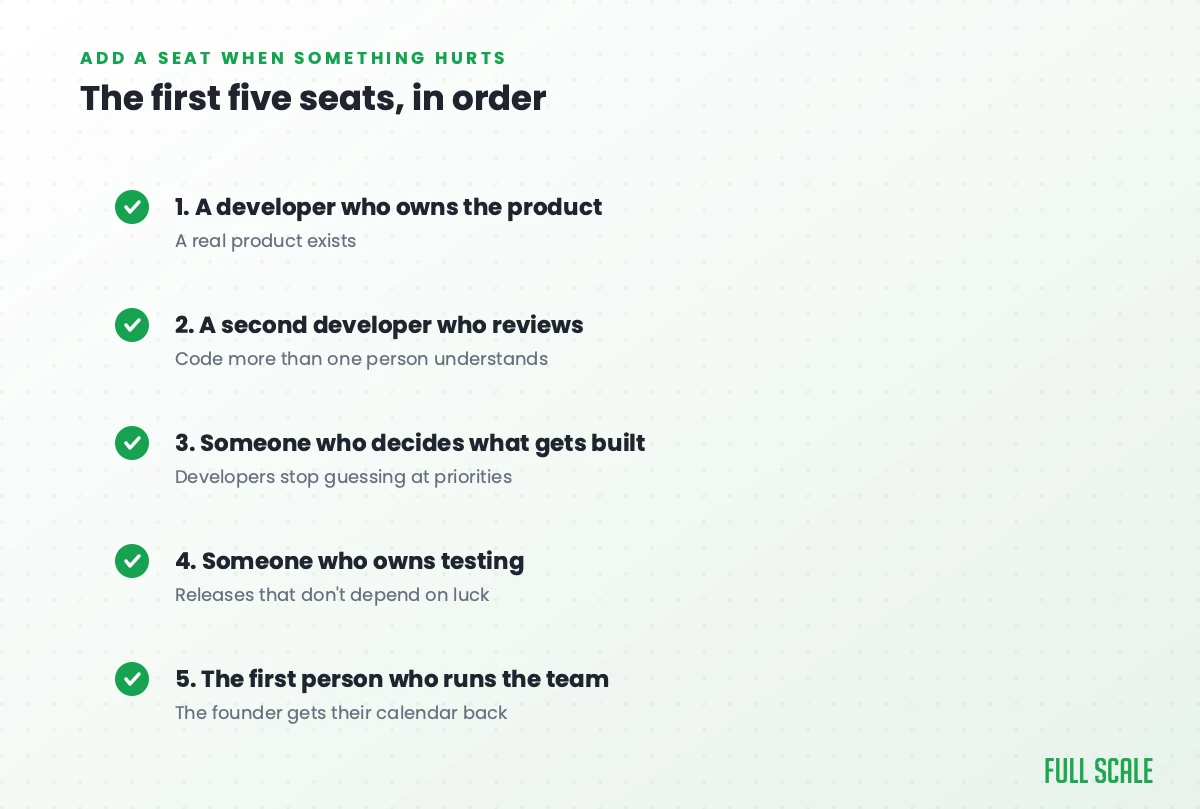
Seat one should be a generalist. Get someone who can learn a little of everything, from the database to the button. You'll have a specialist later, when the product needs one. Until then, a specialist creates holes in your capability that you might not notice for a few months. As the product grows and the scope of the problem widens, you'll bring in the specialists. Seat one is for a generalist until you know what the product needs. (If you're really looking for a technical partner who will take ownership of the technology for the foreseeable future, that's more akin to a technical co-founder situation, and I touched on the first-hire issue in hiring a developer for a startup.)
Seat three is where I'd push back on the usual order. Many hiring guides have a project manager or product owner way back at the end of the list. My first hire at EngagePath was a product manager, because the thing I needed most was someone to translate what was in my head into something my engineers could execute. The gap you find yourself in may differ, but if you're the one answering "what should this button do" forty times a day, your number three should come before your number two.
Testing in seat four belongs to a person too. It costs more money to find out about a bug through a customer complaint than it does to test for it.
The last position, seat five, is usually the one that founders hold off on the longest, because that seat requires you to realize that you're becoming the bottleneck. I've been there, and I've written about the moment when that realization hits in what a VP of engineering does.
Why teams stop scaling at the same sizes
The problem is that you can't scale a team linearly. Adding more people to a team does not yield a linear increase in capacity. Each additional person introduces new ways they can communicate with each other. Brooks' law, from The Mythical Man-Month, says adding people to a late software project makes it later. Martin Fowler's summary is a good short read on why. Here's the math. A team of n people contains n(n-1)/2 possible communication paths.
At Full Scale, we've used this math to illustrate why a larger roadmap warrants two smaller teams rather than a single large one.
| Team size | Possible communication pairs | What it feels like |
|---|---|---|
| 3 | 3 | Everyone knows everything |
| 5 | 10 | Still one conversation |
| 8 | 28 | Someone needs to run this |
| 12 | 66 | Two teams pretending to be one |
| 20 | 190 | Meetings about meetings |
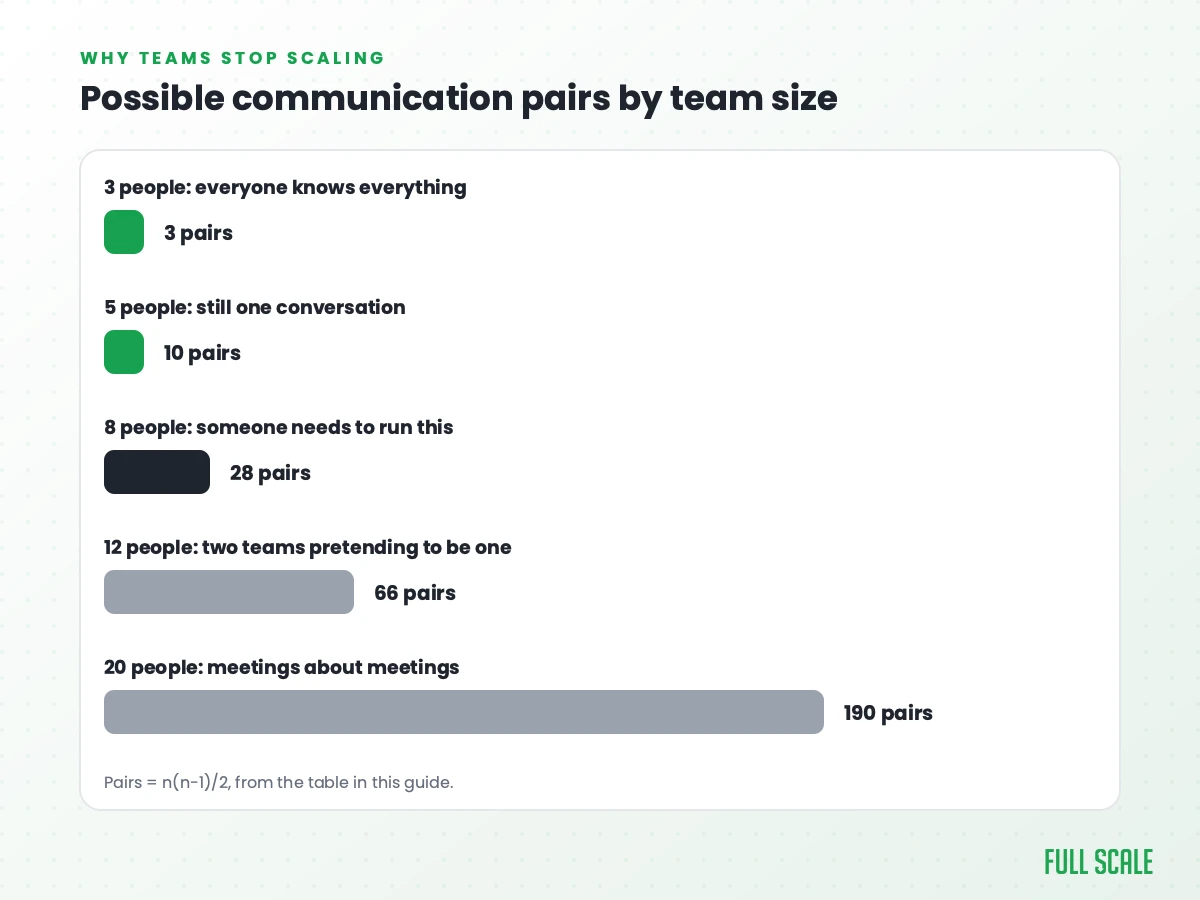
This isn't data from an actual team, but rather a mathematical illustration. Brooks himself called the law a deliberate sharpening. However, it helps us understand why the seat-five manager starts to appear when there are eight people.
To see just how rapidly this happens in reality, VinSolutions grew from 89 employees to 489 during its five years on the Inc. 5000 list. You don't get that kind of growth by simply adding more people to an existing team.
What the team costs per month
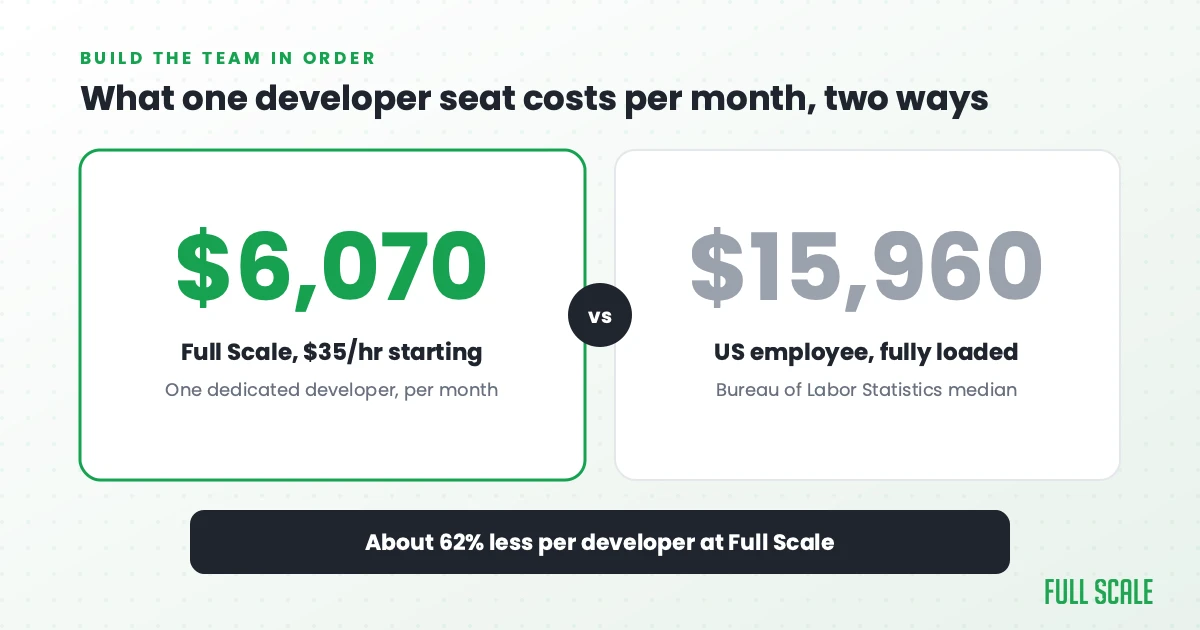
Four developers make a dedicated team that runs around $24,300 per month for Full Scale at its $35-an-hour starting rate, compared to around $63,800 for four US employees at the BLS median, fully loaded. Per developer, that's around $6,070 a month for Full Scale and $15,960 for a US employee, representing roughly a 62% difference.
Full Scale ran this developer-month calculation for four team sizes. The US figures use the BLS median of $134,040 for software developers, quality assurance analysts, and testers, grossed up because wages represent 70% of what private employers spend. One developer-month equals roughly 173 hours.
| Developers on the team | Full Scale dedicated team at $35/hr starting | US employees, fully loaded at the BLS median |
|---|---|---|
| 2 | About $12,100 a month | About $31,900 a month |
| 4 | About $24,300 a month | About $63,800 a month |
| 6 | About $36,400 a month | About $95,700 a month |
| 8 | About $48,500 a month | About $127,700 a month |
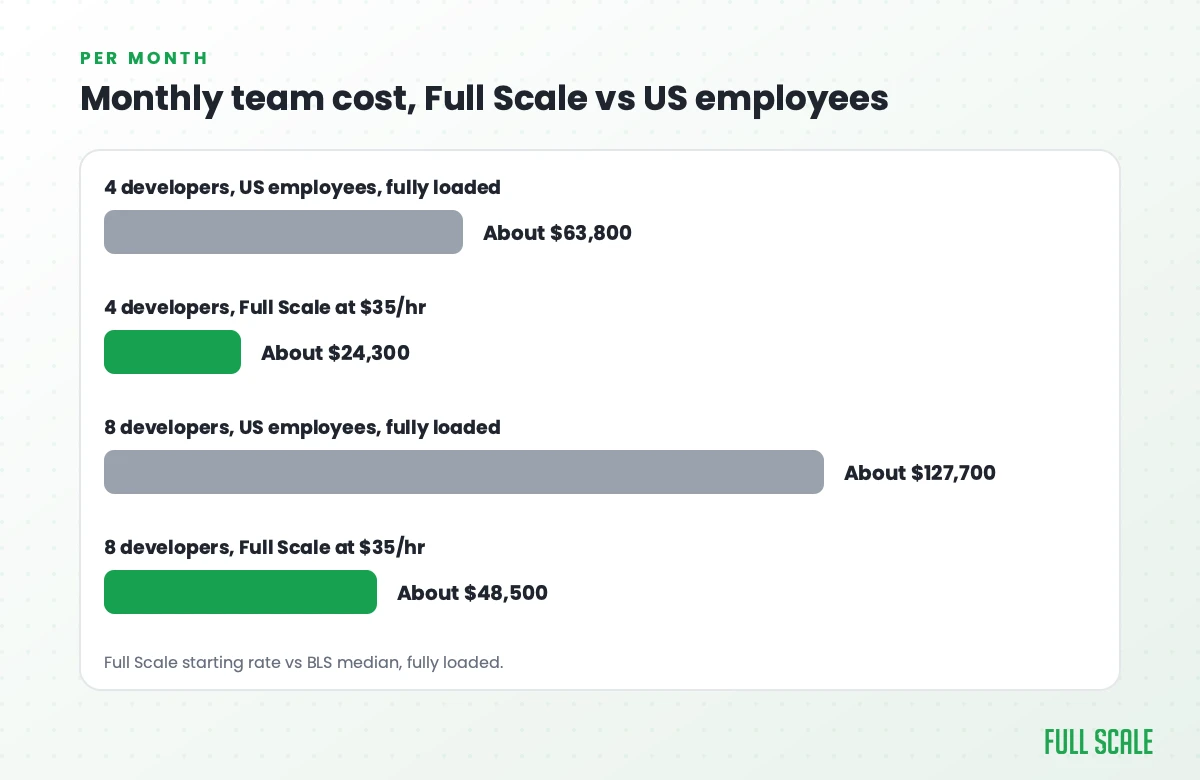
The prices shown apply strictly to developers. Add a lead developer, UI/UX designer, tester, and product owner on each side. A senior-heavy team bills above the starting rate, and the final rate depends on seniority, skill, and team size, so your gap will land somewhere in the 50 to 70% range Full Scale clients typically save. To find out how much it costs to hire a developer in specific locations, read our post about the the cost to hire a software developer.
Where offshore developers fit in the sequence
Keep the seats that control the leadership and product vision in-house, and bring in dedicated developers via staff augmentation to do the rest of the building. That's typically seats one and three, and whoever else ends up leading the team.
This split makes sense because adding a developer who owns the product vision is a lot more difficult. Dedicated developers come onto your team and work for you like any other employee, which is great for building whatever you say to build. Owning the vision is a different role, and if no one on your end is capable of it, hire a consultant or fractional CTO before hiring another developer. Without someone directing, you've purchased capacity but have no idea where it's going, and I'd prefer you be aware of that before signing than after.
Everything else is the same process. Add another developer for code reviews, add a tester, add a lead, etc. as each gate triggers. Staff augmentation is really great for filling out the middle of the table because it's so simple to hire people and to scale down if the plan changes. The terms are the two-week money-back guarantee, followed by 30 days' notice and no long-term agreement. You can get started in as little as 7 days.
If you're looking to hire a dedicated team as a whole, check out how to hire a dedicated development team for five gates on selecting a vendor. To hire one developer at a time, check out how to hire software developers.
Three ways teams get built backwards
There are three common mistakes to look out for.
- Hiring for the org chart. There's a box for the QA Lead before there's anything to test. The box gets paid. There is no work.
- Hiring the cheapest developer to fill seat one. Seat 1 is the template for anyone after, and I call price-only hiring cheapshoring. It looks cheaper right until the first rewrite.
- Skipping seat five. The founder keeps running the team because it's free. Technically. What it really costs is the one thing they can't buy more of: their time.
All three of these have one thing in common that I've written about in my book Product Driven. A team only works if they own the outcome, not if they own the boxes.
Frequently asked questions
How do you build a software development team from scratch?
Add seats in the order the work breaks, not in the order an org chart lists them. Start with one person who owns the product end to end, add a second developer who can review the first one's work, then someone who owns what gets built, then testing, and only then a lead. Each seat has a trigger, and that trigger is usually a problem you can already feel.
What roles do you need in a software development team?
A small team needs five jobs covered: building, reviewing, deciding what to build, testing, and running the team. One person can cover two of them early on. Our guide to software development team structure covers the full role list and team models, so this guide sticks to the order you add them.
How big should a software development team be?
Five to eight people is a workable size for most teams. Past eight, the number of possible communication pairs passes 28, and every new person adds more coordination than output for a while. When you need more capacity than that, split into two teams with clear ownership instead of growing one.
How much does it cost to build a software development team?
At Full Scale's $35-an-hour starting rate, one dedicated developer costs about $6,070 a month, so a team of four costs about $24,300 a month. The same four as US employees at the Bureau of Labor Statistics median, fully loaded, run about $63,800 a month. Designers, testers, and a lead are extra on both sides.
Can you build a software development team with offshore developers?
Yes, if someone on your side directs the work. Full Scale developers join your team and work under your direction, so the team still needs a person who owns the product vision and checks what gets built. If you don't have that person, a consultant or fractional CTO fills the gap better than another developer. A common setup is one or two in-house seats with dedicated developers added around them.
What to do this week
Once you've got a team, you can run through the table above as a diagnostic. Note down your current seats, then annotate the 5 jobs each person handles today. The ones no one is handling are your next hire. The ones the founder is handling are the ones you're currently paying for with time rather than money.
If you don't have a team yet, there's only one question to answer: who is seat one and what will they be accountable for on day 30?
Add the next seat
When your next hire is a developer, Full Scale's software product development team can show you who's on the roster for your stack. Tell us which seat you're filling and we'll quote it to you at our $35-an-hour starting rate.