
How to Hire Software Engineers: A Practical Guide

In this article
- The two questions that decide where to look
- The four ways to hire software engineers, and when each one wins
- Where the best engineers actually come from
- Write a job description that attracts the right person
- How to screen and interview without wasting everyone’s time
- What to look for beyond the resume: how they think
- Making the offer and onboarding
- Hiring software engineers in the AI era
- The bottom line
- Frequently asked questions
I’ve hired software engineers in four countries. Uruguay, Colombia, Russia, and the Philippines, starting with a team in St. Petersburg back in 2012 at Stackify. Some of those hires worked out great. Some of them didn’t. And almost every mistake I made early on came from the same place. I was so focused on how to hire that I never stopped to ask where I should be looking in the first place. If you are weighing a platform instead of hiring direct, here is a closer look at developer hiring platforms like Toptal and Gigster. Tactics like these matter more as hiring developers in 2026 gets harder and more expensive.
Most “how to hire software engineers” guides have that same blind spot. They hand you a checklist. Write a job description, post it on a few job boards, run a coding test, make an offer, onboard the person. None of that is wrong. But it skips the decision that actually determines whether the hire works out. Part of that decision is whether Toptal or Turing is right for you, or whether you need a team that stays. If you are hiring for a specific stack, our take on interviewing iOS developers shows how the questions change in the AI era. For browser-facing roles, start with our AI-proof front-end interview questions.
Before you ask how to hire a software engineer, you have to ask where to find one. For server-side roles, start with the backend developer skills that actually predict a good hire.
There are four real ways to bring engineering talent onto your project, and they are not interchangeable. Pick the wrong one for your situation and no amount of good interviewing will save you. It also pays to know the types of developers you are hiring for before you start. The standard technical interview is a big part of why hiring goes sideways, which is why I rethought how to interview a software engineer from scratch. And the questions change by stack: here are the questions to ask a PHP developer now that AI writes the boilerplate. We published the rubric we score interviews against so you can see what that judgment looks like written down.
The two questions that decide where to look
When someone asks me how to hire a software engineer, my first move is to ask two questions back. For a server-side hire, that starts with knowing what a senior backend engineer really does.
The first one is about time. Do you need a specific thing built over the next few days or weeks, or do you have ongoing work that will need someone for months and years?
The second is about the role. Are you hiring someone to lead and drive strategy, or someone to execute and ship the work? Going through recruiting agencies for software developers is one option, though it is rarely the cheapest way to staff a team over time.
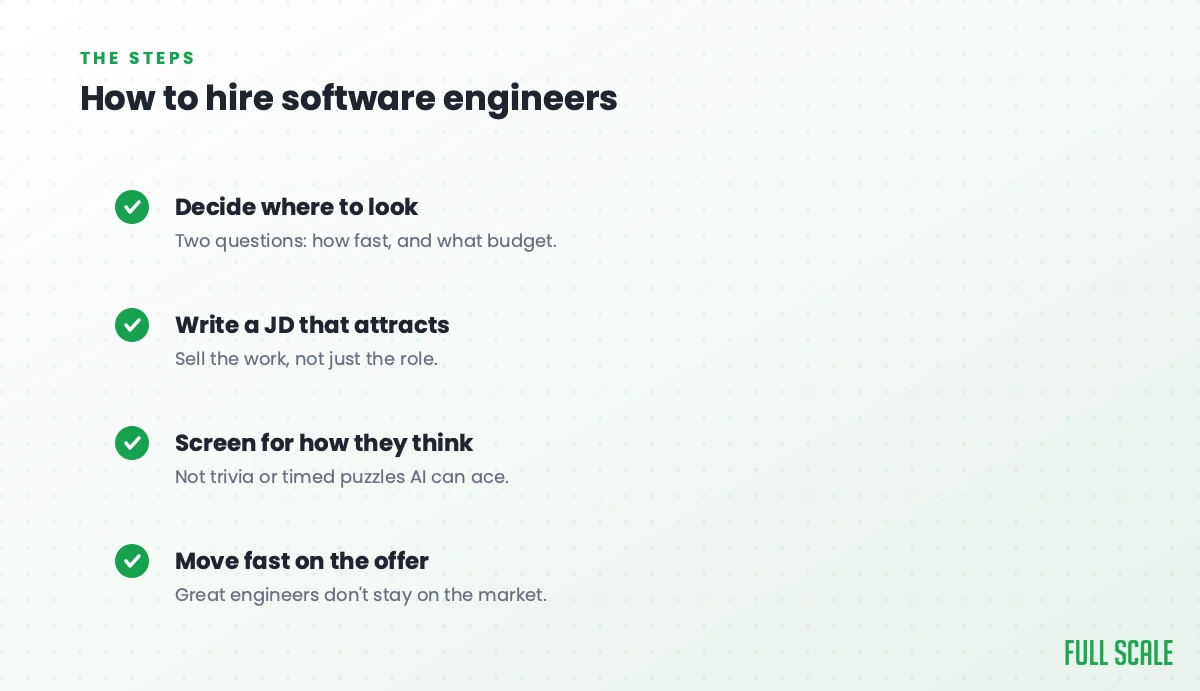
Those two questions narrow things down fast. Short, well-defined work points one way; work that will need someone for years points another. And if you’re hiring a leader who will own your architecture, that’s a different and harder search than hiring a strong developer to build features. The answers don’t always drop you onto a single option, but they get you close, and one more question usually settles it: can you afford a US salary and manage the person in-house, or would you rather a partner handle the cost and the management for you?
Here is why that matters more than the checklist. The most expensive hiring mistakes I have made were sourcing mistakes, not interview mistakes. Hiring across borders changes that math, which is why offshore developer interview questions deserve their own thinking. I hired a freelancer for work that needed a committed team. I spent weeks and a fee chasing a full-time hire for a job a contractor could have finished in days. The interview was never the problem. The path was.
The four ways to hire software engineers, and when each one wins
Freelancer or contractor
A freelancer or contractor is the right call for short-term work with a clear finish line. If you have a scoped project, a defined piece of work with a clear deliverable, this is often the cheapest and fastest way to get it done. I’ve done it plenty. I’ve outsourced projects for WordPress, Elasticsearch, and other things I didn’t know much about, because they were quick, well-defined jobs and I just needed them shipped.
The trap is using a freelancer for ongoing product work. The moment “build this one thing” turns into “now maintain it, add to it, and be around in six months,” a freelancer is the wrong tool. They move on, and they take all the context with them. Chasing the cheapest freelancer you can find on a marketplace is its own version of the mistake. I call it cheapshoring: when price is the only thing you’re optimizing for, you buy the cheapest option, and the cheapest option is the one that vanishes mid-sprint.
So use a freelancer for a statement of work (SOW) project. Don’t use one to build your actual product.
Full-time employee
A full-time hire is the most straightforward option for long-term work you can manage and afford in-house. They’re committed, they build deep knowledge of your product over time, and they answer to you. For a lot of companies, this is the default, and for good reason.
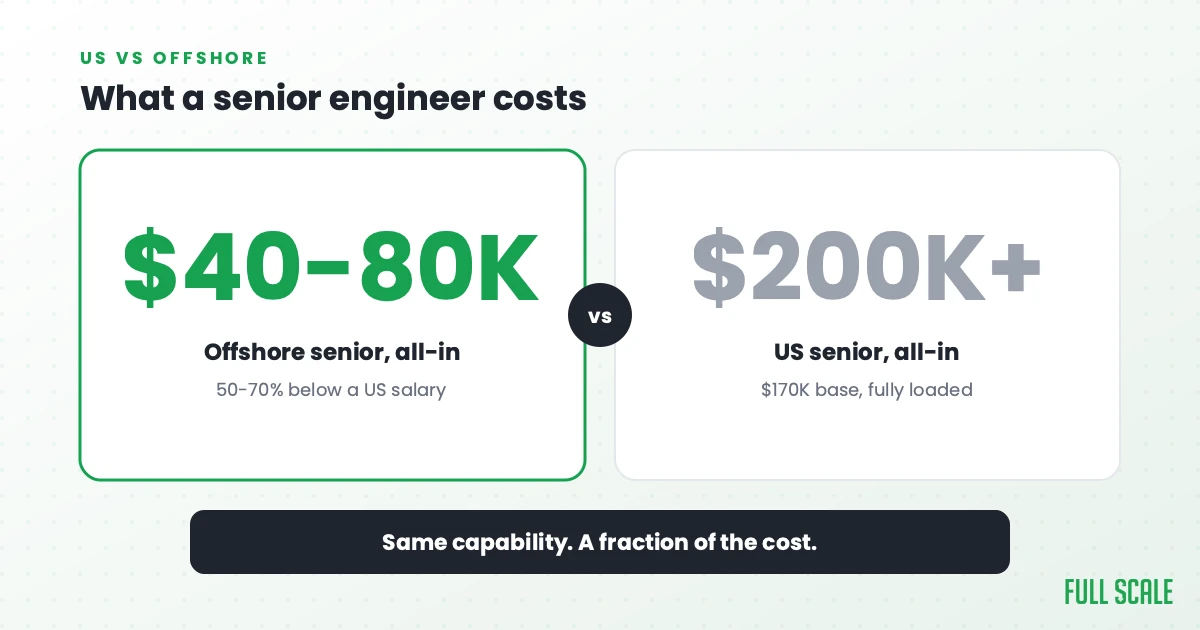
The catch is cost, and it’s worth being clear-eyed about the number. US software developers earn a median of about $133,000 a year, according to the Bureau of Labor Statistics (BLS). Salary isn’t the whole cost, either. Once you add benefits, payroll taxes, equipment, and overhead, the loaded cost of an employee runs about 1.25 to 1.4 times the base salary. A senior developer with a base closer to $170,000, once you load it, runs past $200,000 a year all-in. On top of that, the same BLS data projects software developer jobs to grow about 15% through 2034, much faster than the 3% average across all occupations. Good engineers have options, and they know it. A full-time hire is great when you can carry that cost and keep the person busy for years. It’s a heavy commitment for work that doesn’t justify it.
Offshore partner or staff augmentation
An offshore partner is a strong option for long-term work when you want a committed team without the full US price tag. This is the lane Full Scale operates in, so weigh my bias, but I’ll be straight about where it fits and where it doesn’t.
Hiring offshore through a staff augmentation partner gives you developers who join your team and work under your direction, the same way an employee would, at cost-of-living rates instead of US rates. Depending on the market, that runs roughly 50 to 70% below a comparable US salary. The important part: it’s a cost-of-living difference, not a skill difference. A senior engineer in Manila is just as capable as one in Austin and costs a fraction of the same person’s loaded cost in the US (here’s what an offshore engineer actually costs).
What makes this path work or fail is whether you treat it like hiring a team or like buying the cheapest labor you can find. A good partner recruits, manages, and keeps real developers, which is why our own team retention sits around 93%. The wrong “partner” is a project shop that hides five engineers behind one account manager you never speak to. The honest test is simple. Can you talk to the developers directly and direct their work? If there’s a middleman standing between you and the people writing your code, that isn’t staff augmentation, and it usually goes sideways. The real tradeoff, even done right, is overlap. You need a few hours of the workday in common and a habit of writing things down, or the distance starts to cost you. For most teams that’s a small price, but it’s a real one. (If you go this route, it’s worth knowing which questions to ask an offshore development company before you sign anything, and what it really costs to hire offshore software engineers.)
Recruiter or staffing agency
A recruiter or staffing agency finds you a candidate and hands them over. You still employ the person; you’re paying for the introduction. In my experience that fee generally runs 20 to 25% of the hire’s first-year salary, sometimes up to 30% for a senior role, and one HR breakdown puts the typical range at 15 to 25%. On a $150,000 hire, that’s $30,000 or more, and it buys you the introduction and nothing after it. I’ve called that a ransom, because that’s what it feels like to pay it.
For most engineering roles, it doesn’t pencil out. The fee sits on top of an already expensive US salary, and you can usually reach equally good people through cheaper channels. Where it does earn its keep is the genuinely hard-to-find local hire: a senior engineering leader, a niche specialist, someone who has to be on-site in your city. When the search itself is the hard part and the person truly has to be local, a recruiter is worth it. For everyone else, the fee is rarely worth paying. The other route is building an in-house recruiting team, which trades the fee for a salary and only pays off when you hire constantly.
Put it together and the rule is short. Short, scoped work goes to a freelancer. Ongoing work splits on budget and management: if you can afford a US salary and want the person on your own payroll, hire full-time; if you want strong talent at a lower cost with a partner handling the management, go offshore. A recruiter isn’t really a fifth path, it’s a way to find someone you’ll still employ, and for most roles it costs more than it’s worth. Save it for the rare senior leader you can’t reach any other way. If you’re weighing the in-house and contractor routes against each other, I’ve broken down staff augmentation versus independent contractors in more detail.
Where the best engineers actually come from
Once you know which path you’re on, you still have to find real people. Here is where I part ways with most hiring advice.
The standard guide tells you to post on job boards and LinkedIn and wait for applications to roll in. In my experience, that’s backwards. The best engineers already have a job, and nobody is letting them go. They aren’t browsing job boards. They’ll never see your post, and they wouldn’t apply if they did. Meanwhile, the people who flood an open job post are often the ones firing off applications to anything that’s hiring, with nothing sticking. You can find good people in that pile, but you’re digging through a lot of noise to reach them. The recent wave of tech layoffs is a real exception worth naming. There’s strong talent on the market right now who didn’t choose to be there, so the open-applicant pool is better than usual. Even so, the default holds: the person you most want usually isn’t the one applying.
So where do my good hires come from? Almost always from referrals and references. Someone I trust has worked with someone, makes an introduction, and that single warm intro is worth more than a stack of cold resumes. The same goes for checking references seriously. A real conversation with someone who has actually worked alongside a candidate tells you more than any line on a resume. Referrals shouldn’t be your only channel, since leaning on them too hard narrows who you ever see, but they’re where the best hires tend to start.
This is also why a good offshore partner or recruiter can be worth what you pay them. Their entire job is reaching the people who aren’t looking. That’s the work, and it’s harder than posting an ad. If you want the deeper argument on why the best engineers never answer a job post, I wrote a whole piece on recruiting passive talent.
Write a job description that attracts the right person
When you do post a role, be specific. A vague listing that asks for a “rockstar full-stack ninja” attracts everyone and tells you nothing. Name the actual stack, the actual problems the person will work on, and the type of engineer you actually need. The more precisely you describe the work, the more you filter for people who want that work and filter out people who don’t.
Keep it honest, too. If the role is mostly maintenance, say so. If it’s greenfield product work, say that. A clear, truthful description does half your screening before anyone applies. Once applications come in, a structured hiring process keeps you from making gut calls you’ll regret.
How to screen and interview without wasting everyone’s time
The goal of an interview is to find out whether someone can do the job and whether you’d want to work with them. That’s it. Most interview loops fail because they test for the wrong things or drag on so long the good candidates take another offer first.
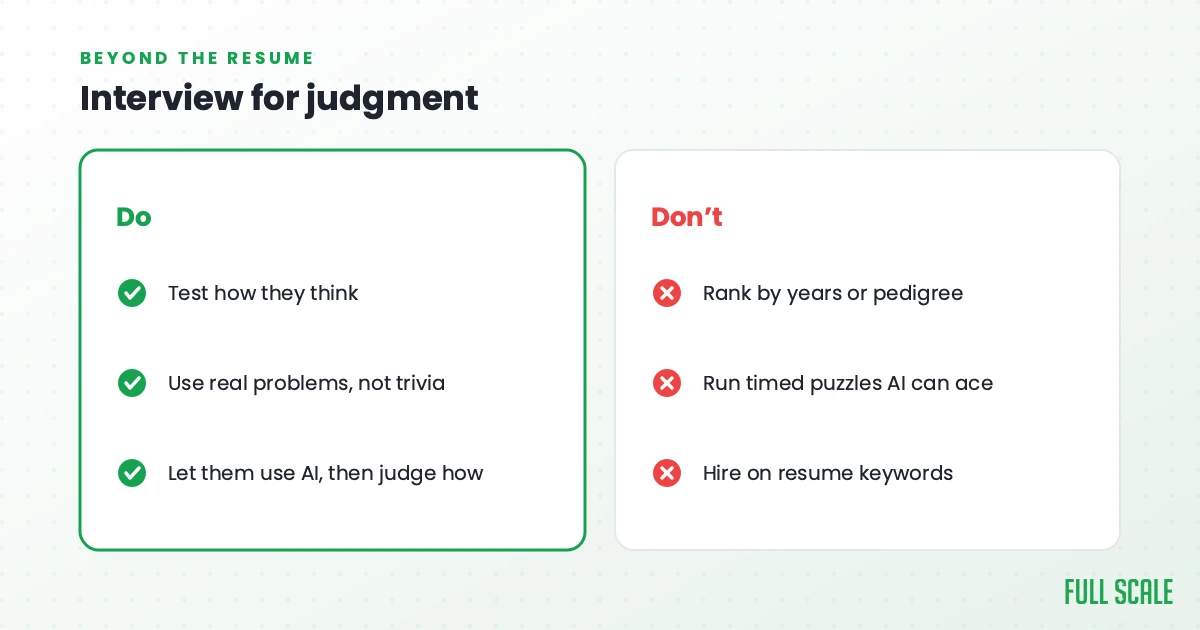
Screen software engineer resumes and portfolios for evidence of real work instead of buzzwords. Look at what they’ve actually built. Then keep the interview itself tight: a technical conversation, a look at how they solve a real problem, and a sense of how they communicate. You don’t need seven rounds.
One thing has changed in the last couple of years and you can’t ignore it. Coding tests aren’t what they used to be. Now that AI writes a large share of code, a take-home coding test mostly measures who’s best at prompting a model, not who can think. I’ve written separately about how to assess developers now that AI writes the code, but the short version is to watch how someone reasons through a problem in front of you, instead of grading code they produced alone at home.
What to look for beyond the resume: how they think
When I personally evaluate a candidate, I’m not really trying to confirm what they already know. I’m trying to learn how they think. How do they approach a problem they’ve never seen before? I want to know whether fuzzy requirements make them curious or make them freeze, whether they dig into how things actually work, and whether they have the courage to ask questions and say so when something doesn’t make sense.
Those qualities map onto something I write about in my book, Product Driven: communication, curiosity, and courage. As AI takes over more of the mechanical typing, those human skills are what separate an engineer who’s worth hiring from one who just produces code. Curiosity is the one I’d weight highest. On my podcast, Mohan Reddy, chief scientist at Cornerstone AI Labs, boiled his whole career down to two lines when I asked for his best advice: “Always be curious. Always be learning.” That’s exactly what I’m listening for in an interview. A curious engineer keeps adapting as the field shifts under them, and that’s the trait that ages best.
You can’t fully measure this with a test. You measure it by talking to someone and listening to the questions they ask you back.
Making the offer and onboarding
When you find the right person, move fast. The good ones don’t stay on the market long, and a slow, indecisive process is how you lose them to a company that decided quicker. Make a competitive offer that reflects the real market rate for the role and seniority you’re hiring.
Then take onboarding seriously. A strong hire who’s dropped into a codebase with no context and no support will look like a weak hire fast, and it won’t be their fault. Give them a clear first project, someone to ask questions, and enough room to ramp. The first few weeks set the tone for everything after.
Hiring software engineers in the AI era
A quick word on AI, because it’s changing what “good” looks like. According to the 2025 Stack Overflow Developer Survey, 84% of developers now use or plan to use AI tools, but trust in those tools’ output has fallen to 29%, down from 40% a year earlier. Developers are using AI more and trusting it less, because it’s often almost right but not quite.
That tells you exactly what to hire for. The engineer worth hiring is the one who can read AI-generated code, catch where it’s wrong, and push back on it. The skill that matters now is judgment, and that’s what you’re paying for.
AI is also reshaping which roles companies hire for, not just how candidates use the tools. Entry-level and junior openings have fallen since their 2022 peak, partly because AI now absorbs the routine work juniors used to learn on, while demand shifts toward engineers who can direct and review what the tools produce (IEEE Spectrum has tracked the hit to entry-level tech jobs). It’s the same lesson from the other side. Hire for judgment, because that’s the part the tools can’t do for you.
The bottom line
Hiring a software engineer works or fails on a decision most guides skip: where you look. Get the two questions right first, how long you need the person and whether they’re leading or executing, and the right path mostly falls out of the answers. Use a freelancer for the short, scoped job. Hire full-time or build an offshore team for the long-term work, depending on your budget and how much you want to manage yourself. Bring in a recruiter only for the senior leader you genuinely can’t reach another way. Then find people through referrals and references, interview for how they think, and move fast when you meet the right one. The mechanics matter, but the path matters more. If you want a long-term team without carrying the full US cost, staff augmentation is worth a look.
Frequently asked questions
What’s the best way to hire software engineers?
There isn’t one best way. It depends on whether the work is short-term or ongoing, and whether you need a leader or someone to execute. Short scoped projects suit a freelancer. Ongoing work suits a full-time hire or an offshore staff augmentation team. A rare hard-to-find local leader is the one case where a recruiter’s fee is worth paying.
How much does it cost to hire a software engineer?
In the US, the median software developer salary is about $133,000, and the loaded cost (benefits, taxes, overhead) runs 1.25 to 1.4 times that, so a senior hire can cost more than $200,000 a year all-in. Hiring comparable talent through an offshore partner typically costs 50 to 70% less, because the gap reflects local cost of living rather than any difference in skill.
How long does it take to hire a software engineer?
For a direct US hire, expect several weeks at minimum, and longer for senior roles. The good candidates aren’t on the market long, so a slow process costs you offers. An offshore staff augmentation partner can usually place a vetted engineer faster, because finding the people is their full-time job.
Should I hire a freelancer or a full-time developer?
Hire a freelancer for a short, well-defined project with a clear deliverable. Hire full-time (or through a long-term offshore team) when the work is ongoing and someone needs to build lasting knowledge of your product. Using a freelancer for ongoing product work is one of the most common and costly mistakes people make when hiring software developers.
How do startups attract strong engineers without a big budget?
Lean on referrals and your network rather than competing on salary alone. The best engineers come through warm introductions far more often than through job ads. And consider an offshore team, which lets a small company afford senior talent it couldn’t hire locally.
What should hiring managers consider when hiring software developers?
Start with two questions before any checklist: how long is the need, a short, well-defined project or ongoing work for months and years, and what kind of role it is, someone to lead and own architecture or someone to execute and ship features. Those two answers, plus whether you can manage the hire in-house or want a partner to handle it, narrow the field faster than any resume screen.
Once you are interviewing for a specific stack, see our AI-proof guides for Java, React, .NET, and Android developers.