
Offshore Developer Productivity vs. In-House: What 7 Studies Actually Show


In this article
- What offshore developer productivity actually depends on
- 1. Too many people slow everything down (Herbsleb & Mockus, 2003)
- 2. Nobody knows what anybody else is doing (Espinosa, Slaughter, Kraut & Herbsleb, 2007)
- 3. Process discipline beats geography (Ramasubbu et al.)
- 4. The playbook that made an offshore team faster than a local one (Sutherland & Schoonheim’s Xebia study)
- 5. What happens to a team with almost no overlap (2020 global software engineering coordination study)
- 6. Remote work has a productivity problem, and it isn’t about location (Stanford economist Nicholas Bloom’s research)
- 7. Small teams that own their work beat big teams that share it (Conway’s Law)
- Why this matters even more now that AI is in the mix
- What this means for how you structure a team
- FAQ
- Studies
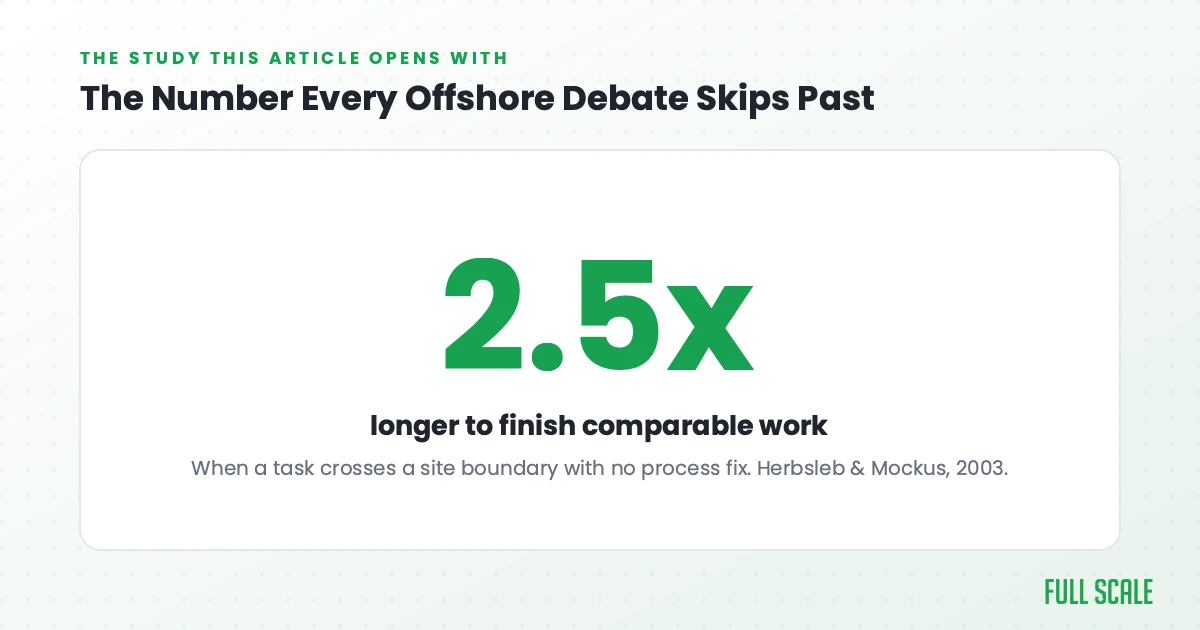
One study says distributed software teams take about 2.5 times longer to finish comparable work than a team sitting in one room. That’s not a made-up statistic. In 2003, researchers evaluated change-management records from a major telecommunications provider to calculate this ratio.
And crucially, the authors did not ascribe this difference to distance. The overhead was attributable to the addition of more people to a project as soon as it left a single team’s boundaries. This is generally supported by the bulk of research published on distributed and offshore software development. The key factor here is coordination overhead, which depends on process. It has nothing to do with whether you hire from the Philippines or from Boston.
As someone who runs an offshore staffing firm, I’d encourage you to read this with however much skepticism is necessary. But I didn’t design our approach and then go looking for papers to back it up. I studied the literature years ago. It’s a big reason we run small teams, work overlapping hours, and think of developers as coworkers rather than a resource. Here are seven studies that quantify this problem, what they found, and what we changed at Full Scale because of it.
What offshore developer productivity actually depends on
Not a single one of these seven studies says offshore development is worse. The consensus is that offshore only magnifies whatever the real problem already is, and the problem disappears once you fix what’s actually causing it. Team size, process, and overlapping working hours come up as the factors that affect performance, over and over. Distance almost never does.
1. Too many people slow everything down (Herbsleb & Mockus, 2003)
Herbsleb and Mockus analyzed actual change-management data from a large global telecommunications company. Their analysis showed that work items completed remotely took around 2.5 times longer to finish than comparable tasks handled by collocated employees. The gap wasn’t a function of physical distance. It was a function of headcount. Remote work items involved more people, and headcount was the strongest predictor of completion time by a wide margin over physical location. (Herbsleb & Mockus, IEEE Transactions on Software Engineering, 2003)
We experienced something similar with our own team. When we launched ProductWave, one of Full Scale Ventures’ own products, earlier this year, there were too many developers on the project. Having more people on the team didn’t mean more work got done. It meant we felt obligated to keep everyone busy, so we kept building things that didn’t matter instead of focusing on the few that did. I’ve said this before on the podcast:
“Most of what software teams ship doesn’t matter to customers. Not because engineers don’t care, because the connection to real outcomes got engineered out of the system. Motivation doesn’t die loudly, it fades. One ignored release at a time.”
Be smaller than you think you need to be, until you know what you’re making. Hire people only after you know what they’ll do. Until then, a pre-product-market-fit startup has nothing valuable to offer a large team.
2. Nobody knows what anybody else is doing (Espinosa, Slaughter, Kraut & Herbsleb, 2007)
Espinosa, Slaughter, Kraut, and Herbsleb tracked one distributed software team’s coordination over time, and the culprit they landed on wasn’t distance. It was a lack of “team knowledge,” where nobody had a clear picture of who was working on what, who was the expert on which part of the system, or who was responsible for a given task. That lack of awareness makes coordination harder no matter where the person happens to be sitting. (Espinosa, Slaughter, Kraut & Herbsleb, Journal of Management Information Systems, 2007)
That’s part of why we hold a daily meeting with every team. It’s a real conversation about what we’re building and why, which keeps the team focused on what matters. It’s also why focus and clarity are the thing I keep coming back to in my book, Product Driven: they’re what make distributed teams actually coordinate.
A better chat tool isn’t going to solve this. Solving it means making sure anyone on the team can tell you why they’re working on something without needing to look it up in Slack.
3. Process discipline beats geography (Ramasubbu et al.)
Ramasubbu and his colleagues analyzed actual outsourced work from two development centers of a single offshore vendor, one in the US and one in India. They found dispersion had the negative effect on productivity and quality you’d expect it to. But wherever the engineering process was mature, that effect went away. Disciplined process was what protected the output. Distance was close to irrelevant. (Ramasubbu et al., Management Science / MIS Quarterly)
This is the study I’d give to anyone who thinks offshore is inherently riskier. It isn’t. The risk is an immature process, which is just easier to hide when everyone’s in the same room.
Treat process as the product, not a bad habit you tolerate until launch day. The difference between a team that pays the dispersion penalty this study measured and one that doesn’t is fairly plain: thorough code review, a sprint cadence that survives the end of the project, and one shared backlog everyone actually pulls from. Which of those signals are worth measuring and which are noise is its own post.
4. The playbook that made an offshore team faster than a local one (Sutherland & Schoonheim’s Xebia study)
Sutherland and Schoonheim tell the story of one real project at Xebia, and it’s worth flagging: this is their own report on their own project, not an outside field study like the others on this list. A Dutch and Indian development team that was already clicking got split when the Indian half moved fully offshore, and nothing broke. Velocity held steady, sometimes better, and the defect rate landed at roughly a fifth of the industry average. They got there by holding onto the same Scrum and engineering standards they’d always practiced instead of lowering the bar because the team was now split across a continent. (Sutherland, Schoonheim & Rustenburg, “Fully Distributed Scrum: The Secret Sauce for Hyperproductive Offshored Development Teams,” IEEE)
Underneath a lot of “communication is key” blog posts is a simpler fact: the offshore half of the team was expected to do the exact same work, at the same bar, as the onsite half.
Full Scale doesn’t run a second, looser process for the offshore part of the team, whether an engineer sits remote or onsite, and it’s the same thing we recommend for anyone managing an offshore team: one backlog, one definition of done, one quality bar for everyone.
5. What happens to a team with almost no overlap (2020 global software engineering coordination study)
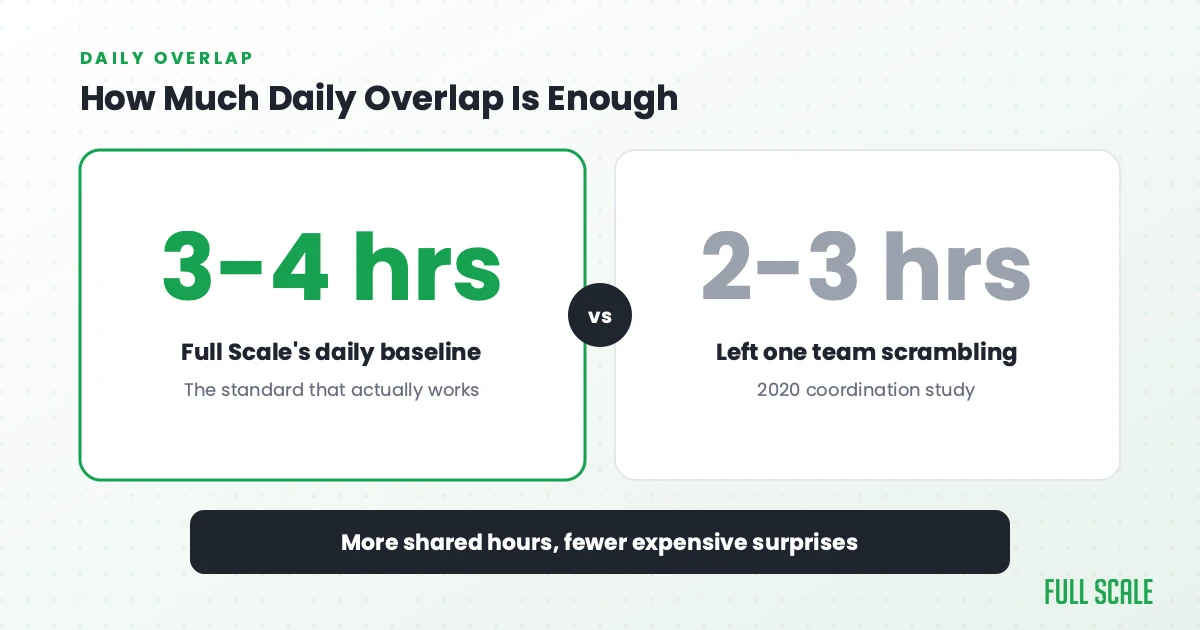
A 2020 mixed-methods study tracked teams at one company split across Norway, Poland, and China. The Norway-Poland team had zero time difference and coordinated well. The Norway-China team had the least overlap in the study, just two to three hours a day, and it showed: key people were often unavailable, meetings kept getting rescheduled, and remote testers eventually stopped asking for feedback at all, figuring the manager on the other end would be too busy anyway. One project in the same company had zero overlapping hours across China, Norway, and the US. Scheduling a joint meeting there wasn’t hard. It was impossible. (Coordination in global software engineering, 2020)
Full Scale staffs to a 3-4 hour daily overlap standard as the baseline, well above the two to three hours that left this study’s most disconnected team scrambling. Engineers can shift further into the US day when a role calls for it. “They’re 12 hours ahead, we’ll just hand off work overnight” sounds efficient. In practice, it’s closer to the zero-overlap case in this study than most people planning it would guess.
Treat overlap hours like a real staffing requirement, not a scheduling afterthought. Nobody on the struggling teams in this study was a bad manager. They just never had enough shared daylight to catch a problem while it was still cheap.
6. Remote work has a productivity problem, and it isn’t about location (Stanford economist Nicholas Bloom’s research)
In 2024, Stanford economist Nicholas Bloom ran a randomized controlled trial of more than 1,600 employees at Trip.com, one of the world’s largest online travel agencies. Those who worked remotely two days a week performed just as well as their fully office-based peers. They got promoted at the same rate, and they quit 33 percent less often. Bloom’s own explanation for why other fully-remote studies tend to come out negative isn’t that working outside an office is worse on its own. It’s that the people running those remote teams weren’t managing them well. (Bloom, published in Nature, covered by Stanford SIEPR, 2024)
This matters because it’s easy to confuse “remote” with “offshore” and blame the wrong factor. A poorly managed remote hire and a well-run offshore engineer don’t have much in common, even though plenty of vendor content writes about them as if they do. Structure explains the gap far better than distance does.
We’ve always called this the A task and the B task. Every developer gets a primary task and a backup task lined up. If they hit a blocker or a decision they’re waiting on, they move to the second task instead of sitting idle for someone in another time zone to wake up. You can’t monitor your way out of a lack of motivation. But you can make sure nobody ever has to sit around with nothing to do.
7. Small teams that own their work beat big teams that share it (Conway’s Law)
This is the only entry on the list that isn’t a data study, it’s a theory Melvin Conway proposed in a 1968 essay, later supported by studies comparing collocated and distributed teams: “organizations which design systems are constrained to produce designs which are copies of the communication structures of these organizations.” In plain terms, your system ends up looking like your organization. Teams that are tightly coupled and share responsibility for everything tend to produce messier systems. Teams organized around clear ownership of one piece tend to produce cleaner ones. (Conway, “How Do Committees Invent?”, 1968)
I’ll just say the quiet part out loud on this one: three or four people who fully own a piece of the system, and are actually trusted to run it, will outperform a bigger group where everyone’s a little bit responsible for everything. That’s the actual key to scaling past the early startup stage. Hire people good enough to own their piece, then get out of the way. It’s such a core part of how I think about engineering leadership that I wrote a whole book about it.
Draw a real boundary around what a small team owns. The alternative, spreading ownership so thin nobody’s actually responsible for anything, is how you end up with a team that’s busy and a system that’s a mess.
Why this matters even more now that AI is in the mix
None of these seven studies were run with AI coding assistants in the picture, and that’s worth addressing directly. AI is changing the economics of collaboration, not just typing speed. Everyone with a decent AI setup produces more code, faster. What’s left over is disproportionately the collaborative work: deciding what actually needs building, negotiating requirements, making judgment calls with the people who own the business outcome. AI just made teams need a lot more collaboration, and that’s pretty much the opposite of what most offshore vendors are built to provide.
The classic project-based offshore shop worked by design around that exact problem: a project manager took the client’s requirements and translated them into a spec, and the engineers delivered against it without ever having to talk to the client directly. That worked because it solved the problem it was built to solve. It’s breaking now because the work AI leaves behind is precisely the work that model was built to avoid.
The offshore teams doing well right now are the ones running real staff augmentation. Engineers are embedded directly on the team: same standups, same Slack channels as product and the client, no project manager standing between them and the decision-making. That’s not a coincidence. It’s the same thread running through every study on this list, just wearing a new hat.
What this means for how you structure a team
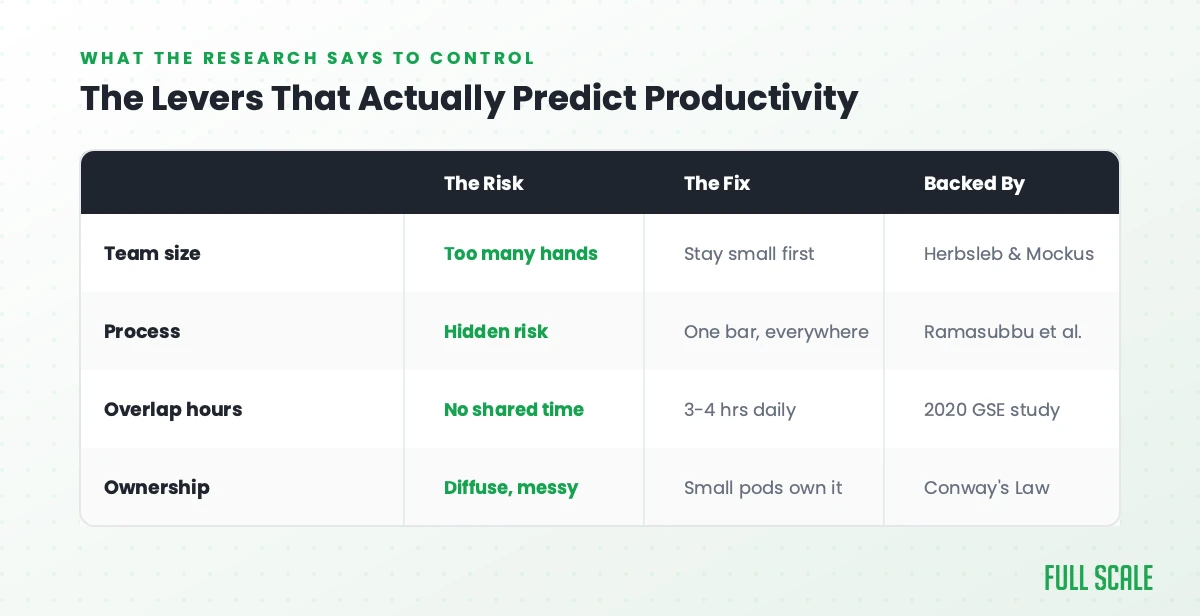
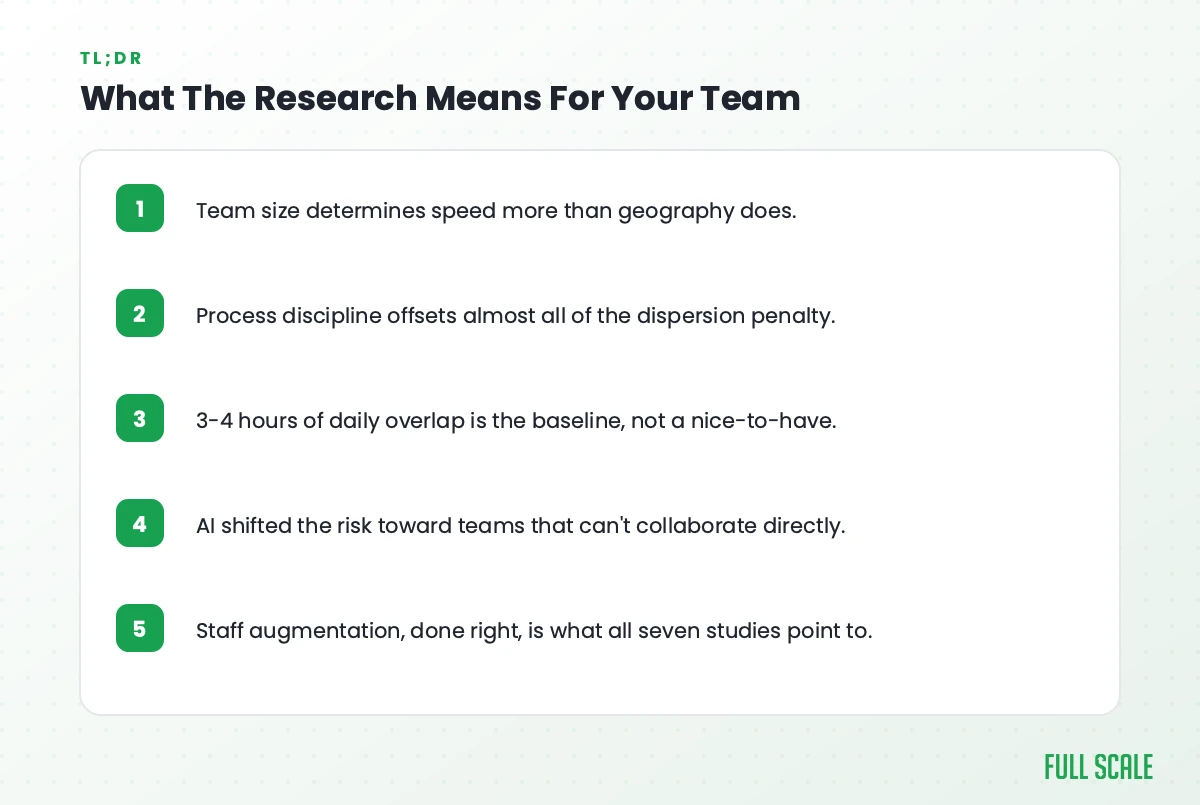
Line up all seven and a pattern falls out that has nothing to do with time zones. Every fix above is something a company controls directly: team size, process, overlap hours, ownership. None of it requires anyone to sit in the same building.
That’s basically a description of how staff augmentation is supposed to work when it’s done well. It’s a different animal from how outsourcing a project works. It’s different again from what I call cheapshoring: finding the cheapest developer you can and hoping none of these seven studies apply to you.
None of this turns offshore development into magic. It means offshore development can be as effective as the process you’re willing to run, no matter where your team sits, and there’s a real number to prove it: Xebia’s fully offshore team shipped at about a fifth of the industry-average defect rate while matching the velocity it had when everyone sat in the same room. That’s what good looks like on the other side of the 2.5x number this article opened with.
If you want to know whether your own team is already set up to work this way, schedule a call and we’ll walk through it with you.
FAQ
Is offshore development actually cheaper if it’s slower?
Only if you let it be slower. Ramasubbu’s field study, and the Xebia case study documented by Sutherland and Schoonheim, reach the same conclusion: a distributed team with a mature process, real daily overlap, and small dedicated pods doesn’t carry the productivity penalty an unmanaged one does. A company doesn’t have to trade cost savings against productivity. Both depend on how the team is actually run.
Isn’t offshore just cheaper because the talent is worse?
Depends how you’re hiring. Every study on this page is about coordination and process, not skill, because skill was never really the variable anyone was testing. Full Scale turns away more than 97 percent of the developers who apply. That’s a talent bar, not a clearance rack.
What does the research actually say about offshore developer productivity?
Seven academic studies on distributed and offshore software teams, including work by Herbsleb and Mockus, Ramasubbu and colleagues, and Stanford economist Nicholas Bloom, land on the same conclusion: coordination overhead, not distance, explains the productivity gap between distributed and collocated teams. Team size, shared team knowledge, process maturity, daily overlap, and clear ownership all measurably close that gap. Studies that controlled for those factors found offshore and distributed teams performing as well as, or better than, their fully collocated counterparts.
Studies
- Herbsleb & Mockus, “An Empirical Study of Speed and Communication in Globally Distributed Software Development,” IEEE Transactions on Software Engineering, 2003. Found distributed work items took about 2.5 times longer to complete than collocated ones, driven by headcount, not distance.
- Espinosa, Slaughter, Kraut & Herbsleb, “Team Knowledge and Coordination in Geographically Distributed Software Development,” Journal of Management Information Systems, 2007. Found that coordination breaks down when a distributed team lacks shared “team knowledge,” not because of distance itself.
- Ramasubbu et al., Management Science / MIS Quarterly. A field study of real outsourced projects across a US and an India development center, showing mature engineering process largely offsets the productivity hit from work dispersion.
- Sutherland, Schoonheim & Rustenburg, “Fully Distributed Scrum: The Secret Sauce for Hyperproductive Offshored Development Teams,” IEEE. Xebia’s own account of moving a Dutch-Indian team fully offshore without losing velocity or code quality.
- Coordination in global software engineering, 2020. A mixed-methods case study of teams split across Norway, Poland, and China, showing what happens to coordination as daily overlap shrinks toward zero.
- Bloom, published in Nature, covered by Stanford SIEPR, 2024. A randomized controlled trial of 1,600+ Trip.com employees finding hybrid work matched in-office productivity and cut turnover.
- Conway, “How Do Committees Invent?”, 1968. The original essay behind Conway’s Law: organizations build software that mirrors their own communication structure.