
What to Look for in a Technical Co-Founder

In this article
- The trait that actually matters is trust
- The skills matter, but not the way you’d think
- The trait nobody lists: whether they scale into a real executive
- How to actually vet a technical co-founder
- The part everyone skips: protect yourself
- When you don’t actually need a technical co-founder
- The bottom line
- Frequently asked questions
You have an idea for a software company. You can sell it, you understand the market, you know exactly who the customer is. The one thing you can’t do is build it. So you go looking for a technical co-founder, and every article you read hands you the same list: passionate, resourceful, a great communicator, a strong coder. A technical co-founder is not the only way to close that gap. A fractional CTO gets you the same judgment without giving up equity.
Every trait on that list is real. But the list leaves out the thing that actually decides whether this partnership works.
I’ve been the technical co-founder of more than one company. I co-founded VinSolutions, ran the technology side, and we bootstrapped it to $35 million in annual revenue before selling for around $150 million. I founded Stackify and built the engineering team that helped get us to an exit. At Full Scale, I’m the technical co-founder alongside Matt DeCoursey. And I’ve had partner problems nearly kill a company more than once. So when a founder asks me what to look for in a technical co-founder, I don’t start with the skills checklist.
I start with one question: do you trust this person to own the technology, completely, without you looking over their shoulder?
The trait that actually matters is trust
Here’s what my co-founders needed from me. Somebody they could trust to take care of the technology part of the business. That’s the whole thing.
When I talk to founders who are struggling, the technology is almost always their biggest source of stress. They hired an engineering leader, or they brought on a technical co-founder, and the product still isn’t getting to market. They ask me what they should do. My answer is always the same question back at them:
Do you still trust this person to be the engineering leader you need?
If the answer is no, that’s your signal. That’s when it’s time to make a big change. This is true of any leadership role, but it hits hardest with a co-founder, because you handed them a piece of the company on the way in.
VinSolutions worked because of trust, not because we were the smartest people in the room. I trusted my business partner to run sales, and I stayed out of his way. He trusted me to run the technology, and he stayed out of mine. I put my head down and innovated. Nobody was second-guessing the other person’s half of the business. That division of trust is the engine. When it’s there, you move fast. When it’s not, every decision turns into a negotiation.
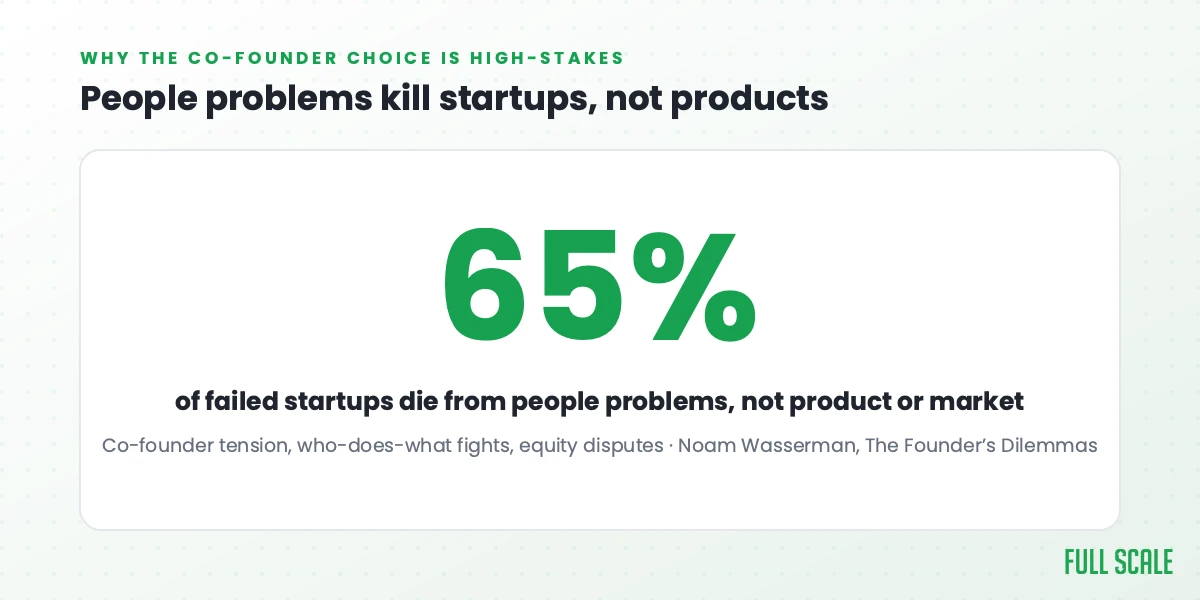
The research backs this up in a blunt way. Harvard Business School professor Noam Wasserman studied thousands of founders for The Founder’s Dilemmas and found that 65% of failed startups die from “people problems,” not from product or market failure. Co-founder tension. Disagreements over who does what. Fights about equity. The relationship is more likely to kill the company than the code is.
So before you evaluate anyone’s GitHub, ask whether this is a person you’d trust with half your company and no daily oversight.
The skills matter, but not the way you’d think
Trust is the foundation. It sits on top of real ability. A few things are genuine table stakes, and you shouldn’t hand-wave them.
They can build the right thing. Plenty of strong engineers can build whatever you put in front of them. That’s not the same as knowing what to build. I’ve said for years that builders often make bad entrepreneurs, because they fall in love with building and forget the business only survives if someone sells what gets built. Your technical co-founder has to care about the customer and the product as much as the architecture.
They own the product vision. This is the one thing you can never outsource. You can hire a company to write code. You cannot hire someone to care about your product the way a founder does. The technical co-founder worth having is the one who gets the product, drives it, and has an innovative mind for where it should go next. That ownership is the spine of how I’ve built every company, and it’s the core of my book, Product Driven. A great technical co-founder doesn’t wait for a spec. They have opinions about the product, and they’re usually right.
They communicate and stay in their lane. The technical and business halves of a startup are constantly making decisions that affect each other. Your co-founder needs to explain technical tradeoffs in terms you can actually use, and they need to trust your half enough to leave it alone. The lane discipline matters as much as the talking. (If you’re still sorting out who owns what between the founders, our breakdown of the CEO and CTO split is a good starting point.)
Notice that none of these are about raw coding speed. The best technical co-founders are leaders who happen to be excellent engineers, not engineers you’ve slapped a title on.
The trait nobody lists: whether they scale into a real executive
Here’s the one almost no one mentions, and it’s the one I’d watch most carefully: can this person scale into a real founder-level executive?
The worst move I see first-time founders make is finding a junior developer somewhere who’s willing to work for cheap or for free, and handing them the CTO title. Sometimes it works out. People get lucky. But far more often, you end up with someone who can ship an early version and then can’t grow into the job. They can’t hire a team. They can’t set technical strategy. They can’t be in the room with investors. And now they have a title and a slice of equity that says they’re your head of engineering forever.
This is the in-house version of what I call cheapshoring: hiring on price instead of on fit, and paying for it later. A co-founder isn’t a contractor you can swap out. You’re betting that the person who can build version one is the same person who can lead engineering when you have 30 people and real customers. Most cheap-and-hungry hires aren’t that person.
Don’t pick someone because they’re available and willing to work for equity. Pick the person you’d still want running engineering three years from now.
How to actually vet a technical co-founder
Every article tells you what traits to look for. Almost none tell you how to confirm someone has them. You can’t read trust off a resume, and a two-hour coffee meeting won’t show it to you either.
My honest answer: your best bet is to work with someone you already know. Someone you’ve worked alongside, or watched operate, or who comes with a very strong recommendation from a person you trust. Trust is built over time, and the fastest way to “know” you can trust a co-founder is to import that knowledge from a relationship that already exists.
That’s not the romantic version. The romantic version is meeting a brilliant stranger at a hackathon and changing the world together. It happens. It’s also how a lot of founders end up locked into a partnership with someone they fundamentally didn’t know. So rank your search the way you’d rank trust: people you’ve actually worked with first, then someone a person you trust will vouch for hard, and a promising stranger a distant third, and only after a real trial.
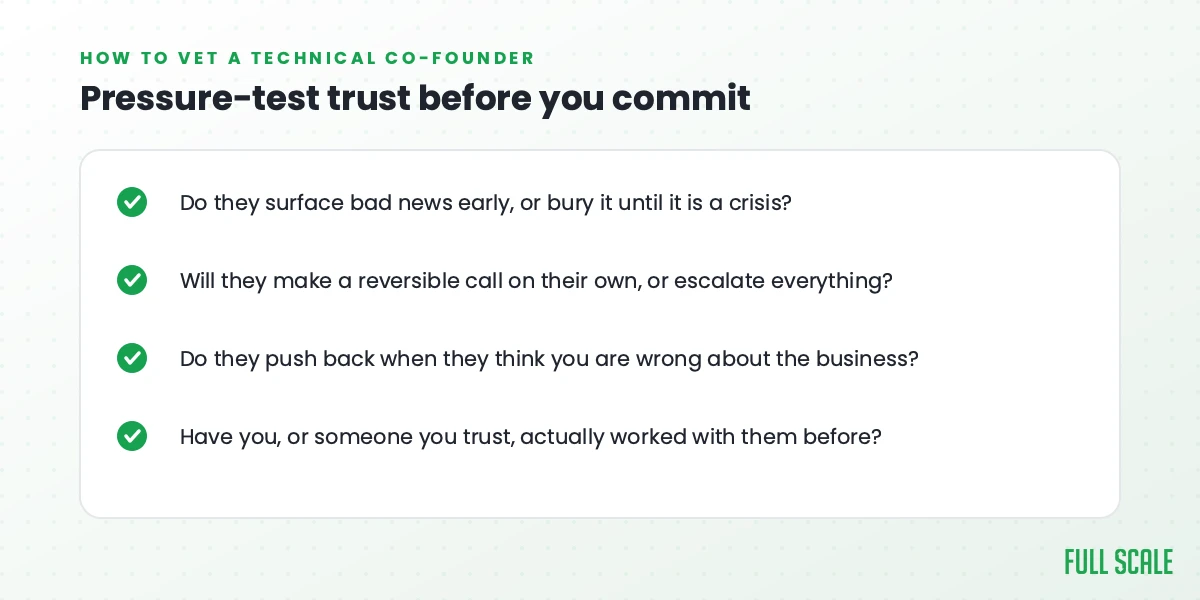
If you can’t start from an existing relationship, work together before you commit. Run a paid trial project or a contract phase with a real deliverable, and watch for the things a resume can’t show you. Do they surface bad news early, or bury it until it’s a crisis? Do they make a reversible call on their own, or push every decision back to you? Do they tell you when they think you’re wrong about the business? Those are the signals that tell you whether you’d trust this person with the company, not whether they can code.
The part everyone skips: protect yourself
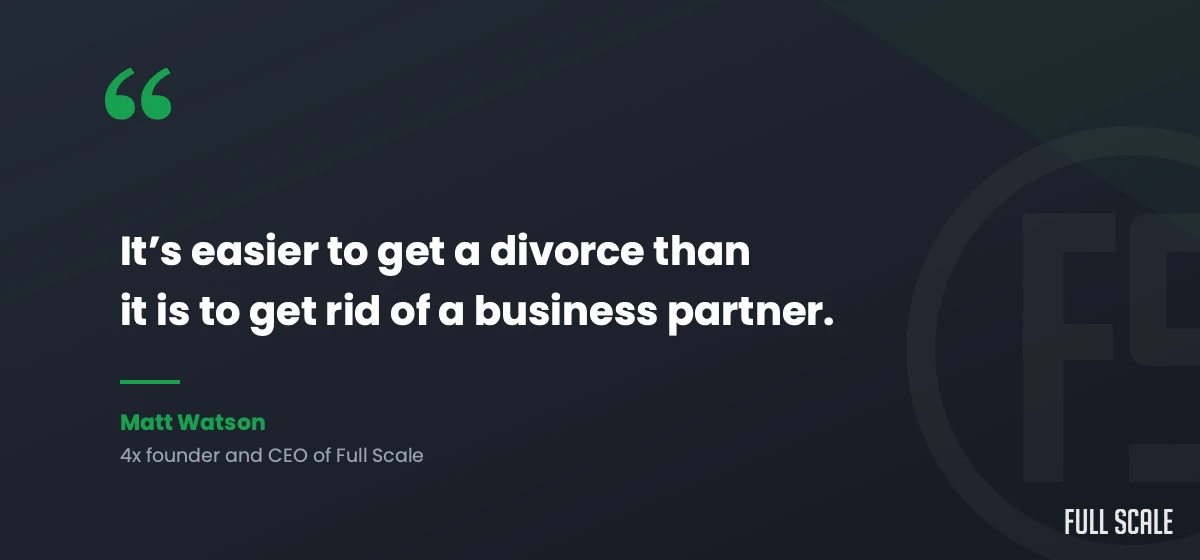
A co-founder relationship is hard to start and brutal to end. I tell people this directly: it’s easier to get a divorce than it is to get rid of a business partner. You usually can’t just buy them out and make them go away. The equity is theirs. The title is theirs. If the relationship sours and they’re holding 40 or 50% of the company, you have a problem that no amount of being right will solve quickly.
So build the protection in at the start, while everyone still likes each other.
- Vest the equity. Nobody should get their full stake on day one. A standard four-year vest with a one-year cliff means a co-founder who leaves in month eight walks away with nothing, and one who leaves in year two takes only what they earned. This protects the company and it protects the co-founders who stay.
- Use performance expectations. Tie equity or continued vesting to the person actually doing the job. If they check out, the cap table shouldn’t keep rewarding them.
- Be deliberate about how much you give away. Y Combinator’s advice is to split equity roughly equally with a real co-founder, because most of the hard work is still ahead of you. That holds when both of you are genuinely carrying half. Just don’t rush to a 50/50 split to dodge an awkward conversation, because that avoidance is its own warning sign. Let vesting do the truing-up. Equity is the most expensive and most permanent currency you have, so spend it on someone who’s truly carrying half the company. If you could have just hired the person, hire them.
Putting this protection in place is what lets both of you move forward with trust, because you each know the structure stays fair if things change.
When you don’t actually need a technical co-founder
You may not need a technical co-founder at all, and most articles won’t tell you that, because they are written to convince you that you must find one.
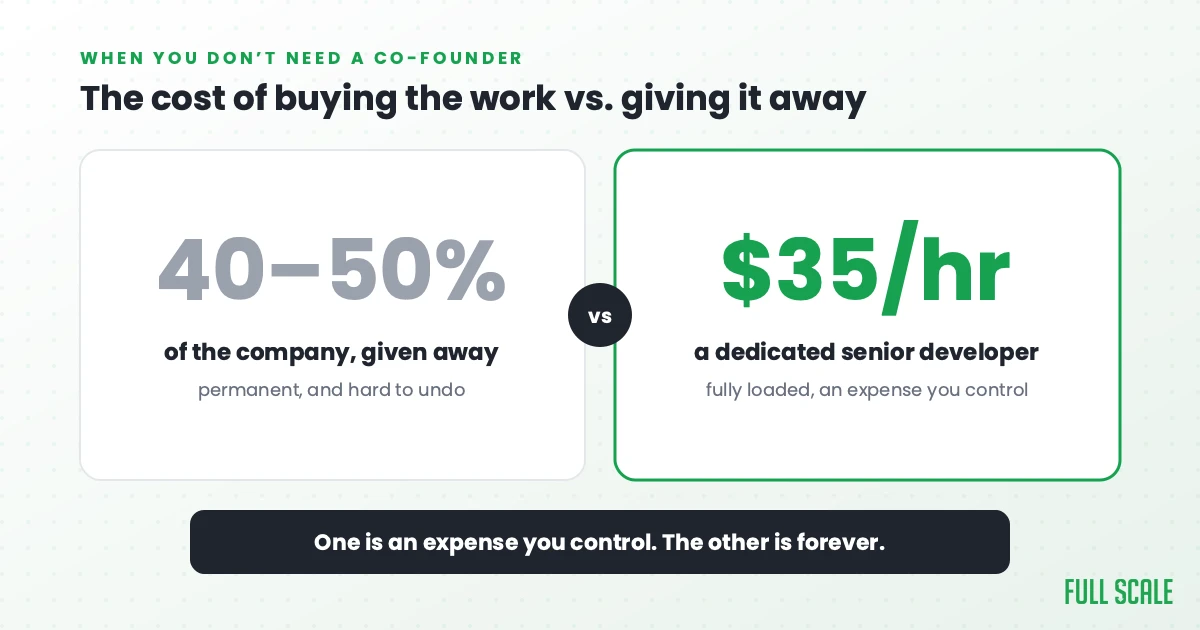
You don’t have to have a technical co-founder. You can hire a company like Full Scale to build your product for you, and we’ve done exactly that for founders many times. A dedicated engineering team through staff augmentation gets you the building capacity without giving away a permanent slice of the company. At roughly $35 an hour fully loaded for an experienced developer, the math against handing over 40 to 50% of your company to get the work done is not close. One is an expense you control. The other is forever. That comparison is about the building, though, not the leadership. You still need someone who owns the product vision, and that is a different question.
But here’s the honest line I always add. You can outsource the building. You should never outsource the vision.
Hire a team to write the code. Keep a strong engineering leader who owns the product direction in-house, at the founder level, with real instincts for where the product goes. That person is irreplaceable, and no vendor can be that for you. The clean split is this: the how of building can be bought; the what and the why stay with the founders. If you genuinely have not settled the what yet, that is a different hire than a technical co-founder or a staff augmentation team. See staff augmentation vs. consulting for when a consultant, not a co-founder, is the right move.
For some companies, that in-house leader is a co-founder. For others, it’s a first senior engineering hire who grows into the role, while a dedicated team handles the volume of work. Both can work. What doesn’t work is assuming you need to give away half the company to a stranger just because you can’t write code yourself.
There’s even data on when that technical seat matters most. First Round Capital looked back at ten years and around 300 startups and found teams with more than one founder beat solo founders by 163%. The wrinkle worth knowing: enterprise startups with a technical co-founder did dramatically better, while consumer startups with one underperformed teams that had none. It’s their own portfolio, not a law of nature, but it matches what I’ve seen. If the hard part of your company is the technology, a technical co-founder earns the equity. If the hard part is distribution, you may need a strong marketer more than someone who codes.
I think this matters enough that I hosted a whole podcast episode on it, “Technical Co-Founders are Startup Gold,” on Startup Hustle. A great one really is gold. But “great” is rare, and a mediocre one tied to your cap table is expensive.
The bottom line
The trait checklist isn’t useless. Skills, communication, and product sense all matter. But they sit on top of the one thing that decides the outcome: do you trust this person to own the technology completely?
Start from someone you know or someone strongly vouched for. Confirm it with real work before you commit. Protect the company with vesting and clear expectations. And be honest about whether you need a co-founder at all, or whether you need a team to build while you keep the vision in-house.
If you’re weighing that decision right now, we can help you think it through, and if a dedicated team is the right move, we can staff it. Talk to us about what you’re building.
Frequently asked questions
What does a technical co-founder actually do?
A technical co-founder owns the technology side of the business. That means setting the technical direction, building or leading the build of the product, hiring and leading the engineering team as it grows, and being an equal partner in company decisions. The key word is own. They’re accountable for technology the way a CEO is accountable for the business. The job isn’t executing tasks someone else defines.
How much equity should a technical co-founder get?
For a true co-founder who’s carrying half the company, the common advice (including from Y Combinator) is to split equity roughly equally, because most of the work is still ahead of you. In practice a genuine technical co-founder who joins at the start usually lands somewhere between a third and an equal share. Whatever you land on, vest it over four years with a one-year cliff so the equity gets earned over time instead of granted on day one. If the person is really a first hire rather than a co-founder, a low-single-digit equity grant plus a salary usually makes more sense than co-founder-level ownership.
Do I need a technical co-founder to start a software company?
No. You need someone who owns the product vision, and you need the product built, but those don’t have to be the same permanent equity stake. You can hire a dedicated development team to build the product and keep the technical leadership in-house. Many founders go this route to avoid giving away a large, irreversible share of the company before they know whether the partnership would even work.
Where do I find a technical co-founder?
The best source is someone you already know or someone with a strong recommendation from a person you trust, because trust is the trait that matters most and it’s hard to assess in a stranger. Beyond your own network, founder communities, accelerators, and technical meetups are common places to meet candidates. Wherever you find them, work together on something real before you commit equity.
What are the red flags in a technical co-founder?
The biggest one is choosing someone because they’re cheap and available rather than because they can grow into a founder-level leader. A junior developer with a CTO title often can’t scale with the company. Other red flags: they can build but show no interest in the customer or the product, they don’t communicate technical decisions clearly, and you can’t point to a concrete reason you trust them beyond a good first impression.